ignition CADILLAC SRX 2009 1.G Owner's Manual
[x] Cancel search | Manufacturer: CADILLAC, Model Year: 2009, Model line: SRX, Model: CADILLAC SRX 2009 1.GPages: 442, PDF Size: 2.42 MB
Page 136 of 442
Sunroof
Sunroof (Ultra View)
{CAUTION:
People who are in a crash and not wearing a
safety belt properly can suffer much worse injuries.
They can hit things inside the vehicle or be ejected
from it, and be seriously injured or killed. This is true
for any vehicle occupant, in any motor vehicle. In a
rollover or other crash, the Ultra View
®roof can be
damaged or destroyed. People who are unbelted
would be at risk of being ejected from the vehicle.
Always fasten your safety belt, and check that your
passengers’ belts are fastened properly too.Your vehicle may have an Ultra View
®sunroof over
the rst two rows of seats. The ignition must be turned
to ON/RUN, ACC/ACCESSORY, or the Retained
Accessory Power (RAP) must be active to operate it.
SeeRetained Accessory Power (RAP) on page 2-24.
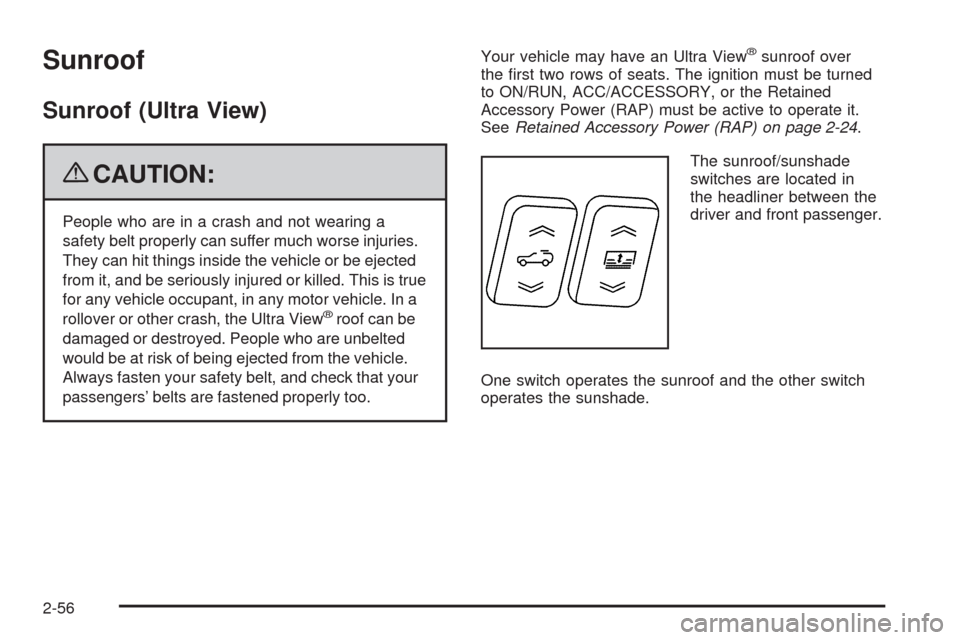
The sunroof/sunshade
switches are located in
the headliner between the
driver and front passenger.
One switch operates the sunroof and the other switch
operates the sunshade.
2-56
Page 153 of 442
Using Cruise Control on Hills
How well your cruise control will work on hills depends
upon your speed, load, and the steepness of the hills.
When going up steep hills, you might have to step
on the accelerator pedal to maintain the vehicle speed.
When going downhill, you might have to brake or
shift to a lower gear to keep the vehicle speed down.
If the brake is applied the cruise control is disengage.
Ending Cruise Control
There are three ways to end cruise control:
Step lightly on the brake pedal.
Press the[button on the steering wheel.
Press theTbutton on the steering wheel.
Erasing Speed Memory
The cruise control set speed memory is erased,
when the cruise control or the ignition is turned off.
Headlamps
The exterior lamp control is located in the middle of the
turn signal/multifunction lever.
O(Exterior Lamp Control):Turn the control with this
symbol on it to operate the exterior lamps.
The exterior lamp control has four positions:
O(Off):Turns off all lamps, except the Daytime
Running Lamps (DRL).
AUTO (Automatic):Turns the exterior lamps on and
off automatically depending upon how much light is
available outside of the vehicle.
;(Parking Lamps):Turns on the parking lamps
together with the following:
Sidemarker Lamps
Taillamps
License Plate Lamps
Instrument Panel Lights
5(Headlamps):Turns on the headlamps, together
with the previously listed lamps and lights.
3-15
Page 154 of 442
Wiper Activated Headlamps
This feature activates the headlamps and parking lamps
after the windshield wipers have been in use for about
six seconds. For this feature to work, the exterior
lamp control must be in AUTO.
The wiper-activated headlamps immediately turn off,
when the ignition is turned to LOCK/OFF or the
windshield wiper control is turned off.
Headlamps on Reminder
A warning chime will sound if the exterior lamp control
is left on in either the headlamp or parking lamp position
and the driver’s door is opened with the ignition off.
SeeLights On Reminder on page 3-43for additional
information.
Daytime Running Lamps (DRL)
Daytime Running Lamps (DRL) can make it easier for
others to see the front of your vehicle during the
day. Fully functional daytime running lamps are required
on all vehicles rst sold in Canada.The DRL system will make the turn signal lamps come
on when the following conditions are met:
It is daylight and the ignition is in the ON/RUN
position.
The exterior lamp control is in the off or AUTO
position and the headlamps are off.
The automatic transmission is not in P (Park).
When DRL are on, only the front turn signal lamps will be
on. The other exterior lamps and the instrument panel
cluster will not be on.
When the exterior lamp control is in AUTO and it is dark
enough outside, the DRL will turn off and the low-beam
headlamps will turn on. When it is bright enough
outside, the low-beam headlamps will go off, and the
DRL will turn back on. If the vehicle is started in a dark
garage, the automatic headlamp system comes on
immediately. Once the vehicle leaves the garage,
it takes about one minute for the automatic headlamp
system to change to DRL if it is light outside. During that
delay, the instrument panel cluster may not be as
bright as usual. Make sure the instrument panel
brightness lever is in the full bright position.
SeeInstrument Panel Brightness on page 3-18.
3-16
Page 155 of 442
To drive the vehicle with the DRL off, turn the exterior
lamp control off. Then turn on the fog lamps or
parking lamps, and the DRL will turn off. This works
regardless of gear position and whether or not the
parking brake is set.
The regular headlamp system should be turned on when
needed.
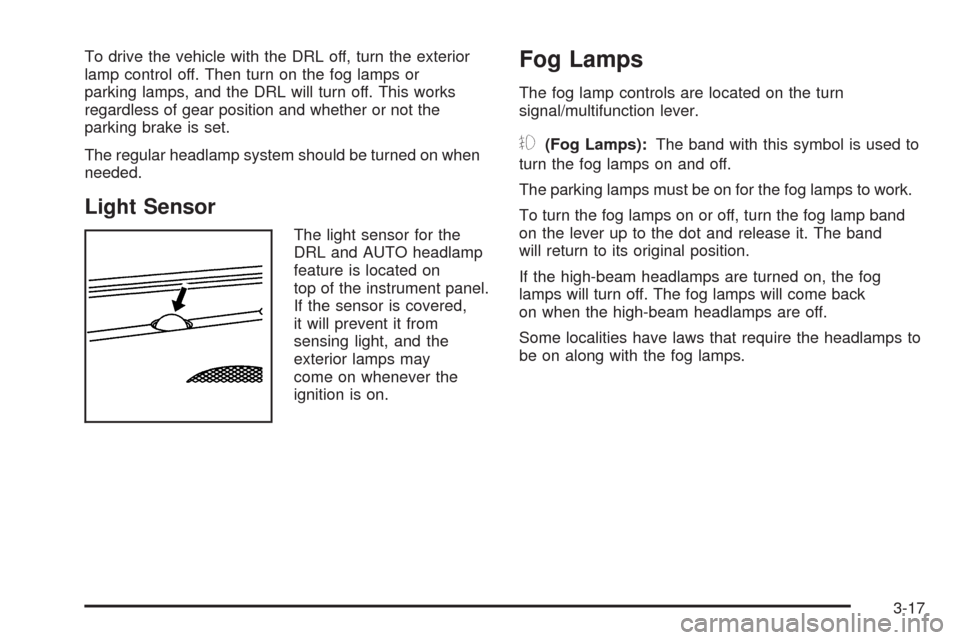
Light Sensor
The light sensor for the
DRL and AUTO headlamp
feature is located on
top of the instrument panel.
If the sensor is covered,
it will prevent it from
sensing light, and the
exterior lamps may
come on whenever the
ignition is on.
Fog Lamps
The fog lamp controls are located on the turn
signal/multifunction lever.
#(Fog Lamps):The band with this symbol is used to
turn the fog lamps on and off.
The parking lamps must be on for the fog lamps to work.
To turn the fog lamps on or off, turn the fog lamp band
on the lever up to the dot and release it. The band
will return to its original position.
If the high-beam headlamps are turned on, the fog
lamps will turn off. The fog lamps will come back
on when the high-beam headlamps are off.
Some localities have laws that require the headlamps to
be on along with the fog lamps.
3-17
Page 156 of 442
Exterior Lighting Battery Saver
The exterior lamps turn off about 10 minutes after the
ignition is turned to LOCK/OFF, if the parking lamps
or headlamps have been left on. This protects against
draining the battery. The battery saver does not
work if the headlamps are turned on after the ignition is
turned to LOCK/OFF.
To keep the lamps on for more than 10 minutes, turn
the lamps back on with the exterior lamp control.
Instrument Panel Brightness
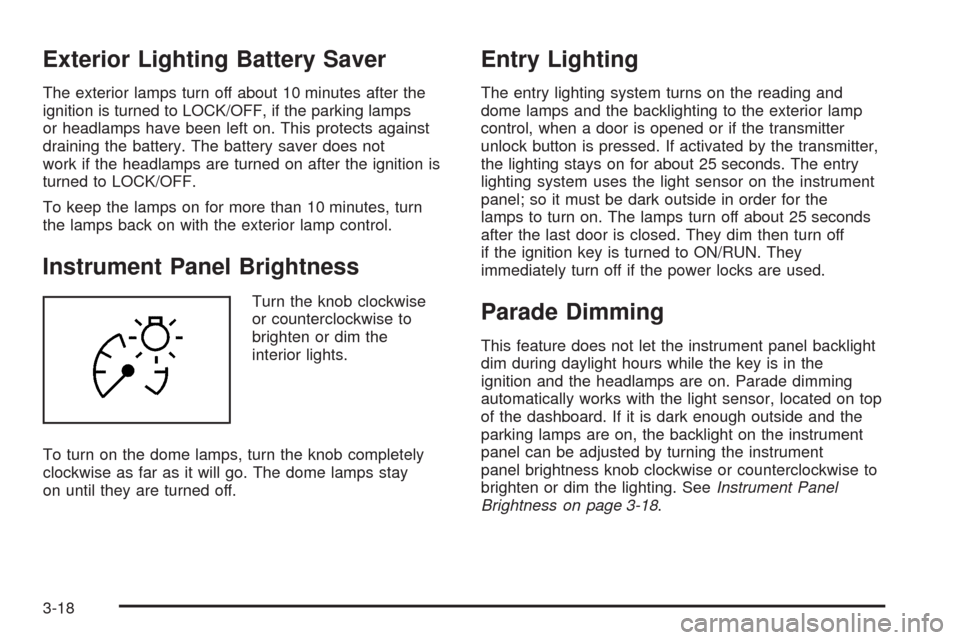
Turn the knob clockwise
or counterclockwise to
brighten or dim the
interior lights.
To turn on the dome lamps, turn the knob completely
clockwise as far as it will go. The dome lamps stay
on until they are turned off.
Entry Lighting
The entry lighting system turns on the reading and
dome lamps and the backlighting to the exterior lamp
control, when a door is opened or if the transmitter
unlock button is pressed. If activated by the transmitter,
the lighting stays on for about 25 seconds. The entry
lighting system uses the light sensor on the instrument
panel; so it must be dark outside in order for the
lamps to turn on. The lamps turn off about 25 seconds
after the last door is closed. They dim then turn off
if the ignition key is turned to ON/RUN. They
immediately turn off if the power locks are used.
Parade Dimming
This feature does not let the instrument panel backlight
dim during daylight hours while the key is in the
ignition and the headlamps are on. Parade dimming
automatically works with the light sensor, located on top
of the dashboard. If it is dark enough outside and the
parking lamps are on, the backlight on the instrument
panel can be adjusted by turning the instrument
panel brightness knob clockwise or counterclockwise to
brighten or dim the lighting. SeeInstrument Panel
Brightness on page 3-18.
3-18
Page 157 of 442
Reading Lamps
The reading lamps are located on the overhead console.
These lamps come on automatically when any door is
opened.
For manual operation, press the button next to each
lamp to turn it on or off.
If the reading lamps are left on, they automatically shut
off 10 minutes after the ignition has been turned off.
Electric Power Management
The vehicle has Electric Power Management (EPM) that
estimates the battery’s temperature and state of
charge. It then adjusts the voltage for best performance
and extended life of the battery.
When the battery’s state of charge is low, the voltage is
raised slightly to quickly bring the charge back up.
When the state of charge is high, the voltage is lowered
slightly to prevent overcharging. If the vehicle has a
voltmeter gage or a voltage display on the Driver
Information Center (DIC), you may see the voltage move
up or down. This is normal. If there is a problem, an
alert will be displayed.The battery can be discharged at idle if the electrical
loads are very high. This is true for all vehicles. This is
because the generator (alternator) may not be spinning
fast enough at idle to produce all the power that is
needed for very high electrical loads.
A high electrical load occurs when several of the
following are on: headlamps, high beams, fog lamps,
rear window defogger, climate control fan at high speed,
heated seats, engine cooling fans, trailer loads, and
loads plugged into accessory power outlets.
EPM works to prevent excessive discharge of the
battery. It does this by balancing the generator’s output
and the vehicle’s electrical needs. It can increase
engine idle speed to generate more power, whenever
needed. It can temporarily reduce the power demands of
some accessories.
Normally, these actions occur in steps or levels, without
being noticeable. In rare cases at the highest levels of
corrective action, this action may be noticeable to the
driver. If so, a Driver Information Center (DIC) message
might be displayed, such as BATTERY SAVER ACTIVE,
BATTERY VOLTAGE LOW, or LOW BATTERY. If this
message is displayed, it is recommended that the driver
reduce the electrical loads as much as possible. SeeDIC
Warnings and Messages on page 3-51.
3-19
Page 173 of 442
If, after several seconds, both status indicator lights
remain on, or if there are no lights at all, there may be
a problem with the lights or the passenger sensing
system. See your dealer/retailer for service.
{CAUTION:
If the airbag readiness light in the instrument panel
cluster ever comes on and stays on, it means that
something may be wrong with the airbag system.
If this ever happens, have the vehicle serviced
promptly, because an adult-size person sitting in
the right front passenger’s seat may not have the
protection of the airbag(s). SeeAirbag Readiness
Light on page 3-32for more on this, including
important safety information.
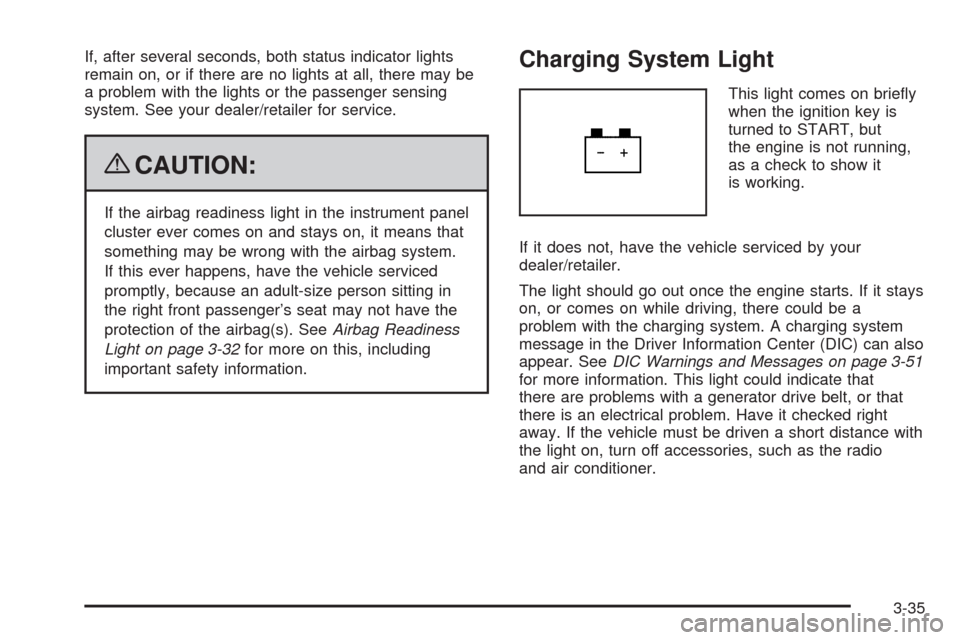
Charging System Light
This light comes on briey
when the ignition key is
turned to START, but
the engine is not running,
as a check to show it
is working.
If it does not, have the vehicle serviced by your
dealer/retailer.
The light should go out once the engine starts. If it stays
on, or comes on while driving, there could be a
problem with the charging system. A charging system
message in the Driver Information Center (DIC) can also
appear. SeeDIC Warnings and Messages on page 3-51
for more information. This light could indicate that
there are problems with a generator drive belt, or that
there is an electrical problem. Have it checked right
away. If the vehicle must be driven a short distance with
the light on, turn off accessories, such as the radio
and air conditioner.
3-35
Page 174 of 442
Brake System Warning Light
Your vehicle’s hydraulic brake system is divided into
two parts. If one part is not working, the other part can
still work and stop you. For good braking, though,
you need both parts working well.
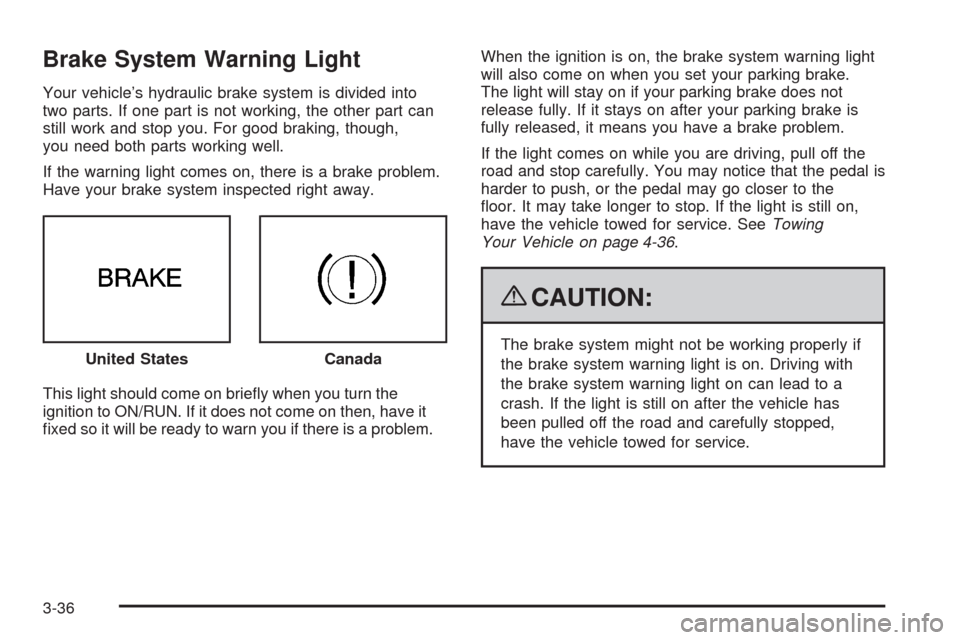
If the warning light comes on, there is a brake problem.
Have your brake system inspected right away.
This light should come on briey when you turn the
ignition to ON/RUN. If it does not come on then, have it
xed so it will be ready to warn you if there is a problem.When the ignition is on, the brake system warning light
will also come on when you set your parking brake.
The light will stay on if your parking brake does not
release fully. If it stays on after your parking brake is
fully released, it means you have a brake problem.
If the light comes on while you are driving, pull off the
road and stop carefully. You may notice that the pedal is
harder to push, or the pedal may go closer to the
oor. It may take longer to stop. If the light is still on,
have the vehicle towed for service. SeeTowing
Your Vehicle on page 4-36.
{CAUTION:
The brake system might not be working properly if
the brake system warning light is on. Driving with
the brake system warning light on can lead to a
crash. If the light is still on after the vehicle has
been pulled off the road and carefully stopped,
have the vehicle towed for service. United StatesCanada
3-36
Page 175 of 442
Antilock Brake System (ABS)
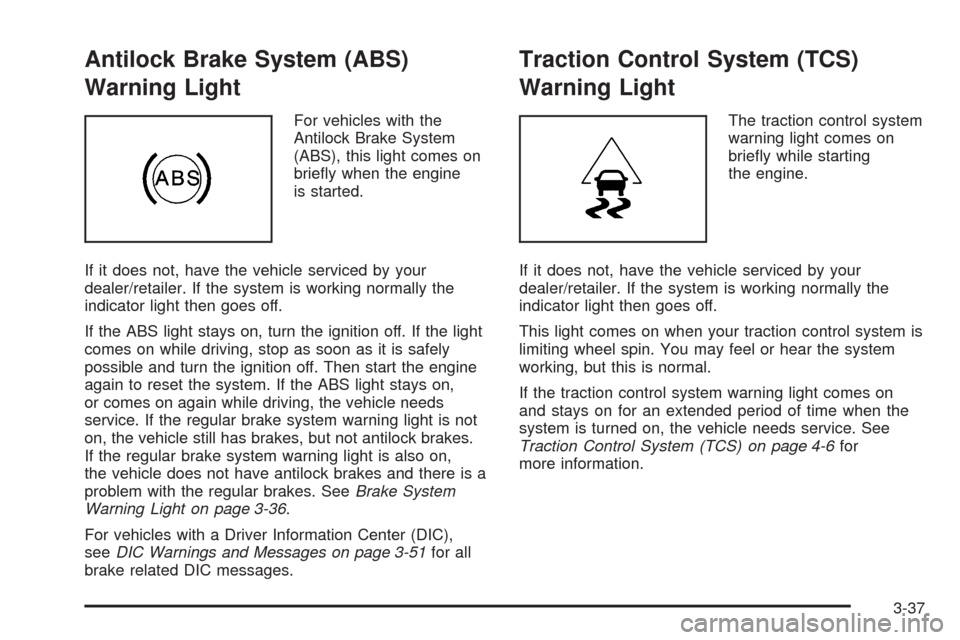
Warning Light
For vehicles with the
Antilock Brake System
(ABS), this light comes on
briey when the engine
is started.
If it does not, have the vehicle serviced by your
dealer/retailer. If the system is working normally the
indicator light then goes off.
If the ABS light stays on, turn the ignition off. If the light
comes on while driving, stop as soon as it is safely
possible and turn the ignition off. Then start the engine
again to reset the system. If the ABS light stays on,
or comes on again while driving, the vehicle needs
service. If the regular brake system warning light is not
on, the vehicle still has brakes, but not antilock brakes.
If the regular brake system warning light is also on,
the vehicle does not have antilock brakes and there is a
problem with the regular brakes. SeeBrake System
Warning Light on page 3-36.
For vehicles with a Driver Information Center (DIC),
seeDIC Warnings and Messages on page 3-51for all
brake related DIC messages.
Traction Control System (TCS)
Warning Light
The traction control system
warning light comes on
briey while starting
the engine.
If it does not, have the vehicle serviced by your
dealer/retailer. If the system is working normally the
indicator light then goes off.
This light comes on when your traction control system is
limiting wheel spin. You may feel or hear the system
working, but this is normal.
If the traction control system warning light comes on
and stays on for an extended period of time when the
system is turned on, the vehicle needs service. See
Traction Control System (TCS) on page 4-6for
more information.
3-37
Page 177 of 442
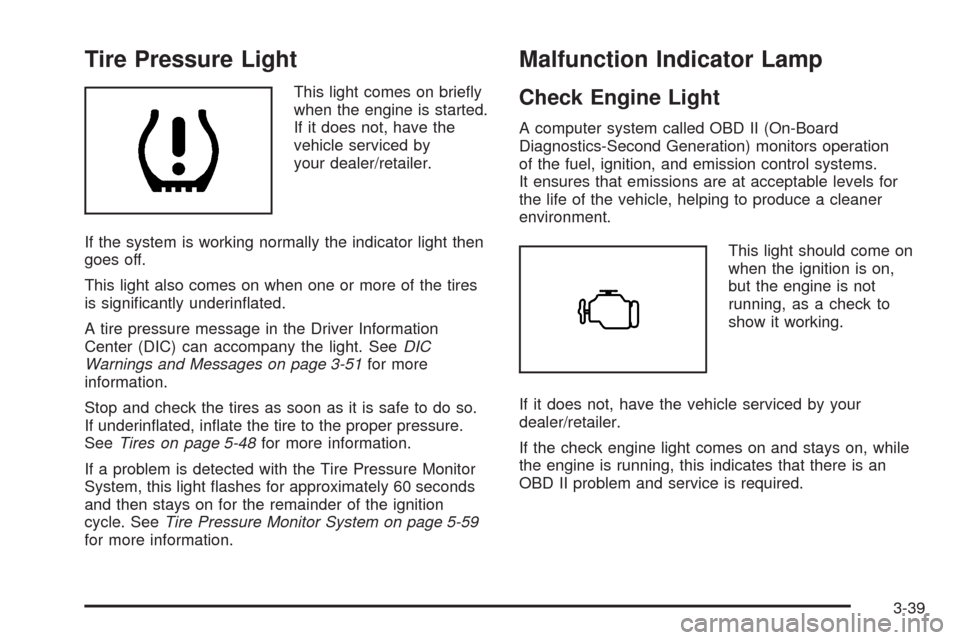
Tire Pressure Light
This light comes on briey
when the engine is started.
If it does not, have the
vehicle serviced by
your dealer/retailer.
If the system is working normally the indicator light then
goes off.
This light also comes on when one or more of the tires
is signicantly underinated.
A tire pressure message in the Driver Information
Center (DIC) can accompany the light. SeeDIC
Warnings and Messages on page 3-51for more
information.
Stop and check the tires as soon as it is safe to do so.
If underinated, inate the tire to the proper pressure.
SeeTires on page 5-48for more information.
If a problem is detected with the Tire Pressure Monitor
System, this light ashes for approximately 60 seconds
and then stays on for the remainder of the ignition
cycle. SeeTire Pressure Monitor System on page 5-59
for more information.
Malfunction Indicator Lamp
Check Engine Light
A computer system called OBD II (On-Board
Diagnostics-Second Generation) monitors operation
of the fuel, ignition, and emission control systems.
It ensures that emissions are at acceptable levels for
the life of the vehicle, helping to produce a cleaner
environment.
This light should come on
when the ignition is on,
but the engine is not
running, as a check to
show it working.
If it does not, have the vehicle serviced by your
dealer/retailer.
If the check engine light comes on and stays on, while
the engine is running, this indicates that there is an
OBD II problem and service is required.
3-39