towing CADILLAC SRX 2009 1.G Owner's Manual
[x] Cancel search | Manufacturer: CADILLAC, Model Year: 2009, Model line: SRX, Model: CADILLAC SRX 2009 1.GPages: 442, PDF Size: 2.42 MB
Page 277 of 442
Following Distance
Stay at least twice as far behind the vehicle ahead as
you would when driving the vehicle without a trailer. This
can help to avoid situations that require heavy braking
and sudden turns.
Passing
More passing distance is needed when towing a trailer.
Because the rig is longer, it is necessary to go much
farther beyond the passed vehicle before returning to
the lane.
Backing Up
Hold the bottom of the steering wheel with one hand.
Then, to move the trailer to the left, move that hand
to the left. To move the trailer to the right, move your
hand to the right. Always back up slowly and, if possible,
have someone guide you.
Making Turns
Notice:Making very sharp turns while trailering
could cause the trailer to come in contact with
the vehicle. The vehicle could be damaged.
Avoid making very sharp turns while trailering.
When turning with a trailer, make wider turns than
normal. Do this so the trailer will not strike soft shoulders,
curbs, road signs, trees or other objects. Avoid jerky or
sudden maneuvers. Signal well in advance.
Turn Signals When Towing a Trailer
The arrows on the instrument panel ash whenever
signaling a turn or lane change. Properly hooked up, the
trailer lamps also ash, telling other drivers the vehicle
is turning, changing lanes or stopping.
When towing a trailer, the arrows on the instrument panel
ash for turns even if the bulbs on the trailer are burned
out. For this reason you may think other drivers are
seeing the signal when they are not. It is important to
check occasionally to be sure the trailer bulbs are still
working.
4-47
Page 278 of 442
Driving on Grades
Reduce speed and shift to a lower gearbeforestarting
down a long or steep downgrade. If the transmission is
not shifted down, the brakes might have to be used so
much that they would get hot and no longer work well.
On a long uphill grade, shift down and reduce the
vehicle’s speed to around 45 mph (70 km/h) to reduce
the possibility of the engine and the transmission
overheating.
Vehicles can tow in D (Drive). Shift the transmission to
a lower gear if the transmission shifts too often under
heavy loads and/or hilly conditions.
The tow/haul mode may be used if the transmission
shifts too often. See Tow/Haul Mode previously.
When towing at high altitude on steep uphill grades,
consider the following: Engine coolant will boil at a lower
temperature than at normal altitudes. If the engine is
turned off immediately after towing at high altitude on
steep uphill grades, the vehicle may show signs similar to
engine overheating. To avoid this, let the engine run while
parked, preferably on level ground, with the automatic
transmission in P (Park) for a few minutes before turning
the engine off. If the overheat warning comes on, see
Engine Overheating on page 5-29.
Parking on Hills
{CAUTION:
Parking the vehicle on a hill with the trailer
attached can be dangerous. If something goes
wrong, the rig could start to move. People can be
injured, and both the vehicle and the trailer can be
damaged. When possible, always park the rig on a
at surface.
If parking the rig on a hill:
1. Press the brake pedal, but do not shift into P (Park)
yet. Turn the wheels into the curb if facing downhill
or into traffic if facing uphill.
2. Have someone place chocks under the trailer
wheels.
3. When the wheel chocks are in place, release the
regular brakes until the chocks absorb the load.
4. Reapply the brake pedal. Then apply the parking
brake and shift into P (Park).
5. Release the brake pedal.
4-48
Page 279 of 442
Leaving After Parking on a Hill
1. Apply and hold the brake pedal while you:
Start the engine
Shift into a gear
Release the parking brake
2. Let up on the brake pedal.
3. Drive slowly until the trailer is clear of the
chocks.
4. Stop and have someone pick up and store
the chocks.
Maintenance When Trailer Towing
The vehicle needs service more often when pulling a
trailer. See this manual’s Maintenance Schedule or Index
for more information. Things that are especially important
in trailer operation are automatic transmission uid,
engine oil, axle lubricant, belts, cooling system and brake
system. It is a good idea to inspect these before and
during the trip.
Check periodically to see that all hitch nuts and bolts
are tight.
Engine Cooling When Trailer Towing
The cooling system may temporarily overheat during
severe operating conditions. SeeEngine Overheating on
page 5-29.
4-49
Page 285 of 442
If doing some of your own service work, use the proper
service manual. It tells you much more about how to
service the vehicle than this manual can. To order
the proper service manual, seeService Publications
Ordering Information on page 7-15.
This vehicle has an airbag system. Before attempting
to do your own service work, seeServicing Your
Airbag-Equipped Vehicle on page 1-70.
Keep a record with all parts receipts and list the
mileage and the date of any service work performed.
SeeMaintenance Record on page 6-17.
Adding Equipment to the Outside of
the Vehicle
Things added to the outside of the vehicle can affect the
airow around it. This can cause wind noise and can
affect fuel economy and windshield washer performance.
Check with your dealer/retailer before adding equipment
to the outside of the vehicle.
Fuel
Use of the recommended fuel is an important part of
the proper maintenance of this vehicle. To help keep
the engine clean and maintain optimum vehicle
performance, we recommend the use of gasoline
advertised as TOP TIER Detergent Gasoline.
The 8th digit of the Vehicle Identication Number (VIN)
shows the code letter or number that identies the
vehicle’s engine. The VIN is at the top left of the
instrument panel. SeeVehicle Identification Number
(VIN) on page 5-97.
Gasoline Octane
If the vehicle has the 3.6L V6 engine (VIN Code 7), use
regular unleaded gasoline with a posted octane rating of
87 or higher. For best performance or trailer towing, you
could choose to use middle grade 89 octane unleaded
gasoline. If the octane rating is less than 87, you might
notice an audible knocking noise when you drive,
commonly referred to as spark knock. If this occurs, use a
gasoline rated at 87 octane or higher as soon as possible.
If you are using gasoline rated at 87 octane or higher and
you hear heavy knocking, the engine needs service.
5-5
Page 311 of 442
If the engine coolant temperature gage is no longer in
the overheat zone or an overheat warning no longer
displays, the vehicle can be driven. Continue to drive the
vehicle slow for about 10 minutes. Keep a safe vehicle
distance from the car in front of you. If the warning
does not come back on, continue to drive normally.
If the warning continues, pull over, stop, and park the
vehicle right away.
If there is no sign of steam, idle the engine for
three minutes while parked. If the warning is still
displayed, turn off the engine until it cools down. Also,
see″Overheated Engine Protection Operating Mode″
later in this section.
Overheated Engine Protection
Operating Mode
This operating mode allows your vehicle to be driven
to a safe place in an emergency. Should a hot engine
condition exist, an overheat protection mode which
alternates ring groups of cylinders helps prevent engine
damage. In this mode, there is a loss in power and
engine performance. Driving extended miles (km) and/or
towing a trailer in the overheat protection mode should
be avoided.Notice:After driving in the overheated engine
protection operating mode, to avoid engine damage,
allow the engine to cool before attempting any
repair. The engine oil will be severely degraded.
Repair the cause of coolant loss and change the oil.
SeeEngine Oil on page 5-16.
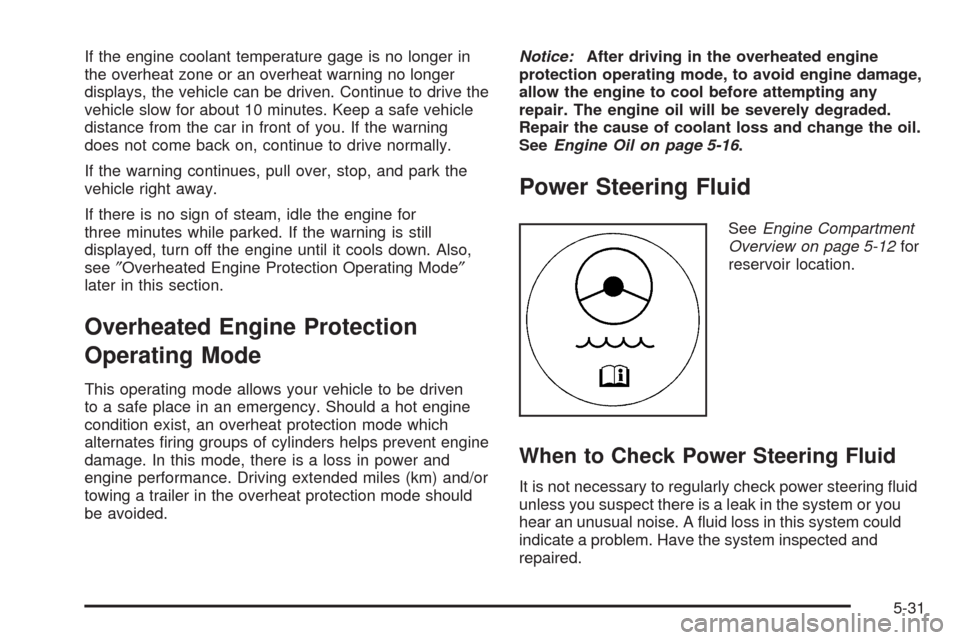
Power Steering Fluid
SeeEngine Compartment
Overview on page 5-12for
reservoir location.
When to Check Power Steering Fluid
It is not necessary to regularly check power steering uid
unless you suspect there is a leak in the system or you
hear an unusual noise. A uid loss in this system could
indicate a problem. Have the system inspected and
repaired.
5-31
Page 396 of 442
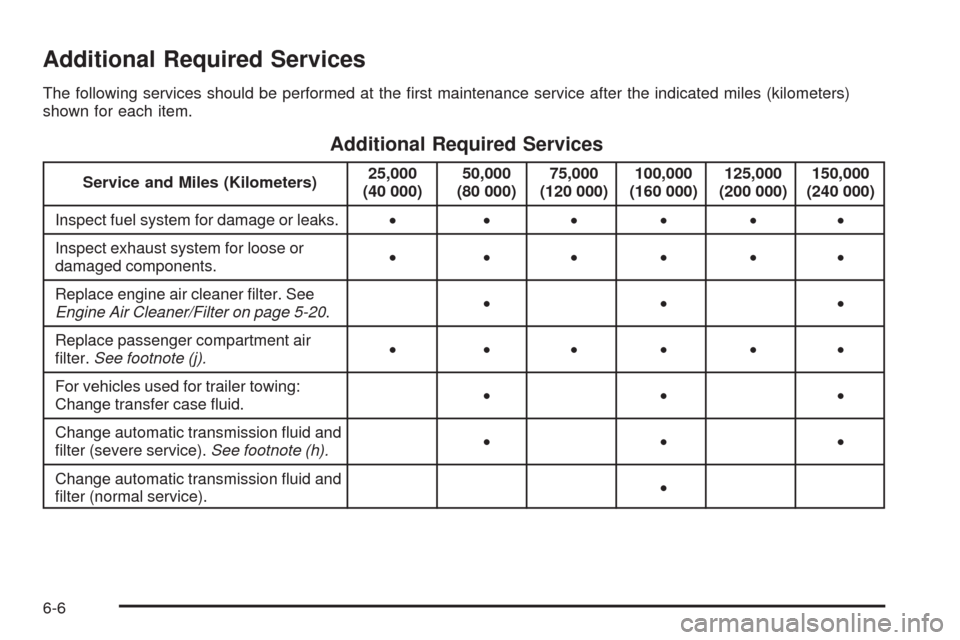
Additional Required Services
The following services should be performed at the rst maintenance service after the indicated miles (kilometers)
shown for each item.
Additional Required Services
Service and Miles (Kilometers)25,000
(40 000)50,000
(80 000)75,000
(120 000)100,000
(160 000)125,000
(200 000)150,000
(240 000)
Inspect fuel system for damage or leaks.• •••••
Inspect exhaust system for loose or
damaged components.• •••••
Replace engine air cleaner lter. See
Engine Air Cleaner/Filter on page 5-20.•••
Replace passenger compartment air
lter.See footnote (j).• •••••
For vehicles used for trailer towing:
Change transfer case uid.•••
Change automatic transmission uid and
lter (severe service).See footnote (h).•••
Change automatic transmission uid and
lter (normal service).•
6-6
Page 399 of 442
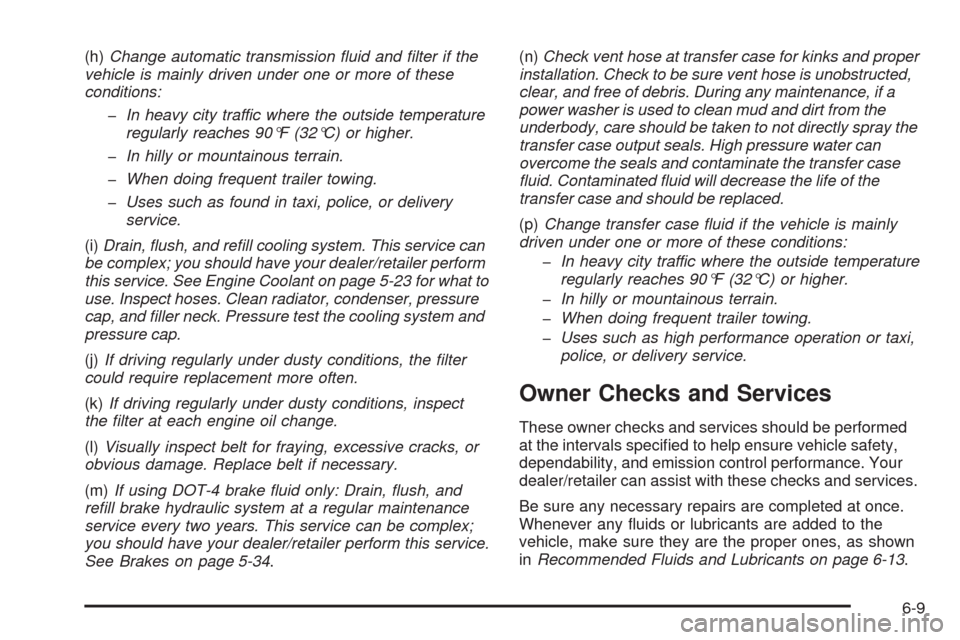
(h)Change automatic transmission fluid and filter if the
vehicle is mainly driven under one or more of these
conditions:
In heavy city traffic where the outside temperature
regularly reaches 90°F (32°C) or higher.
In hilly or mountainous terrain.
When doing frequent trailer towing.
Uses such as found in taxi, police, or delivery
service.
(i)Drain, flush, and refill cooling system. This service can
be complex; you should have your dealer/retailer perform
this service. See Engine Coolant on page 5-23 for what to
use. Inspect hoses. Clean radiator, condenser, pressure
cap, and filler neck. Pressure test the cooling system and
pressure cap.
(j)If driving regularly under dusty conditions, the filter
could require replacement more often.
(k)If driving regularly under dusty conditions, inspect
the filter at each engine oil change.
(l)Visually inspect belt for fraying, excessive cracks, or
obvious damage. Replace belt if necessary.
(m)If using DOT-4 brake fluid only: Drain, flush, and
refill brake hydraulic system at a regular maintenance
service every two years. This service can be complex;
you should have your dealer/retailer perform this service.
See Brakes on page 5-34.(n)Check vent hose at transfer case for kinks and proper
installation. Check to be sure vent hose is unobstructed,
clear, and free of debris. During any maintenance, if a
power washer is used to clean mud and dirt from the
underbody, care should be taken to not directly spray the
transfer case output seals. High pressure water can
overcome the seals and contaminate the transfer case
fluid. Contaminated fluid will decrease the life of the
transfer case and should be replaced.
(p)Change transfer case fluid if the vehicle is mainly
driven under one or more of these conditions:
In heavy city traffic where the outside temperature
regularly reaches 90°F (32°C) or higher.
In hilly or mountainous terrain.
When doing frequent trailer towing.
Uses such as high performance operation or taxi,
police, or delivery service.
Owner Checks and Services
These owner checks and services should be performed
at the intervals specied to help ensure vehicle safety,
dependability, and emission control performance. Your
dealer/retailer can assist with these checks and services.
Be sure any necessary repairs are completed at once.
Whenever any uids or lubricants are added to the
vehicle, make sure they are the proper ones, as shown
inRecommended Fluids and Lubricants on page 6-13.
6-9
Page 419 of 442
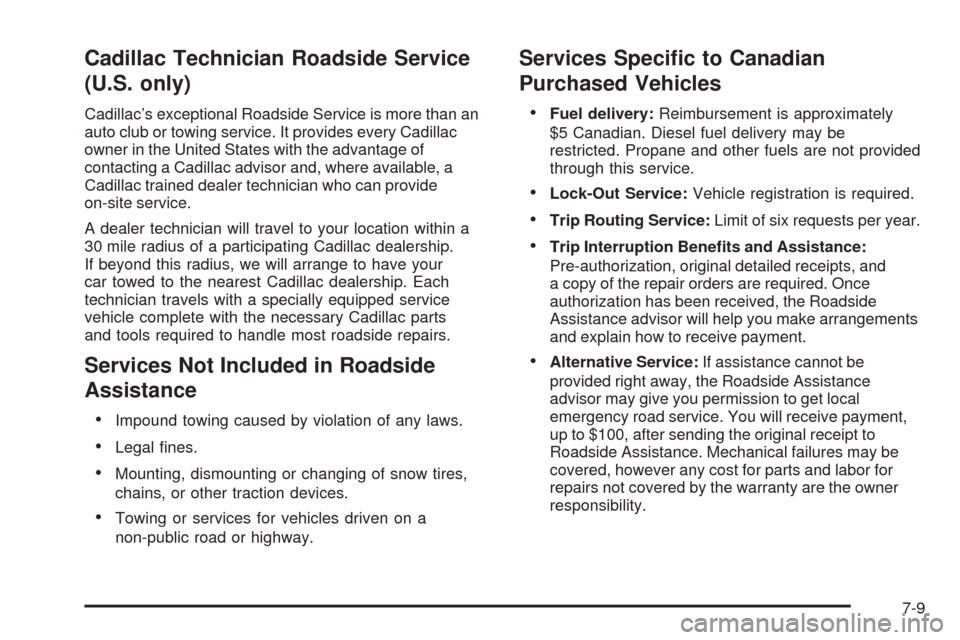
Cadillac Technician Roadside Service
(U.S. only)
Cadillac’s exceptional Roadside Service is more than an
auto club or towing service. It provides every Cadillac
owner in the United States with the advantage of
contacting a Cadillac advisor and, where available, a
Cadillac trained dealer technician who can provide
on-site service.
A dealer technician will travel to your location within a
30 mile radius of a participating Cadillac dealership.
If beyond this radius, we will arrange to have your
car towed to the nearest Cadillac dealership. Each
technician travels with a specially equipped service
vehicle complete with the necessary Cadillac parts
and tools required to handle most roadside repairs.
Services Not Included in Roadside
Assistance
Impound towing caused by violation of any laws.
Legal nes.
Mounting, dismounting or changing of snow tires,
chains, or other traction devices.
Towing or services for vehicles driven on a
non-public road or highway.
Services Specic to Canadian
Purchased Vehicles
Fuel delivery:Reimbursement is approximately
$5 Canadian. Diesel fuel delivery may be
restricted. Propane and other fuels are not provided
through this service.
Lock-Out Service:Vehicle registration is required.
Trip Routing Service:Limit of six requests per year.
Trip Interruption Benets and Assistance:
Pre-authorization, original detailed receipts, and
a copy of the repair orders are required. Once
authorization has been received, the Roadside
Assistance advisor will help you make arrangements
and explain how to receive payment.
Alternative Service:If assistance cannot be
provided right away, the Roadside Assistance
advisor may give you permission to get local
emergency road service. You will receive payment,
up to $100, after sending the original receipt to
Roadside Assistance. Mechanical failures may be
covered, however any cost for parts and labor for
repairs not covered by the warranty are the owner
responsibility.
7-9
Page 423 of 442
If a Crash Occurs
Here is what to do if you are involved in a crash.
Try to relax and then check to make sure you are all
right. If you are uninjured, make sure that no one else
in your vehicle, or the other vehicle, is injured.
If there has been an injury, call emergency services
for help. Do not leave the scene of a crash until all
matters have been taken care of. Move your vehicle
only if its position puts you in danger or you are
instructed to move it by a police officer.
Give only the necessary and requested information
to police and other parties involved in the crash.
Do not discuss your personal condition, mental frame
of mind, or anything unrelated to the crash. This will
help guard against post-crash legal action.
If you need roadside assistance, call GM Roadside
Assistance. SeeRoadside Service on page 7-7for
more information.
If your vehicle cannot be driven, know where the
towing service will be taking it. Get a card from the
tow truck operator or write down the driver’s name,
the service’s name, and the phone number.
Remove any valuables from your vehicle before it is
towed away. Make sure this includes your insurance
information and registration if you keep these items
in your vehicle.
Gather the important information you will need from
the other driver. Things like name, address, phone
number, driver’s license number, vehicle license
plate, vehicle make, model and model year, Vehicle
Identication Number (VIN), insurance company and
policy number, and a general description of the
damage to the other vehicle.
If possible, call your insurance company from the
scene of the crash. They will walk you through the
information they will need. If they ask for a police
report, phone or go to the police department
headquarters the next day and you can get a copy of
the report for a nominal fee. In some states/provinces
with “no fault” insurance laws, a report may not be
necessary. This is especially true if there are no
injuries and both vehicles are driveable.
Choose a reputable collision repair facility for your
vehicle. Whether you select a GM dealer/retailer
or a private collision repair facility to x the damage,
make sure you are comfortable with them.
Remember, you will have to feel comfortable
with their work for a long time.
Once you have an estimate, read it carefully and
make sure you understand what work will be
performed on your vehicle. If you have a question,
ask for an explanation. Reputable shops welcome
this opportunity.
7-13
Page 438 of 442
Power (cont.)
Lumbar Controls........................................... 1-4
Retained Accessory.....................................2-24
Seat ............................................................ 1-3
Steering Fluid.............................................5-31
Windows....................................................2-16
Privacy..........................................................7-16
Event Data Recorders..................................7-17
Navigation System.......................................7-18
OnStar .......................................................7-18
Radio Frequency Identication.......................7-18
Programmable Automatic Door Locks.................2-10
R
Radio Frequency Identication (RFID),
Privacy......................................................7-18
Radio(s)........................................................3-72
Radios
Navigation/Radio System,
see Navigation Manual..............................3-88
Rear Seat Audio..........................................3-88
Reception...................................................3-91
Setting the Clock.........................................3-69
Theft-Deterrent............................................3-90
Reading Lamps..............................................3-19
Rear Air Conditioning System...........................3-27Rear Axle......................................................5-43
Limited-Slip.................................................. 4-8
Rear Door Security Locks................................2-11
Rear Seat Audio (RSA)....................................3-88
Rear Seat Entertainment System.......................3-88
Rear Seat Operation.......................................1-11
Rear Side Window Antenna..............................3-92
Rear Windshield Washer/Wiper.........................3-11
Rearview Mirror, Automatic Dimming..................2-38
Reclining Seatbacks.......................................... 1-6
Recommended Fluids and Lubricants.................6-13
Recreational Vehicle Towing.............................4-36
Remote Keyless Entry (RKE) System.................. 2-4
Remote Keyless Entry (RKE) System,
Operation..................................................... 2-4
Remote Vehicle Start........................................ 2-7
Removing the Flat Tire and Installing the
Spare Tire..................................................5-78
Removing the Spare Tire and Tools...................5-75
Replacement Parts, Maintenance......................6-15
Reporting Safety Defects
Canadian Government..................................7-15
General Motors...........................................7-15
United States Government............................7-14
Restraint System Check
Checking the Restraint Systems....................1-72
Replacing Restraint System Parts
After a Crash..........................................1-73
10