coolant CADILLAC SRX 2011 2.G User Guide
[x] Cancel search | Manufacturer: CADILLAC, Model Year: 2011, Model line: SRX, Model: CADILLAC SRX 2011 2.GPages: 498, PDF Size: 7.62 MB
Page 347 of 498
Black plate (9,1)Cadillac SRX Owner Manual - 2011
Vehicle Care 10-9
A.Engine Air Cleaner/Filter on
page 10‑16.
B. Power Steering Reservoir and Cap (Under engine cover).
See Power Steering Fluid on
page 10‑24.
C. Engine Oil Fill Cap. See Engine
Oil on page 10‑10.
D. Engine Oil Dipstick (Out of View). See Engine Oil on
page 10‑10.
E. Engine Cover on page 10‑9.
F. Transmission Fluid Cap and Dipstick. See Automatic
Transmission Fluid on
page 10‑15.
G. Brake Master Cylinder Reservoir. See Brakes on
page 10‑25. H. Engine Coolant Surge Tank and
Pressure Cap. See Engine
Coolant on page 10‑19.
I. Battery (Out of View). See Battery on page 10‑28.
J. Remote Positive (+) Terminal. See Jump Starting on
page 10‑94.
K. Remote Negative (−) Terminal (Out of View). See Jump
Starting on page 10‑94.
L. Engine Compartment Fuse
Block on page 10‑46.
M. Windshield Washer Fluid Reservoir. See Washer Fluid on
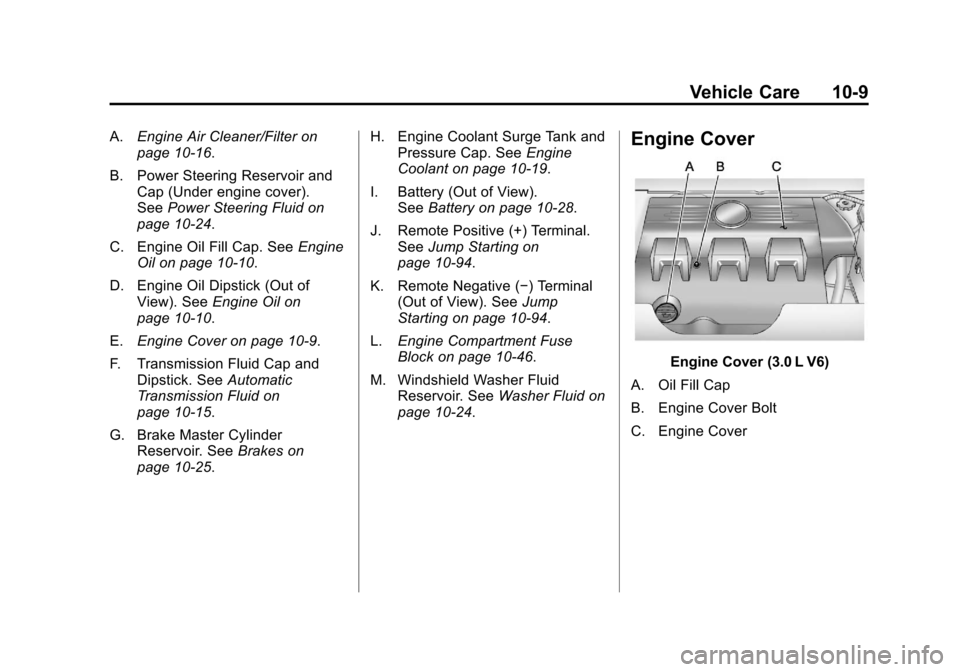
page 10‑24.Engine Cover
Engine Cover (3.0 L V6)
A. Oil Fill Cap
B. Engine Cover Bolt
C. Engine Cover
Page 356 of 498
Black plate (18,1)Cadillac SRX Owner Manual - 2011
10-18 Vehicle Care
Cooling System
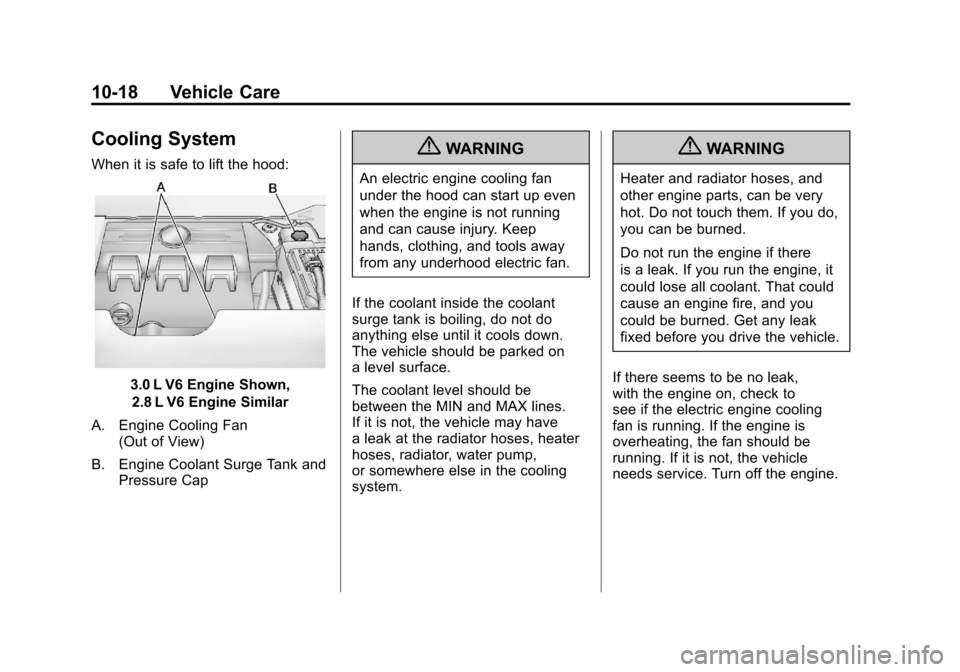
When it is safe to lift the hood:
3.0 L V6 Engine Shown,2.8 L V6 Engine Similar
A. Engine Cooling Fan (Out of View)
B. Engine Coolant Surge Tank and Pressure Cap
{WARNING
An electric engine cooling fan
under the hood can start up even
when the engine is not running
and can cause injury. Keep
hands, clothing, and tools away
from any underhood electric fan.
If the coolant inside the coolant
surge tank is boiling, do not do
anything else until it cools down.
The vehicle should be parked on
a level surface.
The coolant level should be
between the MIN and MAX lines.
If it is not, the vehicle may have
a leak at the radiator hoses, heater
hoses, radiator, water pump,
or somewhere else in the cooling
system.
{WARNING
Heater and radiator hoses, and
other engine parts, can be very
hot. Do not touch them. If you do,
you can be burned.
Do not run the engine if there
is a leak. If you run the engine, it
could lose all coolant. That could
cause an engine fire, and you
could be burned. Get any leak
fixed before you drive the vehicle.
If there seems to be no leak,
with the engine on, check to
see if the electric engine cooling
fan is running. If the engine is
overheating, the fan should be
running. If it is not, the vehicle
needs service. Turn off the engine.
Page 357 of 498
Black plate (19,1)Cadillac SRX Owner Manual - 2011
Vehicle Care 10-19
Notice:Using coolant other
than DEX-COOL®can cause
premature engine, heater core,
or radiator corrosion. In addition,
the engine coolant could require
changing sooner, at 50 000 km
(30,000 miles) or 24 months,
whichever occurs first. Any
repairs would not be covered
by the vehicle warranty. Always
use DEX-COOL (silicate-free)
coolant in the vehicle.
Engine Coolant
The cooling system in the vehicle
is filled with DEX-COOL®engine
coolant. This coolant is designed to
remain in the vehicle for 5 years or
240 000 km (150,000 mi), whichever
occurs first.
The following explains the cooling
system and how to check and add
coolant when it is low. If there is a
problem with engine overheating,
see Engine Overheating on
page 10‑22
What to Use
{WARNING
Adding only plain water or some
other liquid to the cooling system
can be dangerous. Plain water
and other liquids, can boil before
the proper coolant mixture will.
The vehicle's coolant warning
system is set for the proper
coolant mixture. With plain water
or the wrong mixture, the engine
could get too hot but you would
not get the overheat warning.
The engine could catch fire and
you or others could be burned.
Use a 50/50 mixture of clean,
drinkable water and DEX-COOL
coolant. Use a 50/50 mixture of clean,
drinkable water and DEX-COOL
coolant. If using this mixture,
nothing else needs to be added.
This mixture:.Gives freezing protection down
to
−37°C (−34°F), outside
temperature.
.Gives boiling protection up
to 129°C (265°F), engine
temperature.
.Protects against rust and
corrosion.
.Will not damage aluminum parts.
.Helps keep the proper engine
temperature.
Notice: If an improper coolant
mixture is used, the engine could
overheat and be badly damaged.
The repair cost would not be
covered by the vehicle warranty.
Too much water in the mixture
can freeze and crack the engine,
radiator, heater core, and other
parts.
Page 358 of 498
Black plate (20,1)Cadillac SRX Owner Manual - 2011
10-20 Vehicle Care
Checking Coolant
The vehicle must be on a level
surface when checking the coolant
level.
Check to see if coolant is visible
in the coolant surge tank. If the
coolant inside the coolant surge
tank is boiling, do not do anything
else until it cools down. If coolant
is visible but the coolant level is
not at the indicated mark, add a
50/50 mixture of clean, drinkable
water and DEX-COOL coolant at the
coolant surge tank, but be sure the
cooling system is cool before this is
done. SeeEngine Overheating on
page 10‑22 for more information.
The coolant surge tank is located
in the engine compartment on
the driver side of the vehicle.
See Engine Compartment Overview
on page 10‑6 for more information
on location.
How to Add Coolant to the
Coolant Surge Tank
Notice: This vehicle has a
specific coolant fill procedure.
Failure to follow this procedure
could cause the engine to
overheat and be severely
damaged.
If no problem is found, check to see
if coolant is visible in the coolant
surge tank. If coolant is visible
but the coolant level is not at
the indicated level mark, add a
50/50 mixture of clean, drinkable
water and DEX-COOL coolant at
the coolant surge tank, but be sure
the cooling system, including the
coolant surge tank pressure cap,
is cool before you do it.
{WARNING
Steam and scalding liquids from a
hot cooling system can blow out
and burn you badly. They are
under pressure, and if you turn
the coolant surge tank pressure
cap —even a little —they can
come out at high speed. Never
turn the cap when the cooling
system, including the coolant
surge tank pressure cap, is hot.
Wait for the cooling system and
coolant surge tank pressure cap
to cool if you ever have to turn
the pressure cap.
Page 359 of 498
Black plate (21,1)Cadillac SRX Owner Manual - 2011
Vehicle Care 10-21
{WARNING
Adding only plain water or some
other liquid to the cooling system
can be dangerous. Plain water
and other liquids, can boil before
the proper coolant mixture will.
The vehicle's coolant warning
system is set for the proper
coolant mixture. With plain water
or the wrong mixture, the engine
could get too hot but you would
not get the overheat warning.
The engine could catch fire and
you or others could be burned.
Use a 50/50 mixture of clean,
drinkable water and DEX-COOL
coolant.
Notice: In cold weather, water
can freeze and crack the engine,
radiator, heater core and other
parts. Use the recommended
coolant and the proper coolant
mixture.
{WARNING
You can be burned if you spill
coolant on hot engine parts.
Coolant contains ethylene glycol
and it will burn if the engine parts
are hot enough. Do not spill
coolant on a hot engine.
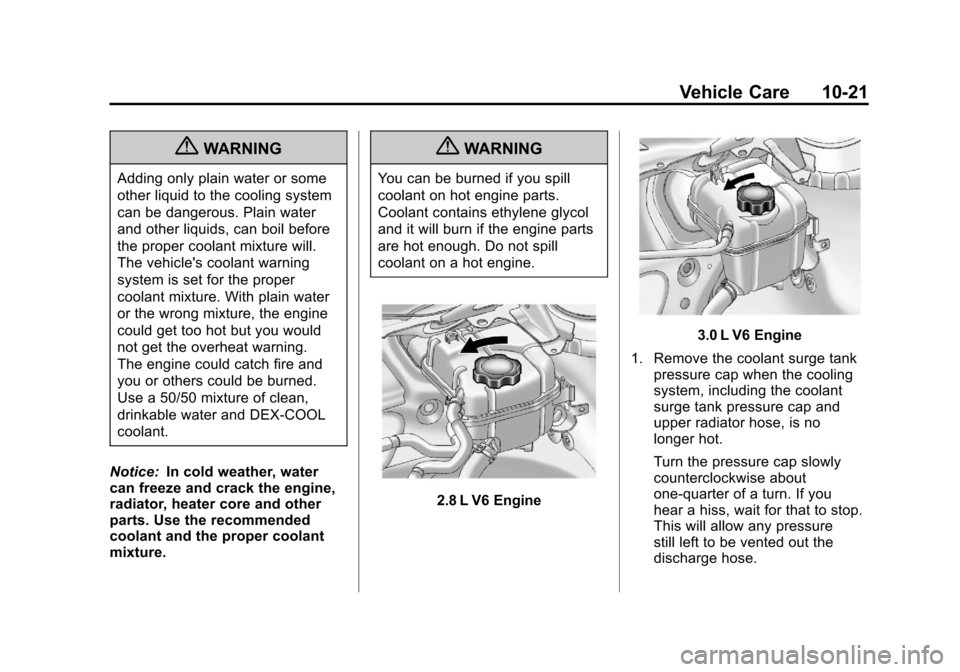
2.8 L V6 Engine
3.0 L V6 Engine
1. Remove the coolant surge tank pressure cap when the cooling
system, including the coolant
surge tank pressure cap and
upper radiator hose, is no
longer hot.
Turn the pressure cap slowly
counterclockwise about
one-quarter of a turn. If you
hear a hiss, wait for that to stop.
This will allow any pressure
still left to be vented out the
discharge hose.
Page 360 of 498
Black plate (22,1)Cadillac SRX Owner Manual - 2011
10-22 Vehicle Care
2. Then keep turning the pressurecap slowly and remove it.
3. Fill the coolant surge tank with the proper DEX-COOL
coolant mixture to the indicated
level mark.
4. With the coolant surge tank pressure cap off, start the
engine and let it run until you
can feel the upper radiator hose
getting hot. Watch out for the
engine cooling fan.
By this time, the coolant level
inside the coolant surge tank
may be lower. If the level is
lower, add more of the proper
DEX-COOL
®coolant mixture
to the coolant surge tank until
the level reaches the indicated
level mark.
5. Then replace the pressure cap. Be sure the pressure cap is
hand-tight. Check the level in the coolant surge
tank when the cooling system has
cooled down. If the coolant is not
at the proper level, repeat Steps 1
through 3 and reinstall the pressure
cap. If the coolant still is not at the
proper level when the system cools
down again, see your dealer.
Engine Overheating
The vehicle has an indicator to warn
of engine overheating.
There is an engine coolant
temperature warning light on
the vehicle's instrument panel.
See
Engine Coolant Temperature
Gauge on page 5‑15.
If the decision is made not to lift the
hood when this warning appears,
but instead get service help right
away. See Roadside Service (U.S.
and Canada) on page 13‑8 or
Roadside Service (Mexico) on
page 13‑10. If the decision is made to lift the
hood, make sure the vehicle is
parked on a level surface.
Then check to see if the engine
cooling fans are running. If the
engine is overheating, both fans
should be running. If they are not,
do not continue to run the engine
and have the vehicle serviced.
Notice:
Engine damage from
running the engine without
coolant is not covered by the
warranty.
Notice: If the engine catches
fire because of being driven
with no coolant, your vehicle can
be badly damaged. The costly
repairs would not be covered by
the vehicle warranty.
Page 361 of 498
Black plate (23,1)Cadillac SRX Owner Manual - 2011
Vehicle Care 10-23
If Steam Is Coming from the
Engine Compartment
{WARNING
Steam from an overheated engine
can burn you badly, even if you
just open the hood. Stay away
from the engine if you see or hear
steam coming from it. Just turn it
off and get everyone away from
the vehicle until it cools down.
Wait until there is no sign of
steam or coolant before you
open the hood.
If you keep driving when your
engine is overheated, the liquids
in it can catch fire. You or others
could be badly burned. Stop your
engine if it overheats, and get out
of the vehicle until the engine
is cool.
If No Steam Is Coming from
the Engine Compartment
If an engine overheat warning is
displayed but no steam can be seen
or heard, the problem may not be
too serious. Sometimes the engine
can get a little too hot when the
vehicle:
.Climbs a long hill on a hot day
.Stops after high-speed driving
.Idles for long periods in traffic
.Tows a trailer
If the overheat warning displays with
no sign of steam:
1. Turn the air off.
2. Turn the heater on to the highest temperature and to the highest
fan speed. Open the windows as
necessary. 3. In heavy traffic, let the engine
idle in N (Neutral) while stopped.
If it is safe to do so, pull off
the road, shift to P (Park) or
N (Neutral) and let the
engine idle.
If the temperature overheat gauge
is no longer in the overheat zone
or an overheat warning no longer
displays, the vehicle can be driven.
Continue to drive the vehicle slowly
for about 10 minutes. Keep a safe
vehicle distance from the vehicle in
front. If the warning does not come
back on, continue to drive normally.
If the warning continues, pull over,
stop, and park the vehicle
right away.
If there is no sign of steam,
idle the engine for three minutes
while parked. If the warning is still
displayed, turn off the engine until it
cools down.
Page 363 of 498
Black plate (25,1)Cadillac SRX Owner Manual - 2011
Vehicle Care 10-25
Adding Washer Fluid
The WASHER FLUID LOW ADD
FLUID message appears on the
Driver Information Center (DIC)
when the fluid level is low.
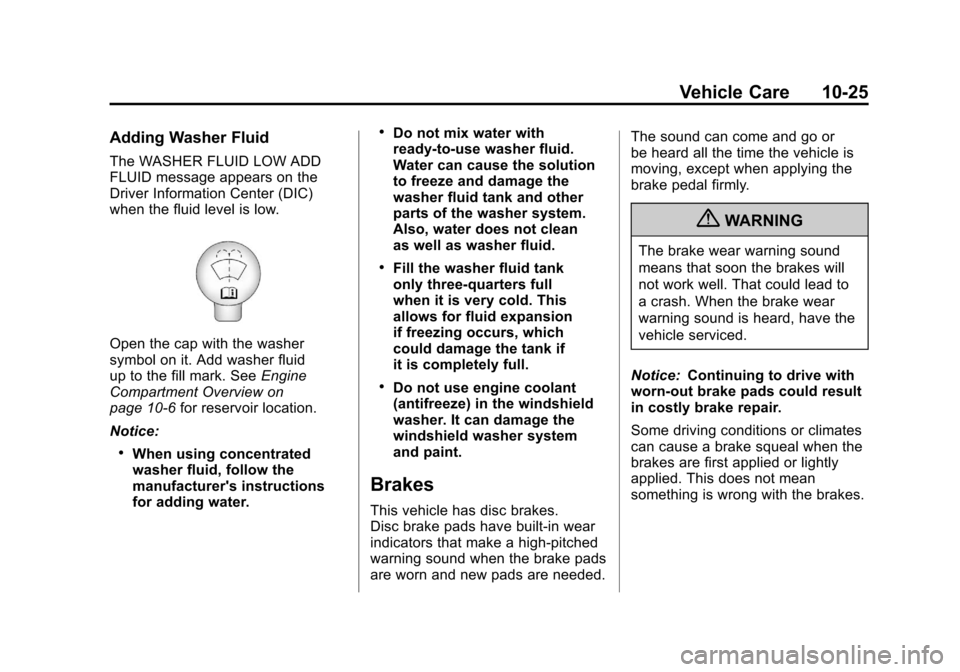
Open the cap with the washer
symbol on it. Add washer fluid
up to the fill mark. SeeEngine
Compartment Overview on
page 10‑6 for reservoir location.
Notice:
.When using concentrated
washer fluid, follow the
manufacturer's instructions
for adding water.
.Do not mix water with
ready-to-use washer fluid.
Water can cause the solution
to freeze and damage the
washer fluid tank and other
parts of the washer system.
Also, water does not clean
as well as washer fluid.
.Fill the washer fluid tank
only three-quarters full
when it is very cold. This
allows for fluid expansion
if freezing occurs, which
could damage the tank if
it is completely full.
.Do not use engine coolant
(antifreeze) in the windshield
washer. It can damage the
windshield washer system
and paint.
Brakes
This vehicle has disc brakes.
Disc brake pads have built-in wear
indicators that make a high-pitched
warning sound when the brake pads
are worn and new pads are needed. The sound can come and go or
be heard all the time the vehicle is
moving, except when applying the
brake pedal firmly.
{WARNING
The brake wear warning sound
means that soon the brakes will
not work well. That could lead to
a crash. When the brake wear
warning sound is heard, have the
vehicle serviced.
Notice: Continuing to drive with
worn-out brake pads could result
in costly brake repair.
Some driving conditions or climates
can cause a brake squeal when the
brakes are first applied or lightly
applied. This does not mean
something is wrong with the brakes.
Page 396 of 498

Black plate (58,1)Cadillac SRX Owner Manual - 2011
10-58 Vehicle Care
(E) Rim Diameter:Diameter of
the wheel in inches.
(F) Service Description
:These
characters represent the load
index and speed rating of the
tire. The load index represents
the load carrying capacity a tire
is certified to carry. The speed
rating is the maximum speed a
tire is certified to carry a load.
Tire Terminology and
Definitions
Air Pressure:The amount
of air inside the tire pressing
outward on each square inch
of the tire. Air pressure is
expressed in psi (pounds per
square inch) or kPa (kilopascal).
Accessory Weight
:This
means the combined weight
of optional accessories.
Some examples of optional
accessories are, automatic
transmission, power steering, power brakes, power windows,
power seats, and air
conditioning.
Aspect Ratio
:The relationship
of a tire's height to its width.
Belt
:A rubber coated layer of
cords that is located between
the plies and the tread. Cords
may be made from steel or other
reinforcing materials.
Bead
:The tire bead contains
steel wires wrapped by steel
cords that hold the tire onto
the rim.
Bias Ply Tire
:A pneumatic
tire in which the plies are laid
at alternate angles less than
90 degrees to the centerline
of the tread.
Cold Tire Pressure
:The
amount of air pressure in a tire,
measured in kPa (kilopascal)
or psi (pounds per square inch) before a tire has built up heat
from driving. See
Tire Pressure
on page 10‑61.
Curb Weight
:The weight of a
motor vehicle with standard and
optional equipment including
the maximum capacity of fuel,
oil, and coolant, but without
passengers and cargo.
DOT Markings
:A code
molded into the sidewall of
a tire signifying that the tire
is in compliance with the U.S.
Department of Transportation
(DOT) motor vehicle safety
standards. The DOT code
includes the Tire Identification
Number (TIN), an alphanumeric
designator which can also
identify the tire manufacturer,
production plant, brand, and
date of production.
GVWR
:Gross Vehicle Weight
Rating. See Vehicle Load Limits
on page 9‑12.
Page 451 of 498
Black plate (3,1)Cadillac SRX Owner Manual - 2011
Service and Maintenance 11-3
If the engine oil life system is reset
accidentally, service the vehicle
within 5 000 km/3,000 miles since
the last service. Reset the oil life
system whenever the oil is changed.
SeeEngine Oil Life System on
page 10‑14.
Every Engine Oil Change
.Change engine oil and
filter. Reset oil life system.
See Engine Oil on page 10‑10
and Engine Oil Life System on
page 10‑14. An Emission
Control Service.
.Engine coolant level check.
See Engine Coolant on
page 10‑19.
.Engine cooling system
inspection. Visual inspection
of hoses, pipes, fittings, and
clamps and replacement,
if needed.
.Windshield washer fluid level
check. See Washer Fluid on
page 10‑24.
.Windshield wiper blade
inspection for wear, cracking,
or contamination and windshield
and wiper blade cleaning,
if contaminated. See Exterior
Care on page 10‑101. Worn
or damaged wiper blade
replacement. See Wiper Blade
Replacement on page 10‑31.
.Tire inflation pressures
check. See Tire Pressure on
page 10‑61.
.Tire wear inspection. See Tire
Inspection on page 10‑68.
.Rotate tires if necessary.
See Tire Rotation on
page 10‑68.
.Fluids visual leak check
(or every 12 months, whichever
occurs first). A leak in any
system must be repaired and
the fluid level checked.
.Engine air cleaner filter
inspection. See Engine Air
Cleaner/Filter on page 10‑16.
.Brake system inspection
(or every 12 months, whichever
occurs first).
.Steering and suspension
inspection. Visual inspection
for damaged, loose, or missing
parts or signs of wear.
.Body hinges and latches,
key lock cylinders, folding
seat hardware, and sunroof
(if equipped) lubrication.
See Recommended Fluids
and Lubricants on page 11‑7.
More frequent lubrication may
be required when the vehicle
is exposed to a corrosive
environment. Applying silicone
grease on weatherstrips with a
clean cloth makes them last
longer, seal better, and not stick
or squeak.