tow CADILLAC SRX 2011 2.G Workshop Manual
[x] Cancel search | Manufacturer: CADILLAC, Model Year: 2011, Model line: SRX, Model: CADILLAC SRX 2011 2.GPages: 498, PDF Size: 7.62 MB
Page 436 of 498
Black plate (98,1)Cadillac SRX Owner Manual - 2011
10-98 Vehicle Care
Towing
Towing the Vehicle
Notice:To avoid damage,
the disabled vehicle should
be towed with all four wheels
off the ground. Care must be
taken with vehicles that have
low ground clearance and/or
special equipment. Always
flatbed on a car carrier.
Consult your dealer or a
professional towing service if the
disabled vehicle must be towed.
See Roadside Service (U.S. and
Canada) on page 13‑8 orRoadside
Service (Mexico) on page 13‑10.
To tow the vehicle behind another
vehicle for recreational purposes,
such as behind a motor home, see
“Recreational Vehicle Towing” in this
section.
Recreational Vehicle
Towing
Recreational vehicle towing means
towing the vehicle behind another
vehicle –such as behind a motor
home. The two most common types
of recreational vehicle towing are
known as dinghy towing and dolly
towing. Dinghy towing is towing the
vehicle with all four wheels on the
ground. Dolly towing is towing the
vehicle with two wheels on the
ground and two wheels up on a
device known as a dolly.
Here are some important things to
consider before recreational vehicle
towing:
.What is the towing capacity
of the towing vehicle?
Be sure to read the tow
vehicle manufacturer's
recommendations.
.What is the distance that will be
travelled? Some vehicles have
restrictions on how far and how
long they can tow.
.Is the proper towing equipment
going to be used? See your
dealer or trailering professional
for additional advice and
equipment recommendations.
.Is the vehicle ready to be
towed? Just as preparing the
vehicle for a long trip, make
sure the vehicle is prepared
to be towed.
Dinghy Towing
Front-wheel‐drive and
all-wheel-drive vehicles may
be dinghy towed from the front.
These vehicles can also be towed
by placing them on a platform
trailer with all four wheels off of the
ground. For other towing options,
see “Dolly Towing” following in this
section.
Page 437 of 498
Black plate (99,1)Cadillac SRX Owner Manual - 2011
Vehicle Care 10-99
Vehicles with an 2.8 L V 6 engine
can be dinghy towed only for
service and are restricted to a
maximum distance of 100 km
(60 miles) and not to exceed
80 km/h (50 mph).
Vehicles with the 3.0 L V 6 engine
can be dinghy towed without
distance restrictions.
Notice:If 105 km/h (65 mph)
is exceeded while towing the
vehicle, it could be damaged.
Never exceed 105 km/h (65 mph)
while towing the vehicle.
For vehicles being dinghy towed,
the vehicle should be run at the
beginning of each day and at each
RV fuel stop for about five minutes.
This will ensure proper lubrication
of transmission components.
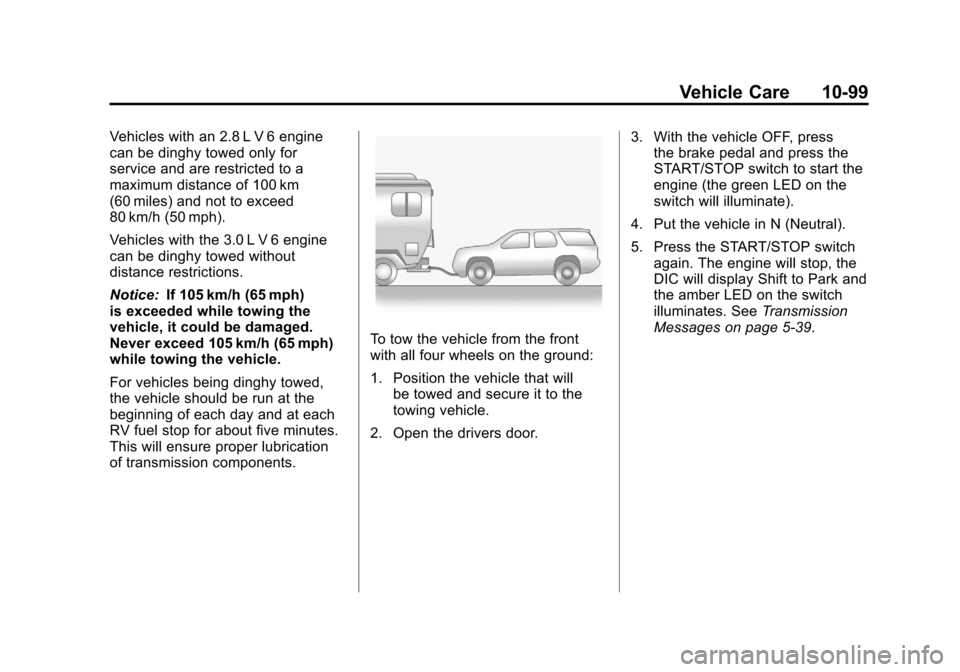
To tow the vehicle from the front
with all four wheels on the ground:
1. Position the vehicle that will be towed and secure it to the
towing vehicle.
2. Open the drivers door. 3. With the vehicle OFF, press
the brake pedal and press the
START/STOP switch to start the
engine (the green LED on the
switch will illuminate).
4. Put the vehicle in N (Neutral).
5. Press the START/STOP switch again. The engine will stop, the
DIC will display Shift to Park and
the amber LED on the switch
illuminates. See Transmission
Messages on page 5‑39.
Page 438 of 498
Black plate (100,1)Cadillac SRX Owner Manual - 2011
10-100 Vehicle Care
6. Remove the following fuses:BCM 1, BCM 2 and BCM 3.
The START/STOP switch LED's
will be off. See Instrument Panel
Fuse Block on page 10‑49.
7. Close the drivers door.
Notice: If the vehicle is
towed without performing
each of the steps listed under
“Dinghy Towing,” the automatic
transmission could be damaged.
Be sure to follow all steps of the
dinghy towing procedure prior to
and after towing the vehicle.
Once the destination has been
reached:
1. Shift the vehicle to P (Park).
2. Reinstall the BCM fuses. See Instrument Panel Fuse
Block on page 10‑49.
3. Disconnect the vehicle from the tow vehicle. Notice:
Too much or too
little fluid can damage the
transmission. Be sure that
the transmission fluid is at the
proper level before towing with
all four wheels on the ground.
Notice: Do not tow a vehicle
with the front drive wheels on
the ground if one of the front
tires is a compact spare tire.
Towing with two different tire
sizes on the front of the vehicle
can cause severe damage to the
transmission.
Dolly Towing
(All-Wheel‐Drive Vehicles)
All-wheel‐drive vehicles should not
be towed with two wheels on the
ground. To properly tow these
vehicles, they should be placed on
a platform trailer with all four wheels
off of the ground or dinghy towed
from the front. See Dinghy Towing
earlier in this section.
Dolly Towing
(Front-Wheel‐ Drive Vehicles)
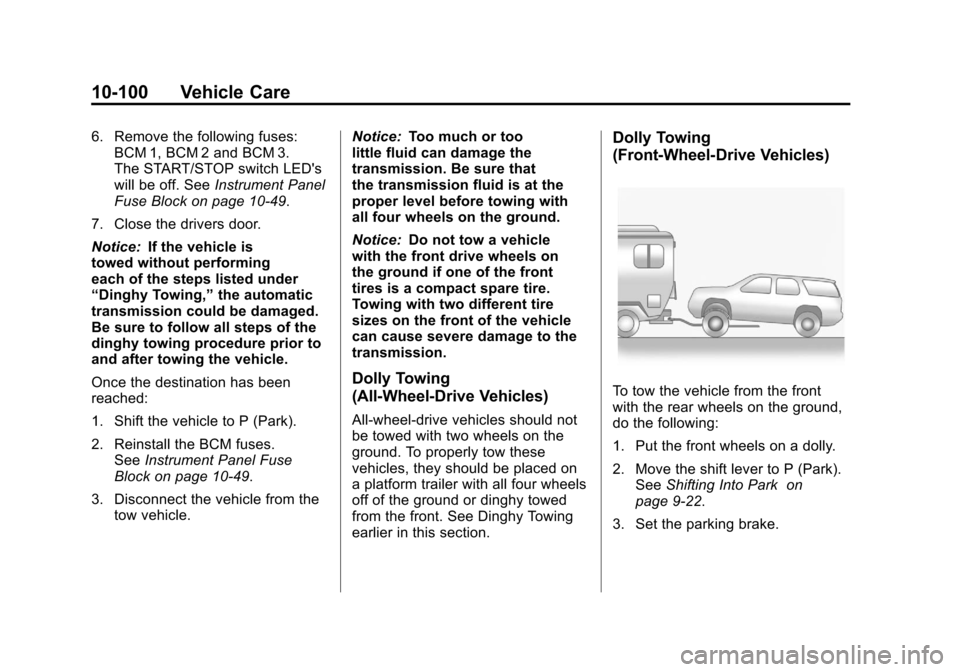
To tow the vehicle from the front
with the rear wheels on the ground,
do the following:
1. Put the front wheels on a dolly.
2. Move the shift lever to P (Park).
See Shifting Into Park on
page 9‑22.
3. Set the parking brake.
Page 439 of 498
Black plate (101,1)Cadillac SRX Owner Manual - 2011
Vehicle Care 10-101
4. Secure the vehicle to the dolly.
5. Follow the dolly manufacturer'sinstructions for preparing the
vehicle and dolly for towing.
6. Release the parking brake.
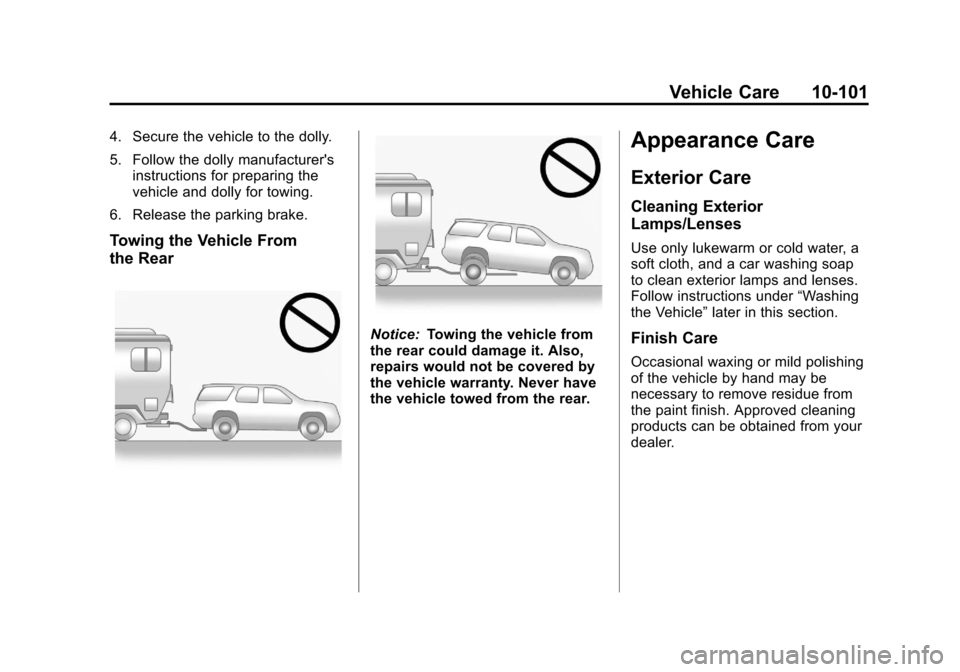
Towing the Vehicle From
the Rear
Notice: Towing the vehicle from
the rear could damage it. Also,
repairs would not be covered by
the vehicle warranty. Never have
the vehicle towed from the rear.
Appearance Care
Exterior Care
Cleaning Exterior
Lamps/Lenses
Use only lukewarm or cold water, a
soft cloth, and a car washing soap
to clean exterior lamps and lenses.
Follow instructions under “Washing
the Vehicle” later in this section.
Finish Care
Occasional waxing or mild polishing
of the vehicle by hand may be
necessary to remove residue from
the paint finish. Approved cleaning
products can be obtained from your
dealer.
Page 441 of 498
Black plate (103,1)Cadillac SRX Owner Manual - 2011
Vehicle Care 10-103
Washing the Vehicle
To preserve the vehicle's finish,
keep it clean by washing it often.
Do not wash the vehicle in
direct sunlight and use a car
washing soap.
Notice:Do not use cleaning
agents that are petroleum based
or that contain acid or abrasives,
as they can damage the paint,
metal, or plastic on the vehicle.
Approved cleaning products
can be obtained from your
dealer. Follow all manufacturer
directions regarding correct
product usage, necessary safety
precautions, and appropriate
disposal of any vehicle care
product. Certain cleaners contain
chemicals that can damage the
emblems or nameplates on the
vehicle. Check the cleaning
product label. If it states that it
should not be used on plastic
parts, do not use it on the vehicle or damage may occur and it
would not be covered by the
warranty.
Do not use cleaning agents that are
petroleum based or that contain
acid or abrasives, as they can
damage the paint, metal, or plastic
on the vehicle. Approved cleaning
products can be obtained from
your dealer. Follow all manufacturer
directions regarding correct
product usage, necessary safety
precautions, and appropriate
disposal of any vehicle care
product.
Rinse the vehicle well, before
washing and after, to remove all
cleaning agents completely. If they
are allowed to dry on the surface,
they could stain.
Dry the finish with a soft, clean
chamois or an all-cotton towel to
avoid surface scratches and water
spotting.
High pressure car washes could
cause water to enter the vehicle.
Avoid using high pressure washes
closer than 30 cm (12 in) to the
surface of the vehicle. Use of power
washers exceeding 8,274 kPa
(1,200 psi) can result in damage
or removal of paint and decals.
Notice:
Conveyor systems on
some automatic car washes could
damage the vehicle. There may
not be enough clearance for the
undercarriage. Check with the car
wash manager before using the
automatic car wash.
Weatherstrips
Silicone grease on weatherstrips
will make them last longer, seal
better, and not stick or squeak.
Apply silicone grease with a clean
cloth. During very cold, damp
weather frequent application may be
required. See Recommended Fluids
and Lubricants on page 11‑7.
Page 442 of 498
Black plate (104,1)Cadillac SRX Owner Manual - 2011
10-104 Vehicle Care
Wheels and Trim—Aluminum
or Chrome
The vehicle may have either
aluminum or chrome-plated wheels.
Keep the wheels clean using a soft,
clean cloth with mild soap and
water. Rinse with clean water. After
rinsing thoroughly, dry with a soft,
clean towel. A wax may then be
applied.
Notice: Chrome wheels and
other chrome trim may be
damaged if the vehicle is not
washed after driving on roads
that have been sprayed with
magnesium, calcium or sodium
chloride. These chlorides are
used on roads for conditions
such as ice and dust. Always
wash the vehicles chrome with
soap and water after exposure.
Notice: Do no use strong soaps,
chemicals, abrasive polishes,
cleaners, brushes, or cleaners
that contain acid on aluminum or chrome-plated wheels, because
the surface could be damaged.
The repairs would not be covered
by the vehicle warranty. Use only
approved cleaners on aluminum
or chrome-plated wheels.
Notice:
Never drive a vehicle that
has aluminum or chrome-plated
wheels through an automatic car
wash that uses silicone carbide
tire cleaning brushes, as this
could cause damage. The repairs
would not be covered by the
vehicle warranty.
Notice: Driving the vehicle
through an automatic car wash
that has silicone carbide tire
cleaning brushes, could damage
the aluminum or chrome-plated
wheels. The repairs would not be
covered by the vehicle warranty.
Never drive a vehicle that has
aluminum or chrome-plated
wheels through an automatic
car wash that uses silicone
carbide tire cleaning brushes.
Windshield and Wiper Blades
Clean the outside of the windshield
with glass cleaner.
Clean the rubber blades using a
lint‐free cloth or paper towel soaked
with windshield washer fluid or a
mild detergent. Wash the windshield
thoroughly when cleaning the
blades. Bugs, road grime, sap,
and a buildup of vehicle wash/wax
treatments may cause wiper
streaking. Replace the wiper blades
if they are worn or damaged.
Wipers can be damaged by:
.Extreme dusty conditions
.Sand and salt
.Heat and sun
.Snow and ice, without proper
removal
Page 445 of 498
Black plate (107,1)Cadillac SRX Owner Manual - 2011
Vehicle Care 10-107
Fabric/Carpet
Use a vacuum cleaner with a soft
brush attachment to remove dust
and loose dirt. A canister vacuum
with rotating brushes in the nozzle
may only be used on floor carpet
and carpeted floor mats. For soils,
always try to remove them first with
plain water or club soda. Before
cleaning, gently remove as much of
the soil as possible using one of the
following techniques:
.For liquids: gently blot the
remaining soil with a paper
towel. Allow the soil to absorb
into the paper towel until no
more can be removed.
.For solid dry soils: remove as
much as possible and then
vacuum.
To clean:
1. Saturate a lint-free, clean white cloth with water or club soda.
2. Remove excess moisture. 3. Start on the outside edge of the
soil and gently rub toward the
center. Continue cleaning, using
a clean area of the cloth each
time it becomes soiled.
4. Continue to gently rub the soiled area.
5. If the soil is not completely removed, use a mild soap
solution and repeat the cleaning
process with plain water.
If any of the soil remains, a
commercial fabric cleaner or spot
lifter may be necessary. Test a small
hidden area for colorfastness before
using a commercial upholstery
cleaner or spot lifter. If the locally
cleaned area gives any impression
that a ring formation may result,
clean the entire surface.
A paper towel can be used to blot
excess moisture from the fabric or
carpet after the cleaning process.
Leather
Leather, and lighter colored leather
in particular, will need more frequent
cleaning to prevent the buildup of
dust, dirt, and colors transferred
from other items so that these do
not become permanent stains.
To remove dust, a soft cloth
dampened with water can be used.
If a more thorough cleaning is
necessary, a soft cloth dampened
with a mild soap solution can be
used. Your dealer has a GM
approved leather cleaner available
that provides superior cleaning
performance when used regularly
on finished automotive leathers.
Allow the leather to dry naturally.
Page 453 of 498
Black plate (5,1)Cadillac SRX Owner Manual - 2011
Service and Maintenance 11-5
First Engine Oil Change After
Every 40 000 km/25,000 Miles
.Passenger compartment
air filter replacement (or every
24 months, whichever occurs
first). More frequent replacement
may be needed if you drive
in areas with heavy traffic,
areas with poor air quality,
or areas with high dust levels.
Replacement may also be
needed if you notice reduced
air flow, windows fogging up,
or odors. Your dealer can help
you determine when it is the
right time to replace the filter.First Engine Oil Change After
Every 80 000 km/50,000 Miles.Engine air cleaner filter
replacement. See
Engine Air
Cleaner/Filter on page 10‑16.
.Automatic transmission fluid
change (severe service)
for vehicles mainly driven
in heavy city traffic in hot
weather, in hilly or mountainous
terrain, when frequently towing
a trailer, or used for taxi,
police, or delivery service.
See Automatic Transmission
Fluid on page 10‑15.
.All‐wheel drive only: Transfer
case fluid change (severe
service) for vehicles mainly
driven when frequently towing
a trailer, or used for taxi, police,
or delivery service. Check
vent hose at transfer case for
kinks and proper installation.
Check to be sure vent hose is
unobstructed, clear, and free of
debris. During any maintenance,
if a power washer is used to
clean mud and dirt from the
underbody, care should be taken
to not directly spray the transfer
case output seals. High pressure
water can overcome the seals
and contaminate the transfer
case fluid. Contaminated fluid
will decrease the life of the
transfer case and should be
replaced.
Page 473 of 498
Black plate (9,1)Cadillac SRX Owner Manual - 2011
Customer Information 13-9
Cadillac Owner Privileges™
.Emergency Fuel Delivery:
Delivery of enough fuel for the
vehicle to get to the nearest
service station.
.Lock‐Out Service:Service to
unlock the vehicle if you are
locked out. A remote unlock may
be available if you have OnStar.
For security reasons, the driver
must present identification
before this service is given.
.Emergency Tow From a Public
Road or Highway: Tow to
the nearest Cadillac dealer for
warranty service, or if the vehicle
was in a crash and cannot be
driven. Assistance is also given
when the vehicle is stuck in the
sand, mud, or snow.
.Flat Tire Change: Service to
change a flat tire with spare tire.
The spare tire, if equipped,
must be in good condition and properly inflated. It is your
responsibility for the repair or
replacement of the tire if it is not
covered by the warranty.
.Battery Jump Start:
Service to
jump start a dead battery.
.Trip Routing Service: Detailed
maps of North America are
provided when requested
either with the most direct
route or the most scenic route.
Additional travel information
is also available. Allow three
weeks for delivery.
.Trip Interruption Benefits
and Service: If your trip is
interrupted due to a warranty
failure, incidental expenses
may be reimbursed during
the 5 years/160 000 km
(100,000 miles) Powertrain
warranty period. Items
considered are hotel, meals,
and rental car.
Cadillac Technician Roadside
Service (U.S. only)
Cadillac's exceptional Roadside
Service is more than an auto club
or towing service. It provides every
Cadillac owner in the United States
with the advantage of contacting
a Cadillac advisor and, where
available, a Cadillac trained dealer
technician who can provide on-site
service.
A dealer technician will travel to
your location within a 30 mile
radius of a participating Cadillac
dealership. If beyond this radius, we
will arrange to have your car towed
to the nearest Cadillac dealership.
Each technician travels with a
specially equipped service vehicle
complete with the necessary
Cadillac parts and tools required
to handle most roadside repairs.
Page 474 of 498
Black plate (10,1)Cadillac SRX Owner Manual - 2011
13-10 Customer Information
Services Not Included in
Roadside Service
.Impound towing caused by
violation of any laws.
.Legal fines.
.Mounting, dismounting,
or changing of snow tires,
chains, or other traction devices.
.Towing or services for vehicles
driven on a non-public road or
highway.
Services Specific to
Canadian‐Purchased Vehicles
.Fuel delivery:Reimbursement
is approximately $5 Canadian.
Diesel fuel delivery may be
restricted. Propane and other
fuels are not provided through
this service.
.Lock-Out Service: Vehicle
registration is required.
.Trip Routing Service: Limit of
six requests per year.
.Trip Interruption Benefits and
Service: Pre-authorization,
original detailed receipts, and
a copy of the repair orders are
required. Once authorization has
been received, the Roadside
Service advisor will help you
make arrangements and explain
how to receive payment.
.Alternative Service: If
assistance cannot be provided
right away, the Roadside
Service advisor may give
you permission to get local
emergency road service.
You will receive payment, up to
$100, after sending the original
receipt to Roadside Service.
Mechanical failures may be
covered, however any cost for
parts and labor for repairs not
covered by the warranty are
the owner responsibility.
Roadside Service
(Mexico)
Roadside Service is available
24 hours a day, 365 days of
the year.
For detailed information about
Roadside Service, please see
the brochure provided with your
new vehicle or visit our website
at: www.cadillac.com.mx.
Navigate the site and click on
“Asistencia en el Camino.” E-mail
correspondence should be sent
to: [email protected].
To contact Roadside Service by
phone, use the following numbers:
Mexico
01-800-466-0805
United States
1-866-466-8906
Canada
1-800-268-6800