steering CADILLAC SRX 2012 2.G Workshop Manual
[x] Cancel search | Manufacturer: CADILLAC, Model Year: 2012, Model line: SRX, Model: CADILLAC SRX 2012 2.GPages: 502, PDF Size: 6.23 MB
Page 376 of 502
Black plate (44,1)Cadillac SRX Owner Manual (Include Mex) - 2012
10-44 Vehicle Care
Mini Fuses Usage53 Headlamp Level
54 Sensing Diagnostic
Module Ignition
55 High-Beam
Headlamp-Right
56 High-Beam
Headlamp-Left
57 Ignition Steering
Column Lock
65 Trailer Right
Stoplamp
66 Trailer Left Stoplamp
67 Spare
68 Spare
69 Spare
70 Spare
71 Spare
72 Spare Mini Relays Usage
7 Powertrain
9 Cooling Fan 2
13 Cooling Fan 1
15 Run/Crank
Micro
Relays Usage
2 Vacuum Pump
4 Wiper Control
5 Wiper Speed
10 Starter
12 Cool Fan 3
14 Low Beam/HID
U Micro Relays Usage
3 Air Conditioning
Compressor Clutch
8 Headlamp WasherInstrument Panel
Fuse Block
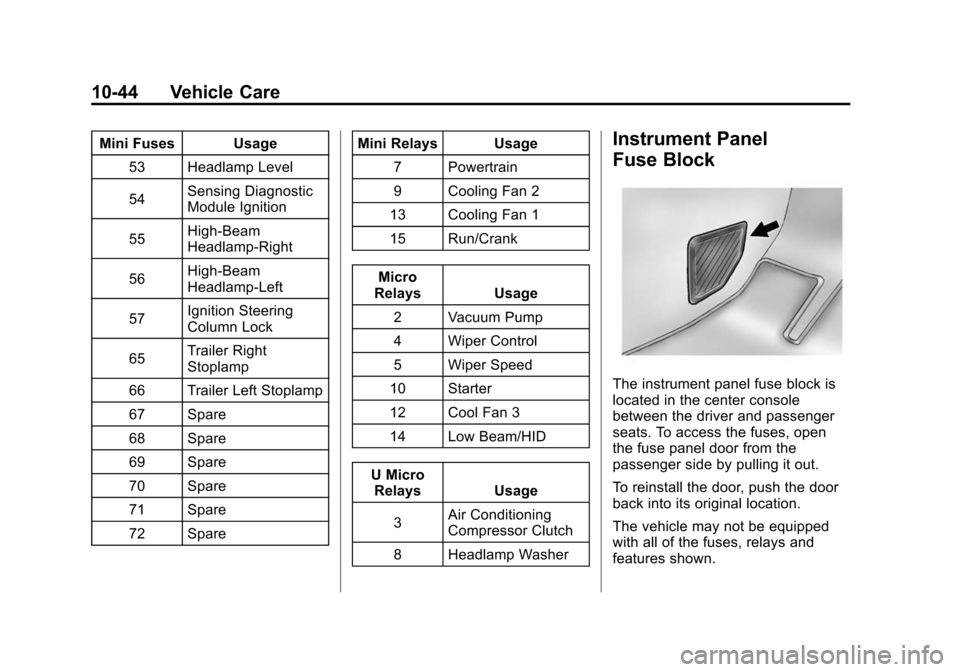
The instrument panel fuse block is
located in the center console
between the driver and passenger
seats. To access the fuses, open
the fuse panel door from the
passenger side by pulling it out.
To reinstall the door, push the door
back into its original location.
The vehicle may not be equipped
with all of the fuses, relays and
features shown.
Page 378 of 502
Black plate (46,1)Cadillac SRX Owner Manual (Include Mex) - 2012
10-46 Vehicle Care
Mini Fuses Usage
RAIN SNSR Rain Sensor
BCM 6 Body Control
Module 6
ESCL Electronic Steering
Column Lock
AIRBAG Sensing and
Diagnostic Module
DLC Data Link
Connection
IPC Instrument Panel
Cluster
SPARE Not Used
BCM 1 Body Control
Module 1
BCM 2 Body Control
Module 2
AMP/RDO Amplifier/Radio
HVAC Heating Ventilation
& Air Conditioning J‐Case
Fuses Usage
BCM 8 Body Control
Module 8
FRT BLWR Front Blower
Relays Usage
LOGIC RLY Logistics Relay
RAP/
ACCY RLY Retained
Accessory Power/
Accessory RelayRear Compartment
Fuse Block
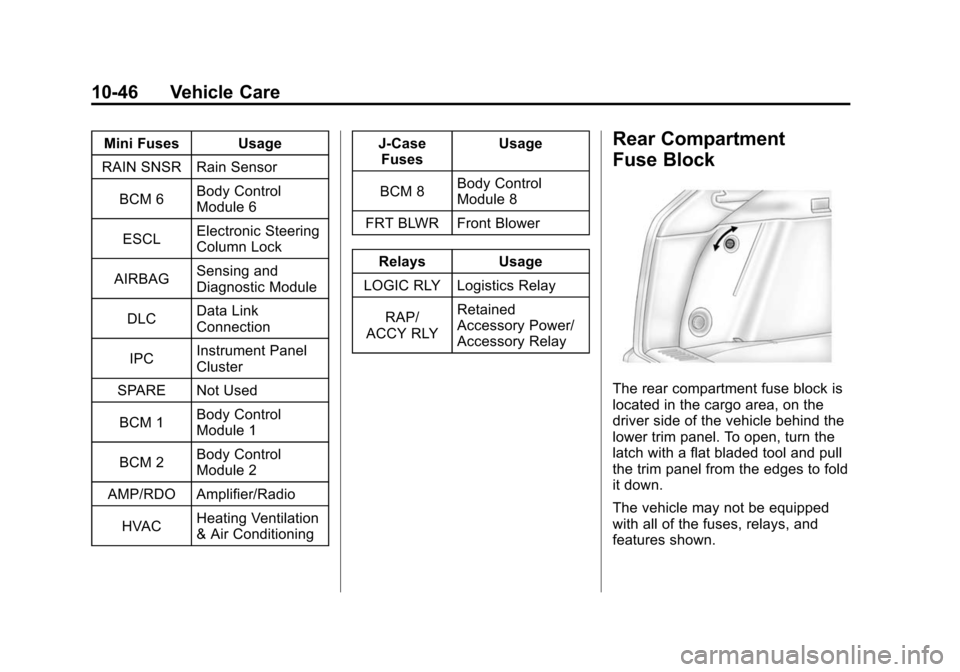
The rear compartment fuse block is
located in the cargo area, on the
driver side of the vehicle behind the
lower trim panel. To open, turn the
latch with a flat bladed tool and pull
the trim panel from the edges to fold
it down.
The vehicle may not be equipped
with all of the fuses, relays, and
features shown.
Page 385 of 502

Black plate (53,1)Cadillac SRX Owner Manual (Include Mex) - 2012
Vehicle Care 10-53
Tire Terminology and
Definitions
Air Pressure:The amount of
air inside the tire pressing
outward on each square inch
of the tire. Air pressure is
expressed in kPa (kilopascal)
or psi (pounds per square inch).
Accessory Weight
:The
combined weight of optional
accessories. Some examples of
optional accessories are
automatic transmission, power
steering, power brakes, power
windows, power seats, and air
conditioning.
Aspect Ratio
:The relationship
of a tire's height to its width. Belt
:A rubber coated layer of
cords that is located between
the plies and the tread. Cords
may be made from steel or other
reinforcing materials.
Bead
:The tire bead contains
steel wires wrapped by steel
cords that hold the tire onto
the rim.
Bias Ply Tire
:A pneumatic tire
in which the plies are laid at
alternate angles less than
90 degrees to the centerline of
the tread.
Cold Tire Pressure
:The
amount of air pressure in a tire,
measured in kPa (kilopascal)
or psi (pounds per square inch)
before a tire has built up heat
from driving. See Tire Pressure
on page 10‑56. Curb Weight
:The weight of a
motor vehicle with standard and
optional equipment including the
maximum capacity of fuel, oil,
and coolant, but without
passengers and cargo.
DOT Markings
:A code molded
into the sidewall of a tire
signifying that the tire is in
compliance with the U.S.
Department of Transportation
(DOT) Motor Vehicle Safety
Standards. The DOT code
includes the Tire Identification
Number (TIN), an alphanumeric
designator which can also
identify the tire manufacturer,
production plant, brand, and
date of production.
GVWR
:Gross Vehicle Weight
Rating. See Vehicle Load Limits
on page 9‑12.
Page 403 of 502
Black plate (71,1)Cadillac SRX Owner Manual (Include Mex) - 2012
Vehicle Care 10-71
WARNING (Continued)
parts. The area damaged by the
tire chains could cause loss of
control and a crash.
Use another type of traction
device only if its manufacturer
recommends it for the vehicle's
tire size combination and road
conditions. Follow that
manufacturer's instructions.
To avoid vehicle damage, drive
slow and readjust or remove the
traction device if it contacts the
vehicle. Do not spin the wheels.
If traction devices are used,
install them on the front tires.
If a Tire Goes Flat
It is unusual for a tire to blow out,
especially if the tires are maintained
properly. SeeTires on page 10‑49.
If air goes out of a tire, it is much
more likely to leak out slowly. But if
there is ever a blowout, here are a
few tips about what to expect and
what to do:
If a front tire fails, the flat tire
creates a drag that pulls the vehicle
toward that side. Take your foot off
the accelerator pedal and grip the
steering wheel firmly. Steer to
maintain lane position, and then
gently brake to a stop, well off the
road, if possible.
A rear blowout, particularly on a
curve, acts much like a skid and
may require the same correction
as used in a skid. Stop pressing
the accelerator pedal and
steer to straighten the vehicle. It may be very bumpy and noisy.
Gently brake to a stop, well off the
road, if possible.
{WARNING
Driving on a flat tire will cause
permanent damage to the tire.
Re-inflating a tire after it has
been driven on while severely
underinflated or flat may cause a
blowout and a serious crash.
Never attempt to re-inflate a tire
that has been driven on while
severely underinflated or flat.
Have your dealer or an authorized
tire service center repair or
replace the flat tire as soon as
possible.
Page 430 of 502
Black plate (98,1)Cadillac SRX Owner Manual (Include Mex) - 2012
10-98 Vehicle Care
Weatherstrips
Apply silicone grease on
weatherstrips to make them last
longer, seal better, and not stick or
squeak. SeeRecommended Fluids
and Lubricants on page 11‑13
Tires
Use a stiff brush with tire cleaner to
clean the tires.
Notice: Using petroleum-based
tire dressing products on the
vehicle may damage the paint
finish and/or tires. When applying
a tire dressing, always wipe off
any overspray from all painted
surfaces on the vehicle.
Wheels and Trim —Aluminum
or Chrome
Use a soft, clean cloth with mild
soap and water to clean the wheels.
After rinsing thoroughly with clean
water, dry with a soft, clean towel.
A wax may then be applied.
Keep the wheels clean using a soft,
clean cloth with mild soap and
water. Rinse with clean water.
After rinsing thoroughly, dry with a
soft, clean towel. A wax may then
be applied.
Notice: Chrome wheels and other
chrome trim may be damaged if
the vehicle is not washed after
driving on roads that have been
sprayed with magnesium,
calcium, or sodium chloride.
These chlorides are used on
roads for conditions such as
ice and dust. Always wash the
chrome with soap and water after
exposure. Notice:
To avoid surface
damage, do not use strong soaps,
chemicals, abrasive polishes,
cleaners, brushes, or cleaners
that contain acid on aluminum or
chrome-plated wheels. Use only
approved cleaners. Also, never
drive a vehicle with aluminum or
chrome-plated wheels through an
automatic car wash that uses
silicone carbide tire cleaning
brushes. Damage could occur
and the repairs would not be
covered by the vehicle warranty.
Steering, Suspension, and
Chassis Components
Visually inspect front and rear
suspension and steering system for
damaged, loose, or missing parts
or signs of wear. Inspect power
steering lines and hoses for proper
hook-up, binding, leaks, cracks,
chafing, etc. Visually check constant
velocity joints, rubber boots, and
axle seals for leaks.
Page 441 of 502

Black plate (5,1)Cadillac SRX Owner Manual (Include Mex) - 2012
Service and Maintenance 11-5
.Visually inspect windshield
wiper blades for wear, cracking,
or contamination. SeeExterior
Care on page 10‑96. Replace
worn or damaged wiper blades.
See Wiper Blade Replacement
on page 10‑26.
.Check tire inflation pressures.
See Tire Pressure on
page 10‑56.
.Inspect tire wear. See Tire
Inspection on page 10‑63.
.Visually check for fluid leaks.
.Inspect engine air cleaner filter.
See Engine Air Cleaner/Filter on
page 10‑12.
.Inspect brake system.
.Visually inspect steering,
suspension, and chassis
components for damaged,
loose, or missing parts or signs
of wear. See Exterior Care on
page 10‑96.
.Check restraint system
components. See Safety
System Check on page 3‑21.
.Visually inspect fuel system for
damage or leaks.
.Visually inspect exhaust system
and nearby heat shields for
loose or damaged parts.
.Lubricate body components.
See Exterior Care on
page 10‑96.
.Check starter switch.
See Starter Switch Check on
page 10‑25.
.Check automatic transmission
shift lock control function.
See Automatic Transmission
Shift Lock Control Function
Check on page 10‑25.
.Check parking brake and
automatic transmission park
mechanism. See Park Brake and
P (Park) Mechanism Check on
page 10‑26.
.Check accelerator pedal for
damage, high effort, or binding.
Replace if needed.
.Visually inspect gas strut for
signs of wear, cracks, or other
damage. Check the hold open
ability of the strut. See your
dealer if service is required.
.Check tire sealant expiration
date, if equipped. See Tire
Sealant and Compressor Kit on
page 10‑73.
.Inspect sunroof track and seal,
if equipped. See Sunroof on
page 2‑27.
Page 447 of 502
Black plate (11,1)Cadillac SRX Owner Manual (Include Mex) - 2012
Service and Maintenance 11-11
Fluids
Proper fluid levels and approved
fluids protect the vehicle’s
systems and components.
SeeRecommended Fluids and
Lubricants on page 11‑13 for
GM approved fluids.
.Engine oil and windshield
washer fluid levels should be
checked at every fuel fill.
.Instrument cluster lights may
come on to indicate that fluids
may be low and need to be
filled.
Hoses
Hoses transport fluids and should
be regularly inspected to ensure
that there are no cracks or leaks.
With a multi‐point inspection, your
dealer can inspect the hoses and
advise if replacement is needed. Lamps
Properly working headlamps,
taillamps, and brake lamps are
important to see and be seen on
the road.
.Signs that the headlamps need
attention include dimming, failure
to light, cracking, or damage.
The brake lamps need to be
checked periodically to ensure
that they light when braking.
.With a multi‐point inspection,
your dealer can check the lamps
and note any concerns.
Shocks and Struts
Shocks and struts help aid in
control for a smoother ride.
.Signs of wear may include
steering wheel vibration,
bounce/sway while braking,
longer stopping distance,
or uneven tire wear.
.As part of the multi‐point
inspection, trained dealer
technicians can visually inspect
the shocks and struts for signs
of leaking, blown seals,
or damage, and can advise
when service is needed.
Page 449 of 502
Black plate (13,1)Cadillac SRX Owner Manual (Include Mex) - 2012
Service and Maintenance 11-13
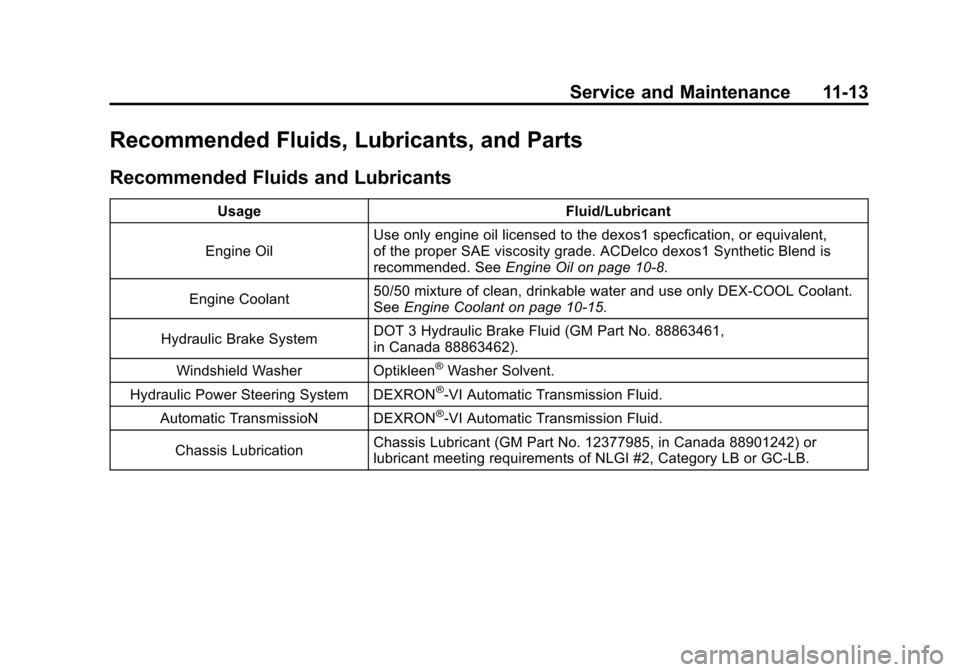
Recommended Fluids, Lubricants, and Parts
Recommended Fluids and Lubricants
UsageFluid/Lubricant
Engine Oil Use only engine oil licensed to the dexos1 specfication, or equivalent,
of the proper SAE viscosity grade. ACDelco dexos1 Synthetic Blend is
recommended. See
Engine Oil on page 10‑8.
Engine Coolant 50/50 mixture of clean, drinkable water and use only DEX-COOL Coolant.
See
Engine Coolant on page 10‑15.
Hydraulic Brake System DOT 3 Hydraulic Brake Fluid (GM Part No. 88863461,
in Canada 88863462).
Windshield Washer Optikleen
®Washer Solvent.
Hydraulic Power Steering System DEXRON
®-VI Automatic Transmission Fluid.
Automatic TransmissioN DEXRON
®-VI Automatic Transmission Fluid.
Chassis Lubrication Chassis Lubricant (GM Part No. 12377985, in Canada 88901242) or
lubricant meeting requirements of NLGI #2, Category LB or GC-LB.
Page 475 of 502
Black plate (17,1)Cadillac SRX Owner Manual (Include Mex) - 2012
Customer Information 13-17
Managing the Vehicle Damage
Repair Process
In the event that the vehicle requires
damage repairs, GM recommends
that you take an active role in its
repair. If you have a pre-determined
repair facility of choice, take the
vehicle there, or have it towed there.
Specify to the facility that any
required replacement collision parts
be original equipment parts, either
new Genuine GM parts or recycled
original GM parts. Remember,
recycled parts will not be covered
by the GM vehicle warranty.
Insurance pays the bill for the
repair, but you must live with the
repair. Depending on your policy
limits, your insurance company
may initially value the repair using
aftermarket parts. Discuss this withthe repair professional, and insist on
Genuine GM parts. Remember,
if the vehicle is leased, you may be
obligated to have the vehicle
repaired with Genuine GM parts,
even if your insurance coverage
does not pay the full cost.
If another party's insurance
company is paying for the repairs,
you are not obligated to accept a
repair valuation based on that
insurance company's collision
policy repair limits, as you have
no contractual limits with that
company. In such cases, you can
have control of the repair and parts
choices as long as the cost stays
within reasonable limits.
Service Publications
Ordering Information
Service Manuals
Service Manuals have the diagnosis
and repair information on the
engines, transmission, axle,
suspension, brakes, electrical,
steering, body, etc.
Service Bulletins
Service Bulletins give additional
technical service information
needed to knowledgeably service
General Motors cars and trucks.
Each bulletin contains instructions
to assist in the diagnosis and
service of the vehicle.
Page 493 of 502

Black plate (5,1)Cadillac SRX Owner Manual (Include Mex) - 2012
INDEX i-5
F
FeaturesMemory . . . . . . . . . . . . . . . . . . . . . . . . 1-8
Filter, Engine Air Cleaner . . . . . . . . . 10-12
Flash-to-Pass . . . . . . . . . . . . . . . . . . . 6-2
Flashers, Hazard Warning . . . . . . 6-5
Flat Tire . . . . . . . . . . . . . . . . . . . . . . 10-71 Changing . . . . . . . . . . . . . . . . . . . 10-81
Floor Mats . . . . . . . . . . . . . . . . . . .10-102
Fluid Automatic Transmission . . . . 10-12
Brakes . . . . . . . . . . . . . . . . . . . . . . 10-22
Power Steering . . . . . . . . . . . . . 10-20
Washer . . . . . . . . . . . . . . . . . . . . . 10-20
Fog Lamps
Bulb Replacement . . . . . . . . . . 10-37
Front . . . . . . . . . . . . . . . . . . . . . . . . . . 6-6
Folding Mirrors . . . . . . . . . . . . . . . . 2-21
Front Fog Lamp Light . . . . . . . . . . . . . . . . . . . . . . . . . . 5-27 Front Seats
Adjustment . . . . . . . . . . . . . . . . . . . . 3-4
Heated and Ventilated . . . . . . . . 3-10
Front Storage . . . . . . . . . . . . . . . . . . . 4-2
Fuel . . . . . . . . . . . . . . . . . . . . . . . . . . . 9-46 Additives . . . . . . . . . . . . . . . . . . . . . 9-48
E85 (85% Ethanol) . . . . . . . . . . . 9-49
Economy Light . . . . . . . . . . . . . . . 5-25
Filling a Portable FuelContainer . . . . . . . . . . . . . . . . . . . 9-52
Filling the Tank . . . . . . . . . . . . . . . 9-50
Fuels in Foreign Countries . . . . 9-48
Gasoline Specifications . . . . . . . 9-47
Gauge . . . . . . . . . . . . . . . . . . . . . . . . 5-12
Low Fuel Warning Light . . . . . . . 5-26
Recommended . . . . . . . . . . . . . . . 9-47
Requirements, California . . . . . 9-48
System Messages . . . . . . . . . . . . 5-36
Fuel Economy Driving . . . . . . . . . . . . . . . . . . . . . . . . 1-23
Fuel Economy Gauge . . . . . . . . . 5-13
Fuel Economy Mode . . . . . . . . . . . 9-29 Fuses
Engine Compartment
Fuse Block . . . . . . . . . . . . . . . . 10-42
Fuses and Circuit Breakers . . . . . . . . . . . . . . . . . . 10-41
Instrument Panel Fuse Block . . . . . . . . . . . . . . . . . . . . . . 10-44
Rear Compartment Fuse Block . . . . . . . . . . . . . . . . . . . . . . 10-46
G
Garage Door Opener . . . . . . . . . . 5-46Programming . . . . . . . . . . . . . . . . . 5-46
Gasoline Specifications . . . . . . . . . . . . . . . . . 9-47
Gasoline Engine, Starting . . . . . . 9-20
Gauges Engine Coolant
Temperature . . . . . . . . . . . . . . . . 5-14
Fuel . . . . . . . . . . . . . . . . . . . . . . . . . . 5-12
Fuel Economy . . . . . . . . . . . . . . . . 5-13
Odometer . . . . . . . . . . . . . . . . . . . . . 5-12
Speedometer . . . . . . . . . . . . . . . . . 5-12
Tachometer . . . . . . . . . . . . . . . . . . . 5-12
Warning Lights and Indicators . . . . . . . . . . . . . . . . . . . 5-10