trailer CADILLAC SRX 2015 2.G Owner's Manual
[x] Cancel search | Manufacturer: CADILLAC, Model Year: 2015, Model line: SRX, Model: CADILLAC SRX 2015 2.GPages: 417, PDF Size: 4.59 MB
Page 258 of 417

Black plate (67,1)Cadillac SRX Owner Manual (GMNA-Localizing-U.S./Canada/Mexico-
7707476) - 2015 - crc - 4/8/14
Driving and Operating 9-67
When TSC is applying the brakes,
the TCS/StabiliTrak indicator light
flashes to notify the driver to reduce
speed. If the trailer continues to
sway, StabiliTrak will reduce engine
torque to help slow the vehicle.
TSC will not function if StabiliTrak is
turned off. SeeTraction Control/
Electronic Stability Control on
page 9-30.
Conversions and
Add-Ons
Add-On Electrical
Equipment
{Caution
Some electrical equipment can
damage the vehicle or cause
components to not work and
would not be covered by the
warranty. Always check with your
dealer before adding electrical
equipment.
Add-on equipment can drain the
vehicle's 12-volt battery, even if the
vehicle is not operating.
The vehicle has an airbag system.
Before attempting to add anything
electrical to the vehicle, see
Servicing the Airbag-Equipped
Vehicle on page 3-30 andAdding
Equipment to the Airbag-Equipped
Vehicle on page 3-31.
Page 276 of 417
Black plate (17,1)Cadillac SRX Owner Manual (GMNA-Localizing-U.S./Canada/Mexico-
7707476) - 2015 - crc - 4/8/14
Vehicle Care 10-17
Then check to see if the engine
cooling fans are running. If the
engine is overheating, both fans
should be running. If they are not,
do not continue to run the engine
and have the vehicle serviced.
{Caution
Running the engine without
coolant may cause damage or a
fire. Vehicle damage would not be
covered by the vehicle warranty.
If Steam Is Coming from the
Engine Compartment
{Warning
Steam from an overheated engine
can burn you badly, even if you
just open the hood. Stay away
from the engine if you see or hear
steam coming from it. Just turn it
off and get everyone away from
the vehicle until it cools down.(Continued)
Warning (Continued)
Wait until there is no sign of
steam or coolant before you open
the hood.
If you keep driving when the
engine is overheated, the liquids
in it can catch fire. You or others
could be badly burned. Stop the
engine if it overheats, and get out
of the vehicle until the engine
is cool.
If No Steam Is Coming from
the Engine Compartment
If an engine overheat warning is
displayed but no steam can be seen
or heard, the problem may not be
too serious. Sometimes the engine
can get a little too hot when the
vehicle:
.Climbs a long hill on a hot day.
.Stops after high-speed driving.
.Idles for long periods in traffic.
.Tows a trailer.
If the overheat warning displays with
no sign of steam:
1. Turn the air conditioning off.
2. Turn the heater on to the highest temperature and to the highest
fan speed. Open the windows as
necessary.
3. When it is safe to do so, pull off the road, shift to P (Park) or
N (Neutral), and let the
engine idle.
If the temperature overheat gauge is
no longer in the overheat zone or an
overheat warning no longer
displays, the vehicle can be driven.
Continue to drive the vehicle slowly
for about 10 minutes. Keep a safe
vehicle distance from the vehicle in
front. If the warning does not come
back on, continue to drive normally
and have the cooling system
checked for proper fill and function.
If the warning continues, pull over,
stop, and park the vehicle
right away.
Page 294 of 417
Black plate (35,1)Cadillac SRX Owner Manual (GMNA-Localizing-U.S./Canada/Mexico-
7707476) - 2015 - crc - 4/8/14
Vehicle Care 10-35
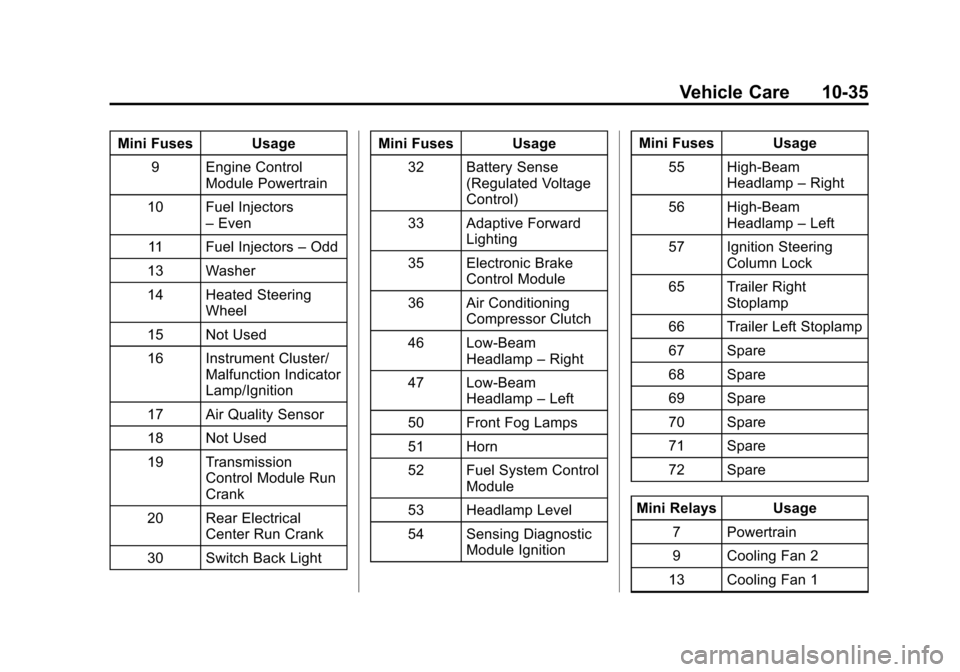
Mini Fuses Usage9 Engine Control Module Powertrain
10 Fuel Injectors –Even
11 Fuel Injectors –Odd
13 Washer
14 Heated Steering Wheel
15 Not Used
16 Instrument Cluster/ Malfunction Indicator
Lamp/Ignition
17 Air Quality Sensor
18 Not Used
19 Transmission Control Module Run
Crank
20 Rear Electrical Center Run Crank
30 Switch Back Light Mini Fuses Usage
32 Battery Sense (Regulated Voltage
Control)
33 Adaptive Forward Lighting
35 Electronic Brake Control Module
36 Air Conditioning Compressor Clutch
46 Low-Beam Headlamp –Right
47 Low-Beam Headlamp –Left
50 Front Fog Lamps
51 Horn
52 Fuel System Control Module
53 Headlamp Level
54 Sensing Diagnostic Module Ignition Mini Fuses Usage
55 High-Beam Headlamp –Right
56 High-Beam Headlamp –Left
57 Ignition Steering Column Lock
65 Trailer Right Stoplamp
66 Trailer Left Stoplamp
67 Spare
68 Spare
69 Spare
70 Spare
71 Spare
72 Spare
Mini Relays Usage 7 Powertrain
9 Cooling Fan 2
13 Cooling Fan 1
Page 299 of 417
Black plate (40,1)Cadillac SRX Owner Manual (GMNA-Localizing-U.S./Canada/Mexico-
7707476) - 2015 - crc - 4/8/14
10-40 Vehicle Care
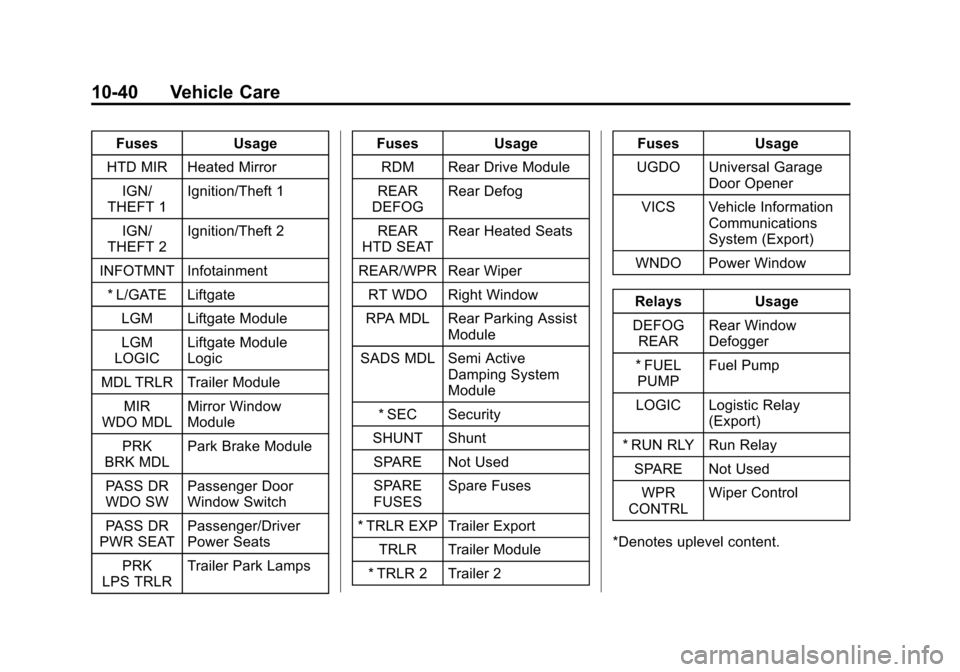
FusesUsage
HTD MIR Heated Mirror IGN/
THEFT 1 Ignition/Theft 1
IGN/
THEFT 2 Ignition/Theft 2
INFOTMNT Infotainment * L/GATE Liftgate LGM Liftgate Module
LGM
LOGIC Liftgate Module
Logic
MDL TRLR Trailer Module MIR
WDO MDL Mirror Window
Module
PRK
BRK MDL Park Brake Module
PASS DR
WDO SW Passenger Door
Window Switch
PASS DR
PWR SEAT Passenger/Driver
Power Seats
PRK
LPS TRLR Trailer Park Lamps Fuses
Usage
RDM Rear Drive Module
REAR
DEFOG Rear Defog
REAR
HTD SEAT Rear Heated Seats
REAR/WPR Rear Wiper RT WDO Right Window
RPA MDL Rear Parking Assist Module
SADS MDL Semi Active Damping System
Module
* SEC Security
SHUNT Shunt SPARE Not Used
SPARE
FUSES Spare Fuses
* TRLR EXP Trailer Export TRLR Trailer Module
* TRLR 2 Trailer 2 Fuses
Usage
UGDO Universal Garage Door Opener
VICS Vehicle Information Communications
System (Export)
WNDO Power Window
Relays Usage
DEFOG REAR Rear Window
Defogger
* FUEL PUMP Fuel Pump
LOGIC Logistic Relay (Export)
* RUN RLY Run Relay SPARE Not UsedWPR
CONTRL Wiper Control
*Denotes uplevel content.
Page 342 of 417

Black plate (83,1)Cadillac SRX Owner Manual (GMNA-Localizing-U.S./Canada/Mexico-
7707476) - 2015 - crc - 4/8/14
Vehicle Care 10-83
Towing the Vehicle
{Caution
Incorrectly towing a disabled
vehicle may cause damage. The
damage would not be covered by
the vehicle warranty.
Have the vehicle towed on a flatbed
car carrier. A wheel lift tow truck
could damage the vehicle.
Consult your dealer or a
professional towing service if the
disabled vehicle must be towed.
Recreational Vehicle
Towing
Recreational vehicle towing means
towing the vehicle behind another
vehicle, such as behind a motor
home. The two most common types
of recreational vehicle towing are
known as dinghy towing and dolly
towing. Dinghy towing is towing the
vehicle with all four wheels on the ground. Dolly towing is towing the
vehicle with two wheels on the
ground and two wheels up on a
device known as a dolly.
Here are some important things to
consider before recreational vehicle
towing:
.The towing capacity of the
towing vehicle. Be sure to read
the tow vehicle manufacturer's
recommendations.
.How far the vehicle will be
towed. Some vehicles have
restrictions on how far and how
long they can tow.
.The proper towing equipment.
See your dealer or trailering
professional for additional advice
and equipment
recommendations.
.If the vehicle is ready to be
towed. Just as preparing the
vehicle for a long trip, make sure
the vehicle is prepared to be
towed.
Dinghy Towing
Front-wheel-drive and
all-wheel-drive vehicles may be
dinghy towed from the front. These
vehicles can also be towed by
placing them on a platform trailer
with all four wheels off of the
ground. For other towing options,
see the information on dolly towing
that follows.
{Caution
If 105 km/h (65 mph) is exceeded
while towing the vehicle, it could
be damaged. Never exceed
105 km/h (65 mph) while towing
the vehicle.
For vehicles being dinghy towed,
the vehicle should be run at the
beginning of each day and at each
RV fuel stop for about five minutes.
This will ensure proper lubrication of
transmission components.
Page 344 of 417
Black plate (85,1)Cadillac SRX Owner Manual (GMNA-Localizing-U.S./Canada/Mexico-
7707476) - 2015 - crc - 4/8/14
Vehicle Care 10-85
Once the destination has been
reached:
1. Shift the vehicle to P (Park).
2. Reinstall the shift lever boot byinserting the front edge and
pressing the rear of the trim
plate until it snaps into place.
3. Start the engine and let it idle for more than three minutes before
driving the vehicle.
{Caution
Too much or too little fluid can
damage the transmission. Be
sure that the transmission fluid is
at the proper level before towing
with all four wheels on the
ground.
{Caution
Do not tow a vehicle with the front
drive wheels on the ground if one
of the front tires is a compact
spare tire. Towing with two
different tire sizes on the front of
the vehicle can cause severe
damage to the transmission.
Dolly Towing (All-Wheel-Drive
Vehicles)
All-wheel-drive vehicles should not
be towed with two wheels on the
ground. To properly tow these
vehicles, they should be placed on
a platform trailer with all four wheels
off of the ground or dinghy towed
from the front. See “Dinghy Towing”
earlier in this section.
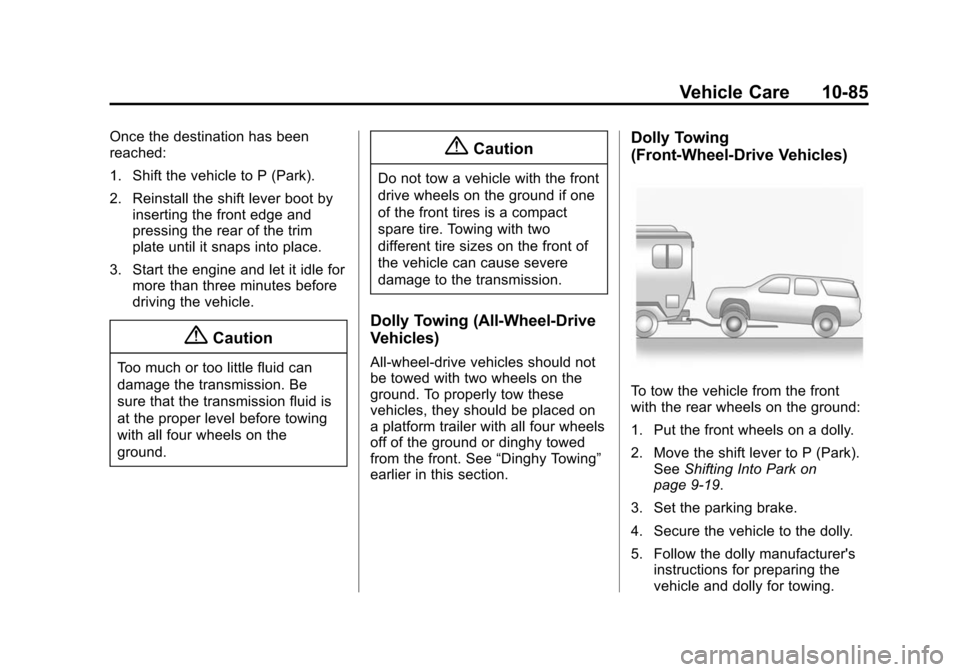
Dolly Towing
(Front-Wheel-Drive Vehicles)
To tow the vehicle from the front
with the rear wheels on the ground:
1. Put the front wheels on a dolly.
2. Move the shift lever to P (Park).
See Shifting Into Park on
page 9-19.
3. Set the parking brake.
4. Secure the vehicle to the dolly.
5. Follow the dolly manufacturer's instructions for preparing the
vehicle and dolly for towing.
Page 357 of 417
Black plate (2,1)Cadillac SRX Owner Manual (GMNA-Localizing-U.S./Canada/Mexico-
7707476) - 2015 - crc - 4/8/14
11-2 Service and Maintenance
technicians, the dealer is the place
for routine maintenance such as oil
changes and tire rotations and
additional maintenance items like
tires, brakes, batteries, and wiper
blades.
{Caution
Damage caused by improper
maintenance can lead to costly
repairs and may not be covered
by the vehicle warranty.
Maintenance intervals, checks,
inspections, recommended fluids,
and lubricants are important to
keep the vehicle in good working
condition.
The Tire Rotation and Required
Services are the responsibility of the
vehicle owner. It is recommended to
have your dealer perform these
services every 12 000 km/7,500 mi.
Proper vehicle maintenance helps to
keep the vehicle in good working
condition, improves fuel economy,
and reduces vehicle emissions. Because of the way people use
vehicles, maintenance needs vary.
There may need to be more
frequent checks and services. The
Additional Required Services -
Normal are for vehicles that:
.Carry passengers and cargo
within recommended limits on
the Tire and Loading Information
label. See
Vehicle Load Limits
on page 9-9.
.Are driven on reasonable road
surfaces within legal driving
limits.
.Use the recommended fuel. See
Fuel on page 9-56.
Refer to the information in the
Maintenance Schedule Additional
Required Services - Normal chart.
The Additional Required Services -
Severe are for vehicles that are:
.Mainly driven in heavy city traffic
in hot weather.
.Mainly driven in hilly or
mountainous terrain.
.Frequently towing a trailer.
.Used for high speed or
competitive driving.
.Used for taxi, police, or delivery
service.
Refer to the information in the
Maintenance Schedule Additional
Required Services - Severe chart.
{Warning
Performing maintenance work can
be dangerous and can cause
serious injury. Perform
maintenance work only if the
required information, proper tools,
and equipment are available.
If they are not, see your dealer to
have a trained technician do the
work. See Doing Your Own
Service Work on page 10-3.
Page 415 of 417

Black plate (12,1)Cadillac SRX Owner Manual (GMNA-Localizing-U.S./Canada/Mexico-
7707476) - 2015 - crc - 4/8/14
i-12 INDEX
Tires . . . . . . . . . . . . . . . . . . . . . . . . . . 10-41All-Season . . . . . . . . . . . . . . . . . . 10-42
Buying New Tires . . . . . . . . . . . 10-57
Chains . . . . . . . . . . . . . . . . . . . . . . 10-61
Changing . . . . . . . . . . . . . . . . . . . 10-72
Compact Spare . . . . . . . . . . . . . 10-78
Designations . . . . . . . . . . . . . . . 10-45
Different Size . . . . . . . . . . . . . . . 10-58
If a Tire Goes Flat . . . . . . . . . . 10-62
Inflation Monitor System . . . . 10-51
Inspection . . . . . . . . . . . . . . . . . . 10-54
Messages . . . . . . . . . . . . . . . . . . . . 5-36
Pressure . . . . . . . . . . . . . . . . . . . . 10-49
Pressure Light . . . . . . . . . . . . . . . . 5-22
Pressure Monitor System . . . 10-50
Rotation . . . . . . . . . . . . . . . . . . . . 10-55
Sealant and
Compressor Kit . . . . . . . . . . . 10-63
Sealant and Compressor Kit, Storing . . . . . . . . . . . . . . . . 10-71
Sidewall Labeling . . . . . . . . . . . 10-43
Terminology and
Definitions . . . . . . . . . . . . . . . . . 10-45
Uniform Tire Quality Grading . . . . . . . . . . . . . . . . . . . 10-59 Tires (cont'd)
Wheel Alignment and Tire
Balance . . . . . . . . . . . . . . . . . . . 10-60
Wheel Replacement . . . . . . . . 10-60
When It Is Time for New
Tires . . . . . . . . . . . . . . . . . . . . . . 10-56
Winter . . . . . . . . . . . . . . . . . . . . . . 10-42
Towing Driving Characteristics . . . . . . . . 9-60
Equipment . . . . . . . . . . . . . . . . . . . . 9-65
General Information . . . . . . . . . . 9-60
Recreational Vehicle . . . . . . . . 10-83
Trailer . . . . . . . . . . . . . . . . . . . . . . . . 9-63
Trailer Sway Control (TSC) . . . 9-66
Vehicle . . . . . . . . . . . . . . . . . . . . . 10-83
Traction Control System (TCS)/StabiliTrak
®Light . . . . . . . . . . . . 5-21
Limited-Slip Rear Axle . . . . . . . . 9-32
Off Light . . . . . . . . . . . . . . . . . . . . . . 5-20
Selective Ride Control . . . . . . . . 9-32
Traction Control/Electronic Stability Control . . . . . . . . . . . . . . 9-30 Trailer
Sway Control (TSC) . . . . . . . . . . 9-66
Towing . . . . . . . . . . . . . . . . . . . . . . . . 9-63
Transmission Automatic . . . . . . . . . . . . . . . . . . . . . 9-22
Fluid, Automatic . . . . . . . . . . . . 10-10
Messages . . . . . . . . . . . . . . . . . . . . 5-37
Transportation Program, Courtesy . . . . . . . . . . . . . . . . . . . . . 13-7
Trip Odometer . . . . . . . . . . . . . . . . . 5-10
Turn and Lane-Change Signals . . . . . . . . . . . . . . . . . . . . . . . . 6-6
Twilight Sentinel . . . . . . . . . . . . . . . . 6-4
U
Uniform Tire Quality Grading . . . . . . . . . . . . . . . . . . . . . 10-59
Universal Remote System . . . . . 5-45
Operation . . . . . . . . . . . . . . . . . . . . . 5-48
Programming . . . . . . . . . . . . . . . . . 5-45
Using This Manual . . . . . . . . . . . . . . . . iii