seats CADILLAC STS 2006 1.G Owner's Guide
[x] Cancel search | Manufacturer: CADILLAC, Model Year: 2006, Model line: STS, Model: CADILLAC STS 2006 1.GPages: 480, PDF Size: 2.74 MB
Page 374 of 480
Tire Size
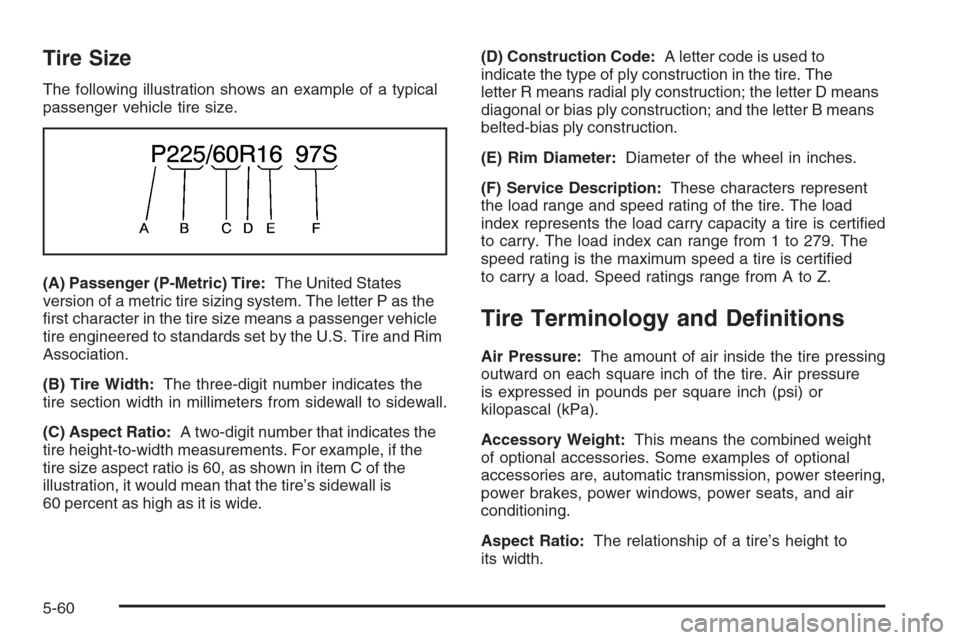
The following illustration shows an example of a typical
passenger vehicle tire size.
(A) Passenger (P-Metric) Tire:The United States
version of a metric tire sizing system. The letter P as the
rst character in the tire size means a passenger vehicle
tire engineered to standards set by the U.S. Tire and Rim
Association.
(B) Tire Width:The three-digit number indicates the
tire section width in millimeters from sidewall to sidewall.
(C) Aspect Ratio:A two-digit number that indicates the
tire height-to-width measurements. For example, if the
tire size aspect ratio is 60, as shown in item C of the
illustration, it would mean that the tire’s sidewall is
60 percent as high as it is wide.(D) Construction Code:A letter code is used to
indicate the type of ply construction in the tire. The
letter R means radial ply construction; the letter D means
diagonal or bias ply construction; and the letter B means
belted-bias ply construction.
(E) Rim Diameter:Diameter of the wheel in inches.
(F) Service Description:These characters represent
the load range and speed rating of the tire. The load
index represents the load carry capacity a tire is certied
to carry. The load index can range from 1 to 279. The
speed rating is the maximum speed a tire is certied
to carry a load. Speed ratings range from A to Z.
Tire Terminology and Denitions
Air Pressure:The amount of air inside the tire pressing
outward on each square inch of the tire. Air pressure
is expressed in pounds per square inch (psi) or
kilopascal (kPa).
Accessory Weight:This means the combined weight
of optional accessories. Some examples of optional
accessories are, automatic transmission, power steering,
power brakes, power windows, power seats, and air
conditioning.
Aspect Ratio:The relationship of a tire’s height to
its width.
5-60
Page 419 of 480
Power Windows and Other
Power Options
Circuit breakers protect the power windows and power
seats. When the current load is too heavy, the circuit
breaker opens and closes, protecting the circuit until the
problem is xed or goes away.
Fuses and Circuit Breakers
The wiring circuits in your vehicle are protected from
short circuits by a combination of fuses, circuit breakers
and fusible thermal links. This greatly reduces the
chance of res caused by electrical problems.Look at the silver-colored band inside the fuse. If the
band is broken or melted, replace the fuse. Be sure you
replace a bad fuse with a new one of the identical
size and rating. If a fuse should blow, see your dealer
for service immediately.
If you ever have a problem on the road and don’t have
a spare fuse, you can borrow one that has the same
amperage. Just pick some feature of your vehicle
that you can get along without — like the radio or
cigarette lighter — and use its fuse, if it is the correct
amperage. Replace it as soon as you can.
The fuses are located in three fuse blocks. One is
located in the engine compartment, on the passenger’s
side of the vehicle, and the other two are located
under the rear seat on both the driver’s and passenger’s
side of the vehicle.
5-105
Page 424 of 480
Rear Underseat Fuse Block
Removing the Rear Seat Cushion
Notice:If you touch the exposed wires with the
metal on the seat cushion, you could cause a short
that could damage the battery and or wires. Avoid
contact between the rear seat and the fuse center
whenever you remove or reinstall the rear seat. Do
not remove covers from any of the covered parts,
and do not store anything under the seats.
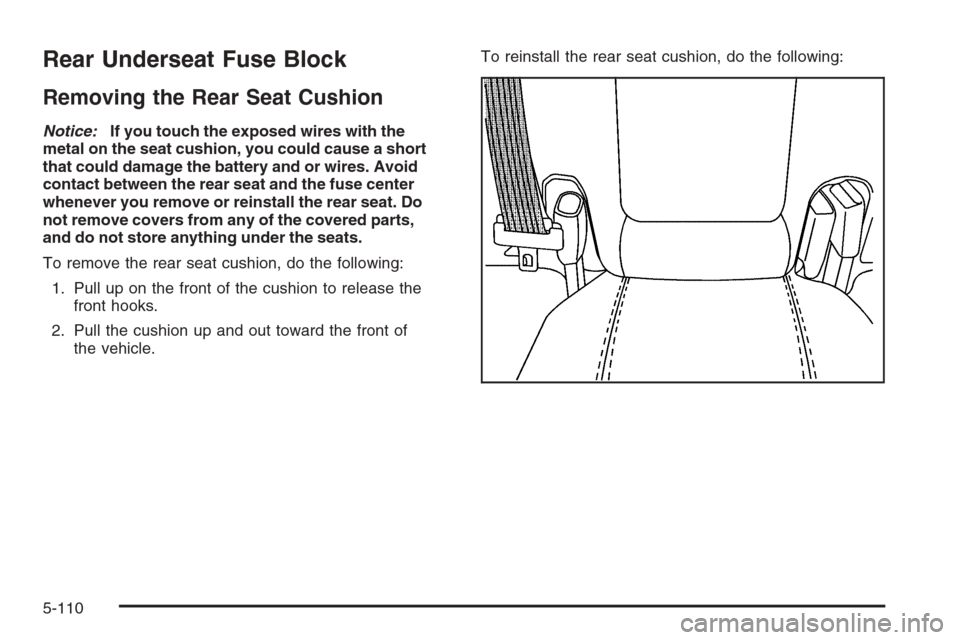
To remove the rear seat cushion, do the following:
1. Pull up on the front of the cushion to release the
front hooks.
2. Pull the cushion up and out toward the front of
the vehicle.To reinstall the rear seat cushion, do the following:
5-110
Page 426 of 480

Driver’s Side
Fuses Usage
AMP Amplier
INTERCOOLER
PUMP (OPT)Intercooler Pump (Option)
THEFT/
SHIFTERTheft Sensors, Auto Shifter,
Power Sounder
MR-RTD MOD
(OPT)Magnetic Ride Control
Module (Option)
REAR DR MOD Rear Door Modules
ELC SOL
(OPT)Automatic Level Control, Exhaust
Solenoid (Option)
DRIVER DR
MODDriver Door Module
TV/VICS Infotainment (Export Only)Fuses Usage
REAR HTD
SEATSRear Heated Seats
SPARE Spare
SPARE Spare
IGN3Front Passenger Heated Seat, Auto
Shifter, Occupant Protection
RR SHLF
SPEAKERRear Shelf Speaker
DPM Memory Seat, Lumbar
TRUNK DR
VALETTrunk Release, Valet Lockout
Switch
REVERSE
LAMPReverse Lamps, Rear Parking Aid,
Inside Rearview Mirror
5-112
Page 427 of 480

Fuses Usage
AIR BAG Airbag
POSITION
LAMPS (OPT)Rear Taillamps
JOINT
CONNECTORJoint Connector
Relays Usage
INTERCOOLER
PUMP
MICRO (OPT)Intercooler Pump (Option)
ELC RELAY
MINI (OPT)Automatic Level Control
Compressor (Option)
L POSITION
RELAY MICROLeft Rear Taillamp, Position
Lamps (Option)
TRUNK DR
REL RELAY
MICROTrunk Release Motor
REV LAMP
RELAY MICROReverse Lamps, Rear Parking Aid,
Inside Rearview Mirror
Relays Usage
R POSITION
RELAY MICRORight Rear Taillamp, Position
Lamps (Option)
RUN RELAY
MICROIgnition 3
ELC RELAY
(OPT)Automatic Level Control (Option)
STNDBY
LAMP RLY
MICRO (OPT)Rear Taillamps, Position
Lamps (Option)
Circuit
BreakersUsage
SEATS C/B Power Seat
Diodes Usage
SPARE Spare
5-113
Page 472 of 480
G
Gage
Engine Coolant Temperature.........................3-67
Fuel..........................................................3-72
Speedometer..............................................3-59
Tachometer.................................................3-59
Garage Door Opener.......................................2-47
Gasoline
Octane........................................................ 5-5
Specications............................................... 5-6
Glove Box.....................................................2-51
GM Mobility Reimbursement Program.................. 7-5
H
Hazard Warning Flashers................................... 3-6
Head Restraints............................................... 1-6
Headlamp Wiring...........................................5-104
Headlamps....................................................3-31
Bulb Replacement.......................................5-53
Daytime Running Lamps...............................3-35
Flash-to-Pass..............................................3-12
Halogen Bulbs............................................5-53
High Intensity Discharge (HID) Lighting...........5-53
High/Low Beam Changer................................ 3-8
On Reminder..............................................3-35Headlamps (cont.)
Washer......................................................3-15
Wiper Activated...........................................3-35
Head-Up Display (HUD)...................................3-40
Heated Seats............................................1-3, 1-4
Heated Steering Wheel..................................... 3-7
Heater...........................................................3-48
Highbeam On Light.........................................3-72
Highway Hypnosis...........................................4-25
Hill and Mountain Roads..................................4-25
Hood
Checking Things Under................................5-10
Release.....................................................5-11
Horn ............................................................... 3-6
How to Use This Manual...................................... ii
How to Wear Safety Belts Properly...................1-13
I
Ignition Positions.............................................2-24
Inadvertent Power Battery Saver.......................3-40
Infants and Young Children, Restraints...............1-29
Ination - Tire Pressure...................................5-64
Instrument Panel
Overview..................................................... 3-4
Instrument Panel (I/P)
Brightness..................................................3-39
Cluster.......................................................3-58
6
Page 476 of 480
Q
Questions and Answers About Safety Belts.........1-12
R
Radios..........................................................3-94
Care of Your CD Player..............................3-122
Care of Your CDs ......................................3-121
Navigation/Radio System, see Navigation
Manual.................................................3-115
Radio Personalization.................................3-115
Radio with CD............................................3-96
Setting the Time..........................................3-95
Theft-Deterrent..........................................3-119
Understanding Reception............................3-120
Rainsense™ II Wipers.....................................3-14
Reading Lamps..............................................3-40
Rear Axle......................................................5-51
Limited-Slip.................................................4-11
Rear Climate Control System............................3-54
Rear Door Security Locks................................2-13
Rear Heated Seats........................................... 1-7
Rear Safety Belt Comfort Guides......................1-23
Rear Seat Passengers, Safety Belts..................1-21
Rearview Mirror, Automatic Dimming..................2-41
Rearview Mirror, Automatic Dimming with
OnStar
®.....................................................2-41Rearview Mirror, Automatic Dimming with
OnStar
®and Compass.................................2-42
Rearview Mirror with Compass and
Temperature................................................. 1-7
Reclining Seatbacks, Power............................... 1-4
Recommended Fluids and Lubricants.................6-12
Recreational Vehicle Towing.............................4-38
Removing the Flat Tire and Installing
the Spare Tire.............................................5-86
Removing the Spare Tire and Tools...................5-85
Replacement Bulbs.........................................5-54
Replacement, Windshield.................................5-55
Reporting Safety Defects
Canadian Government..................................7-13
General Motors...........................................7-14
United States Government............................7-13
Restraint System Check
Checking the Restraint Systems....................1-64
Replacing Restraint System Parts
After a Crash..........................................1-65
Retained Accessory Power (RAP)......................2-25
Right Front Passenger Position, Safety Belts......1-21
Roadside
Service........................................................ 7-5
Rocking Your Vehicle to Get it Out....................4-32
Routing, Engine Drive Belt...............................6-15
Run-Flat Tires................................................5-63
Running the Engine While Parked.....................2-40
10
Page 477 of 480
S
Safety Belt
Passenger Reminder Light............................3-60
Pretensioners..............................................1-25
Reminder Light............................................3-59
Safety Belts
Care of ......................................................5-97
Driver Position............................................1-13
How to Wear Safety Belts Properly................1-13
Questions and Answers About Safety Belts.....1-12
Rear Safety Belt Comfort Guides...................1-23
Rear Seat Passengers.................................1-21
Right Front Passenger Position......................1-21
Safety Belt Extender....................................1-26
Safety Belt Use During Pregnancy.................1-20
Safety Belts Are for Everyone......................... 1-8
Shoulder Belt Height Adjuster........................1-20
Safety Warnings and Symbols.............................. iii
Scheduled Maintenance..................................... 6-4
Seats
Head Restraints............................................ 1-6
Heated and Ventilated Seats........................... 1-4
Heated Seats............................................... 1-3
Heated Seats - Rear..................................... 1-7
Memory .....................................................2-70
Power Lumbar .............................................. 1-2
Power Reclining Seatbacks............................. 1-4
Power Seats................................................. 1-2Securing a Child Restraint
Rear Seat Position......................................1-44
Right Front Seat Position..............................1-46
Security Light.................................................3-71
Service........................................................... 5-3
Accessories and Modications......................... 5-3
Adding Equipment to the Outside of Your
Vehicle..................................................... 5-5
California Proposition 65 Warning.................... 5-3
Doing Your Own Work................................... 5-4
Engine Soon Light.......................................3-67
Publications Ordering Information...................7-14
Servicing Your Airbag-Equipped Vehicle..............1-63
Setting the Time.............................................3-95
Sheet Metal Damage.....................................5-100
Shifting Into Park (P).......................................2-36
Shifting Out of Park (P)...................................2-38
Shoulder Belt Height Adjuster...........................1-20
Signals, Turn and Lane-Change.......................... 3-8
Spare Tire
Compact....................................................5-94
Installing....................................................5-86
Removing...................................................5-85
Storing.......................................................5-92
Specications, Capacities...............................5-116
Speedometer..................................................3-59
StabiliTrak
®System.........................................4-11
Starting Your Engine.......................................2-25
11
Page 479 of 480
Towing
Recreational Vehicle.....................................4-38
Towing a Trailer..........................................4-40
Your Vehicle...............................................4-37
Traction
Control System (TCS).................................... 4-9
Control System Warning Light.......................3-66
Limited-Slip Rear Axle..................................4-11
Magnetic Ride Control..................................4-11
StabiliTrak
®System.....................................4-11
Transmission
Fluid, Automatic...........................................5-26
Transmission Operation, Automatic............2-28, 2-32
Trunk............................................................2-14
Turn and Lane-Change Signals.......................... 3-8
Turn Signal/Multifunction Lever........................... 3-7
Twilight Sentinel
®............................................3-37
U
Ultrasonic Rear Parking Assist (URPA)...............3-44
Understanding Radio Reception.......................3-120
Uniform Tire Quality Grading............................5-75
Universal Home Remote System.......................2-47
Operation...................................................2-48
V
Valet Lockout Switch.......................................2-23
Vehicle
Control........................................................ 4-6
Damage Warnings........................................... iv
Loading......................................................4-32
Symbols......................................................... iv
Vehicle Data Collection and Event Data
Recorders.................................................... 7-8
Vehicle Identication
Number (VIN)............................................5-103
Service Parts Identication Label..................5-103
Vehicle Personalization....................................2-53
Memory Seat, Mirrors and Steering Wheel......2-70
Ventilated Seats............................................... 1-4
Ventilation Adjustment......................................3-54
Visors...........................................................2-20
13