belt CADILLAC STS 2006 1.G Workshop Manual
[x] Cancel search | Manufacturer: CADILLAC, Model Year: 2006, Model line: STS, Model: CADILLAC STS 2006 1.GPages: 480, PDF Size: 2.74 MB
Page 314 of 480
When You Are Ready to Leave After
Parking on a Hill
1. Apply your regular brakes and hold the pedal down
while you:
start your engine
shift into a gear, and
release the parking brake.
2. Let up on the brake pedal.
3. Drive slowly until the trailer is clear of the chocks.
4. Stop and have someone pick up and store
the chocks.
Maintenance When Trailer Towing
Your vehicle will need service more often when you are
pulling a trailer. See the Maintenance Schedule for
more on this. Things that are especially important in
trailer operation are automatic transmission uid (do not
overll), engine oil, drive belt, cooling system and
brake system. Each of these is covered in this manual,
and the Index will help you nd them quickly. If you
are trailering, it is a good idea to review this information
before you start your trip.
Check periodically to see that all hitch nuts and bolts
are tight.
Engine Cooling When Trailer Towing
Your cooling system may temporarily overheat during
severe operating conditions. SeeEngine Overheating on
page 5-30.
4-46
Page 316 of 480
Buying New Tires.........................................5-72
Different Size Tires and Wheels......................5-74
Uniform Tire Quality Grading..........................5-75
Wheel Alignment and Tire Balance..................5-76
Wheel Replacement......................................5-76
Tire Chains..................................................5-78
Lifting Your Vehicle (STS-V )..........................5-79
If a Tire Goes Flat........................................5-81
Changing a Flat Tire (STS Only).....................5-83
Removing the Spare Tire and Tools
(STS Only)...............................................5-85
Removing the Flat Tire and Installing
the Spare Tire (STS Only)..........................5-86
Storing a Flat or Spare Tire and Tools
(STS Only)...............................................5-92
Compact Spare Tire (STS Only).....................5-94
Appearance Care............................................5-94
Cleaning the Inside of Your Vehicle.................5-94
Fabric/Carpet...............................................5-96
Leather.......................................................5-96
Instrument Panel, Vinyl, and Other
Plastic Surfaces........................................5-97
Wood Panels...............................................5-97
Speaker Covers............................................5-97
Care of Safety Belts......................................5-97Weatherstrips...............................................5-97
Washing Your Vehicle...................................5-98
Cleaning Exterior Lamps/Lenses.....................5-98
Finish Care..................................................5-98
Windshield and Wiper Blades.........................5-99
Aluminum or Chrome-Plated Wheels................5-99
Tires.........................................................5-100
Sheet Metal Damage...................................5-100
Finish Damage...........................................5-101
Underbody Maintenance...............................5-101
Chemical Paint Spotting...............................5-101
Vehicle Care/Appearance Materials................5-102
Vehicle Identication.....................................5-103
Vehicle Identication Number (VIN)................5-103
Service Parts Identication Label...................5-103
Electrical System..........................................5-104
Add-On Electrical Equipment.........................5-104
Headlamp Wiring........................................5-104
Windshield Wiper Fuses...............................5-104
Power Windows and Other Power Options......5-105
Fuses and Circuit Breakers..........................5-105
Underhood Fuse Block................................5-106
Rear Underseat Fuse Block..........................5-110
Capacities and Specications........................5-116
Section 5 Service and Appearance Care
5-2
Page 374 of 480
Tire Size
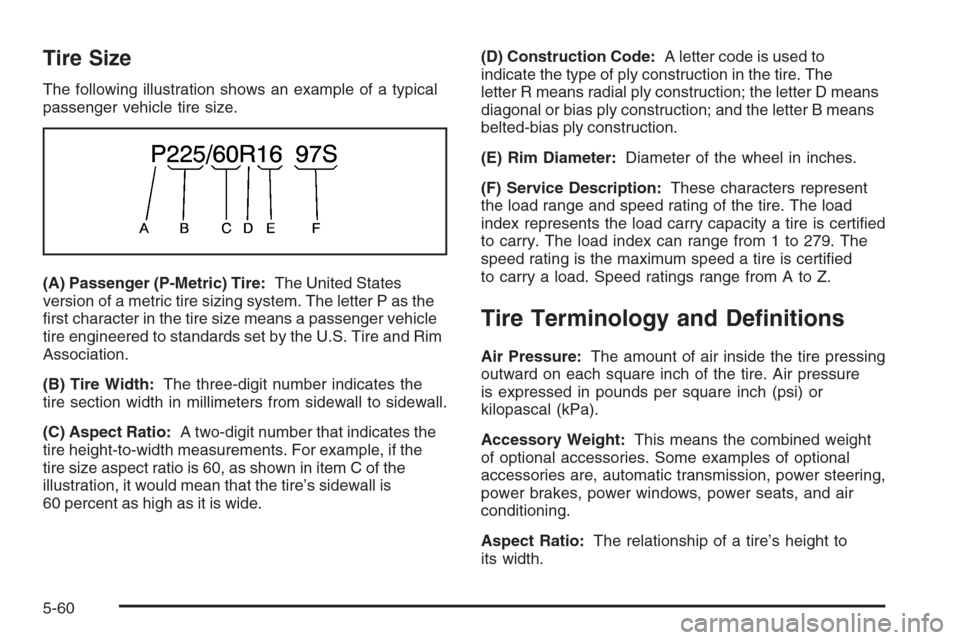
The following illustration shows an example of a typical
passenger vehicle tire size.
(A) Passenger (P-Metric) Tire:The United States
version of a metric tire sizing system. The letter P as the
rst character in the tire size means a passenger vehicle
tire engineered to standards set by the U.S. Tire and Rim
Association.
(B) Tire Width:The three-digit number indicates the
tire section width in millimeters from sidewall to sidewall.
(C) Aspect Ratio:A two-digit number that indicates the
tire height-to-width measurements. For example, if the
tire size aspect ratio is 60, as shown in item C of the
illustration, it would mean that the tire’s sidewall is
60 percent as high as it is wide.(D) Construction Code:A letter code is used to
indicate the type of ply construction in the tire. The
letter R means radial ply construction; the letter D means
diagonal or bias ply construction; and the letter B means
belted-bias ply construction.
(E) Rim Diameter:Diameter of the wheel in inches.
(F) Service Description:These characters represent
the load range and speed rating of the tire. The load
index represents the load carry capacity a tire is certied
to carry. The load index can range from 1 to 279. The
speed rating is the maximum speed a tire is certied
to carry a load. Speed ratings range from A to Z.
Tire Terminology and Denitions
Air Pressure:The amount of air inside the tire pressing
outward on each square inch of the tire. Air pressure
is expressed in pounds per square inch (psi) or
kilopascal (kPa).
Accessory Weight:This means the combined weight
of optional accessories. Some examples of optional
accessories are, automatic transmission, power steering,
power brakes, power windows, power seats, and air
conditioning.
Aspect Ratio:The relationship of a tire’s height to
its width.
5-60
Page 375 of 480
Belt:A rubber coated layer of cords that is located
between the plies and the tread. Cords may be made
from steel or other reinforcing materials.
Bead:The tire bead contains steel wires wrapped by
steel cords that hold the tire onto the rim.
Bias Ply Tire:A pneumatic tire in which the plies are
laid at alternate angles less than 90 degrees to the
centerline of the tread.
Cold Tire Pressure:The amount of air pressure in
a tire, measured in pounds per square inch (psi) or
kilopascals (kPa) before a tire has built up heat from
driving. SeeInation - Tire Pressure on page 5-64.
Curb Weight:This means the weight of a motor vehicle
with standard and optional equipment including the
maximum capacity of fuel, oil, and coolant, but without
passengers and cargo.
DOT Markings:A code molded into the sidewall of a
tire signifying that the tire is in compliance with the U.S.
Department of Transportation (DOT) motor vehicle
safety standards. The DOT code includes the Tire
Identication Number (TIN), an alphanumeric designator
which can also identify the tire manufacturer, production
plant, brand, and date of production.
GVWR:Gross Vehicle Weight Rating. SeeLoading
Your Vehicle on page 4-32.GAWR FRT:Gross Axle Weight Rating for the front
axle. SeeLoading Your Vehicle on page 4-32.
GAWR RR:Gross Axle Weight Rating for the rear axle.
SeeLoading Your Vehicle on page 4-32.
Intended Outboard Sidewall:The side of an
asymmetrical tire, that must always face outward when
mounted on a vehicle.
Kilopascal (kPa):The metric unit for air pressure.
Light Truck (LT-Metric) Tire:A tire used on light duty
trucks and some multipurpose passenger vehicles.
Load Index:An assigned number ranging from 1 to 279
that corresponds to the load carrying capacity of a tire.
Maximum Ination Pressure:The maximum air
pressure to which a cold tire may be inated. The
maximum air pressure is molded onto the sidewall.
Maximum Load Rating:The load rating for a tire at the
maximum permissible ination pressure for that tire.
Maximum Loaded Vehicle Weight:The sum of curb
weight, accessory weight, vehicle capacity weight,
and production options weight.
Normal Occupant Weight:The number of occupants a
vehicle is designed to seat multiplied by 150 lbs (68 kg).
SeeLoading Your Vehicle on page 4-32.
5-61
Page 387 of 480
{CAUTION:
Mixing tires could cause you to lose control
while driving. If you mix tires of different sizes
(other than those originally installed on
your vehicle), brands, or types (radial and
bias-belted tires), the vehicle may not handle
properly, and you could have a crash. Using
tires of different sizes (other than those
originally installed on your vehicle), brands, or
types may also cause damage to your vehicle.
Be sure to use the correct size, brand, and
type of tires on all wheels. It is all right to drive
with your vehicle’s compact spare temporarily,
it was developed for use on your vehicle. See
Compact Spare Tire (STS Only) on page 5-94.
{CAUTION:
If you use bias-ply tires on your vehicle, the
wheel rim anges could develop cracks after
many miles of driving. A tire and/or wheel
could fail suddenly, causing a crash. Use only
radial-ply tires with the wheels on your vehicle.
If you must replace your vehicle’s tires with those that
do not have a TPC Spec number, make sure they
are the same size, load range, speed rating, and
construction type (radial and bias-belted tires) as your
vehicle’s original tires.
5-73
Page 411 of 480
Instrument Panel, Vinyl, and Other
Plastic Surfaces
A soft cloth dampened with water may be used to
remove dust. If a more thorough cleaning is necessary,
a clean soft cloth dampened with a mild soap solution
can be used to gently remove dust and dirt. Never use
spot lifters or removers on plastic surfaces. Many
commercial cleaners and coatings that are sold to
preserve and protect soft plastic surfaces may
permanently change the appearance and feel of your
interior and are not recommended. Do not use silicone
or wax-based products, or those containing organic
solvents to clean your vehicle’s interior because
they can alter the appearance by increasing the gloss
in a non-uniform manner.
Some commercial products may increase gloss on
your instrument panel. The increase in gloss may cause
annoying reections in the windshield and even make
it difficult to see through the windshield under certain
conditions.
Wood Panels
Use a clean cloth moistened in warm, soapy water
(use mild dish washing soap). Dry the wood immediately
with a clean cloth.
Speaker Covers
Vacuum around a speaker cover gently, so that the
speaker will not be damaged. Clean spots with just water
and mild soap.
Care of Safety Belts
Keep belts clean and dry.
{CAUTION:
Do not bleach or dye safety belts. If you do, it
may severely weaken them. In a crash, they
might not be able to provide adequate
protection. Clean safety belts only with mild
soap and lukewarm water.
Weatherstrips
Silicone grease on weatherstrips will make them last
longer, seal better, and not stick or squeak. Apply
silicone grease with a clean cloth. During very cold,
damp weather frequent application may be required.
SeeRecommended Fluids and Lubricants on page 6-12.
5-97
Page 425 of 480
{CAUTION:
A safety belt that is not properly routed
through the seat cushion or is twisted will not
provide the protection needed in a crash. If the
safety belt has not been routed through the
seat cushion at all, it will not be there to work
for the next passenger. The person sitting in
that position could be badly injured. After
reinstalling the seat cushion, always check to
be sure that the safety belts are properly
routed and are not twisted.
1. Buckle the center passenger position safety belt,
then route the safety belts through the proper slots
in the seat cushion. Do not let the safety belts
get twisted.
2. Slide the rear of the cushion up and under the
seatback so the rear-locating guides hook into
the wire loops on the back frame.3. With the seat cushion lowered, push rearward and
then press down on the seat cushion until the
spring locks on both ends engage.
4. Check to make sure the safety belts are properly
routed and that no portion of any safety belt is
trapped under the seat. Also make sure the seat
cushion is secured.
Rear Underseat Fuse Block
There is a fuse block located under the rear seat on the
driver’s side and passenger’s side of the vehicle. The
rear seat cushion must be removed to access the
fuse blocks. See “Removing the Rear Seat Cushion”
listed previously in this section.
To access the fuses, push in the two tabs, then lift the
cover off.
Your vehicle may not have all the fuses listed next.
5-111
Page 433 of 480
Maintenance Schedule......................................6-2
Introduction...................................................6-2
Maintenance Requirements..............................6-2
Your Vehicle and the Environment....................6-2
Using the Maintenance Schedule......................6-2
Scheduled Maintenance...................................6-4
Additional Required Services............................6-6
Maintenance Footnotes...................................6-7Owner Checks and Services............................6-8
At Each Fuel Fill............................................6-9
At Least Once a Month...................................6-9
At Least Once a Year...................................6-10
Recommended Fluids and Lubricants...............6-12
Normal Maintenance Replacement Parts..........6-14
Engine Drive Belt Routing (STS-V)..................6-15
Maintenance Record.....................................6-16
Section 6 Maintenance Schedule
6-1
Page 439 of 480
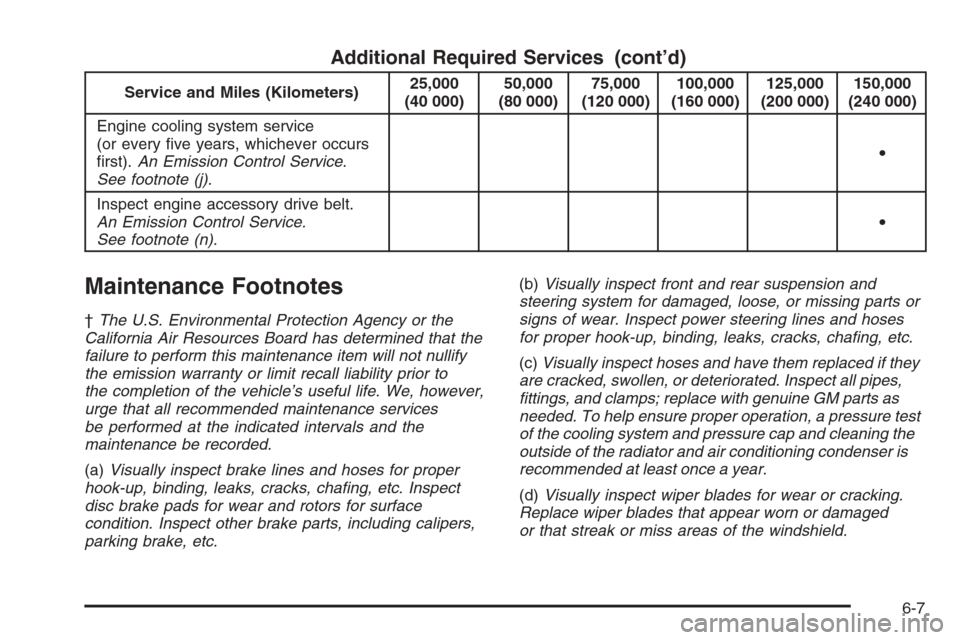
Additional Required Services (cont’d)
Service and Miles (Kilometers)25,000
(40 000)50,000
(80 000)75,000
(120 000)100,000
(160 000)125,000
(200 000)150,000
(240 000)
Engine cooling system service
(or every ve years, whichever occurs
rst).An Emission Control Service.
See footnote (j).•
Inspect engine accessory drive belt.
An Emission Control Service.
See footnote (n).•
Maintenance Footnotes
†The U.S. Environmental Protection Agency or the
California Air Resources Board has determined that the
failure to perform this maintenance item will not nullify
the emission warranty or limit recall liability prior to
the completion of the vehicle’s useful life. We, however,
urge that all recommended maintenance services
be performed at the indicated intervals and the
maintenance be recorded.
(a)Visually inspect brake lines and hoses for proper
hook-up, binding, leaks, cracks, chang, etc. Inspect
disc brake pads for wear and rotors for surface
condition. Inspect other brake parts, including calipers,
parking brake, etc.(b)Visually inspect front and rear suspension and
steering system for damaged, loose, or missing parts or
signs of wear. Inspect power steering lines and hoses
for proper hook-up, binding, leaks, cracks, chang, etc.
(c)Visually inspect hoses and have them replaced if they
are cracked, swollen, or deteriorated. Inspect all pipes,
ttings, and clamps; replace with genuine GM parts as
needed. To help ensure proper operation, a pressure test
of the cooling system and pressure cap and cleaning the
outside of the radiator and air conditioning condenser is
recommended at least once a year.
(d)Visually inspect wiper blades for wear or cracking.
Replace wiper blades that appear worn or damaged
or that streak or miss areas of the windshield.
6-7
Page 440 of 480
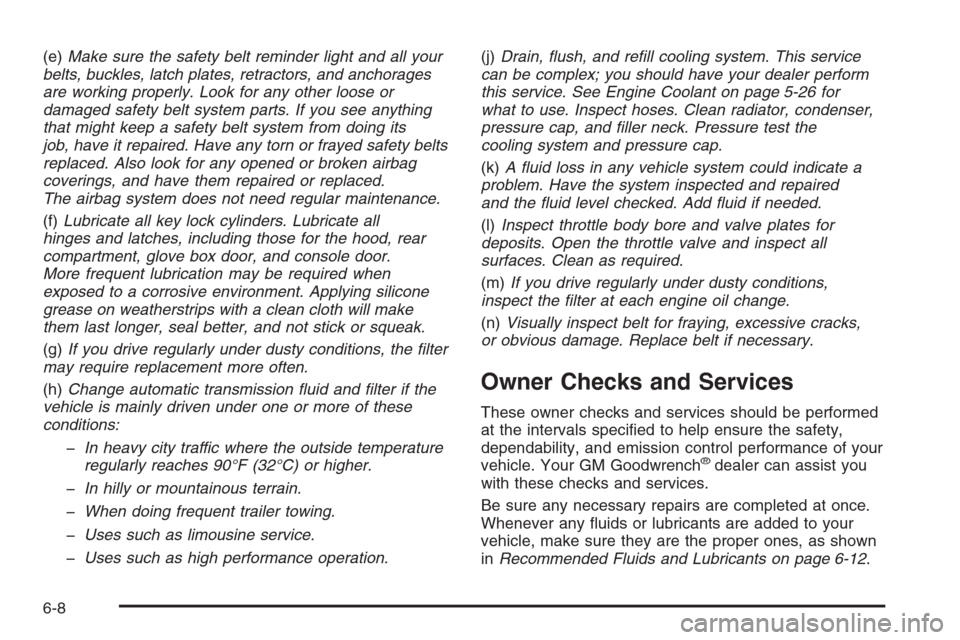
(e)Make sure the safety belt reminder light and all your
belts, buckles, latch plates, retractors, and anchorages
are working properly. Look for any other loose or
damaged safety belt system parts. If you see anything
that might keep a safety belt system from doing its
job, have it repaired. Have any torn or frayed safety belts
replaced. Also look for any opened or broken airbag
coverings, and have them repaired or replaced.
The airbag system does not need regular maintenance.
(f)Lubricate all key lock cylinders. Lubricate all
hinges and latches, including those for the hood, rear
compartment, glove box door, and console door.
More frequent lubrication may be required when
exposed to a corrosive environment. Applying silicone
grease on weatherstrips with a clean cloth will make
them last longer, seal better, and not stick or squeak.
(g)If you drive regularly under dusty conditions, the lter
may require replacement more often.
(h)Change automatic transmission uid and lter if the
vehicle is mainly driven under one or more of these
conditions:
In heavy city traffic where the outside temperature
regularly reaches 90°F (32°C) or higher.
In hilly or mountainous terrain.
When doing frequent trailer towing.
Uses such as limousine service.
Uses such as high performance operation.(j)Drain, ush, and rell cooling system. This service
can be complex; you should have your dealer perform
this service. See Engine Coolant on page 5-26 for
what to use. Inspect hoses. Clean radiator, condenser,
pressure cap, and ller neck. Pressure test the
cooling system and pressure cap.
(k)A uid loss in any vehicle system could indicate a
problem. Have the system inspected and repaired
and the uid level checked. Add uid if needed.
(l)Inspect throttle body bore and valve plates for
deposits. Open the throttle valve and inspect all
surfaces. Clean as required.
(m)If you drive regularly under dusty conditions,
inspect the lter at each engine oil change.
(n)Visually inspect belt for fraying, excessive cracks,
or obvious damage. Replace belt if necessary.
Owner Checks and Services
These owner checks and services should be performed
at the intervals specied to help ensure the safety,
dependability, and emission control performance of your
vehicle. Your GM Goodwrench
®dealer can assist you
with these checks and services.
Be sure any necessary repairs are completed at once.
Whenever any uids or lubricants are added to your
vehicle, make sure they are the proper ones, as shown
inRecommended Fluids and Lubricants on page 6-12.
6-8