lock CADILLAC STS 2007 1.G Manual PDF
[x] Cancel search | Manufacturer: CADILLAC, Model Year: 2007, Model line: STS, Model: CADILLAC STS 2007 1.GPages: 560, PDF Size: 2.92 MB
Page 291 of 560
Radio Message
THEFTLOCK:This message is displayed when
the THEFTLOCK®system has been activated.
Take the vehicle to the dealer for service.
Radio Messages for XM™ Only
SeeXM Radio Messages on page 303later in this
section for further detail.
Using the Single CD Player
Insert a CD partway into the slot, label side up.
The player pulls it in. If the ignition and the
radio are on, the CD begins playing. A CD can be
loaded with the radio off, but it does not start
playing until the radio is on.
If the ignition or radio is turned off with a CD in
the player, it stays in the player. While the ignition
or radio is turned on, the CD starts to play
where it stopped, if it was the last selected
audio source.When the CD is inserted, CD displays. As each
new track starts to play, the track number displays.
The CD player can play the smaller 3 inch
(8 cm) single CDs with an adapter ring. Full-size
CDs and the smaller CDs are loaded in the
same manner.
If playing a CD-R, the sound quality can be
reduced due to CD-R quality, the method of
recording, the quality of the music that has been
recorded, and the way the CD-R has been
handled. There can be an increase in skipping,
difficulty in nding tracks, and/or difficulty in loading
and ejecting. If these problems occur, check the
bottom surface of the CD. If the surface of the CD
is damaged, such as cracked, broken, or
scratched, the CD will not play properly. If the
surface of the CD is soiled, seeCare of Your CDs
on page 313for more information.
If there is no apparent damage, try a known
good CD.
291
Page 303 of 560
XM Radio Messages
Radio Display Message Condition Action Required
XL (Explicit Language
Channels)XL on the radio display,
after the channel name,
indicates content with
explicit language.These channels, or any others, can be blocked at a
customer’s request, by calling 1-800-852-XMXM (9696).
XM Updating Updating encryption code The encryption code in the receiver is being updated, and no
action is required. This process should take no longer than
30 seconds.
No XM Signal Loss of signal The system is functioning correctly, but the vehicle is in a
location that is blocking the XM™ signal. When the vehicle is
moved into an open area, the signal should return.
Loading XM Acquiring channel audio
(after 4 second delay)The audio system is acquiring and processing audio and text
data. No action is needed. This message should disappear
shortly.
Channel Off Air Channel not in service This channel is not currently in service. Tune in to
another channel.
Channel Unavail Channel no
longer availableThis previously assigned channel is no longer assigned.
Tune to another station. If this station was one of the presets,
choose another station for that preset button.
No Artist Info Artist Name/Feature
not availableNo artist information is available at this time on this channel.
The system is working properly.
303
Page 304 of 560
Radio Display Message Condition Action Required
No Title Info Song/Program Title
not availableNo song title information is available at this time on this
channel. The system is working properly.
No CAT Info Category Name
not availableNo category information is available at this time on this
channel. The system is working properly.
CAT Not Found No channel available for
the chosen categoryThere are no channels available for the selected category.
The system is working properly.
No Information No Text/Informational
message availableNo text or informational messages are available at this time
on this channel. The system is working properly.
XM Theftlocked Theft lock active The XM™ receiver in your vehicle could have previously
been in another vehicle. For security purposes, XM™
receivers cannot be swapped between vehicles. If this
message is received after having your vehicle serviced,
check with your dealer.
XM Radio ID Radio ID label (channel 0) If tuned to channel 0, this message alternates with the XM™
Radio 8 digit radio ID label. This label is needed to activate
the service.
Unknown Radio ID not known
(should only be if
hardware failure)If this message is received when tuned to channel 0,
there could be a receiver fault. Consult with your dealer.
Check XM Receivr Hardware failure If this message does not clear within a short period of time,
the receiver could have a fault. Consult with your dealer.
304
Page 305 of 560

Navigation/Radio System
Your vehicle could have a navigation radio
system.
The navigation system has built-in features
intended to minimize driver distraction. Technology
alone, no matter how advanced, can never
replace your own judgment. See the Navigation
System manual for some tips to help you
reduce distractions while driving.
Radio Personalization
Accessing the Radio’s Main Menu
(Base Audio System)
There are two different procedures for accessing
the radio’s main menu depending upon whether
or not your vehicle has the Navigation system.To access the main menu of the radio, do one of
the following:
Using the Base audio system, press the
CNFG button located on the radio or press the
tune/select knob located on the right side of
the radio. Then turn the tune/select knob
clockwise or counterclockwise to scroll through
the menu items.
If your vehicle has the Navigation system, see
the Navigation System manual supplied with
your vehicle for more information on accessing
the main menu and for descriptions of the
menu items for the Navigation system.
305
Page 306 of 560
The main menu for the Base audio system
consists of the following menu items:
eBASS - MID - TREBLE
xBALANCE - FADER
eEQ EQUALIZER
H/A (HOME/AWAY) PRESETS
AUTOSTORE PRESETS
CAT CATEGORY
TA TRAFFIC ANNOUNCE
RECALL RDS (Radio Data System)
MESSAGE
AF ALTERNATE FREQ. (Frequency)
ASEEK LOCAL/DISTANT
8SET CLOCK
BSET DATE
4INFO (Information)
LANG LANGUAGE
SETUP
Radio Main Menu Item Descriptions
(Base Audio System)
The following descriptions are for the Base audio
system. For information pertaining to the
Navigation audio system, see “Audio System” in
the Index of the Navigation System manual
supplied with your vehicle.
eBASS - MID (Midrange) - TREBLE:This
menu item lets you adjust the levels for the bass,
midrange and treble features of the audio
system. See “Setting the Tone (Bass/Treble)”
underRadio with CD on page 282for more
information.
xBALANCE - FADER:This menu item lets you
adjust the levels for the balance and fader
features of the audio system. See “Adjusting the
Speakers (Balance/Fade)” underRadio with CD on
page 282for more information.
eEQ (Equalizer):This menu item lets you
choose among ve preset equalizations for the
audio system. See “Audio Equalizer” underRadio
with CD on page 282for more information.
306
Page 307 of 560
H/A (Home/Away) PRESETS:This menu item
lets you switch back and forth between your home
and away preset radio stations. See “Presets
Home/Away” underRadio with CD on page 282
for more information.
AUTOSTORE PRESETS:This menu item lets
you automatically store radio stations with
the strongest signals as presets. See “Autostore
Presets” underRadio with CD on page 282
for more information.
CAT (Category):This menu item lets you select
radio stations based on preset categories. See
“Activating Program Type (PTY) Stations”
underRadio with CD on page 282for more
information.
TA (Traffic Announcement):This menu item lets
you turn the TA feature on and off. See “TA
(Traffic Announcement)” underRadio with CD on
page 282for more information.
RECALL RDS MESSAGE:This menu item lets
you view an RDS radio station message broadcast
by a radio station. See “MSG (Message)” under
Radio with CD on page 282for more information.AF (Alternate Frequency):This menu item lets
you turn the AF feature on and off. See “Activating
Program Type (PTY) Stations (RDS and XM™)”
underRadio with CD on page 282for more
information.
ASEEK LOCAL/DISTANT:This feature instructs
the audio system to seek only local radio
stations with the strongest signal or to seek all
radio stations with a strong signal in a large area.
Use LOCAL while in urban areas where there
are several strong radio station signals and you
want to limit the number of stations to those
with the strongest signals only. Use DISTANT
while in rural areas where there are fewer
radio station signals available.
See “Local/Distant Selection” underRadio with CD
on page 282for more information.
8SET CLOCK:Use this menu item to set
the time.
SeeSetting the Time on page 281for more
information.
307
Page 309 of 560
DRIVER SELECTION
When you select this item, the following submenu
displays:
DRIVER 1
DRIVER 2
RECALL DRIVER SETTINGS
STORE DRIVER SETTINGS
For more information on the DRIVER SELECTION
submenu item, see “Recalling Driver Settings”
and “Storing Driver Settings” underMemory Seat,
Mirrors and Steering Wheel on page 169.
DRIVER EXIT SETTINGS
When you select this item, the following
submenu displays:
RECALL EXIT SETTINGS
STORE EXIT SETTINGS
For more information on the DRIVER EXIT
SETTINGS submenu item, see “Recalling Exit
Settings” and “Storing Exit Settings” underMemory
Seat, Mirrors and Steering Wheel on page 169.
CONFIGURE DISPLAY KEYS
(Base Audio System)
This item lets you customize the functions of the
four congurable keys located to the left and
right of the audio display. See “Congurable Radio
Display Keys” underRadio with CD on page 282
for programming information.
Theft-Deterrent Feature
THEFTLOCK®is designed to discourage theft
of your vehicle’s radio. The feature works
automatically by learning a portion of the Vehicle
Identication Number (VIN). If the radio is
moved to a different vehicle, it does not operate.
If the radio is removed from your vehicle, the
original VIN in the radio can be used to trace the
radio back to your vehicle.
With THEFTLOCK
®activated, the radio will not
operate if stolen.
309
Page 315 of 560
Your Driving, the Road, and
Your Vehicle............................................ 316
Defensive Driving...................................... 316
Drunken Driving........................................ 317
Control of a Vehicle.................................. 320
Braking...................................................... 320
Anti-Lock Brake System (ABS).................. 321
Braking in Emergencies............................. 323
Traction Control System (TCS).................. 323
Competitive Driving Mode (STS-V)............ 325
Magnetic Ride Control............................... 325
Limited-Slip Rear Axle............................... 325
StabiliTrak
®System................................... 326
Panic Brake Assist.................................... 327
All-Wheel Drive (AWD) System.................. 327
Steering.................................................... 327
Off-Road Recovery.................................... 330
Passing..................................................... 330
Loss of Control.......................................... 332Competitive Driving................................... 333
Driving at Night......................................... 333
Driving in Rain and on Wet Roads............ 335
City Driving............................................... 338
Freeway Driving........................................ 339
Before Leaving on a Long Trip.................. 340
Highway Hypnosis..................................... 341
Hill and Mountain Roads........................... 342
Winter Driving........................................... 344
If Your Vehicle is Stuck in Sand,
Mud, Ice, or Snow ................................. 348
Rocking Your Vehicle to Get It Out........... 349
Loading Your Vehicle................................ 349
Towing........................................................ 355
Towing Your Vehicle ................................. 355
Recreational Vehicle Towing...................... 355
Towing a Trailer........................................ 357
Section 4 Driving Your Vehicle
315
Page 321 of 560

Avoid needless heavy braking. Some people drive
in spurts — heavy acceleration followed by heavy
braking — rather than keeping pace with traffic.
This is a mistake. The brakes may not have time to
cool between hard stops. The brakes will wear out
much faster if you do a lot of heavy braking. If you
keep pace with the traffic and allow realistic
following distances, you will eliminate a lot of
unnecessary braking. That means better braking
and longer brake life.
If your vehicle’s engine ever stops while you are
driving, brake normally but do not pump the
brakes. If you do, the pedal may get harder to
push down. If the engine stops, you will still have
some power brake assist. But you will use it
when you brake. Once the power assist is used
up, it may take longer to stop and the brake pedal
will be harder to push.
Adding non-GM accessories can affect your
vehicle’s performance. SeeAccessories and
Modications on page 363.Anti-Lock Brake System (ABS)
Your vehicle has the Anti-Lock Brake
System (ABS), an advanced electronic braking
system that will help prevent a braking skid.
When you start the engine and begin to drive
away, ABS will check itself. You may hear
a momentary motor or clicking noise while this test
is going on, and you may even notice that the
brake pedal moves a little. This is normal.
If there is a problem
with ABS, this warning
light will stay on.
SeeAnti-Lock Brake
System Warning
Light on page 249.
321
Page 323 of 560
Remember: ABS does not change the time you
need to get your foot up to the brake pedal
or always decrease stopping distance. If you get
too close to the vehicle in front of you, you will not
have time to apply the brakes if that vehicle
suddenly slows or stops. Always leave enough
room up ahead to stop, even though you
have ABS.
Using ABS
Do not pump the brakes. Just hold the brake pedal
down rmly and let anti-lock work for you. You may
hear the anti-lock pump or motor operate, and feel
the brake pedal pulsate, but this is normal.
Braking in Emergencies
With ABS, you can steer and brake at the same
time. In many emergencies, steering can help you
more than even the very best braking.
Traction Control System (TCS)
Your vehicle has a traction control system that
limits wheel spin. This is especially useful in
slippery road conditions. On a rear-wheel-drive
vehicle, the system operates if it senses that
one or both of the rear wheels are spinning or
beginning to lose traction. On an All-Wheel-Drive
(AWD) vehicle, the system will operate if it
senses that any of the wheels are spinning or
beginning to lose traction. When this happens, the
system brakes the spinning wheel(s) and/or
reduces engine power to limit wheel spin.
You may feel or hear the system working, but this
is normal.
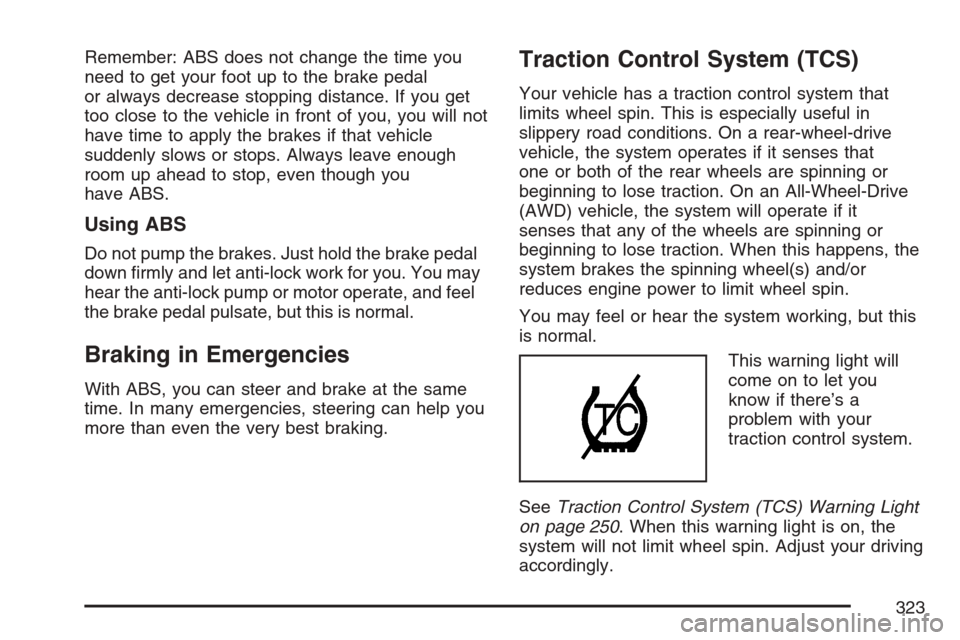
This warning light will
come on to let you
know if there’s a
problem with your
traction control system.
SeeTraction Control System (TCS) Warning Light
on page 250. When this warning light is on, the
system will not limit wheel spin. Adjust your driving
accordingly.
323