seats CADILLAC STS 2008 1.G Owner's Manual
[x] Cancel search | Manufacturer: CADILLAC, Model Year: 2008, Model line: STS, Model: CADILLAC STS 2008 1.GPages: 500, PDF Size: 5.81 MB
Page 196 of 500
Reading Lamps
The reading lamps are located on the overhead console.
These lamps come on automatically when any door is
opened.
For manual operation, press the button next to each
lamp to turn it on or off.
If the reading lamps are left on, they automatically shut
off 10 minutes after the ignition has been turned off.
Battery Load Management
The battery load management feature is designed to
monitor the vehicle’s electrical load and determine when
the battery is in a heavy discharge condition. During
times of high electrical loading, the engine may idle
at a higher revolutions per minute (rpm) setting
than normal to make sure the battery charges.
High electrical loads may occur when several of the
following are on: headlamps, high beams, fog lamps,
rear window defogger, the climate control fan at
high speeds, heated seats and engine cooling fans.If the battery continues to discharge, even with the
engine idling at a higher rpm setting, some electrical
loads will automatically be reduced. When this occurs,
the rear window defogger may take slightly longer
to clear the glass and the fan may cut back to a lower
speed. For more battery saving information, see
“Battery Saver Active Message” underDIC Warnings
and Messages on page 3-80.
Electric Power Management
The vehicle has Electric Power Management (EPM)
that estimates the battery’s temperature and state
of charge. It then adjusts the voltage for best
performance and extended life of the battery.
When the battery’s state of charge is low, the voltage
is raised slightly to quickly put the charge back in.
When the state of charge is high, the voltage is lowered
slightly to prevent overcharging. If the vehicle has a
voltmeter gage or a voltage display on the Driver
Information Center (DIC), you may see the voltage
move up or down. This is normal. If there is a problem,
an alert will be displayed.
3-42
Page 197 of 500
The battery can be discharged at idle if the electrical
loads are very high. This is true for all vehicles.
This is because the generator (alternator) may not be
spinning fast enough at idle to produce all the power
that is needed for very high electrical loads.
A high electrical load occurs when several of the
following loads are on: headlamps, high beams, fog
lamps, rear window defogger, climate control fan at
high speed, heated seats, engine cooling fans, trailer
loads, and loads plugged into accessory power outlets.
EPM works to prevent excessive discharge of the
battery. It does this by balancing the generator’s output
and the vehicle’s electrical needs. It can increase
engine idle speed to generate more power, whenever
needed. It can temporarily reduce the power demands
of some accessories.
Normally, these actions occur in steps or levels, without
being noticeable. In rare cases at the highest levels
of corrective action, this action may be noticeable to
the driver. If so, a Driver Information Center (DIC)
message might be displayed, such as Battery Saver
Active or Service Battery Charging System. If this
message is displayed, it is recommended that the
driver reduce the electrical loads as much as possible.
SeeDIC Warnings and Messages on page 3-80.Inadvertent Power Battery Saver
This feature is designed to protect your vehicle’s battery
against drainage from the interior lamps, trunk lamp,
glove box lamp, or the garage door opener. When the
ignition is turned off, the power to these features will
automatically turn off after 10 minutes (three minutes if
a new car has 15 miles (24 km) or less). Power will
be restored for an additional 10 minutes if any door is
opened, the trunk is opened or the courtesy lamp switch
is turned on.
Head-Up Display (HUD)
{CAUTION:
If the HUD image is too bright, or too high in
your eld of view, it may take you more time
to see things you need to see when it is dark
outside. Be sure to keep the HUD image dim
and placed low in your eld of view.
For vehicles with the Head-Up Display (HUD), it projects
some of the driver information that appears on the
instrument panel cluster onto the windshield.
3-43
Page 202 of 500
Cigarette Lighter
Notice:Holding a cigarette lighter in while it is
heating will not allow the lighter to back away from
the heating element when it is hot. Damage from
overheating may occur to the lighter or heating
element, or a fuse could be blown. Do not hold
a cigarette lighter in while it is heating. Do not use
equipment exceeding maximum amperage
rating of 15 amperes.
The cigarette lighter is located next to the ashtray.
The vehicle does not have any cigarette lighters for
the rear seat passengers.
To activate the cigarette lighter, push it into the heating
element and let go. When the lighter is ready it will
pop back out by itself.
Climate Controls
Dual Climate Control System
The heating, cooling, and ventilation can be controlled
for the vehicle with this system.
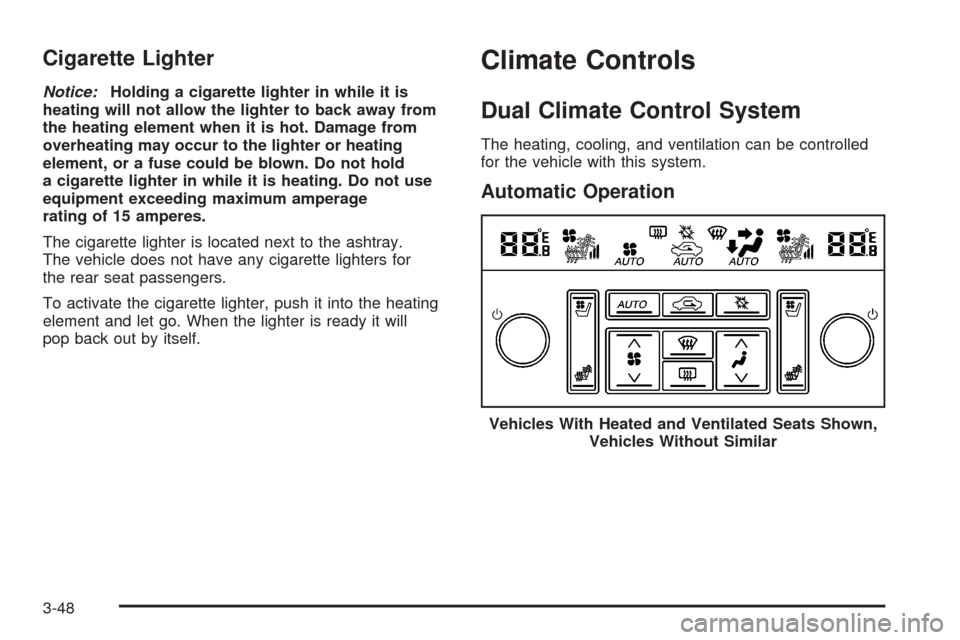
Automatic Operation
Vehicles With Heated and Ventilated Seats Shown,
Vehicles Without Similar
3-48
Page 205 of 500
Under some conditions, the air quality sensor system
does not operate. In cold weather, the system might
not be active (even if AUTO is displayed) because
of concerns of fogging your windows, which may occur
by activating recirculation mode. Also, the air quality
sensor system does not remain in recirculation mode
for extended periods of time that could cause stuffy
or very dry conditions in the vehicle. Following a poorly
running vehicle for an extended period of time may
not keep recirculation active indenitely.
The air quality sensor does not activate due to organic
odors, like skunk, and may not activate on many
chemical-related odors. If you wish to limit these types
of odors, manually select recirculation. Your vehicle
could also have a charcoal lter that can limit many
odors from being pulled into your vehicle. This
lter needs to be changed periodically. SeeScheduled
Maintenance on page 6-4. The air quality sensor
system does not protect against carbon monoxide (CO),
which you cannot see or smell. SeeEngine Exhaust
on page 2-38.
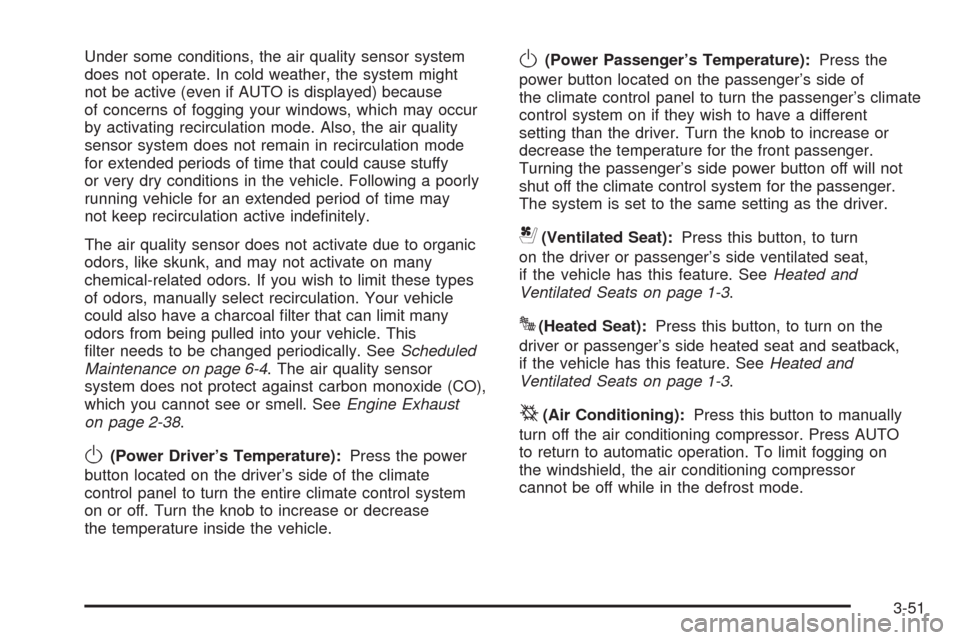
O(Power Driver’s Temperature):Press the power
button located on the driver’s side of the climate
control panel to turn the entire climate control system
on or off. Turn the knob to increase or decrease
the temperature inside the vehicle.
O(Power Passenger’s Temperature):Press the
power button located on the passenger’s side of
the climate control panel to turn the passenger’s climate
control system on if they wish to have a different
setting than the driver. Turn the knob to increase or
decrease the temperature for the front passenger.
Turning the passenger’s side power button off will not
shut off the climate control system for the passenger.
The system is set to the same setting as the driver.
{(Ventilated Seat):Press this button, to turn
on the driver or passenger’s side ventilated seat,
if the vehicle has this feature. SeeHeated and
Ventilated Seats on page 1-3.
J(Heated Seat):Press this button, to turn on the
driver or passenger’s side heated seat and seatback,
if the vehicle has this feature. SeeHeated and
Ventilated Seats on page 1-3.
^(Air Conditioning):Press this button to manually
turn off the air conditioning compressor. Press AUTO
to return to automatic operation. To limit fogging on
the windshield, the air conditioning compressor
cannot be off while in the defrost mode.
3-51
Page 208 of 500
Outlet Adjustment
Use the lever located in the center of each outlet to
change the direction of the airow, either side-to-side
or up and down. Use the thumbwheels to open or close
the outlets to adjust the airow.
Turn the thumbwheel towards the vehicle door to open
the outlets and allow the maximum amount of air to
enter your vehicle. Turn the thumbwheel towards
the center console to close the outlets and minimize
the amount of air entering the vehicle.
Operation Tips
Clear away any ice, snow or leaves from the air
inlets at the base of the windshield that may
block the ow of air into your vehicle.
Use of non-GM approved hood deectors may
adversely affect the performance of the system.
Keep the path under the front seats clear of
objects to help circulate the air inside of your
vehicle more effectively.
If the airow seems low when the fan speed is at the
highest setting, the passenger compartment air lter
may need to be replaced. For more information, see
Passenger Compartment Air Filter on page 3-55.
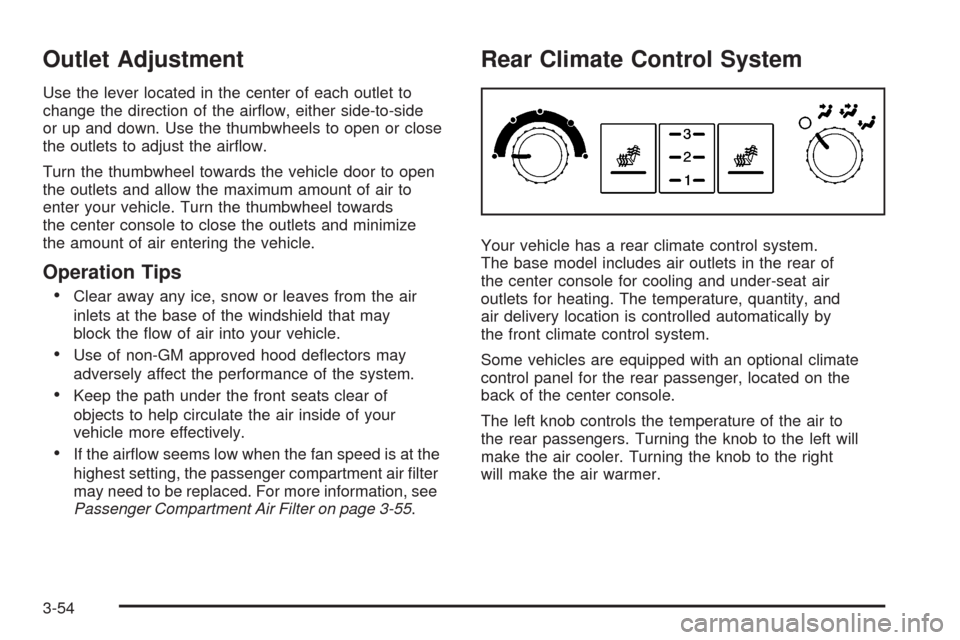
Rear Climate Control System
Your vehicle has a rear climate control system.
The base model includes air outlets in the rear of
the center console for cooling and under-seat air
outlets for heating. The temperature, quantity, and
air delivery location is controlled automatically by
the front climate control system.
Some vehicles are equipped with an optional climate
control panel for the rear passenger, located on the
back of the center console.
The left knob controls the temperature of the air to
the rear passengers. Turning the knob to the left will
make the air cooler. Turning the knob to the right
will make the air warmer.
3-54
Page 209 of 500
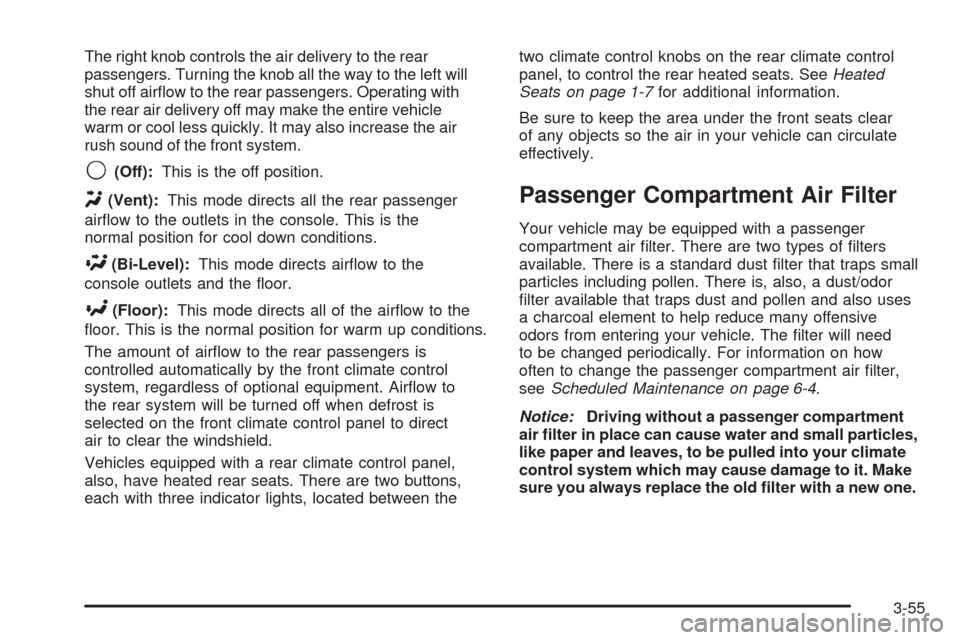
The right knob controls the air delivery to the rear
passengers. Turning the knob all the way to the left will
shut off airow to the rear passengers. Operating with
the rear air delivery off may make the entire vehicle
warm or cool less quickly. It may also increase the air
rush sound of the front system.
9(Off):This is the off position.
Y(Vent):This mode directs all the rear passenger
airow to the outlets in the console. This is the
normal position for cool down conditions.
\(Bi-Level):This mode directs airow to the
console outlets and the oor.
[(Floor):This mode directs all of the airow to the
oor. This is the normal position for warm up conditions.
The amount of airow to the rear passengers is
controlled automatically by the front climate control
system, regardless of optional equipment. Airow to
the rear system will be turned off when defrost is
selected on the front climate control panel to direct
air to clear the windshield.
Vehicles equipped with a rear climate control panel,
also, have heated rear seats. There are two buttons,
each with three indicator lights, located between thetwo climate control knobs on the rear climate control
panel, to control the rear heated seats. SeeHeated
Seats on page 1-7for additional information.
Be sure to keep the area under the front seats clear
of any objects so the air in your vehicle can circulate
effectively.
Passenger Compartment Air Filter
Your vehicle may be equipped with a passenger
compartment air lter. There are two types of lters
available. There is a standard dust lter that traps small
particles including pollen. There is, also, a dust/odor
lter available that traps dust and pollen and also uses
a charcoal element to help reduce many offensive
odors from entering your vehicle. The lter will need
to be changed periodically. For information on how
often to change the passenger compartment air lter,
seeScheduled Maintenance on page 6-4.
Notice:Driving without a passenger compartment
air lter in place can cause water and small particles,
like paper and leaves, to be pulled into your climate
control system which may cause damage to it. Make
sure you always replace the old lter with a new one.
3-55
Page 309 of 500
If you put things inside your vehicle, like suitcases,
tools, packages, or anything else, they will go as
fast as the vehicle goes. If you have to stop or turn
quickly, or if there is a crash, they will keep going.
{CAUTION:
Things you put inside your vehicle can
strike and injure people in a sudden stop
or turn, or in a crash.
Put things in the trunk of your vehicle.
In a trunk, put them as far forward as
you can. Try to spread the weight
evenly.
Never stack heavier things, like
suitcases, inside the vehicle so that
some of them are above the tops of
the seats.
Do not leave an unsecured child
restraint in your vehicle.
When you carry something inside the
vehicle, secure it whenever you can.
Do not leave a seat folded down
unless you need to.
Towing
Towing Your Vehicle
Consult your dealer/retailer or a professional towing
service if you need to have your disabled vehicle towed.
SeeRoadside Service on page 7-6.
If you want to tow your vehicle behind another vehicle
for recreational purposes (such as behind a motorhome),
see Recreational Vehicle Towing following.
Recreational Vehicle Towing
Recreational vehicle towing means towing your vehicle
behind another vehicle – such as behind a motorhome.
The two most common types of recreational vehicle
towing are known as “dinghy towing” (towing your vehicle
with all four wheels on the ground) and “dolly towing”
(towing your vehicle with two wheels on the ground and
two wheels up on a device known as a “dolly”).
With the proper preparation and equipment, many
vehicles can be towed in these ways. See “Dinghy
Towing” and “Dolly Towing,” following.
4-31
Page 380 of 500
(C) Aspect Ratio:A two-digit number that
indicates the tire height-to-width measurements.
For example, if the tire size aspect ratio is 60,
as shown in item C of the illustration, it would
mean that the tire’s sidewall is 60 percent as
high as it is wide.
(D) Construction Code
:A letter code is
used to indicate the type of ply construction
in the tire. The letter R means radial ply
construction; the letter D means diagonal or
bias ply construction; and the letter B means
belted-bias ply construction.
(E) Rim Diameter
:Diameter of the wheel in
inches.
(F) Service Description
:These characters
represent the load range and speed rating of the
tire. The load index represents the load carry
capacity a tire is certied to carry. The load index
can range from 1 to 279. The speed rating is
the maximum speed a tire is certied to carry a
load. Speed ratings range from A to Z.
Tire Terminology and Denitions
Air Pressure:The amount of air inside the
tire pressing outward on each square inch of
the tire. Air pressure is expressed in pounds per
square inch (psi) or kilopascal (kPa).
Accessory Weight
:This means the combined
weight of optional accessories. Some examples of
optional accessories are, automatic transmission,
power steering, power brakes, power windows,
power seats, and air conditioning.
Aspect Ratio
:The relationship of a tire’s height
to its width.
Belt
:A rubber coated layer of cords that is
located between the plies and the tread. Cords
may be made from steel or other reinforcing
materials.
Bead
:The tire bead contains steel wires wrapped
by steel cords that hold the tire onto the rim.
Bias Ply Tire
:A pneumatic tire in which the plies
are laid at alternate angles less than 90 degrees
to the centerline of the tread.
5-62
Page 439 of 500
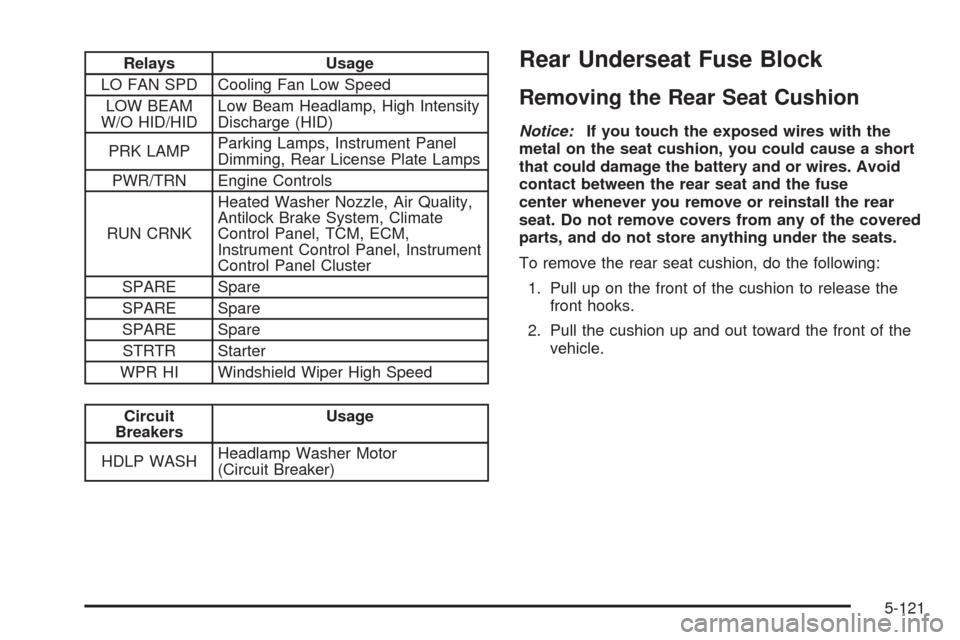
Relays Usage
LO FAN SPD Cooling Fan Low Speed
LOW BEAM
W/O HID/HIDLow Beam Headlamp, High Intensity
Discharge (HID)
PRK LAMPParking Lamps, Instrument Panel
Dimming, Rear License Plate Lamps
PWR/TRN Engine Controls
RUN CRNKHeated Washer Nozzle, Air Quality,
Antilock Brake System, Climate
Control Panel, TCM, ECM,
Instrument Control Panel, Instrument
Control Panel Cluster
SPARE Spare
SPARE Spare
SPARE Spare
STRTR Starter
WPR HI Windshield Wiper High Speed
Circuit
BreakersUsage
HDLP WASHHeadlamp Washer Motor
(Circuit Breaker)
Rear Underseat Fuse Block
Removing the Rear Seat Cushion
Notice:If you touch the exposed wires with the
metal on the seat cushion, you could cause a short
that could damage the battery and or wires. Avoid
contact between the rear seat and the fuse
center whenever you remove or reinstall the rear
seat. Do not remove covers from any of the covered
parts, and do not store anything under the seats.
To remove the rear seat cushion, do the following:
1. Pull up on the front of the cushion to release the
front hooks.
2. Pull the cushion up and out toward the front of the
vehicle.
5-121
Page 443 of 500
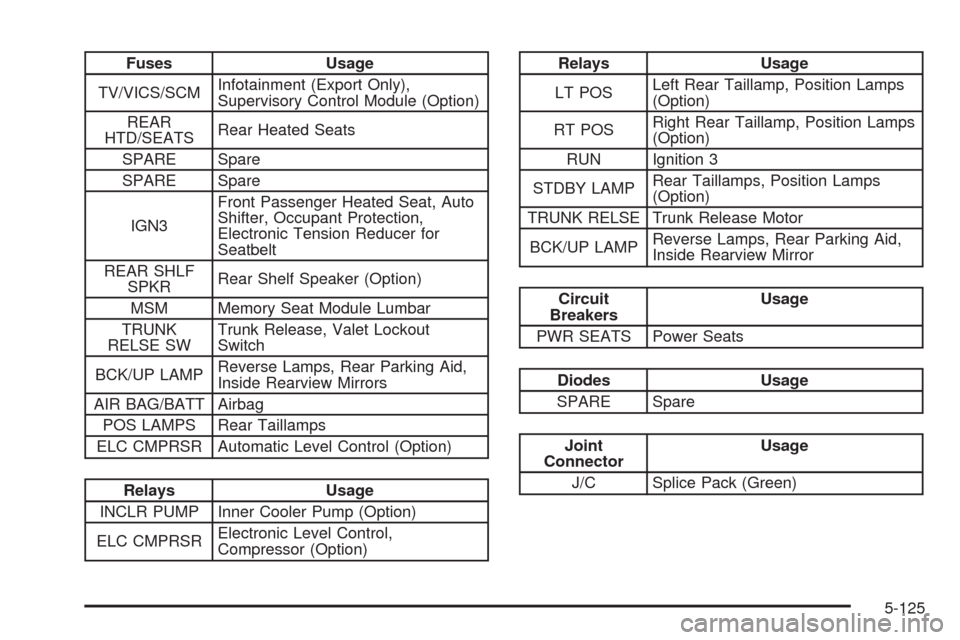
Fuses Usage
TV/VICS/SCMInfotainment (Export Only),
Supervisory Control Module (Option)
REAR
HTD/SEATSRear Heated Seats
SPARE Spare
SPARE Spare
IGN3Front Passenger Heated Seat, Auto
Shifter, Occupant Protection,
Electronic Tension Reducer for
Seatbelt
REAR SHLF
SPKRRear Shelf Speaker (Option)
MSM Memory Seat Module Lumbar
TRUNK
RELSE SWTrunk Release, Valet Lockout
Switch
BCK/UP LAMPReverse Lamps, Rear Parking Aid,
Inside Rearview Mirrors
AIR BAG/BATT Airbag
POS LAMPS Rear Taillamps
ELC CMPRSR Automatic Level Control (Option)
Relays Usage
INCLR PUMP Inner Cooler Pump (Option)
ELC CMPRSRElectronic Level Control,
Compressor (Option)
Relays Usage
LT POSLeft Rear Taillamp, Position Lamps
(Option)
RT POSRight Rear Taillamp, Position Lamps
(Option)
RUN Ignition 3
STDBY LAMPRear Taillamps, Position Lamps
(Option)
TRUNK RELSE Trunk Release Motor
BCK/UP LAMPReverse Lamps, Rear Parking Aid,
Inside Rearview Mirror
Circuit
BreakersUsage
PWR SEATS Power Seats
Diodes Usage
SPARE Spare
Joint
ConnectorUsage
J/C Splice Pack (Green)
5-125