towing CADILLAC STS 2008 1.G Owner's Manual
[x] Cancel search | Manufacturer: CADILLAC, Model Year: 2008, Model line: STS, Model: CADILLAC STS 2008 1.GPages: 500, PDF Size: 5.81 MB
Page 318 of 500
3. When the wheel chocks are in place, release the
regular brakes until the chocks absorb the load.
4. Reapply the regular brakes. Then apply your
parking brake, and then shift to PARK (P).
5. Release the regular brakes.
When You Are Ready to Leave After
Parking on a Hill
1. Apply your regular brakes and hold the pedal down
while you:
Start your engine.
Shift into a gear.
Release the parking brake.
2. Let up on the brake pedal.
3. Drive slowly until the trailer is clear of the chocks.
4. Stop and have someone pick up and store the
chocks.
Maintenance When Trailer Towing
Your vehicle will need service more often when you’re
pulling a trailer. See the Maintenance Schedule for more
on this. Things that are especially important in trailer
operation are automatic transmission uid (don’t overll),
engine oil, drive belt, cooling system and brake
system. Each of these is covered in this manual, and
the Index will help you nd them quickly. If you’re
trailering, it’s a good idea to review this information
before you start your trip.
Check periodically to see that all hitch nuts and bolts
are tight.
Engine Cooling When Trailer Towing
Your cooling system may temporarily overheat during
severe operating conditions. SeeEngine Overheating on
page 5-29.
Towing a Trailer (Vehicles Without
Heavy Duty Cooling)
Vehicles without heavy duty cooling are neither designed
nor intended to tow a trailer.
4-40
Page 349 of 500
If you get the overheat warning with no sign of steam,
try this for a minute or so:
1. In heavy traffic, let the engine idle in NEUTRAL (N)
while stopped. If it is safe to do so, pull off the road,
shift to PARK (P) or NEUTRAL (N) and let the
engine idle.
2. Set the climate controls to the highest heat setting
and fan speed and open the windows, as
necessary.
If the coolant warning light is not on or the coolant
temperature gage does not indicate the engine
is overheating, you can drive. Just to be safe, drive
slower for about 10 minutes. If the warnings do not come
back on, drive normally.
If the warnings continue and you have not stopped, pull
over, stop, and park the vehicle right away.
If there is still no sign of steam, idle the engine for three
minutes while parked. If the warnings are still indicated,
turn off the engine and get everyone out of the
vehicle until it cools down. Also, see “Overheated
Engine Protection Operating Mode” later in this section.
You might decide not to lift the hood but to get
service help right away.Overheated Engine Protection
Operating Mode
This operating mode allows your vehicle to be driven
to a safe place in an emergency. Should an overheated
engine condition exist, an overheat protection mode
which alternates ring groups of cylinders helps prevent
engine damage. In this mode, you will notice a loss
in power and engine performance. An engine overheat
warning will indicate that an overheat condition
exists. Driving extended miles (km) and/or towing a
trailer in the overheat protection mode should be
avoided.
Notice:After driving in the overheated engine
protection operating mode, to avoid engine damage,
allow the engine to cool before attempting any
repair. The engine oil will be severely degraded.
Repair the cause of coolant loss and change the oil.
SeeEngine Oil on page 5-18.
5-31
Page 455 of 500
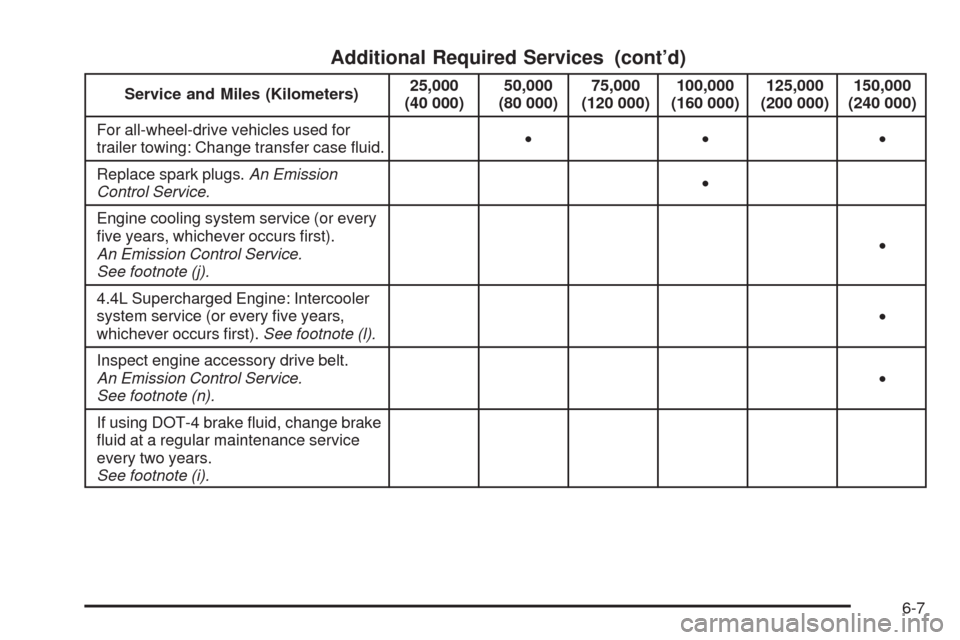
Additional Required Services (cont’d)
Service and Miles (Kilometers)25,000
(40 000)50,000
(80 000)75,000
(120 000)100,000
(160 000)125,000
(200 000)150,000
(240 000)
For all-wheel-drive vehicles used for
trailer towing: Change transfer case uid.•••
Replace spark plugs.An Emission
Control Service.•
Engine cooling system service (or every
ve years, whichever occurs rst).
An Emission Control Service.
See footnote (j).•
4.4L Supercharged Engine: Intercooler
system service (or every ve years,
whichever occurs rst).See footnote (l).•
Inspect engine accessory drive belt.
An Emission Control Service.
See footnote (n).•
If using DOT-4 brake uid, change brake
uid at a regular maintenance service
every two years.
See footnote (i).
6-7
Page 456 of 500
Maintenance Footnotes
(a)Visually inspect brake lines and hoses for proper
hook-up, binding, leaks, cracks, chafing, etc. Inspect
disc brake pads for wear and rotors for surface
condition. Inspect other brake parts, including calipers,
parking brake, etc.
(b)Visually inspect front and rear suspension and
steering system for damaged, loose, or missing parts or
signs of wear. Inspect power steering lines and hoses
for proper hook-up, binding, leaks, cracks, chafing, etc.
(c)Visually inspect hoses and have them replaced if
they are cracked, swollen, or deteriorated. Inspect
all pipes, fittings, and clamps; replace with genuine parts
as needed. To help ensure proper operation, a pressure
test of the cooling system and pressure cap and
cleaning the outside of the radiator and air conditioning
condenser is recommended at least once a year.
(d)Inspect wiper blades for wear, cracking, or
contamination. Clean the windshield and wiper blades,
if contaminated. Replace wiper blades that are worn
or damaged. See Windshield Wiper Blade Replacement
on page 5-55 and Windshield and Wiper Blades on
page 5-112 for more information.(e)Make sure the safety belt reminder light and safety
belt assemblies are working properly. Look for any
other loose or damaged safety belt system parts. If you
see anything that might keep a safety belt system
from doing its job, have it repaired. Have any torn or
frayed safety belts replaced. Also see Checking
the Restraint Systems on page 1-66.
(f)Lubricate all key lock cylinders. Lubricate all hinges
and latches, including those for the hood, rear
compartment, glove box door, and console door. More
frequent lubrication may be required when exposed
to a corrosive environment. Applying silicone grease on
weatherstrips with a clean cloth will make them last
longer, seal better, and not stick or squeak.
(g)If you drive regularly under dusty conditions, the
filter may require replacement more often.
(h)Change automatic transmission fluid and filter if the
vehicle is mainly driven under one or more of these
conditions:
In heavy city traffic where the outside temperature
regularly reaches 90°F (32°C) or higher.
In hilly or mountainous terrain.
When doing frequent trailer towing.
Uses such as limousine service.
Uses such as high performance operation.
6-8
Page 476 of 500
Cadillac Technician Roadside Service
(U.S. only)
Cadillac’s exceptional Roadside Service is more than an
auto club or towing service. It provides every Cadillac
owner in the United States with the advantage of
contacting a Cadillac advisor and, where available,
a Cadillac trained dealer technician who can provide
on-site service.
A dealer technician will travel to your location within a
30 mile radius of a participating Cadillac dealership.
If beyond this radius, we will arrange to have your
car towed to the nearest Cadillac dealership.
Each technician travels with a specially equipped
service vehicle complete with the necessary Cadillac
parts and tools required to handle most roadside repairs.
Calling for Assistance
For prompt and efficient assistance when calling, please
provide the following to the Roadside Service
Representative:
Your name, home address, and home telephone
number
Telephone number of your location
Location of the vehicle
Model, year, color, and license plate number of
the vehicle
Odometer reading, Vehicle Identication Number
(VIN), and delivery date of the vehicle
Description of the problem
Towing and Road Service Exclusions
Specically excluded from Roadside Service coverage
are towing or services for vehicles operated on a
non-public roadway or highway, nes, impound towing
caused by a violation of local, Municipal, State,
Provincial or Federal law, and mounting, dismounting or
changing of snow tires, chains, or other traction devices.
Roadside Service is not part of or included in the
coverage provided by the New Vehicle Limited Warranty.
Cadillac and General Motors of Canada Limited reserve
the right to make any changes or discontinue the
Roadside Service program at any time without
notication.
7-8
Page 480 of 500
Insuring Your Vehicle
Protect your investment in your GM vehicle with
comprehensive and collision insurance coverage.
There are signicant differences in the quality of
coverage afforded by various insurance policy terms.
Many insurance policies provide reduced protection
to your GM vehicle by limiting compensation for damage
repairs by using aftermarket collision parts. Some
insurance companies will not specify aftermarket
collision parts. When purchasing insurance, we
recommend that you assure your vehicle will be repaired
with GM original equipment collision parts. If such
insurance coverage is not available from your current
insurance carrier, consider switching to another
insurance carrier.
If your vehicle is leased, the leasing company may
require you to have insurance that assures repairs with
Genuine GM Original Equipment Manufacturer (OEM)
parts or Genuine Manufacturer replacement parts.
Read your lease carefully, as you may be charged at
the end of your lease for poor quality repairs.
If a Crash Occurs
Here is what to do if you are involved in a crash.
Try to relax and then check to make sure you are all
right. If you are uninjured, make sure that no one else
in your vehicle, or the other vehicle, is injured.
If there has been an injury, call emergency services
for help. Do not leave the scene of a crash until all
matters have been taken care of. Move your vehicle
only if its position puts you in danger or you are
instructed to move it by a police officer.
Give only the necessary and requested information
to police and other parties involved in the crash.
Do not discuss your personal condition, mental frame
of mind, or anything unrelated to the crash. This will
help guard against post-crash legal action.
If you need roadside assistance, call GM Roadside
Assistance. SeeRoadside Service on page 7-6
for more information.
If your vehicle cannot be driven, know where the
towing service will be taking it. Get a card from the
tow truck operator or write down the driver’s name,
the service’s name, and the phone number.
Remove any valuables from your vehicle before it is
towed away. Make sure this includes your insurance
information and registration if you keep these items
in your vehicle.
7-12
Page 496 of 500
R
Radio Frequency Identication (RFID), Privacy......7-17
Radios..........................................................3-98
Radio(s).......................................................3-100
Radios
Navigation/Radio System, see
Navigation Manual..................................3-117
Radio Personalization.................................3-117
Reception.................................................3-123
Setting the Time..........................................3-99
Theft-Deterrent..........................................3-121
Rainsense™ II Wipers.....................................3-15
Reading Lamps..............................................3-42
Rear Axle......................................................5-51
Limited-Slip.................................................. 4-8
Rear Climate Control System............................3-54
Rear Door Security Locks................................2-15
Rear Heated Seats........................................... 1-7
Rearview Mirror, Automatic Dimming..................2-40
Rearview Mirror, Automatic Dimming
with OnStar
®..............................................2-40
Rearview Mirror, Automatic Dimming
with OnStar
®and Compass..........................2-41
Rearview Mirror with Compass and Temperature..... 1-7Reclining Seatbacks, Power............................... 1-4
Recommended Fluids and Lubricants.................6-13
Recreational Vehicle Towing.............................4-31
Remote, Keyless Access System........................ 2-5
Remote Vehicle Start.......................................2-12
Removing the Flat Tire and Installing
the Spare Tire.............................................5-99
Removing the Spare Tire and Tools...................5-98
Replacement Bulbs.........................................5-55
Replacement, Windshield.................................5-55
Reporting Safety Defects
Canadian Government..................................7-14
General Motors...........................................7-14
United States Government............................7-14
Restraint System Check
Checking the Restraint Systems....................1-66
Replacing Restraint System Parts
After a Crash..........................................1-67
Retained Accessory Power (RAP)......................2-29
Roadside
Service........................................................ 7-6
Rocking Your Vehicle to Get it Out....................4-26
Routing, Engine Drive Belt...............................6-16
Run-Flat Tires................................................5-65
Running the Engine While Parked.....................2-39
10
Page 498 of 500
Storage Areas
Center Console Storage Area........................2-58
Convenience Net.........................................2-58
Cupholder(s)...............................................2-58
Glove Box..................................................2-58
Stuck in Sand, Mud, Ice, or Snow.....................4-25
Sun Visors.....................................................2-22
Sunroof.........................................................2-58
T
Tachometer....................................................3-59
TCS Warning Light..........................................3-65
Telescopic Steering Column, Power Tilt Wheel...... 3-7
Theft-Deterrent, Radio....................................3-121
Theft-Deterrent System....................................2-22
Theft-Deterrent Systems...................................2-22
Immobilizer.................................................2-26
Immobilizer Operation...................................2-26
Time, Setting..................................................3-99
Tire
Pressure Light.............................................3-67
Tires.............................................................5-57
Aluminum or Chrome-Plated Wheels,
Cleaning...............................................5-112
Buying New Tires........................................5-76
Chains.......................................................5-82
Changing a Flat Tire....................................5-96Tires (cont.)
Cleaning...................................................5-113
Compact Spare Tire...................................5-106
Different Size..............................................5-78
High-Speed Operation..................................5-68
If a Tire Goes Flat.......................................5-86
Ination - Tire Pressure................................5-66
Inspection and Rotation................................5-73
Installing the Spare Tire................................5-99
Lifting Your Vehicle......................................5-83
Pressure Monitor Operation...........................5-70
Pressure Monitor System..............................5-68
Removing the Flat Tire.................................5-99
Removing the Spare Tire and Tools...............5-98
Run-Flat.....................................................5-65
Storing a Flat or Spare Tire and Tools..........5-104
Tire Sealant and Compressor Kit...................5-87
Tire Sidewall Labeling..................................5-59
Tire Terminology and Denitions....................5-62
Uniform Tire Quality Grading.........................5-79
Wheel Alignment and Tire Balance.................5-80
Wheel Replacement.....................................5-80
When It Is Time for New Tires......................5-75
Winter Tires................................................5-58
Towing
Recreational Vehicle.....................................4-31
Towing a Trailer..................................4-34, 4-40
Your Vehicle...............................................4-31
12