belt CADILLAC STS 2008 1.G Repair Manual
[x] Cancel search | Manufacturer: CADILLAC, Model Year: 2008, Model line: STS, Model: CADILLAC STS 2008 1.GPages: 500, PDF Size: 5.81 MB
Page 380 of 500
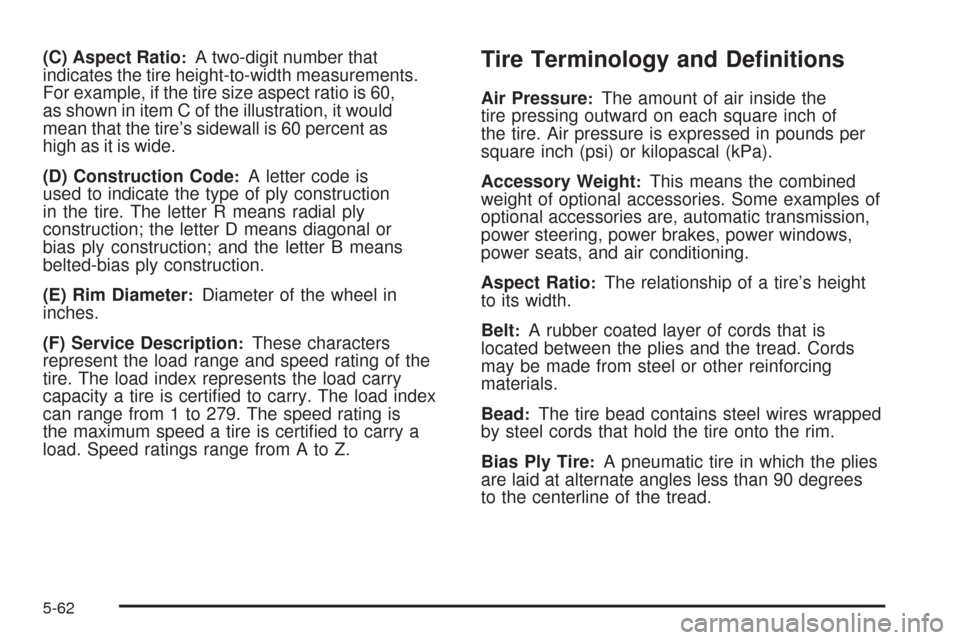
(C) Aspect Ratio:A two-digit number that
indicates the tire height-to-width measurements.
For example, if the tire size aspect ratio is 60,
as shown in item C of the illustration, it would
mean that the tire’s sidewall is 60 percent as
high as it is wide.
(D) Construction Code
:A letter code is
used to indicate the type of ply construction
in the tire. The letter R means radial ply
construction; the letter D means diagonal or
bias ply construction; and the letter B means
belted-bias ply construction.
(E) Rim Diameter
:Diameter of the wheel in
inches.
(F) Service Description
:These characters
represent the load range and speed rating of the
tire. The load index represents the load carry
capacity a tire is certied to carry. The load index
can range from 1 to 279. The speed rating is
the maximum speed a tire is certied to carry a
load. Speed ratings range from A to Z.
Tire Terminology and Denitions
Air Pressure:The amount of air inside the
tire pressing outward on each square inch of
the tire. Air pressure is expressed in pounds per
square inch (psi) or kilopascal (kPa).
Accessory Weight
:This means the combined
weight of optional accessories. Some examples of
optional accessories are, automatic transmission,
power steering, power brakes, power windows,
power seats, and air conditioning.
Aspect Ratio
:The relationship of a tire’s height
to its width.
Belt
:A rubber coated layer of cords that is
located between the plies and the tread. Cords
may be made from steel or other reinforcing
materials.
Bead
:The tire bead contains steel wires wrapped
by steel cords that hold the tire onto the rim.
Bias Ply Tire
:A pneumatic tire in which the plies
are laid at alternate angles less than 90 degrees
to the centerline of the tread.
5-62
Page 395 of 500
{CAUTION:
Mixing tires could cause you to lose control
while driving. If you mix tires of different sizes
(other than those originally installed on your
vehicle), brands, or types (radial and
bias-belted tires), the vehicle may not handle
properly, and you could have a crash. Using
tires of different sizes (other than those
originally installed on your vehicle), brands, or
types may also cause damage to your vehicle.
Be sure to use the correct size, brand, and
type of tires on all wheels. It is all right to drive
with your vehicle’s compact spare temporarily,
it was developed for use on your vehicle. See
Compact Spare Tire on page 5-106.
{CAUTION:
If you use bias-ply tires on your vehicle,
the wheel rim anges could develop
cracks after many miles of driving. A tire
and/or wheel could fail suddenly, causing
a crash. Use only radial-ply tires with the
wheels on your vehicle.
If you must replace your vehicle’s tires with those that
do not have a TPC Spec number, make sure they
are the same size, load range, speed rating, and
construction type (radial and bias-belted tires) as your
vehicle’s original tires.
Vehicles that have a tire pressure monitoring system
could give an inaccurate low-pressure warning if
non-TPC Spec rated tires are installed on it. Non-TPC
Spec rated tires may give a low-pressure warning that is
higher or lower than the proper warning level you
would get with TPC Spec rated tires. SeeTire Pressure
Monitor System on page 5-68.
5-77
Page 428 of 500
Wood Panels
Use a clean cloth moistened in warm, soapy water (use
mild dish washing soap). Dry the wood immediately
with a clean cloth.
Speaker Covers
Vacuum around a speaker cover gently, so that the
speaker will not be damaged. Clean spots with
just water and mild soap.
Care of Safety Belts
Keep belts clean and dry.
{CAUTION:
Do not bleach or dye safety belts. If you do, it
may severely weaken them. In a crash, they
might not be able to provide adequate
protection. Clean safety belts only with mild
soap and lukewarm water.
Weatherstrips
Silicone grease on weatherstrips will make them last
longer, seal better, and not stick or squeak. Apply
silicone grease with a clean cloth. During very cold,
damp weather frequent application may be required. See
Recommended Fluids and Lubricants on page 6-13.
Washing Your Vehicle
The best way to preserve your vehicle’s nish is to keep
it clean by washing it often.
Notice:Certain cleaners contain chemicals that can
damage the emblems or nameplates on your
vehicle. Check the cleaning product label. If it states
that is should not be used on plastic parts, do not
use it on your vehicle or damage may occur and
it would not be covered by the warranty.
Do not wash the vehicle in direct sunlight. Use a car
washing soap. Do not use cleaning agents that
are petroleum based or that contain acid or abrasives,
as they can damage the paint, metal or plastic on
your vehicle. Approved cleaning products can be
obtained from your dealer/retailer. SeeVehicle
Care/Appearance Materials on page 5-115. Follow all
manufacturers’ directions regarding correct product
usage, necessary safety precautions and appropriate
disposal of any vehicle care product.
5-110
Page 440 of 500
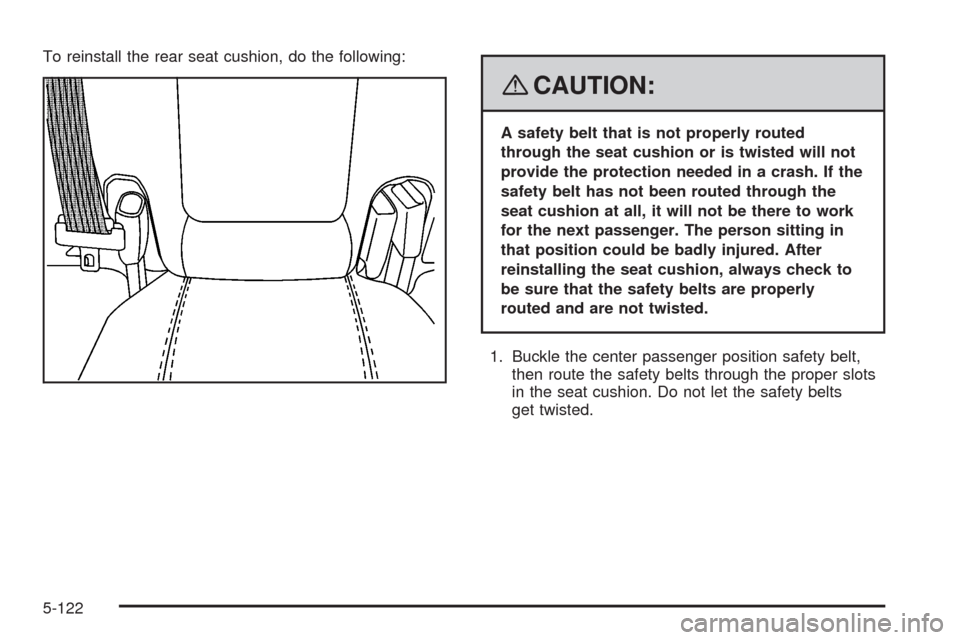
To reinstall the rear seat cushion, do the following:
{CAUTION:
A safety belt that is not properly routed
through the seat cushion or is twisted will not
provide the protection needed in a crash. If the
safety belt has not been routed through the
seat cushion at all, it will not be there to work
for the next passenger. The person sitting in
that position could be badly injured. After
reinstalling the seat cushion, always check to
be sure that the safety belts are properly
routed and are not twisted.
1. Buckle the center passenger position safety belt,
then route the safety belts through the proper slots
in the seat cushion. Do not let the safety belts
get twisted.
5-122
Page 441 of 500
2. Slide the rear of the cushion up and under the
seatback so the rear-locating guides hook into
the wire loops on the back frame.
3. With the seat cushion lowered, push rearward and
then press down on the seat cushion until the
spring locks on both ends engage.
4. Check to make sure the safety belts are properly
routed and that no portion of any safety belt is
trapped under the seat. Also make sure the seat
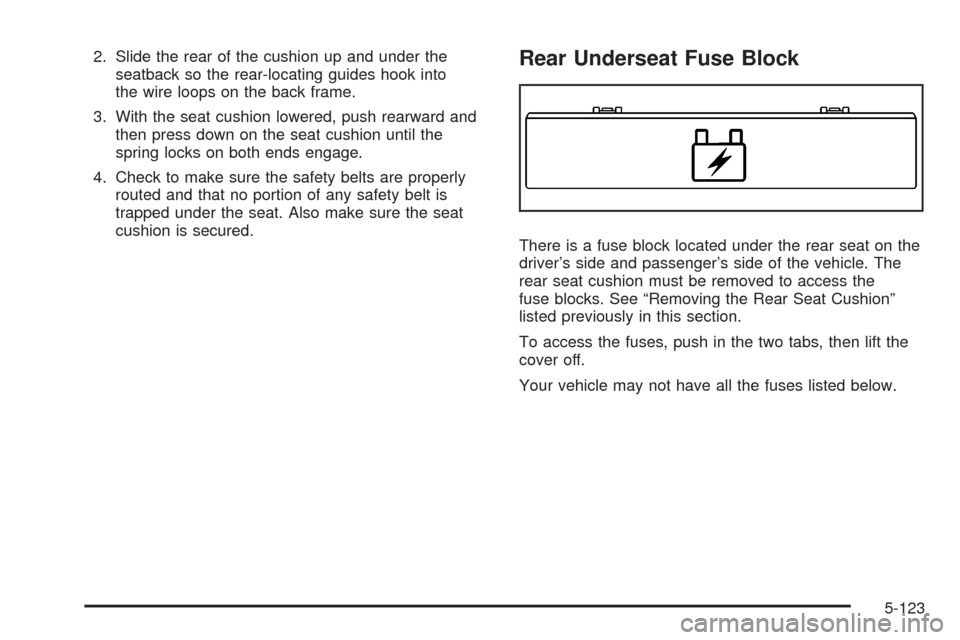
cushion is secured.Rear Underseat Fuse Block
There is a fuse block located under the rear seat on the
driver’s side and passenger’s side of the vehicle. The
rear seat cushion must be removed to access the
fuse blocks. See “Removing the Rear Seat Cushion”
listed previously in this section.
To access the fuses, push in the two tabs, then lift the
cover off.
Your vehicle may not have all the fuses listed below.
5-123
Page 443 of 500
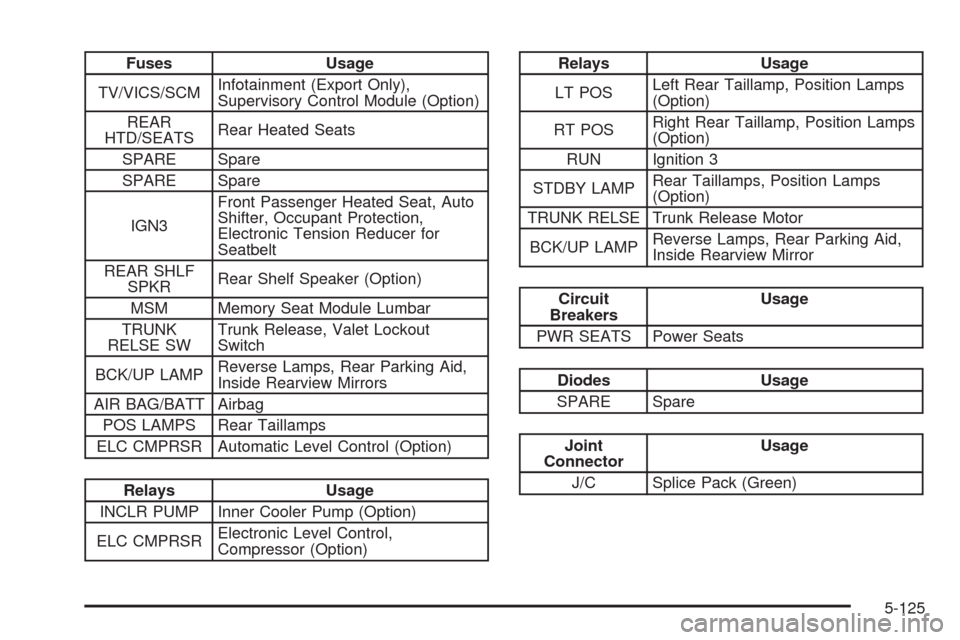
Fuses Usage
TV/VICS/SCMInfotainment (Export Only),
Supervisory Control Module (Option)
REAR
HTD/SEATSRear Heated Seats
SPARE Spare
SPARE Spare
IGN3Front Passenger Heated Seat, Auto
Shifter, Occupant Protection,
Electronic Tension Reducer for
Seatbelt
REAR SHLF
SPKRRear Shelf Speaker (Option)
MSM Memory Seat Module Lumbar
TRUNK
RELSE SWTrunk Release, Valet Lockout
Switch
BCK/UP LAMPReverse Lamps, Rear Parking Aid,
Inside Rearview Mirrors
AIR BAG/BATT Airbag
POS LAMPS Rear Taillamps
ELC CMPRSR Automatic Level Control (Option)
Relays Usage
INCLR PUMP Inner Cooler Pump (Option)
ELC CMPRSRElectronic Level Control,
Compressor (Option)
Relays Usage
LT POSLeft Rear Taillamp, Position Lamps
(Option)
RT POSRight Rear Taillamp, Position Lamps
(Option)
RUN Ignition 3
STDBY LAMPRear Taillamps, Position Lamps
(Option)
TRUNK RELSE Trunk Release Motor
BCK/UP LAMPReverse Lamps, Rear Parking Aid,
Inside Rearview Mirror
Circuit
BreakersUsage
PWR SEATS Power Seats
Diodes Usage
SPARE Spare
Joint
ConnectorUsage
J/C Splice Pack (Green)
5-125
Page 449 of 500
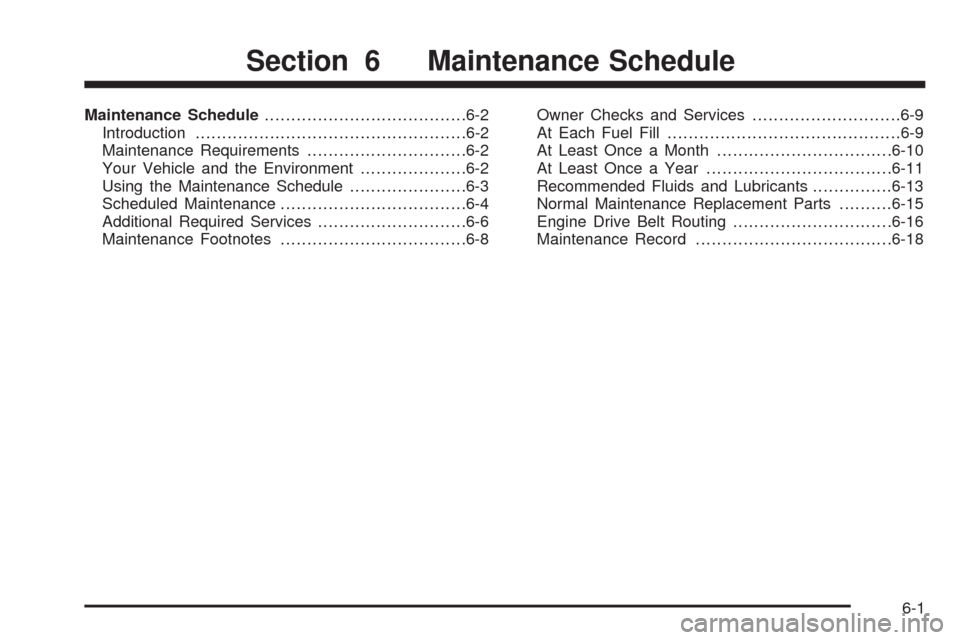
Maintenance Schedule......................................6-2
Introduction...................................................6-2
Maintenance Requirements..............................6-2
Your Vehicle and the Environment....................6-2
Using the Maintenance Schedule......................6-3
Scheduled Maintenance...................................6-4
Additional Required Services............................6-6
Maintenance Footnotes...................................6-8Owner Checks and Services............................6-9
At Each Fuel Fill............................................6-9
At Least Once a Month.................................6-10
At Least Once a Year...................................6-11
Recommended Fluids and Lubricants...............6-13
Normal Maintenance Replacement Parts..........6-15
Engine Drive Belt Routing..............................6-16
Maintenance Record.....................................6-18
Section 6 Maintenance Schedule
6-1
Page 455 of 500
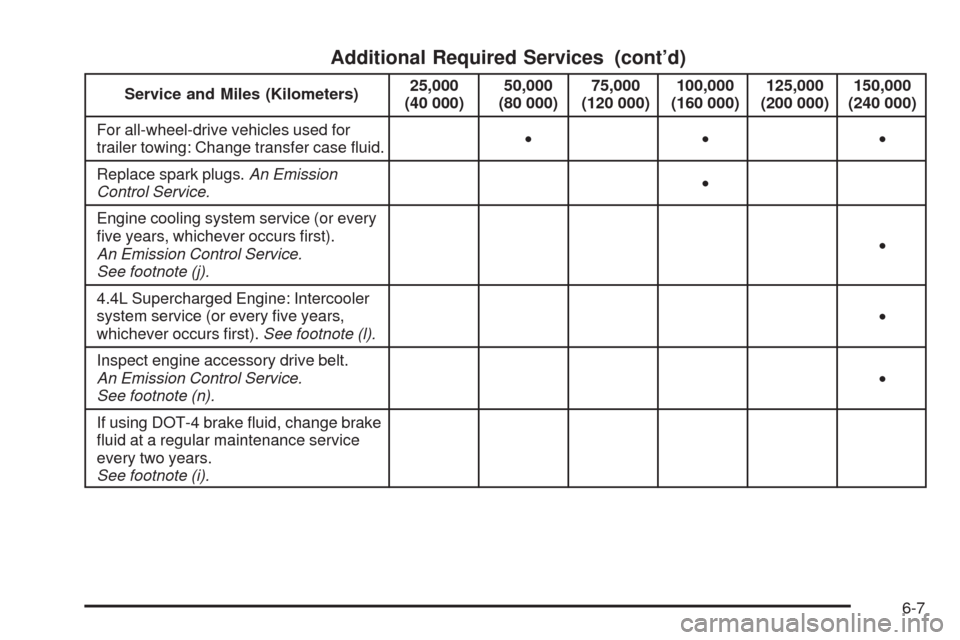
Additional Required Services (cont’d)
Service and Miles (Kilometers)25,000
(40 000)50,000
(80 000)75,000
(120 000)100,000
(160 000)125,000
(200 000)150,000
(240 000)
For all-wheel-drive vehicles used for
trailer towing: Change transfer case uid.•••
Replace spark plugs.An Emission
Control Service.•
Engine cooling system service (or every
ve years, whichever occurs rst).
An Emission Control Service.
See footnote (j).•
4.4L Supercharged Engine: Intercooler
system service (or every ve years,
whichever occurs rst).See footnote (l).•
Inspect engine accessory drive belt.
An Emission Control Service.
See footnote (n).•
If using DOT-4 brake uid, change brake
uid at a regular maintenance service
every two years.
See footnote (i).
6-7
Page 456 of 500
Maintenance Footnotes
(a)Visually inspect brake lines and hoses for proper
hook-up, binding, leaks, cracks, chafing, etc. Inspect
disc brake pads for wear and rotors for surface
condition. Inspect other brake parts, including calipers,
parking brake, etc.
(b)Visually inspect front and rear suspension and
steering system for damaged, loose, or missing parts or
signs of wear. Inspect power steering lines and hoses
for proper hook-up, binding, leaks, cracks, chafing, etc.
(c)Visually inspect hoses and have them replaced if
they are cracked, swollen, or deteriorated. Inspect
all pipes, fittings, and clamps; replace with genuine parts
as needed. To help ensure proper operation, a pressure
test of the cooling system and pressure cap and
cleaning the outside of the radiator and air conditioning
condenser is recommended at least once a year.
(d)Inspect wiper blades for wear, cracking, or
contamination. Clean the windshield and wiper blades,
if contaminated. Replace wiper blades that are worn
or damaged. See Windshield Wiper Blade Replacement
on page 5-55 and Windshield and Wiper Blades on
page 5-112 for more information.(e)Make sure the safety belt reminder light and safety
belt assemblies are working properly. Look for any
other loose or damaged safety belt system parts. If you
see anything that might keep a safety belt system
from doing its job, have it repaired. Have any torn or
frayed safety belts replaced. Also see Checking
the Restraint Systems on page 1-66.
(f)Lubricate all key lock cylinders. Lubricate all hinges
and latches, including those for the hood, rear
compartment, glove box door, and console door. More
frequent lubrication may be required when exposed
to a corrosive environment. Applying silicone grease on
weatherstrips with a clean cloth will make them last
longer, seal better, and not stick or squeak.
(g)If you drive regularly under dusty conditions, the
filter may require replacement more often.
(h)Change automatic transmission fluid and filter if the
vehicle is mainly driven under one or more of these
conditions:
In heavy city traffic where the outside temperature
regularly reaches 90°F (32°C) or higher.
In hilly or mountainous terrain.
When doing frequent trailer towing.
Uses such as limousine service.
Uses such as high performance operation.
6-8
Page 457 of 500
(i)If using DOT-4 brake fluid only: Drain, flush, and refill
brake hydraulic system at a regular maintenance
service every two years. This service can be complex;
you should have your dealer/retailer perform this service.
See Brakes on page 5-41.
(j)Drain, flush, and refill cooling system. This service
can be complex; you should have your dealer/retailer
perform this service. See Engine Coolant on page 5-25
for what to use. Inspect hoses. Clean radiator,
condenser, pressure cap, and filler neck. Pressure test
the cooling system and pressure cap.
(k)A fluid loss in any vehicle system could indicate a
problem. Have the system inspected and repaired
and the fluid level checked. Add fluid if needed.
(l)Drain, flush, and refill intercooler system. This service
can be complex; you should have your dealer/retailer
perform this service. See Engine Coolant on page 5-25.
(m)If you drive regularly under dusty conditions,
inspect the filter at each engine oil change.
(n)Visually inspect belt for fraying, excessive cracks, or
obvious damage. Replace belt if necessary.Owner Checks and Services
These owner checks and services should be performed
at the intervals specied to help ensure the safety,
dependability, and emission control performance of your
vehicle. Your dealer/retailer can assist you with these
checks and services.
Be sure any necessary repairs are completed at once.
Whenever any uids or lubricants are added to your
vehicle, make sure they are the proper ones, as shown
inRecommended Fluids and Lubricants on page 6-13.
At Each Fuel Fill
It is important to perform these underhood checks at
each fuel fill.
Engine Oil Level Check
Notice:It is important to check the engine oil
regularly and keep it at the proper level. Failure to
keep the engine oil at the proper level can cause
damage to the engine not covered by your warranty.
Check the engine oil level and add the proper oil if
necessary. SeeEngine Oil on page 5-18.
6-9