lights CADILLAC STS 2009 1.G User Guide
[x] Cancel search | Manufacturer: CADILLAC, Model Year: 2009, Model line: STS, Model: CADILLAC STS 2009 1.GPages: 514, PDF Size: 2.73 MB
Page 155 of 514
Instrument Panel Overview...............................3-4
Hazard Warning Flashers................................3-6
Horn .............................................................3-6
Power Tilt Wheel and Telescopic
Steering Column.........................................3-6
Heated Steering Wheel...................................3-7
Turn Signal/Multifunction Lever.........................3-7
Turn and Lane-Change Signals........................3-8
Headlamp High/Low-Beam Changer..................3-9
Forward Collision Alert (FCA) System................3-9
Flash-to-Pass...............................................3-13
Windshield Wipers........................................3-13
Rainsense™ II Wipers...................................3-14
Windshield Washer.......................................3-15
Headlamp Washer........................................3-16
Cruise Control..............................................3-16
Adaptive Cruise Control.................................3-20
Headlamps..................................................3-32
Wiper Activated Headlamps............................3-36
Headlamps on Reminder................................3-36
Daytime Running Lamps (DRL).......................3-36
Fog Lamps ..................................................3-38
Twilight Sentinel
®..........................................3-38
Exterior Lighting Battery Saver........................3-40Instrument Panel Brightness...........................3-40
Entry Lighting...............................................3-41
Parade Dimming...........................................3-41
Reading Lamps............................................3-41
Battery Load Management.............................3-41
Electric Power Management...........................3-42
Inadvertent Power Battery Saver.....................3-42
Head-Up Display (HUD).................................3-43
Accessory Power Outlet(s).............................3-46
Ashtray(s) and Cigarette Lighter......................3-47
Climate Controls............................................3-48
Dual Climate Control System..........................3-48
Outlet Adjustment.........................................3-52
Rear Climate Control System.........................3-53
Passenger Compartment Air Filter...................3-54
Warning Lights, Gages, and Indicators............3-55
Instrument Panel Cluster................................3-56
Speedometer and Odometer...........................3-57
Tachometer.................................................3-57
Safety Belt Reminders...................................3-57
Airbag Readiness Light..................................3-58
Passenger Airbag Status Indicator...................3-59
Charging System Light..................................3-61
Brake System Warning Light..........................3-62
Section 3 Instrument Panel
3-1
Page 156 of 514
Antilock Brake System (ABS)
Warning Light...........................................3-63
Traction Control System (TCS)
Warning Light...........................................3-63
Lane Departure Warning Light........................3-64
Engine Coolant Temperature
Warning Light...........................................3-64
Engine Coolant Temperature Gage..................3-65
Tire Pressure Light.......................................3-65
Malfunction Indicator Lamp.............................3-66
Oil Pressure Light.........................................3-69
Security Light...............................................3-69
Fog Lamp Light............................................3-70
Lights On Reminder......................................3-70
Cruise Control Light......................................3-70
Highbeam On Light.......................................3-70
Fuel Gage...................................................3-71Driver Information Center (DIC).......................3-72
DIC Operation and Displays...........................3-72
DIC Warnings and Messages.........................3-79
Other Messages...........................................3-96
Audio System(s).............................................3-97
Setting the Clock..........................................3-98
Radio(s)......................................................3-98
Using an MP3............................................3-111
XM Radio Messages...................................3-114
Navigation/Radio System..............................3-116
Bluetooth
®.................................................3-116
Radio Personalization..................................3-126
Theft-Deterrent Feature................................3-130
Audio Steering Wheel Controls......................3-131
Radio Reception.........................................3-133
Backglass Antenna......................................3-134
XM™ Satellite Radio Antenna System............3-134
Section 3 Instrument Panel
3-2
Page 181 of 514
{CAUTION:
When the Adaptive Cruise Control radar is blocked
by snow, ice, or dirt, it may not detect a vehicle
ahead. Adaptive Cruise Control may not have time
to slow your vehicle enough to avoid a collision.
Do not use Adaptive Cruise Control when the
radar is blocked by snow, ice, or dirt. Keep your
radar clean. See “Cleaning the System” later in
this section.
Adaptive Cruise Control automatically slows your vehicle
down when approaching a slower moving vehicle. It then
adjusts your speed to follow the vehicle in front at the
selected following distance. Your speed increases or
decreases to follow the vehicle in front of you but will
not exceed the set speed. It may apply limited braking,
if necessary. When braking is active, your brake lights
come on. It may feel or sound different than if you were
applying the brakes yourself. This is normal.
Stationary or Very Slow-Moving Objects
{CAUTION:
Adaptive Cruise Control may not detect and
react to stationary or slow-moving vehicles or
other objects ahead of you. You could crash into
an object ahead of you. Do not use Adaptive
Cruise Control when approaching stationary
or slow-moving vehicles or other objects.
{CAUTION:
Adaptive Cruise Control may not detect and react
to stationary or slow-moving vehicles or other
objects ahead of you. Your vehicle may accelerate
toward objects, such as a stopped vehicle that
suddenly appears after the lead vehicle changes
lanes. Your complete attention is always required
while driving and you should be ready to take
action and apply the brakes.
3-27
Page 186 of 514

Headlamps
The exterior lamp control is located in the middle of the
turn signal/multifunction lever.
O(Exterior Lamp Control):Turn the control with this
symbol on it to operate the exterior lamps.
The exterior lamp control has four positions:
O(Off):Turns off all lamps and automatic lighting
features, including Daytime Running Lamps (DRL) and
IntelliBeam™.
This is a momentary switch that springs back to the
AUTO position when released. An AUTOMATIC LIGHTS
ON message appears on the DIC when automatic lights
are enabled or an AUTOMATIC LIGHTS OFF message
appears on the DIC when the automatic lights are
disabled.AUTO (Automatic):Turns the exterior lamps on and
off automatically depending upon how much light is
outside of the vehicle.
The automatic lights may be disabled even if the control
is in the AUTO position.
To enable automatic lighting do any of the following:
Turn the headlamp control from AUTO to off
and release the switch. It returns back to the
AUTO position by itself.
Turn the headlamp control from the parking lamp
position to AUTO.
Turn the headlamp control from the headlamp
position to AUTO.
To disable automatic lighting do any of the following:
Turn the headlamp control from AUTO to off
and release the switch. It returns back to the
AUTO position by itself.
Turn the headlamp control from AUTO to the
parking lamp position.
Turn the headlamp control from AUTO to the
headlamp position.
Disabling automatic lighting disables the automatic
headlamp operation, DRL, and IntelliBeam™
High-Beams (if the vehicle has them).
3-32
Page 187 of 514

;(Parking Lamps):Turns on the parking lamps
together with the following:
Sidemarker Lamps
Taillamps
License Plate Lamps
Instrument Panel Lights
5(Headlamps):Turns on the headlamps, together
with the previously listed lamps and lights.
IntelliBeam™ Intelligent High-Beam
Headlamp Control System
For vehicles with IntelliBeam, read this entire section
before using this feature.
IntelliBeam is an enhancement to the vehicle’s
headlamp system. It uses a light sensor located on
the back of the rearview mirror to turn the high-beam
headlamps on and off depending on approaching traffic.
The IntelliBeam system turns the high-beam headlamps
on when it is dark enough, there is no other traffic
present, and the IntelliBeam system is enabled.
Turning On and Enabling IntelliBeam
AUTO3(IntelliBeam On/Off):Press and release
the IntelliBeam button on the inside rear view mirror.
The indicator on the mirror turns on. Once the system
has been turned on, it remains on each time the vehicle
is started. Additionally, the IntelliBeam system must be
enabled.
To enable the System, turn the exterior lamp control
to AUTO, with the turn signal/multifunction lever in its
starting position. The High-Beam On Light appears on
the instrument panel cluster when the high-beams are on.
SeeHighbeam On Light on page 3-70. The vehicle has
variable intensity high-beams. The high-beam indicator
on the instrument panel cluster comes on as soon as the
high-beams start to come on, and remains on until the
high-beams have completely turned off. Vehicles with
IntelliBeam quickly turn off the high-beams if the system
detects the sudden presence of vehicle lights ahead.
3-33
Page 188 of 514

Driving with IntelliBeam
IntelliBeam only activates the high-beams when driving
over 20 mph (32 km/h).
The high-beam headlamps remain on, under the control
of IntelliBeam, until any of the following situations occur:
The system detects an approaching vehicle’s
headlamps.
The system detects a preceding vehicle’s taillamps.
The outside light is bright enough that high-beam
headlamps are not required.
The high-beam headlamps are manually turned on
or you use the ash-to-pass feature. SeeHeadlamp
High/Low-Beam Changer on page 3-9and
Flash-to-Pass on page 3-13.
When either of these conditions occur, the IntelliBeam
feature is temporarily disabled until the high-beam
stalk is returned to its starting position. If either of
these conditions occur and IntelliBeam already has
the high-beam headlamps on, the feature is disabled
and the light in the mirror turns off.
The exterior lamp control is turned to any setting
except AUTO.
When this occurs, IntelliBeam is disabled until the
control is turned back to the AUTO position and the
AUTOMATIC LIGHTS ON message displays on
the DIC.
The IntelliBeam system is turned off at the inside
rearview mirror.
The vehicle’s speed drops below 15 mph (24 km/h).
IntelliBeam may not turn off the high-beams if the
system cannot detect other vehicle’s lamps because
of any of the following:
The others vehicle’s lamp(s) are missing, damaged,
obstructed from view, or otherwise undetected.
The other vehicle’s lamp(s) are covered with dirt,
snow and/or road spray.
The other vehicle’s lamp(s) cannot be detected due
to dense exhaust, smoke, fog, snow, road spray,
mist, or other airborne obstructions.
Your vehicle’s windshield is dirty, cracked, or
obstructed by something that blocks the view of
the IntelliBeam light sensor.
Your vehicle’s windshield is covered with ice, dirt,
haze, or other obstructions.
Your vehicle is loaded such that the front end of
the vehicle points upward, causing the IntelliBeam
sensor to aim high and not detect headlamps
and taillamps.
You are driving on winding or hilly roads.
You might need to manually disable or cancel the
high-beam headlamps by turning the low-beam
headlamps on, if any of the above conditions exist.
3-34
Page 190 of 514
Wiper Activated Headlamps
This feature activates the headlamps and parking lamps
after the windshield wipers have been in use for about
six seconds. For this feature to work, automatic lighting
must be enabled. SeeHeadlamps on page 3-32for
additional information.
When the ignition is turned off, the wiper-activated
headlamps will immediately turn off. They will also
turn off if the windshield wiper control is turned off.
Headlamps on Reminder
A warning chime will sound if the exterior lamp control
is left on in either the headlamp or parking lamp position
and the driver’s door is opened with the ignition off.
SeeLights On Reminder on page 3-70for additional
information.
Daytime Running Lamps (DRL)
Daytime Running Lamps (DRL) can make it easier for
others to see the front of your vehicle during the day.
Fully functional daytime running lamps are required
on all vehicles rst sold in Canada.The DRL system comes on when the following
conditions are met:
It is still daylight and the ignition is on.
The automatic lights are enabled.
The transmission is not in P (Park).
When DRL are on, only the front turn signal lamps will
be on. No other exterior lamps will be on when the DRL
are being used. The instrument panel will not be lit.
When the automatic lights are enabled and it is dark
enough outside, the DRL will turn off and the low-beam
headlamps will turn on. When it is bright enough outside,
the low-beam headlamps will go off, and the DRL will turn
back on. If the vehicle is started in a dark garage, the
automatic headlamp system comes on immediately.
Once the vehicle leaves the garage, it will take about
one minute for the automatic headlamp system to
change to DRL if it is light outside. During that delay,
the instrument panel cluster may not be as bright as
usual. Make sure the instrument panel brightness lever
is in the full bright position. SeeInstrument Panel
Brightness on page 3-40.
3-36
Page 191 of 514

To operate the vehicle with the DRL off, turn the
exterior lamp control off and then do one of the
following:
Turn the exterior lamp control to the parking lamp
position.
Turn the exterior lamp control to the headlamp
position.
Turn the exterior lamp control from AUTO to off and
back to AUTO.
An AUTOMATIC LIGHTS OFF message will appear
on the DIC, showing that automatic lighting has
been disabled. SeeDIC Warnings and Messages
on page 3-79.
The regular headlamp system should be turned on
when needed.
Light Sensor
The light sensor for the DRL is located on top of the
instrument panel. If the sensor is covered, it will prevent it
from sensing light, and the exterior lamps may come on
when they are not needed.
3-37
Page 194 of 514

Exterior Lighting Battery Saver
If the parking lamps or headlamps have been left on,
the exterior lamps will turn off about 10 minutes after the
ignition is turned off. This protects against draining the
battery in case you have accidentally left the headlamps
or parking lamps on. The battery saver does not work
if the headlamps are turned on after the ignition is
turned off.
If you need to leave the lamps on for more than
10 minutes, use the exterior lamp control to turn
the lamps back on.
Instrument Panel Brightness
Press the center knob on
the DIC control panel to
extend. Then turn the knob
clockwise to brighten the
lights or counterclockwise
to dim them. If the knob
is turned completely
clockwise, the interior
lamps turn on.
Base Level Shown,
Uplevel Similar
3-40
Page 197 of 514
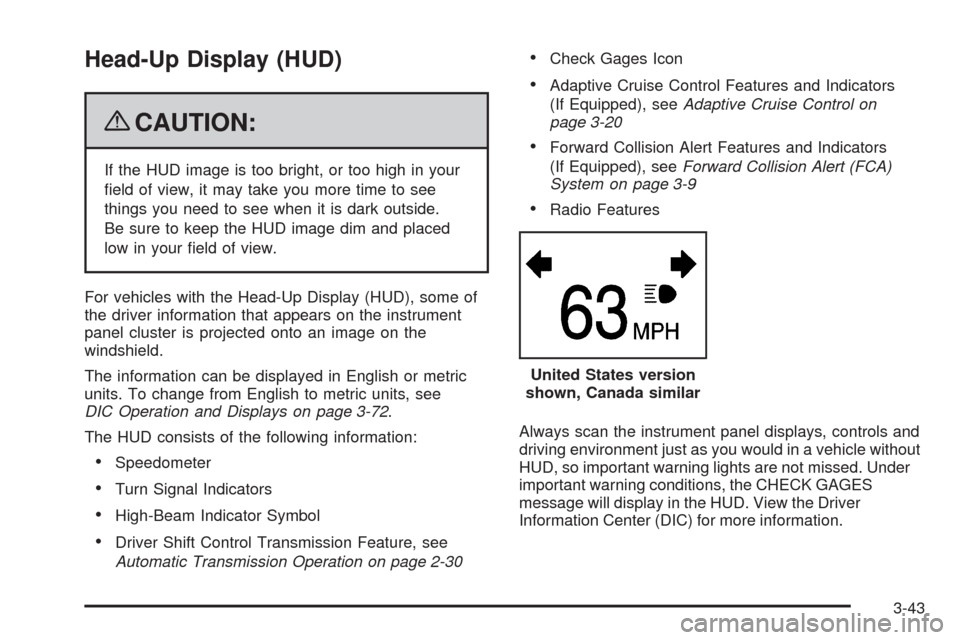
Head-Up Display (HUD)
{CAUTION:
If the HUD image is too bright, or too high in your
eld of view, it may take you more time to see
things you need to see when it is dark outside.
Be sure to keep the HUD image dim and placed
low in your eld of view.
For vehicles with the Head-Up Display (HUD), some of
the driver information that appears on the instrument
panel cluster is projected onto an image on the
windshield.
The information can be displayed in English or metric
units. To change from English to metric units, see
DIC Operation and Displays on page 3-72.
The HUD consists of the following information:
Speedometer
Turn Signal Indicators
High-Beam Indicator Symbol
Driver Shift Control Transmission Feature, see
Automatic Transmission Operation on page 2-30
Check Gages Icon
Adaptive Cruise Control Features and Indicators
(If Equipped), seeAdaptive Cruise Control on
page 3-20
Forward Collision Alert Features and Indicators
(If Equipped), seeForward Collision Alert (FCA)
System on page 3-9
Radio Features
Always scan the instrument panel displays, controls and
driving environment just as you would in a vehicle without
HUD, so important warning lights are not missed. Under
important warning conditions, the CHECK GAGES
message will display in the HUD. View the Driver
Information Center (DIC) for more information.United States version
shown, Canada similar
3-43