wheel CADILLAC STS 2009 1.G Repair Manual
[x] Cancel search | Manufacturer: CADILLAC, Model Year: 2009, Model line: STS, Model: CADILLAC STS 2009 1.GPages: 514, PDF Size: 2.73 MB
Page 320 of 514
Towing a Trailer (Vehicles With
Heavy Duty Cooling)
{CAUTION:
The driver can lose control when pulling a trailer if
the correct equipment is not used or the vehicle is
not driven properly. For example, if the trailer is
too heavy, the brakes may not work well — or
even at all. The driver and passengers could
be seriously injured. The vehicle may also be
damaged; the resulting repairs would not be
covered by the vehicle warranty. Pull a trailer only
if all the steps in this section have been followed.
Ask your dealer/retailer for advice and information
about towing a trailer with the vehicle.
Vehicles with heavy duty cooling can tow a trailer if
equipped with the proper trailer towing equipment.To identify the trailering capacity of the vehicle, read
the information in “Weight of the Trailer” that appears
later in this section.
Trailering is different than just driving the vehicle
by itself. Trailering means changes in handling,
acceleration, braking, durability and fuel economy.
Successful, safe trailering takes correct equipment,
and it has to be used properly.
The following information has many time-tested,
important trailering tips and safety rules. Many of these
are important for your safety and that of your passengers.
So please read this section carefully before pulling a
trailer.
Load-pulling components such as the engine,
transmission, rear axle, wheel assemblies and tires are
forced to work harder against the drag of the added
weight. The engine is required to operate at relatively
higher speeds and under greater loads, generating
extra heat. The trailer also adds considerably to wind
resistance, increasing the pulling requirements.
4-32
Page 324 of 514
Driving with a Trailer
Towing a trailer requires a certain amount of experience.
Get to know the rig before setting out for the open
road. Get acquainted with the feel of handling and
braking with the added weight of the trailer. And always
keep in mind that the vehicle you are driving is now
longer and not as responsive as the vehicle is by itself.
Before starting, check all trailer hitch parts and
attachments, safety chains, electrical connectors, lamps,
tires and mirror adjustments. If the trailer has electric
brakes, start the vehicle and trailer moving and then
apply the trailer brake controller by hand to be sure the
brakes are working. This checks the electrical connection
at the same time.
During the trip, check occasionally to be sure that the
load is secure, and that the lamps and any trailer brakes
are still working.
Following Distance
Stay at least twice as far behind the vehicle ahead as
you would when driving the vehicle without a trailer.
This can help to avoid situations that require heavy
braking and sudden turns.
Passing
More passing distance is needed when towing a trailer.
Because the rig is longer, it is necessary to go much
farther beyond the passed vehicle before returning to
the lane.
Backing Up
Hold the bottom of the steering wheel with one hand.
Then, to move the trailer to the left, move that hand
to the left. To move the trailer to the right, move your
hand to the right. Always back up slowly and, if possible,
have someone guide you.
Making Turns
Notice:Making very sharp turns while trailering
could cause the trailer to come in contact with the
vehicle. The vehicle could be damaged. Avoid
making very sharp turns while trailering.
When turning with a trailer, make wider turns than
normal. Do this so the trailer will not strike soft
shoulders, curbs, road signs, trees or other objects.
Avoid jerky or sudden maneuvers. Signal well in
advance.
4-36
Page 326 of 514

Parking on Hills
{CAUTION:
Parking the vehicle on a hill with the trailer
attached can be dangerous. If something goes
wrong, the rig could start to move. People can be
injured, and both the vehicle and the trailer can be
damaged. When possible, always park the rig on a
at surface.
If parking the rig on a hill:
1. Press the brake pedal, but do not shift into P (Park)
yet. Turn the wheels into the curb if facing downhill
or into traffic if facing uphill.
2. Have someone place chocks under the trailer
wheels.
3. When the wheel chocks are in place, release the
regular brakes until the chocks absorb the load.
4. Reapply the brake pedal. Then apply the parking
brake and shift into P (Park).
5. Release the brake pedal.
Leaving After Parking on a Hill
1. Apply and hold the brake pedal while you:
Start the engine
Shift into a gear
Release the parking brake
2. Let up on the brake pedal.
3. Drive slowly until the trailer is clear of the chocks.
4. Stop and have someone pick up and store the
chocks.
Maintenance When Trailer Towing
The vehicle needs service more often when pulling a
trailer. See this manual’s Maintenance Schedule
or Index for more information. Things that are especially
important in trailer operation are automatic transmission
uid, engine oil, axle lubricant, belts, cooling system
and brake system. It is a good idea to inspect
these before and during the trip.
Check periodically to see that all hitch nuts and bolts
are tight.
Engine Cooling When Trailer Towing
The cooling system may temporarily overheat during
severe operating conditions. SeeEngine Overheating on
page 5-34.
4-38
Page 327 of 514
Service............................................................5-3
Accessories and Modications..........................5-3
California Proposition 65 Warning.....................5-4
California Perchlorate Materials Requirements......5-4
Doing Your Own Service Work.........................5-4
Adding Equipment to the Outside of
the Vehicle.................................................5-5
Fuel................................................................5-5
Gasoline Octane............................................5-5
Gasoline Specications....................................5-6
California Fuel...............................................5-6
Additives.......................................................5-7
Fuels in Foreign Countries...............................5-7
Filling the Tank..............................................5-8
Filling a Portable Fuel Container.....................5-10
Checking Things Under the Hood....................5-10
Hood Release..............................................5-11
Engine Compartment Overview.......................5-12
Engine Oil...................................................5-18
Engine Oil Life System..................................5-21
Engine Air Cleaner/Filter................................5-23
Automatic Transmission Fluid.........................5-25
Cooling System............................................5-26
Engine Coolant.............................................5-27
Coolant Surge Tank Pressure Cap..................5-34
Engine Overheating.......................................5-34Overheated Engine Protection
Operating Mode........................................5-36
Power Steering Fluid.....................................5-37
Windshield Washer Fluid................................5-38
Brakes........................................................5-39
Battery........................................................5-42
Jump Starting...............................................5-42
All-Wheel Drive..............................................5-47
Rear Axle.......................................................5-48
Front Axle......................................................5-49
Headlamp Aiming...........................................5-50
Bulb Replacement..........................................5-51
High Intensity Discharge (HID) Lighting............5-51
Halogen Bulbs..............................................5-51
Back-Up Lamps............................................5-52
Replacement Bulbs.......................................5-52
Windshield Replacement.................................5-52
Windshield Wiper Blade Replacement..............5-52
Tires..............................................................5-54
Winter Tires.................................................5-55
Tire Sidewall Labeling...................................5-56
Tire Terminology and Denitions.....................5-59
Run-Flat Tires (STS-V)..................................5-62
Ination - Tire Pressure.................................5-64
High-Speed Operation...................................5-65
Tire Pressure Monitor System.........................5-66
Tire Pressure Monitor Operation.....................5-68
Section 5 Service and Appearance Care
5-1
Page 328 of 514
Tire Inspection and Rotation...........................5-71
When It Is Time for New Tires.......................5-73
Buying New Tires.........................................5-74
Different Size Tires and Wheels......................5-76
Uniform Tire Quality Grading..........................5-77
Wheel Alignment and Tire Balance..................5-79
Wheel Replacement......................................5-79
Tire Chains..................................................5-81
Lifting the Vehicle (STS-V).............................5-82
If a Tire Goes Flat........................................5-84
Tire Sealant and Compressor Kit
(Without Selector Switch)............................5-87
Tire Sealant and Compressor Kit
(With Selector Switch)................................5-96
Tire Sealant and Compressor Kit Storage.......5-104
Changing a Flat Tire...................................5-104
Removing the Spare Tire and Tools..............5-106
Removing the Flat Tire and Installing
the Spare Tire.........................................5-107
Storing a Flat or Spare Tire and Tools...........5-112
Compact Spare Tire....................................5-114
Appearance Care..........................................5-115
Interior Cleaning.........................................5-115
Fabric/Carpet..............................................5-116
Leather......................................................5-117
Instrument Panel, Vinyl, and Other
Plastic Surfaces.......................................5-117Wood Panels..............................................5-117
Speaker Covers..........................................5-118
Care of Safety Belts....................................5-118
Weatherstrips.............................................5-118
Washing Your Vehicle..................................5-118
Cleaning Exterior Lamps/Lenses....................5-119
Finish Care................................................5-119
Windshield and Wiper Blades.......................5-120
Aluminum or Chrome-Plated Wheels
and Trim................................................5-120
Tires.........................................................5-121
Sheet Metal Damage...................................5-121
Finish Damage...........................................5-121
Underbody Maintenance...............................5-121
Chemical Paint Spotting...............................5-122
Vehicle Identication.....................................5-122
Vehicle Identication Number (VIN)................5-122
Service Parts Identication Label...................5-122
Electrical System..........................................5-123
Add-On Electrical Equipment.........................5-123
Headlamp Wiring........................................5-123
Windshield Wiper Fuses...............................5-123
Power Windows and Other Power Options......5-123
Fuses and Circuit Breakers..........................5-123
Underhood Fuse Block................................5-124
Rear Underseat Fuse Block..........................5-128
Capacities and Specications........................5-134
Section 5 Service and Appearance Care
5-2
Page 367 of 514
{CAUTION:
The brake wear warning sound means that soon
the brakes will not work well. That could lead to an
accident. When the brake wear warning sound is
heard, have the vehicle serviced.
Notice:Continuing to drive with worn-out brake
pads could result in costly brake repair.
Some driving conditions or climates can cause a brake
squeal when the brakes are rst applied or lightly
applied. This does not mean something is wrong
with the brakes.
Properly torqued wheel nuts are necessary to help
prevent brake pulsation. When tires are rotated, inspect
brake pads for wear and evenly tighten wheel nuts
in the proper sequence to torque specications
inCapacities and Specifications on page 5-134.
Brake linings should always be replaced as complete
axle sets.
Brake Pedal Travel
See your dealer/retailer if the brake pedal does not
return to normal height, or if there is a rapid increase in
pedal travel. This could be a sign that brake service
might be required.
Brake Adjustment
Every time the brakes are applied, with or without the
vehicle moving, the brakes adjust for wear.
Replacing Brake System Parts
The braking system on a vehicle is complex. Its many
parts have to be of top quality and work well together if
the vehicle is to have really good braking. The vehicle
was designed and tested with top-quality brake parts.
When parts of the braking system are replaced — for
example, when the brake linings wear down and new
ones are installed — be sure to get new approved
replacement parts. If this is not done, the brakes might
not work properly. For example, if someone puts in
brake linings that are wrong for the vehicle, the balance
between the front and rear brakes can change — for the
worse. The braking performance expected can change
in many other ways if the wrong replacement brake parts
are installed.
5-41
Page 373 of 514

Notice:If the jumper cables are connected or
removed in the wrong order, electrical shorting may
occur and damage the vehicle. The repairs would
not be covered by your warranty. Always connect
and remove the jumper cables in the correct
order, making sure that the cables do not touch
each other or other metal.
A. Heavy, Unpainted Metal Engine Part or Remote
Negative (−) Terminal
B. Good Battery or Remote Positive (+) and Remote
Negative (−) Terminals
C. Dead Battery or Remote Positive (+) TerminalTo disconnect the jumper cables from both vehicles, do
the following:
1. Disconnect the black negative (−) cable from the
vehicle that had the dead battery.
2. Disconnect the black negative (−) cable from the
vehicle with the good battery.
3. Disconnect the red positive (+) cable from the
vehicle with the good battery.
4. Disconnect the red positive (+) cable from the other
vehicle.
All-Wheel Drive
All of the lubricant checks in this section apply to your
vehicle. If you have an all-wheel-drive vehicle, there
is an additional system that need lubrication.
Transfer Case
When to Check Lubricant
It is not necessary to regularly check the transfer case
uid unless you suspect there is a leak or you hear
an unusual noise. A uid loss could indicate a problem.
Have it inspected and repaired. Jumper Cable Removal
5-47
Page 381 of 514
Low-Prole Performance Tires
If your vehicle has 255/45ZR18, P255/45R18
or P275/40R19 size tires, they are classied as
low-prole performance tires. These tires are
designed for very responsive driving on wet or
dry pavement. You may also notice more road
noise with low-prole performance tires and that
they tend to wear faster. These performance tires
are not rated as all-season tires. Winter tires are
recommended for snow or ice covered roads.
Notice:If the vehicle has low-prole tires, they
are more susceptible to damage from road
hazards or curb impact than standard prole
tires. Tire and/or wheel assembly damage
can occur when coming into contact with
road hazards like, potholes, or sharp edged
objects, or when sliding into a curb. The
vehicle warranty does not cover this type of
damage. Keep tires set to the correct ination
pressure and, when possible avoid contact
with curbs, potholes, and other road hazards.
Winter Tires
If you expect to drive on snow or ice covered roads
often, you may want to get winter tires for your vehicle.
All season tires provide good overall performance on
most surfaces but they may not offer the traction
you would like or the same level of performance
as winter tires on snow or ice covered roads.
Winter tires, in general, are designed for increased
traction on snow and ice covered roads. With winter
tires, there may be decreased dry road traction,
increased road noise, and shorter tread life. After
switching to winter tires, be alert for changes in
vehicle handling and braking.
See your dealer/retailer for details regarding winter tire
availability and proper tire selection. Also, seeBuying
New Tires on page 5-74.
If you choose to use winter tires:
Use tires of the same brand and tread type on all
four wheel positions.
Use only radial ply tires of the same size, load
range, and speed rating as the original equipment
tires.
Winter tires with the same speed rating as your original
equipment tires may not be available for H, V, W, Y,
and ZR speed rated tires. If you choose winter tires with
a lower speed rating, never exceed the tire’s maximum
speed capability.
5-55
Page 384 of 514
(F) Tire Size:A combination of letters and
numbers dene a tire’s width, height, aspect
ratio, construction type, and service description.
The letter T as the rst character in the tire
size means the tire is for temporary use only.
(G) TPC Spec (Tire Performance Criteria
Specication)
:Original equipment tires designed
to GM’s specic tire performance criteria have
a TPC specication code molded onto the sidewall.
GM’s TPC specications meet or exceed all
federal safety guidelines.
Tire Size
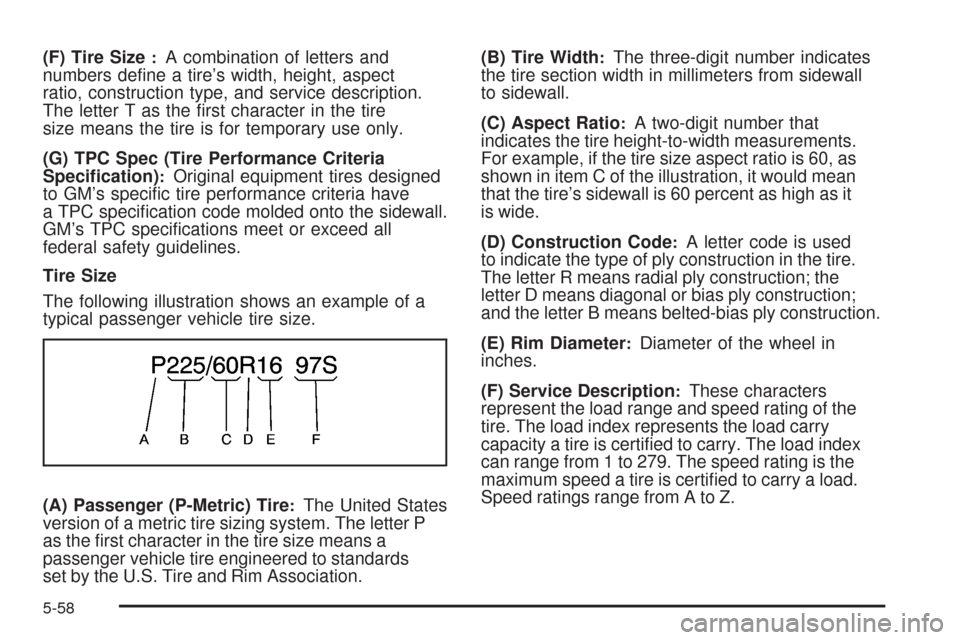
The following illustration shows an example of a
typical passenger vehicle tire size.
(A) Passenger (P-Metric) Tire
:The United States
version of a metric tire sizing system. The letter P
as the rst character in the tire size means a
passenger vehicle tire engineered to standards
set by the U.S. Tire and Rim Association.(B) Tire Width
:The three-digit number indicates
the tire section width in millimeters from sidewall
to sidewall.
(C) Aspect Ratio
:A two-digit number that
indicates the tire height-to-width measurements.
For example, if the tire size aspect ratio is 60, as
shown in item C of the illustration, it would mean
that the tire’s sidewall is 60 percent as high as it
is wide.
(D) Construction Code
:A letter code is used
to indicate the type of ply construction in the tire.
The letter R means radial ply construction; the
letter D means diagonal or bias ply construction;
and the letter B means belted-bias ply construction.
(E) Rim Diameter
:Diameter of the wheel in
inches.
(F) Service Description
:These characters
represent the load range and speed rating of the
tire. The load index represents the load carry
capacity a tire is certied to carry. The load index
can range from 1 to 279. The speed rating is the
maximum speed a tire is certied to carry a load.
Speed ratings range from A to Z.
5-58
Page 389 of 514

If a tire goes at, you will not need to stop on the side of
the road to change the tire. You can just keep on driving.
The vehicle’s run-at tires can operate effectively with no
air pressure for up to 50 miles (80 km) at speeds up to
55 mph (90 km/h). The shorter the distance you drive and
the slower the speed, the greater the chance that the tire
will not have to be replaced. When a tire is lled with air,
it provides a cushion between the road and the wheel.
Because you will not have this cushion when driving on
a deated run-at tire, try to avoid potholes that could
damage your wheel and require replacement of it.
Some road hazards can damage a tire beyond repair.
This damage could occur even before you have driven
on the tire in a deated condition. When a tire has been
damaged, or if you have driven any distance on a
deated run-at tire, check with an authorized run-at
tire service center, as soon as possible, to determine
whether the tire can be repaired or should be replaced.
To maintain your vehicle’s run-at feature, all
replacement tires must be self-supporting tires.
To locate the nearest GM or authorized run-at
servicing facility, call Roadside Service. See
Roadside Service on page 7-7for details.
{CAUTION:
Run-at tires are constructed differently than other
tires and could explode during improper service.
You or others could be injured or killed if you
attempt to repair, replace, dismount, or mount a
run-at tire. Let only an authorized run-at service
center repair, replace, dismount, and mount
run-at tires.
The valve stems on your vehicle’s run-at tires have
sensors that are part of the Tire Pressure Monitor
System (TPMS). These sensors contain batteries which
are designed to last for 10 years under normal driving
conditions. See your GM dealer, if the TPMS sensors or
a wheel ever need replacement.
Notice:Using liquid sealants can damage the tire
valves and tire pressure monitor sensors in the
vehicle’s run-at tires. This damage would not be
covered by warranty. Do not use liquid sealants
in the vehicle’s run-at tires.
5-63