lock CADILLAC STS 2011 1.G Owners Manual
[x] Cancel search | Manufacturer: CADILLAC, Model Year: 2011, Model line: STS, Model: CADILLAC STS 2011 1.GPages: 528, PDF Size: 4.96 MB
Page 439 of 528
Black plate (89,1)Cadillac STS Owner Manual - 2011
If a tire goes flat, avoid further tire and wheel damage
by driving slowly to a level place. Turn on the hazard
warning flashers. SeeHazard Warning Flashers
on
page 4‑3.
See If a Tire Goes Flat
on page 6‑74for other
important safety warnings.
Do not remove any objects that have penetrated
the tire.
1. Remove the tire sealant and compressor kit from its storage location. See Tire Sealant and
Compressor Kit Storage on page 6‑94.
2. Unwrap the sealant/air hose (F) and the power plug (H).
3. Place the kit on the ground.
4. Remove the valve stem cap from the flat tire by turning it counterclockwise.
5. Attach the sealant/air hose (F) onto the tire valve stem. Turn it clockwise until it is tight. 6. Plug the power plug (H) into the accessory power
outlet in the vehicle. Unplug all items from other
accessory power outlets. See Accessory Power
Outlet(s) on page 4‑42.
If the vehicle has an accessory power outlet, do
not use the cigarette lighter.
If the vehicle only has a cigarette lighter, use the
cigarette lighter.
Do not pinch the power plug cord in the door or
window.
7. Start the vehicle. The vehicle must be running while using the air compressor.
8. Turn the selector switch (A) counterclockwise to the Sealant + Air position.
9. Press the on/off (B) button to turn the tire sealant and compressor kit on.
The compressor will inject sealant and air into
the tire.
The pressure gauge (C) will initially show a high
pressure while the compressor pushes the sealant
into the tire. Once the sealant is completely
dispersed into the tire, the pressure will quickly
drop and start to rise again as the tire inflates with
air only.
6-89
Page 440 of 528
Black plate (90,1)Cadillac STS Owner Manual - 2011
10. Inflate the tire to the recommended inflationpressure using the pressure gauge (C). The
recommended inflation pressure can be found on
the Tire and Loading Information label. See
Inflation - Tire Pressure on page 6‑58.
The pressure gauge (C) may read higher than the
actual tire pressure while the compressor is on.
Turn the compressor off to get an accurate
pressure reading. The compressor may be turned
on/off until the correct pressure is reached.
Notice: If the recommended pressure cannot be
reached after approximately 25 minutes, the vehicle
should not be driven farther. The tire is too severely
damaged and the tire sealant and compressor kit
cannot inflate the tire. Remove the power plug from
the accessory power outlet and unscrew the
inflating hose from the tire valve. See Roadside
Service on page 8‑8.
11. Press the on/off button (B) to turn the tire sealant and compressor kit off.
The tire is not sealed and will continue to leak air
until the vehicle is driven and the sealant is
distributed in the tire, therefore, Steps 12 through
18 must be done immediately after Step 11.
Be careful while handling the tire sealant and
compressor kit as it could be warm after usage. 12. Unplug the power plug (H) from the accessory
power outlet in the vehicle.
13. Turn the sealant/air hose (F) counterclockwise to remove it from the tire valve stem.
14. Replace the tire valve stem cap.
15. Replace the sealant/air hose (F), and the power plug (H) back in their original location.
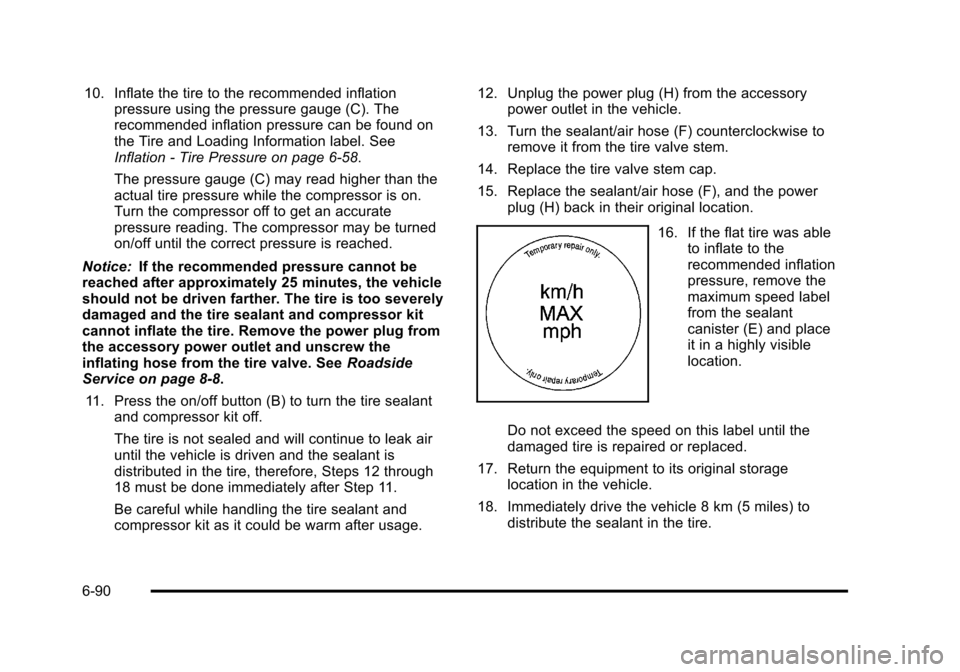
16. If the flat tire was ableto inflate to the
recommended inflation
pressure, remove the
maximum speed label
from the sealant
canister (E) and place
it in a highly visible
location.
Do not exceed the speed on this label until the
damaged tire is repaired or replaced.
17. Return the equipment to its original storage location in the vehicle.
18. Immediately drive the vehicle 8 km (5 miles) to distribute the sealant in the tire.
6-90
Page 442 of 528

Black plate (92,1)Cadillac STS Owner Manual - 2011
SeeIf a Tire Goes Flaton page 6‑74for other
important safety warnings.
1. Remove the tire sealant and compressor kit from its storage location. See Tire Sealant and
Compressor Kit Storage on page 6‑94.
2. Unwrap the air only hose (G) and the power plug (H).
3. Place the kit on the ground.
4. Remove the tire valve stem cap from the flat tire by turning it counterclockwise.
5. Attach the air only hose (G) onto the tire valve stem by turning it clockwise until it is tight.
6. Plug the power plug (H) into the accessory power outlet in the vehicle. Unplug all items from other
accessory power outlets. See Accessory Power
Outlet(s) on page 4‑42.
If the vehicle has an accessory power outlet, do
not use the cigarette lighter.
If the vehicle only has a cigarette lighter, use the
cigarette lighter.
Do not pinch the power plug cord in the door or
window.
7. Start the vehicle. The vehicle must be running while using the air compressor.
8. Turn the selector switch (A) clockwise to the Air Only position. 9. Press the on/off (B) button to turn the
compressor on.
The compressor will inflate the tire with air only.
10. Inflate the tire to the recommended inflation pressure using the pressure gauge (C). The
recommended inflation pressure can be found on
the Tire and Loading Information label. See
Inflation - Tire Pressure on page 6‑58.
The pressure gauge (C) may read higher than the
actual tire pressure while the compressor is on.
Turn the compressor off to get an accurate
reading. The compressor may be turned on/off until
the correct pressure is reached.
If you inflate the tire higher than the recommended
pressure you can adjust the excess pressure by
pressing the pressure deflation button (D) until the
proper pressure reading is reached. This option is
only functional when using the air only hose (G).
11. Press the on/off button (B) to turn the tire sealant and compressor kit off.
Be careful while handling the tire sealant and
compressor kit as it could be warm after usage.
12. Unplug the power plug (H) from the accessory power outlet in the vehicle.
13. Disconnect the air only hose (G) from the tire valve stem, by turning it counterclockwise, and replace
the tire valve stem cap.
6-92
Page 445 of 528
Black plate (95,1)Cadillac STS Owner Manual - 2011
WARNING: (Continued)
To be even more certain the vehicle will not move,
you should put blocks at the front and rear of the
tire farthest away from the one being changed.
That would be the tire, on the other side, at the
opposite end of the vehicle.
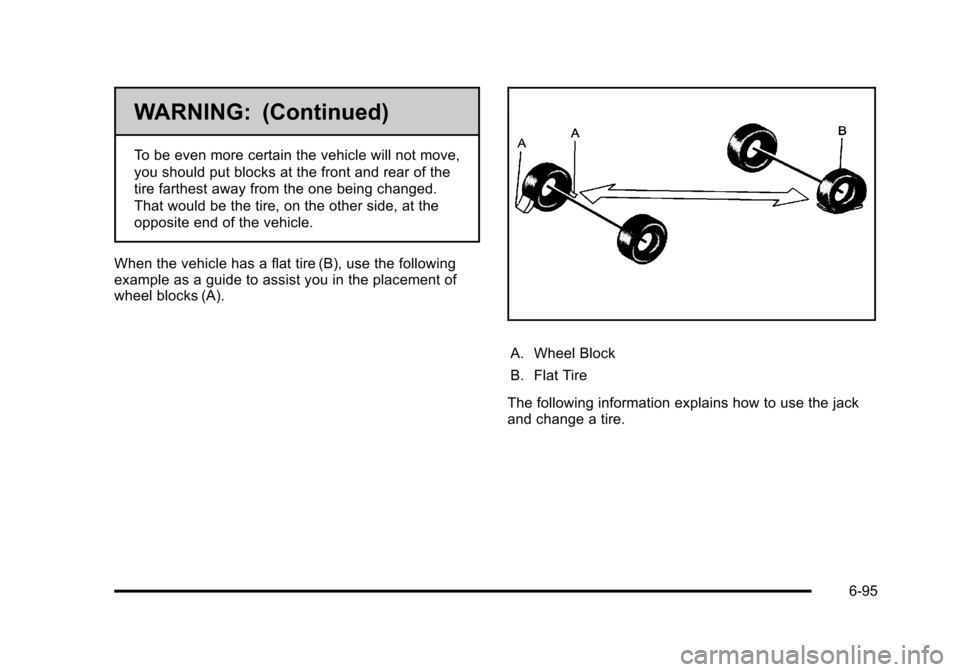
When the vehicle has a flat tire (B), use the following
example as a guide to assist you in the placement of
wheel blocks (A).
A. Wheel Block
B. Flat Tire
The following information explains how to use the jack
and change a tire.
6-95
Page 446 of 528
Black plate (96,1)Cadillac STS Owner Manual - 2011
Removing the Spare Tire and Tools
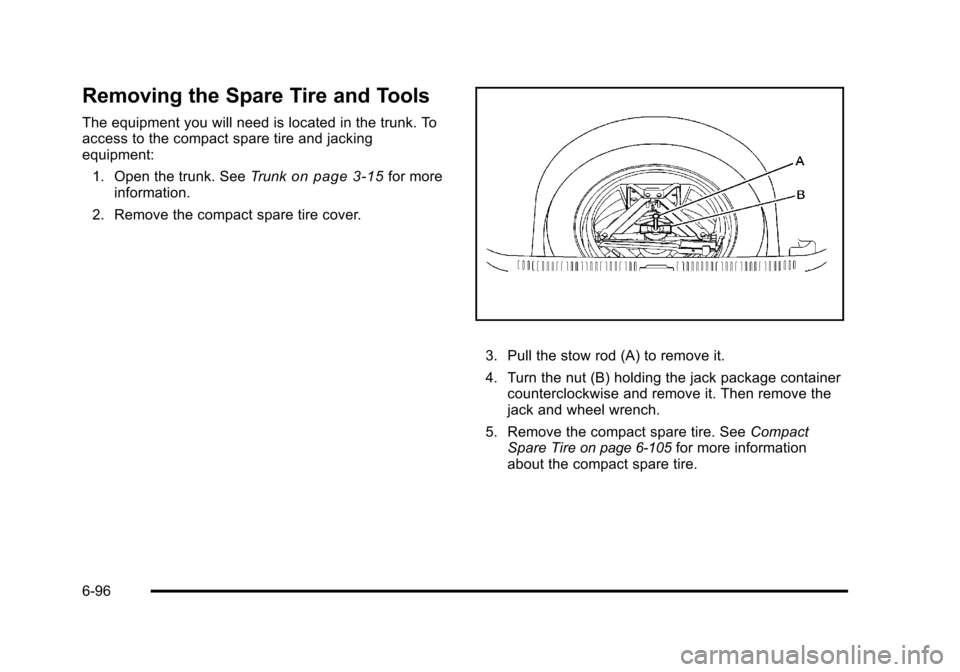
The equipment you will need is located in the trunk. To
access to the compact spare tire and jacking
equipment:1. Open the trunk. See Trunk
on page 3‑15for more
information.
2. Remove the compact spare tire cover.
3. Pull the stow rod (A) to remove it.
4. Turn the nut (B) holding the jack package container counterclockwise and remove it. Then remove the
jack and wheel wrench.
5. Remove the compact spare tire. See Compact
Spare Tire
on page 6‑105for more information
about the compact spare tire.
6-96
Page 449 of 528
Black plate (99,1)Cadillac STS Owner Manual - 2011
{WARNING:
Lifting a vehicle and getting under it to do
maintenance or repairs is dangerous without the
appropriate safety equipment and training. If a
jack is provided with the vehicle, it is designed
only for changing a flat tire. If it is used for
anything else, you or others could be badly
injured or killed if the vehicle slips off the jack. If a
jack is provided with the vehicle, only use it for
changing a flat tire.
Notice: If you position the jack under the rocker
molding and attempt to raise the vehicle, you could
break the molding and/or cause other damage to
your vehicle. Always position the jack so that when
the jack head is raised, it will fit firmly in the notch
located inboard from the rocker molding.
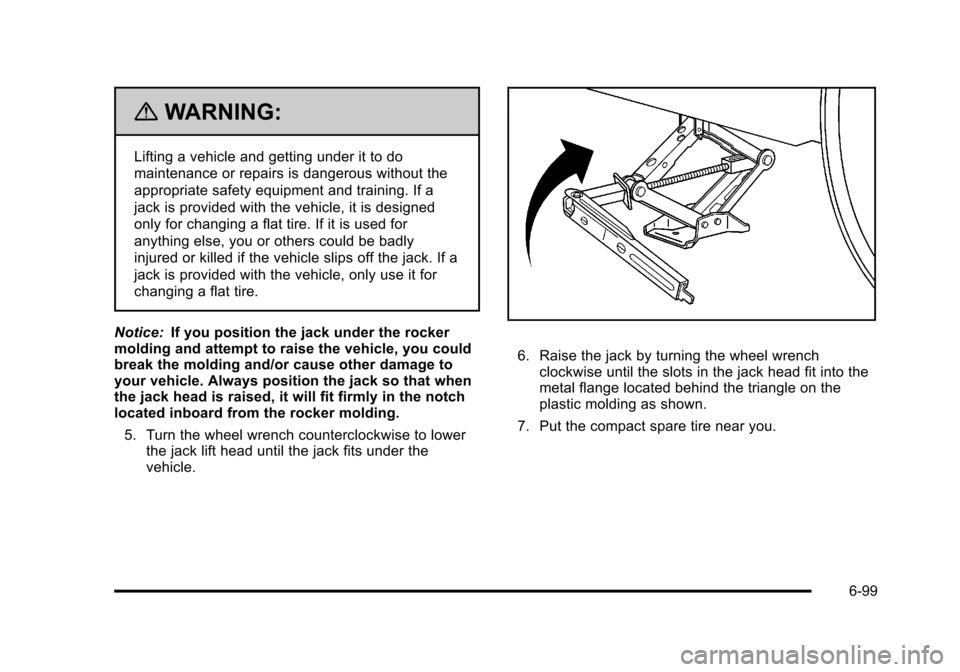
5. Turn the wheel wrench counterclockwise to lower the jack lift head until the jack fits under the
vehicle.
6. Raise the jack by turning the wheel wrenchclockwise until the slots in the jack head fit into the
metal flange located behind the triangle on the
plastic molding as shown.
7. Put the compact spare tire near you.
6-99
Page 450 of 528
Black plate (100,1)Cadillac STS Owner Manual - 2011
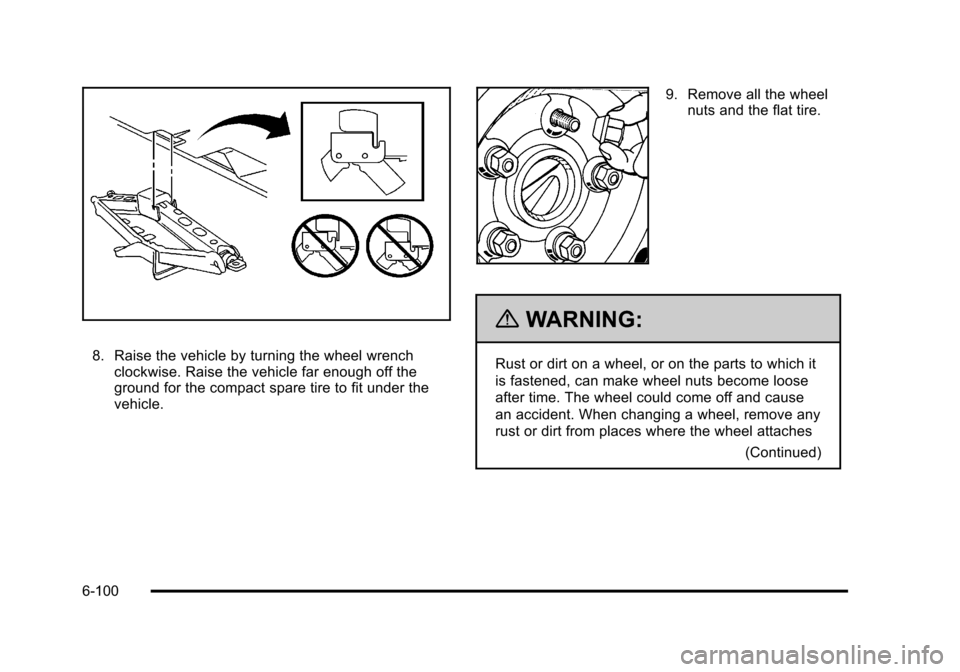
8. Raise the vehicle by turning the wheel wrenchclockwise. Raise the vehicle far enough off the
ground for the compact spare tire to fit under the
vehicle.
9. Remove all the wheel
nuts and the flat tire.
{WARNING:
Rust or dirt on a wheel, or on the parts to which it
is fastened, can make wheel nuts become loose
after time. The wheel could come off and cause
an accident. When changing a wheel, remove any
rust or dirt from places where the wheel attaches
(Continued)
6-100
Page 451 of 528

Black plate (101,1)Cadillac STS Owner Manual - 2011
WARNING: (Continued)
to the vehicle. In an emergency, use a cloth or a
paper towel to do this; but be sure to use a
scraper or wire brush later, if needed, to get all the
rust or dirt off. SeeChanging a Flat Tire
on
page 6‑94
.
{WARNING:
Never use oil or grease on bolts or nuts because
the nuts might come loose. The vehicle's wheel
could fall off, causing a crash.
10. Remove any rust or dirt from the wheel bolts,
mounting surfaces, and
spare wheel.
11. Install the spare tire.
12. Put the wheel nuts back on with the rounded end of the nuts toward the wheel.
13. Tighten each wheel nut by turning it clockwise with your hand until the wheel is held against the hub.
6-101
Page 452 of 528
Black plate (102,1)Cadillac STS Owner Manual - 2011
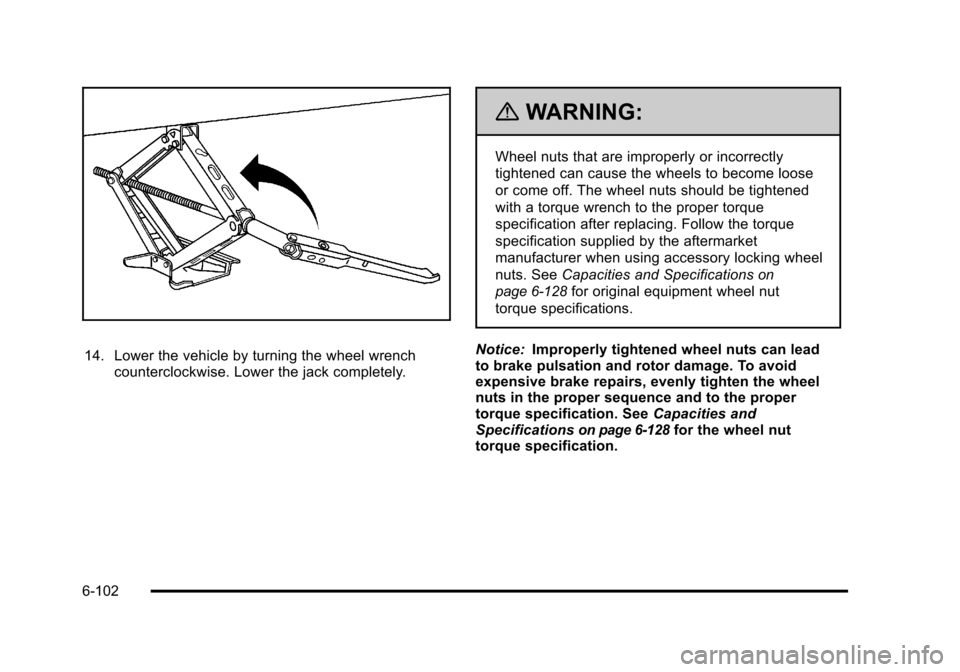
14. Lower the vehicle by turning the wheel wrenchcounterclockwise. Lower the jack completely.
{WARNING:
Wheel nuts that are improperly or incorrectly
tightened can cause the wheels to become loose
or come off. The wheel nuts should be tightened
with a torque wrench to the proper torque
specification after replacing. Follow the torque
specification supplied by the aftermarket
manufacturer when using accessory locking wheel
nuts. See Capacities and Specifications
on
page 6‑128
for original equipment wheel nut
torque specifications.
Notice: Improperly tightened wheel nuts can lead
to brake pulsation and rotor damage. To avoid
expensive brake repairs, evenly tighten the wheel
nuts in the proper sequence and to the proper
torque specification. See Capacities and
Specifications
on page 6‑128for the wheel nut
torque specification.
6-102
Page 465 of 528
Black plate (115,1)Cadillac STS Owner Manual - 2011
The vehicle has an airbag system. Before attempting to
add anything electrical to the vehicle, seeServicing
Your Airbag-Equipped Vehicle
on page 2‑70and
Adding Equipment to Your Airbag-Equipped Vehicleon
page 2‑71.
Headlamp Wiring
The headlamp wiring is protected by fuses in the fuse
block. An electrical overload will cause the lamps to turn
off. If this happens, have the headlamp wiring checked
right away.
Windshield Wiper Fuses
The windshield wiper motor is protected by an internal
circuit breaker. If the wiper motor overheats due to
heavy snow, the wipers will stop until the motor cools
and will then restart.
Power Windows and Other Power
Options
Circuit breakers in the fuse block protect the power
windows and other power accessories. When the
current load is too heavy, the circuit breaker opens and
closes, protecting the circuit until the problem is fixed or
goes away.
Fuses and Circuit Breakers
The wiring circuits in the vehicle are protected from
short circuits by a combination of fuses, circuit breakers
and fusible thermal links. This greatly reduces the
chance of fires caused by electrical problems.
Look at the silver-colored band inside the fuse. If the
band is broken or melted, replace the fuse. Be sure you
replace a bad fuse with a new one of the identical size
and rating.
Fuses of the same amperage can be temporarily
borrowed from another fuse location, if a fuse goes out.
Replace the fuse as soon as you can.
6-115