cooling CADILLAC STS 2011 1.G User Guide
[x] Cancel search | Manufacturer: CADILLAC, Model Year: 2011, Model line: STS, Model: CADILLAC STS 2011 1.GPages: 528, PDF Size: 4.96 MB
Page 374 of 528
Black plate (24,1)Cadillac STS Owner Manual - 2011
Cooling System
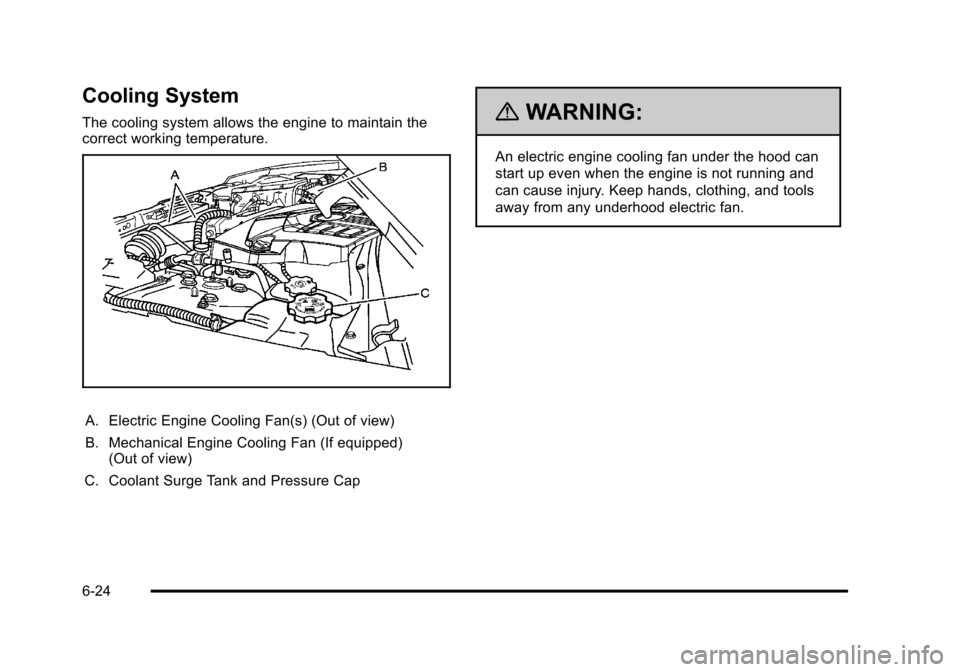
The cooling system allows the engine to maintain the
correct working temperature.
A. Electric Engine Cooling Fan(s) (Out of view)
B. Mechanical Engine Cooling Fan (If equipped)(Out of view)
C. Coolant Surge Tank and Pressure Cap
{WARNING:
An electric engine cooling fan under the hood can
start up even when the engine is not running and
can cause injury. Keep hands, clothing, and tools
away from any underhood electric fan.
6-24
Page 375 of 528
Black plate (25,1)Cadillac STS Owner Manual - 2011
{WARNING:
Heater and radiator hoses, and other engine
parts, can be very hot. Do not touch them. If you
do, you can be burned.
Do not run the engine if there is a leak. If you run
the engine, it could lose all coolant. That could
cause an engine fire, and you could be burned.
Get any leak fixed before you drive the vehicle.
Notice: Using coolant other than DEX-COOL
®can
cause premature engine, heater core, or radiator
corrosion. In addition, the engine coolant could
require changing sooner, at 50 000 km (30,000 miles)
or 24 months, whichever occurs first. Any repairs
would not be covered by the vehicle warranty.
Always use DEX-COOL (silicate-free) coolant in the
vehicle.
Engine Coolant
The cooling system in the vehicle is filled with
DEX-COOL®engine coolant. This coolant is designed
to remain in the vehicle for five years or 240 000 km
(150,000 miles), whichever occurs first.
The following explains the cooling system and how to
check and add coolant when it is low. If there is a
problem with engine overheating, see Engine
Overheating on page 6‑30
6-25
Page 376 of 528
Black plate (26,1)Cadillac STS Owner Manual - 2011
What to Use
{WARNING:
Adding only plain water or some other liquid to the
cooling system can be dangerous. Plain water
and other liquids, can boil before the proper
coolant mixture will. The vehicle's coolant warning
system is set for the proper coolant mixture. With
plain water or the wrong mixture, the engine could
get too hot but you would not get the overheat
warning. The engine could catch fire and you or
others could be burned. Use a 50/50 mixture of
clean, drinkable water and DEX-COOL coolant.
Use a 50/50 mixture of clean, drinkable water and
DEX-COOL
®coolant. If using this mixture, nothing else
needs to be added. This mixture:
.Gives freezing protection down to −34°F (−37°C),
outside temperature.
.Gives boiling protection up to 265°F (129°C),
engine temperature.
.Protects against rust and corrosion.
.Will not damage aluminum parts.
.Helps keep the proper engine temperature.
Notice: If an improper coolant mixture is used, the
engine could overheat and be badly damaged. The
repair cost would not be covered by the vehicle
warranty. Too much water in the mixture can freeze
and crack the engine, radiator, heater core, and
other parts.
Notice: If extra inhibitors and/or additives are used
in the vehicle's cooling system, the vehicle could be
damaged. Use only the proper mixture of the engine
coolant listed in this manual for the cooling system.
See Recommended Fluids and Lubricants
on
page 7‑9for more information.
6-26
Page 377 of 528
Black plate (27,1)Cadillac STS Owner Manual - 2011
Checking Coolant
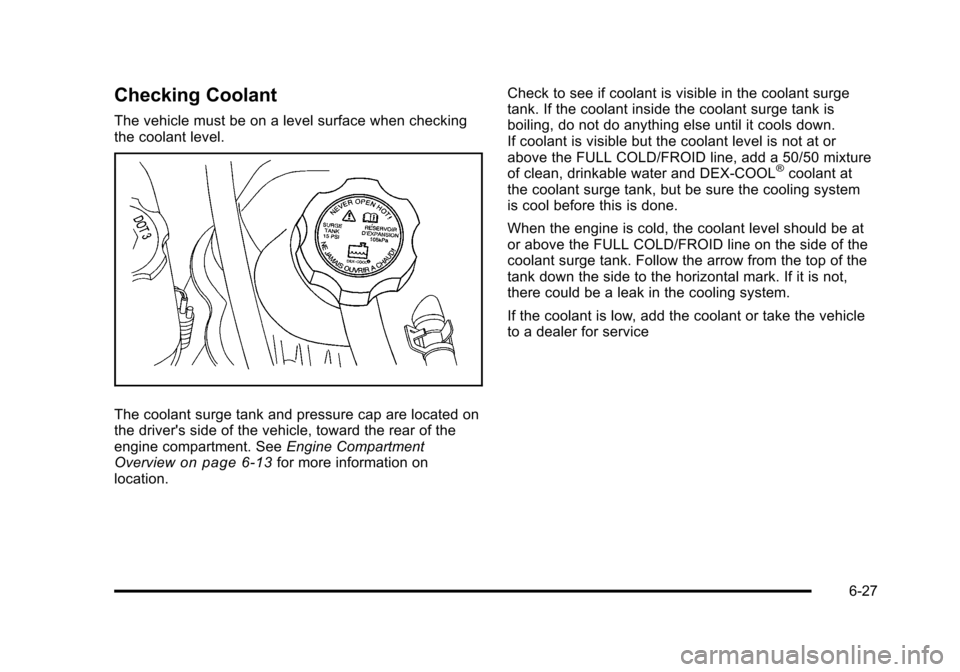
The vehicle must be on a level surface when checking
the coolant level.
The coolant surge tank and pressure cap are located on
the driver's side of the vehicle, toward the rear of the
engine compartment. SeeEngine Compartment
Overview
on page 6‑13for more information on
location. Check to see if coolant is visible in the coolant surge
tank. If the coolant inside the coolant surge tank is
boiling, do not do anything else until it cools down.
If coolant is visible but the coolant level is not at or
above the FULL COLD/FROID line, add a 50/50 mixture
of clean, drinkable water and DEX-COOL
®coolant at
the coolant surge tank, but be sure the cooling system
is cool before this is done.
When the engine is cold, the coolant level should be at
or above the FULL COLD/FROID line on the side of the
coolant surge tank. Follow the arrow from the top of the
tank down the side to the horizontal mark. If it is not,
there could be a leak in the cooling system.
If the coolant is low, add the coolant or take the vehicle
to a dealer for service
6-27
Page 378 of 528
Black plate (28,1)Cadillac STS Owner Manual - 2011
How to Add Coolant to the Surge Tank
{WARNING:
You can be burned if you spill coolant on hot
engine parts. Coolant contains ethylene glycol
and it will burn if the engine parts are hot enough.
Do not spill coolant on a hot engine.
{WARNING:
Steam and scalding liquids from a hot cooling
system can blow out and burn you badly. They are
under pressure, and if you turn the coolant surge
tank pressure cap—even a little —they can come
out at high speed. Never turn the cap when the
cooling system, including the coolant surge tank
pressure cap, is hot. Wait for the cooling system
and coolant surge tank pressure cap to cool if you
ever have to turn the pressure cap.
{WARNING:
An electric engine cooling fan under the hood can
start up even when the engine is not running and
can cause injury. Keep hands, clothing, and tools
away from any underhood electric fan.
If no coolant is visible in the surge tank, add coolant as
follows: 1. Remove the coolant surge tank pressure cap when the cooling system, including the coolant surge
tank pressure cap and upper radiator hose, is
no longer hot. Turn the pressure cap slowly
counterclockwise about one-quarter of a turn.
If you hear a hiss, wait for that to stop. A hiss
means there is still some pressure left.
6-28
Page 380 of 528
Black plate (30,1)Cadillac STS Owner Manual - 2011
4. With the coolant surge tank pressure cap off, startthe engine and let it run until you can feel the
upper radiator hose getting hot. The upper radiator
hose is the largest of the hoses which comes out
of the radiator, on the passenger side of the
vehicle. Watch out for the engine cooling fans.
By this time, the coolant level inside the coolant
surge tank may be lower. If the level is lower, add
more of the proper mixture to the coolant surge
tank until the level reaches the FULL COLD/FROID
line on the side of the coolant surge tank.
5. Then replace the pressure cap. Be sure the pressure cap is hand-tight and fully seated.
Start the engine and allow it to warm up.
Engine Overheating
The vehicle has several indicators to warn of engine
overheating.
There are two engine hot messages that could be
displayed in the Driver Information Center (DIC). See
DIC Warnings and Messages
on page 4‑76DIC
Warnings and Messages for more information. If the engine is overheating, then you will find a coolant
temperature gauge and a coolant warning light on the
instrument panel. See
Engine Coolant Temperature
Gauge
on page 4‑61and Engine Coolant Temperature
Warning Lighton page 4‑61for more information.
You may decide not to lift the hood when this warning
appears, but instead get service help right away. See
Roadside Service on page 8‑8.
If you do decide to lift the hood , make sure the vehicle
is parked on a level surface.
Then check to see if the engine cooling fans are
running. If the engine is overheating, both fans should
be running. If they are not, do not continue to run the
engine and have the vehicle serviced.
Notice: Engine damage from running your engine
without coolant is not covered by the vehicle
warranty. See Overheated Engine Protection
Operating Mode for information on driving to a safe
place in an emergency.
Notice: If the engine catches fire while driving with
no coolant, the vehicle can be badly damaged. The
costly repairs would not be covered by the vehicle
warranty. See Overheated Engine Protection
Operating Mode
on page 6‑32for information on
driving to a safe place in an emergency.
6-30
Page 423 of 528

Black plate (73,1)Cadillac STS Owner Manual - 2011
If you need to replace any of your wheels, wheel bolts,
wheel nuts, or Tire Pressure Monitor System (TPMS)
sensors, replace them only with new GM original
equipment parts. This way, you will be sure to have the
right wheel, wheel bolts, wheel nuts, and TPMS sensors
for your vehicle.
{WARNING:
Using the wrong replacement wheels, wheel bolts,
or wheel nuts on your vehicle can be dangerous.
It could affect the braking and handling of your
vehicle, make your tires lose air and make you
lose control. You could have a collision in which
you or others could be injured. Always use the
correct wheel, wheel bolts, and wheel nuts for
replacement.Notice:
The wrong wheel can also cause problems
with bearing life, brake cooling, speedometer or
odometer calibration, headlamp aim, bumper height,
vehicle ground clearance, and tire or tire chain
clearance to the body and chassis.
See Changing a Flat Tire
on page 6‑94for more
information.
Used Replacement Wheels
{WARNING:
Putting a used wheel on the vehicle is dangerous.
You cannot know how it has been used or how far
it has been driven. It could fail suddenly and
cause a crash. If you have to replace a wheel, use
a new GM original equipment wheel.
6-73
Page 467 of 528

Black plate (117,1)Cadillac STS Owner Manual - 2011
The underhood fuse block is located in the front of the
engine compartment on the passenger side of the
vehicle. SeeEngine Compartment Overview
on
page 6‑13for more information on location and
removal procedure for the front compartment underhood
sights shields.
To access the fuses, push in the tabs located on each
side of the fuse block cover, then lift the cover off.
Notice: Spilling liquid on any electrical component
on the vehicle may damage it. Always keep the
covers on any electrical component.
Fuses JCase Usage
ABS MTR ABS Module- ABS Module-Stabilitrak AFS Active Front Steering
BLWR Blower Motor
FAN 1 Cooling Fan-Low Speed
FAN 2 Cooling Fan-High Speed
LPDB 1 Driver Side Rear Fuse Block
LPDB 2 Driver Side Rear Fuse Block
RPDB 1 Passenger Side Rear Fuse Block
RPDB 2 Passenger Side Rear Fuse Block
Fuses JCase Usage
SPARE Spare
SPARE Spare
STRTR Starter
Fuses MiniUsage
A/C CLTCH Air Conditioning Compressor Clutch
ABS ABS Module-Stabilitrak
ABS IGN Antilock Brake Controller
AUX OUTLET Rear Accessory Power Outlet BRK
VAC PUMP Brake Vacuum Pump
CCP Climate Control Panel
CCP/RLY COILS Climate Control Panel, Headlamp
Level Control, Active Cruise Control,
Relay Coils, Starter, Front Blower
ECM 1 Engine Control Module (ECM)
ECM/TCM BATT ECM, Transmission Control
Module (TCM)
ECM/TCM IGN ECM, TCM, Instrument Panel Cluster
6-117
Page 468 of 528

Black plate (118,1)Cadillac STS Owner Manual - 2011
Fuses MiniUsage
EKM/I/P MDLEasy Key Module (EKM), Instrument
Panel Module (I/P MDL)
EVEN COILS Even Ignition Coils, Even Fuel
Injectors
FOG LAMP Front Fog Lamps
FRT PWR OUTLET Front Accessory Power Outlet
FUEL COOL Fuel Cooling HORN Horn
HTD
WASH/AQS Heated Headlamp Washer, Air Quality
Sensor
HUD Heads-Up Display, Steering Column
Switch
I/BEAM IntelliBeam Relay
I/P MDL/ALDL Instrument Panel Module, Assembly
Line Data Link Connector
LIC DIM License Plate, Instrument Panel
Dimming
LT HI BEAM Driver Side High Beam Headlamp
LT LO BEAM Driver Side Low Beam Headlamp
Fuses Mini Usage
LT PRKDriver Side Park Lamp/Driver Side
Taillamp
ODD COILS Odd Ignition Coils, Odd Fuel Injectors
POST O2 SNSR Post Oxygen Sensor PRE O2 SNSR Pre Oxygen Sensor, CAM Sensors
RAIN
SNSR/TPM Rain Sensor, Relay Coil:
Headlamp Wash
RT HI BEAM Passenger Side High Beam
Headlamp
RT LO BEAM Passenger Side Low Beam Headlamp
RT PRK Passenger Side Park Lamp,
Passenger Side Taillamp
SPARE Spare
SPARE Spare
SPARE Spare
SPARE Spare
SPARE Spare
SPARE Spare
SPARE Spare
6-118
Page 469 of 528

Black plate (119,1)Cadillac STS Owner Manual - 2011
Fuses MiniUsage
V/CHKInstrument Panel Module-Voltage
Check
WPR Wipe/Wash Module Assembly
WPR SW/VICS Rain Sensor, Wiper Switch
Relays Usage
A/C CMPRSR
CLTCH Air Conditioning Compressor Clutch
ACCY Accessory, Rain Sensor, Headlamp
Washer Relay Coil, Windshield
Wiper/Washer Module
BRK
VAC PUMP Brake Vacuum Pump
FAN S/P Cooling Fan Series/Parallel
FOG LAMP Fog Lamps FRT BLWR Front Blower Motor
FUEL COOL Fuel Cooling Pump
HI BEAM High Beam Headlamp
HI FAN SPD Cooling Fan High Speed HORN Horn
Relays Usage
LO FAN SPD Cooling Fan Low Speed
LOW BEAM
W/O HID/HID Low Beam Headlamp, High Intensity
Discharge (HID)
PRK LAMP Parking Lamps, Instrument Panel
Dimming, Rear License Plate Lamps
PWR/TRN Engine Controls
RUN CRNK Heated Washer Nozzle, Air Quality,
Antilock Brake System, Climate
Control Panel, TCM, ECM, Instrument
Panel Cluster
SPARE Spare
SPARE Spare
SPARE Spare
STRTR Starter
WPR HI Windshield Wiper High Speed
Circuit
Breakers Usage
HDLP WASH
Headlamp Washer Motor
(Circuit Breaker)
6-119