tow CADILLAC STS 2011 1.G Owner's Manual
[x] Cancel search | Manufacturer: CADILLAC, Model Year: 2011, Model line: STS, Model: CADILLAC STS 2011 1.GPages: 528, PDF Size: 4.96 MB
Page 191 of 528
Black plate (5,1)Cadillac STS Owner Manual - 2011
The lever returns to its starting position when it is
released.
If after signaling a turn or lane change the arrow flashes
rapidly or does not come on, a signal bulb may be
burned out.
Have the bulbs replaced. If the bulb is not burned out,
check the fuse. SeeFuses and Circuit Breakers
on
page 6‑115.
Turn Signal On Chime
If the turn signal is left on for about 1.6 km (1 mile), a
warning chime will sound and the TURN SIGNAL ON
message will appear on the Driver Information Center
(DIC) display. See “Turn Signal On”underDIC
Warnings and Messages
on page 4‑76for more
information.
Headlamp High/Low-Beam Changer
Push forward on the turn signal/multifunction lever to
change the headlamps from low to high beam. Pull the
lever back and then release it to change from high to
low beam.
If you turn the vehicle off with the high beams on, the
next time you start your vehicle the low beams will
be on.
To re-activate high beams, pull lever toward you and
then push it forward again.
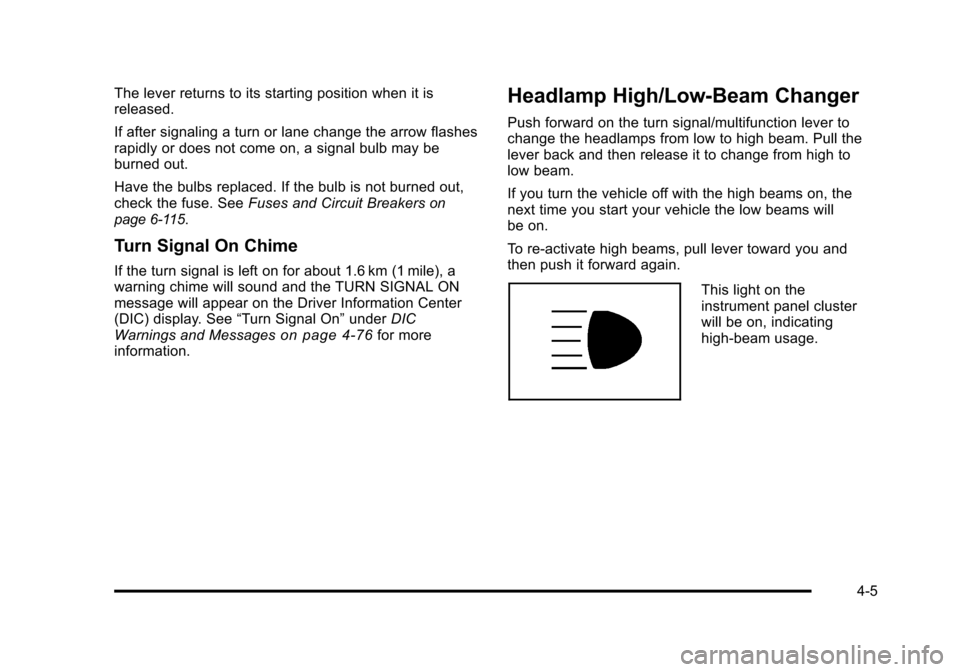
This light on the
instrument panel cluster
will be on, indicating
high-beam usage.
4-5
Page 195 of 528
Black plate (9,1)Cadillac STS Owner Manual - 2011
Unnecessary Warnings
FCA may occasionally provide an unnecessary warning
to guard rails, signs, and other stationary objects. This
is normal operation, your vehicle does not need service.
Other Messages
There are three messages that may appear on the
Driver Information Center (DIC). They are CLEAN
RADAR, RADAR CRUISE NOT READY and SERVICE
RADAR CRUISE. SeeDIC Warnings and Messages
on
page 4‑76.
Cleaning the System
The radar can become blocked by snow, ice, or dirt.
If so, you may need to turn off the engine and clean the
lens. See “Cleaning the System” underAdaptive Cruise
Control on page 4‑15.
Flash-to-Pass
This feature allows you to use the high-beam
headlamps to signal the driver in front of you that you
want to pass.
Pull and hold the turn signal/multifunction lever toward
you to use this feature. When this is done the following
will occur:
.If the headlamps are off, in low-beam or in Daytime
Running Lamps (DRL) mode, the high-beam
headlamps will turn on. They will stay on as long
as the lever is held there. Release the lever to turn
them off.
.If the headlamps are in high-beam mode, they will
switch to low beam. To return to high-beam, push
the lever forward.
4-9
Page 209 of 528
Black plate (23,1)Cadillac STS Owner Manual - 2011
Stationary or Very Slow-Moving Objects
{WARNING:
Adaptive Cruise Control may not detect and
react to stationary or slow‐moving vehicles or
other objects ahead of you. You could crash into
an object ahead of you. Do not use Adaptive
Cruise Control when approaching stationary or
slow‐moving vehicles or other objects.
{WARNING:
Adaptive Cruise Control may not detect and react
to stationary or slow-moving vehicles or other
objects ahead of you. Your vehicle may accelerate
toward objects, such as a stopped vehicle that
suddenly appears after the lead vehicle changes
lanes. Your complete attention is always required
while driving and you should be ready to take
action and apply the brakes.
Low-Speed Deactivation
If your speed falls below 40 km/h (25 mph) while
following a vehicle ahead, Adaptive Cruise Control will
begin to disengage. The driver alert symbol on the HUD
will flash and the warning beep will sound. The driver
must take action since Adaptive Cruise Control will not
slow the vehicle to a stop.
Deactivation When Head-Up Display is
Turned Off
If the HUD is turned off when Adaptive Cruise Control is
engaged, it will begin to disengage. A warning beep
sounds and the message RADAR CRUISE NOT
READY appears on the Driver Information Center (DIC).
SeeDIC Warnings and Messages
on page 4‑76for
additional information. If Adaptive Cruise Control was
braking when the HUD is turned off, the braking will
continue briefly.
4-23
Page 212 of 528
Black plate (26,1)Cadillac STS Owner Manual - 2011
Highway Exit Ramps
{WARNING:
Adaptive Cruise Control may lose track of the
vehicle ahead and accelerate up to your set
speed while entering or on highway exit ramps.
You could be startled by this acceleration and
even lose control of the vehicle. Disengage
Adaptive Cruise Control before entering a
highway exit ramp. Do not use Adaptive Cruise
Control while entering or on exit ramps.
Other Vehicle Lane Changes
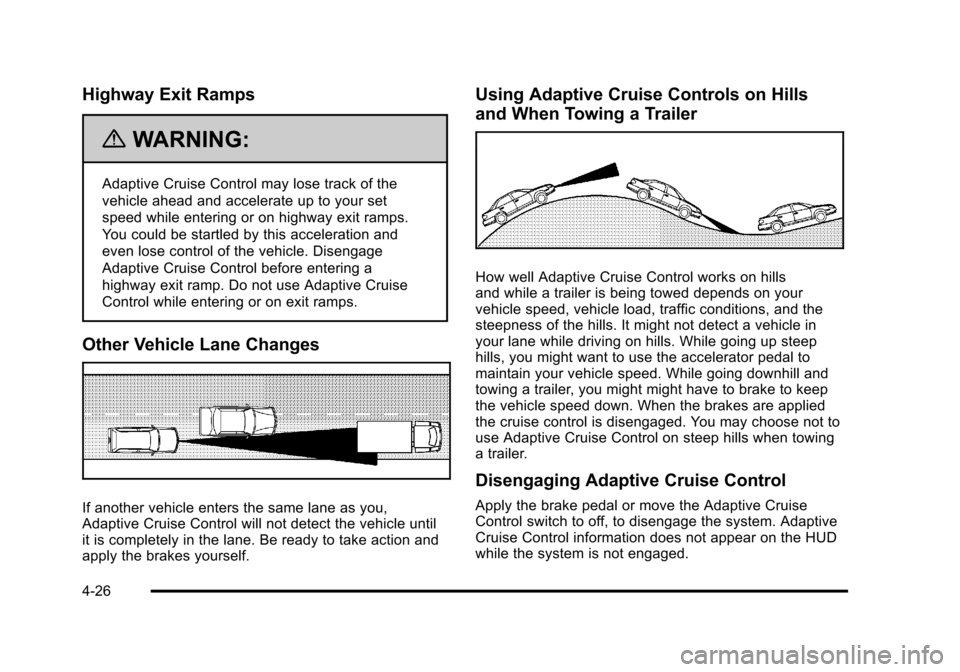
If another vehicle enters the same lane as you,
Adaptive Cruise Control will not detect the vehicle until
it is completely in the lane. Be ready to take action and
apply the brakes yourself.
Using Adaptive Cruise Controls on Hills
and When Towing a Trailer
How well Adaptive Cruise Control works on hills
and while a trailer is being towed depends on your
vehicle speed, vehicle load, traffic conditions, and the
steepness of the hills. It might not detect a vehicle in
your lane while driving on hills. While going up steep
hills, you might want to use the accelerator pedal to
maintain your vehicle speed. While going downhill and
towing a trailer, you might might have to brake to keep
the vehicle speed down. When the brakes are applied
the cruise control is disengaged. You may choose not to
use Adaptive Cruise Control on steep hills when towing
a trailer.
Disengaging Adaptive Cruise Control
Apply the brake pedal or move the Adaptive Cruise
Control switch to off, to disengage the system. Adaptive
Cruise Control information does not appear on the HUD
while the system is not engaged.
4-26
Page 234 of 528
Black plate (48,1)Cadillac STS Owner Manual - 2011
Outlet Adjustment
Use the lever located in the center of each outlet to
change the direction of the airflow, either side-to-side or
up and down. Use the thumbwheels to open or close
the outlets to adjust the airflow.
Turn the thumbwheel towards the vehicle door to open
the outlets and allow the maximum amount of air to
enter your vehicle. Turn the thumbwheel towards the
center console to close the outlets and minimize the
amount of air entering the vehicle.
Operation Tips
.Clear away any ice, snow or leaves from the air
inlets at the base of the windshield that may block
the flow of air into your vehicle.
.Use of non-GM approved hood deflectors may
adversely affect the performance of the system.
.Keep the path under the front seats clear of
objects to help circulate the air inside of your
vehicle more effectively.
.If the airflow seems low when the fan speed is at
the highest setting, the passenger compartment
air filter may need to be replaced. For more
information, seePassenger Compartment Air
Filter on page 4‑50.
4-48
Page 237 of 528
Black plate (51,1)Cadillac STS Owner Manual - 2011
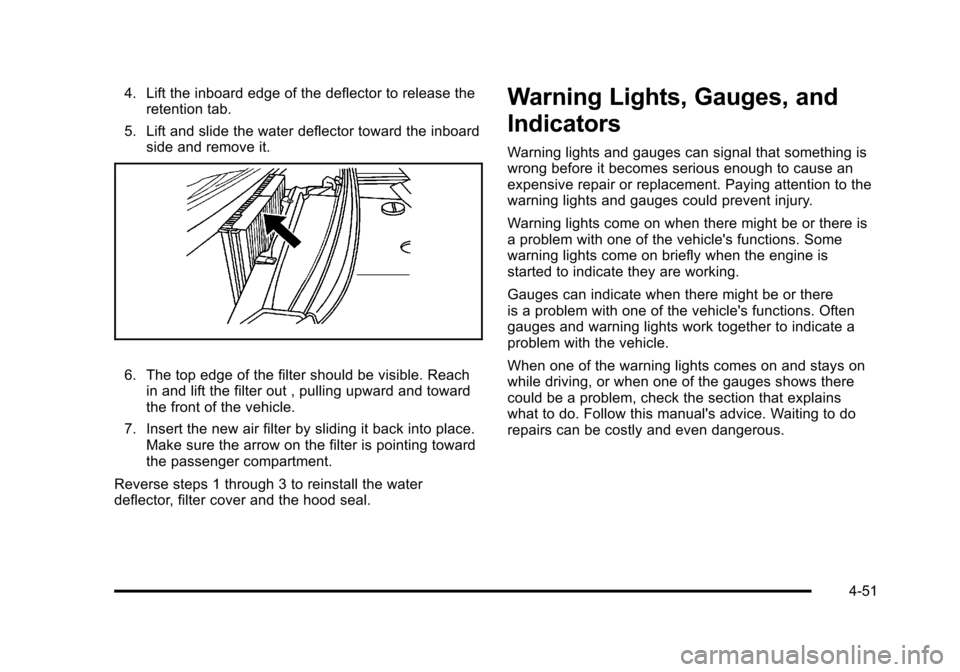
4. Lift the inboard edge of the deflector to release theretention tab.
5. Lift and slide the water deflector toward the inboard side and remove it.
6. The top edge of the filter should be visible. Reachin and lift the filter out , pulling upward and toward
the front of the vehicle.
7. Insert the new air filter by sliding it back into place. Make sure the arrow on the filter is pointing toward
the passenger compartment.
Reverse steps 1 through 3 to reinstall the water
deflector, filter cover and the hood seal.
Warning Lights, Gauges, and
Indicators
Warning lights and gauges can signal that something is
wrong before it becomes serious enough to cause an
expensive repair or replacement. Paying attention to the
warning lights and gauges could prevent injury.
Warning lights come on when there might be or there is
a problem with one of the vehicle's functions. Some
warning lights come on briefly when the engine is
started to indicate they are working.
Gauges can indicate when there might be or there
is a problem with one of the vehicle's functions. Often
gauges and warning lights work together to indicate a
problem with the vehicle.
When one of the warning lights comes on and stays on
while driving, or when one of the gauges shows there
could be a problem, check the section that explains
what to do. Follow this manual's advice. Waiting to do
repairs can be costly and even dangerous.
4-51
Page 244 of 528
Black plate (58,1)Cadillac STS Owner Manual - 2011
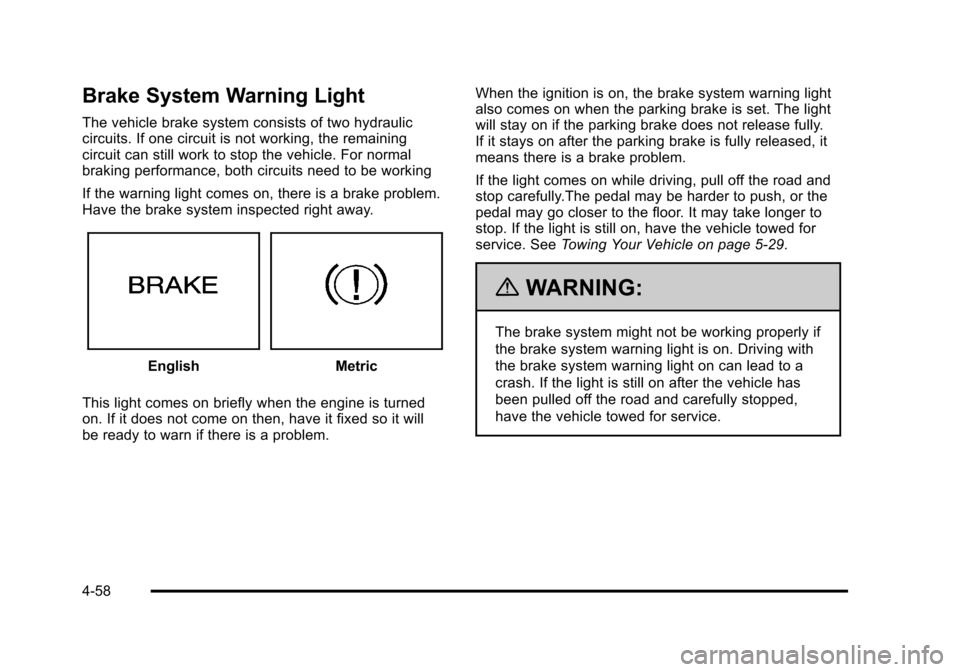
Brake System Warning Light
The vehicle brake system consists of two hydraulic
circuits. If one circuit is not working, the remaining
circuit can still work to stop the vehicle. For normal
braking performance, both circuits need to be working
If the warning light comes on, there is a brake problem.
Have the brake system inspected right away.
EnglishMetric
This light comes on briefly when the engine is turned
on. If it does not come on then, have it fixed so it will
be ready to warn if there is a problem. When the ignition is on, the brake system warning light
also comes on when the parking brake is set. The light
will stay on if the parking brake does not release fully.
If it stays on after the parking brake is fully released, it
means there is a brake problem.
If the light comes on while driving, pull off the road and
stop carefully.The pedal may be harder to push, or the
pedal may go closer to the floor. It may take longer to
stop. If the light is still on, have the vehicle towed for
service. See
Towing Your Vehicle on page 5‑29.
{WARNING:
The brake system might not be working properly if
the brake system warning light is on. Driving with
the brake system warning light on can lead to a
crash. If the light is still on after the vehicle has
been pulled off the road and carefully stopped,
have the vehicle towed for service.
4-58
Page 249 of 528
Black plate (63,1)Cadillac STS Owner Manual - 2011
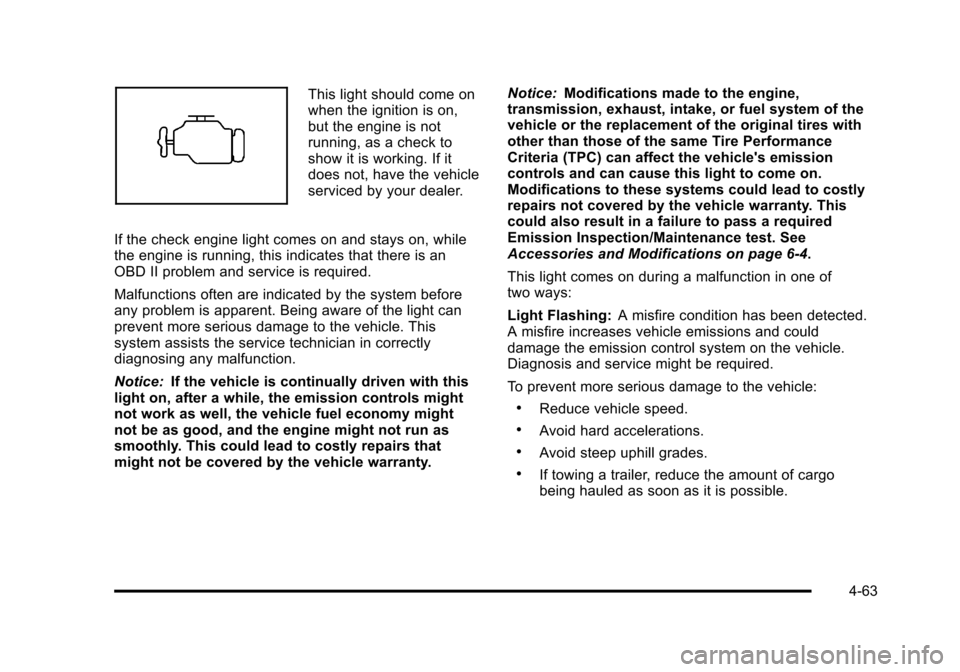
This light should come on
when the ignition is on,
but the engine is not
running, as a check to
show it is working. If it
does not, have the vehicle
serviced by your dealer.
If the check engine light comes on and stays on, while
the engine is running, this indicates that there is an
OBD II problem and service is required.
Malfunctions often are indicated by the system before
any problem is apparent. Being aware of the light can
prevent more serious damage to the vehicle. This
system assists the service technician in correctly
diagnosing any malfunction.
Notice: If the vehicle is continually driven with this
light on, after a while, the emission controls might
not work as well, the vehicle fuel economy might
not be as good, and the engine might not run as
smoothly. This could lead to costly repairs that
might not be covered by the vehicle warranty. Notice:
Modifications made to the engine,
transmission, exhaust, intake, or fuel system of the
vehicle or the replacement of the original tires with
other than those of the same Tire Performance
Criteria (TPC) can affect the vehicle's emission
controls and can cause this light to come on.
Modifications to these systems could lead to costly
repairs not covered by the vehicle warranty. This
could also result in a failure to pass a required
Emission Inspection/Maintenance test. See
Accessories and Modifications on page 6‑4.
This light comes on during a malfunction in one of
two ways:
Light Flashing: A misfire condition has been detected.
A misfire increases vehicle emissions and could
damage the emission control system on the vehicle.
Diagnosis and service might be required.
To prevent more serious damage to the vehicle:
.Reduce vehicle speed.
.Avoid hard accelerations.
.Avoid steep uphill grades.
.If towing a trailer, reduce the amount of cargo
being hauled as soon as it is possible.
4-63
Page 313 of 528

Black plate (1,1)Cadillac STS Owner Manual - 2011
Section 5 Driving Your Vehicle
Your Driving, the Road, and the Vehicle. . . . . . . . . .5-2
Defensive Driving . . . . . . . . . . . . . . . . . . . . . . . . . . . . . . . 5-2
Drunk Driving . . . . . . . . . . . . . . . . . . . . . . . . . . . . . . . . . . . 5-2
Control of a Vehicle . . . . . . . . . . . . . . . . . . . . . . . . . . . . . 5-3
Braking . . . . . . . . . . . . . . . . . . . . . . . . . . . . . . . . . . . . . . . . . 5-4
Antilock Brake System (ABS) . . . . . . . . . . . . . . . . . . . 5-5
Braking in Emergencies . . . . . . . . . . . . . . . . . . . . . . . . . 5-6
StabiliTrak
®System . . . . . . . . . . . . . . . . . . . . . . . . . . . . . 5-6
Enhanced StabiliTrak®. . . . . . . . . . . . . . . . . . . . . . . . . . 5-7
Traction Control System (TCS) . . . . . . . . . . . . . . . . . . 5-9
Limited-Slip Rear Axle . . . . . . . . . . . . . . . . . . . . . . . . . 5-11
All-Wheel Drive (AWD) System . . . . . . . . . . . . . . . . 5-11
Steering . . . . . . . . . . . . . . . . . . . . . . . . . . . . . . . . . . . . . . . 5-11
Off-Road Recovery . . . . . . . . . . . . . . . . . . . . . . . . . . . . 5-14
Passing . . . . . . . . . . . . . . . . . . . . . . . . . . . . . . . . . . . . . . . . 5-14 Loss of Control . . . . . . . . . . . . . . . . . . . . . . . . . . . . . . . . 5-14
Driving at Night . . . . . . . . . . . . . . . . . . . . . . . . . . . . . . . . 5-16
Driving in Rain and on Wet Roads . . . . . . . . . . . . . 5-16
Before Leaving on a Long Trip . . . . . . . . . . . . . . . . . 5-18
Highway Hypnosis . . . . . . . . . . . . . . . . . . . . . . . . . . . . . 5-18
Hill and Mountain Roads . . . . . . . . . . . . . . . . . . . . . . . 5-19
Winter Driving . . . . . . . . . . . . . . . . . . . . . . . . . . . . . . . . . 5-20
If Your Vehicle is Stuck in Sand, Mud, Ice,
or Snow . . . . . . . . . . . . . . . . . . . . . . . . . . . . . . . . . . . . . 5-22
Rocking Your Vehicle to Get It Out . . . . . . . . . . . . . 5-23
Loading the Vehicle . . . . . . . . . . . . . . . . . . . . . . . . . . . . 5-23
Towing . . . . . . . . . . . . . . . . . . . . . . . . . . . . . . . . . . . . . . . . . . . . 5-29
Towing Your Vehicle . . . . . . . . . . . . . . . . . . . . . . . . . . . 5-29
Recreational Vehicle Towing . . . . . . . . . . . . . . . . . . . 5-29
Towing a Trailer . . . . . . . . . . . . . . . . . . . . . . . . . . . . . . . . 5-31
5-1
Page 335 of 528
Black plate (23,1)Cadillac STS Owner Manual - 2011
Rocking Your Vehicle to Get It Out
Turn the steering wheel left and right to clear the area
around the front wheels. Turn off any traction or stability
system. Shift back and forth between R (Reverse) and a
forward gear, spinning the wheels as little as possible.
To prevent transmission wear, wait until the wheels stop
spinning before shifting gears. Release the accelerator
pedal while shifting, and press lightly on the accelerator
pedal when the transmission is in gear. Slowly spinning
the wheels in the forward and reverse directions causes
a rocking motion that could free the vehicle. If that does
not get the vehicle out after a few tries, it might need to
be towed out. If the vehicle does need to be towed out,
seeTowing Your Vehicle on page 5‑29.
Loading the Vehicle
It is very important to know how much weight your
vehicle can carry. This weight is called the vehicle
capacity weight and includes the weight of all
occupants, cargo, and all nonfactory‐installed
options. Two labels on your vehicle show how
much weight it may properly carry, the Tire and
Loading Information label, and the Certification
label.
{WARNING:
Do not load the vehicle any heavier than
the Gross Vehicle Weight Rating (GVWR),
or either the maximum front or rear Gross
Axle Weight Rating (GAWR). If you do, parts
on the vehicle can break, and it can change
the way the vehicle handles. These could
cause you to lose control and crash. Also,
overloading can shorten the life of the
vehicle.
5-23