ECU CADILLAC XLR 2004 1.G User Guide
[x] Cancel search | Manufacturer: CADILLAC, Model Year: 2004, Model line: XLR, Model: CADILLAC XLR 2004 1.GPages: 356, PDF Size: 2.36 MB
Page 37 of 356

1. Find the anchors in the passenger seat. SeeLower
Anchorages and Top Tethers for Children (LATCH
System) on page 1-27
.
2. Put the child restraint on the seat.
3. Attach the anchor points on the child restraint to the
anchors in the vehicle. The child restraint
instructions will show you how. See
Top Strap on
page 1-27if your child restraint has one.
4. Push and pull the child restraint in different
directions to be sure it is secure.
To remove the child restraint, disconnect the anchor
points.
Securing a Child Restraint in the
Passenger Seat Position
Your vehicle has passenger air bags. There is an air bag
off switch in the glove box you can use to turn off the
passenger's air bags. See
Air Bag Off Switch on
page 1-44for more on this, including important safety
information. Your vehicle will either have the Canadian
switch design (A) or the United States switch design (B).
1-31
Page 38 of 356
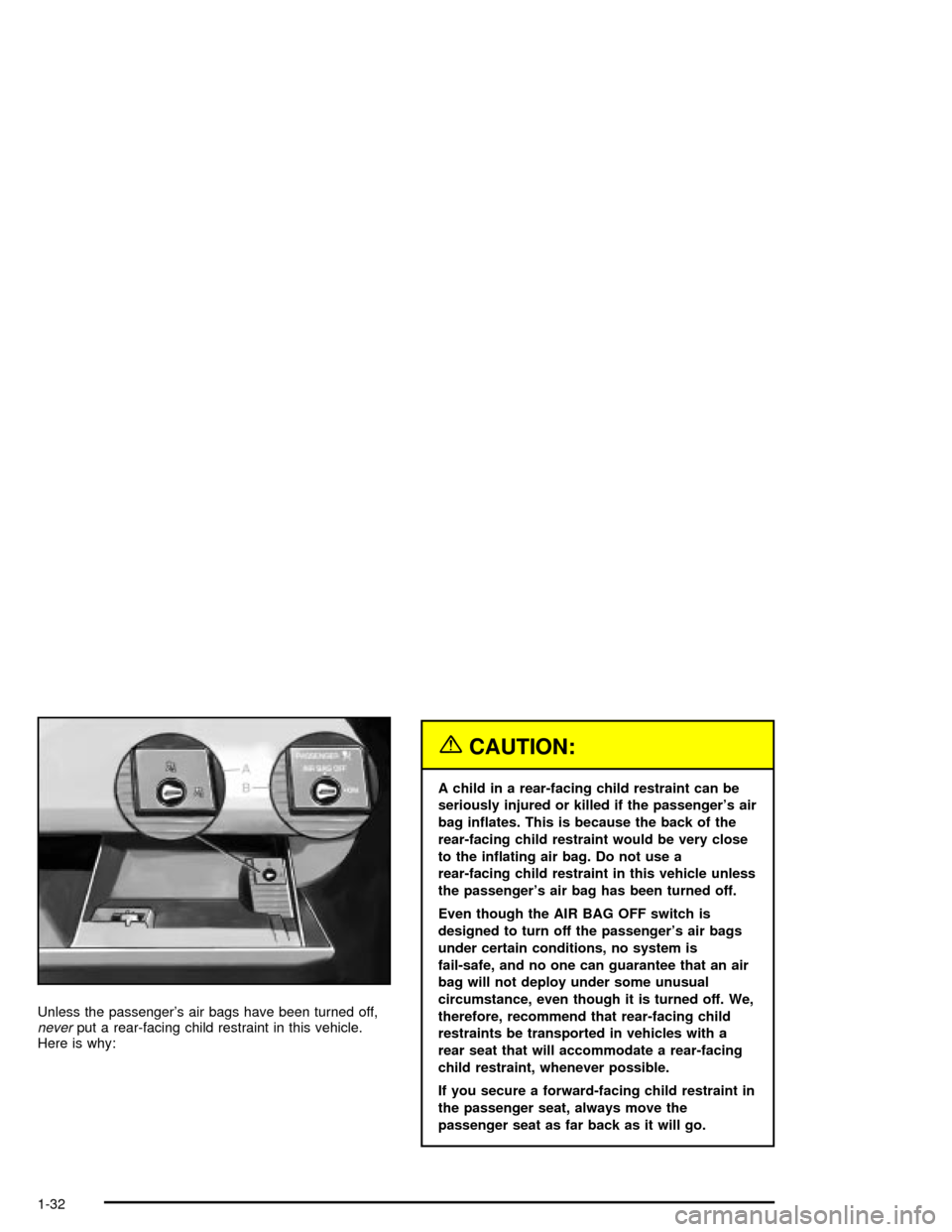
Unless the passenger's air bags have been turned off,neverput a rear-facing child restraint in this vehicle.
Here is why:
{CAUTION:
A child in a rear-facing child restraint can be
seriously injured or killed if the passenger's air
bag in¯ates. This is because the back of the
rear-facing child restraint would be very close
to the in¯ating air bag. Do not use a
rear-facing child restraint in this vehicle unless
the passenger's air bag has been turned off.
Even though the AIR BAG OFF switch is
designed to turn off the passenger's air bags
under certain conditions, no system is
fail-safe, and no one can guarantee that an air
bag will not deploy under some unusual
circumstance, even though it is turned off. We,
therefore, recommend that rear-facing child
restraints be transported in vehicles with a
rear seat that will accommodate a rear-facing
child restraint, whenever possible.
If you secure a forward-facing child restraint in
the passenger seat, always move the
passenger seat as far back as it will go.
1-32
Page 39 of 356

{CAUTION:
If the air bag readiness light ever comes on
when you have turned off the air bags, it
means that something may be wrong with the
air bag system. The passenger's air bags
could in¯ate even though the switch is off. If
this ever happens, do not let anyone whom the
national government has identi®ed as a
member of a passenger air bag risk group sit
in the passenger's position (for example, do
not secure a rear-facing child restraint in your
vehicle) until you have your vehicle serviced.
See
Air Bag Off Switch on page 1-44.
If your child restraint is equipped with the LATCH
system, see
Lower Anchorages and Top Tethers for
Children (LATCH System) on page 1-27. SeeTop Strap
on page 1-27if the child restraint has one.There are no top strap anchors in this vehicle. Do not
secure a child seat in this vehicle if a national or
local law requires that the top strap be anchored, or if
the instructions that come with the restraint say that the
top strap must be anchored.
If your child restraint does not have the latch system,
you will be using the lap-shoulder belt to secure the child
restraint in this position. Be sure to follow the
instructions that came with the child restraint. Secure
the child in the child restraint when and as the
instructions say.
1. Your vehicle has passenger's air bags. If you need
to use a rear-facing child restraint in this seat, make
sure the air bags are turned off. See
Air Bag Off
Switch on page 1-44. If your child restraint is
forward-facing, always move the seat as far back
as it will go before securing it in this seat. See
Eight-Way Power Seats on page 1-2.
2. Put the restraint on the seat.
3. Pick up the latch plate, and run the lap and shoulder
portions of the vehicle's safety belt through or
around the restraint. The child restraint instructions
will show you how.
1-33
Page 41 of 356
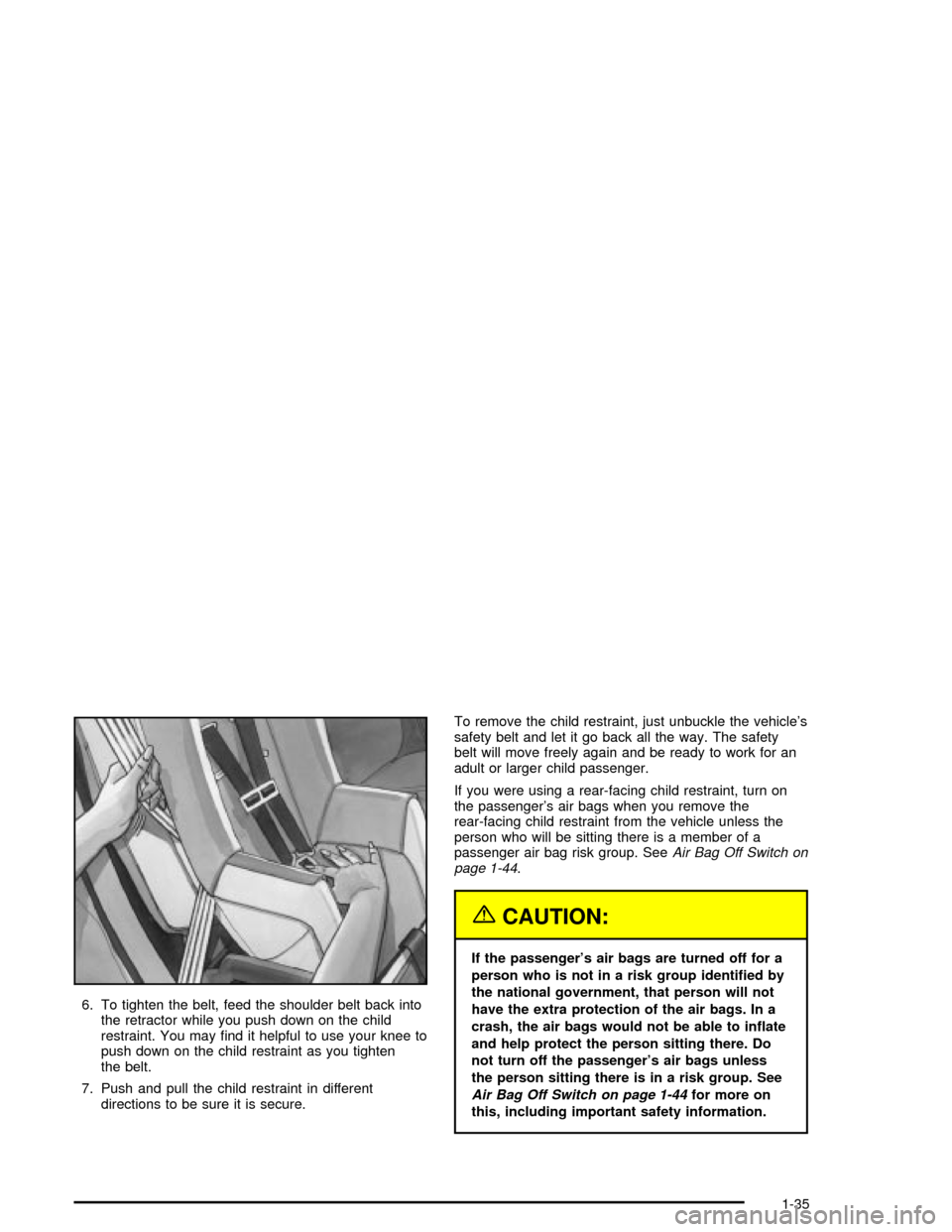
6. To tighten the belt, feed the shoulder belt back into
the retractor while you push down on the child
restraint. You may ®nd it helpful to use your knee to
push down on the child restraint as you tighten
the belt.
7. Push and pull the child restraint in different
directions to be sure it is secure.To remove the child restraint, just unbuckle the vehicle's
safety belt and let it go back all the way. The safety
belt will move freely again and be ready to work for an
adult or larger child passenger.
If you were using a rear-facing child restraint, turn on
the passenger's air bags when you remove the
rear-facing child restraint from the vehicle unless the
person who will be sitting there is a member of a
passenger air bag risk group. See
Air Bag Off Switch on
page 1-44.
{CAUTION:
If the passenger's air bags are turned off for a
person who is not in a risk group identi®ed by
the national government, that person will not
have the extra protection of the air bags. In a
crash, the air bags would not be able to in¯ate
and help protect the person sitting there. Do
not turn off the passenger's air bags unless
the person sitting there is in a risk group. See
Air Bag Off Switch on page 1-44for more on
this, including important safety information.
1-35
Page 43 of 356

{CAUTION:
Both frontal and side impact air bags in¯ate
with great force, faster than the blink of an
eye. If you are too close to an in¯ating air bag,
as you would be if you were leaning forward, it
could seriously injure you. Safety belts help
keep you in position for air bag in¯ation before
and during a crash. Always wear your safety
belt, even with frontal air bags. The driver
should sit as far back as possible while still
maintaining control of the vehicle. Front
occupants should not lean on or sleep against
the door.
{CAUTION:
Anyone who is up against, or very close to,
any air bag when it in¯ates can be seriously
injured or killed. Air bags plus lap-shoulder
belts offer the best protection for adults, but
not for young children and infants. Neither the
vehicle's safety belt system nor its air bag
system is designed for them. Young children
and infants need the protection that a child
restraint system can provide. Always secure
children properly in your vehicle. To read how,
see the part of this manual called ªOlder
Childrenº or ªInfants and Young Children.º
1-37
Page 70 of 356
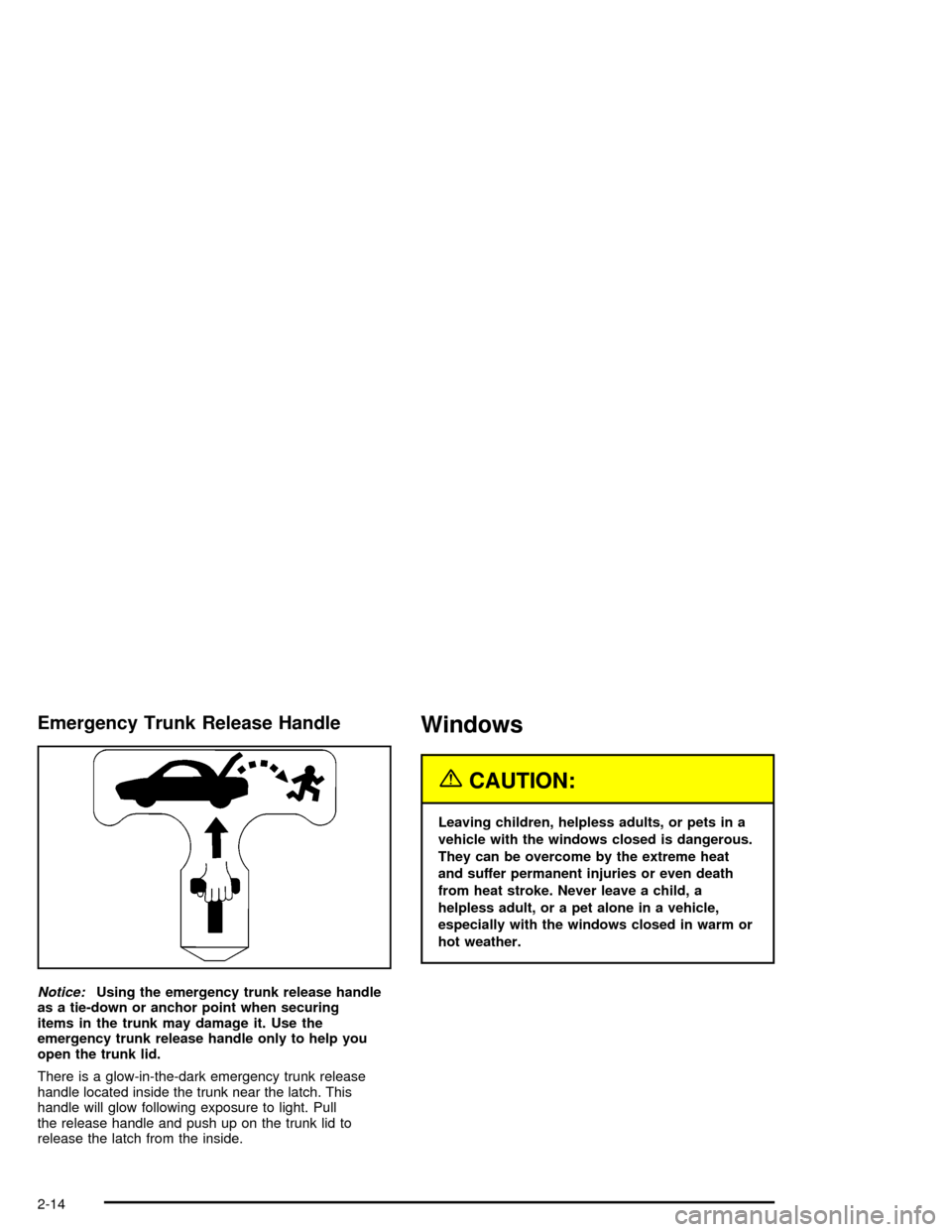
Emergency Trunk Release Handle
Notice:Using the emergency trunk release handle
as a tie-down or anchor point when securing
items in the trunk may damage it. Use the
emergency trunk release handle only to help you
open the trunk lid.
There is a glow-in-the-dark emergency trunk release
handle located inside the trunk near the latch. This
handle will glow following exposure to light. Pull
the release handle and push up on the trunk lid to
release the latch from the inside.
Windows
{CAUTION:
Leaving children, helpless adults, or pets in a
vehicle with the windows closed is dangerous.
They can be overcome by the extreme heat
and suffer permanent injuries or even death
from heat stroke. Never leave a child, a
helpless adult, or a pet alone in a vehicle,
especially with the windows closed in warm or
hot weather.
2-14
Page 73 of 356

Theft-Deterrent Systems
Vehicle theft is big business, especially in some cities.
Although your vehicle has a number of theft-deterrent
features, we know that nothing we put on it can make it
impossible to steal. However, there are ways you
can help.
Theft-Deterrent System
Your vehicle is equipped with a theft-deterrent alarm
system.
With this system, the
security light will ¯ash
when the door is open and
locked with the power
door lock switch.
If this light is on continuously while the engine is
running, your vehicle needs service.
Arming the System
Use one of the two following items listed here to arm
the system:
·Press the lock button on the keyless access
transmitter.
·Open the door. Lock the door with the power door
lock switch. The SECURITY light should ¯ash.
Close the door. The SECURITY light will stop
¯ashing and stay on. After 30 seconds, the light
should turn off.
·The vehicle can be programmed to automatically
lock the doors when you exit the vehicle. See
DIC Vehicle Personalization on page 3-66.
Now, if a door or the trunk lid is opened without the
keyless access transmitter, the alarm will go off. Your
horn will sound for two minutes, then it will go off to save
battery power. And, your vehicle will not start without
a keyless transmitter present.
The theft-deterrent system will not arm if you lock the
driver's door with the power door lock switch after
the doors are closed.
If your passenger stays in the vehicle when you leave
with the keyless access transmitter, have the passenger
lock the vehicle after the doors are closed. This way the
alarm will not arm, and your passenger will not set it off.
2-17
Page 74 of 356
Testing the Alarm
Do the following to test the system:
1. Make sure the trunk lid is latched.
2. Lower the window on the driver's door.
3. Manually arm the system.
4. Close the doors and wait 30 seconds.
5. Reach through the open window and manually pull
the release lever on the ¯oor.
6. Turn off the alarm by pressing the unlock button on
the transmitter.
If the alarm is inoperative, check to see if the horn
works. If not, check the horn fuse. See
Fuses and Circuit
Breakers on page 5-85. If the horn works, but the
alarm does not go off, see your dealer.
Disarming the System
Always use your keyless access transmitter to unlock a
door either by pressing the unlock button on the
transmitter or by squeezing the door handle sensor
while you have the transmitter with you. Unlocking a
door any other way will set off the alarm. If your alarm
sounds, press the unlock button on the keyless
access transmitter to disarm it.
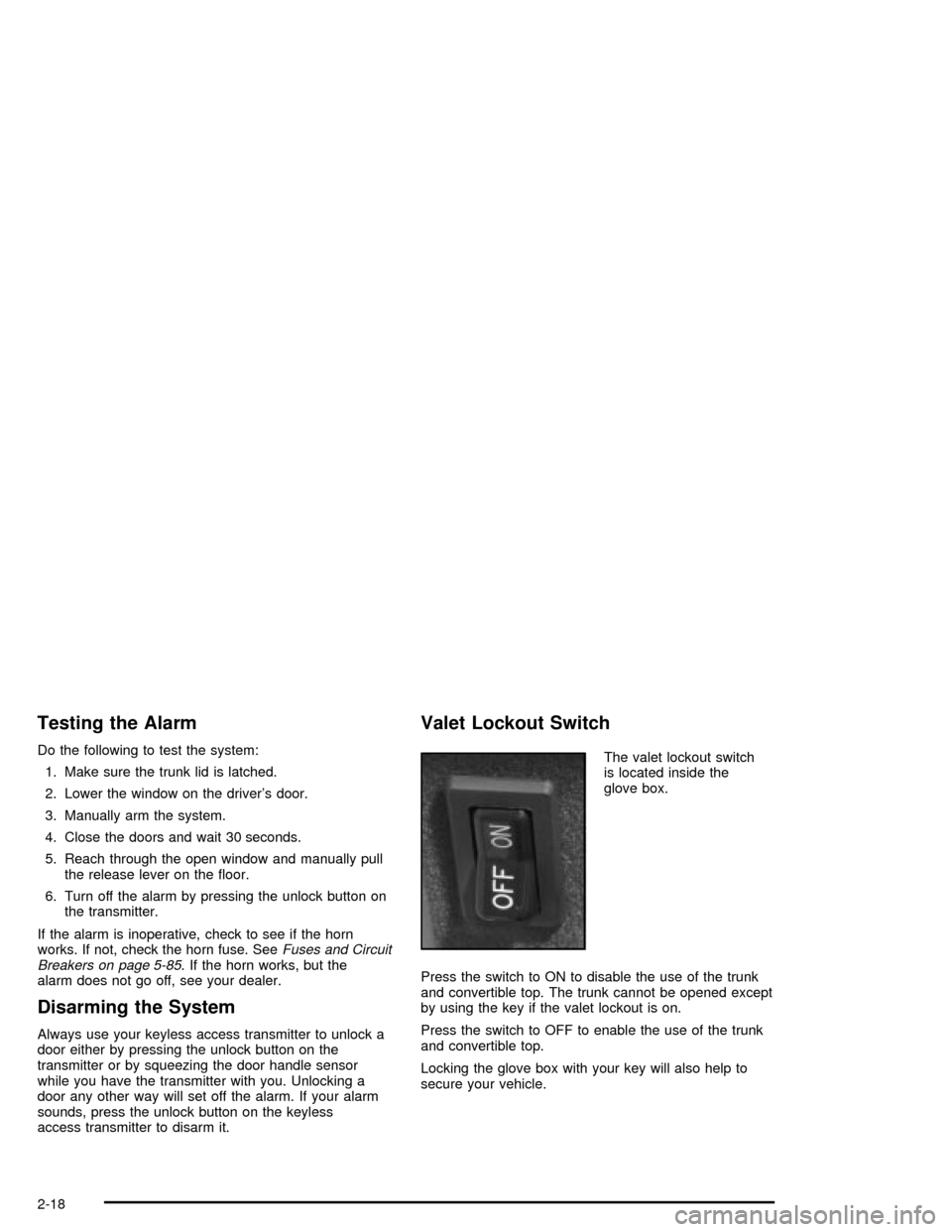
Valet Lockout Switch
The valet lockout switch
is located inside the
glove box.
Press the switch to ON to disable the use of the trunk
and convertible top. The trunk cannot be opened except
by using the key if the valet lockout is on.
Press the switch to OFF to enable the use of the trunk
and convertible top.
Locking the glove box with your key will also help to
secure your vehicle.
2-18
Page 91 of 356

OnStaržSystem
OnStaržuses global positioning system (GPS) satellite
technology, wireless communications, and call centers
to provide you with a wide range of safety, security,
information and convenience services.
A complete OnStar
žuser's guide and the terms and
conditions of the OnStaržSubscription Service
Agreement are included in your vehicle's glove box
literature. For more information, visit www.onstar.com,
contact OnStar
žat 1-888-4-ONSTAR (1-888-466-7827),
or press the blue OnStaržbutton to speak to an
OnStaržadvisor 24 hours a day, 7 days a week.
A completed Subscription Service Agreement is required
prior to delivery of OnStar
žservices and prepaid
calling minutes are also required for OnStaržPersonal
Calling and OnStaržVirtual Advisor use. Terms and
conditions of the Subscription Service Agreement can be
found at www.onstar.com.
OnStaržServices
One of the following plans is normally included for a
speci®c duration with each vehicle equipped with
OnStar
ž. You can upgrade or extend your OnStarž
service plan to meet your needs.
Safe and Sound Plan
·
Automatic Noti®cation of Air Bag Deployment
·Emergency Services
·Roadside Assistance
·Stolen Vehicle Assistance
·AccidentAssist
·Remote Door Unlock
·Remote Diagnostics
·Online Concierge
Directions and Connections Plan
·
All Safe and Sound Plan services
·Route Support
·RideAssist
·Information and Convenience Services
2-35
Page 93 of 356
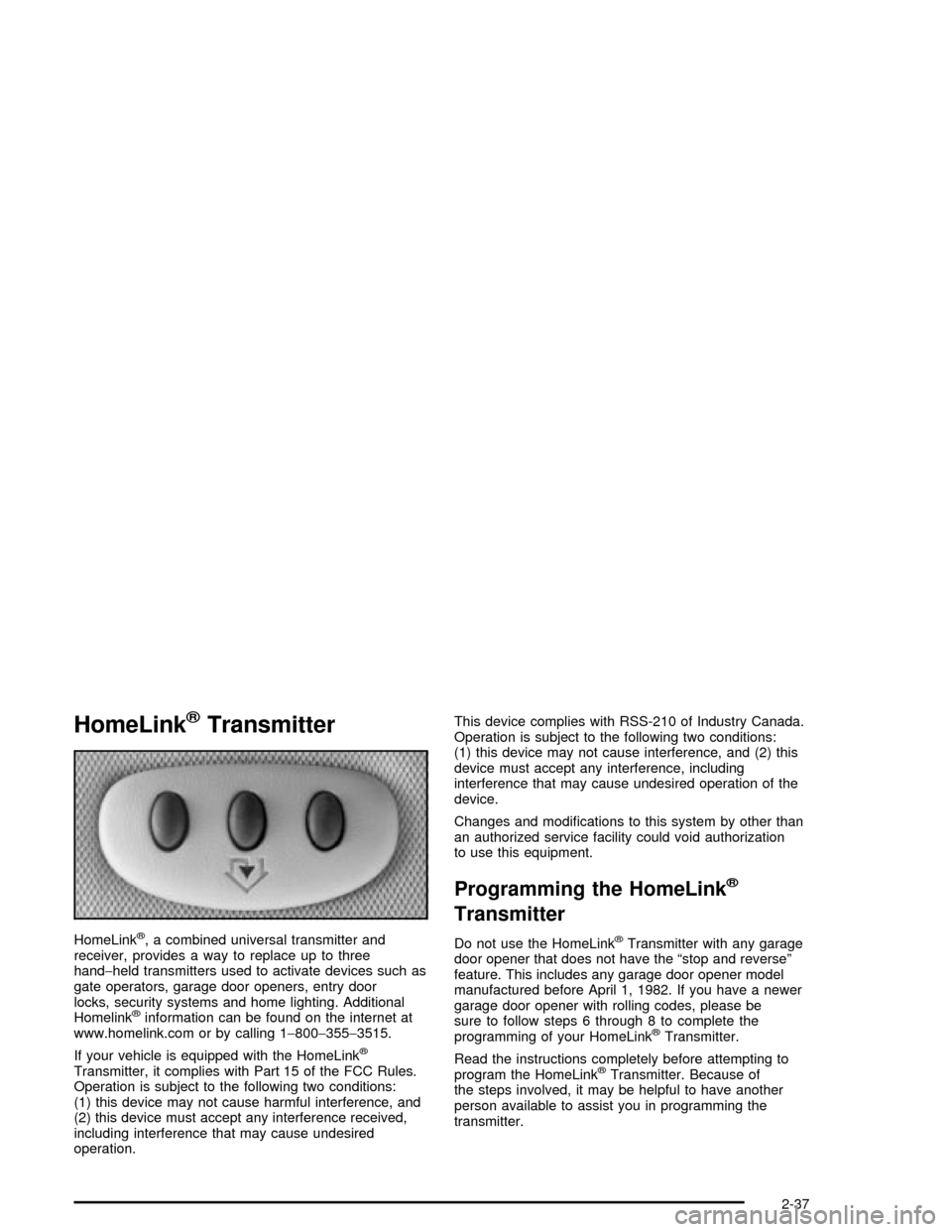
HomeLinkžTransmitter
HomeLinkž, a combined universal transmitter and
receiver, provides a way to replace up to three
hand-held transmitters used to activate devices such as
gate operators, garage door openers, entry door
locks, security systems and home lighting. Additional
Homelink
žinformation can be found on the internet at
www.homelink.com or by calling 1-800-355-3515.
If your vehicle is equipped with the HomeLink
ž
Transmitter, it complies with Part 15 of the FCC Rules.
Operation is subject to the following two conditions:
(1) this device may not cause harmful interference, and
(2) this device must accept any interference received,
including interference that may cause undesired
operation.This device complies with RSS-210 of Industry Canada.
Operation is subject to the following two conditions:
(1) this device may not cause interference, and (2) this
device must accept any interference, including
interference that may cause undesired operation of the
device.
Changes and modi®cations to this system by other than
an authorized service facility could void authorization
to use this equipment.
Programming the HomeLinkž
Transmitter
Do not use the HomeLinkžTransmitter with any garage
door opener that does not have the ªstop and reverseº
feature. This includes any garage door opener model
manufactured before April 1, 1982. If you have a newer
garage door opener with rolling codes, please be
sure to follow steps 6 through 8 to complete the
programming of your HomeLink
žTransmitter.
Read the instructions completely before attempting to
program the HomeLink
žTransmitter. Because of
the steps involved, it may be helpful to have another
person available to assist you in programming the
transmitter.
2-37