climate control CADILLAC XLR 2008 1.G User Guide
[x] Cancel search | Manufacturer: CADILLAC, Model Year: 2008, Model line: XLR, Model: CADILLAC XLR 2008 1.GPages: 470, PDF Size: 8.39 MB
Page 188 of 470
HIGH VOLTAGE
This message displays when the electrical charging
system is overcharging. To avoid being stranded, have
the electrical system checked by your dealer/retailer.
You can reduce the charging overload by using
the accessories. Turn on the lamps and radio, set the
climate control on AUTO and the fan speed on HI,
and turn the rear window defogger on. You can monitor
battery voltage on the DIC by pressing the information
button. The normal range is 11.5 to 15.5 volts when the
engine is running.
HOT ENGINE–A/C OFF
This message displays when the engine coolant
becomes hotter than the normal operating temperature.
You can continue to drive your vehicle. If this message
continues to display, have the system repaired by
your dealer/retailer as soon as possible to avoid
compressor damage.
ICE POSSIBLE
This message displays when the outside air temperature
is cold enough to create icy road conditions.
Adjust your driving accordingly.
LEFT DOOR AJAR
This message displays anytime the engine is running,
the transmission is not in PARK (P), and the driver door
is open or ajar. A chime sounds when the vehicle’s
speed is greater than 3 mph (5 km/h).
LOW BRAKE FLUID
This message displays if the engine is running to inform
the driver that the brake uid level is low. Have the
brake system serviced by your dealer/retailer as soon
as possible. See “Brake Fluid” underBrakes on
page 6-37.
LOW COOLANT
This message displays when there is a low level of
engine coolant. Have the cooling system serviced by
your dealer/retailer as soon as possible. SeeEngine
Coolant on page 6-24.
LOW FUEL
This message displays when the fuel supply is less
than 5 gallons (18.9 L) and the display is turned off.
A single chime also sounds when this message is
displayed.
3-66
Page 192 of 470
REDUCED ENGINE POWER
This message displays when the vehicle is reducing
engine power because the transmission is being placed
in gear under conditions that may cause damage to
the vehicle’s engine, transmission, or ability to
accelerate. Reduced engine power can affect the
vehicle’s ability to accelerate. If this message is on,
but there is no reduction in performance, proceed
to your destination. The performance may be reduced
the next time the vehicle is driven. The vehicle may
be driven at a reduced speed while this message is on,
but acceleration and speed may be reduced. Anytime
this message stays on, the vehicle should be taken
to your dealer/retailer for service as soon as possible.
RIGHT DOOR AJAR
This message displays anytime the engine is running,
the transmission is not in PARK (P), and the passenger
door is open or ajar. A chime sounds if the vehicle’s
speed is greater than 3 mph (5 km/h).
SERVICE A/C
This message displays when the electronic sensors that
control the air conditioning and heating systems are
no longer working. Have the climate control system
serviced by your dealer/retailer if you notice a drop in
heating and air conditioning efficiency.
SERVICE ABS (Antilock Brake System)
If this message displays when you are driving, stop
as soon as possible and turn the ignition off. Then start
the engine again to reset the system. If the message
stays on, or comes back on again while you are driving,
your vehicle is in need of service. See your
dealer/retailer.
If the SERVICE ABS message is being displayed, the
Traction Control System (TCS) and StabiliTrak
®System
will also be disabled. The Driver Information Center
will scroll three messages: SERVICE ABS, SERVICE
TRACTION SYS, and SERVICE STABILITRAK, and the
antilock brake system and traction control warning
lights on the instrument panel cluster will be illuminated.
SeeAntilock Brake System Warning Light on page 3-51
andTraction Control System (TCS) Warning Light on
page 3-52. The driver can acknowledge these messages
by pressing the RESET button three times. When the
service message is displayed, the computer controlled
systems will not assist the driver and you should
have the system repaired by your dealer/retailer as
soon as possible. Adjust your driving accordingly.
3-70
Page 349 of 470
If you get the overheat warning with no sign of steam,
try this for a minute or so:
1. In heavy traffic, let the engine idle in NEUTRAL (N)
while stopped. If it is safe to do so, pull off the road,
shift to PARK (P) or NEUTRAL (N) and let the
engine idle.
2. Set the climate controls to the highest heat setting
and fan speed and open the windows as necessary.
If you no longer have the overheat warning, you
can drive. Just to be safe, drive slower for about
10 minutes. If the warning does not come back on,
you can drive normally.
If the warning continues, pull over, stop, and park your
vehicle right away.
If there is still no sign of steam, idle the engine for
three minutes while you are parked. If you still have the
warning, turn off the engine and get everyone out of
the vehicle until it cools down. Also, see “Overheated
Engine Protection Operating Mode” later in this section.
You may decide not to lift the hood but to get service
help right away.Overheated Engine Protection
Operating Mode
This operating mode allows your vehicle to be driven to
a safe place in an emergency situation. If an overheated
engine condition exists and the DIC message ENGINE
HOT, STOP ENGINE is displayed, an overheat
protection mode which alternates ring groups of
cylinders helps prevent engine damage. In this mode,
you will notice a signicant loss in power and engine
performance. Driving extended miles (km) in the
overheat protection mode should be avoided.
Notice:After driving in the overheated engine
protection operating mode, to avoid engine damage,
allow the engine to cool before attempting any
repair. The engine oil will be severely degraded.
Repair the cause of coolant loss, change the oil
and reset the oil life system. SeeEngine Oil
on page 6-16.
6-29
Page 389 of 470

Uniform Tire Quality Grading
Quality grades can be found where applicable on
the tire sidewall between tread shoulder and
maximum section width. For example:
Treadwear 200 Traction AA Temperature A
The following information relates to the system
developed by the United States National Highway
Traffic Safety Administration (NHTSA), which
grades tires by treadwear, traction, and
temperature performance. This applies only to
vehicles sold in the United States. The grades are
molded on the sidewalls of most passenger car
tires. The Uniform Tire Quality Grading (UTQG)
system does not apply to deep tread, winter-type
snow tires, space-saver, or temporary use
spare tires, tires with nominal rim diameters of
10 to 12 inches (25 to 30 cm), or to some
limited-production tires.
While the tires available on General Motors
passenger cars and light trucks may vary with
respect to these grades, they must also conform
to federal safety requirements and additional
General Motors Tire Performance Criteria (TPC)
standards.
Treadwear
The treadwear grade is a comparative rating
based on the wear rate of the tire when tested
under controlled conditions on a specied
government test course. For example, a tire
graded 150 would wear one and a half (1.5) times
as well on the government course as a tire
graded 100. The relative performance of tires
depends upon the actual conditions of their use,
however, and may depart signicantly from
the norm due to variations in driving habits, service
practices, and differences in road characteristics
and climate.
Traction – AA, A, B, C
The traction grades, from highest to lowest, are AA,
A, B, and C. Those grades represent the tire’s
ability to stop on wet pavement as measured under
controlled conditions on specied government test
surfaces of asphalt and concrete. A tire marked C
may have poor traction performance.
Warning:The traction grade assigned to this tire
is based on straight-ahead braking traction tests,
and does not include acceleration, cornering,
hydroplaning, or peak traction characteristics.
6-69
Page 412 of 470

Fuses Usage
FUSE PULLER Fuse Puller
REVERSE
LAMPReverse Lamp
RUN/CRANK Starter/Crank
PRK/BRK
SOL AParking Brake Solenoid A
REVERSE
LAMPSReverse Lamps
BTSI SOL/
COL LOCKBTSI Solenoid, Column Lock
EMPTY Not Used
EMPTY Not Used
GMLAN
DEVICESGMLAN Devices
RPA/H/C
SEAT/WPR
RELAYSRear Park Aid, Heated/Cooled
Seats, Windshield Wiper Relays
DR LOCKS Door Locks
ECM Engine Control Module
INTERIOR
LIGHTSInterior LightsFuses Usage
SDM/PSIR SW Airbags
EMPTY Not Used
ONSTAR OnStar
®
ACCA/DRIV
DR SWAdaptive Cruise Control (ACC),
Driver Door Switch
TILT/TELE
SW/MEM SEAT
MOD/TOP SWPower Tilt Wheel, Telescopic
Steering Column, Memory Seat,
Driver Seat Switch, Retractable
Hardtop Switch
IGN SW/INTR
SNSRIgnition Switch, Intrusion Sensor
STOP LAMP Stop Lamp
ISRVM/HVACInside Rearview Mirror, Climate
Control System, Column Lock,
Power Sounder
CLSTR/HUDInstrument Panel Cluster, Head-Up
Display (HUD)
RADIO/
S-BAND/VICSRadio, S-Band, CD Changer
TUTD SW/
STRG COL SWTap-Up/Tap-Down Switch
HVAC/PWR
SNDClimate Control System, Power
Sounder
6-92
Page 415 of 470
Fuses Usage
6 Oxygen Sensor
7 Battery 5
8 Parking Lamps
9 Electronic Throttle Control
10 Fuel Pump
11Engine Control Module,
Transmission Control Module
12 Odd Injectors
13 Electronic Suspension Control
14 Emission Controls
15 Air Conditioning Compressor
16 Even Injectors
17Windshield Washer, Adaptive
Forward Lighting System (AFS),
Intercooler Pump
18 Headlamp Washer
19 Right Low Beam Headlamp
20 Not Used
21 Left Low Beam Headlamp
22 Fog LampFuses Usage
23 Right High Beam Headlamp
24 Left High Beam Headlamp
25 Cooling Fan
26 Battery 3
27 Antilock Brakes
28 Climate Controls
29 Battery 2
30 Starter
31 Audio Amplier
32 Not Used
33 Battery 1
48 Spare
49 Spare
50 Spare
51 Spare
52 Spare
53 Not Used
54 Fuse Puller
6-95
Page 459 of 470
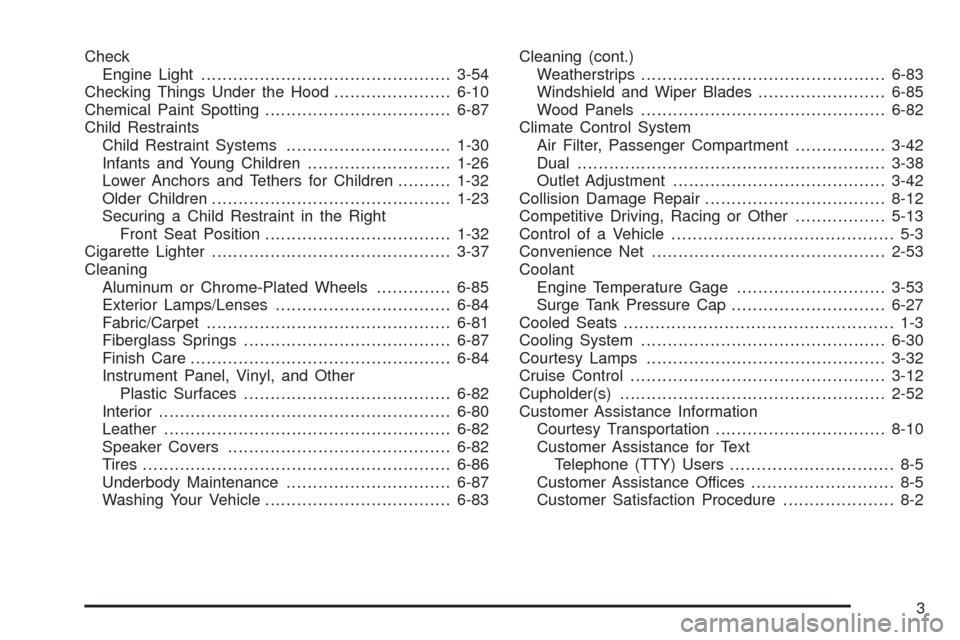
Check
Engine Light...............................................3-54
Checking Things Under the Hood......................6-10
Chemical Paint Spotting...................................6-87
Child Restraints
Child Restraint Systems...............................1-30
Infants and Young Children...........................1-26
Lower Anchors and Tethers for Children..........1-32
Older Children.............................................1-23
Securing a Child Restraint in the Right
Front Seat Position...................................1-32
Cigarette Lighter.............................................3-37
Cleaning
Aluminum or Chrome-Plated Wheels..............6-85
Exterior Lamps/Lenses.................................6-84
Fabric/Carpet..............................................6-81
Fiberglass Springs.......................................6-87
Finish Care.................................................6-84
Instrument Panel, Vinyl, and Other
Plastic Surfaces.......................................6-82
Interior.......................................................6-80
Leather......................................................6-82
Speaker Covers..........................................6-82
Tires..........................................................6-86
Underbody Maintenance...............................6-87
Washing Your Vehicle...................................6-83Cleaning (cont.)
Weatherstrips..............................................6-83
Windshield and Wiper Blades........................6-85
Wood Panels..............................................6-82
Climate Control System
Air Filter, Passenger Compartment.................3-42
Dual..........................................................3-38
Outlet Adjustment........................................3-42
Collision Damage Repair..................................8-12
Competitive Driving, Racing or Other.................5-13
Control of a Vehicle.......................................... 5-3
Convenience Net............................................2-53
Coolant
Engine Temperature Gage
............................3-53
Surge Tank Pressure Cap.............................6-27
Cooled Seats................................................... 1-3
Cooling System..............................................6-30
Courtesy Lamps.............................................3-32
Cruise Control................................................3-12
Cupholder(s)..................................................2-52
Customer Assistance Information
Courtesy Transportation................................8-10
Customer Assistance for Text
Telephone (TTY) Users............................... 8-5
Customer Assistance Offices........................... 8-5
Customer Satisfaction Procedure..................... 8-2
3
Page 460 of 470

Customer Assistance Information (cont.)
GM Mobility Reimbursement Program............... 8-7
Reporting Safety Defects to General Motors....8-16
Reporting Safety Defects to the
Canadian Government..............................8-15
Reporting Safety Defects to the
United States Government.........................8-15
Roadside Service.......................................... 8-7
Service Publications Ordering Information........8-16
D
Database Coverage Explanations......................4-53
Daytime Running Lamps..................................3-29
Defensive Driving............................................. 5-2
Diversity Antenna System.................................3-85
Doing Your Own Service Work........................... 6-4
Door
Automatic Door Lock....................................2-12
Locks........................................................2-10
Power Door Locks.......................................2-12
Programmable Automatic Door Unlock............2-12
Driver Information Center (DIC).........................3-60
DIC Operation and Displays..........................3-60
DIC Vehicle Personalization..........................3-76
DIC Warnings and Messages........................3-63
Other Messages..........................................3-74Driving
At Night.....................................................5-14
Before a Long Trip......................................5-15
Defensive..................................................... 5-2
Drunken....................................................... 5-2
Highway Hypnosis.......................................5-16
Hill and Mountain Roads..............................5-16
In Rain and on Wet Roads...........................5-14
Rocking Your Vehicle to Get it Out.................5-22
Winter........................................................5-17
Dual Climate Control System............................3-38
DVD, CD Player.............................................4-70
E
Edit
Avoid Point/Area..........................................4-26
Memory Point.............................................4-20
Waypoint....................................................4-24
EDR .............................................................8-17
Electrical System
Add-On Equipment......................................6-89
Fuses and Circuit Breakers...........................6-90
Instrument Panel Fuse Block.........................6-90
Power Windows and Other Power Options......6-90
Underhood Fuse Block.................................6-94
Windshield Wiper Fuses...............................6-90
4