tire type CADILLAC XLR 2009 1.G User Guide
[x] Cancel search | Manufacturer: CADILLAC, Model Year: 2009, Model line: XLR, Model: CADILLAC XLR 2009 1.GPages: 462, PDF Size: 3.72 MB
Page 384 of 462

Uniform Tire Quality Grading
Quality grades can be found where applicable on
the tire sidewall between tread shoulder and
maximum section width. For example:
Treadwear 200 Traction AA
Temperature A
The following information relates to the system
developed by the United States National Highway
Traffic Safety Administration (NHTSA), which
grades tires by treadwear, traction, and
temperature performance. This applies only to
vehicles sold in the United States. The grades are
molded on the sidewalls of most passenger car
tires. The Uniform Tire Quality Grading (UTQG)
system does not apply to deep tread, winter-type
snow tires, space-saver, or temporary use spare
tires, tires with nominal rim diameters of
10 to 12 inches (25 to 30 cm), or to some
limited-production tires.
While the tires available on General Motors
passenger cars and light trucks may vary with
respect to these grades, they must also conform
to federal safety requirements and additional
General Motors Tire Performance Criteria (TPC)
standards.
Treadwear
The treadwear grade is a comparative rating based
on the wear rate of the tire when tested under
controlled conditions on a specied government
test course. For example, a tire graded 150 would
wear one and a half (1.5) times as well on the
government course as a tire graded 100. The
relative performance of tires depends upon the
actual conditions of their use, however, and may
depart signicantly from the norm due to variations
in driving habits, service practices, and differences
in road characteristics and climate.
Traction – AA, A, B, C
The traction grades, from highest to lowest, are AA,
A, B, and C. Those grades represent the tire’s
ability to stop on wet pavement as measured under
controlled conditions on specied government test
surfaces of asphalt and concrete. A tire marked C
may have poor traction performance.
6-64
Page 388 of 462
Tire Chains
{CAUTION:
Do not use tire chains. There is not enough
clearance. Tire chains used on a vehicle without the
proper amount of clearance can cause damage to
the brakes, suspension, or other vehicle parts. The
area damaged by the tire chains could cause you to
lose control of the vehicle and you or others may be
injured in a crash. Use another type of traction
device only if its manufacturer recommends it for
use on the vehicle and tire size combination and
road conditions. Follow that manufacturer’s
instructions. To help avoid damage to the vehicle,
drive slowly, re-adjust or remove the device if it is
contacting the vehicle, and do not spin the wheels.
If you do nd traction devices that will t, install
them on the rear tires.
Lifting the Vehicle
{CAUTION:
Lifting a vehicle can cause an injury. The vehicle
can slip off the jack and roll over you or others.
You and they could be badly injured. Find a level
place to lift the vehicle. To help prevent the
vehicle from moving:
1. Firmly set the parking brake.
2. Put an automatic transmission shift lever in
P (Park).
3. Turn the engine off.
4. Put blocks in front of and behind the wheels.
{CAUTION:
Getting under a vehicle when it is jacked up is
dangerous. If the vehicle slips off the jack, you
could be badly injured or killed. Never get under a
vehicle when it is supported only by a jack.
6-68
Page 392 of 462
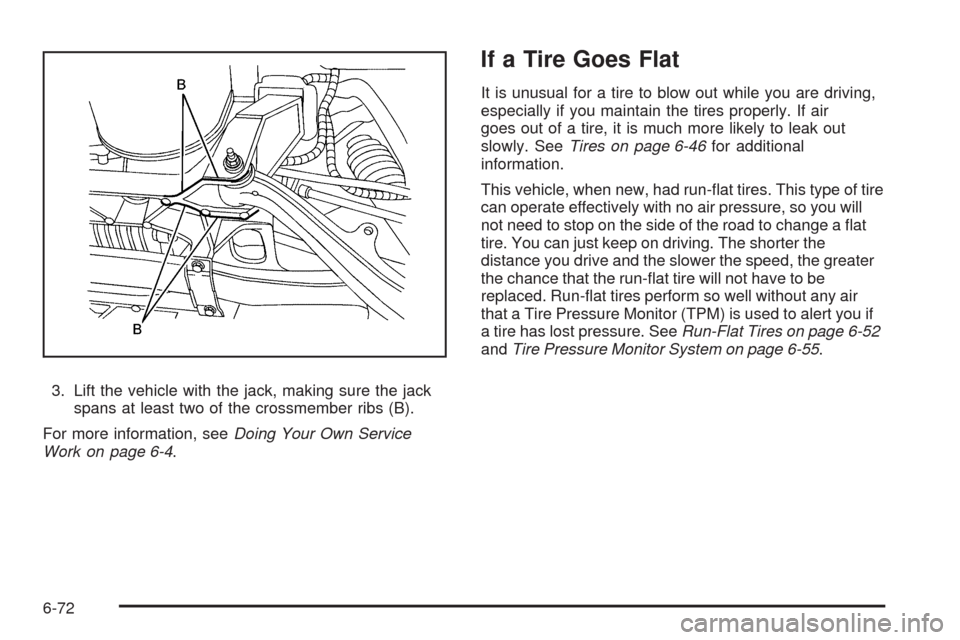
3. Lift the vehicle with the jack, making sure the jack
spans at least two of the crossmember ribs (B).
For more information, seeDoing Your Own Service
Work on page 6-4.
If a Tire Goes Flat
It is unusual for a tire to blow out while you are driving,
especially if you maintain the tires properly. If air
goes out of a tire, it is much more likely to leak out
slowly. SeeTires on page 6-46for additional
information.
This vehicle, when new, had run-at tires. This type of tire
can operate effectively with no air pressure, so you will
not need to stop on the side of the road to change a at
tire. You can just keep on driving. The shorter the
distance you drive and the slower the speed, the greater
the chance that the run-at tire will not have to be
replaced. Run-at tires perform so well without any air
that a Tire Pressure Monitor (TPM) is used to alert you if
a tire has lost pressure. SeeRun-Flat Tires on page 6-52
andTire Pressure Monitor System on page 6-55.
6-72
Page 438 of 462
Coverage
Services are provided up to 5 years/100,000 miles
(160 000 km), whichever comes rst.
In the U.S., anyone driving the vehicle is covered.
In Canada, a person driving the vehicle without
permission from the owner is not covered.
Roadside Assistance is not a part of the New Vehicle
Limited Warranty. Cadillac and General Motors of
Canada Limited reserve the right to make any changes
or discontinue the Roadside Assistance program at
any time without notication.
Cadillac and General Motors of Canada Limited reserve
the right to limit services or payment to an owner or
driver if they decide the claims are made too often, or
the same type of claim is made many times.
Cadillac Owner Privileges™
Emergency Fuel Delivery:Delivery of enough fuel
for the vehicle to get to the nearest service station.
Lock-Out Service:Service is provided to unlock the
vehicle if you are locked out. A remote unlock may
be available if you have OnStar
®. For security
reasons, the driver must present identication
before this service is given.
Emergency Tow From a Public Road or
Highway:Tow to the nearest Cadillac dealer for
warranty service, or if the vehicle was in a crash and
cannot be driven. Assistance is also given when
the vehicle is stuck in the sand, mud, or snow.
Flat Tire Change:Service is provided to change a
at tire with spare tire. The spare tire, if equipped,
must be in good condition and properly inated.
It is your responsibility for the repair or replacement
of the tire if it is not covered by the warranty.
Battery Jump Start:Service is provided to jump
start a dead battery.
Trip Routing Service:Detailed maps of North
America are provided when requested either
with the most direct route or the most scenic route.
Additional travel information is also available.
Allow three weeks for delivery.
Trip Interruption Benets and Assistance:
If your trip is interrupted due to a warranty failure,
incidental expenses may be reimbursed during
the 5 year/100,000 miles (160 000 km) Powertrain
warranty period. Items considered are hotel,
meals, and rental car.
8-8