wheel CADILLAC XLR 2009 1.G Repair Manual
[x] Cancel search | Manufacturer: CADILLAC, Model Year: 2009, Model line: XLR, Model: CADILLAC XLR 2009 1.GPages: 462, PDF Size: 3.72 MB
Page 385 of 462

{WARNING:
The traction grade assigned to this tire is
based on straight-ahead braking traction tests,
and does not include acceleration, cornering,
hydroplaning, or peak traction characteristics.
Temperature – A, B, C
The temperature grades are A (the highest), B,
and C, representing the tire’s resistance to
the generation of heat and its ability to dissipate
heat when tested under controlled conditions on a
specied indoor laboratory test wheel. Sustained
high temperature can cause the material of the tire
to degenerate and reduce tire life, and excessive
temperature can lead to sudden tire failure.
The grade C corresponds to a level of performance
which all passenger car tires must meet under
the Federal Motor Vehicle Safety Standard
No. 109. Grades B and A represent higher levels
of performance on the laboratory test wheel
than the minimum required by law.
{WARNING:
The temperature grade for this tire is
established for a tire that is properly inated
and not overloaded. Excessive speed,
underination, or excessive loading, either
separately or in combination, can cause heat
buildup and possible tire failure.
Wheel Alignment and Tire Balance
The tires and wheels on your vehicle were aligned
and balanced carefully at the factory to give you the
longest tire life and best overall performance.
Adjustments to wheel alignment and tire balancing will
not be necessary on a regular basis. However, if
you notice unusual tire wear or your vehicle pulling to
one side or the other, the alignment might need to
be checked. If you notice your vehicle vibrating when
driving on a smooth road, the tires and wheels
might need to be rebalanced. See your dealer/retailer
for proper diagnosis.
6-65
Page 386 of 462
Wheel Replacement
Replace any wheel that is bent, cracked, or badly rusted
or corroded. If wheel nuts keep coming loose, the wheel,
wheel bolts, and wheel nuts should be replaced. If the
wheel leaks air, replace it (except some aluminum
wheels, which can sometimes be repaired). See your
dealer/retailer if any of these conditions exist.
Your dealer/retailer will know the kind of wheel you need.
Each new wheel should have the same load-carrying
capacity, diameter, width, offset, and be mounted
the same way as the one it replaces.
If you need to replace any of your wheels, wheel bolts or
wheel nuts, replace them only with new GM original
equipment parts. This way, you will be sure to have the
right wheel, wheel bolts, and wheel nuts for your vehicle.
{CAUTION:
Using the wrong replacement wheels, wheel bolts,
or wheel nuts on your vehicle can be dangerous.
It could affect the braking and handling of your
CAUTION: (Continued)
CAUTION: (Continued)
vehicle, make your tires lose air and make you
lose control. You could have a collision in which
you or others could be injured. Always use the
correct wheel, wheel bolts, and wheel nuts for
replacement.
{CAUTION:
Putting a used wheel on the vehicle is dangerous.
You cannot know how it has been used or how far
it has been driven. It could fail suddenly and
cause a crash. If you have to replace a wheel, use
a new GM original equipment wheel.
Notice:The wrong wheel can also cause problems
with bearing life, brake cooling, speedometer or
odometer calibration, headlamp aim, bumper height,
vehicle ground clearance, and tire clearance to
the body and chassis.
6-66
Page 387 of 462
{CAUTION:
Rust or dirt on a wheel, or on the parts to
which it is fastened, can make wheel nuts
become loose after a time. The wheel could
come off and cause a crash. When you
change a wheel, remove any rust or dirt from
places where the wheel attaches to the
vehicle. In an emergency, you can use a
cloth or a paper towel to do this; but be sure
to use a scraper or wire brush later, if you
need to, to get all the rust or dirt off.
Tightening Wheel Lug Nuts
{CAUTION:
Never use oil or grease on studs or the threads of
the wheel nuts. If you do, the wheel nuts might
come loose and the wheel could fall off, causing
a crash.
{CAUTION:
Incorrect wheel nuts or improperly tightened wheel
nuts can cause the wheel to become loose and
even come off. This could lead to a crash. Be sure
to use the correct wheel nuts. If you have to
replace them, be sure to get new GM original
equipment wheel nuts.
Notice:Improperly tightened wheel nuts can lead
to brake pulsation and rotor damage. To avoid
expensive brake repairs, evenly tighten the wheel
nuts in the proper sequence and to the proper
torque specication.
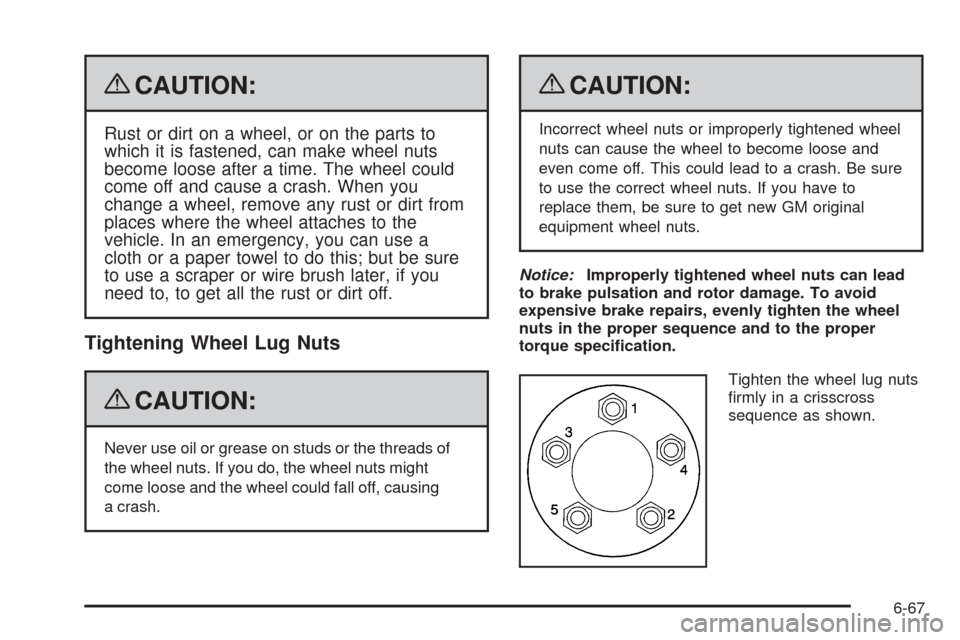
Tighten the wheel lug nuts
rmly in a crisscross
sequence as shown.
6-67
Page 388 of 462
Tire Chains
{CAUTION:
Do not use tire chains. There is not enough
clearance. Tire chains used on a vehicle without the
proper amount of clearance can cause damage to
the brakes, suspension, or other vehicle parts. The
area damaged by the tire chains could cause you to
lose control of the vehicle and you or others may be
injured in a crash. Use another type of traction
device only if its manufacturer recommends it for
use on the vehicle and tire size combination and
road conditions. Follow that manufacturer’s
instructions. To help avoid damage to the vehicle,
drive slowly, re-adjust or remove the device if it is
contacting the vehicle, and do not spin the wheels.
If you do nd traction devices that will t, install
them on the rear tires.
Lifting the Vehicle
{CAUTION:
Lifting a vehicle can cause an injury. The vehicle
can slip off the jack and roll over you or others.
You and they could be badly injured. Find a level
place to lift the vehicle. To help prevent the
vehicle from moving:
1. Firmly set the parking brake.
2. Put an automatic transmission shift lever in
P (Park).
3. Turn the engine off.
4. Put blocks in front of and behind the wheels.
{CAUTION:
Getting under a vehicle when it is jacked up is
dangerous. If the vehicle slips off the jack, you
could be badly injured or killed. Never get under a
vehicle when it is supported only by a jack.
6-68
Page 397 of 462
Weatherstrips
Silicone grease on weatherstrips will make them last
longer, seal better, and not stick or squeak. Apply
silicone grease with a clean cloth. During very cold,
damp weather frequent application may be required. See
Recommended Fluids and Lubricants on page 7-11.
Washing Your Vehicle
The best way to preserve your vehicle’s nish is to keep
it clean by washing it often.
Notice:Certain cleaners contain chemicals that can
damage the emblems or nameplates on your vehicle.
Check the cleaning product label. If it states that it
should not be used on plastic parts, do not use it on
your vehicle or damage may occur and it would not
be covered by the warranty.
Do not wash the vehicle in direct sunlight. Use a car
washing soap. Do not use cleaning agents that are
petroleum based or that contain acid or abrasives, as
they can damage the paint, metal or plastic on your
vehicle. Approved cleaning products can be obtained
from your dealer/retailer. Follow all manufacturers’
directions regarding correct product usage, necessary
safety precautions and appropriate disposal of any
vehicle care product.Rinse the vehicle well, before washing and after to
remove all cleaning agents completely. If they are
allowed to dry on the surface, they could stain.
Dry the nish with a soft, clean chamois or an all-cotton
towel to avoid surface scratches and water spotting.
Notice:If you drive the vehicle through an
automatic car wash that does not have enough
clearance for the wide rear tires and wheels, you
could damage the vehicle. Verify with the manager
of the car wash that the vehicle will t before
entering the car wash or use a touchless car wash.
High pressure car washes may cause water to enter the
vehicle. Avoid using high pressure washes closer than
12 inches (30 cm) to the surface of the vehicle. Use of
power washers exceeding 1,200 psi (8 274 kPa) can
result in damage or removal of paint and decals.
Cleaning Exterior Lamps/Lenses
Use only lukewarm or cold water, a soft cloth and a car
washing soap to clean exterior lamps and lenses. Follow
instructions underWashing Your Vehicle on page 6-77.
6-77
Page 399 of 462

Aluminum or Chrome-Plated Wheels
and Trim
Your vehicle may have either aluminum or
chrome-plated wheels.
Keep the wheels clean using a soft clean cloth with mild
soap and water. Rinse with clean water. After rinsing
thoroughly, dry with a soft clean towel. A wax may then
be applied.
Notice:Chrome wheels and other chrome trim may
be damaged if you do not wash your vehicle after
driving on roads that have been sprayed with
magnesium, calcium or sodium chloride. These
chlorides are used on roads for conditions such as
ice and dust. Always wash your vehicle’s chrome
with soap and water after exposure.
Notice:If you use strong soaps, chemicals,
abrasive polishes, cleaners, brushes, or cleaners that
contain acid on aluminum or chrome-plated wheels,
you could damage the surface of the wheel(s).
The repairs would not be covered by your warranty.
Use only approved cleaners on aluminum or
chrome-plated wheels.The surface of these wheels is similar to the painted
surface of your vehicle. Do not use strong soaps,
chemicals, abrasive polishes, abrasive cleaners,
cleaners with acid, or abrasive cleaning brushes on
them because you could damage the surface. Do not
use chrome polish on aluminum wheels.
Notice:Using chrome polish on aluminum wheels
could damage the wheels. The repairs would not
be covered by your warranty. Use chrome polish on
chrome wheels only.
Use chrome polish only on chrome-plated wheels, but
avoid any painted surface of the wheel, and buff off
immediately after application.
Notice:If you drive your vehicle through an
automatic car wash that has silicone carbide tire
cleaning brushes, you could damage the aluminum
or chrome-plated wheels. The repairs would not
be covered by your warranty. Never drive a vehicle
equipped with aluminum or chrome-plated wheels
through an automatic car wash that uses silicone
carbide tire cleaning brushes.
6-79
Page 405 of 462
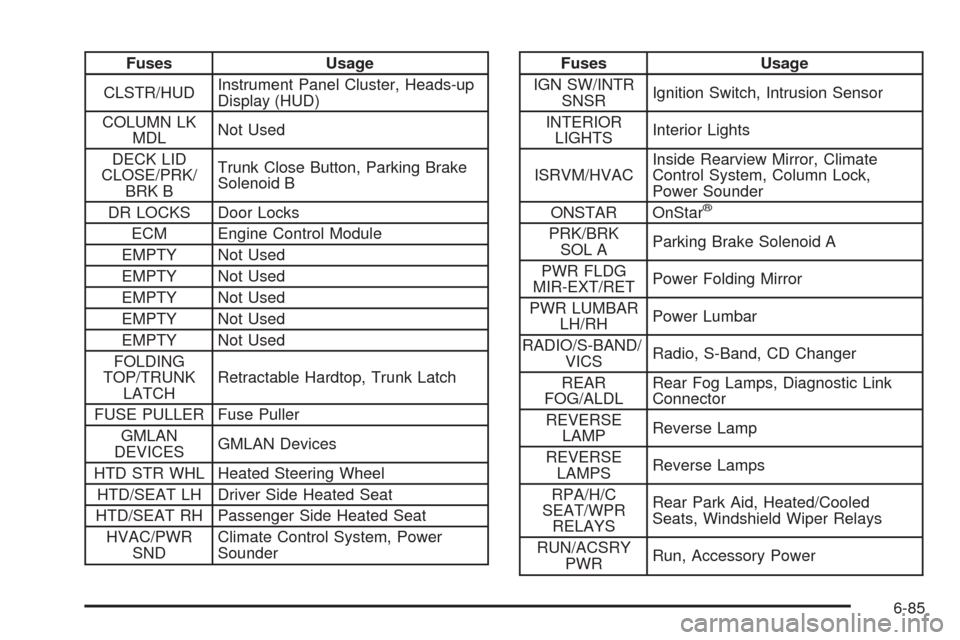
Fuses Usage
CLSTR/HUDInstrument Panel Cluster, Heads-up
Display (HUD)
COLUMN LK
MDLNot Used
DECK LID
CLOSE/PRK/
BRK BTrunk Close Button, Parking Brake
Solenoid B
DR LOCKS Door Locks
ECM Engine Control Module
EMPTY Not Used
EMPTY Not Used
EMPTY Not Used
EMPTY Not Used
EMPTY Not Used
FOLDING
TOP/TRUNK
LATCHRetractable Hardtop, Trunk Latch
FUSE PULLER Fuse Puller
GMLAN
DEVICESGMLAN Devices
HTD STR WHL Heated Steering Wheel
HTD/SEAT LH Driver Side Heated Seat
HTD/SEAT RH Passenger Side Heated Seat
HVAC/PWR
SNDClimate Control System, Power
SounderFuses Usage
IGN SW/INTR
SNSRIgnition Switch, Intrusion Sensor
INTERIOR
LIGHTSInterior Lights
ISRVM/HVACInside Rearview Mirror, Climate
Control System, Column Lock,
Power Sounder
ONSTAR OnStar
®
PRK/BRK
SOL AParking Brake Solenoid A
PWR FLDG
MIR-EXT/RETPower Folding Mirror
PWR LUMBAR
LH/RHPower Lumbar
RADIO/S-BAND/
VICSRadio, S-Band, CD Changer
REAR
FOG/ALDLRear Fog Lamps, Diagnostic Link
Connector
REVERSE
LAMPReverse Lamp
REVERSE
LAMPSReverse Lamps
RPA/H/C
SEAT/WPR
RELAYSRear Park Aid, Heated/Cooled
Seats, Windshield Wiper Relays
RUN/ACSRY
PWRRun, Accessory Power
6-85
Page 406 of 462
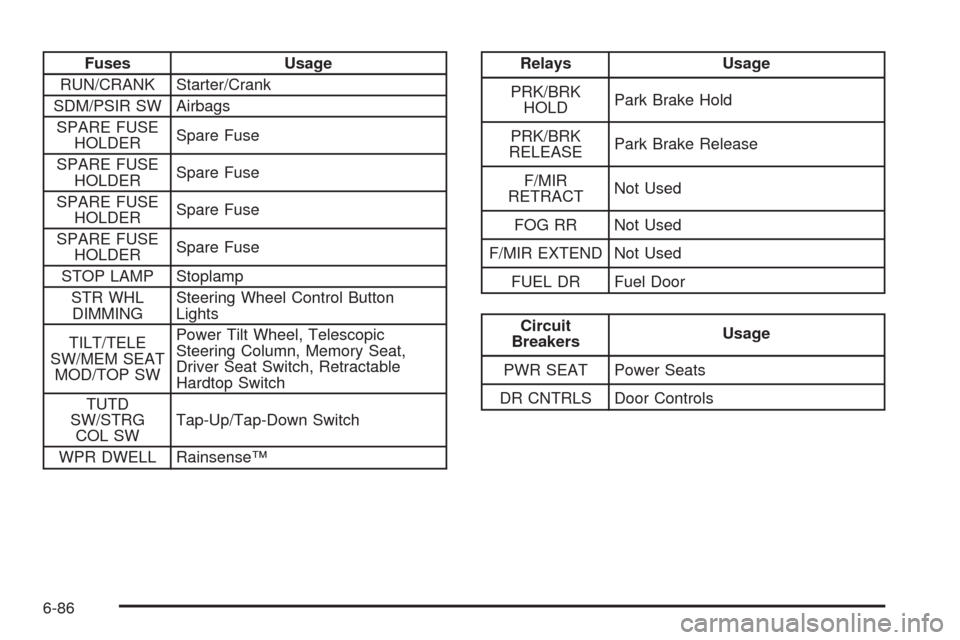
Fuses Usage
RUN/CRANK Starter/Crank
SDM/PSIR SW Airbags
SPARE FUSE
HOLDERSpare Fuse
SPARE FUSE
HOLDERSpare Fuse
SPARE FUSE
HOLDERSpare Fuse
SPARE FUSE
HOLDERSpare Fuse
STOP LAMP Stoplamp
STR WHL
DIMMINGSteering Wheel Control Button
Lights
TILT/TELE
SW/MEM SEAT
MOD/TOP SWPower Tilt Wheel, Telescopic
Steering Column, Memory Seat,
Driver Seat Switch, Retractable
Hardtop Switch
TUTD
SW/STRG
COL SWTap-Up/Tap-Down Switch
WPR DWELL Rainsense™Relays Usage
PRK/BRK
HOLDPark Brake Hold
PRK/BRK
RELEASEPark Brake Release
F/MIR
RETRACTNot Used
FOG RR Not Used
F/MIR EXTEND Not Used
FUEL DR Fuel Door
Circuit
BreakersUsage
PWR SEAT Power Seats
DR CNTRLS Door Controls
6-86
Page 410 of 462
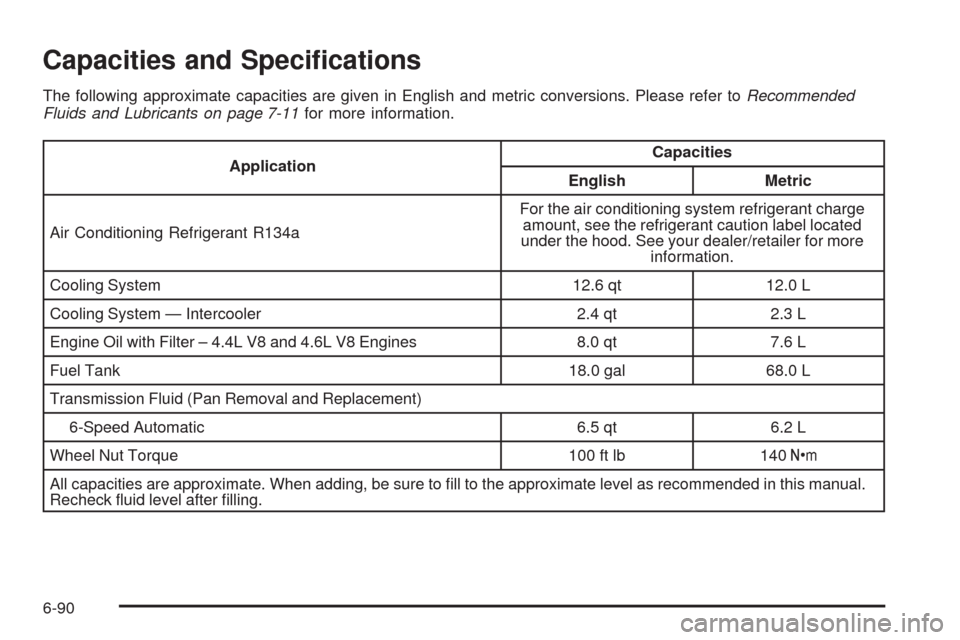
Capacities and Specications
The following approximate capacities are given in English and metric conversions. Please refer toRecommended
Fluids and Lubricants on page 7-11for more information.
ApplicationCapacities
English Metric
Air Conditioning Refrigerant R134aFor the air conditioning system refrigerant charge
amount, see the refrigerant caution label located
under the hood. See your dealer/retailer for more
information.
Cooling System 12.6 qt 12.0 L
Cooling System — Intercooler 2.4 qt 2.3 L
Engine Oil with Filter – 4.4L V8 and 4.6L V8 Engines 8.0 qt 7.6 L
Fuel Tank 18.0 gal 68.0 L
Transmission Fluid (Pan Removal and Replacement)
6-Speed Automatic 6.5 qt 6.2 L
Wheel Nut Torque 100 ft lb 140Y
All capacities are approximate. When adding, be sure to ll to the approximate level as recommended in this manual.
Recheck uid level after lling.
6-90
Page 437 of 462

Mexico, Central America and Caribbean
Islands/Countries (Except Puerto Rico
and U.S. Virgin Islands) — Customer
Assistance
General Motors de Mexico, S. de R.L. de C.V.
Customer Assistance Center
Paseo de la Reforma # 2740
Col. Lomas de Bezares
C.P. 11910, Mexico, D.F.
01-800-508-0000
Long Distance: 011-52-53 29 0 800
GM Mobility Reimbursement
Program
This program, available to qualied applicants, can
reimburse you up to $1,000 of the cost of eligible
aftermarket adaptive equipment required for your vehicle,
such as hand controls or a wheelchair/scooter lift.The offer is available for a very limited period of time
from the date of vehicle purchase/lease. For more
details, or to determine your vehicle’s eligibility, visit
gmmobility.com or call the GM Mobility Assistance
Center at 1-800-323-9935. Text telephone (TTY) users,
call 1-800-833-9935.
General Motors of Canada also has a Mobility Program.
Call 1-800-GM-DRIVE (463-7483) for details. TTY users
call 1-800-263-3830.
Roadside Service
In the United States or Canada, call1-800-882-1112.
Text Telephone (TTY), U.S. only, call1-888-889-2438.
Service is available 24 hours a day, 365 days a year.
Calling for Assistance
When calling Roadside Assistance, have the following
information ready:
Your name, home address, and home telephone
number
Telephone number of your location
Location of the vehicle
Model, year, color, and license plate number of the
vehicle
Odometer reading, Vehicle Identication
Number (VIN), and delivery date of the vehicle
Description of the problem
8-7