heating CADILLAC XT5 2018 User Guide
[x] Cancel search | Manufacturer: CADILLAC, Model Year: 2018, Model line: XT5, Model: CADILLAC XT5 2018Pages: 380, PDF Size: 6.21 MB
Page 250 of 380
Cadillac XT5 Owner Manual (GMNA-Localizing-U.S./Canada/Mexico-
11349110) - 2018 - CRC - 9/28/17
VEHICLE CARE 249
Vehicle Care
General Information
General Information . . . . . . . . . . . . . 250
California Proposition65 Warning . . . . . . . . . . . . . . . . . . . . . 250
California Perchlorate Materials Requirements . . . . . . . . . . . . . . . . . . . 251
Accessories and Modifications . . . . . . . . . . . . . . . . . . . 251
Vehicle Checks
Doing Your OwnService Work . . . . . . . . . . . . . . . . . . . . 251
Hood . . . . . . . . . . . . . . . . . . . . . . . . . . . . . . 252
Engine Compartment Overview . . . . . . . . . . . . . . . . . . . . . . . . . 253
Engine Oil . . . . . . . . . . . . . . . . . . . . . . . . . 254
Engine Oil Life System . . . . . . . . . . . 256
Automatic Transmission Fluid . . . . . . . . . . . . . . . . . . . . . . . . . . . . . 257
Engine Air Cleaner/Filter . . . . . . . . . 257
Cooling System . . . . . . . . . . . . . . . . . . . 258
Engine Overheating . . . . . . . . . . . . . . 261
Washer Fluid . . . . . . . . . . . . . . . . . . . . . 263
Brakes . . . . . . . . . . . . . . . . . . . . . . . . . . . . . 263
Brake Fluid . . . . . . . . . . . . . . . . . . . . . . . 264
Battery - North America . . . . . . . . . 265
All-Wheel Drive . . . . . . . . . . . . . . . . . . 266 Starter Switch Check . . . . . . . . . . . . . 266
Park Brake and P (Park)
Mechanism Check . . . . . . . . . . . . . . 266
Wiper Blade Replacement . . . . . . . 267
Windshield Replacement . . . . . . . . 268
Gas Strut(s) . . . . . . . . . . . . . . . . . . . . . . . 268
Headlamp Aiming
Headlamp Aiming . . . . . . . . . . . . . . . . 269
Bulb Replacement
Bulb Replacement . . . . . . . . . . . . . . . . 270
Halogen Bulbs . . . . . . . . . . . . . . . . . . . . 270
LED Lighting . . . . . . . . . . . . . . . . . . . . . 270
Headlamps and Front Turn Signal . . . . . . . . . . . . . . . . . . . . . . . . . . . . 270
Back-Up Lamps . . . . . . . . . . . . . . . . . . . 271
Electrical System
Electrical System Overload . . . . . . 271
Fuses and Circuit Breakers . . . . . . 272
Engine Compartment Fuse Block . . . . . . . . . . . . . . . . . . . . . . . . . . . . 272
Instrument Panel Fuse Block . . . . 275
Rear Compartment Fuse Block . . . . . . . . . . . . . . . . . . . . . . . . . . . . 277
Wheels and Tires
Tires . . . . . . . . . . . . . . . . . . . . . . . . . . . . . . . 279
All-Season Tires . . . . . . . . . . . . . . . . . . 280
Winter Tires . . . . . . . . . . . . . . . . . . . . . . 280
Summer Tires . . . . . . . . . . . . . . . . . . . . 281 Tire Sidewall Labeling . . . . . . . . . . . 281
Tire Designations . . . . . . . . . . . . . . . . . 283
Tire Terminology and
Definitions . . . . . . . . . . . . . . . . . . . . . . 284
Tire Pressure . . . . . . . . . . . . . . . . . . . . . . 286
Tire Pressure for High-Speed
Operation . . . . . . . . . . . . . . . . . . . . . . . . 288
Tire Pressure Monitor System . . . 288
Tire Pressure Monitor Operation . . . . . . . . . . . . . . . . . . . . . . . . 289
Tire Inspection . . . . . . . . . . . . . . . . . . . 293
Tire Rotation . . . . . . . . . . . . . . . . . . . . . 293
When It Is Time for New Tires . . . . . . . . . . . . . . . . . . . . . . . . . . . . . 294
Buying New Tires . . . . . . . . . . . . . . . . 295
Different Size Tires and Wheels . . . . . . . . . . . . . . . . . . . . . . . . . . 296
Uniform Tire Quality Grading . . . 297
Wheel Alignment and Tire Balance . . . . . . . . . . . . . . . . . . . . . . . . . . 298
Wheel Replacement . . . . . . . . . . . . . . 298
Tire Chains . . . . . . . . . . . . . . . . . . . . . . . 299
If a Tire Goes Flat . . . . . . . . . . . . . . . . 300
Tire Sealant and Compressor Kit . . . . . . . . . . . . . . . . . 301
Storing the Tire Sealant and Compressor Kit . . . . . . . . . . . . . . . . . 307
Tire Changing . . . . . . . . . . . . . . . . . . . . . 308
Compact Spare Tire . . . . . . . . . . . . . . 313
Page 260 of 380
Cadillac XT5 Owner Manual (GMNA-Localizing-U.S./Canada/Mexico-
11349110) - 2018 - CRC - 9/28/17
VEHICLE CARE 259
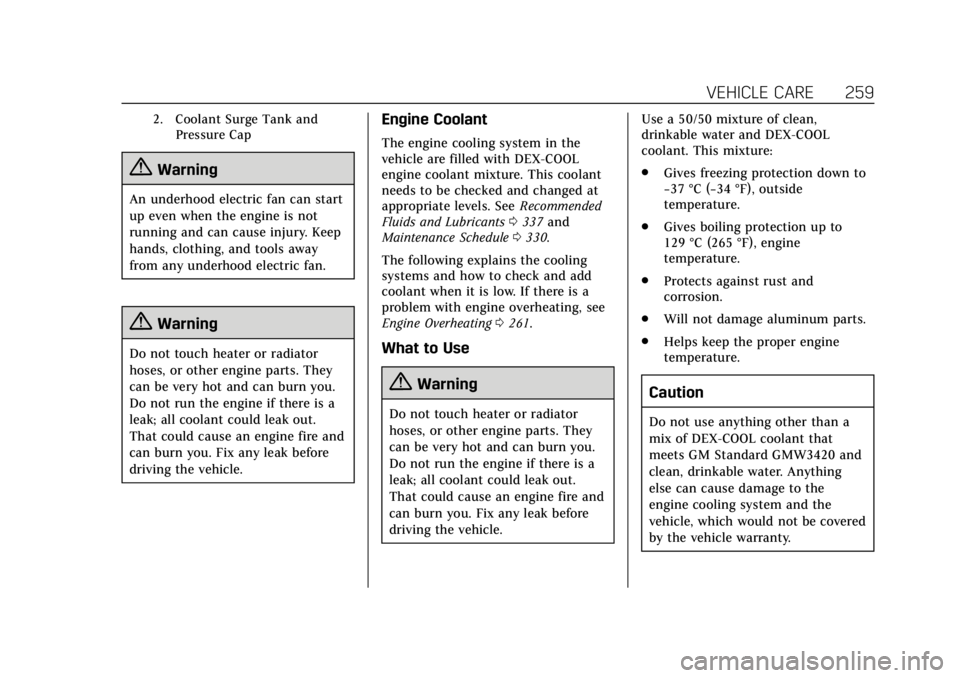
2. Coolant Surge Tank andPressure Cap
{Warning
An underhood electric fan can start
up even when the engine is not
running and can cause injury. Keep
hands, clothing, and tools away
from any underhood electric fan.
{Warning
Do not touch heater or radiator
hoses, or other engine parts. They
can be very hot and can burn you.
Do not run the engine if there is a
leak; all coolant could leak out.
That could cause an engine fire and
can burn you. Fix any leak before
driving the vehicle.
Engine Coolant
The engine cooling system in the
vehicle are filled with DEX-COOL
engine coolant mixture. This coolant
needs to be checked and changed at
appropriate levels. See Recommended
Fluids and Lubricants 0337 and
Maintenance Schedule 0330.
The following explains the cooling
systems and how to check and add
coolant when it is low. If there is a
problem with engine overheating, see
Engine Overheating 0261.
What to Use
{Warning
Do not touch heater or radiator
hoses, or other engine parts. They
can be very hot and can burn you.
Do not run the engine if there is a
leak; all coolant could leak out.
That could cause an engine fire and
can burn you. Fix any leak before
driving the vehicle. Use a 50/50 mixture of clean,
drinkable water and DEX-COOL
coolant. This mixture:
.
Gives freezing protection down to
−37 °C (−34 °F), outside
temperature.
. Gives boiling protection up to
129 °C (265 °F), engine
temperature.
. Protects against rust and
corrosion.
. Will not damage aluminum parts.
. Helps keep the proper engine
temperature.
Caution
Do not use anything other than a
mix of DEX-COOL coolant that
meets GM Standard GMW3420 and
clean, drinkable water. Anything
else can cause damage to the
engine cooling system and the
vehicle, which would not be covered
by the vehicle warranty.
Page 261 of 380
Cadillac XT5 Owner Manual (GMNA-Localizing-U.S./Canada/Mexico-
11349110) - 2018 - CRC - 9/28/17
260 VEHICLE CARE
Never dispose of engine coolant by
putting it in the trash, pouring it on
the ground, or pouring into sewers,
streams, or bodies of water. Have the
coolant changed by an authorized
service center, familiar with legal
requirements regarding used coolant
disposal. This will help protect the
environment and your health.
Checking Coolant
The vehicle must be on a level surface
when checking the coolant level.
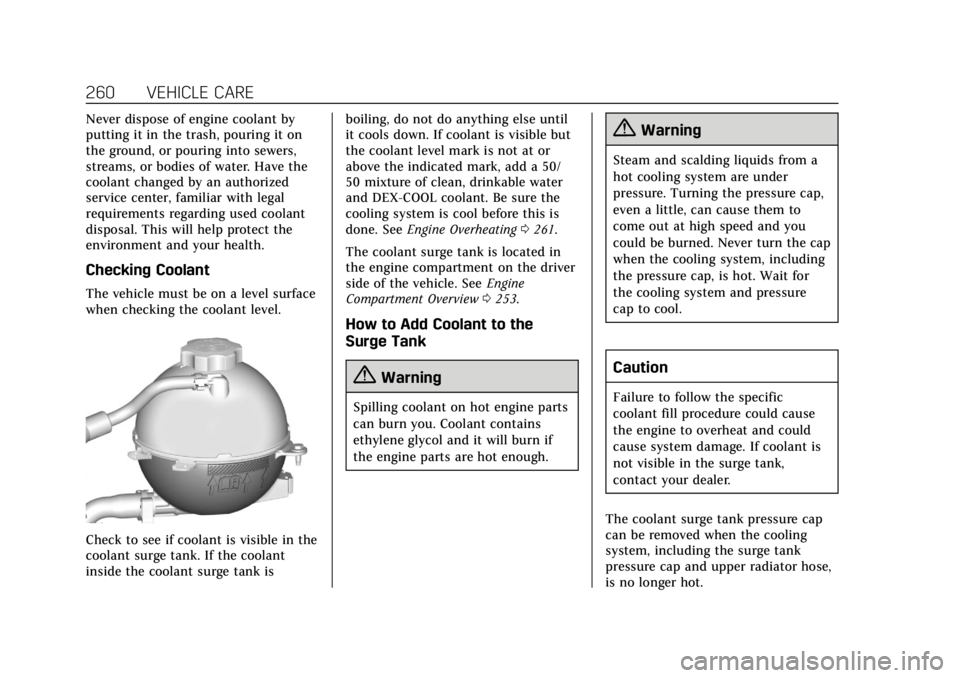
Check to see if coolant is visible in the
coolant surge tank. If the coolant
inside the coolant surge tank isboiling, do not do anything else until
it cools down. If coolant is visible but
the coolant level mark is not at or
above the indicated mark, add a 50/
50 mixture of clean, drinkable water
and DEX-COOL coolant. Be sure the
cooling system is cool before this is
done. See
Engine Overheating 0261.
The coolant surge tank is located in
the engine compartment on the driver
side of the vehicle. See Engine
Compartment Overview 0253.
How to Add Coolant to the
Surge Tank
{Warning
Spilling coolant on hot engine parts
can burn you. Coolant contains
ethylene glycol and it will burn if
the engine parts are hot enough.
{Warning
Steam and scalding liquids from a
hot cooling system are under
pressure. Turning the pressure cap,
even a little, can cause them to
come out at high speed and you
could be burned. Never turn the cap
when the cooling system, including
the pressure cap, is hot. Wait for
the cooling system and pressure
cap to cool.
Caution
Failure to follow the specific
coolant fill procedure could cause
the engine to overheat and could
cause system damage. If coolant is
not visible in the surge tank,
contact your dealer.
The coolant surge tank pressure cap
can be removed when the cooling
system, including the surge tank
pressure cap and upper radiator hose,
is no longer hot.
Page 262 of 380
Cadillac XT5 Owner Manual (GMNA-Localizing-U.S./Canada/Mexico-
11349110) - 2018 - CRC - 9/28/17
VEHICLE CARE 261
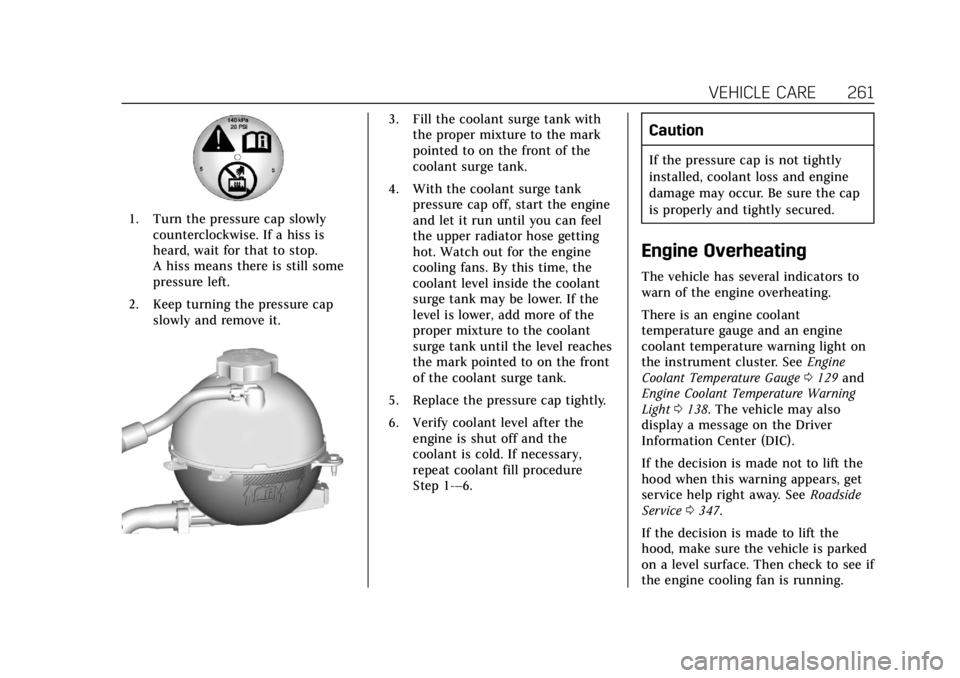
1. Turn the pressure cap slowlycounterclockwise. If a hiss is
heard, wait for that to stop.
A hiss means there is still some
pressure left.
2. Keep turning the pressure cap slowly and remove it.
3. Fill the coolant surge tank withthe proper mixture to the mark
pointed to on the front of the
coolant surge tank.
4. With the coolant surge tank pressure cap off, start the engine
and let it run until you can feel
the upper radiator hose getting
hot. Watch out for the engine
cooling fans. By this time, the
coolant level inside the coolant
surge tank may be lower. If the
level is lower, add more of the
proper mixture to the coolant
surge tank until the level reaches
the mark pointed to on the front
of the coolant surge tank.
5. Replace the pressure cap tightly.
6. Verify coolant level after the engine is shut off and the
coolant is cold. If necessary,
repeat coolant fill procedure
Step 1-–6.Caution
If the pressure cap is not tightly
installed, coolant loss and engine
damage may occur. Be sure the cap
is properly and tightly secured.
Engine Overheating
The vehicle has several indicators to
warn of the engine overheating.
There is an engine coolant
temperature gauge and an engine
coolant temperature warning light on
the instrument cluster. See Engine
Coolant Temperature Gauge 0129 and
Engine Coolant Temperature Warning
Light 0138. The vehicle may also
display a message on the Driver
Information Center (DIC).
If the decision is made not to lift the
hood when this warning appears, get
service help right away. See Roadside
Service 0347.
If the decision is made to lift the
hood, make sure the vehicle is parked
on a level surface. Then check to see if
the engine cooling fan is running.
Page 263 of 380
Cadillac XT5 Owner Manual (GMNA-Localizing-U.S./Canada/Mexico-
11349110) - 2018 - CRC - 9/28/17
262 VEHICLE CARE
If the engine is overheating, the fan
should be running. If it is not, do not
continue to run the engine. Have the
vehicle serviced.
Caution
Do not run the engine if there is a
leak in the engine cooling system.
This can cause a loss of all coolant
and can damage the system and
vehicle. Have any leaks fixed
right away.
If Steam Is Coming from the
Engine Compartment
{Warning
Steam and scalding liquids from a
hot cooling system are under
pressure. Turning the pressure cap,
even a little, can cause them to
come out at high speed and you
could be burned. Never turn the cap
when the cooling system, including(Continued)
Warning (Continued)
the pressure cap, is hot. Wait for
the cooling system and pressure
cap to cool.
If No Steam Is Coming from the
Engine Compartment
If an engine overheat warning is
displayed but no steam can be seen or
heard, the problem may not be too
serious. Sometimes the engine can get
a little too hot when the vehicle:
.Climbs a long hill on a hot day.
. Stops after high-speed driving.
. Idles for long periods in traffic.
If the overheat warning is displayed
with no sign of steam: 1. Turn the air conditioning off.
2. Turn the heater on to the highest temperature and to the highest
fan speed. Open the windows as
necessary. 3. When it is safe to do so, pull off
the road, shift to P (Park) or
N (Neutral), and let the
engine idle.
If the engine coolant temperature
gauge is no longer in the overheated
area or the engine coolant
temperature warning light no longer
displays, the vehicle can be driven.
Continue to drive the vehicle slowly
for about 10 minutes. Keep a safe
distance from the vehicle in front.
If the warning does not come back on,
continue to drive normally and have
the cooling system checked for proper
fill and function.
If the warning continues, pull over,
stop, and park the vehicle right away.
If there is no sign of steam, idle the
engine for three minutes while parked.
If the warning is still displayed, turn
off the engine until it cools down.
Page 275 of 380
Cadillac XT5 Owner Manual (GMNA-Localizing-U.S./Canada/Mexico-
11349110) - 2018 - CRC - 9/28/17
274 VEHICLE CARE
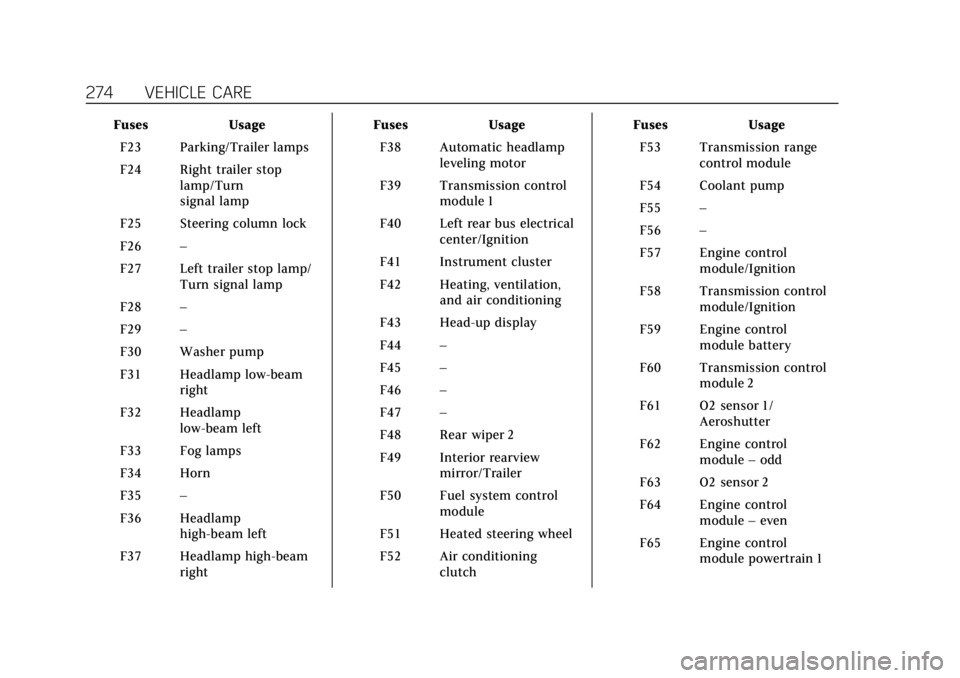
FusesUsage
F23 Parking/Trailer lamps
F24 Right trailer stop lamp/Turn
signal lamp
F25 Steering column lock
F26 –
F27 Left trailer stop lamp/ Turn signal lamp
F28 –
F29 –
F30 Washer pump
F31 Headlamp low-beam right
F32 Headlamp low-beam left
F33 Fog lamps
F34 Horn
F35 –
F36 Headlamp high-beam left
F37 Headlamp high-beam right Fuses
Usage
F38 Automatic headlamp leveling motor
F39 Transmission control module 1
F40 Left rear bus electrical center/Ignition
F41 Instrument cluster
F42 Heating, ventilation, and air conditioning
F43 Head-up display
F44 –
F45 –
F46 –
F47 –
F48 Rear wiper 2
F49 Interior rearview mirror/Trailer
F50 Fuel system control module
F51 Heated steering wheel
F52 Air conditioning clutch Fuses
Usage
F53 Transmission range control module
F54 Coolant pump
F55 –
F56 –
F57 Engine control module/Ignition
F58 Transmission control module/Ignition
F59 Engine control module battery
F60 Transmission control module 2
F61 O2 sensor 1/ Aeroshutter
F62 Engine control module–odd
F63 O2 sensor 2
F64 Engine control module–even
F65 Engine control module powertrain 1
Page 277 of 380
Cadillac XT5 Owner Manual (GMNA-Localizing-U.S./Canada/Mexico-
11349110) - 2018 - CRC - 9/28/17
276 VEHICLE CARE
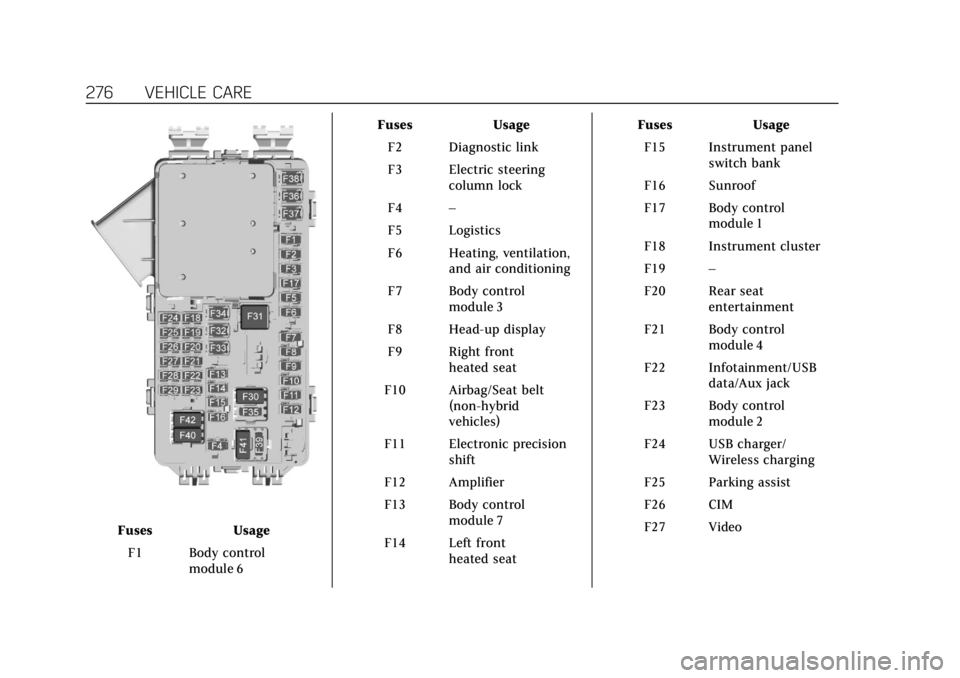
FusesUsage
F1 Body control module 6 Fuses
Usage
F2 Diagnostic link
F3 Electric steering column lock
F4 –
F5 Logistics
F6 Heating, ventilation, and air conditioning
F7 Body control module 3
F8 Head-up display
F9 Right front heated seat
F10 Airbag/Seat belt (non-hybrid
vehicles)
F11 Electronic precision shift
F12 Amplifier
F13 Body control module 7
F14 Left front heated seat Fuses
Usage
F15 Instrument panel switch bank
F16 Sunroof
F17 Body control module 1
F18 Instrument cluster
F19 –
F20 Rear seat entertainment
F21 Body control module 4
F22 Infotainment/USB data/Aux jack
F23 Body control module 2
F24 USB charger/ Wireless charging
F25 Parking assist
F26 CIM
F27 Video
Page 278 of 380
Cadillac XT5 Owner Manual (GMNA-Localizing-U.S./Canada/Mexico-
11349110) - 2018 - CRC - 9/28/17
VEHICLE CARE 277
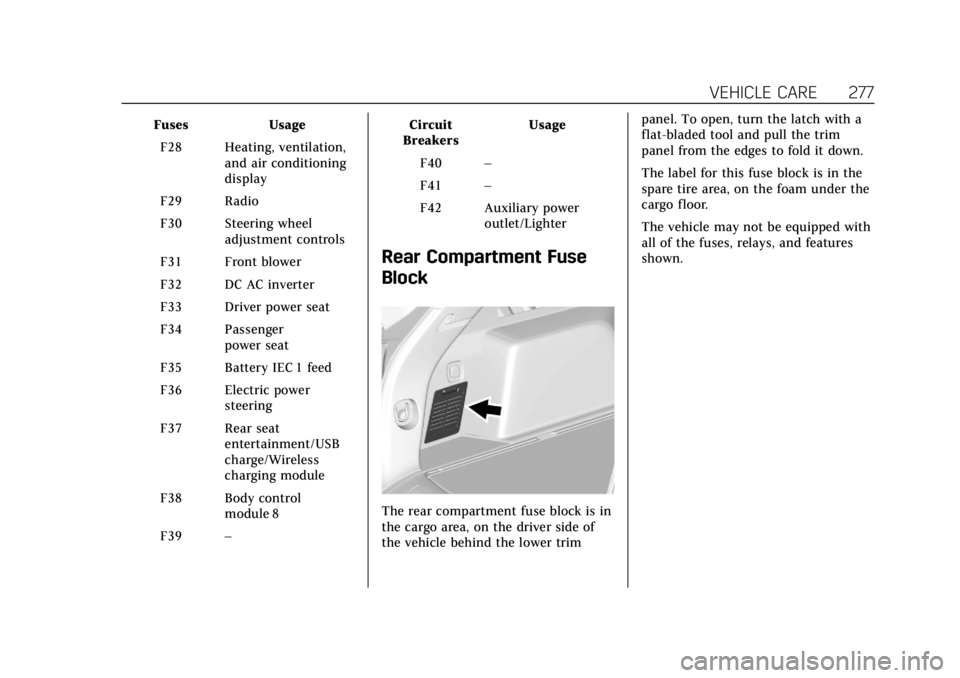
FusesUsage
F28 Heating, ventilation, and air conditioning
display
F29 Radio
F30 Steering wheel adjustment controls
F31 Front blower
F32 DC AC inverter
F33 Driver power seat
F34 Passenger power seat
F35 Battery IEC 1 feed
F36 Electric power steering
F37 Rear seat entertainment/USB
charge/Wireless
charging module
F38 Body control module 8
F39 – Circuit
Breakers Usage
F40 –
F41 –
F42 Auxiliary power outlet/Lighter
Rear Compartment Fuse
Block
The rear compartment fuse block is in
the cargo area, on the driver side of
the vehicle behind the lower trim panel. To open, turn the latch with a
flat-bladed tool and pull the trim
panel from the edges to fold it down.
The label for this fuse block is in the
spare tire area, on the foam under the
cargo floor.
The vehicle may not be equipped with
all of the fuses, relays, and features
shown.
Page 280 of 380
Cadillac XT5 Owner Manual (GMNA-Localizing-U.S./Canada/Mexico-
11349110) - 2018 - CRC - 9/28/17
VEHICLE CARE 279
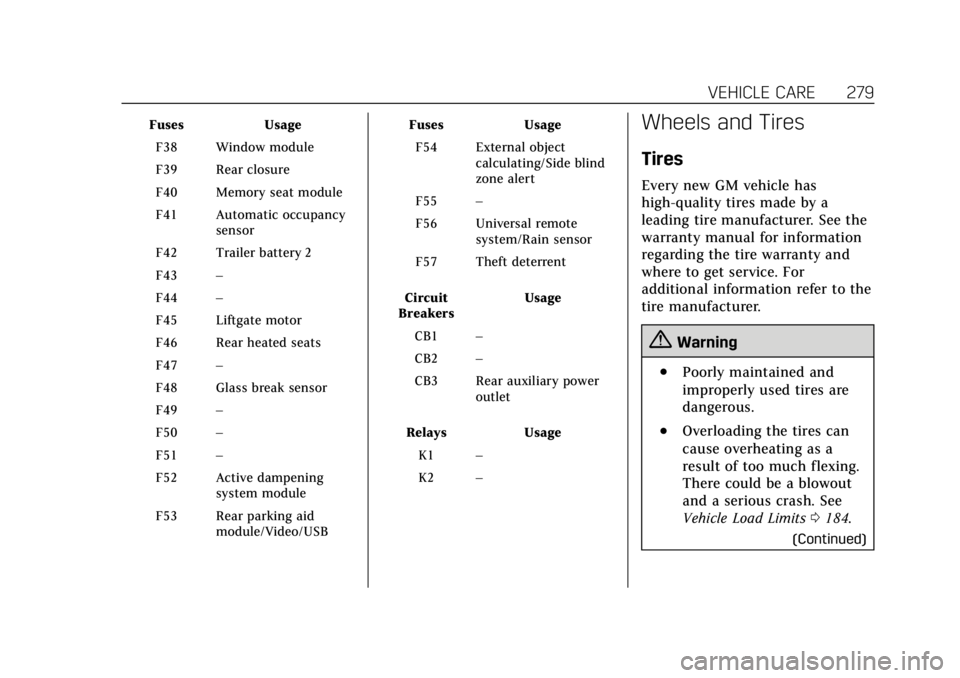
FusesUsage
F38 Window module
F39 Rear closure
F40 Memory seat module
F41 Automatic occupancy sensor
F42 Trailer battery 2
F43 –
F44 –
F45 Liftgate motor
F46 Rear heated seats
F47 –
F48 Glass break sensor
F49 –
F50 –
F51 –
F52 Active dampening system module
F53 Rear parking aid module/Video/USB Fuses
Usage
F54 External object calculating/Side blind
zone alert
F55 –
F56 Universal remote system/Rain sensor
F57 Theft deterrent
Circuit
Breakers Usage
CB1 –
CB2 –
CB3 Rear auxiliary power outlet
Relays Usage
K1 –
K2 –Wheels and Tires
Tires
Every new GM vehicle has
high-quality tires made by a
leading tire manufacturer. See the
warranty manual for information
regarding the tire warranty and
where to get service. For
additional information refer to the
tire manufacturer.
{Warning
.Poorly maintained and
improperly used tires are
dangerous.
.Overloading the tires can
cause overheating as a
result of too much flexing.
There could be a blowout
and a serious crash. See
Vehicle Load Limits 0184.
(Continued)
Page 288 of 380
Cadillac XT5 Owner Manual (GMNA-Localizing-U.S./Canada/Mexico-
11349110) - 2018 - CRC - 9/28/17
VEHICLE CARE 287
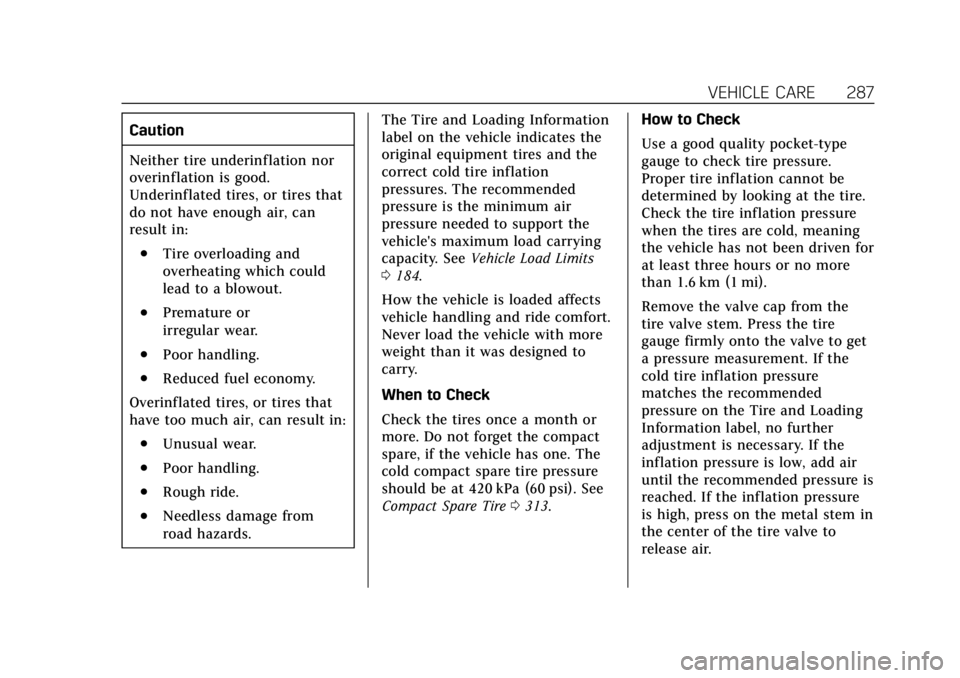
Caution
Neither tire underinflation nor
overinflation is good.
Underinflated tires, or tires that
do not have enough air, can
result in:
.Tire overloading and
overheating which could
lead to a blowout.
.Premature or
irregular wear.
.Poor handling.
.Reduced fuel economy.
Overinflated tires, or tires that
have too much air, can result in:
.Unusual wear.
.Poor handling.
.Rough ride.
.Needless damage from
road hazards. The Tire and Loading Information
label on the vehicle indicates the
original equipment tires and the
correct cold tire inflation
pressures. The recommended
pressure is the minimum air
pressure needed to support the
vehicle's maximum load carrying
capacity. See
Vehicle Load Limits
0 184.
How the vehicle is loaded affects
vehicle handling and ride comfort.
Never load the vehicle with more
weight than it was designed to
carry.
When to Check
Check the tires once a month or
more. Do not forget the compact
spare, if the vehicle has one. The
cold compact spare tire pressure
should be at 420 kPa (60 psi). See
Compact Spare Tire 0313. How to Check
Use a good quality pocket-type
gauge to check tire pressure.
Proper tire inflation cannot be
determined by looking at the tire.
Check the tire inflation pressure
when the tires are cold, meaning
the vehicle has not been driven for
at least three hours or no more
than 1.6 km (1 mi).
Remove the valve cap from the
tire valve stem. Press the tire
gauge firmly onto the valve to get
a pressure measurement. If the
cold tire inflation pressure
matches the recommended
pressure on the Tire and Loading
Information label, no further
adjustment is necessary. If the
inflation pressure is low, add air
until the recommended pressure is
reached. If the inflation pressure
is high, press on the metal stem in
the center of the tire valve to
release air.