child seat CADILLAC XT5 2023 Owner's Guide
[x] Cancel search | Manufacturer: CADILLAC, Model Year: 2023, Model line: XT5, Model: CADILLAC XT5 2023Pages: 482, PDF Size: 7.1 MB
Page 99 of 482
Cadillac XT5 Owner Manual (GMNA-Localizing-U.S./Canada/Mexico-
16406251) - 2023 - CRC - 3/25/22
98 Seats and Restraints
If the child restraint or vehicle
seat position does not have
the LATCH system, you will be
using the seat belt to secure
the child restraint. Be sure to
follow the instructions that
came with the child restraint.
If more than one child restraint
needs to be installed in the
rear seat, be sure to read
Where to Put the Restraint
088.
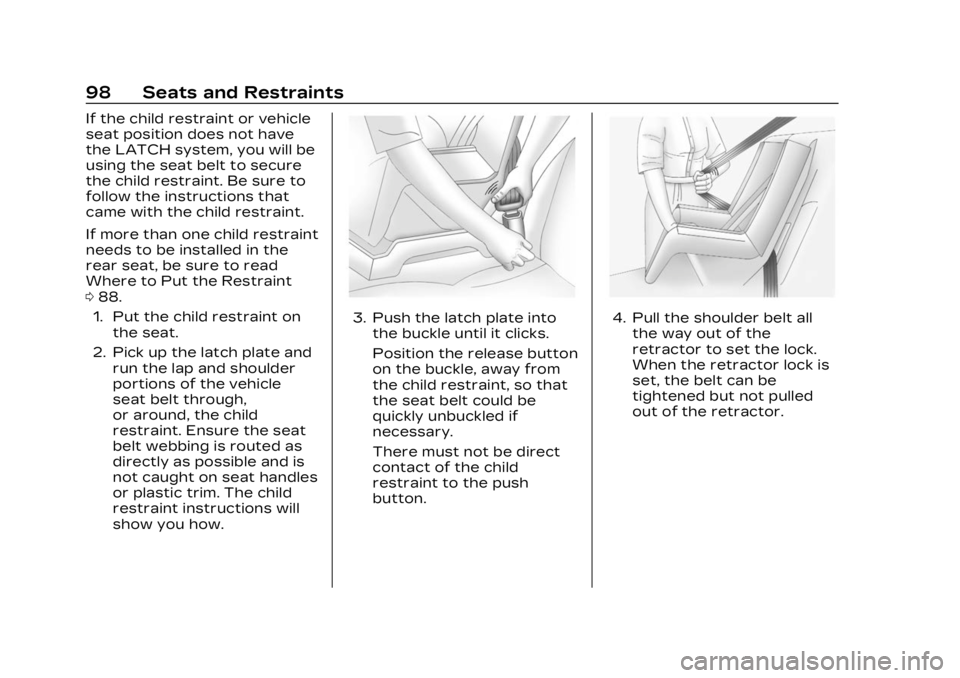
1. Put the child restraint on the seat.
2. Pick up the latch plate and run the lap and shoulder
portions of the vehicle
seat belt through,
or around, the child
restraint. Ensure the seat
belt webbing is routed as
directly as possible and is
not caught on seat handles
or plastic trim. The child
restraint instructions will
show you how.
3. Push the latch plate intothe buckle until it clicks.
Position the release button
on the buckle, away from
the child restraint, so that
the seat belt could be
quickly unbuckled if
necessary.
There must not be direct
contact of the child
restraint to the push
button.4. Pull the shoulder belt allthe way out of the
retractor to set the lock.
When the retractor lock is
set, the belt can be
tightened but not pulled
out of the retractor.
Page 100 of 482
Cadillac XT5 Owner Manual (GMNA-Localizing-U.S./Canada/Mexico-
16406251) - 2023 - CRC - 3/25/22
Seats and Restraints 99
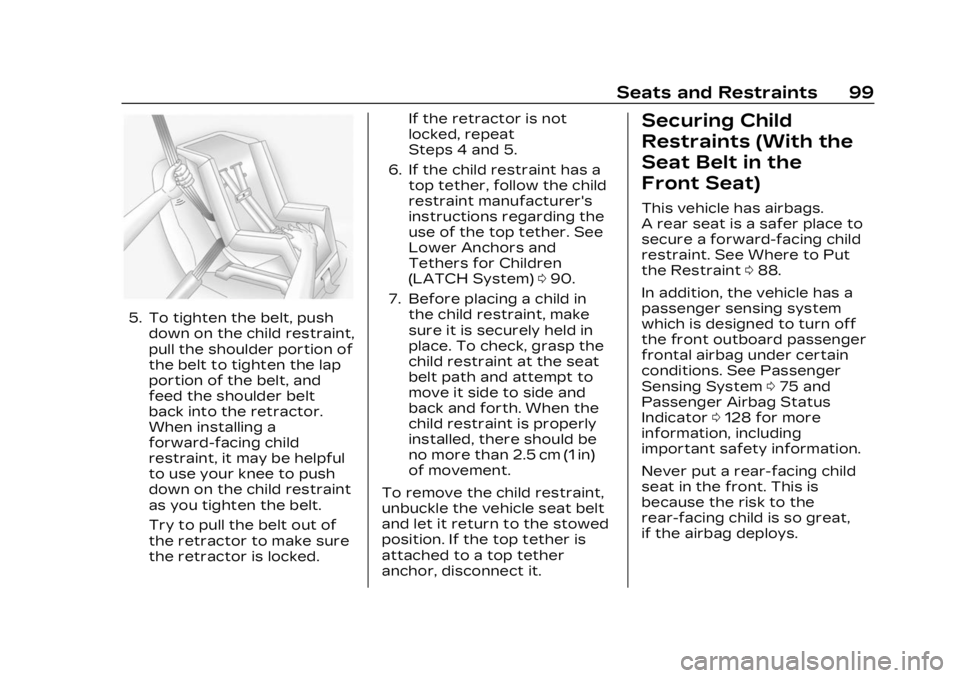
5. To tighten the belt, pushdown on the child restraint,
pull the shoulder portion of
the belt to tighten the lap
portion of the belt, and
feed the shoulder belt
back into the retractor.
When installing a
forward-facing child
restraint, it may be helpful
to use your knee to push
down on the child restraint
as you tighten the belt.
Try to pull the belt out of
the retractor to make sure
the retractor is locked. If the retractor is not
locked, repeat
Steps 4 and 5.
6. If the child restraint has a top tether, follow the child
restraint manufacturer's
instructions regarding the
use of the top tether. See
Lower Anchors and
Tethers for Children
(LATCH System) 090.
7. Before placing a child in the child restraint, make
sure it is securely held in
place. To check, grasp the
child restraint at the seat
belt path and attempt to
move it side to side and
back and forth. When the
child restraint is properly
installed, there should be
no more than 2.5 cm (1 in)
of movement.
To remove the child restraint,
unbuckle the vehicle seat belt
and let it return to the stowed
position. If the top tether is
attached to a top tether
anchor, disconnect it.
Securing Child
Restraints (With the
Seat Belt in the
Front Seat)
This vehicle has airbags.
A rear seat is a safer place to
secure a forward-facing child
restraint. See Where to Put
the Restraint 088.
In addition, the vehicle has a
passenger sensing system
which is designed to turn off
the front outboard passenger
frontal airbag under certain
conditions. See Passenger
Sensing System 075 and
Passenger Airbag Status
Indicator 0128 for more
information, including
important safety information.
Never put a rear-facing child
seat in the front. This is
because the risk to the
rear-facing child is so great,
if the airbag deploys.
Page 101 of 482

Cadillac XT5 Owner Manual (GMNA-Localizing-U.S./Canada/Mexico-
16406251) - 2023 - CRC - 3/25/22
100 Seats and Restraints
{Warning
A child in a rear-facing child
restraint can be seriously
injured or killed if the front
outboard passenger frontal
airbag inflates. This is
because the back of the
rear-facing child restraint
would be very close to the
inflating airbag. A child in a
forward-facing child
restraint can be seriously
injured or killed if the front
outboard passenger frontal
airbag inflates and the
passenger seat is in a
forward position.
Even if the passenger
sensing system has turned
off the front outboard
passenger frontal airbag, no
system is fail-safe. No one
can guarantee that an
airbag will not deploy under
some unusual circumstance,
even though it is turned off.(Continued)
Warning (Continued)
Secure rear-facing child
restraints in a rear seat,
even if the airbag is off.
If you secure a
forward-facing child
restraint in the front
outboard passenger seat,
always move the seat as far
back as it will go. It is better
to secure the child restraint
in a rear seat.
See Passenger Sensing
System075 for additional
information.
If the child restraint uses a top
tether, see Lower Anchors
and Tethers for Children
(LATCH System) 090 for top
tether anchor locations.
Do not secure a child seat in a
position without a top tether
anchor if a national or local law
requires that the top tether be
anchored, or if the instructions that come with the child
restraint say that the top
tether must be anchored.
In Canada, the law requires
that forward-facing child
restraints have a top tether,
and that the tether be
attached.
When using the lap-shoulder
belt to secure the child
restraint in this position, follow
the instructions that came
with the child restraint and the
following instructions:
1. Move the seat as far back as it will go before
securing the
forward-facing child
restraint. Move the seat
upward or the seatback to
an upright position,
if needed, to get a tight
installation of the child
restraint. There must be
finger clearance between
the push button and the
child restraint.
Page 102 of 482

Cadillac XT5 Owner Manual (GMNA-Localizing-U.S./Canada/Mexico-
16406251) - 2023 - CRC - 3/25/22
Seats and Restraints 101
When the passenger
sensing system has turned
off the front outboard
passenger frontal airbag,
the OFF indicator on the
passenger airbag status
indicator should light and
stay lit when you start the
vehicle. See Passenger
Airbag Status Indicator
0128.
2. Put the child restraint on the seat.
3. Pick up the latch plate and run the lap and shoulder
portions of the vehicle
seat belt through or
around the restraint.
Ensure the seat belt
webbing is routed as direct
as possible and is not
caught on seat handles or
plastic trim. The child
restraint instructions will
show you how.
Tilt the latch plate to
adjust the belt if needed.
4. Push the latch plate intothe buckle until it clicks. Position the release button
on the buckle, away from
the child restraint, so that
the seat belt could be
quickly unbuckled if
necessary.
5. Pull the shoulder belt all
the way out of the
retractor to set the lock.
When the retractor lock is
set, the belt can be
tightened but not pulled
out of the retractor.
Page 103 of 482
Cadillac XT5 Owner Manual (GMNA-Localizing-U.S./Canada/Mexico-
16406251) - 2023 - CRC - 3/25/22
102 Seats and Restraints
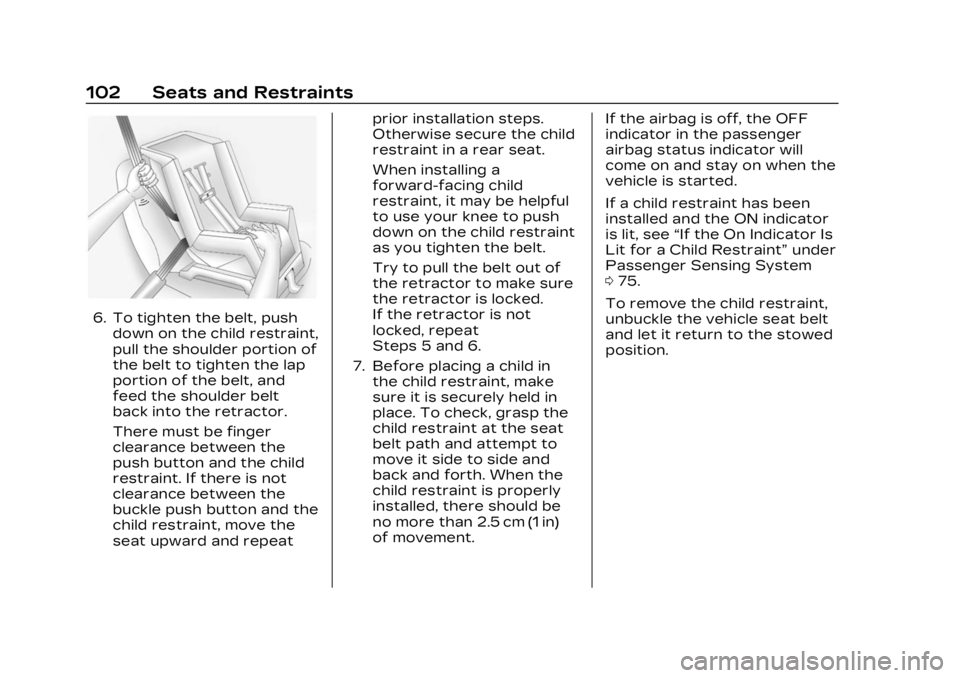
6. To tighten the belt, pushdown on the child restraint,
pull the shoulder portion of
the belt to tighten the lap
portion of the belt, and
feed the shoulder belt
back into the retractor.
There must be finger
clearance between the
push button and the child
restraint. If there is not
clearance between the
buckle push button and the
child restraint, move the
seat upward and repeat prior installation steps.
Otherwise secure the child
restraint in a rear seat.
When installing a
forward-facing child
restraint, it may be helpful
to use your knee to push
down on the child restraint
as you tighten the belt.
Try to pull the belt out of
the retractor to make sure
the retractor is locked.
If the retractor is not
locked, repeat
Steps 5 and 6.
7. Before placing a child in the child restraint, make
sure it is securely held in
place. To check, grasp the
child restraint at the seat
belt path and attempt to
move it side to side and
back and forth. When the
child restraint is properly
installed, there should be
no more than 2.5 cm (1 in)
of movement. If the airbag is off, the OFF
indicator in the passenger
airbag status indicator will
come on and stay on when the
vehicle is started.
If a child restraint has been
installed and the ON indicator
is lit, see
“If the On Indicator Is
Lit for a Child Restraint” under
Passenger Sensing System
0 75.
To remove the child restraint,
unbuckle the vehicle seat belt
and let it return to the stowed
position.
Page 236 of 482

Cadillac XT5 Owner Manual (GMNA-Localizing-U.S./Canada/Mexico-
16406251) - 2023 - CRC - 3/25/22
Driving and Operating 235
.Always follow posted speed
limits or drive more slowly
when conditions require.
.Keep vehicle tires properly
inflated.
.Combine several trips into a
single trip.
.Replace the vehicle's tires
with the same TPC Spec
number molded into the
tire's sidewall near the size.
.Follow recommended
scheduled maintenance.
Distracted Driving
Distraction comes in many
forms and can take your focus
from the task of driving.
Exercise good judgment and
do not let other activities
divert your attention away
from the road. Many local
governments have enacted
laws regarding driver
distraction. Become familiar
with the local laws in
your area.To avoid distracted driving,
keep your eyes on the road,
keep your hands on the
steering wheel, and focus your
attention on driving.
.Do not use a phone in
demanding driving situations.
Use a hands-free method to
place or receive necessary
phone calls.
.Watch the road. Do not read,
take notes, or look up
information on phones or
other electronic devices.
.Designate a front seat
passenger to handle
potential distractions.
.Become familiar with vehicle
features before driving, such
as programming favorite
radio stations and adjusting
climate control and seat
settings. Program all trip
information into any
navigation device prior to
driving.
.Wait until the vehicle is
parked to retrieve items that
have fallen to the floor.
.Stop or park the vehicle to
tend to children.
.Keep pets in an appropriate
carrier or restraint.
.Avoid stressful
conversations while driving,
whether with a passenger or
on a cell phone.
{Warning
Taking your eyes off the
road too long or too often
could cause a crash
resulting in injury or death.
Focus your attention on
driving.
Refer to the infotainment
section for more information
on using that system and the
navigation system, if equipped,
including pairing and using a
cell phone.
Defensive Driving
Defensive driving means
“always expect the
unexpected.” The first step in
Page 252 of 482

Cadillac XT5 Owner Manual (GMNA-Localizing-U.S./Canada/Mexico-
16406251) - 2023 - CRC - 3/25/22
Driving and Operating 251
Caution
Overloading the vehicle may
cause damage. Repairs
would not be covered by the
vehicle warranty. Do not
overload the vehicle.
{Warning
Things inside the vehicle
can strike and injure
people in a sudden stop
or turn, or in a crash.
.Put things in the cargo
area of the vehicle. In
the cargo area, put
them as far forward as
possible. Try to spread
the weight evenly.
.Never stack heavier
things, like suitcases,
inside the vehicle so
that some of them are
above the tops of the
seats.
(Continued)
Warning (Continued)
.Do not leave an
unsecured child
restraint in the vehicle.
.Secure loose items in
the vehicle.
.Do not leave a seat
folded down unless
needed.
Starting and
Operating
New Vehicle Break-In
Caution
The vehicle does not need
an elaborate break-in. But it
will perform better in the
long run if you follow these
guidelines:
.Do not drive at any one
constant speed, fast or
slow, for the first 800 km
(500 mi). Do not make (Continued)
Caution (Continued)
full-throttle starts. Avoid
downshifting to brake or
slow the vehicle.
.Avoid making hard stops
for the first 300 km
(200 mi) or so. During this
time the new brake linings
are not yet broken in. Hard
stops with new linings can
mean premature wear and
earlier replacement.
Follow this breaking-in
guideline every time you
get new brake linings.
.Do not tow a trailer during
break-in. See Trailer
Towing0326 for the
trailer towing capabilities
of the vehicle and more
information.
Following break-in, engine
speed and load can be
gradually increased.
On new vehicles, the various
mechanical and electrical
systems experience a
Page 290 of 482

Cadillac XT5 Owner Manual (GMNA-Localizing-U.S./Canada/Mexico-
16406251) - 2023 - CRC - 3/25/22
Driving and Operating 289
{Warning
Do not rely on the Driver
Assistance Systems. These
systems do not replace the
need for paying attention
and driving safely. You may
not hear or feel alerts or
warnings provided by these
systems. Failure to use
proper care when driving
may result in injury, death,
or vehicle damage. See
Defensive Driving0235.
Under many conditions,
these systems will not:
.Detect children,
pedestrians, bicyclists,
or animals.
.Detect vehicles or objects
outside the area
monitored by the system.
.Work at all driving speeds.
.Warn you or provide you
with enough time to avoid
a crash. (Continued)
Warning (Continued)
.Work under poor visibility
or bad weather conditions.
.Work if the detection
sensor is not cleaned or is
covered by ice, snow, mud,
or dirt.
.Work if the detection
sensor is covered up, such
as with a sticker, magnet,
or metal plate.
.Work if the detection
sensor viewing zone is
interrupted by an installed
accessory, such as a bike
rack, or hitch mounted
cargo carrier.
.Work if the area
surrounding the detection
sensor is damaged or not
properly repaired.
Complete attention is
always required while
driving, and you should be
ready to take action and (Continued)
Warning (Continued)
apply the brakes and/or
steer the vehicle to avoid
crashes.
Audible or Safety Alert Seat
Some driver assistance
features alert the driver of
obstacles by beeping. To view
available settings for this
feature, touch the Settings
icon on the infotainment home
page. Select “Vehicle”to
display the list of available
options and select “Comfort
and Convenience”.
If equipped with the Safety
Alert Seat, the driver seat
cushion may provide a
vibrating pulse alert instead of
beeping. To view available
settings for this feature, touch
the Settings icon on the
infotainment home page.
Select “Vehicle” to display the
list of available options and
select “Collision/Detection
Systems”.
Page 296 of 482

Cadillac XT5 Owner Manual (GMNA-Localizing-U.S./Canada/Mexico-
16406251) - 2023 - CRC - 3/25/22
Driving and Operating 295
Different environmental
conditions may affect whether
and how far the Park Assist
system can detect objects.
Keep the sensors clean of
mud, dirt, snow, ice, and slush;
and clean sensors after a car
wash in freezing
temperatures. Sensors that
are not clean may not detect
objects or may cause the
system to alert when not
required.
{Warning
The Park Assist System is
no substitute for careful and
attentive driving. The Park
Assist system does not
detect children, pedestrians,
bicyclists, animals, or objects
located below the bumper or
that are too close or too far
from the vehicle. It is not
available at speeds greater
than 9 km/h (6 mph). To
prevent injury, death,
or vehicle damage, even with(Continued)
Warning (Continued)
Park Assist, always check
the area around the vehicle
and check all mirrors before
moving forward or backing.
How the System Works
The vehicle may have a Park
Assist amphitheatre-like
display on the cluster with
bars that represent the
estimated location of a
detected object and the
vehicle’s distance from the
object. As a detected object
becomes closer, more bars
light up and change color from
yellow to amber to red.
When an object is first
detected in the rear, one beep
will be heard from the rear,
or the driver's seat will pulse
two times, if equipped with
Safety Alert Seat. When an
object is very close, five beeps
will sound from the front or
rear (depending on the
object's location), or the driver's seat will pulse five
times. Beeps for front are
higher pitched than the rear.
Turning the System On
and Off
The Park Assist System can
be turned on or off using the
infotainment system. To view
available settings for this
feature, touch the Settings
icon on the infotainment home
page. Select
“Vehicle”to
display the list of available
options and select “Collision/
Detection Systems”.
The
Xbutton is used to turn
on or off the Park Assist,
which also turns on or off the
Backing Warning and Reverse
Page 300 of 482

Cadillac XT5 Owner Manual (GMNA-Localizing-U.S./Canada/Mexico-
16406251) - 2023 - CRC - 3/25/22
Driving and Operating 299
System Limitations
Automatic Parking Assist has
certain limitations. The system
cannot:
.Continue to operate if the
maneuver speed exceeds
5 km/h (3 mph).
.Detect whether a parking
space is legal or restricted.
.Detect pavement markings
or lines.
.Park the vehicle closely lined
up with the vehicle next to it,
particularly if the spot is
approached at an angle or if
the parking space is angled.
.Park exactly centered in a
very large spot.
.Always detect short curbs.
.Operate while towing any
trailer.
.Function the vehicle is raised
or lowered by air
suspension,if equipped.When the System Does Not
Seem to Work Properly
If the vehicle does not reverse
into the expected parking
space, the system could be
maneuvering the vehicle into a
previously detected space.
Reverse Automatic
Braking (RAB)
Backing Warning and
Reverse Automatic
Braking (RAB)
If equipped, vehicles with
Adaptive Cruise Control (ACC)
have the Backing Warning
System and Reverse
Automatic Braking (RAB)
system. When in R (Reverse),
Backing Warning alerts of rear
objects at vehicle speeds
greater than 8 km/h (5 mph),
and RAB may automatically
brake hard at speeds between
1–32 km/h (0.5–20 mph).
The Backing Warning System
will beep once from the rear
when an object is first detected, or pulse twice on
both sides of the Safety Alert
Seat. When the system
detects a potential crash,
beeps will be heard from the
rear, or five pulses will be felt
on both sides of the Safety
Alert Seat. There may also be
a brief, sharp application of
the brakes.
{Warning
The Backing Warning
System only operates at
speeds greater than 8 km/h
(5 mph). It does not detect
children, pedestrians,
bicyclists, animals, or objects
below the bumper or that
are too close or too far from
the vehicle. In some
situations, such as at higher
backing speeds, there may
not be enough time for the
short, sharp application of
the vehicle brake system to
occur. To prevent injury,
death, or vehicle damage,
(Continued)