lock CADILLAC XTS 2013 1.G Owners Manual
[x] Cancel search | Manufacturer: CADILLAC, Model Year: 2013, Model line: XTS, Model: CADILLAC XTS 2013 1.GPages: 438, PDF Size: 7.4 MB
Page 308 of 438
Black plate (14,1)Cadillac XTS Owner Manual - 2013 - 1st - 4/13/12
10-14 Vehicle Care
{WARNING
Steam and scalding liquids from a
hot cooling system can blow out
and burn you badly. Never turn
the cap when the cooling system,
including the surge tank pressure
cap, is hot. Wait for the cooling
system and surge tank pressure
cap to cool.
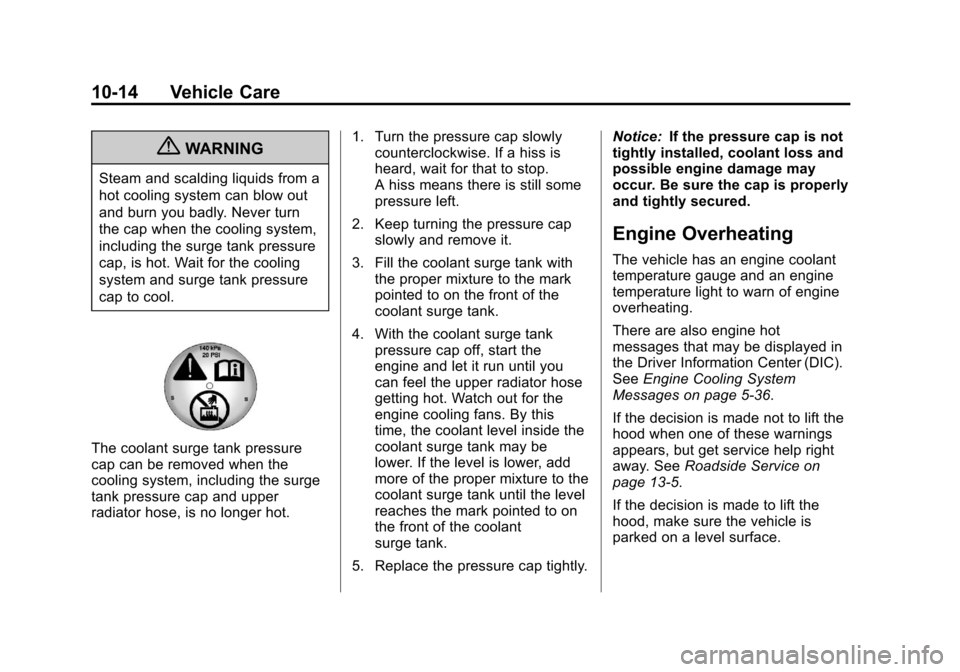
The coolant surge tank pressure
cap can be removed when the
cooling system, including the surge
tank pressure cap and upper
radiator hose, is no longer hot.1. Turn the pressure cap slowly
counterclockwise. If a hiss is
heard, wait for that to stop.
A hiss means there is still some
pressure left.
2. Keep turning the pressure cap slowly and remove it.
3. Fill the coolant surge tank with the proper mixture to the mark
pointed to on the front of the
coolant surge tank.
4. With the coolant surge tank pressure cap off, start the
engine and let it run until you
can feel the upper radiator hose
getting hot. Watch out for the
engine cooling fans. By this
time, the coolant level inside the
coolant surge tank may be
lower. If the level is lower, add
more of the proper mixture to the
coolant surge tank until the level
reaches the mark pointed to on
the front of the coolant
surge tank.
5. Replace the pressure cap tightly. Notice:
If the pressure cap is not
tightly installed, coolant loss and
possible engine damage may
occur. Be sure the cap is properly
and tightly secured.
Engine Overheating
The vehicle has an engine coolant
temperature gauge and an engine
temperature light to warn of engine
overheating.
There are also engine hot
messages that may be displayed in
the Driver Information Center (DIC).
See Engine Cooling System
Messages on page 5‑36.
If the decision is made not to lift the
hood when one of these warnings
appears, but get service help right
away. See Roadside Service on
page 13‑5.
If the decision is made to lift the
hood, make sure the vehicle is
parked on a level surface.
Page 310 of 438
Black plate (16,1)Cadillac XTS Owner Manual - 2013 - 1st - 4/13/12
10-16 Vehicle Care
If the warning continues, pull over,
stop, and park the vehicle
right away.
If there is no sign of steam, idle the
engine for three minutes while
parked. If the warning is still
displayed, turn off the engine until it
cools down. Also, see“Overheated
Engine Protection Operating Mode”
next in this section.
Overheated Engine
Protection
Operating Mode
This emergency operating mode
allows the vehicle to be driven to a
safe place in an emergency
situation. If an overheated engine
condition exists, an overheat
protection mode, which alternates
firing groups of cylinders, helps
prevent engine damage. In this
mode, there is significant loss in
power and engine performance. The engine coolant temperature
warning light comes on in the
instrument cluster, to indicate the
vehicle has entered overheated
engine protection operating mode.
The temperature gauge also
indicates an overheat condition
exists. Driving extended distances
and/or towing a trailer in the
overheat protection mode should be
avoided.
Power Steering Fluid
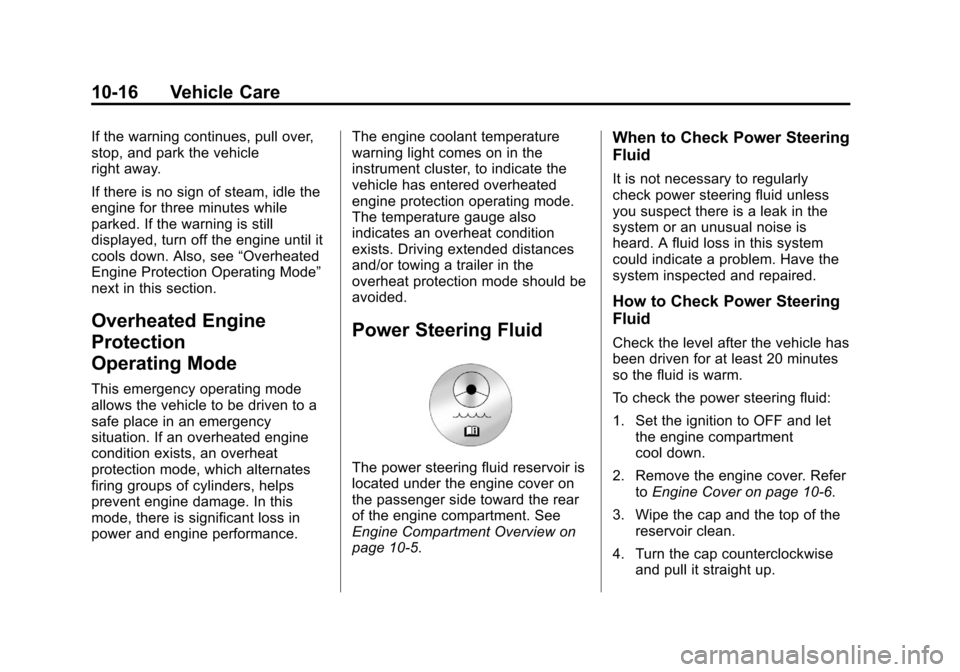
The power steering fluid reservoir is
located under the engine cover on
the passenger side toward the rear
of the engine compartment. See
Engine Compartment Overview on
page 10‑5.
When to Check Power Steering
Fluid
It is not necessary to regularly
check power steering fluid unless
you suspect there is a leak in the
system or an unusual noise is
heard. A fluid loss in this system
could indicate a problem. Have the
system inspected and repaired.
How to Check Power Steering
Fluid
Check the level after the vehicle has
been driven for at least 20 minutes
so the fluid is warm.
To check the power steering fluid:
1. Set the ignition to OFF and let
the engine compartment
cool down.
2. Remove the engine cover. Refer toEngine Cover on page 10‑6.
3. Wipe the cap and the top of the reservoir clean.
4. Turn the cap counterclockwise and pull it straight up.
Page 315 of 438
Black plate (21,1)Cadillac XTS Owner Manual - 2013 - 1st - 4/13/12
Vehicle Care 10-21
2. Firmly apply both the parkingbrake and the regular brake.
See Electric Parking Brake on
page 9‑26.
Do not use the accelerator
pedal, and be ready to turn off
the engine immediately if it
starts.
3. Try to start the engine in each gear. The vehicle should start
only in P (Park) or N (Neutral).
If the vehicle starts in any other
position, contact your dealer for
service.
Automatic Transmission
Shift Lock Control
Function Check
{WARNING
When you are doing this
inspection, the vehicle could
move suddenly. If the vehicle
moves, you or others could be
injured. 1. Before starting this check, be
sure there is enough room
around the vehicle. It should be
parked on a level surface.
2. Firmly apply the parking brake. See Electric Parking Brake on
page 9‑26.
Be ready to apply the regular
brake immediately if the vehicle
begins to move.
3. With the engine off, turn the ignition on, but do not start the
engine. Without applying the
regular brake, try to move the
shift lever out of P (Park) with
normal effort. If the shift lever
moves out of P (Park), contact
your dealer for service.
Park Brake and P (Park)
Mechanism Check
{WARNING
When you are doing this check,
the vehicle could begin to move.
You or others could be injured
and property could be damaged.
Make sure there is room in front
of the vehicle in case it begins to
roll. Be ready to apply the regular
brake at once should the vehicle
begin to move.
Park on a fairly steep hill, with the
vehicle facing downhill. Keeping
your foot on the regular brake, set
the parking brake.
.To check the parking brake's
holding ability: With the engine
running and the transmission in
N (Neutral), slowly remove foot
pressure from the regular brake
pedal. Do this until the vehicle is
held by the parking brake only.
Page 318 of 438
Black plate (24,1)Cadillac XTS Owner Manual - 2013 - 1st - 4/13/12
10-24 Vehicle Care
2. Remove the bulb socket (1) byturning counterclockwise and
pulling straight out of the lamp
assembly (2).
3. Pull the bulb out of the socket.
4. Install the new bulb in the bulb socket.
5. Install the bulb socket by turning clockwise.License Plate Lamp
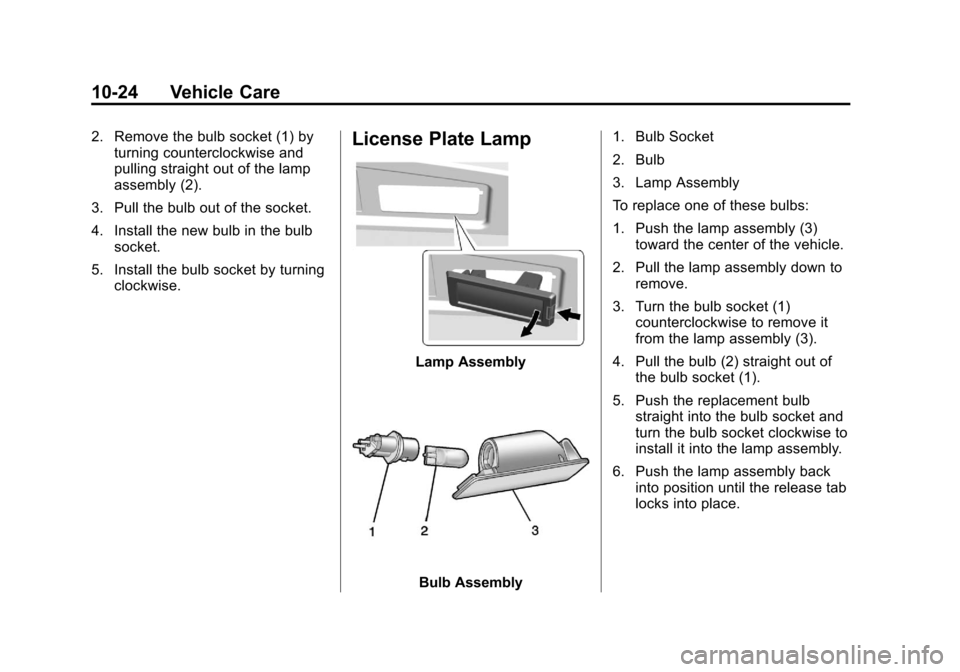
Lamp Assembly
Bulb Assembly 1. Bulb Socket
2. Bulb
3. Lamp Assembly
To replace one of these bulbs:
1. Push the lamp assembly (3)
toward the center of the vehicle.
2. Pull the lamp assembly down to remove.
3. Turn the bulb socket (1) counterclockwise to remove it
from the lamp assembly (3).
4. Pull the bulb (2) straight out of the bulb socket (1).
5. Push the replacement bulb straight into the bulb socket and
turn the bulb socket clockwise to
install it into the lamp assembly.
6. Push the lamp assembly back into position until the release tab
locks into place.
Page 320 of 438
Black plate (26,1)Cadillac XTS Owner Manual - 2013 - 1st - 4/13/12
10-26 Vehicle Care
Fuses and Circuit
Breakers
The wiring circuits in the vehicle are
protected from short circuits by a
combination of fuses and circuit
breakers. This greatly reduces the
chance of damage caused by
electrical problems.
To check a fuse, look at the
silver-colored band inside the fuse.
If the band is broken or melted,
replace the fuse. Be sure to replace
a bad fuse with a new one of the
identical size and rating.Fuses of the same amperage can
be temporarily borrowed from
another fuse location, if a fuse goes
out. Replace the fuse as soon as
possible.
To identify and check fuses, circuit
breakers, and relays, see
Engine
Compartment Fuse Block on
page 10‑26, Instrument Panel Fuse
Block on page 10‑30, and Rear
Compartment Fuse Block on
page 10‑32.
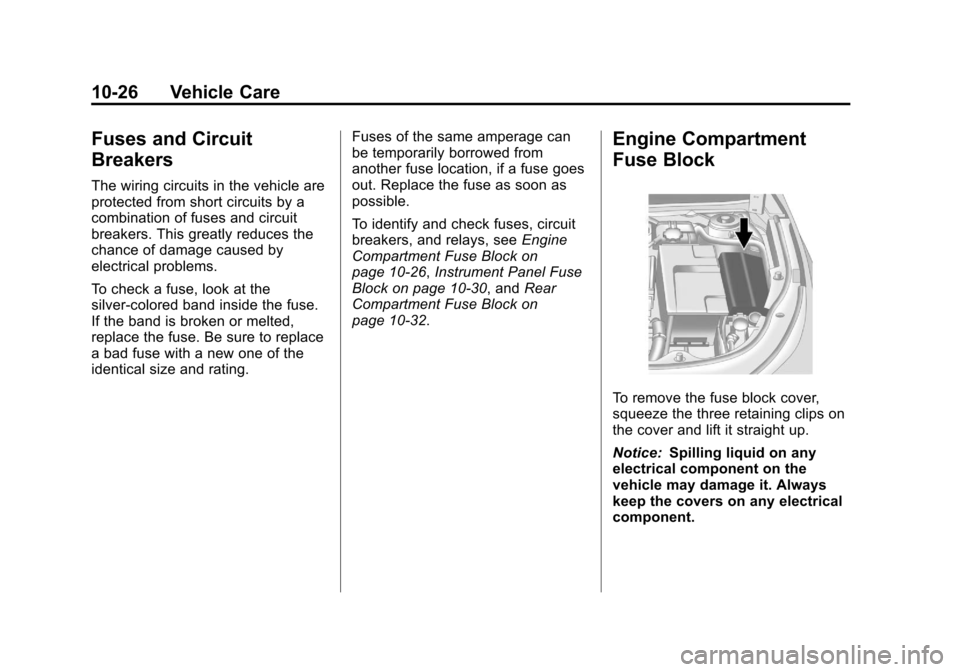
Engine Compartment
Fuse Block
To remove the fuse block cover,
squeeze the three retaining clips on
the cover and lift it straight up.
Notice: Spilling liquid on any
electrical component on the
vehicle may damage it. Always
keep the covers on any electrical
component.
Page 321 of 438

Black plate (27,1)Cadillac XTS Owner Manual - 2013 - 1st - 4/13/12
Vehicle Care 10-27
The vehicle may not be equipped
with all of the fuses, relays, and
features shown.J-CaseFuses Usage
6 Wiper
12 Starter J-Case
Fuses Usage
21 Rear Power
Windows
22 Sunroof
24 Front Power
Windows J-Case
Fuses Usage
25 Retained Accessory
Power
26 Antilock Brake
System Pump
27 Electric Parking
Brake
28 Rear Window
Defogger
41 Brake Vacuum
Assist Pump
42 Cooling Fan K2
44 Headlamp Washer
45 Cooling Fan K1
Mini Fuses Usage
1 Transmission
Control Module
—
Battery
2 Engine Control
Module Battery
Page 322 of 438
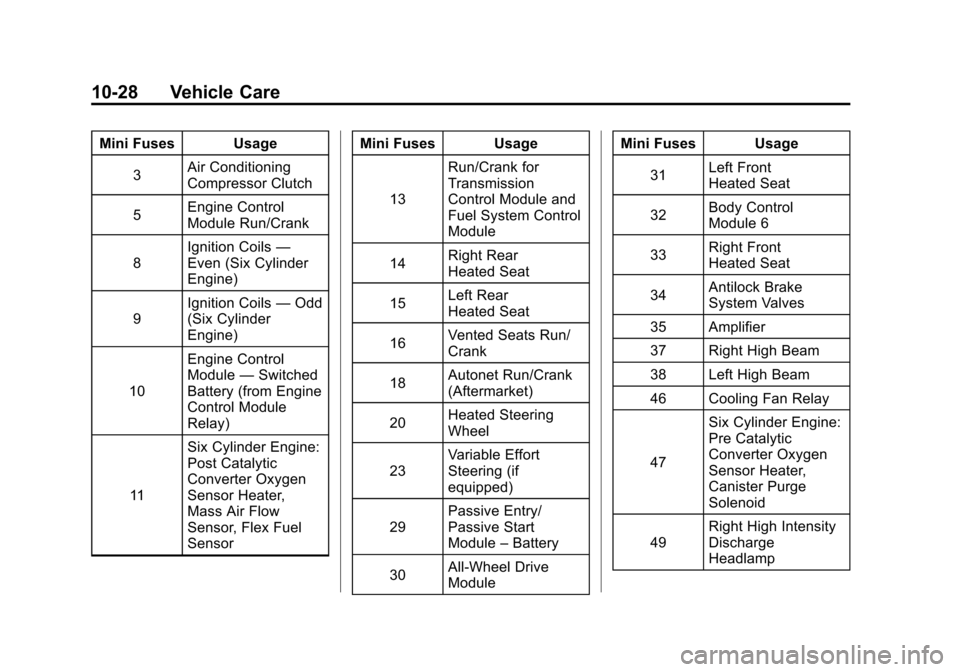
Black plate (28,1)Cadillac XTS Owner Manual - 2013 - 1st - 4/13/12
10-28 Vehicle Care
Mini Fuses Usage3 Air Conditioning
Compressor Clutch
5 Engine Control
Module Run/Crank
8 Ignition Coils
—
Even (Six Cylinder
Engine)
9 Ignition Coils
—Odd
(Six Cylinder
Engine)
10 Engine Control
Module
—Switched
Battery (from Engine
Control Module
Relay)
11 Six Cylinder Engine:
Post Catalytic
Converter Oxygen
Sensor Heater,
Mass Air Flow
Sensor, Flex Fuel
Sensor Mini Fuses Usage
13 Run/Crank for
Transmission
Control Module and
Fuel System Control
Module
14 Right Rear
Heated Seat
15 Left Rear
Heated Seat
16 Vented Seats Run/
Crank
18 Autonet Run/Crank
(Aftermarket)
20 Heated Steering
Wheel
23 Variable Effort
Steering (if
equipped)
29 Passive Entry/
Passive Start
Module
–Battery
30 All-Wheel Drive
Module Mini Fuses Usage
31 Left Front
Heated Seat
32 Body Control
Module 6
33 Right Front
Heated Seat
34 Antilock Brake
System Valves
35 Amplifier
37 Right High Beam
38 Left High Beam
46 Cooling Fan Relay
47 Six Cylinder Engine:
Pre Catalytic
Converter Oxygen
Sensor Heater,
Canister Purge
Solenoid
49 Right High Intensity
Discharge
Headlamp
Page 323 of 438
Black plate (29,1)Cadillac XTS Owner Manual - 2013 - 1st - 4/13/12
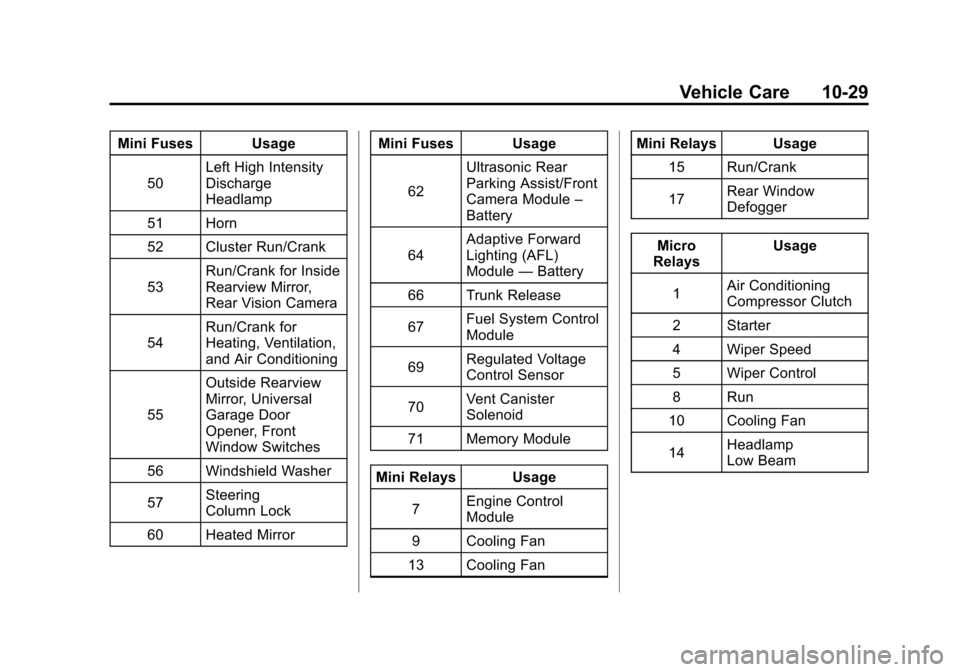
Vehicle Care 10-29
Mini Fuses Usage50 Left High Intensity
Discharge
Headlamp
51 Horn
52 Cluster Run/Crank
53 Run/Crank for Inside
Rearview Mirror,
Rear Vision Camera
54 Run/Crank for
Heating, Ventilation,
and Air Conditioning
55 Outside Rearview
Mirror, Universal
Garage Door
Opener, Front
Window Switches
56 Windshield Washer
57 Steering
Column Lock
60 Heated Mirror Mini Fuses Usage
62 Ultrasonic Rear
Parking Assist/Front
Camera Module
–
Battery
64 Adaptive Forward
Lighting (AFL)
Module
—Battery
66 Trunk Release
67 Fuel System Control
Module
69 Regulated Voltage
Control Sensor
70 Vent Canister
Solenoid
71 Memory Module
Mini Relays Usage 7 Engine Control
Module
9 Cooling Fan
13 Cooling Fan Mini Relays Usage
15 Run/Crank
17 Rear Window
Defogger
Micro
Relays Usage
1 Air Conditioning
Compressor Clutch
2 Starter
4 Wiper Speed
5 Wiper Control
8 Run
10 Cooling Fan
14 Headlamp
Low Beam
Page 324 of 438

Black plate (30,1)Cadillac XTS Owner Manual - 2013 - 1st - 4/13/12
10-30 Vehicle Care
Instrument Panel Fuse
Block
The instrument panel fuse block is
located in the instrument panel, on
the driver side of the vehicle. To
access the fuses, open the fuse
panel door by pulling down at
the top.
Press in on the sides of the door to
release it from the instrument panel.
Pull the door toward you to release
it from the hinge.
The vehicle may not be equipped
with all of the fuses, relays, and
features shown.Fuses Usage
1 OnStar
2 Body Control
Module 7
3 Body Control
Module 5
4 Radio Fuses
Usage
5 Infotainment and
Center Stack
Displays, Head-up
Display, Instrument
Cluster, Rear Seat
Entertainment
6 Power Outlet 1
7 Power Outlet 2
8 Body Control
Module 1
9 Body Control
Module 4
10 Body Control
Module 8
(J-Case Fuse)
11 Front Heater
Ventilation Air
Conditioning/Blower
(J-Case Fuse)
12 Passenger Seat
(Circuit Breaker)
13 Driver Seat (Circuit
Breaker)
Page 325 of 438
Black plate (31,1)Cadillac XTS Owner Manual - 2013 - 1st - 4/13/12
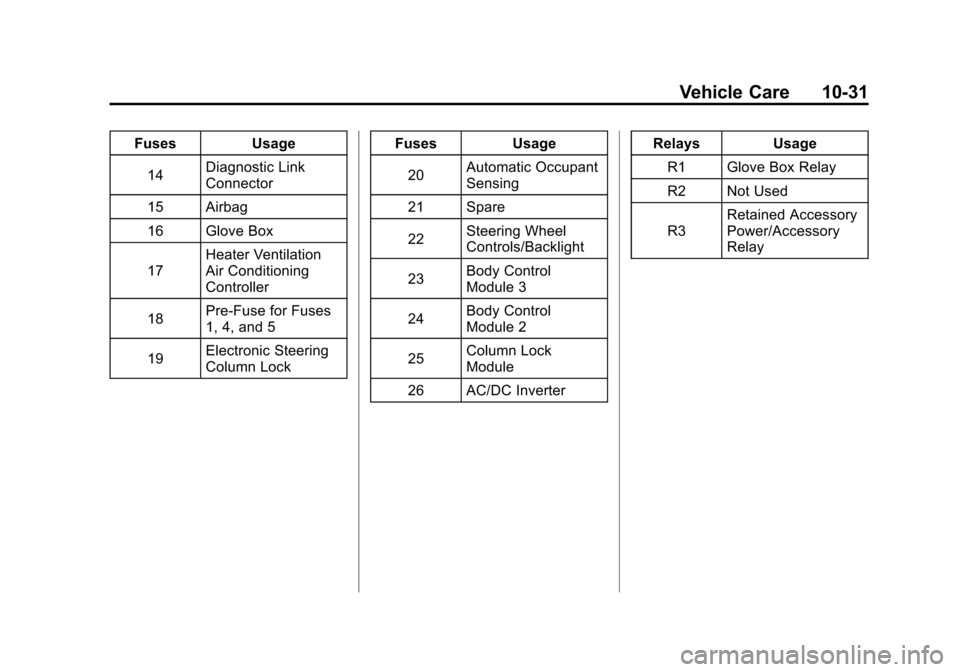
Vehicle Care 10-31
FusesUsage
14 Diagnostic Link
Connector
15 Airbag
16 Glove Box
17 Heater Ventilation
Air Conditioning
Controller
18 Pre-Fuse for Fuses
1, 4, and 5
19 Electronic Steering
Column Lock Fuses
Usage
20 Automatic Occupant
Sensing
21 Spare
22 Steering Wheel
Controls/Backlight
23 Body Control
Module 3
24 Body Control
Module 2
25 Column Lock
Module
26 AC/DC Inverter Relays
Usage
R1 Glove Box Relay
R2 Not Used
R3 Retained Accessory
Power/Accessory
Relay