roof CADILLAC XTS 2016 1.G User Guide
[x] Cancel search | Manufacturer: CADILLAC, Model Year: 2016, Model line: XTS, Model: CADILLAC XTS 2016 1.GPages: 320, PDF Size: 2.07 MB
Page 73 of 320
Cadillac XTS Owner Manual (GMNA-Localizing-MidEast-9369806) - 2016 -
crc - 6/24/15
72 Seats and Restraints
predict how severe a crash is likely
to be in time for the airbags to
inflate and help restrain the
occupants. The vehicle has
electronic sensors that help the
airbag system determine the
severity of the impact. Deployment
thresholds can vary with specific
vehicle design.
Frontal airbags are designed to
inflate in moderate to severe frontal
or near frontal crashes to help
reduce the potential for severe
injuries, mainly to the driver's or
front outboard passenger's head
and chest.
Whether the frontal airbags will or
should inflate is not based primarily
on how fast the vehicle is traveling.
It depends on what is hit, the
direction of the impact, and how
quickly the vehicle slows down.
Frontal airbags may inflate at
different crash speeds depending on
whether the vehicle hits an object
straight on or at an angle, and
whether the object is fixed or
moving, rigid or deformable, narrow
or wide.Frontal airbags are not intended to
inflate during vehicle rollovers, in
rear impacts, or in many side
impacts.
In addition, the vehicle has
advanced technology frontal
airbags. Advanced technology
frontal airbags adjust the restraint
according to crash severity.
Knee airbags are designed to inflate
in moderate to severe frontal or
near frontal impacts. Knee airbags
are not designed to inflate during
vehicle rollovers, in rear impacts,
or in many side impacts.
Seat-mounted side impact airbags
are designed to inflate in moderate
to severe side crashes depending
on the location of the impact.
Seat-mounted side impact airbags
are not designed to inflate in frontal
impacts, near frontal impacts,
rollovers, or rear impacts.
A seat-mounted side impact airbag
is designed to inflate on the side of
the vehicle that is struck.
Roof-rail airbags are designed to
inflate in moderate to severe side
crashes depending on the locationof the impact. In addition, the
roof-rail airbags are designed to
inflate during a rollover or in a
severe frontal impact. Roof-rail
airbags are not designed to inflate in
rear impacts. Both roof-rail airbags
will inflate when either side of the
vehicle is struck, if the sensing
system predicts that the vehicle is
about to roll over on its side, or in a
severe frontal impact.
In any particular crash, no one can
say whether an airbag should have
inflated simply because of the
vehicle damage or repair costs.
What Makes an Airbag
Inflate?
In a deployment event, the sensing
system sends an electrical signal
triggering a release of gas from the
inflator. Gas from the inflator fills the
airbag causing the bag to break out
of the cover. The inflator, the airbag,
and related hardware are all part of
the airbag module.
For airbag locations, see
Where Are
the Airbags? 070.
Page 74 of 320
Cadillac XTS Owner Manual (GMNA-Localizing-MidEast-9369806) - 2016 -
crc - 6/24/15
Seats and Restraints 73
How Does an Airbag
Restrain?
In moderate to severe frontal or
near frontal collisions, even belted
occupants can contact the steering
wheel or the instrument panel. In
moderate to severe side collisions,
even belted occupants can contact
the inside of the vehicle.
Airbags supplement the protection
provided by safety belts by
distributing the force of the impact
more evenly over the
occupant's body.
Rollover capable roof-rail airbags
are designed to help contain the
head and chest of occupants in the
outboard seating positions in the
first and second rows. The rollover
capable roof-rail airbags are
designed to help reduce the risk of
full or partial ejection in rollover
events, although no system can
prevent all such ejections.But airbags would not help in many
types of collisions, primarily
because the occupant's motion is
not toward those airbags. See
When
Should an Airbag Inflate? 071.
Airbags should never be regarded
as anything more than a supplement
to safety belts.
What Will You See after
an Airbag Inflates?
After the frontal airbags and
seat-mounted side impact airbags
inflate, they quickly deflate, so
quickly that some people may not
even realize an airbag inflated.
Roof-rail airbags may still be at least
partially inflated for some time after
they inflate. Some components of
the airbag module may be hot for
several minutes. For location of the
airbags, see Where Are the
Airbags? 070.
The parts of the airbag that come
into contact with you may be warm,
but not too hot to touch. There may
be some smoke and dust coming
from the vents in the deflated
airbags. Airbag inflation does not prevent the driver from seeing out of
the windshield or being able to steer
the vehicle, nor does it prevent
people from leaving the vehicle.
{Warning
When an airbag inflates, there
may be dust in the air. This dust
could cause breathing problems
for people with a history of
asthma or other breathing trouble.
To avoid this, everyone in the
vehicle should get out as soon as
it is safe to do so. If you have
breathing problems but cannot
get out of the vehicle after an
airbag inflates, then get fresh air
by opening a window or a door.
If you experience breathing
problems following an airbag
deployment, you should seek
medical attention.
The vehicle has a feature that may
automatically unlock the doors, turn
on the interior lamps and hazard
warning flashers, and shut off the
fuel system after the airbags inflate.
Page 80 of 320
Cadillac XTS Owner Manual (GMNA-Localizing-MidEast-9369806) - 2016 -
crc - 6/24/15
Seats and Restraints 79
Your dealer and the service manual
have information about the location
of the airbag sensors, sensing and
diagnostic module, and airbag
wiring.
In addition, the vehicle has a
passenger sensing system for the
front outboard passenger position,
which includes sensors that are part
of the passenger seat. The
passenger sensing system may not
operate properly if the original seat
trim is replaced with non-GM
covers, upholstery, or trim; or with
GM covers, upholstery, or trim
designed for a different vehicle. Any
object, such as an aftermarket seat
heater or a comfort-enhancing pad
or device, installed under or on top
of the seat fabric, could also
interfere with the operation of the
passenger sensing system. This
could either prevent proper
deployment of the passenger
airbag(s) or prevent the passenger
sensing system from properly
turning off the passenger airbag(s).
SeePassenger Sensing System
0 74. The vehicle has rollover roof-rail
airbags, see
Different Size Tires
and Wheels 0272 for additional
important information.
If your vehicle needs to be modified
because you have a disability and
you have questions about whether
the modifications will affect the
vehicle's airbag system, or if you
have questions about whether the
airbag system will be affected if the
vehicle is modified for any other
reason, see your dealer.
Airbag System Check
The airbag system does not need
regularly scheduled maintenance or
replacement. Make sure the airbag
readiness light is working. See
Airbag Readiness Light 0118.
Caution
If an airbag covering is damaged,
opened, or broken, the airbag
may not work properly. Do not
open or break the airbag
coverings. If there are any
(Continued)
Caution (Continued)
opened or broken airbag
coverings, have the airbag
covering and/or airbag module
replaced. For the location of the
airbags, seeWhere Are the
Airbags? 070. See your dealer
for service.
Replacing Airbag System
Parts after a Crash
{Warning
A crash can damage the airbag
systems in the vehicle.
A damaged airbag system may
not work properly and may not
protect you and your
passenger(s) in a crash, resulting
in serious injury or even death. To
help make sure the airbag
systems are working properly
after a crash, have them
(Continued)
Page 185 of 320
Cadillac XTS Owner Manual (GMNA-Localizing-MidEast-9369806) - 2016 -
crc - 6/24/15
184 Driving and Operating
Retained Accessory
Power (RAP)
These vehicle accessories can be
used for up to 10 minutes after the
engine is turned off:
.Infotainment System
. Power Windows
. Sunroof (If Equipped)
. Accessory Power Outlets
Power to the infotainment system
will continue to operate for up to
10 minutes or until the driver door is
opened.
Power to the power windows and
sunroof will continue to operate for
up to 10 minutes or until any door is
opened.
All of these features will work when
the ignition is in ON/RUN or ACC/
ACCESSORY.
Shifting Into Park
1. Hold the brake pedal down and apply the parking brake. See
Electric Parking Brake 0190. 2. Move the shift lever into
P (Park) by pushing the lever
all the way toward the front of
the vehicle.
3. Turn the ignition off.
Leaving the Vehicle with the
Engine Running
{Warning
It can be dangerous to leave the
vehicle with the engine running.
It could overheat and catch fire.
It is dangerous to get out of the
vehicle if the shift lever is not fully
in P (Park) with the parking brake
firmly set. The vehicle can roll.
Do not leave the vehicle when the
engine is running. If you have left
the engine running, the vehicle
can move suddenly. You or others
could be injured. To be sure the
vehicle will not move, even when
you are on fairly level ground,
always set the parking brake and
move the shift lever to P (Park). (Continued)
Warning (Continued)
SeeShifting Into Park 0184.
If you are towing a trailer, see
Driving Characteristics and
Towing Tips 0221.
If you have to leave the vehicle with
the engine running, be sure the
vehicle is in P (Park) and the
parking brake is firmly set before
you leave it. After you have moved
the shift lever into P (Park), hold
down the regular brake pedal. See if
you can move the shift lever away
from P (Park) without first pulling it
toward you. If you can, it means that
the shift lever was not fully locked
into P (Park).
Torque Lock
Torque lock is when the weight of
the vehicle puts too much force on
the parking pawl in the
transmission. This happens when
parking on a hill and shifting the
transmission into P (Park) is not
done properly and then it is difficult
to shift out of P (Park). To prevent
Page 256 of 320
Cadillac XTS Owner Manual (GMNA-Localizing-MidEast-9369806) - 2016 -
crc - 6/24/15
Vehicle Care 255
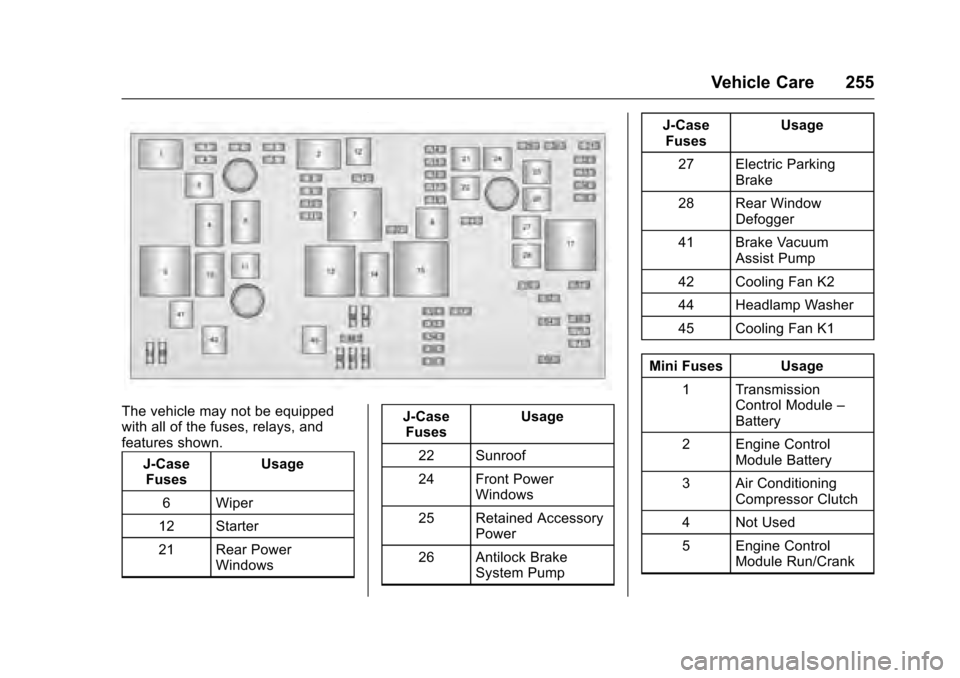
The vehicle may not be equipped
with all of the fuses, relays, and
features shown.J-CaseFuses Usage
6 Wiper
12 Starter
21 Rear Power Windows J-Case
Fuses Usage
22 Sunroof
24 Front Power Windows
25 Retained Accessory Power
26 Antilock Brake System Pump J-Case
Fuses Usage
27 Electric Parking Brake
28 Rear Window Defogger
41 Brake Vacuum Assist Pump
42 Cooling Fan K2
44 Headlamp Washer
45 Cooling Fan K1
Mini Fuses Usage 1 Transmission Control Module –
Battery
2 Engine Control Module Battery
3 Air Conditioning Compressor Clutch
4 Not Used
5 Engine Control Module Run/Crank
Page 299 of 320
Cadillac XTS Owner Manual (GMNA-Localizing-MidEast-9369806) - 2016 -
crc - 6/24/15
298 Service and Maintenance
.Tire wear inspection. See Tire
Inspection 0268.
. Rotate tires if necessary. See
Tire Rotation 0269.
. Fluids visual leak check (or
every 12 months, whichever
occurs first). A leak in any
system must be repaired and the
fluid level checked.
. Engine air cleaner filter
inspection. See Engine Air
Cleaner/Filter 0237.
. Brake system inspection (or
every 12 months, whichever
occurs first). See Exterior Care
0 287.
. Steering and suspension
inspection. Visual inspection for
damaged, loose, or missing
parts or signs of wear.
. Body hinges and latches, key
lock cylinders, folding seat
hardware, and sunroof (if
equipped) lubrication. See
Recommended Fluids and
Lubricants 0301. More frequent
lubrication may be required
when the vehicle is exposed to a corrosive environment. Applying
silicone grease on weatherstrips
with a clean cloth makes them
last longer, seal better, and not
stick or squeak.
. Restraint system component
check. See Safety System
Check 067.
. Fuel system inspection for
damage or leaks.
. Exhaust system and nearby heat
shields inspection for loose or
damaged components.
Additional Required Services
Every Service
.Rotate tires. Tires should be
rotated every service. See Tire
Rotation 0269.
At Each Fuel Stop
. Engine oil level check. See
Engine Oil 0234.
. Engine coolant level check. See
Engine Coolant 0240.
. Windshield washer fluid level
check. See Washer Fluid 0245. Once a Month
.
Tire inflation check. See Tire
Pressure 0263.
. Tire wear inspection. See Tire
Inspection 0268.
. Sunroof track and seal
inspection, if equipped. See
Sunroof 047.
Once a Year
. See Starter Switch Check 0249.
. See Automatic Transmission
Shift Lock Control Function
Check 0249.
. See Park Brake and P (Park)
Mechanism Check 0249.
. Accelerator pedal check for
damage, high effort, or binding.
Replace if needed.
. Underbody flushing service.
. Hood/Decklid/Liftgate/Liftglass
Support Gas Strut Service:
Visually inspect gas strut,
if equipped, for signs of wear,
cracks, or other damage. Check
Page 318 of 320

Cadillac XTS Owner Manual (GMNA-Localizing-MidEast-9369806) - 2016 -
crc - 6/24/15
Index 317
Recreational Vehicle Towing . . . . 284
Remote Keyless Entry (RKE)System . . . . . . . . . . . . . . . . . . . . . . . . . 27
Remote Vehicle Start . . . . . . . . . . . . 31
Replacement Bulbs . . . . . . . . . . . . . 253
Replacement Parts Airbags . . . . . . . . . . . . . . . . . . . . . . . . . 79
Maintenance . . . . . . . . . . . . . . . . . . 302
Replacing Airbag System . . . . . . . . 79
Replacing LATCH System Parts after a Crash . . . . . . . . . . . . . 92
Replacing Safety Belt System Parts after a Crash . . . . . . . . . . . . . 68
Restraints Where to Put . . . . . . . . . . . . . . . . . . . 85
Retained Accessory
Power (RAP) . . . . . . . . . . . . . . . . . . 184
Reverse Tilt Mirrors . . . . . . . . . . . . . . 42
Ride Control Systems Limited Slip Rear Axle . . . . . . . . 194
Magnetic . . . . . . . . . . . . . . . . . . . . . 194
Messages . . . . . . . . . . . . . . . . . . . . 141
Roads Driving, Wet . . . . . . . . . . . . . . . . . . 174
Roof
Sunroof . . . . . . . . . . . . . . . . . . . . . . . . . 47
Rotation, Tires . . . . . . . . . . . . . . . . . . 269
Routing, Engine Drive Belt . . . . . . 307 Running the Vehicle While
Parked . . . . . . . . . . . . . . . . . . . . . . . . 186
S
Safety Belts . . . . . . . . . . . . . . . . . . . . . 62
Care . . . . . . . . . . . . . . . . . . . . . . . . . . . . 67
How to Wear Safety BeltsProperly . . . . . . . . . . . . . . . . . . . . . . . 63
Lap-Shoulder Belt . . . . . . . . . . . . . . 64
Reminders . . . . . . . . . . . . . . . . . . . . .117
Replacing after a Crash . . . . . . . . 68
Use During Pregnancy . . . . . . . . . . 67
Safety Locks . . . . . . . . . . . . . . . . . . . . . 36
Safety System Check . . . . . . . . . . . . 67
Seats Head Restraints . . . . . . . . . . . . . . . . 50
Heated and Ventilated Front . . . . 57
Heated, Rear . . . . . . . . . . . . . . . . . . . 61
Lumbar Adjustment, Front . . . . . . 53
Memory . . . . . . . . . . . . . . . . . . . . . . . . . 56
Power Adjustment, Front . . . . . . . 52
Rear . . . . . . . . . . . . . . . . . . . . . . . . . . . . 59
Reclining Seatbacks . . . . . . . . . . . . 55
Securing Child Restraints . . . . 93, 95
Security Light . . . . . . . . . . . . . . . . . . . . . . . . . . 126
Messages . . . . . . . . . . . . . . . . . . . . 142
Vehicle . . . . . . . . . . . . . . . . . . . . . . . . . 39
Vehicle Alarm . . . . . . . . . . . . . . . . . . . 39 Service . . . . . . . . . . . . . . . . . . . . . . . . . 168
Accessories and
Modifications . . . . . . . . . . . . . . . . 228
Doing Your Own Work . . . . . . . . 229
Engine Soon Light . . . . . . . . . . . . .119
Maintenance Records . . . . . . . . 303
Maintenance, General Information . . . . . . . . . . . . . . . . . . 296
Parts Identification Label . . . . . 304
Vehicle Messages . . . . . . . . . . . . 142
Service Electric Parking
Brake Light . . . . . . . . . . . . . . . . . . . . 122
Servicing the Airbag . . . . . . . . . . . . . 78
Shift Lock Control Function Check, Automatic
Transmission . . . . . . . . . . . . . . . . . . 249
Shifting Into Park . . . . . . . . . . . . . . . . . . . . . . 184
Out of Park . . . . . . . . . . . . . . . . . . . 185
Side Blind Zone Alert (SBZA) . . . 215
Signals, Turn and Lane-Change . . . . . . . . . . . . . . . . . 156
Spare Tire Compact . . . . . . . . . . . . . . . . . . . . . . 280
Specifications and
Capacities . . . . . . . . . . . . . . . . . . . . . 305
Speedometer . . . . . . . . . . . . . . . . . . . 114
Page 319 of 320

Cadillac XTS Owner Manual (GMNA-Localizing-MidEast-9369806) - 2016 -
crc - 6/24/15
318 Index
StabiliTrakOFF Light . . . . . . . . . . . . . . . . . . . . . 124
Start Assist, Hills . . . . . . . . . . . . . . . 192
Start Vehicle, Remote . . . . . . . . . . . 31
Starter Switch Check . . . . . . . . . . . 249
Starting the Engine . . . . . . . . . . . . . 182
Starting the Vehicle Messages . . . . . . . . . . . . . . . . . . . . . 143
Steering . . . . . . . . . . . . . . . . . . . . . . . . 172 Fluid, Power . . . . . . . . . . . . . . . . . . 244
Heated Wheel . . . . . . . . . . . . . . . . 103
Wheel Adjustment . . . . . . . . . . . . 103
Wheel Controls . . . . . . . . . . . . . . . 103
Storage Areas Armrest . . . . . . . . . . . . . . . . . . . . . . . . . 99
Cargo ManagementSystem . . . . . . . . . . . . . . . . . . . . . . 101
Center Console . . . . . . . . . . . . . . . . . 99
Convenience Net . . . . . . . . . . . . . 101
Glove Box . . . . . . . . . . . . . . . . . . . . . . 99
Instrument Panel . . . . . . . . . . . . . . . 98
Storage Compartments . . . . . . . . . . 98
Stuck Vehicle . . . . . . . . . . . . . . . . . . . 176
Summer Tires . . . . . . . . . . . . . . . . . . 262
Sun Visors . . . . . . . . . . . . . . . . . . . . . . . 45
Sunroof . . . . . . . . . . . . . . . . . . . . . . . . . . 47
Sunshade Rear Window . . . . . . . . . . . . . . . . . . . 46 Symbols . . . . . . . . . . . . . . . . . . . . . . . . . . 2
System
Forward CollisionAlert (FCA) . . . . . . . . . . . . . . . . . . .211
Infotainment . . . . . . . . . . . . . 160, 309
Systems Driver Assistance . . . . . . . . . . . . . 205
T
Tachometer . . . . . . . . . . . . . . . . . . . . . 115
Theft-Deterrent Systems . . . . . . . . . 40
Thigh Support Adjustment . . . . . . . 54
Time . . . . . . . . . . . . . . . . . . . . . . . . . . . . 106
Tires . . . . . . . . . . . . . . . . . . . . . . . . . . . . 261
All-Season . . . . . . . . . . . . . . . . . . . . 262
Buying New Tires . . . . . . . . . . . . . 271
Chains . . . . . . . . . . . . . . . . . . . . . . . . 273
Changing . . . . . . . . . . . . . . . . . . . . . 275
Compact Spare . . . . . . . . . . . . . . . 280
Different Size . . . . . . . . . . . . . . . . . 272
If a Tire Goes Flat . . . . . . . . . . . . 274
Inspection . . . . . . . . . . . . . . . . . . . . 268
Messages . . . . . . . . . . . . . . . . . . . . 143
Pressure . . . . . . . . . . . . . . . . . . . . . . 264
Pressure Light . . . . . . . . . . . . . . . . 125
Pressure Monitor Operation . . 266
Pressure Monitor System . . . . . 265
Rotation . . . . . . . . . . . . . . . . . . . . . . 269 Tires (cont'd)
Wheel Alignment and Tire
Balance . . . . . . . . . . . . . . . . . . . . . 272
Wheel Replacement . . . . . . . . . . 273
When It Is Time for New
Tires . . . . . . . . . . . . . . . . . . . . . . . . 270
Winter . . . . . . . . . . . . . . . . . . . . . . . . 262
Towing Driving Characteristics . . . . . . . . 221
Equipment . . . . . . . . . . . . . . . . . . . . 225
General Information . . . . . . . . . . 221
Recreational Vehicle . . . . . . . . . . 284
Trailer . . . . . . . . . . . . . . . . . . . . . . . . 224
Vehicle . . . . . . . . . . . . . . . . . . . . . . . 284
Traction Control System (TCS)/StabiliTrak
®Light . . . . . . . . . . . . 124
Limited-Slip Rear Axle . . . . . . . . 194
Off Light . . . . . . . . . . . . . . . . . . . . . . 123
Traction Control/Electronic Stability Control . . . . . . . . . . . . . . . 192
Trailer Towing . . . . . . . . . . . . . . . . . . . . . . . . 224
Transmission Automatic . . . . . . . . . . . . . . . . . . . . . 187
Fluid, Automatic . . . . . . . . . . . . . . 237
Messages . . . . . . . . . . . . . . . . . . . . 143
Trip Odometer . . . . . . . . . . . . . . . . . . 115