instrument panel CADILLAC XTS 2019 Owner's Guide
[x] Cancel search | Manufacturer: CADILLAC, Model Year: 2019, Model line: XTS, Model: CADILLAC XTS 2019Pages: 376, PDF Size: 6.71 MB
Page 168 of 376
Cadillac XTS Owner Manual (GMNA-Localizing-U.S./Canada-12032610) -
2019 - crc - 8/22/18
CLIMATE CONTROLS 167
Caution (Continued)
stations clearly. The repairs would
not be covered by the vehicle
warranty.
Driver and Passenger Heated and
Ventilated Seats : If equipped, press
Jorzto heat the driver or
passenger seat cushion and seatback.
Press
Cor{to ventilate the driver
or passenger seat. See Heated and
Ventilated Front Seats 063.
The vehicle also has auto heated or
ventilated seats that turn on when the
vehicle is on. The seats will activate at
the level required by the vehicle’s
interior temperature. To turn off the
heated seats, press
Jorz. To turn
off the ventilated seats, press
Cor{.
The auto heated or ventilated seats
feature can be turned on or off.
See Vehicle Personalization 0147 and
Heated and Ventilated Front Seats 063. Remote Start Climate Control
Operation :
If equipped with the
remote start feature, the climate
control system may run when the
vehicle is started remotely. The system
uses the driver’s previous settings to
heat or cool the inside of the vehicle.
The rear defog may come on during
remote start based on cold ambient
conditions. The rear defog indicator
light does not come on during a
remote start.
If equipped, the heated seats will turn
on if it is cold outside or the
ventilated seats will turn on if it is hot
outside. The heated and ventilated
seat indicator lights may not come on
during a remote start. If equipped, the
heated steering wheel will come on in
a remote start if it is cold outside. The
heated steering wheel indicator light
may not come on.
See Remote Vehicle Start 034 and
Heated and Ventilated Front Seats 063.
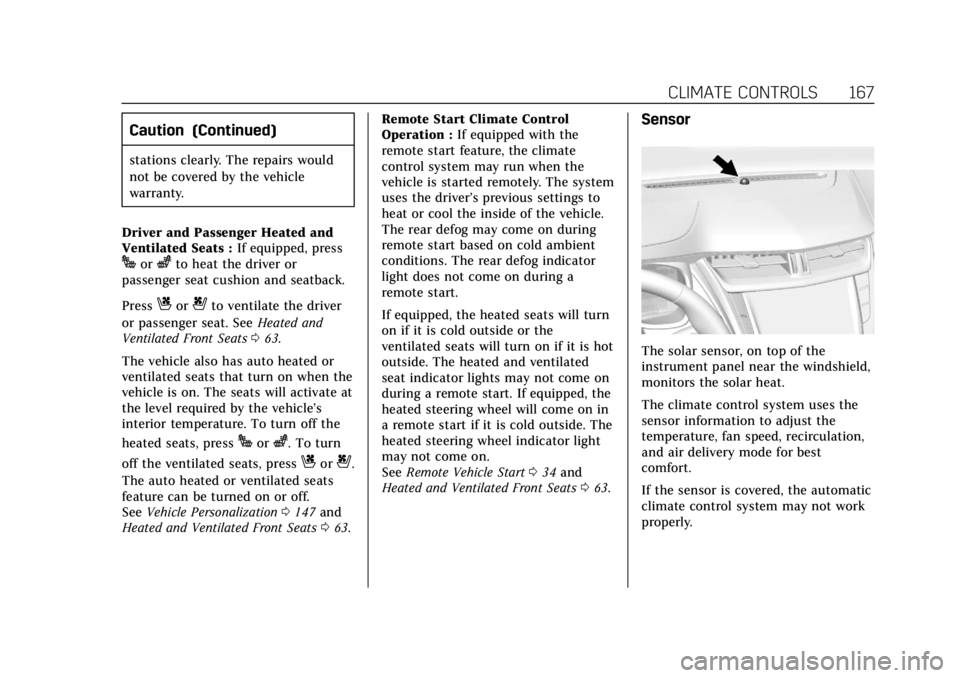
Sensor
The solar sensor, on top of the
instrument panel near the windshield,
monitors the solar heat.
The climate control system uses the
sensor information to adjust the
temperature, fan speed, recirculation,
and air delivery mode for best
comfort.
If the sensor is covered, the automatic
climate control system may not work
properly.
Page 170 of 376
Cadillac XTS Owner Manual (GMNA-Localizing-U.S./Canada-12032610) -
2019 - crc - 8/22/18
CLIMATE CONTROLS 169
Q:Touch to lock or unlock control of
the rear climate control system from
the rear seat passengers. When locked,
the rear climate controls can only be
adjusted from the front seat.
Automatic Operation
AUTO : Press to turn on or off. The
air delivery is controlled
automatically. The Auto indicator
appears on the display. If the MODE
setting is manually adjusted, this
cancels full automatic operation.
Manual Operation
i h: Press or press and hold the front
climate control buttons or display to
increase or decrease the rear climate
airf low.
RQ: Press or press and hold the rear
temperature control buttons or display
to adjust the rear passenger
temperature. Press
Qfor warmer air
and press
Rfor cooler air.
Y/[/\: Touch the desired mode
button on the display or the MODE
button on the rear climate controls to
change the direction of the airf low in
the rear seating area.
MorL: If equipped, pressMorLto heat the left or right outboard seat
cushion and seatback. See Heated Rear
Seats 067.
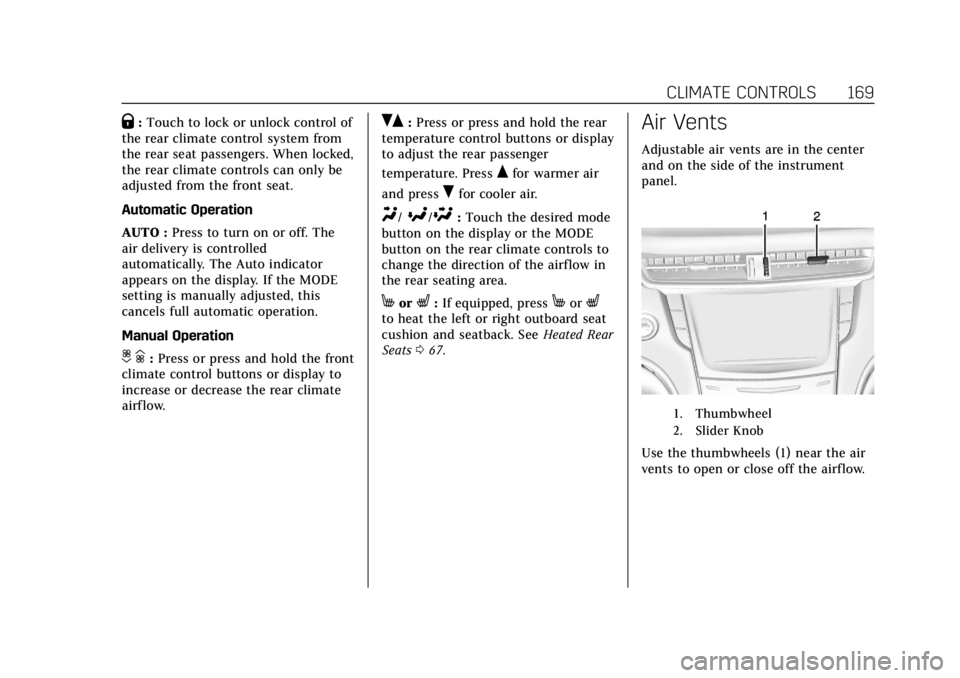
Air Vents
Adjustable air vents are in the center
and on the side of the instrument
panel.
1. Thumbwheel
2. Slider Knob
Use the thumbwheels (1) near the air
vents to open or close off the airflow.
Page 179 of 376
Cadillac XTS Owner Manual (GMNA-Localizing-U.S./Canada-12032610) -
2019 - crc - 8/22/18
178 DRIVING AND OPERATING
.Drive at speeds that keep the
vehicle in its own lane. Do not
swing wide or cross the
center line.
. Be alert on top of hills; something
could be in your lane (e.g., stalled
car, crash).
. Pay attention to special road signs
(e.g., falling rocks area, winding
roads, long grades, passing or
no-passing zones) and take
appropriate action.
Winter Driving
Driving on Snow or Ice
Snow or ice between the tires and the
road creates less traction or grip, so
drive carefully. Wet ice can occur at
about 0 °C (32 °F) when freezing rain
begins to fall. Avoid driving on wet ice
or in freezing rain until roads can be
treated.
For Slippery Road Driving:
.Accelerate gently. Accelerating too
quickly causes the wheels to spin
and makes the surface under the
tires slick. .
Turn on Traction Control. See
Traction Control/Electronic Stability
Control 0196.
. Antilock Brake System (ABS)
improves vehicle stability during
hard stops, but the brakes should
be applied sooner than when on
dry pavement. See Antilock Brake
System (ABS) 0194.
. Allow greater following distance
and watch for slippery spots. Icy
patches can occur on otherwise
clear roads in shaded areas. The
surface of a curve or an overpass
can remain icy when the
surrounding roads are clear. Avoid
sudden steering maneuvers and
braking while on ice.
. Turn off cruise control.
Blizzard Conditions
Stay with the vehicle unless there is
help nearby. If possible, use Roadside
Assistance. See Roadside Service 0343.
To get help and keep everyone in the
vehicle safe:
. Turn on the hazard warning
flashers. .
Tie a red cloth to an outside
mirror.
{Warning
Snow can trap engine exhaust
under the vehicle. This may cause
exhaust gases to get inside. Engine
exhaust contains carbon monoxide
(CO), which cannot be seen or
smelled. It can cause
unconsciousness and even death.
If the vehicle is stuck in snow:
. Clear snow from the base of
the vehicle, especially any
blocking the exhaust pipe.
. Open a window about 5 cm
(2 in) on the vehicle side that
is away from the wind, to
bring in fresh air.
. Fully open the air outlets on
or under the instrument
panel.
. Adjust the climate control
system to circulate the air
inside the vehicle and set the
(Continued)
Page 205 of 376
Cadillac XTS Owner Manual (GMNA-Localizing-U.S./Canada-12032610) -
2019 - crc - 8/22/18
204 DRIVING AND OPERATING
ACC will not set at a speed less than
25 km/h (15 mph), although it can be
resumed when driving at lower
speeds.
To set ACC:1. Press
J.
2. Get up to the desired speed.
3. Press and release SET–.
4. Remove foot from the accelerator.
After ACC is set, it may immediately
apply the brakes if a vehicle ahead is
detected closer than the selected
following gap.
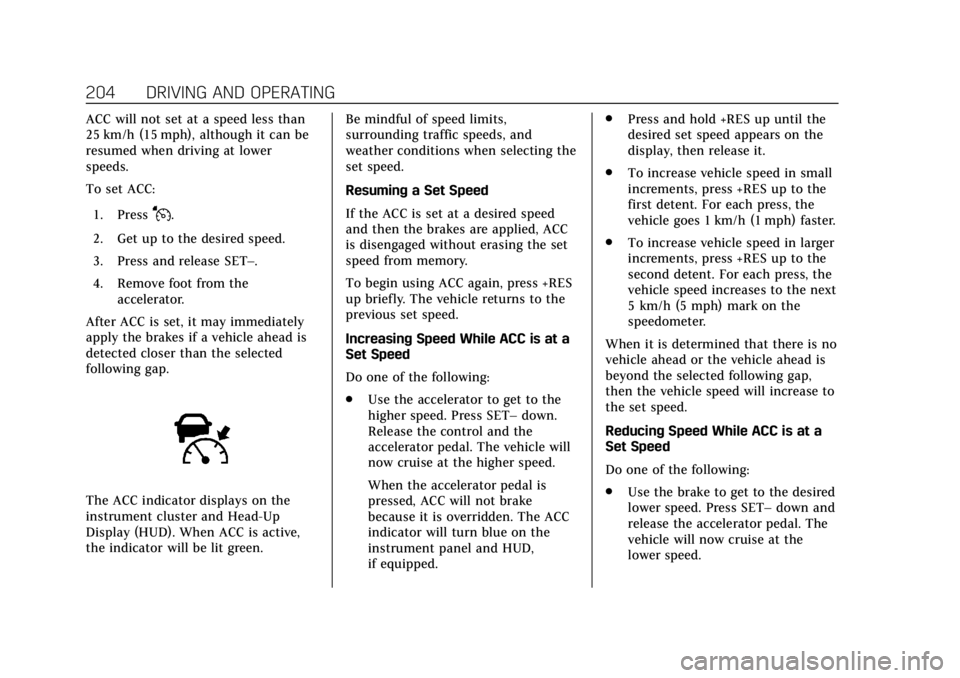
The ACC indicator displays on the
instrument cluster and Head-Up
Display (HUD). When ACC is active,
the indicator will be lit green. Be mindful of speed limits,
surrounding traffic speeds, and
weather conditions when selecting the
set speed.
Resuming a Set Speed
If the ACC is set at a desired speed
and then the brakes are applied, ACC
is disengaged without erasing the set
speed from memory.
To begin using ACC again, press +RES
up briefly. The vehicle returns to the
previous set speed.
Increasing Speed While ACC is at a
Set Speed
Do one of the following:
.
Use the accelerator to get to the
higher speed. Press SET– down.
Release the control and the
accelerator pedal. The vehicle will
now cruise at the higher speed.
When the accelerator pedal is
pressed, ACC will not brake
because it is overridden. The ACC
indicator will turn blue on the
instrument panel and HUD,
if equipped. .
Press and hold +RES up until the
desired set speed appears on the
display, then release it.
. To increase vehicle speed in small
increments, press +RES up to the
first detent. For each press, the
vehicle goes 1 km/h (1 mph) faster.
. To increase vehicle speed in larger
increments, press +RES up to the
second detent. For each press, the
vehicle speed increases to the next
5 km/h (5 mph) mark on the
speedometer.
When it is determined that there is no
vehicle ahead or the vehicle ahead is
beyond the selected following gap,
then the vehicle speed will increase to
the set speed.
Reducing Speed While ACC is at a
Set Speed
Do one of the following:
. Use the brake to get to the desired
lower speed. Press SET– down and
release the accelerator pedal. The
vehicle will now cruise at the
lower speed.
Page 231 of 376
Cadillac XTS Owner Manual (GMNA-Localizing-U.S./Canada-12032610) -
2019 - crc - 8/22/18
230 DRIVING AND OPERATING
Trailer Towing
General Towing
Information
Only use towing equipment that has
been designed for the vehicle. Contact
your dealer or trailering dealer for
assistance with preparing the vehicle
for towing a trailer. Read the entire
section before towing a trailer.
For towing a disabled vehicle, see
Towing the Vehicle0309. For towing
the vehicle behind another vehicle
such as a motor home, see
Recreational Vehicle Towing 0310.
Driving Characteristics and
Towing Tips
Driving with a Trailer
When towing a trailer:
.
Become familiar with the state
and local laws that apply to trailer
towing. These requirements vary
from state to state. .
Do not tow a trailer during the
first 800 km (500 mi) to prevent
damage to the engine, axle,
or other parts.
. It is recommended to perform the
first oil change before heavy
towing.
. Then during the first 800 km
(500 mi) of trailer towing, do not
drive over 80 km/h (50 mph) and
do not make starts at full throttle.
. Vehicles can tow in D (Drive). Shift
the transmission to a lower gear if
the transmission shifts too often
under heavy loads and/or hilly
conditions.
. Do not use Adaptive Cruise
Control when towing.
. The Forward Automatic Braking
System should be set to Off when
towing. See Forward Automatic
Braking (FAB) 0219.
. Turn off Parking Assist when
towing.
{Warning
When towing a trailer, exhaust
gases may collect at the rear of the
vehicle and enter if the liftgate,
trunk/hatch, or rear-most window
is open.
When towing a trailer:
. Do not drive with the liftgate,
trunk/hatch, or rear-most
window open.
. Fully open the air outlets on
or under the instrument
panel.
. Also adjust the climate
control system to a setting
that brings in only outside air.
See “Climate Control Systems ”
in the Index.
For more information about carbon
monoxide, see Engine Exhaust
0 190.
Towing a trailer requires a certain
amount of experience. The
combination you are driving is longer
Page 237 of 376
Cadillac XTS Owner Manual (GMNA-Localizing-U.S./Canada-12032610) -
2019 - crc - 8/22/18
236 VEHICLE CARE
Vehicle Care
General Information
General Information . . . . . . . . . . . . . 237
California Proposition65 Warning . . . . . . . . . . . . . . . . . . . . . 237
California Perchlorate Materials Requirements . . . . . . . . . . . . . . . . . . . 238
Accessories and Modifications . . . . . . . . . . . . . . . . . . . 238
Vehicle Checks
Doing Your OwnService Work . . . . . . . . . . . . . . . . . . . . 238
Hood . . . . . . . . . . . . . . . . . . . . . . . . . . . . . . 239
Engine Compartment Overview . . . . . . . . . . . . . . . . . . . . . . . . . 240
Engine Cover . . . . . . . . . . . . . . . . . . . . . . 243
Engine Oil . . . . . . . . . . . . . . . . . . . . . . . . . 244
Engine Oil Life System . . . . . . . . . . . 246
Automatic Transmission Fluid . . . . . . . . . . . . . . . . . . . . . . . . . . . . . 247
Engine Air Cleaner/Filter . . . . . . . . . 248
Cooling System . . . . . . . . . . . . . . . . . . . 250
Engine Overheating . . . . . . . . . . . . . . 253
Overheated Engine Protection Operating Mode . . . . . . . . . . . . . . . . . 254
Power Steering Fluid (LF3 and LFX with AWD) . . . . . . . . . . . . . . . . . 255 Power Steering Fluid (LFX
with FWD) . . . . . . . . . . . . . . . . . . . . . . 255
Washer Fluid . . . . . . . . . . . . . . . . . . . . . 256
Brakes . . . . . . . . . . . . . . . . . . . . . . . . . . . . . 256
Brake Fluid . . . . . . . . . . . . . . . . . . . . . . . 257
Battery - North America . . . . . . . . . 258
All-Wheel Drive . . . . . . . . . . . . . . . . . . 259
Starter Switch Check . . . . . . . . . . . . . 259
Automatic Transmission Shift Lock Control Function
Check . . . . . . . . . . . . . . . . . . . . . . . . . . . . 259
Park Brake and P (Park) Mechanism Check . . . . . . . . . . . . . . 260
Wiper Blade Replacement . . . . . . . 260
Windshield Replacement . . . . . . . . 261
Gas Strut(s) . . . . . . . . . . . . . . . . . . . . . . . 261
Headlamp Aiming
Headlamp Aiming . . . . . . . . . . . . . . . . 262
Bulb Replacement
Bulb Replacement . . . . . . . . . . . . . . . . 263
LED Lighting . . . . . . . . . . . . . . . . . . . . . 263
Back-Up Lamps . . . . . . . . . . . . . . . . . . . 263
License Plate Lamp . . . . . . . . . . . . . . 264
Electrical System
Electrical System Overload . . . . . . 264
Fuses and Circuit Breakers . . . . . . 265
Engine Compartment Fuse Block . . . . . . . . . . . . . . . . . . . . . . . . . . . . 265 Instrument Panel Fuse Block . . . . 268
Rear Compartment Fuse
Block . . . . . . . . . . . . . . . . . . . . . . . . . . . . 270
Wheels and Tires
Tires . . . . . . . . . . . . . . . . . . . . . . . . . . . . . . . 272
All-Season Tires . . . . . . . . . . . . . . . . . . 273
Winter Tires . . . . . . . . . . . . . . . . . . . . . . 273
Low-Profile Tires . . . . . . . . . . . . . . . . . 273
Summer Tires . . . . . . . . . . . . . . . . . . . . 273
Tire Sidewall Labeling . . . . . . . . . . . 274
Tire Designations . . . . . . . . . . . . . . . . . 276
Tire Terminology andDefinitions . . . . . . . . . . . . . . . . . . . . . . 277
Tire Pressure . . . . . . . . . . . . . . . . . . . . . . 279
Tire Pressure for High-Speed Operation . . . . . . . . . . . . . . . . . . . . . . . . 281
Tire Pressure Monitor System . . . 281
Tire Pressure Monitor Operation . . . . . . . . . . . . . . . . . . . . . . . . 282
Tire Inspection . . . . . . . . . . . . . . . . . . . 285
Tire Rotation . . . . . . . . . . . . . . . . . . . . . 285
When It Is Time for New Tires . . . . . . . . . . . . . . . . . . . . . . . . . . . . . 286
Buying New Tires . . . . . . . . . . . . . . . . 287
Different Size Tires and Wheels . . . . . . . . . . . . . . . . . . . . . . . . . . 288
Uniform Tire Quality Grading . . . 289
Wheel Alignment and Tire Balance . . . . . . . . . . . . . . . . . . . . . . . . . . 290
Wheel Replacement . . . . . . . . . . . . . . 290
Page 240 of 376
Cadillac XTS Owner Manual (GMNA-Localizing-U.S./Canada-12032610) -
2019 - crc - 8/22/18
VEHICLE CARE 239
If equipped with remote vehicle start,
open the hood before performing any
service work to prevent remote
starting the vehicle accidentally. See
Remote Vehicle Start034.
Keep a record with all parts receipts
and list the mileage and the date of
any service work performed. See
Maintenance Records 0335.
Caution
Even small amounts of
contamination can cause damage to
vehicle systems. Do not allow
contaminants to contact the fluids,
reservoir caps, or dipsticks.
Hood
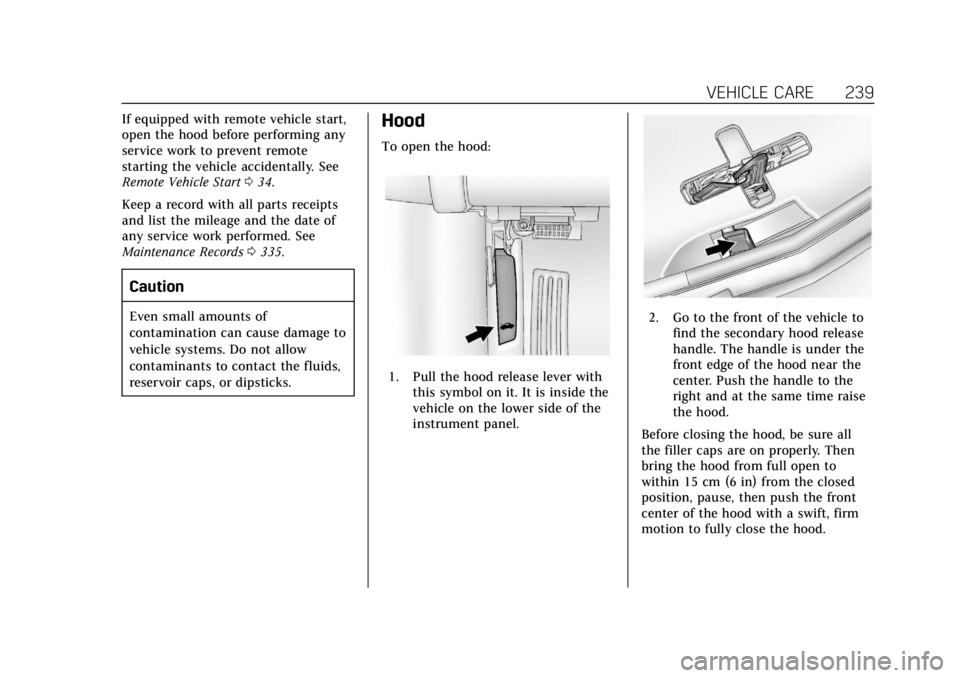
To open the hood:
1. Pull the hood release lever with
this symbol on it. It is inside the
vehicle on the lower side of the
instrument panel.
2. Go to the front of the vehicle tofind the secondary hood release
handle. The handle is under the
front edge of the hood near the
center. Push the handle to the
right and at the same time raise
the hood.
Before closing the hood, be sure all
the filler caps are on properly. Then
bring the hood from full open to
within 15 cm (6 in) from the closed
position, pause, then push the front
center of the hood with a swift, firm
motion to fully close the hood.
Page 269 of 376

Cadillac XTS Owner Manual (GMNA-Localizing-U.S./Canada-12032610) -
2019 - crc - 8/22/18
268 VEHICLE CARE
FusesUsage
64 Spare
65 Spare
66 Trunk release
67 Chassis control module
68 –
69 Battery voltage sensor
70 Canister vent solenoid
71 Memory seat module
72 Electric power steering
Relays Usage
1 A/C clutch
2 Starter
3 –
4 Wiper speed
5 Wiper control
6 –
7 Powertrain
8 – Relays
Usage
9 Cooling fan –high
speed
10 Cooling fan –low
speed
11 Taillamps/Parking lamps
12 –
13 Cooling fan control
14 Low-beam LED headlamps
15 Run/Crank
16 –
17 Rear window and mirror defoggerInstrument Panel Fuse
Block
The instrument panel fuse block is in
the instrument panel, on the driver
side of the vehicle. To access the
fuses, open the fuse panel door by
pulling down at the top.
Press in on the sides of the door to
release it from the instrument panel.
Pull the door toward you to release it
from the hinge.
Page 319 of 376
Cadillac XTS Owner Manual (GMNA-Localizing-U.S./Canada-12032610) -
2019 - crc - 8/22/18
318 VEHICLE CARE
If the soil is not completely removed,
it may be necessary to use a
commercial upholstery cleaner or spot
lifter. Test a small hidden area for
colorfastness before using a
commercial upholstery cleaner or spot
lifter. If ring formation occurs, clean
the entire fabric or carpet.
After cleaning, use a paper towel to
blot excess moisture.
Cleaning High Gloss Surfaces
and Vehicle Information and
Radio Displays
Use a microfiber cloth on high gloss
surfaces or vehicle displays. First, use
a soft bristle brush to remove dirt that
can scratch the surface. Then gently
clean by rubbing with a microfiber
cloth. Never use window cleaners or
solvents. Periodically hand wash the
microfiber cloth separately, using mild
soap. Do not use bleach or fabric
softener. Rinse thoroughly and air dry
before next use.
Caution
Do not attach a device with a
suction cup to the display. This may
cause damage and would not be
covered by the vehicle warranty.
Instrument Panel, Leather, Vinyl,
Other Plastic Surfaces, Low
Gloss Paint Surfaces, and
Natural Open Pore Wood
Surfaces
Use a soft microfiber cloth dampened
with water to remove dust and loose
dirt. For a more thorough cleaning,
use a soft microfiber cloth dampened
with a mild soap solution.
Caution
Soaking or saturating leather,
especially perforated leather, as well
as other interior surfaces, may
cause permanent damage. Wipe
excess moisture from these surfaces
after cleaning and allow them to(Continued)
Caution (Continued)
dry naturally. Never use heat,
steam, or spot removers. Do not use
cleaners that contain silicone or
wax-based products. Cleaners
containing these solvents can
permanently change the appearance
and feel of leather or soft trim, and
are not recommended.
Do not use cleaners that increase
gloss, especially on the instrument
panel. Reflected glare can decrease
visibility through the windshield
under certain conditions.
Caution
Use of air fresheners may cause
permanent damage to plastics and
painted surfaces. If an air freshener
comes in contact with any plastic
or painted surface in the vehicle,
blot immediately and clean with a
soft cloth dampened with a mild (Continued)
Page 337 of 376
Cadillac XTS Owner Manual (GMNA-Localizing-U.S./Canada-12032610) -
2019 - crc - 8/22/18
336 TECHNICAL DATA
Technical Data
Vehicle Identification
Vehicle IdentificationNumber (VIN) . . . . . . . . . . . . . . . . . . . 336
Service Parts Identification Label . . . . . . . . . . . . . . . . . . . . . . . . . . . . . 336
Vehicle Data
Capacities and Specifications . . . . 337
Engine Drive Belt Routing . . . . . . . 338
Vehicle Identification
Vehicle Identification
Number (VIN)
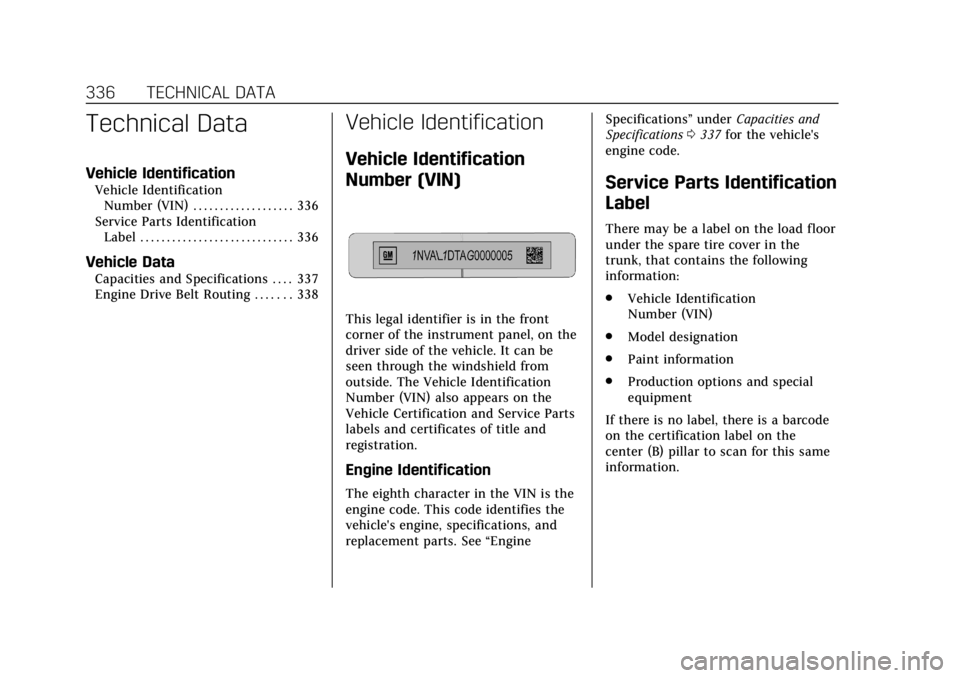
This legal identifier is in the front
corner of the instrument panel, on the
driver side of the vehicle. It can be
seen through the windshield from
outside. The Vehicle Identification
Number (VIN) also appears on the
Vehicle Certification and Service Parts
labels and certificates of title and
registration.
Engine Identification
The eighth character in the VIN is the
engine code. This code identifies the
vehicle's engine, specifications, and
replacement parts. See “EngineSpecifications”
underCapacities and
Specifications 0337 for the vehicle's
engine code.
Service Parts Identification
Label
There may be a label on the load floor
under the spare tire cover in the
trunk, that contains the following
information:
. Vehicle Identification
Number (VIN)
. Model designation
. Paint information
. Production options and special
equipment
If there is no label, there is a barcode
on the certification label on the
center (B) pillar to scan for this same
information.