wheel CHERY TIGGO 2009 Service Repair Manual
[x] Cancel search | Manufacturer: CHERY, Model Year: 2009, Model line: TIGGO, Model: CHERY TIGGO 2009Pages: 1903, PDF Size: 33.38 MB
Page 1383 of 1903
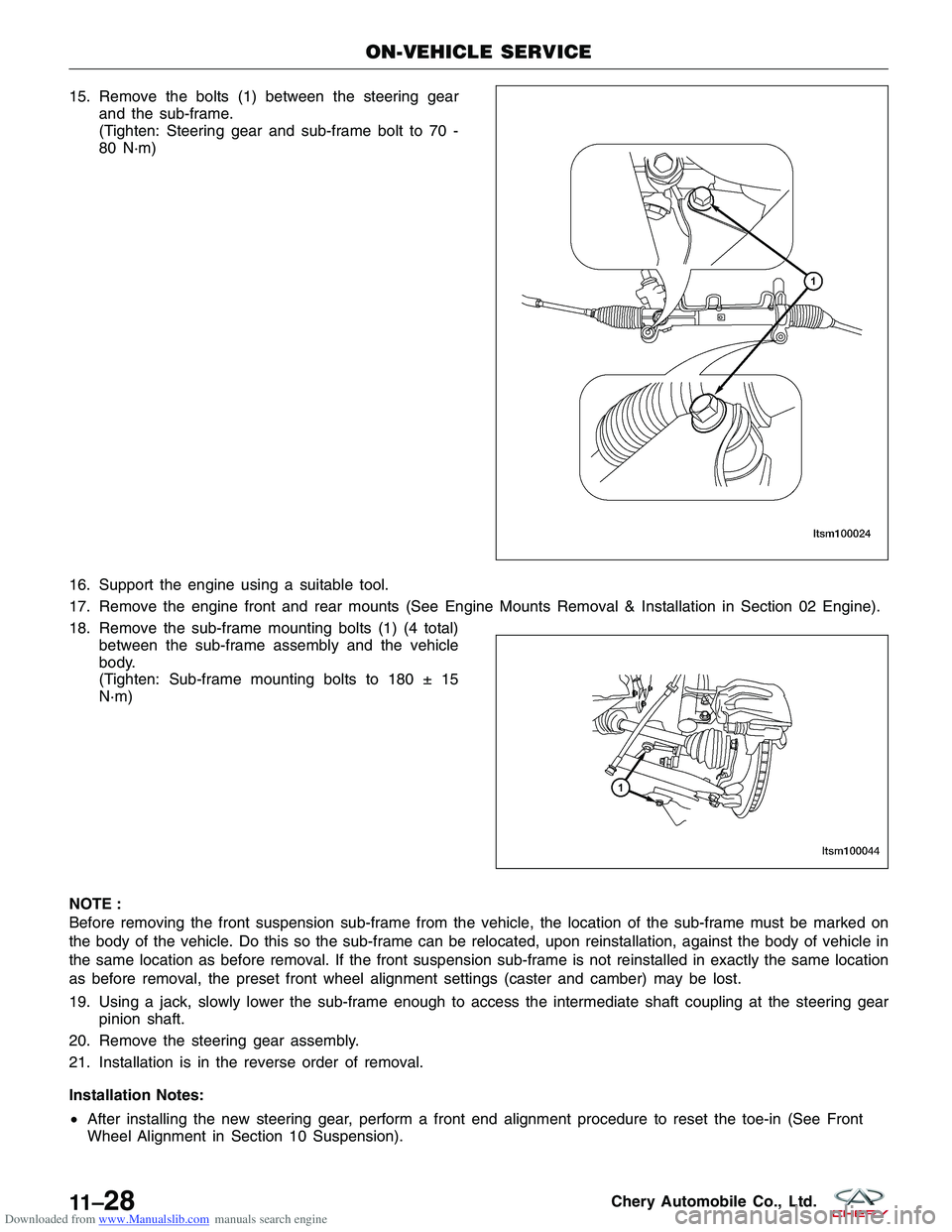
Downloaded from www.Manualslib.com manuals search engine 15. Remove the bolts (1) between the steering gearand the sub-frame.
(Tighten: Steering gear and sub-frame bolt to 70 -
80 N·m)
16. Support the engine using a suitable tool.
17. Remove the engine front and rear mounts (See Engine Mounts Removal & Installation in Section 02 Engine).
18. Remove the sub-frame mounting bolts (1) (4 total) between the sub-frame assembly and the vehicle
body.
(Tighten: Sub-frame mounting bolts to 180 ± 15
N·m)
NOTE :
Before removing the front suspension sub-frame from the vehicle, the location of the sub-frame must be marked on
the body of the vehicle. Do this so the sub-frame can be relocated, upon reinstallation, against the body of vehicle in
the same location as before removal. If the front suspension sub-frame is not reinstalled in exactly the same location
as before removal, the preset front wheel alignment settings (caster and camber) may be lost.
19. Using a jack, slowly lower the sub-frame enough to access the intermediate shaft coupling at the steering gear pinion shaft.
20. Remove the steering gear assembly.
21. Installation is in the reverse order of removal.
Installation Notes:
• After installing the new steering gear, perform a front end alignment procedure to reset the toe-in (See Front
Wheel Alignment in Section 10 Suspension).
ON-VEHICLE SERVICE
LTSM100024
LTSM100044
11 –28Chery Automobile Co., Ltd.
Page 1384 of 1903
Downloaded from www.Manualslib.com manuals search engine Tie Rod
Removal & Installation
NOTE :
The following special tool is required to perform the repair procedure:
•CH-10002 - Ball Joint Separator
1. Raise and support the vehicle.
2. Remove the wheel mounting nuts and the wheel assembly. (Tighten: Wheel mounting nuts to 110 N·m)
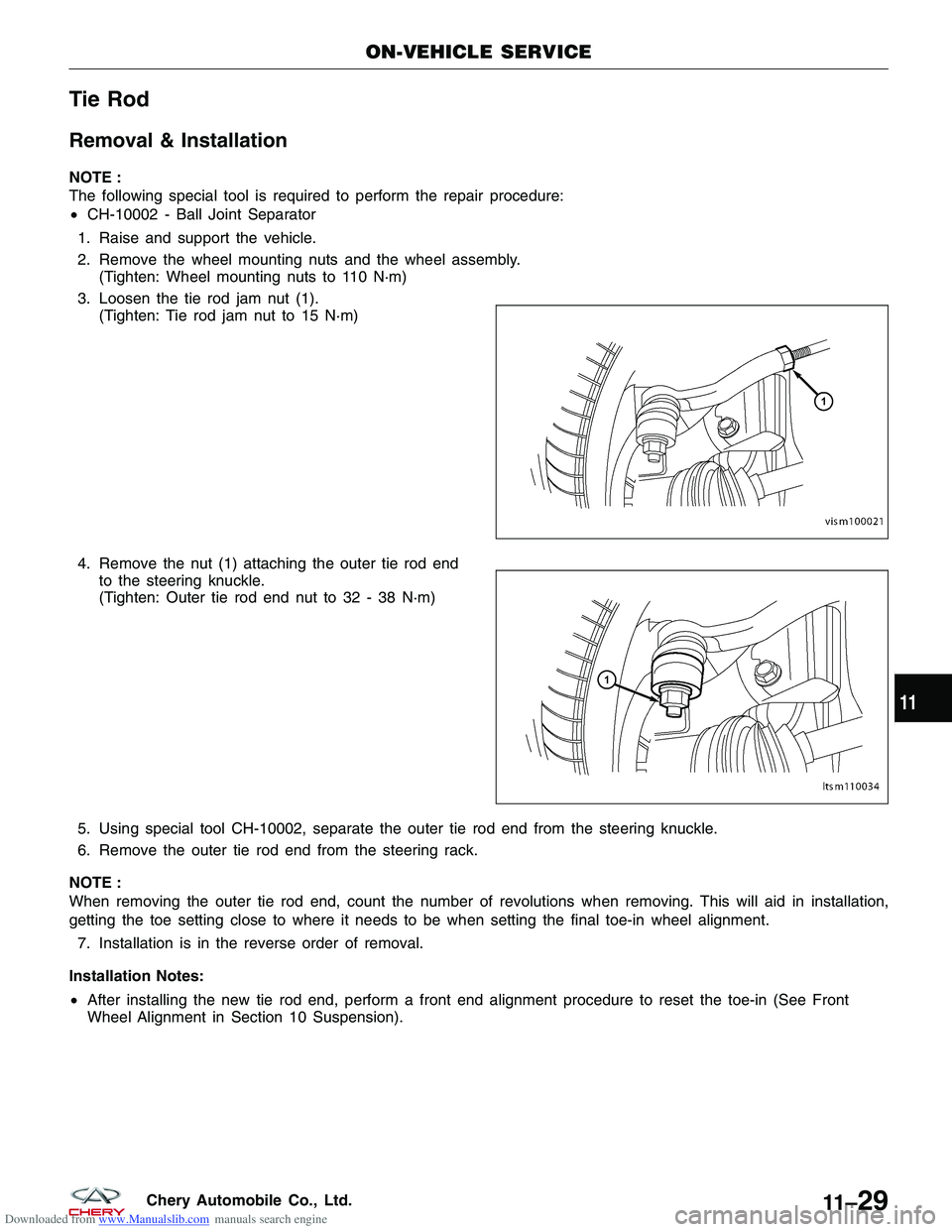
3. Loosen the tie rod jam nut (1). (Tighten: Tie rod jam nut to 15 N·m)
4. Remove the nut (1) attaching the outer tie rod end to the steering knuckle.
(Tighten: Outer tie rod end nut to 32 - 38 N·m)
5. Using special tool CH-10002, separate the outer tie rod end from the steering knuckle.
6. Remove the outer tie rod end from the steering rack.
NOTE :
When removing the outer tie rod end, count the number of revolutions when removing. This will aid in installation,
getting the toe setting close to where it needs to be when setting the final toe-in wheel alignment. 7. Installation is in the reverse order of removal.
Installation Notes:
• After installing the new tie rod end, perform a front end alignment procedure to reset the toe-in (See Front
Wheel Alignment in Section 10 Suspension).
ON-VEHICLE SERVICE
VISM100021
LTSM110034
11
11 –29Chery Automobile Co., Ltd.
Page 1387 of 1903
Downloaded from www.Manualslib.com manuals search engine GENERAL INFORMATION
Description
The power steering pump is a constant flow rate and displacement vane type pump. The pump reservoir is detached
from the pump body. The pump is connected to the steering gear by the pressure and return lines.
Operation
The power steering pump is mounted to the engine and driven by the engine accessory drive belt. Power steering
fluid enters the pump from the reservoir. The power steering fluid is then trapped between the pump vanes and
moved to the high-pressure side of the pump creating a flow of steering fluid. The restriction of this flow by the
steering gear creates the pressure that provides the steering assist.
CAUTION:
•Operating the power steering with a low steering fluid level will damage the power steering sys-
tem.
• Holding the steering wheel in the full lock position for more than 3 seconds will damage the
power steering system.
Specifications
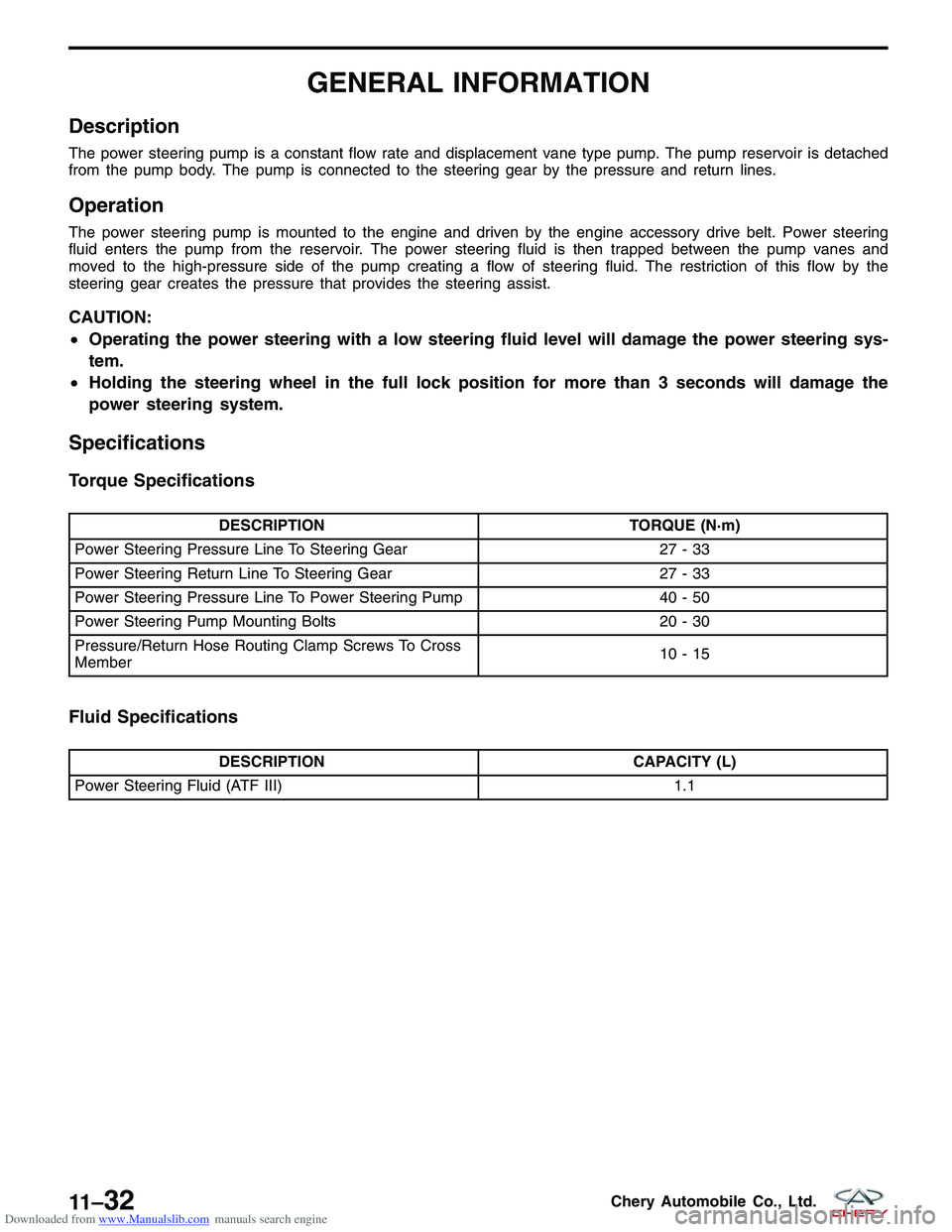
Torque Specifications
DESCRIPTION TORQUE (N·m)
Power Steering Pressure Line To Steering Gear 27 - 33
Power Steering Return Line To Steering Gear 27 - 33
Power Steering Pressure Line To Power Steering Pump 40 - 50
Power Steering Pump Mounting Bolts 20 - 30
Pressure/Return Hose Routing Clamp Screws To Cross
Member 10-15
Fluid Specifications
DESCRIPTION
CAPACITY (L)
Power Steering Fluid (ATF III) 1.1
11 –32Chery Automobile Co., Ltd.
Page 1388 of 1903
Downloaded from www.Manualslib.com manuals search engine DIAGNOSIS & TESTING
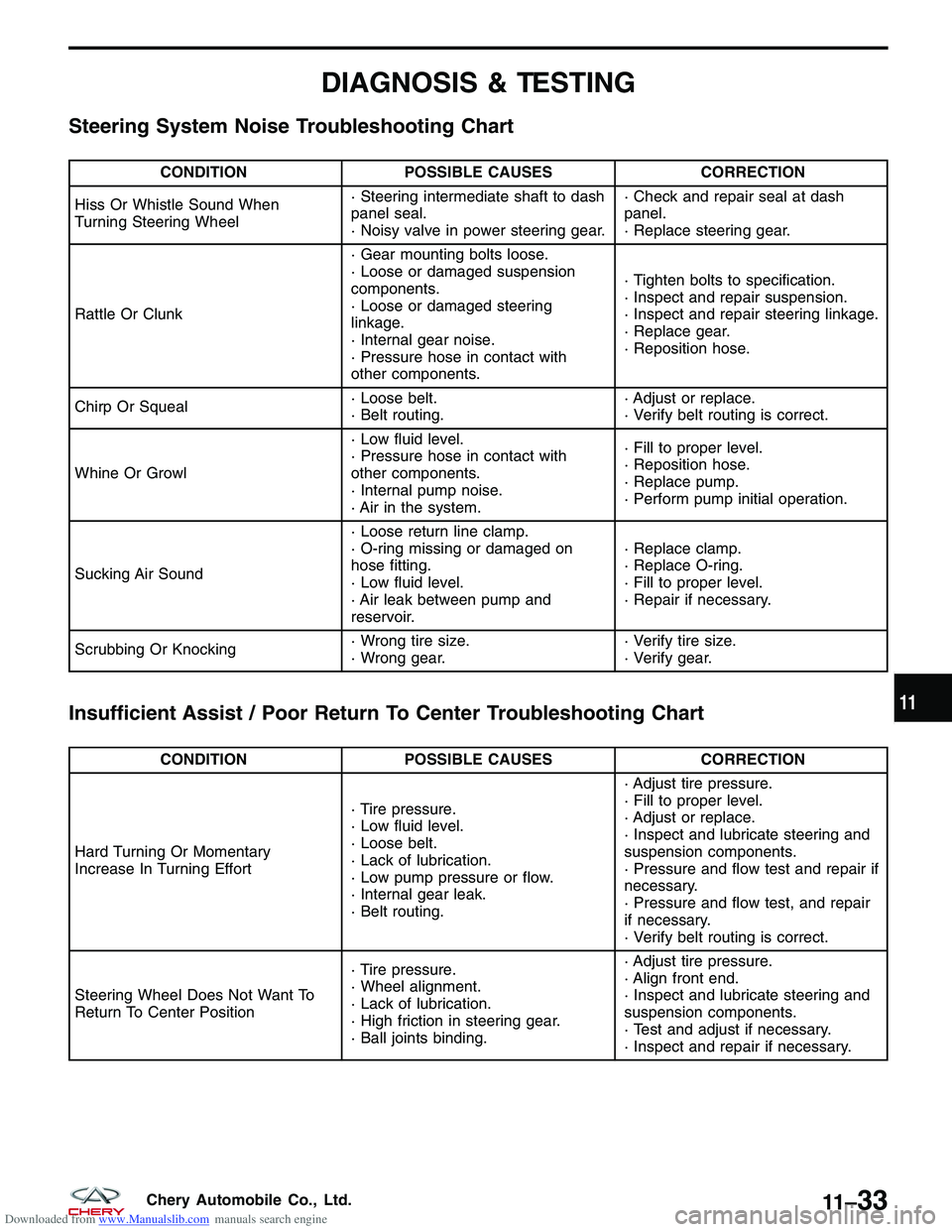
Steering System Noise Troubleshooting Chart
CONDITIONPOSSIBLE CAUSES CORRECTION
Hiss Or Whistle Sound When
Turning Steering Wheel · Steering intermediate shaft to dash
panel seal.
· Noisy valve in power steering gear.· Check and repair seal at dash
panel.
· Replace steering gear.
Rattle Or Clunk · Gear mounting bolts loose.
· Loose or damaged suspension
components.
· Loose or damaged steering
linkage.
· Internal gear noise.
· Pressure hose in contact with
other components.· Tighten bolts to specification.
· Inspect and repair suspension.
· Inspect and repair steering linkage.
· Replace gear.
· Reposition hose.
Chirp Or Squeal · Loose belt.
· Belt routing.· Adjust or replace.
· Verify belt routing is correct.
Whine Or Growl · Low fluid level.
· Pressure hose in contact with
other components.
· Internal pump noise.
· Air in the system.· Fill to proper level.
· Reposition hose.
· Replace pump.
· Perform pump initial operation.
Sucking Air Sound · Loose return line clamp.
· O-ring missing or damaged on
hose fitting.
· Low fluid level.
· Air leak between pump and
reservoir.· Replace clamp.
· Replace O-ring.
· Fill to proper level.
· Repair if necessary.
Scrubbing Or Knocking · Wrong tire size.
· Wrong gear.· Verify tire size.
· Verify gear.
Insufficient Assist / Poor Return To Center Troubleshooting Chart
CONDITION
POSSIBLE CAUSES CORRECTION
Hard Turning Or Momentary
Increase In Turning Effort · Tire pressure.
· Low fluid level.
· Loose belt.
· Lack of lubrication.
· Low pump pressure or flow.
· Internal gear leak.
· Belt routing.· Adjust tire pressure.
· Fill to proper level.
· Adjust or replace.
· Inspect and lubricate steering and
suspension components.
· Pressure and flow test and repair if
necessary.
· Pressure and flow test, and repair
if necessary.
· Verify belt routing is correct.
Steering Wheel Does Not Want To
Return To Center Position · Tire pressure.
· Wheel alignment.
· Lack of lubrication.
· High friction in steering gear.
· Ball joints binding.· Adjust tire pressure.
· Align front end.
· Inspect and lubricate steering and
suspension components.
· Test and adjust if necessary.
· Inspect and repair if necessary.
11
11 –33Chery Automobile Co., Ltd.
Page 1390 of 1903
Downloaded from www.Manualslib.com manuals search engine Power Steering Pump - 2.4L
Removal & Installation
1. Siphon out as much power steering fluid as possible from the reservoir.
2. Raise and support the vehicle.
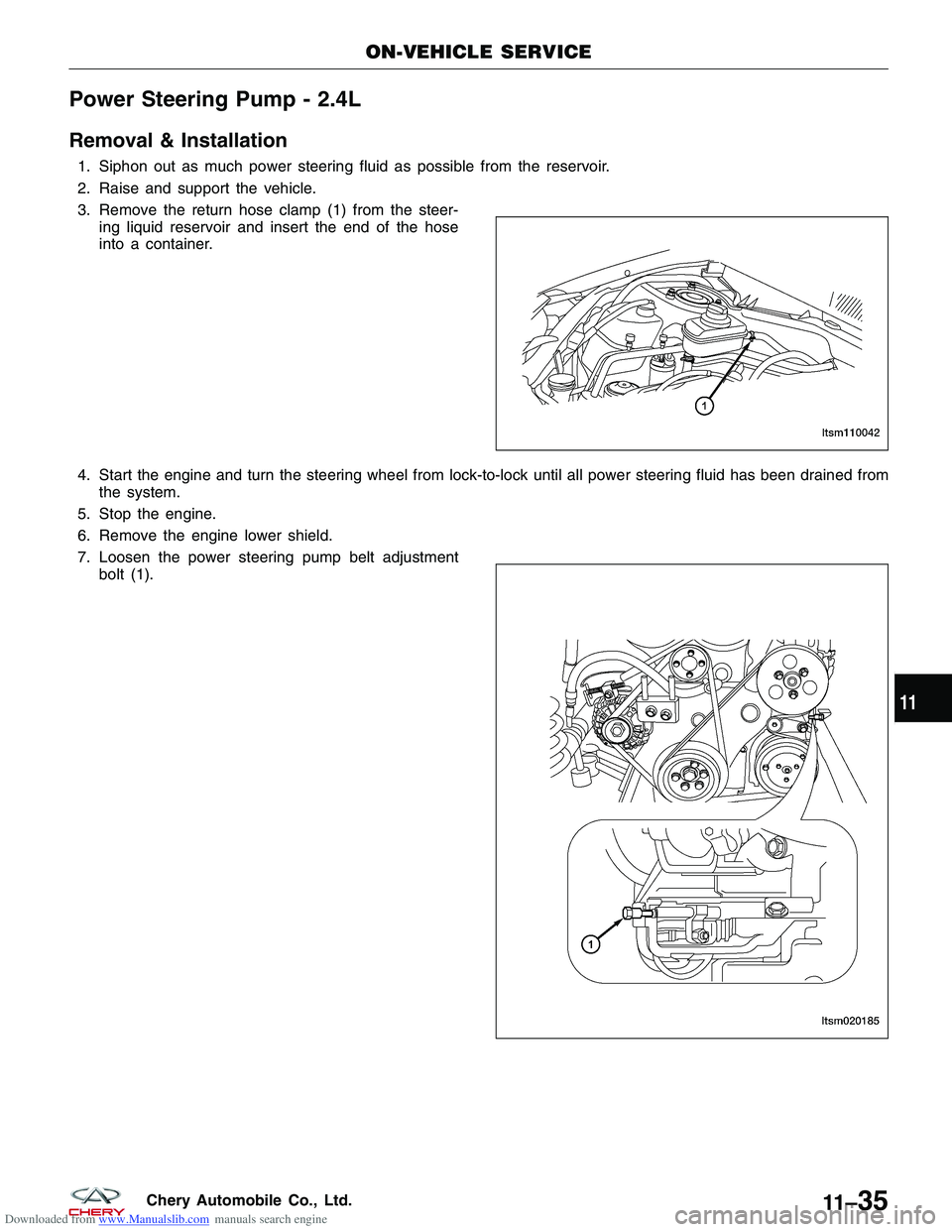
3. Remove the return hose clamp (1) from the steer-ing liquid reservoir and insert the end of the hose
into a container.
4. Start the engine and turn the steering wheel from lock-to-lock until all power steering fluid has been drained from the system.
5. Stop the engine.
6. Remove the engine lower shield.
7. Loosen the power steering pump belt adjustment bolt (1).
ON-VEHICLE SERVICE
LTSM110042
LTSM020185
11
11 –35Chery Automobile Co., Ltd.
Page 1397 of 1903
Downloaded from www.Manualslib.com manuals search engine GENERAL INFORMATION
Description
Base Brakes
The base brake system consists of the following components:
•Brake pedal
• Power brake booster
• Master cylinder
• Brake tubes and hoses
• Disc brakes (front)
• Disc brakes (rear)
• Parking brake
• Parking brake shoes (rear)
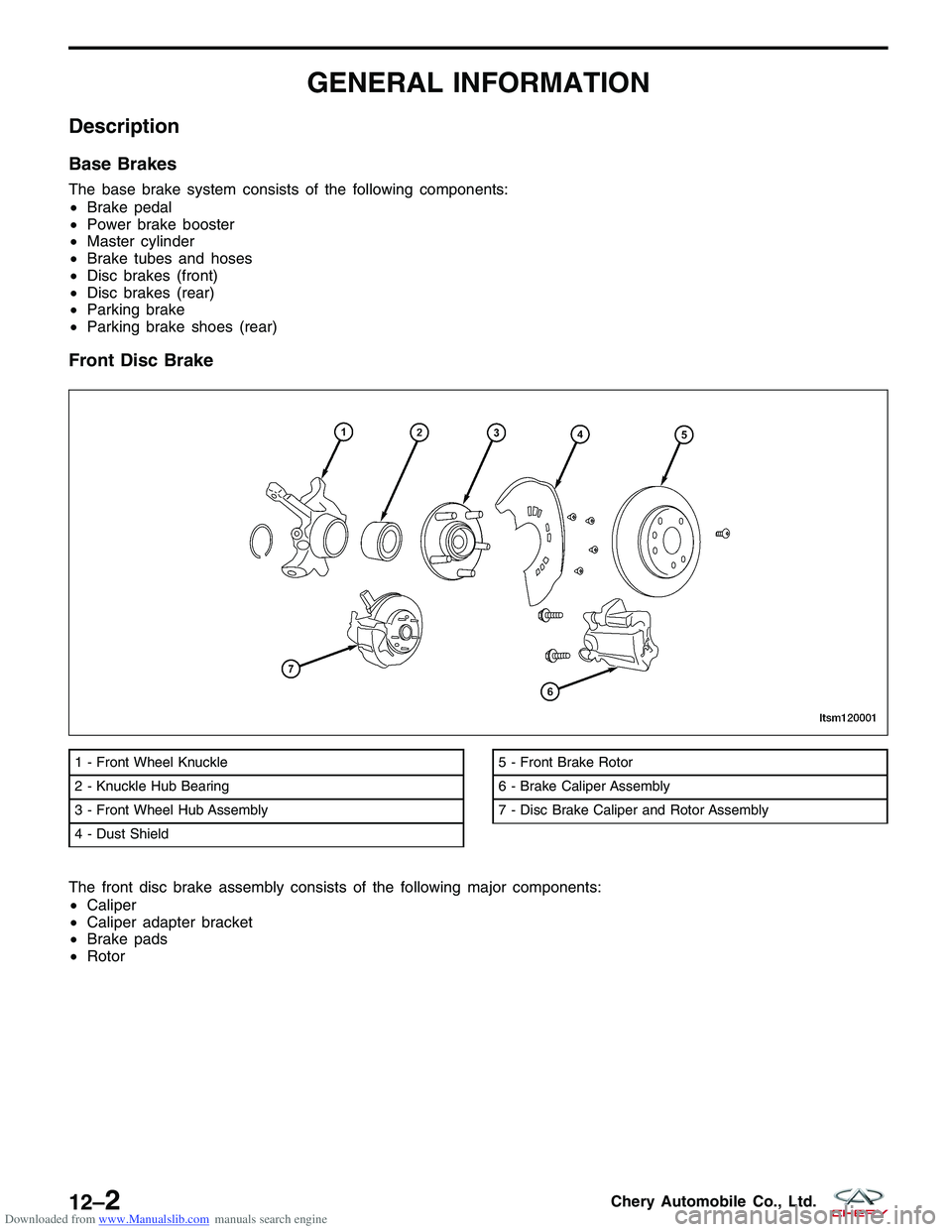
Front Disc Brake
The front disc brake assembly consists of the following major components:
•Caliper
• Caliper adapter bracket
• Brake pads
• Rotor
1 - Front Wheel Knuckle
2 - Knuckle Hub Bearing
3 - Front Wheel Hub Assembly
4 - Dust Shield5 - Front Brake Rotor
6 - Brake Caliper Assembly
7 - Disc Brake Caliper and Rotor Assembly
LTSM120001
12–2Chery Automobile Co., Ltd.
Page 1398 of 1903
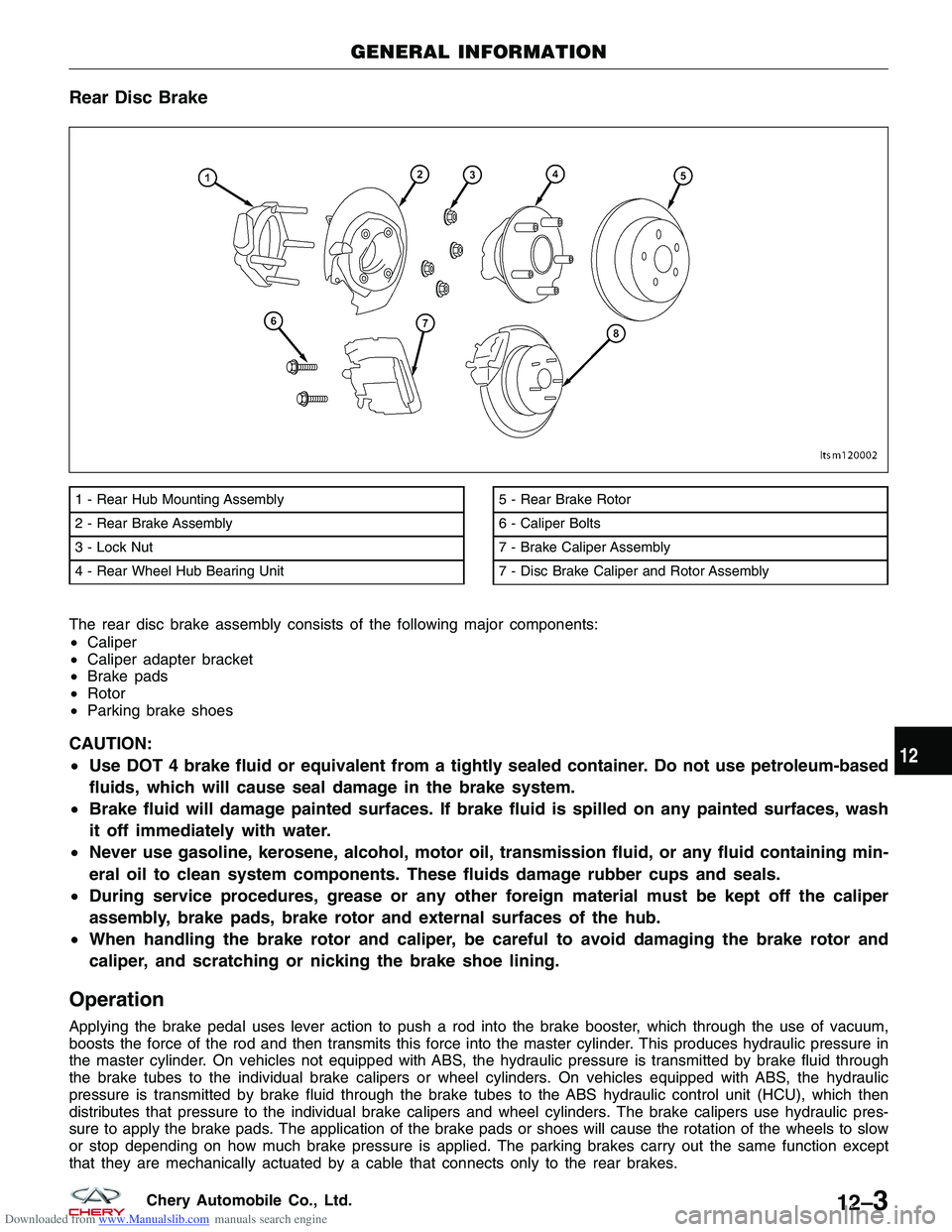
Downloaded from www.Manualslib.com manuals search engine Rear Disc Brake
The rear disc brake assembly consists of the following major components:
•Caliper
• Caliper adapter bracket
• Brake pads
• Rotor
• Parking brake shoes
CAUTION:
•Use DOT 4 brake fluid or equivalent from a tightly sealed container. Do not use petroleum-based
fluids, which will cause seal damage in the brake system.
• Brake fluid will damage painted surfaces. If brake fluid is spilled on any painted surfaces, wash
it off immediately with water.
• Never use gasoline, kerosene, alcohol, motor oil, transmission fluid, or any fluid containing min-
eral oil to clean system components. These fluids damage rubber cups and seals.
• During service procedures, grease or any other foreign material must be kept off the caliper
assembly, brake pads, brake rotor and external surfaces of the hub.
• When handling the brake rotor and caliper, be careful to avoid damaging the brake rotor and
caliper, and scratching or nicking the brake shoe lining.
Operation
Applying the brake pedal uses lever action to push a rod into the brake booster, which through the use of vacuum,
boosts the force of the rod and then transmits this force into the master cylinder. This produces hydraulic pressure in
the master cylinder. On vehicles not equipped with ABS, the hydraulic pressure is transmitted by brake fluid through
the brake tubes to the individual brake calipers or wheel cylinders. On vehicles equipped with ABS, the hydraulic
pressure is transmitted by brake fluid through the brake tubes to the ABS hydraulic control unit (HCU), which then
distributes that pressure to the individual brake calipers and wheel cylinders. The brake calipers use hydraulic pres-
sure to apply the brake pads. The application of the brake pads or shoes will cause the rotation of the wheels to slow
or stop depending on how much brake pressure is applied. The parking brakes carry out the same function except
that they are mechanically actuated by a cable that connects only to the rear brakes.
1 - Rear Hub Mounting Assembly
2 - Rear Brake Assembly
3 - Lock Nut
4 - Rear Wheel Hub Bearing Unit5 - Rear Brake Rotor
6 - Caliper Bolts
7 - Brake Caliper Assembly
7 - Disc Brake Caliper and Rotor Assembly
GENERAL INFORMATION
LTSM120002
12
12–3Chery Automobile Co., Ltd.
Page 1399 of 1903
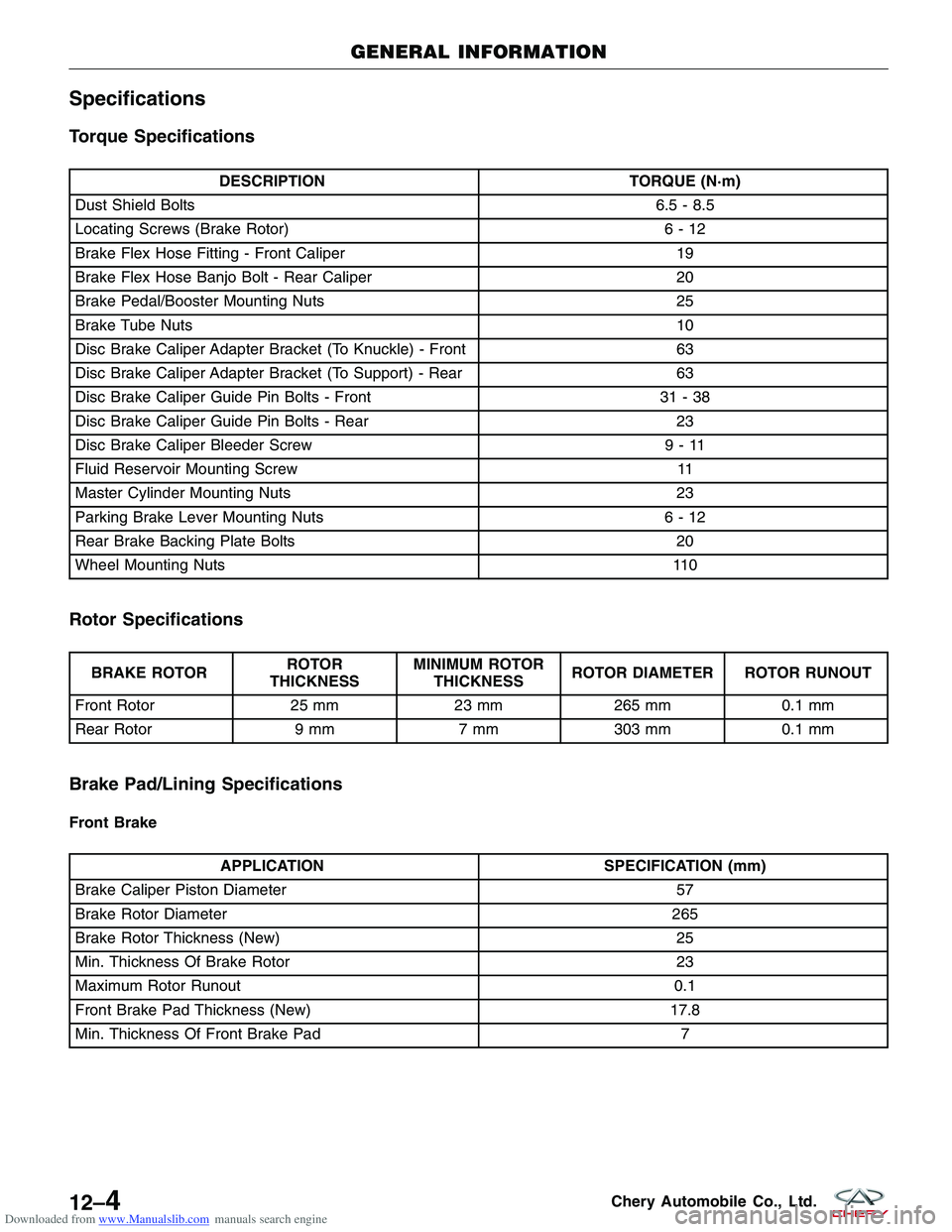
Downloaded from www.Manualslib.com manuals search engine Specifications
Torque Specifications
DESCRIPTIONTORQUE (N·m)
Dust Shield Bolts 6.5 - 8.5
Locating Screws (Brake Rotor) 6 - 12
Brake Flex Hose Fitting - Front Caliper 19
Brake Flex Hose Banjo Bolt - Rear Caliper 20
Brake Pedal/Booster Mounting Nuts 25
Brake Tube Nuts 10
Disc Brake Caliper Adapter Bracket (To Knuckle) - Front 63
Disc Brake Caliper Adapter Bracket (To Support) - Rear 63
Disc Brake Caliper Guide Pin Bolts - Front 31 - 38
Disc Brake Caliper Guide Pin Bolts - Rear 23
Disc Brake Caliper Bleeder Screw 9 - 11
Fluid Reservoir Mounting Screw 11
Master Cylinder Mounting Nuts 23
Parking Brake Lever Mounting Nuts 6 - 12
Rear Brake Backing Plate Bolts 20
Wheel Mounting Nuts 110
Rotor Specifications
BRAKE ROTORROTOR
THICKNESS MINIMUM ROTOR
THICKNESS ROTOR DIAMETER ROTOR RUNOUT
Front Rotor 25 mm23 mm265 mm 0.1 mm
Rear Rotor 9 mm7 mm303 mm 0.1 mm
Brake Pad/Lining Specifications
Front Brake
APPLICATION SPECIFICATION (mm)
Brake Caliper Piston Diameter 57
Brake Rotor Diameter 265
Brake Rotor Thickness (New) 25
Min. Thickness Of Brake Rotor 23
Maximum Rotor Runout 0.1
Front Brake Pad Thickness (New) 17.8
Min. Thickness Of Front Brake Pad 7
GENERAL INFORMATION
12–4Chery Automobile Co., Ltd.
Page 1402 of 1903
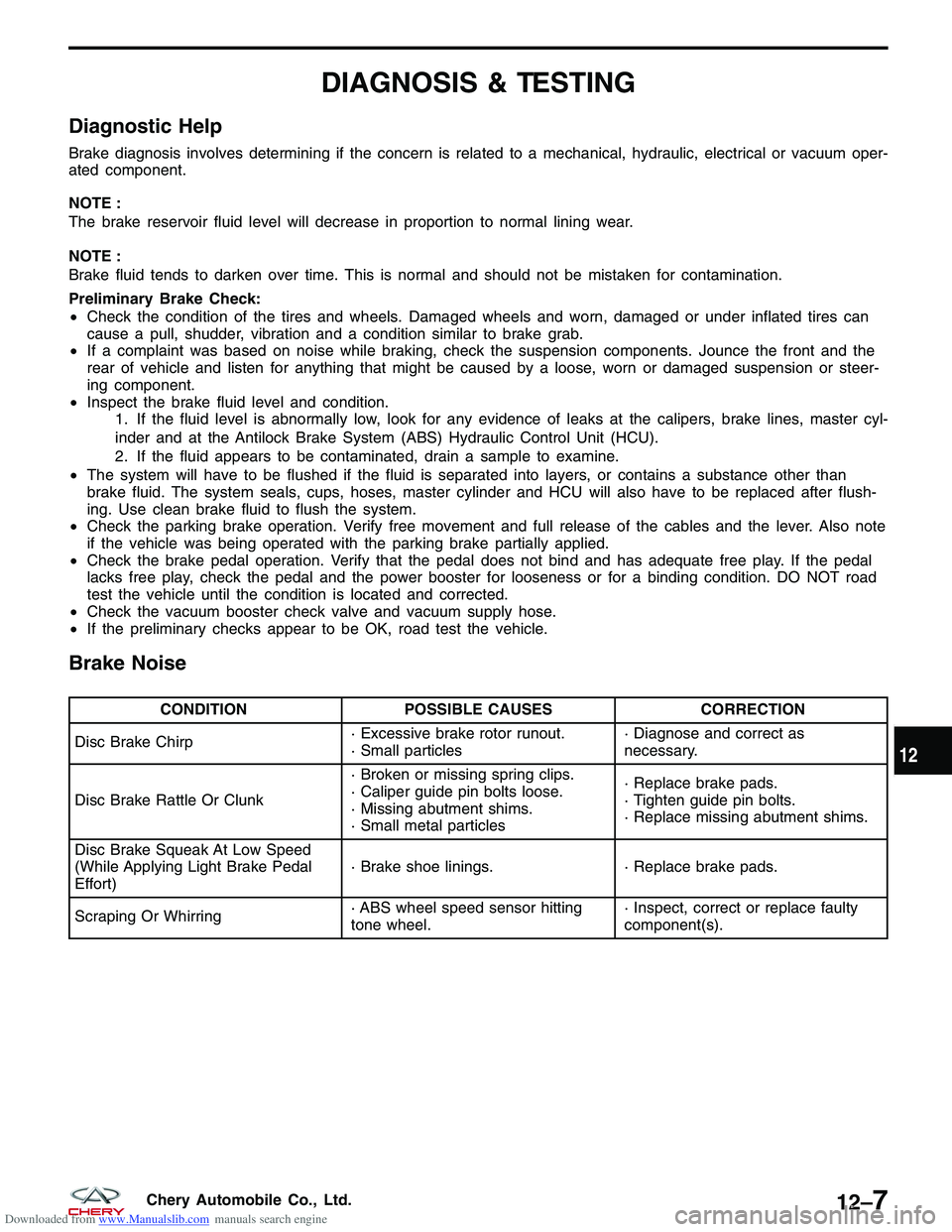
Downloaded from www.Manualslib.com manuals search engine DIAGNOSIS & TESTING
Diagnostic Help
Brake diagnosis involves determining if the concern is related to a mechanical, hydraulic, electrical or vacuum oper-
ated component.
NOTE :
The brake reservoir fluid level will decrease in proportion to normal lining wear.
NOTE :
Brake fluid tends to darken over time. This is normal and should not be mistaken for contamination.
Preliminary Brake Check:
•Check the condition of the tires and wheels. Damaged wheels and worn, damaged or under inflated tires can
cause a pull, shudder, vibration and a condition similar to brake grab.
• If a complaint was based on noise while braking, check the suspension components. Jounce the front and the
rear of vehicle and listen for anything that might be caused by a loose, worn or damaged suspension or steer-
ing component.
• Inspect the brake fluid level and condition.
1. If the fluid level is abnormally low, look for any evidence of leaks at the calipers, brake lines, master cyl-
inder and at the Antilock Brake System (ABS) Hydraulic Control Unit (HCU).
2. If the fluid appears to be contaminated, drain a sample to examine.
• The system will have to be flushed if the fluid is separated into layers, or contains a substance other than
brake fluid. The system seals, cups, hoses, master cylinder and HCU will also have to be replaced after flush-
ing. Use clean brake fluid to flush the system.
• Check the parking brake operation. Verify free movement and full release of the cables and the lever. Also note
if the vehicle was being operated with the parking brake partially applied.
• Check the brake pedal operation. Verify that the pedal does not bind and has adequate free play. If the pedal
lacks free play, check the pedal and the power booster for looseness or for a binding condition. DO NOT road
test the vehicle until the condition is located and corrected.
• Check the vacuum booster check valve and vacuum supply hose.
• If the preliminary checks appear to be OK, road test the vehicle.
Brake Noise
CONDITION POSSIBLE CAUSES CORRECTION
Disc Brake Chirp · Excessive brake rotor runout.
· Small particles· Diagnose and correct as
necessary.
Disc Brake Rattle Or Clunk · Broken or missing spring clips.
· Caliper guide pin bolts loose.
· Missing abutment shims.
· Small metal particles· Replace brake pads.
· Tighten guide pin bolts.
· Replace missing abutment shims.
Disc Brake Squeak At Low Speed
(While Applying Light Brake Pedal
Effort) · Brake shoe linings.
· Replace brake pads.
Scraping Or Whirring · ABS wheel speed sensor hitting
tone wheel.· Inspect, correct or replace faulty
component(s).
12
12–7Chery Automobile Co., Ltd.
Page 1403 of 1903
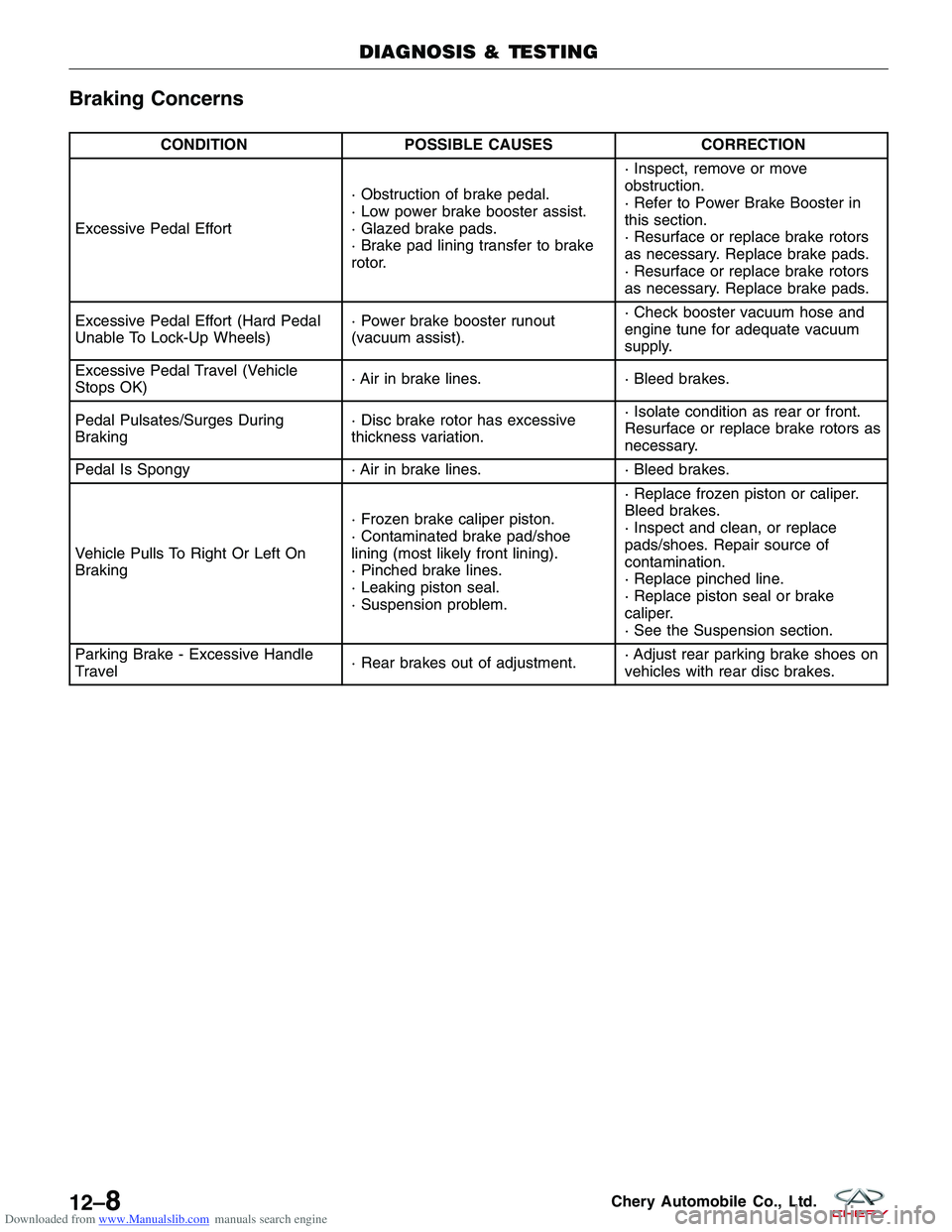
Downloaded from www.Manualslib.com manuals search engine Braking Concerns
CONDITIONPOSSIBLE CAUSES CORRECTION
Excessive Pedal Effort · Obstruction of brake pedal.
· Low power brake booster assist.
· Glazed brake pads.
· Brake pad lining transfer to brake
rotor.· Inspect, remove or move
obstruction.
· Refer to Power Brake Booster in
this section.
· Resurface or replace brake rotors
as necessary. Replace brake pads.
· Resurface or replace brake rotors
as necessary. Replace brake pads.
Excessive Pedal Effort (Hard Pedal
Unable To Lock-Up Wheels) · Power brake booster runout
(vacuum assist).· Check booster vacuum hose and
engine tune for adequate vacuum
supply.
Excessive Pedal Travel (Vehicle
Stops OK) · Air in brake lines.
· Bleed brakes.
Pedal Pulsates/Surges During
Braking · Disc brake rotor has excessive
thickness variation.· Isolate condition as rear or front.
Resurface or replace brake rotors as
necessary.
Pedal Is Spongy · Air in brake lines.· Bleed brakes.
Vehicle Pulls To Right Or Left On
Braking · Frozen brake caliper piston.
· Contaminated brake pad/shoe
lining (most likely front lining).
· Pinched brake lines.
· Leaking piston seal.
· Suspension problem.· Replace frozen piston or caliper.
Bleed brakes.
· Inspect and clean, or replace
pads/shoes. Repair source of
contamination.
· Replace pinched line.
· Replace piston seal or brake
caliper.
· See the Suspension section.
Parking Brake - Excessive Handle
Travel · Rear brakes out of adjustment.· Adjust rear parking brake shoes on
vehicles with rear disc brakes.
DIAGNOSIS & TESTING
12–8Chery Automobile Co., Ltd.