CHERY TIGGO 2009 Service Repair Manual
TIGGO 2009
CHERY
CHERY
https://www.carmanualsonline.info/img/53/56852/w960_56852-0.png
CHERY TIGGO 2009 Service Repair Manual
Page 1428 of 1903
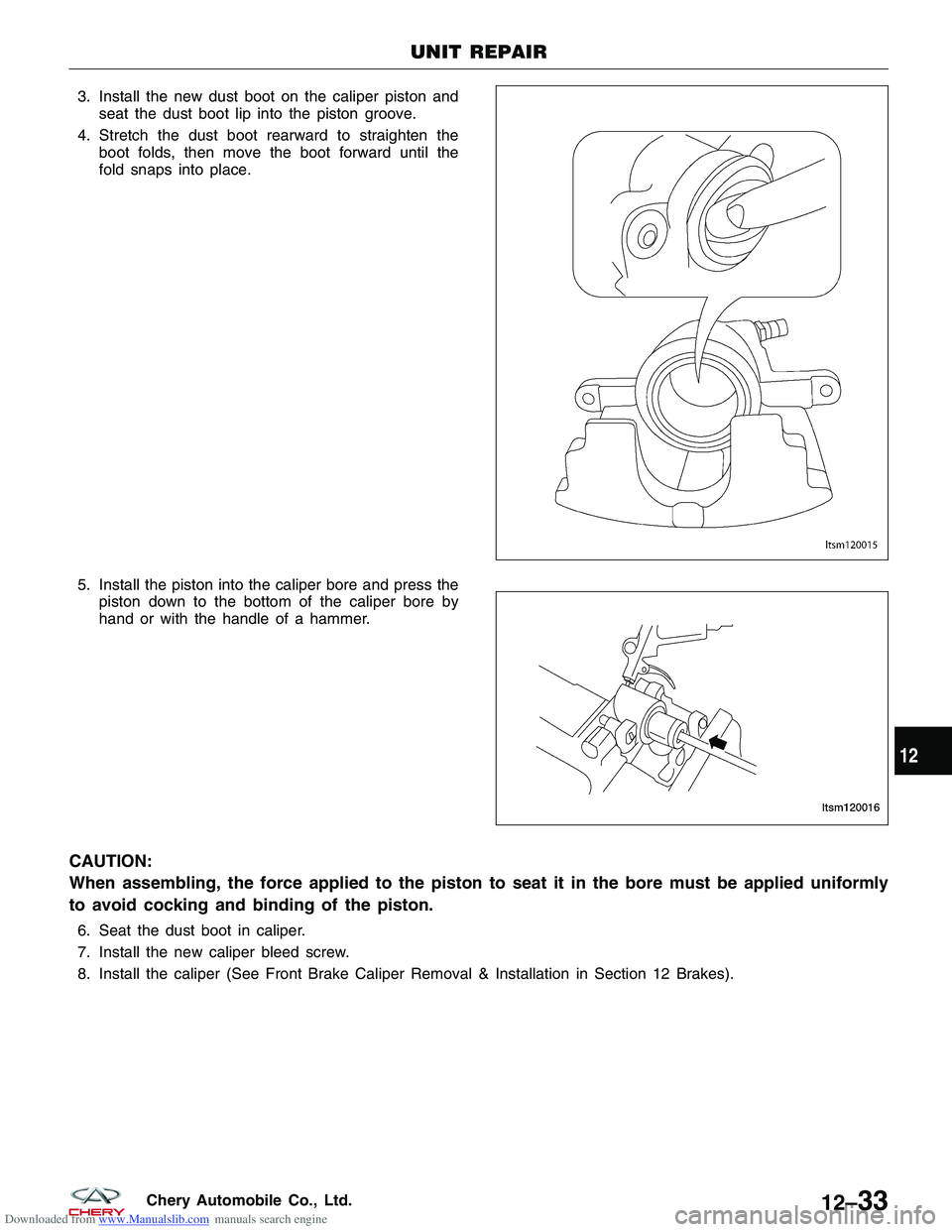
Downloaded from www.Manualslib.com manuals search engine 3. Install the new dust boot on the caliper piston andseat the dust boot lip into the piston groove.
4. Stretch the dust boot rearward to straighten the boot folds, then move the boot forward until the
fold snaps into place.
5. Install the piston into the caliper bore and press the piston down to the bottom of the caliper bore by
hand or with the handle of a hammer.
CAUTION:
When assembling, the force applied to the piston to seat it in the bore must be applied uniformly
to avoid cocking and binding of the piston.
6. Seat the dust boot in caliper.
7. Install the new caliper bleed screw.
8. Install the caliper (See Front Brake Caliper Removal & Installation in Section 12 Brakes).
UNIT REPAIR
LTSM120015
LTSM120016
12
12–33Chery Automobile Co., Ltd.
Page 1429 of 1903
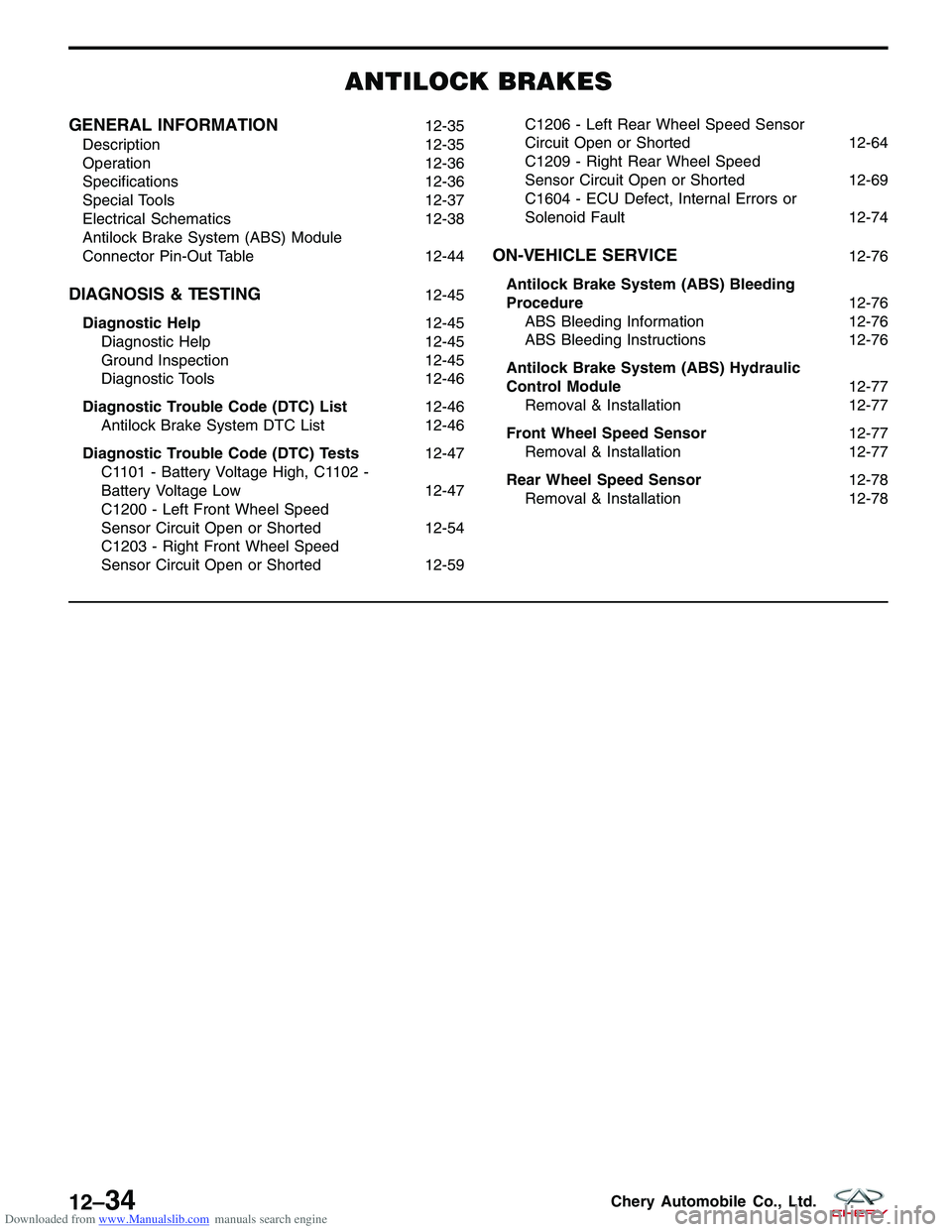
Downloaded from www.Manualslib.com manuals search engine ANTILOCK BRAKES
GENERAL INFORMATION12-35
Description 12-35
Operation 12-36
Specifications 12-36
Special Tools 12-37
Electrical Schematics 12-38
Antilock Brake System (ABS) Module
Connector Pin-Out Table 12-44
DIAGNOSIS & TESTING12-45
Diagnostic Help 12-45
Diagnostic Help 12-45
Ground Inspection 12-45
Diagnostic Tools 12-46
Diagnostic Trouble Code (DTC) List 12-46
Antilock Brake System DTC List 12-46
Diagnostic Trouble Code (DTC) Tests 12-47
C1101 - Battery Voltage High, C1102 -
Battery Voltage Low 12-47
C1200 - Left Front Wheel Speed
Sensor Circuit Open or Shorted 12-54
C1203 - Right Front Wheel Speed
Sensor Circuit Open or Shorted 12-59 C1206 - Left Rear Wheel Speed Sensor
Circuit Open or Shorted 12-64
C1209 - Right Rear Wheel Speed
Sensor Circuit Open or Shorted 12-69
C1604 - ECU Defect, Internal Errors or
Solenoid Fault 12-74
ON-VEHICLE SERVICE12-76
Antilock Brake System (ABS) Bleeding
Procedure 12-76
ABS Bleeding Information 12-76
ABS Bleeding Instructions 12-76
Antilock Brake System (ABS) Hydraulic
Control Module 12-77
Removal & Installation 12-77
Front Wheel Speed Sensor 12-77
Removal & Installation 12-77
Rear Wheel Speed Sensor 12-78
Removal & Installation 12-78
12–34Chery Automobile Co., Ltd.
Page 1430 of 1903
Downloaded from www.Manualslib.com manuals search engine GENERAL INFORMATION
Description
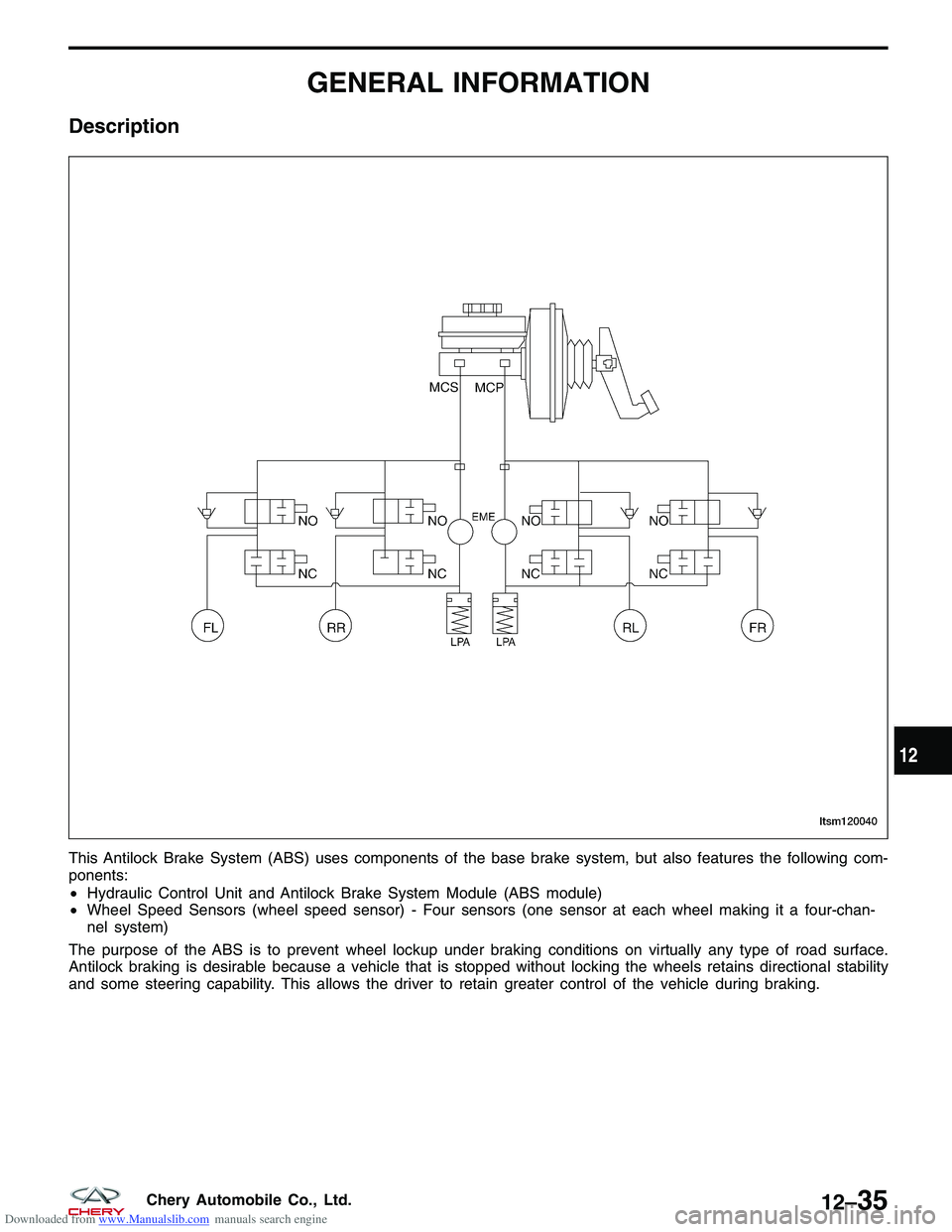
This Antilock Brake System (ABS) uses components of the base brake system, but also features the following com-
ponents:
•Hydraulic Control Unit and Antilock Brake System Module (ABS module)
• Wheel Speed Sensors (wheel speed sensor) - Four sensors (one sensor at each wheel making it a four-chan-
nel system)
The purpose of the ABS is to prevent wheel lockup under braking conditions on virtually any type of road surface.
Antilock braking is desirable because a vehicle that is stopped without locking the wheels retains directional stability
and some steering capability. This allows the driver to retain greater control of the vehicle during braking.LTSM120040
12
12–35Chery Automobile Co., Ltd.
Page 1431 of 1903
Downloaded from www.Manualslib.com manuals search engine Operation
ABS Braking
•ABS operation is available at all vehicle speeds above 20 km/h. If a wheel locking tendency is detected during
a brake application, the brake system enters the ABS mode. During ABS braking, hydraulic pressure in the four
wheel circuits is modulated to prevent any wheel from locking. Each wheel circuit is designed with a set of
electric solenoids to allow modulation. The system can build and release pressure at each wheel, depending on
signals generated by the wheel speed sensors at each wheel and received at the ABS Module.
• There are a few performance characteristics of the ABS that may at first seem abnormal, but in fact are nor-
mal. These characteristics are described below.
If the electrical system malfunctions, the Fail-Safe function is activated, the ABS becomes inoperative and
the ABS warning lamp turns on.
During ABS operation, the brake pedal may vibrate lightly and a mechanical noise may be heard. This is normal.
Stopping distance may be longer than that of vehicles without ABS when vehicle drives on rough, gravel, or snow-covered (fresh, deep snow) roads.
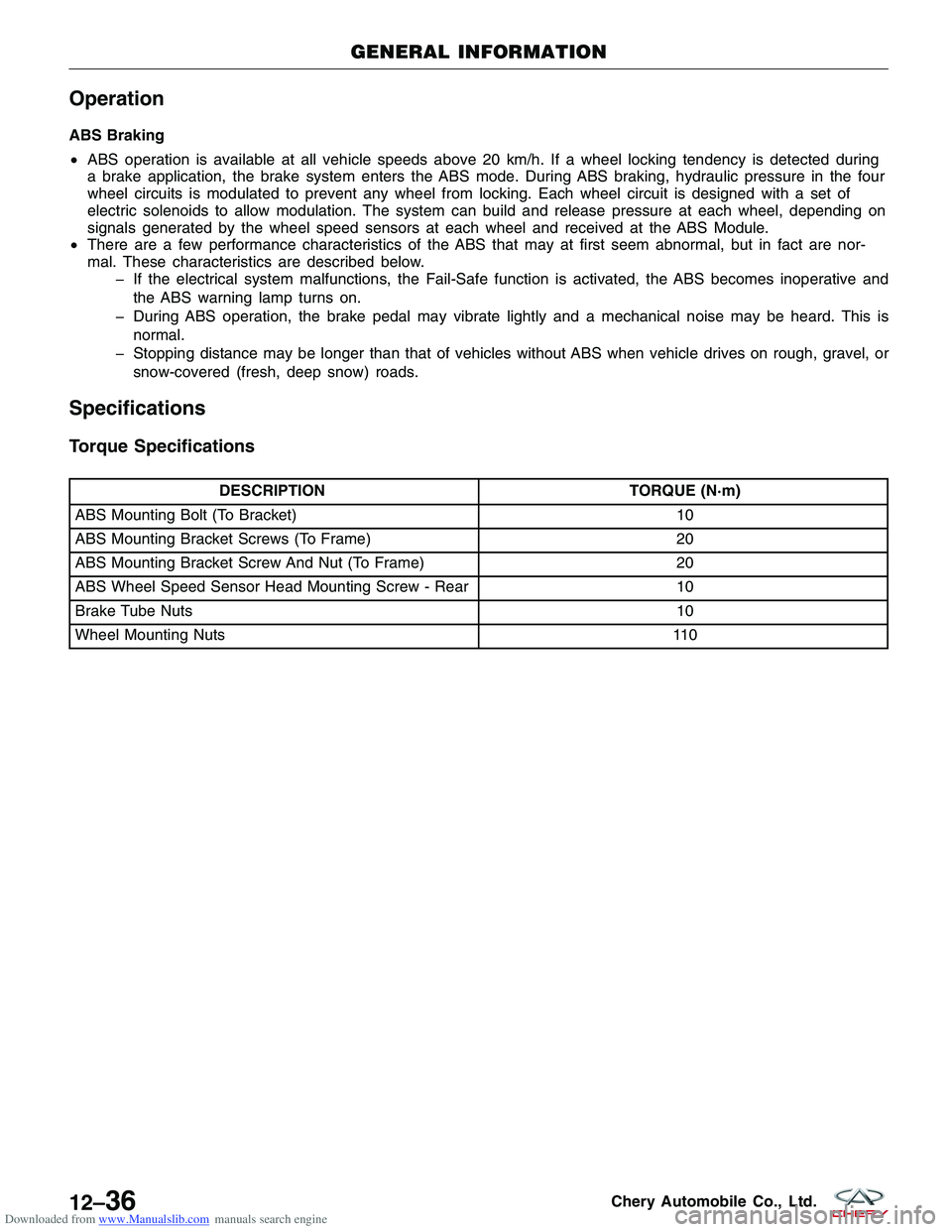
Specifications
Torque Specifications
DESCRIPTION TORQUE (N·m)
ABS Mounting Bolt (To Bracket) 10
ABS Mounting Bracket Screws (To Frame) 20
ABS Mounting Bracket Screw And Nut (To Frame) 20
ABS Wheel Speed Sensor Head Mounting Screw - Rear 10
Brake Tube Nuts 10
Wheel Mounting Nuts 110
GENERAL INFORMATION
12–36Chery Automobile Co., Ltd.
Page 1433 of 1903
Downloaded from www.Manualslib.com manuals search engine Electrical Schematics
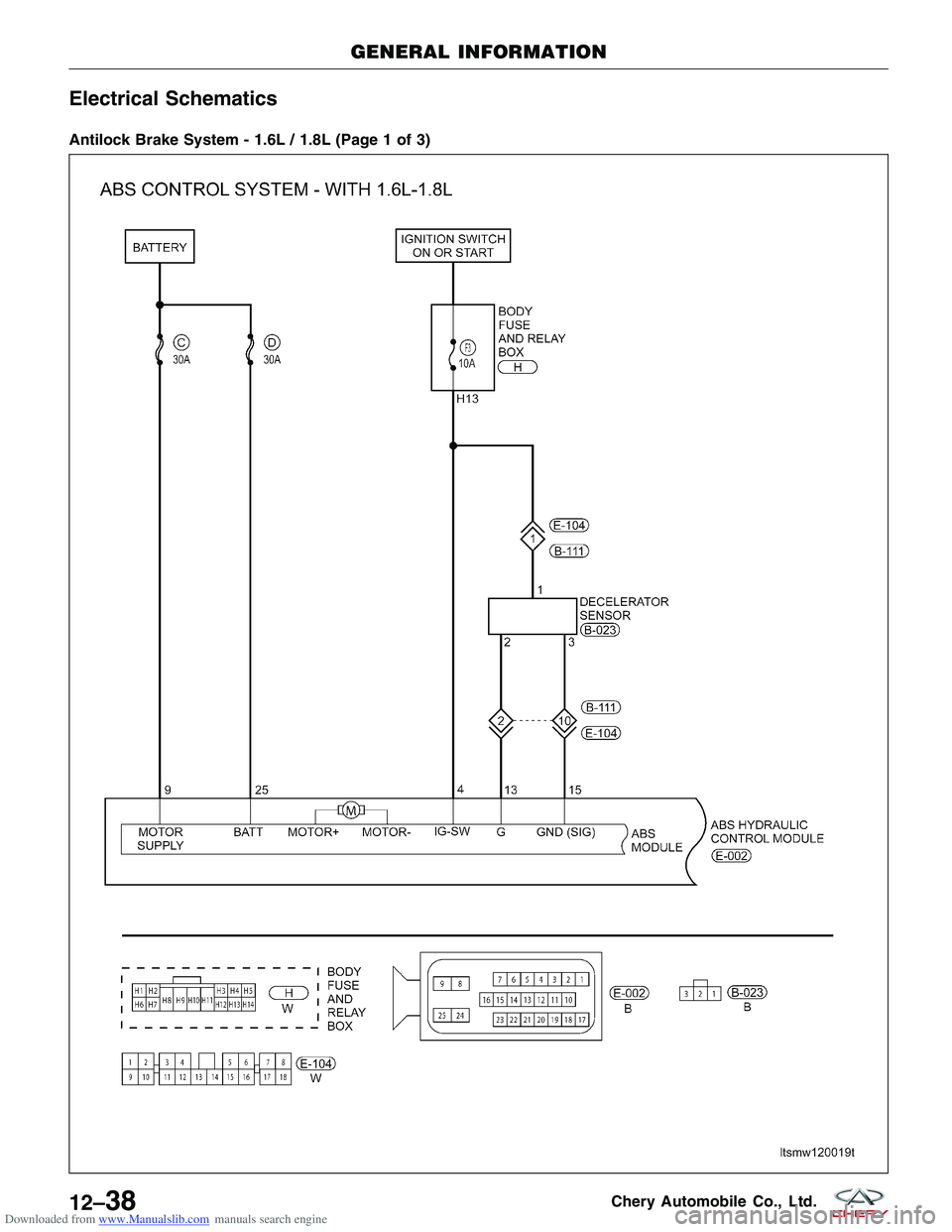
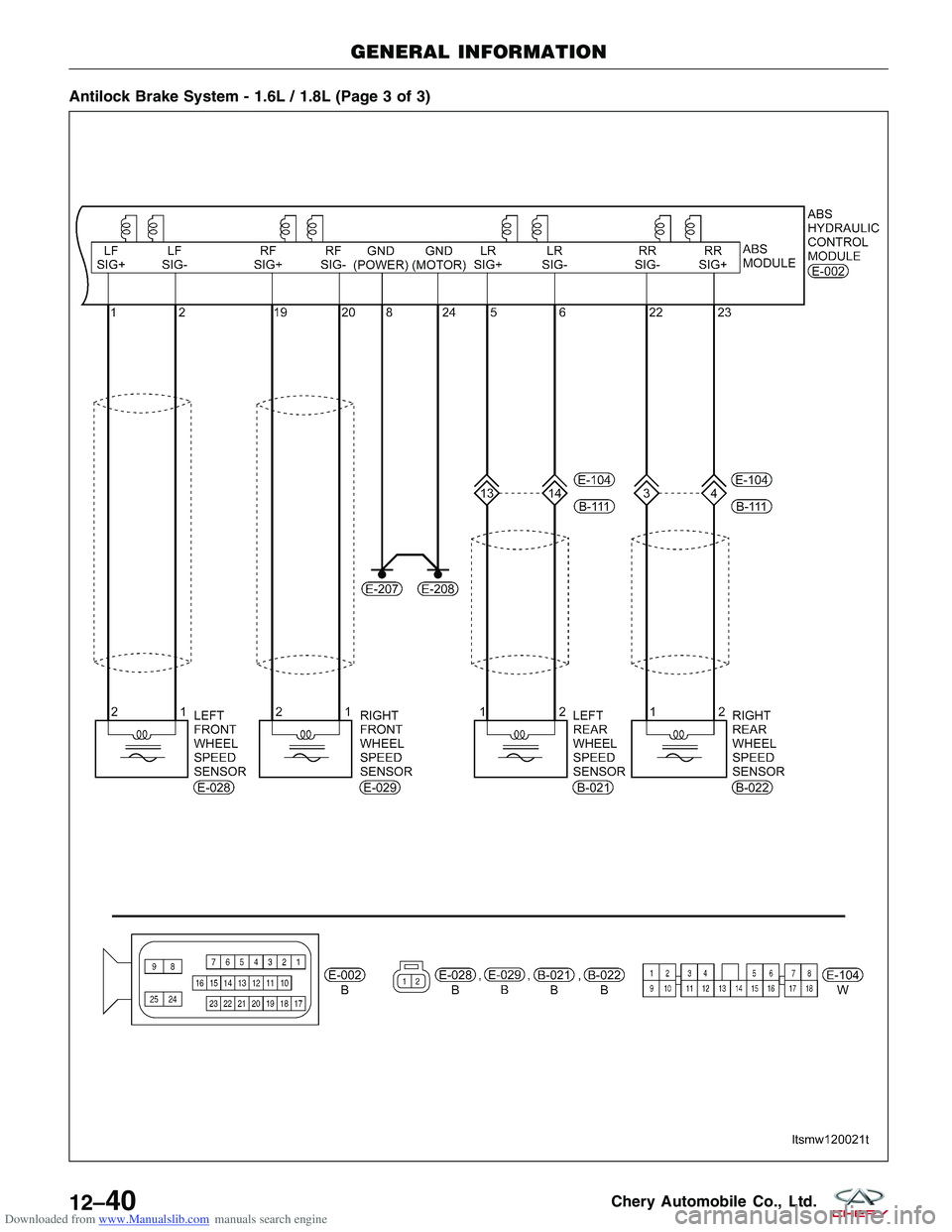
Antilock Brake System - 1.6L / 1.8L (Page 1 of 3)
GENERAL INFORMATION
LTSMW120019T
12–38Chery Automobile Co., Ltd.
Page 1434 of 1903
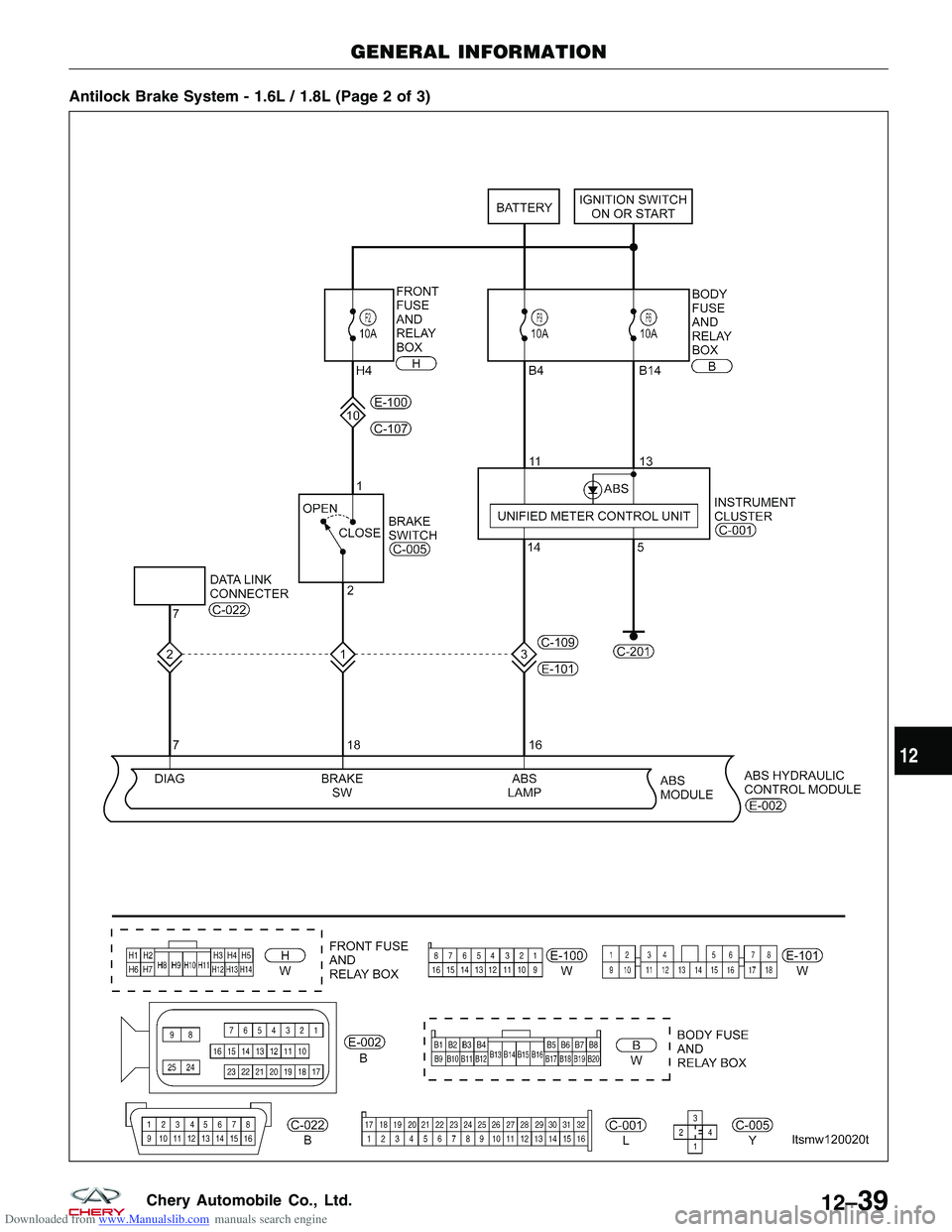
Downloaded from www.Manualslib.com manuals search engine Antilock Brake System - 1.6L / 1.8L (Page 2 of 3)
GENERAL INFORMATION
LTSMW120020T
12
12–39Chery Automobile Co., Ltd.
Page 1435 of 1903
Downloaded from www.Manualslib.com manuals search engine Antilock Brake System - 1.6L / 1.8L (Page 3 of 3)
GENERAL INFORMATION
LTSMW120021T
12–40Chery Automobile Co., Ltd.
Page 1436 of 1903
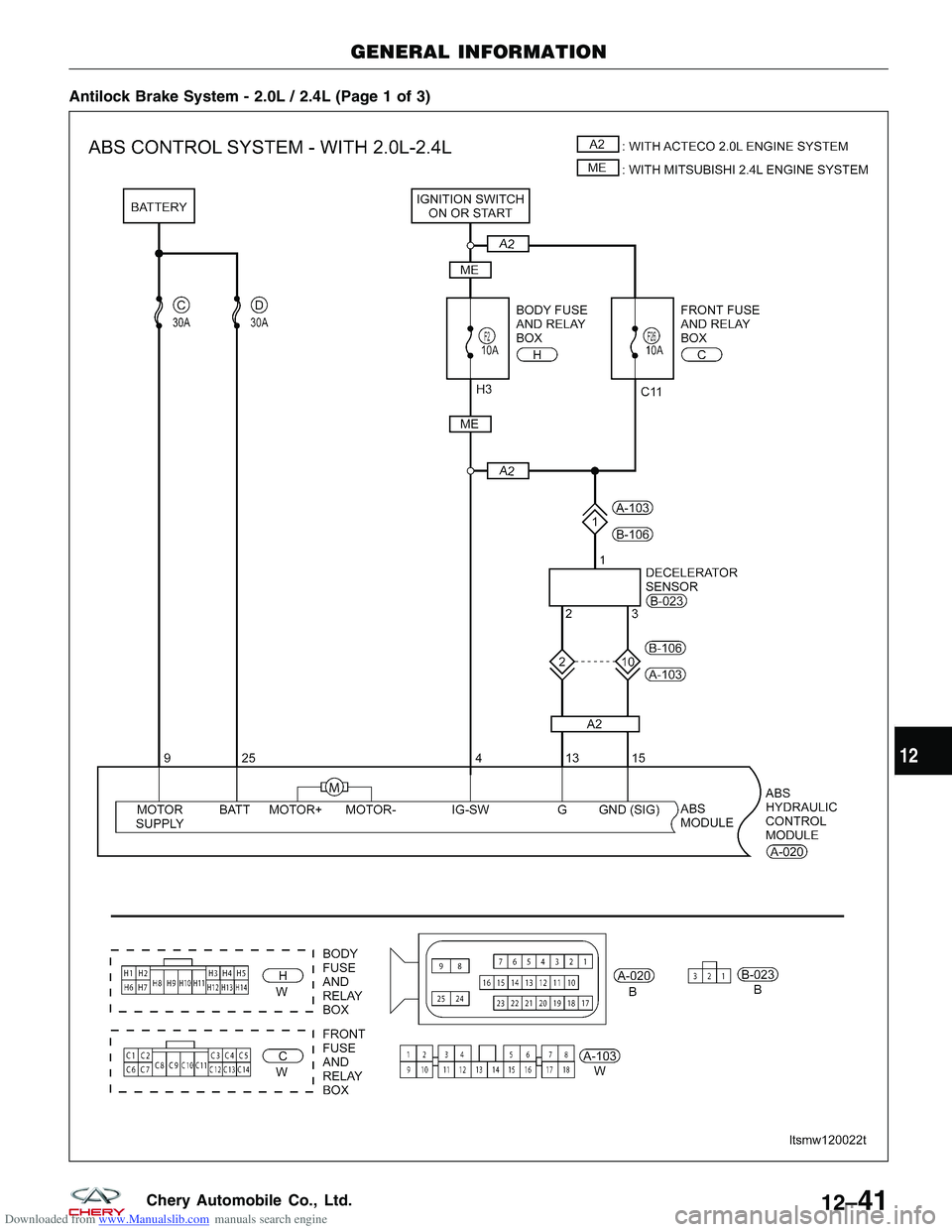
Downloaded from www.Manualslib.com manuals search engine Antilock Brake System - 2.0L / 2.4L (Page 1 of 3)
GENERAL INFORMATION
LTSMW120022T
12
12–41Chery Automobile Co., Ltd.
Page 1437 of 1903
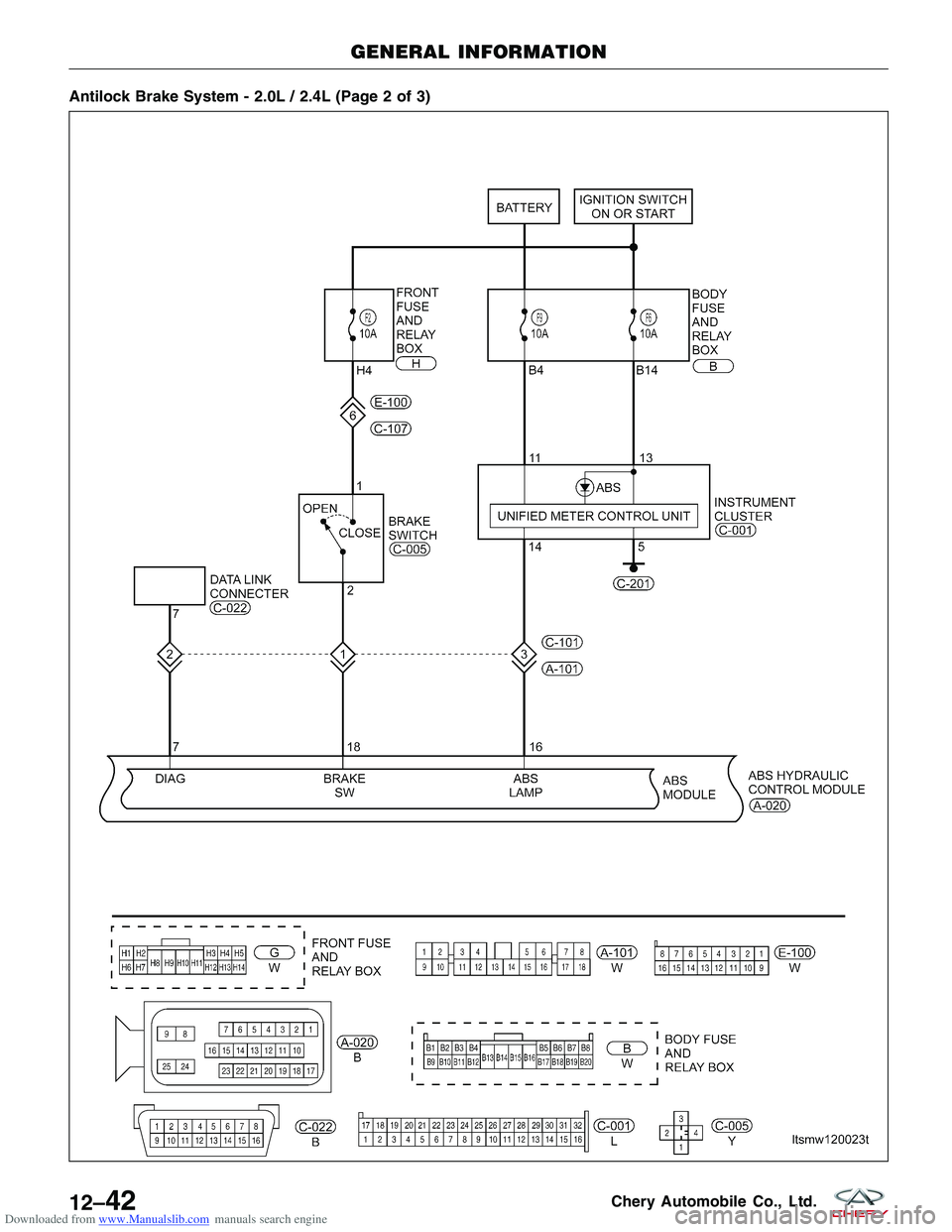
Downloaded from www.Manualslib.com manuals search engine Antilock Brake System - 2.0L / 2.4L (Page 2 of 3)
GENERAL INFORMATION
LTSMW120023T
12–42Chery Automobile Co., Ltd.
Page 1438 of 1903
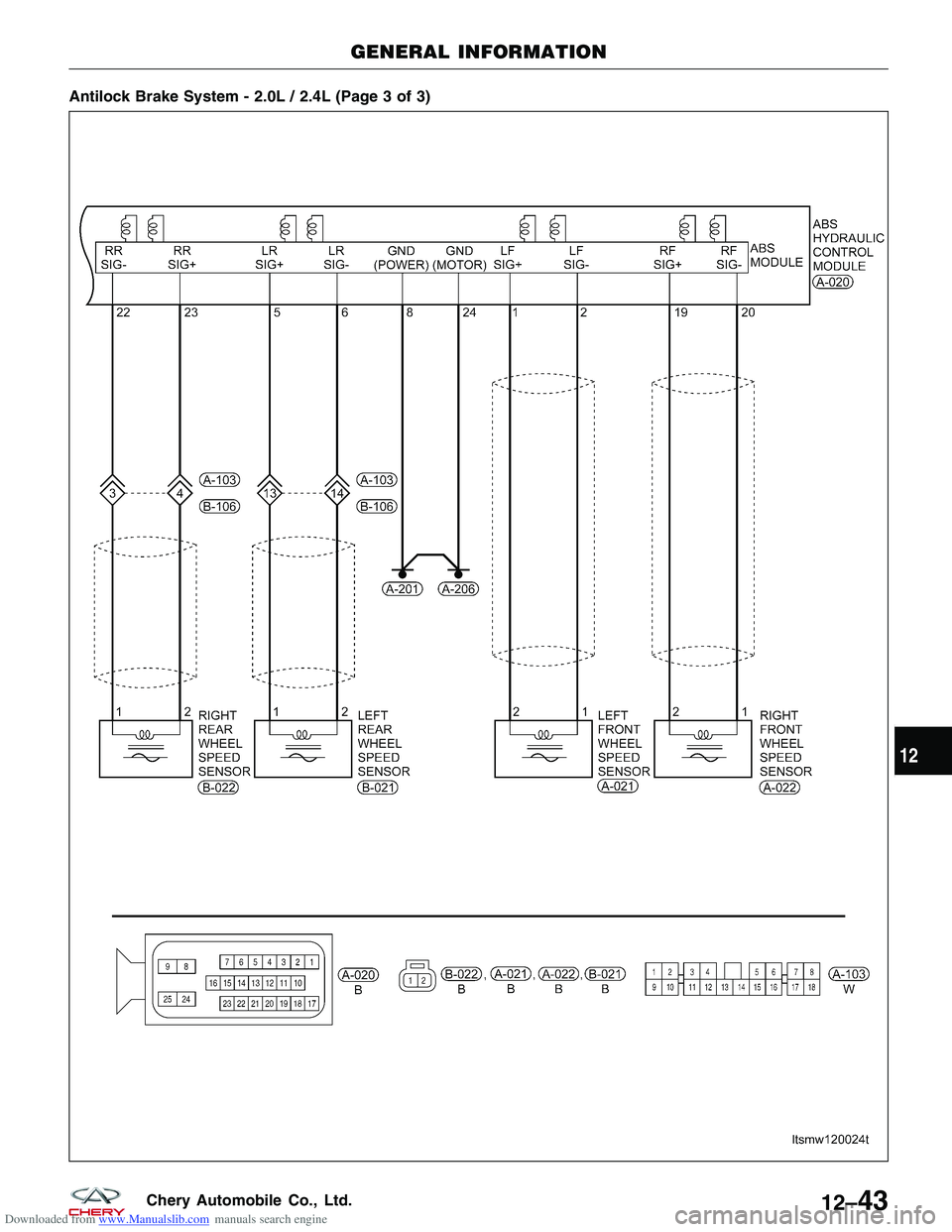
Downloaded from www.Manualslib.com manuals search engine Antilock Brake System - 2.0L / 2.4L (Page 3 of 3)
GENERAL INFORMATION
LTSMW120024T
12
12–43Chery Automobile Co., Ltd.