cooling CHERY TIGGO 2009 Service Workshop Manual
[x] Cancel search | Manufacturer: CHERY, Model Year: 2009, Model line: TIGGO, Model: CHERY TIGGO 2009Pages: 1903, PDF Size: 33.38 MB
Page 1080 of 1903
Downloaded from www.Manualslib.com manuals search engine 15. Remove the bolts attaching the transaxle cooling lines to the transaxle.
16. Remove the starter motor (See Starter Removal & Installation in Section 05 Starting & Charging).
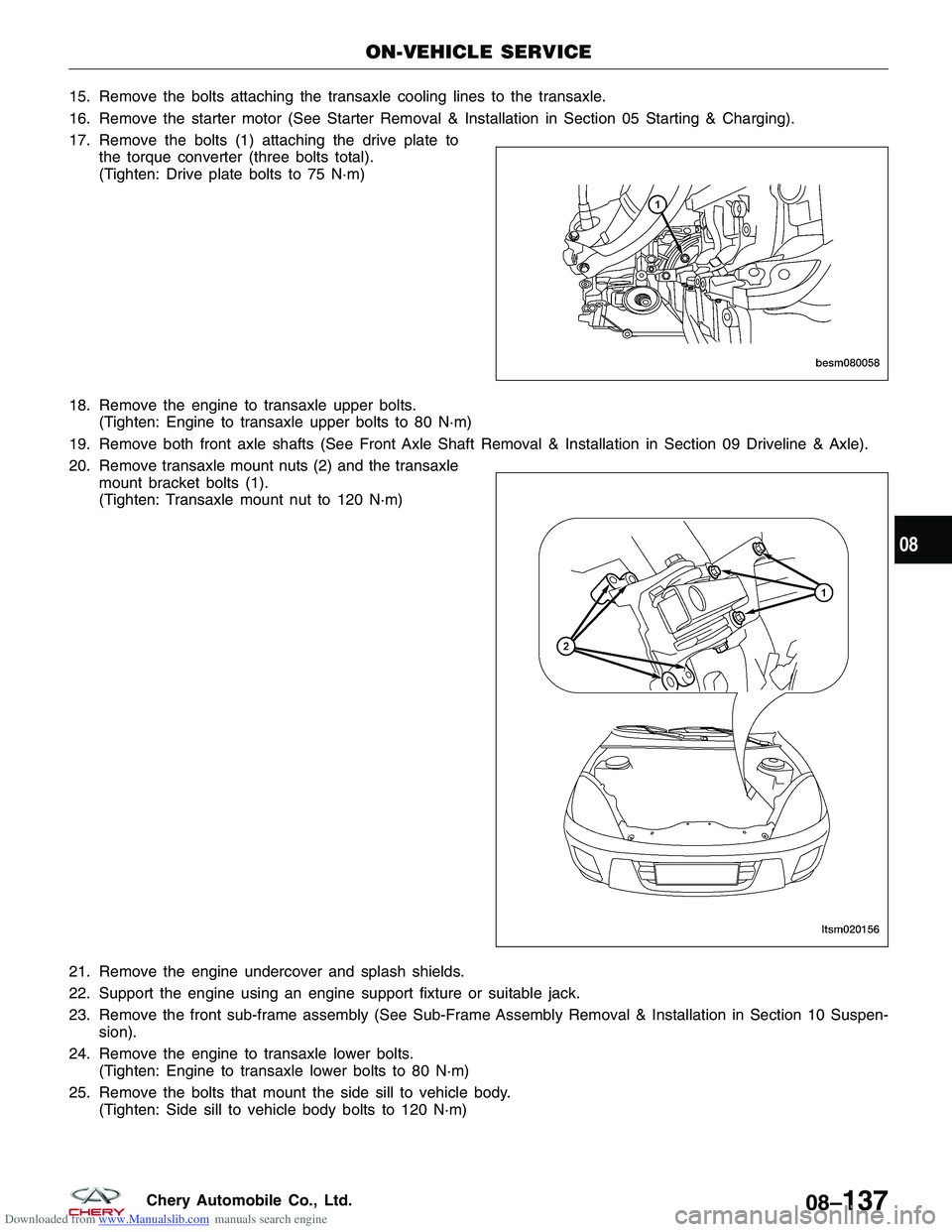
17. Remove the bolts (1) attaching the drive plate tothe torque converter (three bolts total).
(Tighten: Drive plate bolts to 75 N·m)
18. Remove the engine to transaxle upper bolts. (Tighten: Engine to transaxle upper bolts to 80 N·m)
19. Remove both front axle shafts (See Front Axle Shaft Removal & Installation in Section 09 Driveline & Axle).
20. Remove transaxle mount nuts (2) and the transaxle mount bracket bolts (1).
(Tighten: Transaxle mount nut to 120 N·m)
21. Remove the engine undercover and splash shields.
22. Support the engine using an engine support fixture or suitable jack.
23. Remove the front sub-frame assembly (See Sub-Frame Assembly Removal & Installation in Section 10 Suspen- sion).
24. Remove the engine to transaxle lower bolts. (Tighten: Engine to transaxle lower bolts to 80 N·m)
25. Remove the bolts that mount the side sill to vehicle body. (Tighten: Side sill to vehicle body bolts to 120 N·m)
ON-VEHICLE SERVICE
BESM080058
LTSM020156
08
08–137Chery Automobile Co., Ltd.
Page 1183 of 1903

Downloaded from www.Manualslib.com manuals search engine ON-VEHICLE SERVICE
F4A4 Automatic Transaxle Assembly
Removal & Installation
1. Raise and support the vehicle.
2. Disconnect the negative battery cable.
3. Remove the battery and battery tray (See Battery Removal & Installation in Section 05 Starting & Charging).
4. Remove the air cleaner and air duct assembly.
5. Drain the cooling system (See Cooling System Draining Procedure in Section 06 Cooling System).
6. Remove the base mounting bolts (1) of the aircleaner housing assembly.
7. Disconnect and remove the electrical connectors for the following components:• Output shaft sensor (1)
• Input shaft sensor (2)
• Electromagnetic valve switch connector (3)
• Gear switch connector (5)
8. Disconnect the transaxle fluid lines (6) using a suit- able tool.
9. Remove the shift cable (4) from the transaxle assembly.
10. Remove the starter motor (See Starter Removal & Installation in Section 05 Starting & Charging).
BESM080038
LTSM080153
08–240Chery Automobile Co., Ltd.
Page 1203 of 1903

Downloaded from www.Manualslib.com manuals search engine ON-VEHICLE SERVICE
Manual Transaxle Assembly
Removal & Installation
NOTE :
The following special tools are required to perform the repair procedure:
•MB-990938 - Handle
• MB-990935 - Installer Connector
1. Raise and support the vehicle.
2. Disconnect the negative battery cable.
3. Remove the battery and battery tray (See Battery Removal & Installation in Section 05 Starting & Charging).
4. Remove air cleaner and air duct.
5. Drain the cooling system (See Cooling System Draining Procedure in Section 06 Cooling System).
6. Remove the base mounting of the air cleaner housing assembly.
7. Remove the backup lamp switch (2) and vehicle speed sensor (1).
LTSM020226
LTSM030029
08–260Chery Automobile Co., Ltd.
Page 1484 of 1903
Downloaded from www.Manualslib.com manuals search engine GENERAL INFORMATION
Description
This vehicle is equipped with a common HVAC housing assembly. The system combines air conditioning, heating,
and ventilating capabilities in a single unit housing mounted under the instrument panel. The driver can choose the
following functions from HVAC control panel:
•The inside temperature
• The speed of the blower
• Five different modes of operation
• A/C compressor clutch operation
• Recirculation door position
NOTE :
To maintain the performance level of the heating, ventilation and air conditioning (HVAC) system, the engine cooling
system must be properly maintained. Any obstructions in front of the radiator or A/C condenser will reduce the per-
formance of the A/C and engine cooling systems.
13–2Chery Automobile Co., Ltd.
Page 1495 of 1903
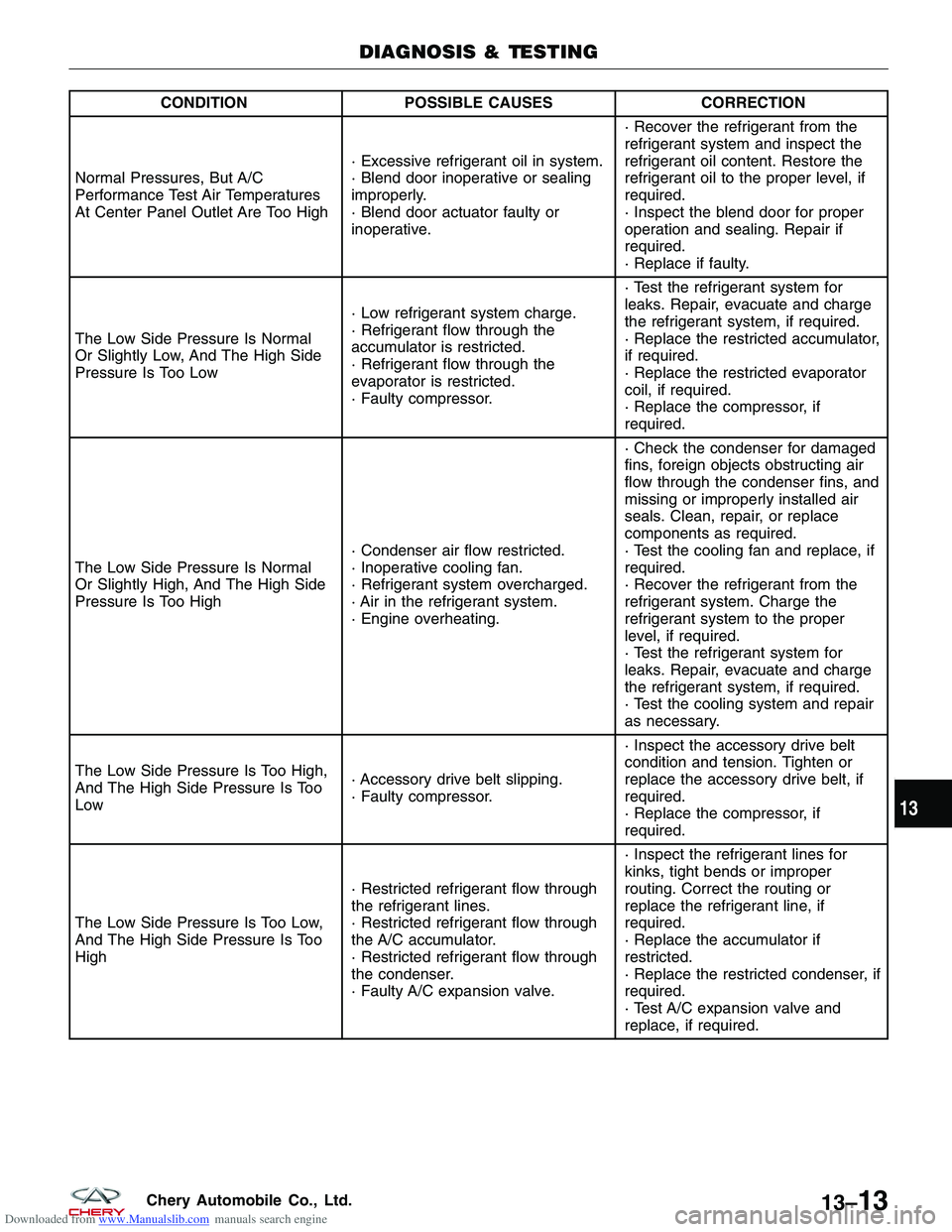
Downloaded from www.Manualslib.com manuals search engine CONDITIONPOSSIBLE CAUSES CORRECTION
Normal Pressures, But A/C
Performance Test Air Temperatures
At Center Panel Outlet Are Too High · Excessive refrigerant oil in system.
· Blend door inoperative or sealing
improperly.
· Blend door actuator faulty or
inoperative.· Recover the refrigerant from the
refrigerant system and inspect the
refrigerant oil content. Restore the
refrigerant oil to the proper level, if
required.
· Inspect the blend door for proper
operation and sealing. Repair if
required.
· Replace if faulty.
The Low Side Pressure Is Normal
Or Slightly Low, And The High Side
Pressure Is Too Low · Low refrigerant system charge.
· Refrigerant flow through the
accumulator is restricted.
· Refrigerant flow through the
evaporator is restricted.
· Faulty compressor.· Test the refrigerant system for
leaks. Repair, evacuate and charge
the refrigerant system, if required.
· Replace the restricted accumulator,
if required.
· Replace the restricted evaporator
coil, if required.
· Replace the compressor, if
required.
The Low Side Pressure Is Normal
Or Slightly High, And The High Side
Pressure Is Too High · Condenser air flow restricted.
· Inoperative cooling fan.
· Refrigerant system overcharged.
· Air in the refrigerant system.
· Engine overheating.· Check the condenser for damaged
fins, foreign objects obstructing air
flow through the condenser fins, and
missing or improperly installed air
seals. Clean, repair, or replace
components as required.
· Test the cooling fan and replace, if
required.
· Recover the refrigerant from the
refrigerant system. Charge the
refrigerant system to the proper
level, if required.
· Test the refrigerant system for
leaks. Repair, evacuate and charge
the refrigerant system, if required.
· Test the cooling system and repair
as necessary.
The Low Side Pressure Is Too High,
And The High Side Pressure Is Too
Low · Accessory drive belt slipping.
· Faulty compressor.· Inspect the accessory drive belt
condition and tension. Tighten or
replace the accessory drive belt, if
required.
· Replace the compressor, if
required.
The Low Side Pressure Is Too Low,
And The High Side Pressure Is Too
High · Restricted refrigerant flow through
the refrigerant lines.
· Restricted refrigerant flow through
the A/C accumulator.
· Restricted refrigerant flow through
the condenser.
· Faulty A/C expansion valve.· Inspect the refrigerant lines for
kinks, tight bends or improper
routing. Correct the routing or
replace the refrigerant line, if
required.
· Replace the accumulator if
restricted.
· Replace the restricted condenser, if
required.
· Test A/C expansion valve and
replace, if required.
DIAGNOSIS & TESTING
13
13–13Chery Automobile Co., Ltd.
Page 1496 of 1903
Downloaded from www.Manualslib.com manuals search engine Heater Performance
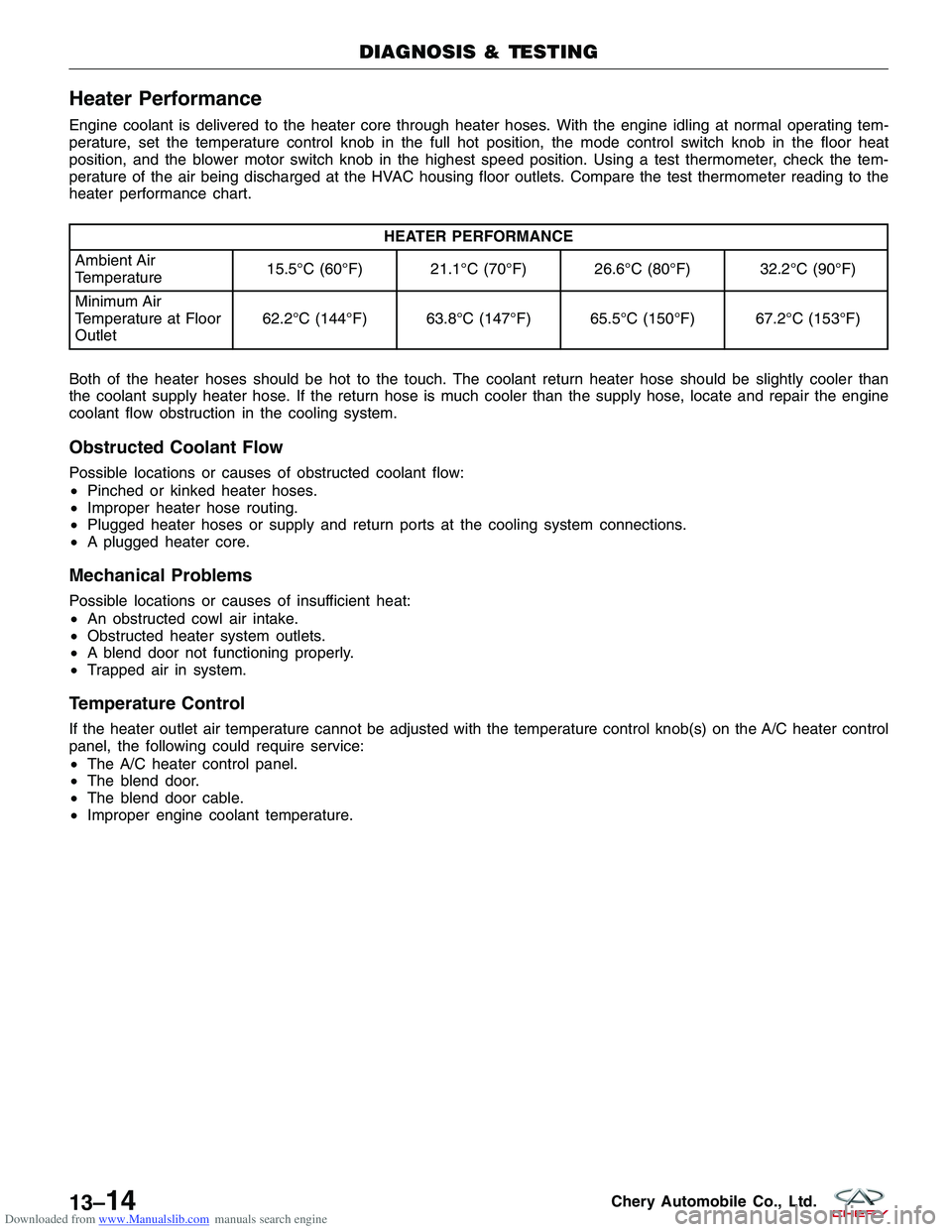
Engine coolant is delivered to the heater core through heater hoses. With the engine idling at normal operating tem-
perature, set the temperature control knob in the full hot position, the mode control switch knob in the floor heat
position, and the blower motor switch knob in the highest speed position. Using a test thermometer, check the tem-
perature of the air being discharged at the HVAC housing floor outlets. Compare the test thermometer reading to the
heater performance chart.
HEATER PERFORMANCE
Ambient Air
Temperature 15.5°C (60°F) 21.1°C (70°F) 26.6°C (80°F) 32.2°C (90°F)
Minimum Air
Temperature at Floor
Outlet 62.2°C (144°F) 63.8°C (147°F) 65.5°C (150°F) 67.2°C (153°F)
Both of the heater hoses should be hot to the touch. The coolant return heater hose should be slightly cooler than
the coolant supply heater hose. If the return hose is much cooler than the supply hose, locate and repair the engine
coolant flow obstruction in the cooling system.
Obstructed Coolant Flow
Possible locations or causes of obstructed coolant flow:
• Pinched or kinked heater hoses.
• Improper heater hose routing.
• Plugged heater hoses or supply and return ports at the cooling system connections.
• A plugged heater core.
Mechanical Problems
Possible locations or causes of insufficient heat:
•An obstructed cowl air intake.
• Obstructed heater system outlets.
• A blend door not functioning properly.
• Trapped air in system.
Temperature Control
If the heater outlet air temperature cannot be adjusted with the temperature control knob(s) on the A/C heater control
panel, the following could require service:
•The A/C heater control panel.
• The blend door.
• The blend door cable.
• Improper engine coolant temperature.
DIAGNOSIS & TESTING
13–14Chery Automobile Co., Ltd.
Page 1511 of 1903
Downloaded from www.Manualslib.com manuals search engine ON-VEHICLE SERVICE
HVAC Housing
Removal & Installation
1. Evacuate the A/C system (See A/C System Evacuation and Recharge in Section 13 Heating & Air Conditioning).
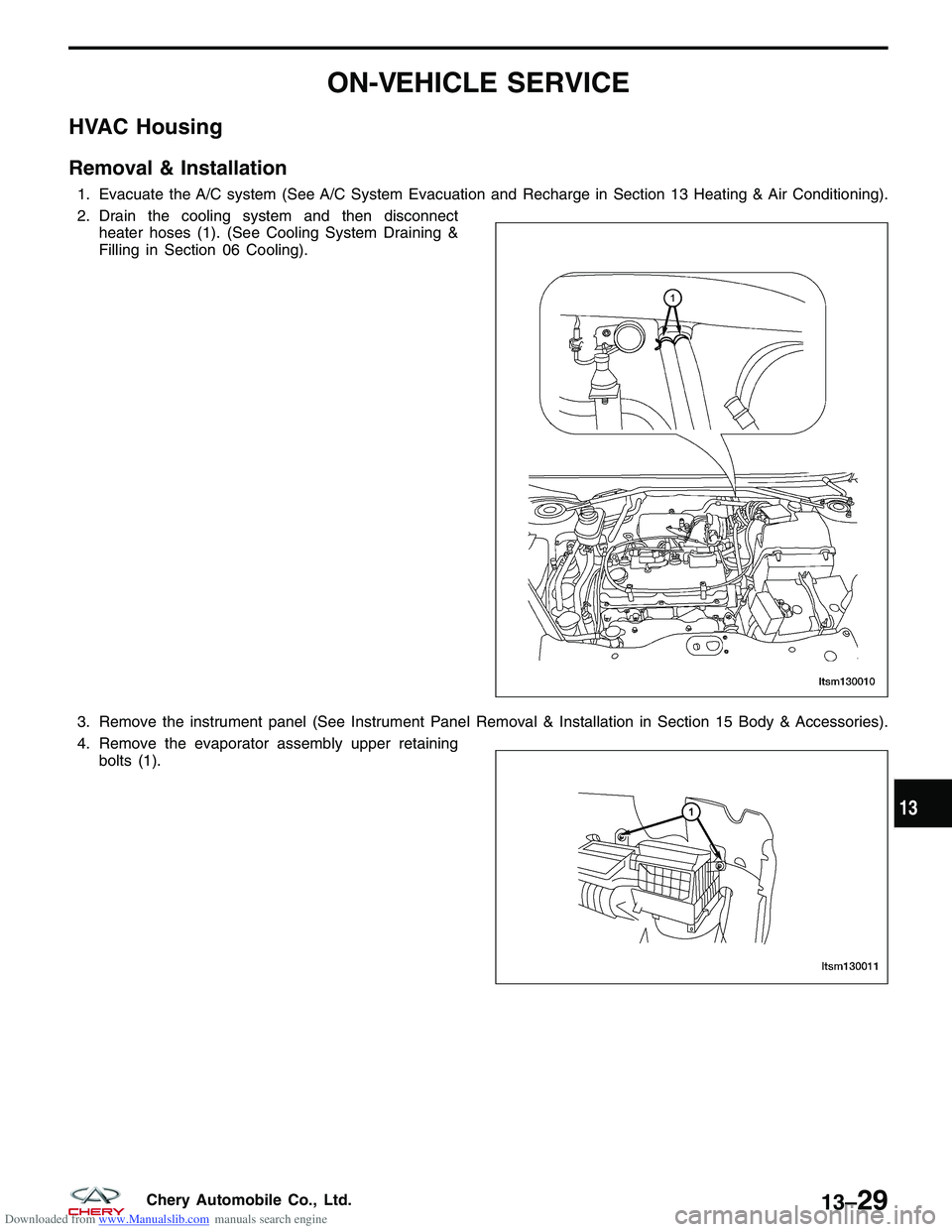
2. Drain the cooling system and then disconnectheater hoses (1). (See Cooling System Draining &
Filling in Section 06 Cooling).
3. Remove the instrument panel (See Instrument Panel Removal & Installation in Section 15 Body & Accessories).
4. Remove the evaporator assembly upper retaining bolts (1).
LTSM130010
LTSM130011
13
13–29Chery Automobile Co., Ltd.
Page 1524 of 1903
Downloaded from www.Manualslib.com manuals search engine •Use only refrigerant oil of the type recommended for the A/C compressor in the vehicle.
• Recharge the A/C system (See A/C System Evacuation and Recharge in Section 13 Heating & Air Condition-
ing).
Evaporator
Description
The evaporator core is located in the HVAC housing, under the instrument panel. The evaporator coil is positioned in
the HVAC housing so that all air that enters the housing must pass over the fins of the evaporator before it is dis-
tributed through the system ducts and outlets. However, air passing over the evaporator core fins will only be con-
ditioned when the compressor is engaged and circulating refrigerant through the evaporator coil tubes.
Operation
Refrigerant enters the evaporator from the orifice tube as a low-temperature, low-pressure liquid. As air flows over
the fins of the evaporator, the humidity in the air condenses on the fins, and the heat from the air is absorbed by the
refrigerant. Heat absorption causes the refrigerant to boil and vaporize. The refrigerant becomes a low-pressure gas
before it leaves the evaporator. The evaporator core housing directs airflow from the blower motor through the evap-
orator core and heater core. All airflow from the blower motor passes through the evaporator core. The airflow is then
directed through or around the heater core by the temperature blend door(s).
Removal & Installation
1. Evacuate the A/C system (See A/C System Evacuation and Recharge in Section 13 Heating & Air Conditioning).
2. Remove the expansion valve.
3. Remove the HVAC housing (See HVAC Housing Removal and Installation in Section 13 Heating & Air Condi-
tioning).
4. Remove the retaining bolts and screws.
5. Remove the evaporator core.
6. Installation is in the reverse order of removal.
Installation Notes:
• Lubricate new rubber O-ring seals with clean refrigerant oil and install them and new gaskets onto the refriger-
ant line fittings.
• Use only the specified O-rings as they are made of a special material for the R-134a system.
• Use only refrigerant oil of the type recommended for the A/C compressor in the vehicle.
• Recharge the A/C system (See A/C System Evacuation and Recharge in Section 13 Heating & Air Condition-
ing).
Condenser
Description
The condenser is located in the air flow in front of the engine cooling radiator. The condenser transforms the refrig-
erant from a gas into a liquid. It is attached to the vehicle with bolts and the A/C lines with fittings.
Operation
When the heat is removed from the refrigerant, it condenses. When the refrigerant leaves the condenser, it becomes
a high-pressure liquid refrigerant. The volume of air flowing over the condenser fins is critical to the proper cooling
performance of the air conditioning system. Therefore, it is important that there are no objects placed in front of the
radiator grille openings in the front of the vehicle or foreign material on the condenser fins that might obstruct proper
air flow. Also, any factory-installed air seals or shrouds must be properly reinstalled following radiator or condenser
service.
ON-VEHICLE SERVICE
13–42Chery Automobile Co., Ltd.
Page 1529 of 1903
Downloaded from www.Manualslib.com manuals search engine Heater Core
Description
The heater core is located in the HVAC housing. The heater core is a heat exchanger made of rows of tubes with
fins and is positioned within the air distribution housing so that only the selected amount of air entering the housing
passes through the heater core before it is distributed through the heating-A/C system ducts and outlets. One end of
the heater core is fitted with a tank that includes the fittings for the heater core tubes. The heater core can only be
serviced by removing the HVAC housing from the vehicle.
Operation
Engine coolant is circulated through the heater hoses to the heater core at all times. As the coolant flows through the
heater core, heat is removed from the engine and is transferred to the heater core tubes and fins. Air directed
through the heater core picks up the heat from the heater core fins. The blend-air door allows control of the heater
output air temperature by regulating the amount of air flowing through the heater core. The blower motor speed con-
trols the volume of air flowing through the HVAC housing.
Removal & Installation
1. Drain the cooling system (See Cooling System Draining Procedure in Section 06 Cooling System).
2. Evacuate the A/C system (See A/C System Evacuation and Recharge in Section 13 Heating & Air Conditioning).
3. Remove the HVAC housing assembly and place it on a workbench (See HVAC Housing Removal & Installationin Section 13 Heating & Air Conditioning).
4. Remove the retaining bolts and clamps.
5. Remove the heater core.
6. Installation is in the reverse order of removal.
Installation Notes:
• Verify the cooling system is filled to proper specifications.
ON-VEHICLE SERVICE
13
13–47Chery Automobile Co., Ltd.
Page 1882 of 1903
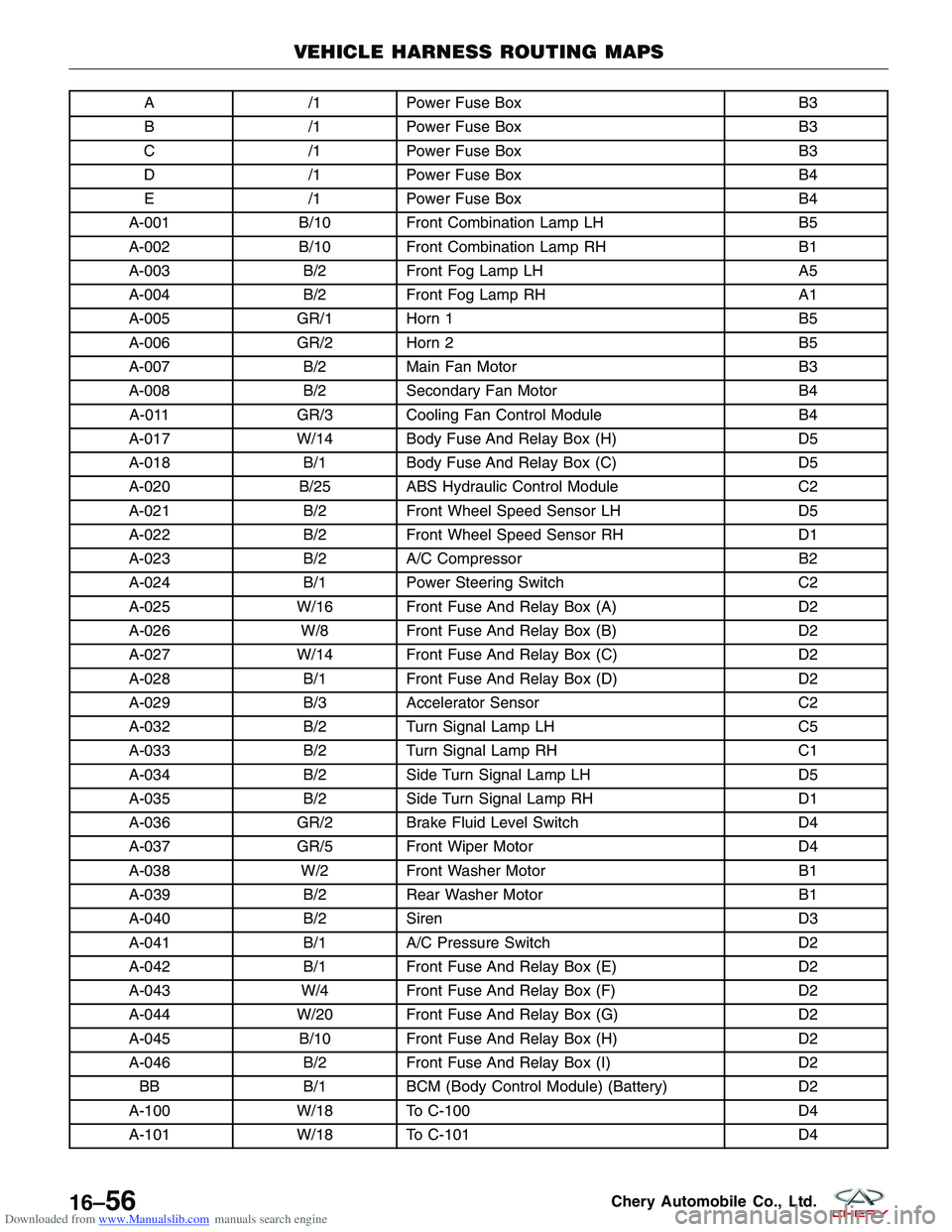
Downloaded from www.Manualslib.com manuals search engine A/1Power Fuse Box B3
B /1Power Fuse Box B3
C /1Power Fuse Box B3
D /1Power Fuse Box B4
E /1Power Fuse Box B4
A-001 B/10 Front Combination Lamp LH B5
A-002 B/10 Front Combination Lamp RH B1
A-003 B/2Front Fog Lamp LH A5
A-004 B/2Front Fog Lamp RH A1
A-005 GR/1 Horn 1 B5
A-006 GR/2 Horn 2 B5
A-007 B/2Main Fan Motor B3
A-008 B/2Secondary Fan Motor B4
A-011 GR/3 Cooling Fan Control Module B4
A-017 W/14 Body Fuse And Relay Box (H) D5
A-018 B/1Body Fuse And Relay Box (C) D5
A-020 B/25 ABS Hydraulic Control Module C2
A-021 B/2Front Wheel Speed Sensor LH D5
A-022 B/2Front Wheel Speed Sensor RH D1
A-023 B/2A/C Compressor B2
A-024 B/1Power Steering Switch C2
A-025 W/16 Front Fuse And Relay Box (A) D2
A-026 W/8 Front Fuse And Relay Box (B) D2
A-027 W/14 Front Fuse And Relay Box (C) D2
A-028 B/1Front Fuse And Relay Box (D) D2
A-029 B/3Accelerator Sensor C2
A-032 B/2Turn Signal Lamp LH C5
A-033 B/2Turn Signal Lamp RH C1
A-034 B/2Side Turn Signal Lamp LH D5
A-035 B/2Side Turn Signal Lamp RH D1
A-036 GR/2 Brake Fluid Level Switch D4
A-037 GR/5 Front Wiper Motor D4
A-038 W/2 Front Washer Motor B1
A-039 B/2Rear Washer Motor B1
A-040 B/2Siren D3
A-041 B/1A/C Pressure Switch D2
A-042 B/1Front Fuse And Relay Box (E) D2
A-043 W/4 Front Fuse And Relay Box (F) D2
A-044 W/20 Front Fuse And Relay Box (G) D2
A-045 B/10 Front Fuse And Relay Box (H) D2
A-046 B/2Front Fuse And Relay Box (I) D2
BB B/1BCM (Body Control Module) (Battery) D2
A-100 W/18 To C-100 D4
A-101 W/18 To C-101 D4
VEHICLE HARNESS ROUTING MAPS
16–56Chery Automobile Co., Ltd.