clock CHEVROLET ASTRO 1996 User Guide
[x] Cancel search | Manufacturer: CHEVROLET, Model Year: 1996, Model line: ASTRO, Model: CHEVROLET ASTRO 1996Pages: 372, PDF Size: 21.51 MB
Page 141 of 372
SCV: This is the Speed-Compensated-Volume (SCV)
knob. Move the control ring behind the PWR-VOL
knob clockwise
to adjust the SCV. Set the volume at
the desired level. As you drive, the SCV automatically
increases the volume, as necessary, to overcome road
and wind noise at any particular speed. The volume
should always sound
the same. Each clockwise position
on the control ring allows for more compensation at a
faster rate.
Finding a
AM-FM: Press this button to switch between AM,
FM1 and FM2. The display will show your selection.
TUNE: Press lightly on this knob to release it from its
stored position. Rotate the knob clockwise
to increase
frequency and counterclockwise to decrease frequency.
When finished tuning, press the knob again
to return it
to its stored position.
SEEK: Press the right arrow to tune to the next higher
station and the left arrow to tune
to the next lower
station and stay there. There will be
no sound when
using the
SEEK feature.
SCAN: Press and hold SEEK for two seconds until
SCAN appears
on the display. SCAN allows you to
listen to stations for a few seconds. The receiver will
continue to scan and momentarily stop at each station
until you press the button again. There will be no sound
when using
the SCAN feature.
PUSHBUTTONS: The six numbered pushbuttons let
you return to your favorite stations. You can set up to
18 stations (six AM, six
FM 1 and six FM2).
1.
2.
3.
4.
5.
Press AM-FM to select the band.
Tune
in the desired station by pressing TUNE or the
SEEK left or right arrows.
Press AUTO TONE
to select the setting you prefer.
Press and hold one of the four pushbuttons.
The sound will mute. When
it returns, release the
button. Whenever you press that numbered button, the
station you set
will return and the tone you selected
will be automatically selected for that button.
3-17
Page 142 of 372
P.SCAN: The preset scan button lets you scan through
your favorite stations stored on your pushbuttons. Select
either the AM,
FMl or FM2 mode and then press
P.SCAN. It will scan through each station stored on
your pushbuttons and stop for a few seconds before
continuing to scan through all of the pushbuttons.
Press P.SCAN again or one
of the pushbuttons to stop
scanning to listen to a specific stored station. PSCAN
will light up on the display while in this mode. If one of
the stations stored
on a pushbutton is too weak for the
location you are in, the radio display will show the
channel number (Pl-P6)
for several seconds before
advancing
to the next preset station.
Setting the Tone
AUTO TONE: Press this button to select among the
five preset equalization settings and tailor the sound to
the music or voice being heard. Each time you press the
button, the selection will switch
to one of the preset
settings
of CLASSIC, NEWS, ROCK, POP or JAZZ.
The display will show which mode the receiver
is in. To
return to the manual mode, press and release this button
until MAN appears
on the display. This will return the
tone adjustment to the TREB and BASS controls. When
a TREB or BASS control is rotated, tone
is
automatically set to MAN.
BASS: Press lightly on this knob to release it from its
stored position. Turn
the knob clockwise to increase the
bass and counterclockwise
to decrease the bass. When
the
BASS control is rotated, the AUTO TONE setting
will change to MAN. Push
the knob back in to its stored
position when done.
TREB: Press lightly on the TREB knob to release it
from its stored position. Turn the knob clockwise to
increase the treble and counterclockwise to decrease the
treble. When the TREB control is rotated, the AUTO
TONE setting will change to MAN. Push the knob back
in to its stored position when done.
Adjusting the Speakers
BAL: Press this button to remove the control from its
stored position. Turn
the control clockwise to adjust
sound to the right speakers and counterclockwise to
adjust sound
to the left speakers. Press the button
again to return BAL
to its stored position.
FADE: Press this button to remove the control from
its stored position. Turn the control clockwise to adjust
the sound to the front and counterclockwise for rear
speakers. Press the button again
to return FADE to its
stored position.
3-18
Page 147 of 372
P.SET PROG: The front passengers must be listening
to something different for each of these three functions
to work:
0 Press this button to seek through your preset radio
stations set on your primary radio pushbuttons.
0 When a cassette tape is playing, press this button to
go to the other side of the tape.
VOL: Press this knob lightly so it extends. Turn the knob
clockwise to increase volume and counterclockwise to
decrease volume. Push the
knob back in when you're
not using
it. The upper VOL knob controls the upper
headphone and the lower
VOL knob controls the
lower headphone.
Theft-Deterrent Feature
THEFTLOCK" is designed to discourage theft of your
radio. It works by using a secret code to disable all radio
functions whenever battery power is removed.
The THEFTLOCK feature for the radio may be used or
ignored. If ignored,
the system plays normally and the
radio is not protected by the feature. If THEFTLOCK
is activated, your radio
will not operate if stolen.
When THEFTLOCK is activated, the radio will display
LOC to indicate a locked condition anytime battery
power is removed. If your battery loses power for any
reason, you must unlock the radio with the secret code
before
it will operate.
3-23
Page 163 of 372
Speed limit signs near curves warn that you should
adjust your speed. Of course, the posted speeds are
based on,good weather and road conditions. Under less
favorable conditions
you’ll want to go slower.
If you need to reduce
your speed as you approach a
curve, do it before
you enter the curve, while your front
wheels are straight ahead.
Try
to adjust your speed so you can “drive” through the
curve. Maintain a reasonable, steady speed. Wait
to
accelerate until you are out of the curve, and then
accelerate gently
into the straightaway.
Steering in Emergencies
There are times when steering can be more effective than
braking. For example, you come over a
hill and find a
truck stopped in your lane, or a car suddenly pulls out
from nowhere, or a child darts out from between parked
cars and stops right
in front of you. You can avoid these
problems
by braking -- if you can stop in time. But
sometimes you can’t; there isn’t room. That’s the time for
evasive action
-- steering around the problem.
Your vehicle can perform very well
in emergencies like
these. First apply your brakes. (See “Braking
in
Emergencies’’ earlier in this section.) It is better to
remove as much speed as you can from a possible
collision. Then steer around the problem,
to the left or
right depending on
the space available. An
emergency like this requires close attention and a
quick decision.
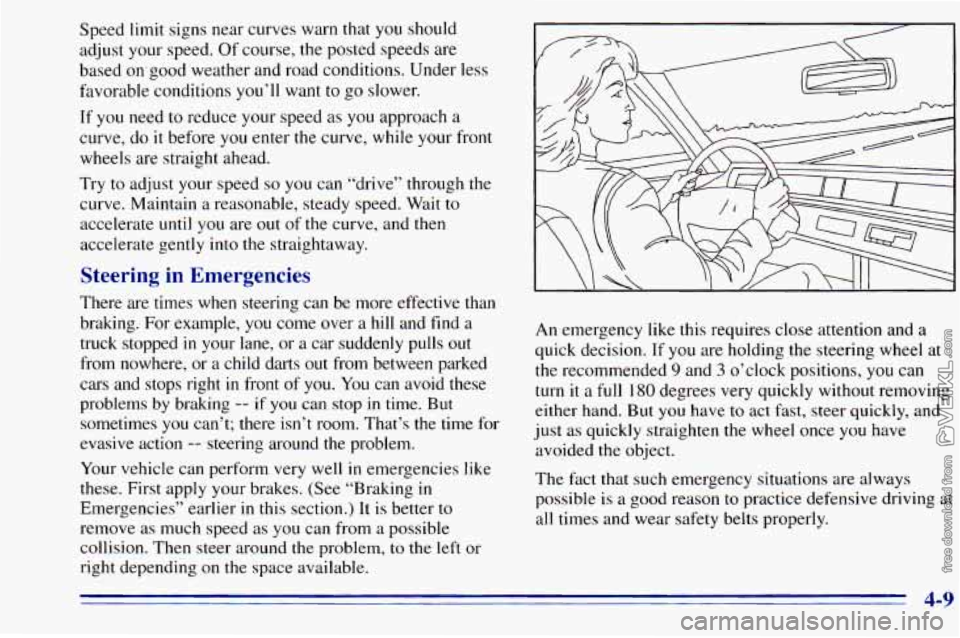
If you are holding the steering wheel at
the recommended 9 and 3 o’clock positions, you can
turn
it a full 180 degrees very quickly without removing
either hand. But you have
to act fast, steer quickly, and
just as quickly straighten the wheel once
you have
avoided the object.
The fact that such emergency situations are always
possible is a good reason
to practice defensive driving at
all times and wear safety belts properly.
4-9
Page 211 of 372
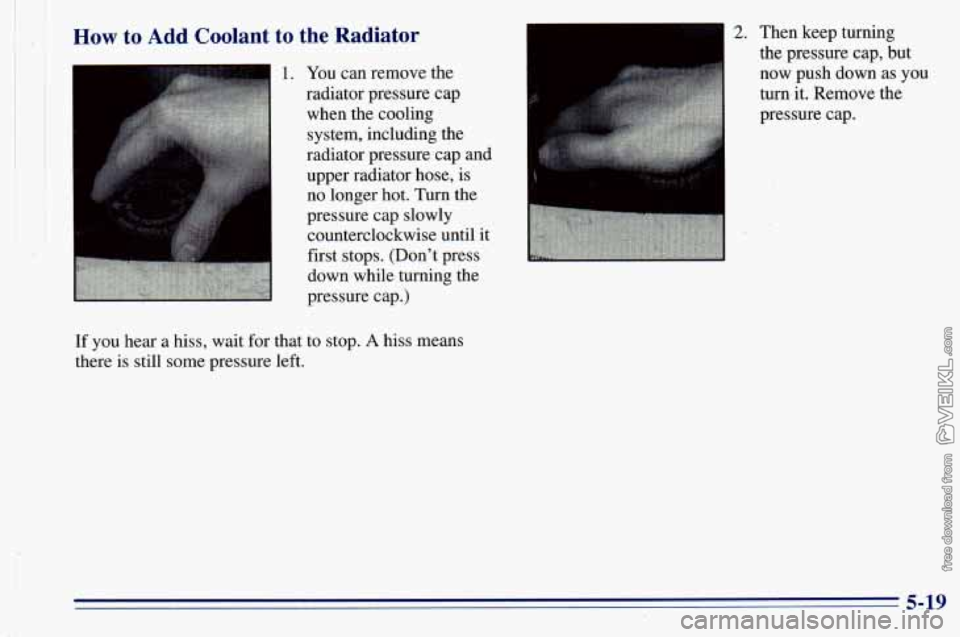
How to Add Coolant to the Radiator
1. You can remove the
radiator pressure cap
when the cooling
system, including the
radiator pressure cap and
upper radiator hose, is
no longer hot. Turn the
pressure cap slowly
counterclockwise until it
first stops. (Don't press
down while turning the
If
you hear a hiss, wait for that to stop. A hiss means
there is still some pressure left.
I 2. Then keep turning
I ,the pressure cap, but
now push down as you
5-19
Page 216 of 372
- Removing the Spare Tire and Tools
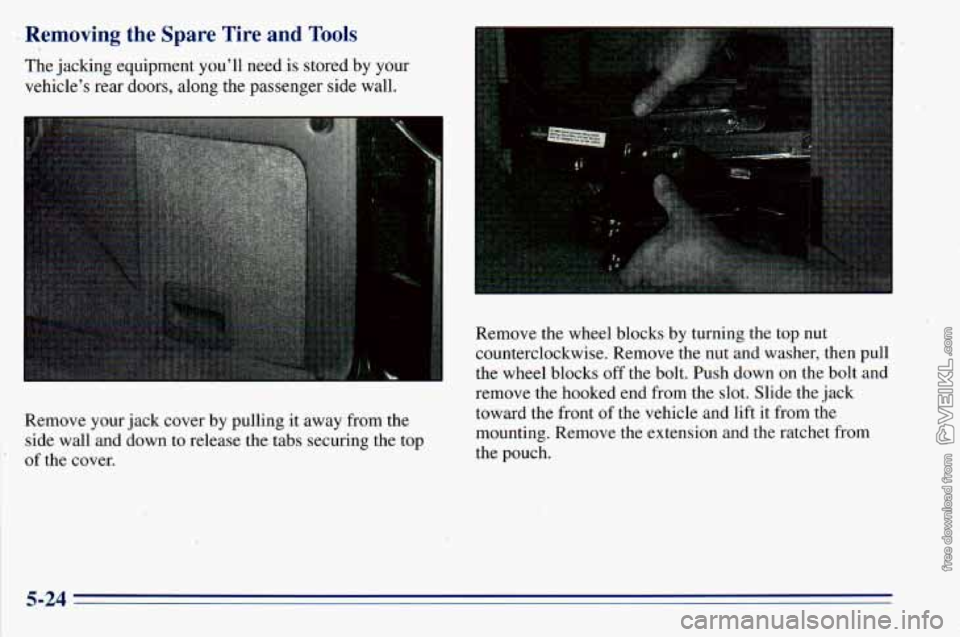
The jacking equipment you’ll need is stored by your
vehicle’s rear doors, along the passenger side wall.
Remove your jack cover by pulling
it away from the
side wall and down to release the tabs securing the top
‘ of the cover. Remove the wheel, blocks by turning the top nut
counterclockwise. Remove the nut and washer, then pull
the wheel blocks off the bolt. Push down on the bolt and
remove the hooked
end from the slot. Slide the jack
toward the front of the vehicle and lift it from the
mounting. Remove the extension and the ratchet from
the pouch.
5-24
Page 218 of 372
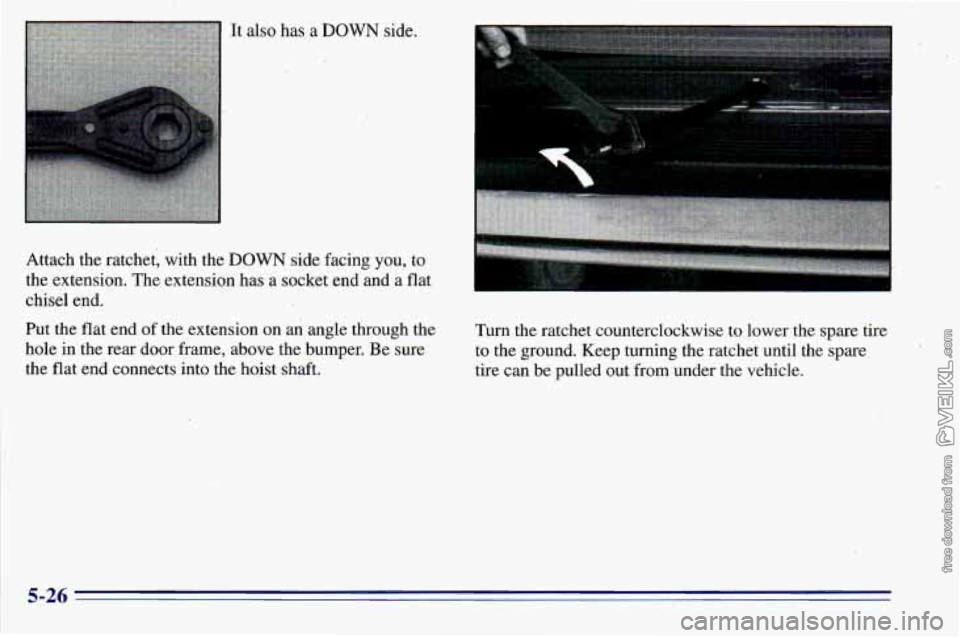
Attach the ratchet, with the DOWN side facing you, to
the extension. The extension has a socket end and
a flat
chisel end.
Put the flat end of the extension on an angle through the
hole in the rear door frame, above the bumper. Be sure
the flat end connects into the hoist shaft. Turn
the ratchet counterclockwise to lower the spare tire
to the ground. Keep turning the ratchet until the spare
tire can be pulled out from under the vehicle.
5-26
Page 223 of 372
1
Getting under a vehicle when it is jacked up is
dangerous.
If the vehicle slips off the jack, you ~
could be badly injured or killed. Never get under
a vehicle when it
is supported only by a jack.
NOTICE:
Raising your vehicle with the jack improperly
positioned will damage the vehicle or may allow
the vehicle to fall
off the jack. Be sure to fit the
jack lift head into the proper location before
raising
your vehicle.
Do not jack up the vehicle with people in or near
the vehicle.
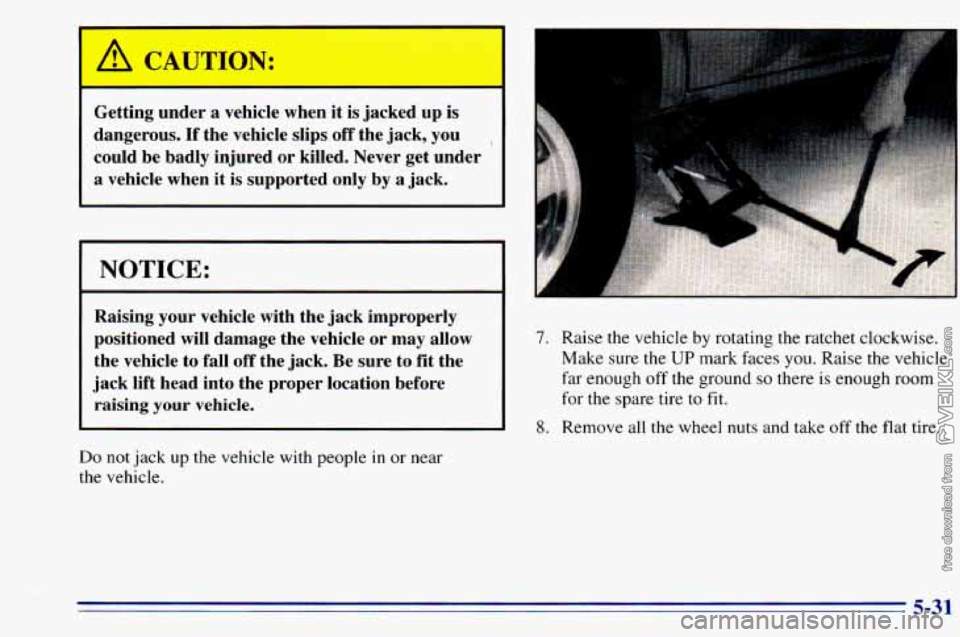
7. Raise the vehicle by rotating the ratchet clockwise.
Make sure the
UP mark faces you. Raise the vehicle
far enough off the ground
so there is enough room
for the spare tire to fit.
8. Remove all the wheel nuts and take off the flat tire.
5-31
Page 225 of 372
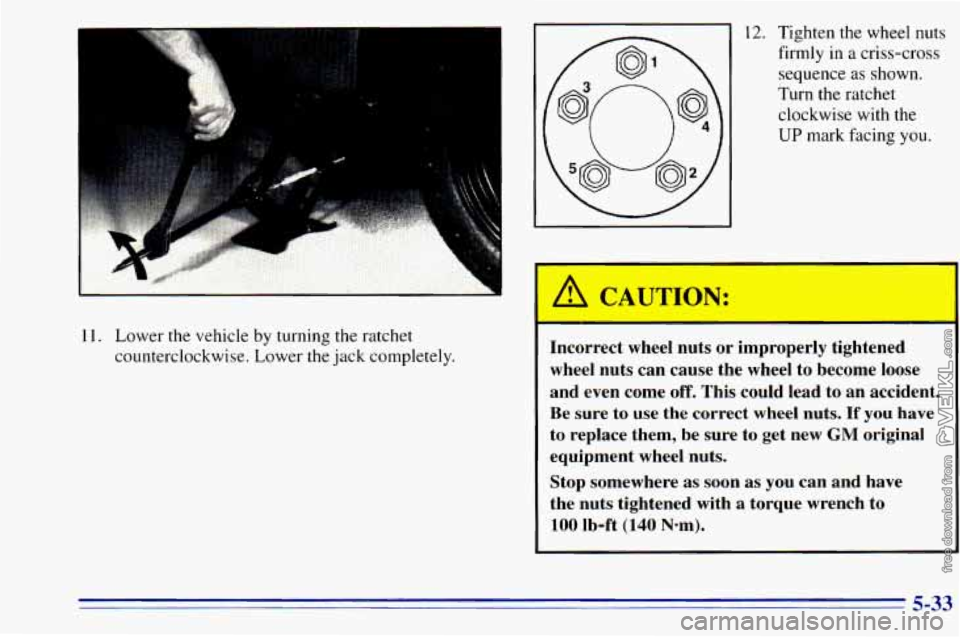
11. Lower the vehicle by turning the ratchet
counterclockwise. Lower
the jack completely.
12. Tighten the wheel nuts
firmly in a criss-cross
sequence as shown.
Turn the ratchet
clockwise with the
UP mark facing you.
A
11 CAUTION:
Incorrect wheel nuts or improperly tightened
wheel nuts can cause the wheel to become loose
and even come
off. This could lead to an accident.
Be sure to use the correct
wheel nuts. If you have
to replace them, be sure to get new
GM original
equipment wheel nuts.
Stop somewhere
as soon as you can and have
the nuts tightened with
a torque wrench to
100 Ib-ft (140 Nom).
I
5-33
Page 227 of 372
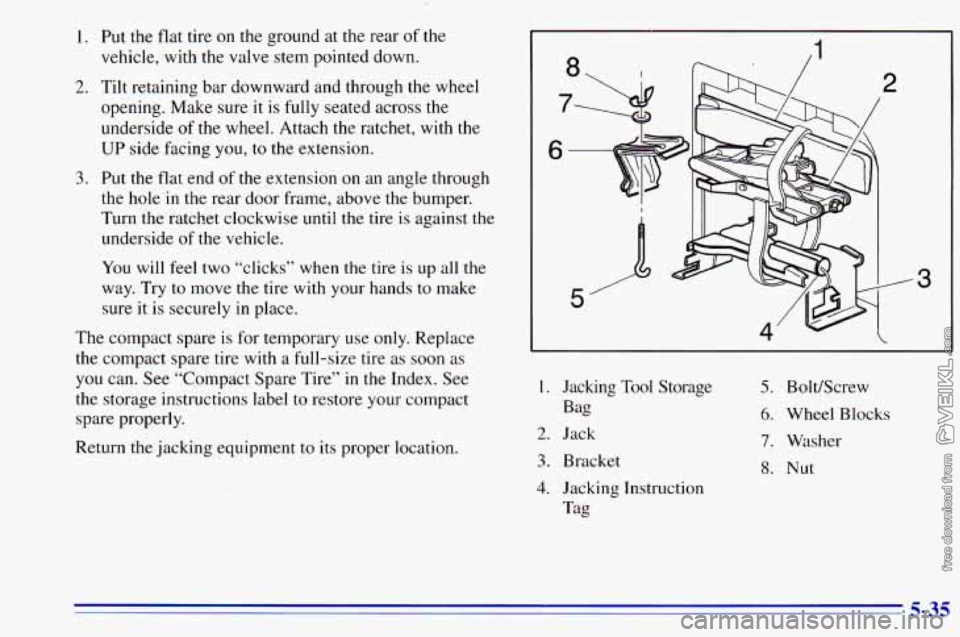
1.
2.
3.
Put the flat tire on the ground at the rear of the
vehicle, with the valve stem pointed down.
Tilt retaining bar downward and through the wheel
opening. Make sure it is fully seated across the
underside of the wheel. Attach the ratchet, with the
UP side facing you, to the extension.
Put the
flat end of the extension on an angle through
the hole in the rear door frame, above the bumper.
Turn the ratchet clockwise until the tire is against the
underside
of the vehicle.
You will
feel two “clicks” when the tire is up all the
way. Try to move the tire with your hands to make
sure it is securely in place.
The compact spare is for temporary use only. Replace
the compact spare tire with a full-size tire
as soon as
you can. See “Compact Spare Tire” in the Index. See
the storage instructions label to restore your compact
spare properly.
Return the jacking equipment
to its proper location.
I 4
3
I. Jacking Tool Storage
Bag
2. Jack
3. Bracket
4. Jacking Instruction
Tag
5. BoltKcrew
6. Wheel Blocks
7, Washer
8. Nut
5-35