engine CHEVROLET ASTRO 1996 User Guide
[x] Cancel search | Manufacturer: CHEVROLET, Model Year: 1996, Model line: ASTRO, Model: CHEVROLET ASTRO 1996Pages: 372, PDF Size: 21.51 MB
Page 82 of 372
NOTICE:
Driving with the parking brake on can cause
your rear brakes to overheat. You may have to
replace them, and you could also damage other
parts of your vehicle.
If you are towing a trailer and are parking on any hill,
see “Towing a Trailer” in the Index. That section shows
what to
do first to keep the trailer from moving.
Shifting Into PARK (P)
CAUTION:
It can be dangerous to get out of your vehicle if
the shift lever is not fully in PARK (P) with the
parking brake firmly set. Your vehicle can roll.
If you have left the engine running, the vehicle
can move suddenly. You or others could be
injured.
To be sure your vehicle won’t move, even
when you’re on fairly level ground, use the steps
that follow.
If you’re pulling a trailer, see
“Towing
a Trailer” in the Index.
1. Hold the brake pedal down with your right foot and
set the parking brake.
2-22
Page 84 of 372
Leaving Your Vehicle With the
E.noiqe Rmnnjnq
r
can be ( lgerous to we your vt cle wi
the engine running. Your vehicle could move
suddenly if the shift lever
is not fully in PARK (P)
with the parking brake firmly set. And, if you
leave the vehicle with the engine running, it could
overheat and even catch fire. You or others could
be injured. Don’t leave your vehicle with the
engine running unless you have
to.
If you have to leave your vehicle with the engine
running, be sure your vehicle is in PARK (P) and your
parking brake is firmly set before you leave it. After
you’ve moved the shift lever into the PARK (P)
position, hold the regular brake pedal down. Then, see
if you can move
the shift lever away from PARK (P)
without first pulling it toward
you. If you can, it means
that the shift lever wasn’t fully locked into PARK (P).
Torque Lock I
If you are parking on a hill and you don’t shift your
transmission
into PARK (P) properly, the weight of the
vehicle may put
too much force on the parking pawl in
the transmission. You may find it difficult to pull the
shift lever out of PARK (P). This is called “torque lock.”
To prevent torque lock, set the parking brake and then
shift into PARK (P) properly before you leave the
driver’s seat.
To find out how, see “Shifting Into
PARK (P)” in the Index.
When you are ready to drive, move the shift lever out
of
PARK (P) before you release the parking brake.
If torque lock does occur,
you may need to have another
vehicle push yours a little uphill
to take some of the
pressure from the transmission, so you can pull the shift
lever out
of PARK (P).
2-24
Page 86 of 372
Engine Exhaust
A CAUTIOF:
Engine exhaust can kill. It contains the gas
carbon monoxide
(CO), which you can’t see or
smell.
It can cause unconsciousness and death.
You might have exhaust coming in if:
0 Your exhaust system sounds strange
Your vehicle gets rusty underneath.
Your vehicle was damaged in a collision.
Your vehicle was damaged when driving over
high points on the road or over road debris.
Repairs weren’t done correctly.
Your vehicle or exhaust system had been
If you ever suspect exhaust is coming into
your vehicle:
Drive it only with all the windows down to
Have your vehicle fixed immediately.
or
different.
modified improperly.
blow out any
CO; and
I
Running Your Engine While
You’re Parked
It’s better not to park with the engine running. But if you
ever have to, here are some things to know.
A CAUTION:
Idling the engine with the air system control off
could allow dangerous exhaust into your vehicle
(see the earlier Caution under “Engine Exhaust”).
Also, idling in a closed-in place can let deadly
carbon monoxide
(CO) into your vehicle even if
the fan switch is at the highest setting. One place
this can happen is
a garage. Exhaust -- with
CO
-- can come in easily. NEVER park in a
garage with the engine running.
Another closed-in place can be a blizzard.
(See “Blizzard” in the Index.)
2-26
Page 87 of 372
CAUTION:
It can be dangerous to get out of your vehicle if
the shift lever is not fully in
PARK (P) with the
parking brake firmly set. Your vehicle can roll.
Don’t leave your vehicle when the engine is
running unless you have to.
If you’ve left the
engine running, the vehicle can move suddenly.
You or others could be injured.
To be sure your
vehicle won’t move, even when you’re on fairly
level ground, always set your parking brake and
move the shift lever to
PARK (P).
Follow the proper steps to be sure your vehicle won’t
move. See “Shifting Into
PARK (P)” in the Index.
If you’re pulling a trailer, see “Towing
a Trailer” in
the Index.
Windows
Manual Windows
To open your manual windows, turn the hand crank on
each door to raise or lower your side door windows.
Power Windows
If you have the optional power windows, the controls
are
on each of the front side doors. The driver’s door has
a switch for the front passenger window
as well. Your
power windows will not move unless the ignition has
been turned to the
RUN position.
2-27
Page 88 of 372
Exprer- ’ wn Window
The driver
s window switch also has an “express”
feature that allows
it to lower without holding the
window switch. Hold the driver’s window switch down
for more than 112 second to activate the express-down
feature. Lightly tap the switch to open the window
slightly. The express-down feature can be interrupted
at any time by pressing the up arrow end of the switch.
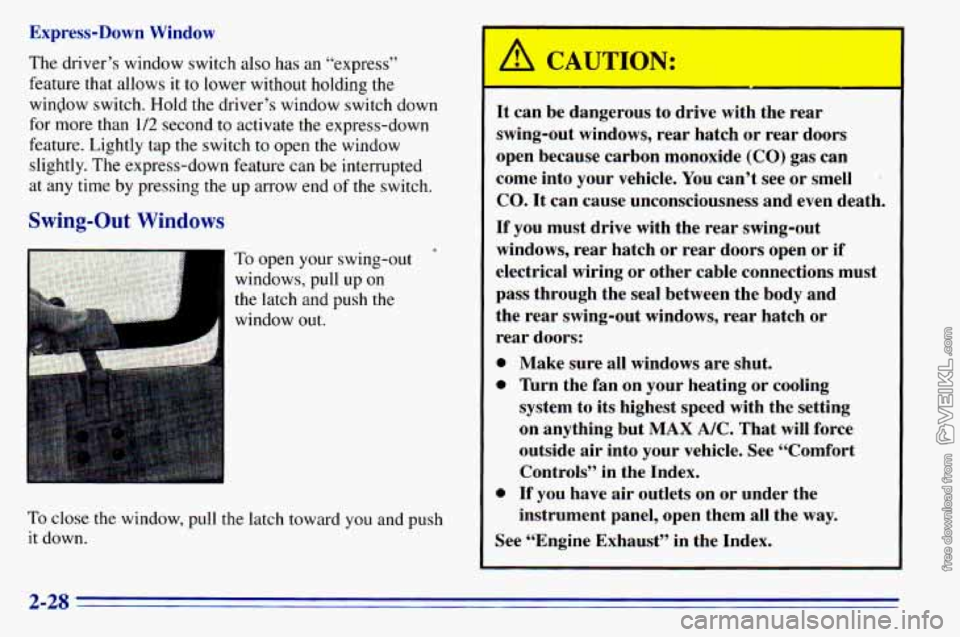
Swing-Out Windows
‘D‘. : .,,: TO open your swing-out +
windows, pull up on
the latch and push the
window out.
e
It can be dangerous to drive with the rear
swing-out windows, rear hatch or rear doors
open because carbon monoxide
(CO) gas can
come into your vehicle. You can’t see or smell
*
CO. It can cause unconsciousness and even death.
If you must drive with the rear swing-out
windows, rear hatch or rear doors open or if
electrical wiring or other cable connections must
pass through the seal between the body and
the rear swing-out windows, rear hatch
or
rear doors:
TO close the window, pull the latch toward you and push
it down.
e
e Make sure all windows are shut.
”urn the fan on your heating or cooling
system to its highest speed with the setting
on anything but MAX
A/C. That will force
outside air into your vehicle. See “Comfort
Controls” in the Index.
If you have air outlets on or under the
instrument panel, open them all the way.
See “Engine Exhaust’’ in the Index.
2-28
Page 100 of 372
Storage Compartments
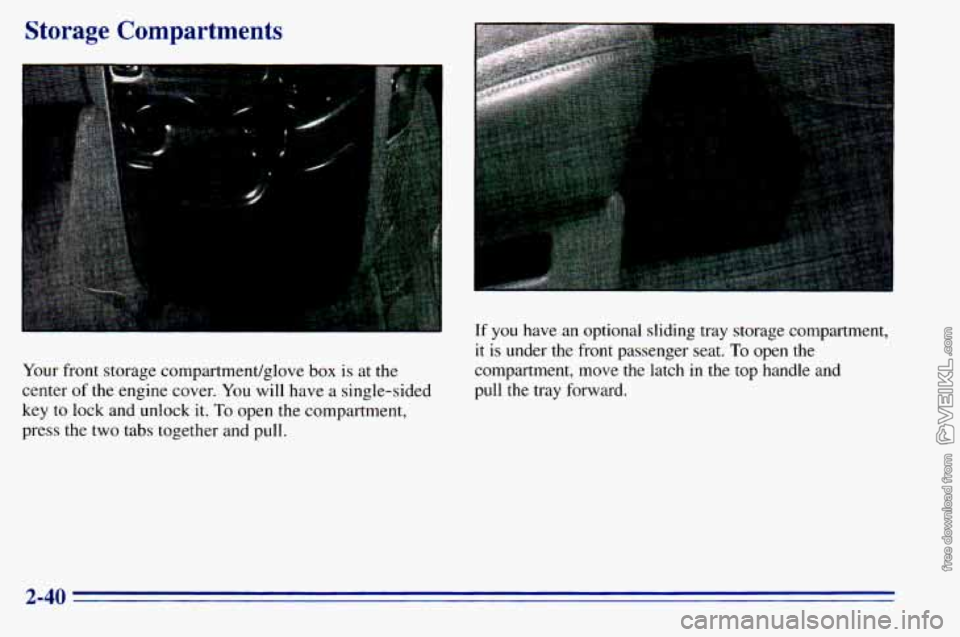
Your front storage compartment/glove box is at the
center
of the engine cover. You will have a single-sided
key
to lock and unlock it. To open the compartment,
press
the two tabs together and pull.
If you have an optional sliding tray storage compartment,
it is under the front passenger seat. To open the
compartment, move the latch in the top handle and
pull the tray forward.
2-40
Page 101 of 372
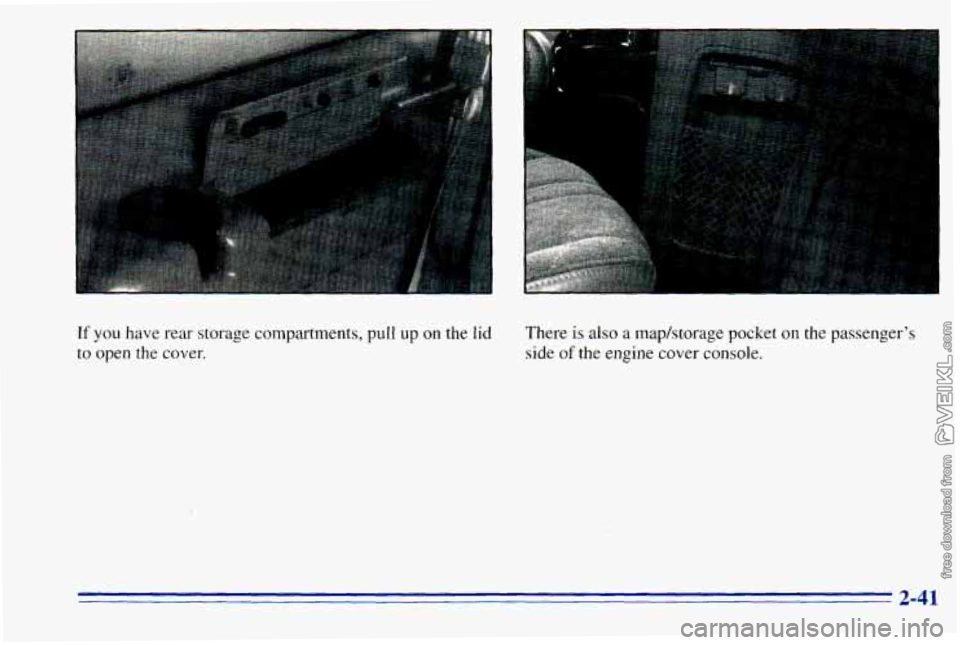
If you have rear storage compartments, pull up on the lid
to open the cover, There
is also a
maphtorage pocket on the passenger's
side
of the engine cover console.
2-41
Page 108 of 372
Ashtl- - ys and Cigarette Lighter
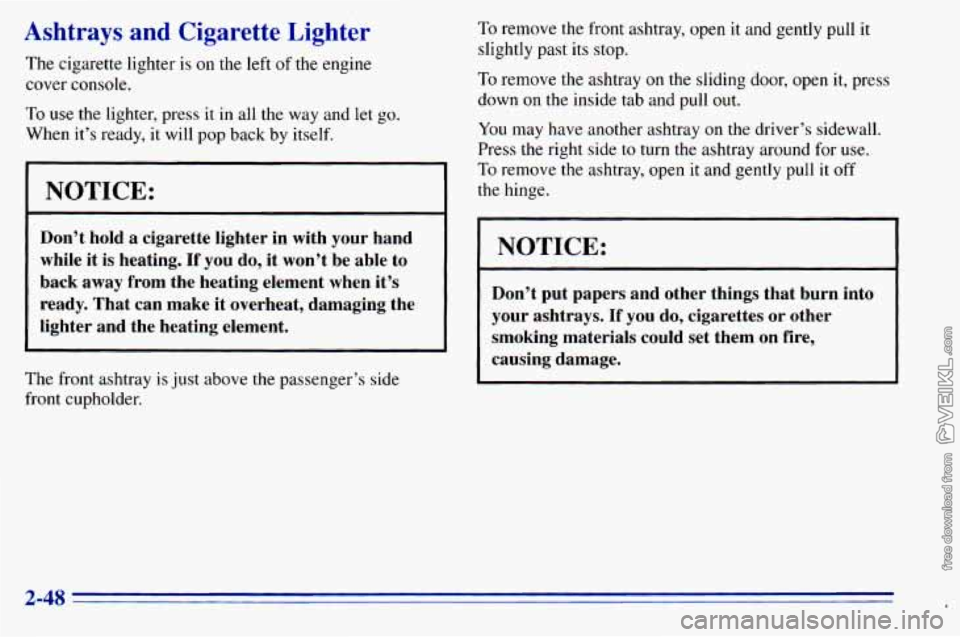
The cigarette lighter is on the left of the engine
cover console.
To use the lighter, press it in all the way and let go.
When it’s ready, it will pop back by itself.
NOTICE:
I
Don’t hold a cigarette lighter in with your hand
while it is heating,
If you do, it won’t be able to
back away from the heating element when it’s
ready. That can make it overheat, damaging the
lighter and the heating element.
The front ashtray is just above the passenger’s side
front cupholder.
To remove the front ashtray, open it and gently pull it
slightly past its stop.
To remove the ashtray on the sliding door, open it, press
down
on the inside tab and pull out.
You may have another ashtray
on the driver’s sidewall.
Press the right side to turn the ashtray around for use.
To remove the ashtray, open it and gently pull it off
the hinge.
I NOTICE:
Don’t put papers and other things that burn into
your ashtrays.
If you do, cigarettes or other
smoking materials could set them on fire,
causing damage.
2-48
Page 109 of 372
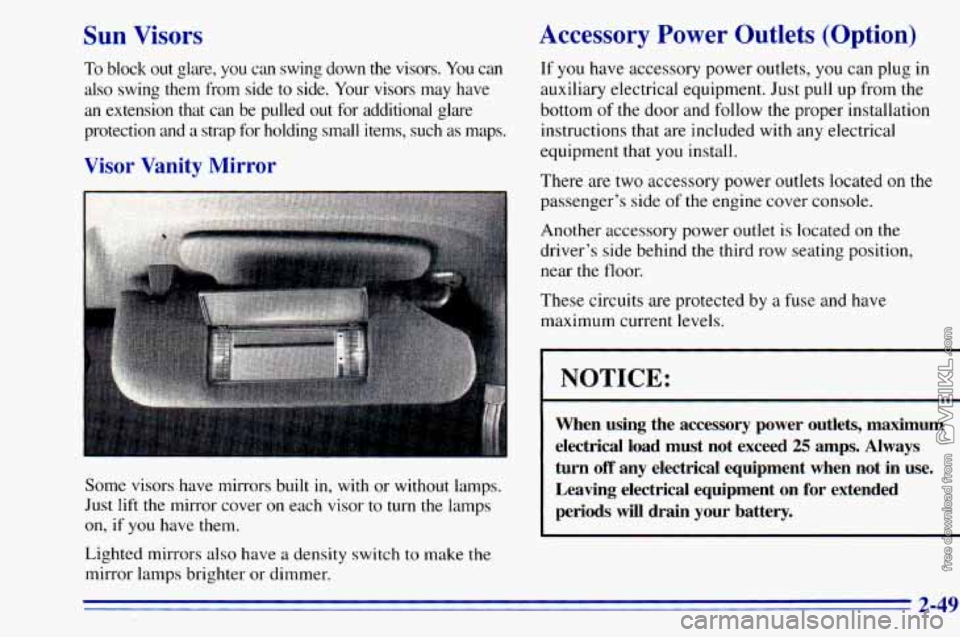
Sun Visors
To block out glare, you can swing down the visors. You can
also swing them from side
to side. Your visors may have
an extension that can be pulled
out for additional glare
protection and
a strap for holding small items, such as maps.
Visor Vanity Mirror
I-
Some visors have mirrors built in, with or without lamps.
Just
lift the mirror cover on each visor to turn the lamps
on, if you have them.
Lighted mirrors also have a density switch to make
the
mirror lamps brighter or dimmer.
Accessory Power Outlets (Option)
If you have accessory power outlets, you can plug in
auxiliary electrical equipment. Just pull up from the
bottom
of the door and follow the proper installation
instructions that are included with any electrical
equipment that
you install.
There are two accessory power outlets located on the
passenger’s side
of the engine cover console.
Another accessory power outlet is located on the
driver’s side behind
the third row seating position,
near the floor.
These circuits are protected by
a fuse and have
maximum current levels.
I NOTICE:
~~
When using the accessory power outlets, maximum
electrical load must not exceed
25 amps. Always
turn
off any electrical equipment when not in use.
Leaving electrical equipment
on for extended
periods will drain your battery.
2-49
Page 113 of 372
Speedometer and Odom. er
Your
speedometer lets you see your speed in both miles
per hour (mph) and kilometers per hour (km/h). Your
odometer shows how far your vehicle has been driven,
in either miles (used in the United States) or kilometers
(used in Canada).
A
Your odometer is tamper resistant. The digital odometer
will read
999,999 if someone tries to turn it back.
You may wonder what happens if your vehicle needs a
new odometer installed.
If the new one can be set to the
mileage total
of the old odometer, then it must be. But if
it can’t, then it’s set at zero, and a label must be put on
the driver’s door to show the old mileage reading when
the new odometer was installed.
Trip Odometer
The trip odometer can tell you how far your vehicle has
been driven since you last set
the trip odometer to zero.
The trip odometer will appear in place
of your regular
odometer when you press the TRIP button.
To reset the trip odometer, press and hold the TRIP
button.
To change back to the regular odometer, press
the TRIP button again.
Warning Lights, Gages and Indicators
This part describes the warning lights and gages that may
be
on your vehicle. The pictures will help you locate them.
Warning lights and gages can signal that something is
wrong before it becomes serious enough to cause
an
expensive repair or replacement. Paying attention to
your warning lights and gages could also save
you or
others from injury.
Warning lights come
on when there may be or is a
problem with one of your vehicle’s functions. As you will
see in the details on the next few pages, some warning
lights come on briefly when
you start the engine just to let
you know they’re working. If you are familiar with this
section, you should not be alarmed when this happens.
Gages can indicate when there may be or is a problem
with
one of your vehicle’s functions. Often gages and
warning lights work together
to let you know when
there’s a problem with your vehicle.
When one of the warning lights comes
on and stays on
when
you are driving, or when one of the gages shows
there may be a problem, check the section that tells you
what to do about
it. Please follow this manual’s advice.
Waiting to do repairs can be costly
-- and even
dangerous.
So please get to know your warning lights
and gages. They’re a big help.
2-53