fuel CHEVROLET ASTRO 1997 2.G User Guide
[x] Cancel search | Manufacturer: CHEVROLET, Model Year: 1997, Model line: ASTRO, Model: CHEVROLET ASTRO 1997 2.GPages: 404, PDF Size: 20.63 MB
Page 203 of 404
Downloaded from www.Manualslib.com manuals search engine This can cause deadly CO (carbon monoxide) gas
to get inside.
CO could overcome you and kill
you.
You can't see it or smell it, so you might not
know
it is in your vehicle. Clear away snow from
around the base
of your vehicle, especially any
that
is blocking your exhaust pipe. And check
around again from time
to time to be sure snow
doesn't collect there.
Open
a window just a little on the side.of the
vehicle that's
away from the wind. This will help
keep
CO out.
Run your engine only as long as you must. This saves
fuel. When you run the engine, make it go a little faster
than just idle. That is, push the accelerator slightly. This
uses less fuel for the heat that you get and it keeps the
battery charged. You will need a well-charged battery to
restart the vehicle,
and possibly for signaling later on
with your headlamps. Let the heater run for awhile.
Then, shut the engine
off and close the window almost
all the way to preserve the heat. Start the engine again
and repeat this only
when you feel really uncomfortable
from the cold. But do it as little as possible. Preserve the
fuel as long as you can.
To help keep warm, you can get
out
of the vehicle and do some fairly vigorous exercises
every half hour or
so until help comes.
4-27
Page 204 of 404
Downloaded from www.Manualslib.com manuals search engine Loading Your Vehicle
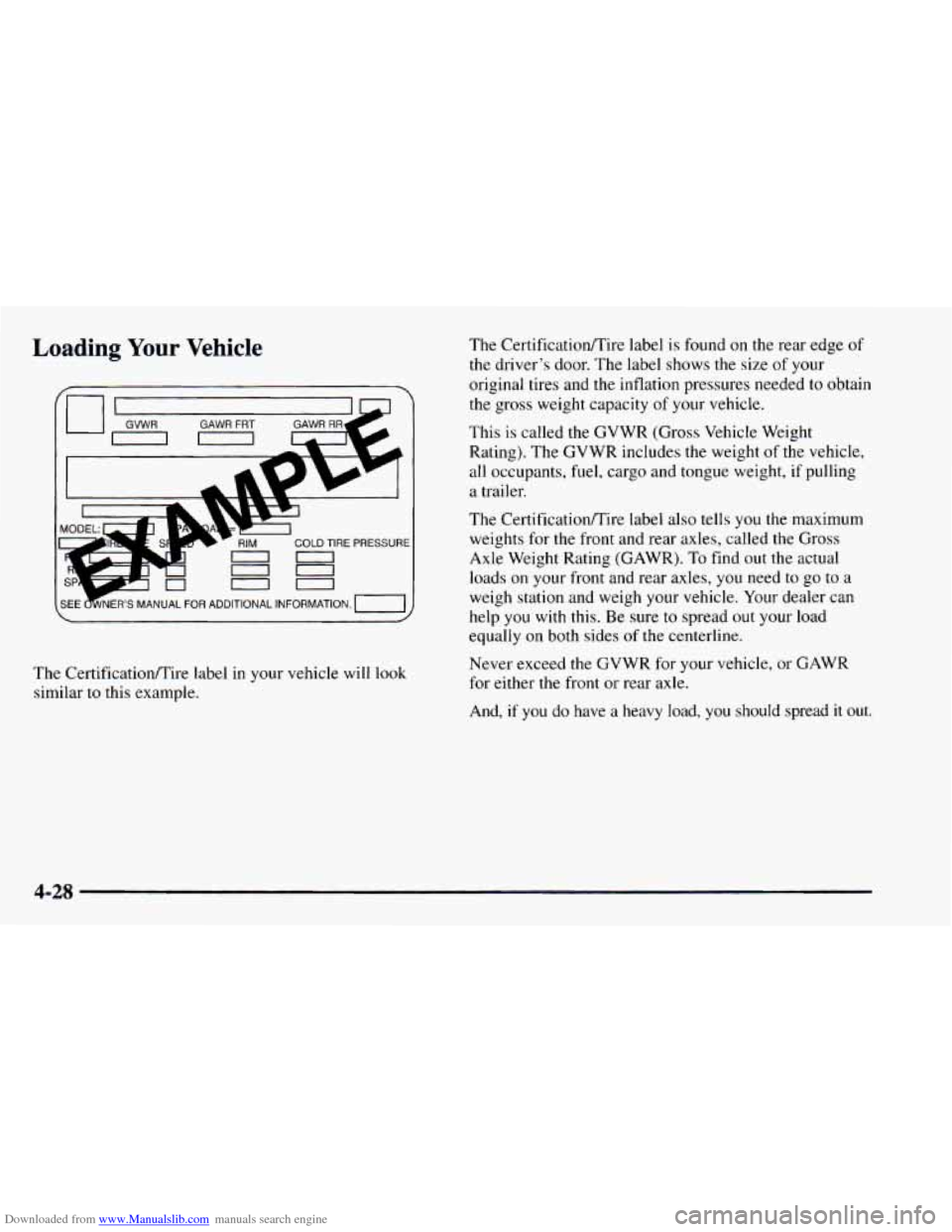
The Certificationmire label in your vehicle will look
similar to this example. The
CertificatiodTire label is found on the rear edge of
the driver’s door. The label shows
the size of your
original tires and the inflation pressures needed to obtain
the gross weight capacity of your vehicle.
This is called the GVWR (Gross Vehicle Weight
Rating). The GVWR includes the weight of
the vehicle,
all occupants, fuel, cargo and tongue weight,
if pulling
a trailer.
The CertificationITire label also tells
you the maximum
weights for
the front and rear axles, called the Gross
Axle Weight Rating (GAWR). To find out the actual
loads on your front and rear axles,
you need to go to a
weigh station and weigh your vehicle. Your dealer can
help you with this. Be sure
to spread out your load
equally on both sides of the centerline.
Never exceed
the GVWR for your vehicle, or GAWR
for either the front or rear axle.
And,
if you do have a heavy load, you should spread it out.
4-28
Page 207 of 404
Downloaded from www.Manualslib.com manuals search engine Towing a Trailer
I
If you don’t use the correct equipment and drive
properly, you can lose control when you pull a
trailer. For example, if the trailer is too heavy, the
brakes may not work well
-- or even at all. You
and your passengers could be seriously injured. Pull a trailer ordy if you have followed
all the
steps in this section. Ask your
GM dealer for
advice and information about towing
a trailer
with your vehicle.
NOTICE:
Pulling a trailer improperly can damage your
vehicle and result in costly repairs not covered
by
your warranty. To pull a trailer correctly, follow
the advice in this part, and see your
GM dealer
for important information about towing a trailer
with your vehicle.
Every vehicle is ready for some trailer towing.
If yours
was built with trailering options,
as many are, it’s ready
for heavier trailers. But trailering
is different than just
driving your vehicle by itself. Trailering means changes
in handling, durability and fuel economy. Successful,
safe trailering takes correct equipment, and
it has to be
used properly.
That’s the reason for this part.
In it are many
time-tested, important trailering tips and safety rules.
Many of these are important for your safety and that of
your passengers.
So please read this section carefully
before you pull
a trailer.
4-31
Page 240 of 404
Downloaded from www.Manualslib.com manuals search engine Engine Fan Noise
This vehicle has a clutched engine cooling fan. When
the clutch is engaged, the fan spins faster to provide
more air
to cool the engine. In most everyday driving
conditions, the clutch is not fully engaged. This
improves
fuel economy and reduces fan noise. Under
heavy vehicle loading, trailer towing and/or high outside
temperatures, the
fan speed increases when the clutch
engages.
So you may hear an increase in fan noise. This
is normal and should not be mistaken as the
transmission slipping or making extra shifts. It is merely
the cooling system functioning properly. The fan will
slow down when additional cooling
is not required and
the clutch disengages.
You may also hear this fan noise when you start the
engine. It will go away as the fan clutch disengages.
If a Tire Goes Flat
It’s unusual for a tire to “blow out” while you’re driving,
especially if
you maintain your tires properly. If air goes
out
of a tire, it’s much more likely to leak out slowly.
But if you should ever have a “blowout,” here are a few
tips about what to expect and what
to do:
If a front tire fails, the
flat tire will create a drag that
pulls
the vehicle toward that side. Take your foot off the
accelerator pedal and grip the steering wheel firmly.
Steer
to maintain lane position, and then gently brake to
a stop well
out of the traffic lane.
A rear blowout, particularly on a curve, acts much like a
skid and may require the same correction you’d use in a
skid.
In any rear blowout, remove your foot from the
accelerator pedal. Get the vehicle under control by
steering
the way you want the vehicle to go. It may be
very bumpy and noisy, but
you can still steer. Gently
brake to a stop
-- well off the road if possible.
If a tire goes flat,
the next part shows how to use your
jacking equipment to change a flat tire safely.
5-22
Page 257 of 404
Downloaded from www.Manualslib.com manuals search engine Section 6 Service and Appearance Care
Here you will find information about the care of your vehicle. This section begins with service and fuel information,
and
then it shows how to check important fluid and lubricant levels. There is also technical information about your
vehicle, and
a part devoted to its appearance care.
6- 2
6-3
6-4
6-5
6-7
6-1 1
6- 15
6- 19
6-20
6-23
6-25
6-25
6-29
6-30
6-30
6-3
1
6-32
6-36
6-36
6-36 Service
Fuel Fuels
in Foreign Countries
Filling Your Tank
Checking Things Under the Hood
Engine Oil
Engine Cover
Air Cleaner
Automatic Transmission Fluid
All-Wheel Drive Rear Axle
Engine Coolant
Radiator Pressure Cap
Thermostat Power Steering Fluid
Windshield Washer Fluid
Brakes Battery
Bulb Replacement Halogen Bulbs 6-42
6-43
6-50
6-5
1
6-54
6-55
6-55
6-57
6-5
8
6-5 8
6-5
8
6-59
6-60
6-60
6-60
6-66
6-66
6-67
6-68 Windshield Wiper Blade Replacement
Tires Appearance Care
Cleaning
the Inside of Your Vehicle
Cleaning Glass Surfaces
Cleaning the Outside
of the Windshield,
Backglass and Wiper Blades
Cleaning the Outside
of Your Vehicle
Cleaning Tires Finish Damage Underbody Maintenance
Chemical Paint Spotting
Appearance Care Materials Chart
Vehicle Identification Number
(VIN)
Service Parts Identification Label
Electrical System Replacement Bulbs
Capacities and Specifications
Air Conditioning Refrigerants
Normal Maintenance Replacement Parts
6-1
Page 259 of 404
Downloaded from www.Manualslib.com manuals search engine Adding Equipment to the Outside of
Your Vehicle
Things you might add to the outside of your vehicle can
affect the airflow around it. This may cause wind noise
and affect windshield washer performance. Check with
your GM dealer before adding equipment
to the outside
of your vehicle.
J
Use regular unleaded gasoline rated at 87 octane or higher.
At a minimum, it should meet specifications ASTM
D48 14
in the United States and CGSB 3.5-M93 in Canada.
Improved gasoline specifications have been developed by
the American Automobile Manufacturers Association (AAMA) for better vehicle performance and engine
protection. Gasolines meeting the AAMA specification
could provide improved driveability and emission control
system protection compared to other gasolines.
Be sure the posted octane is at least 87. If the octane
is
less than 87, you may get a heavy knocking noise when
you drive. If it’s bad enough, it can damage your engine.
If you’re using fuel rated at 87 octane or higher and you
hear heavy knocking, your engine needs service. But
don’t worry if
you hear a little pinging noise when
you’re accelerating or driving up a hill. That’s normal,
and you don’t have to buy a higher octane fuel to get rid
of pinging. It’s the heavy, constant knock that means
you have a problem.
If your vehicle is certified to meet California Emission
Standards (indicated on the underhood tune-up label),
it is designed to operate
on fuels that meet California
specifications. If such fuels are
not available in states
adopting California emissions standards, your vehicle
will operate satisfactorily on fuels meeting federal
specifications, but emission control system performance
may be affected. The malfunction indicator lamp on
your instrument panel may turn on and/or your vehicle
may fail a smog-check test. If this occurs, return to your
authorized GM dealer for diagnosis to determine the
cause
of failure. In the event it is determined that the
cause of the condition is the type of fuels used, repairs
may not be covered by your warranty.
Some gasolines that are not reformulated for low
emissions contain an octane-enhancing additive called
methylcyclopentadienyl manganese tricarbonyl (MMT);
ask your service station operator whether or not his fuel
contains MMT. General Motors does
not recommend the
use of such gasolines. If fuels containing MMT are used,
spark plug
life may be reduced and your emission
control system performance may be affected.
The
malfunction indicator lamp on your instrument panel
may turn
on. If this occurs, return to your authorized
GM dealer for service.
6-3
Page 260 of 404
Downloaded from www.Manualslib.com manuals search engine To provide cleaner air, all gasolines in the United States
are now required to contain additives that will help
prevent deposits from forming
in your engine and fuel
system, allowing your emission control system to
function properly. Therefore, you should
not have to add
anything
to the fuel. In addition, gasolines containing
oxygenates,
such as ethers and ethanol, and reformulated
gasolines may be available in your area to help clean the
air. General Motors recommends that you use these
gasolines
if they comply with the specifications
described earlier.
NOTICE:
Your vehicle was not designed for fuel that
contains methanol. Don’t use it.
It can corrode
metal parts in your fuel system and also damage
plastic and rubber parts. That damage wouldn’t
be covered under your warranty.
Fuels in Foreign Countries
If you plan on driving in another country outside the
United States or Canada, the proper fuel may be hard to
find. Never use leaded gasoline or any other fuel
not
recommended in the previous text on fuel. Costly repairs
caused by use
of improper fuel wouldn’t be covered by
your warranty.
To check on fuel availability, ask an auto club, or
contact a major oil company that does business in the
country where you’ll be driving.
You can also write us at the following address for
advice. Just tell us where you’re going and give your
Vehicle Identification Number
(VIN).
General Motors International Product Center
1908 Colonel Sam Drive
Oshawa, Ontario LlH
8P7
6-4
Page 261 of 404
Downloaded from www.Manualslib.com manuals search engine Filling Your Tank
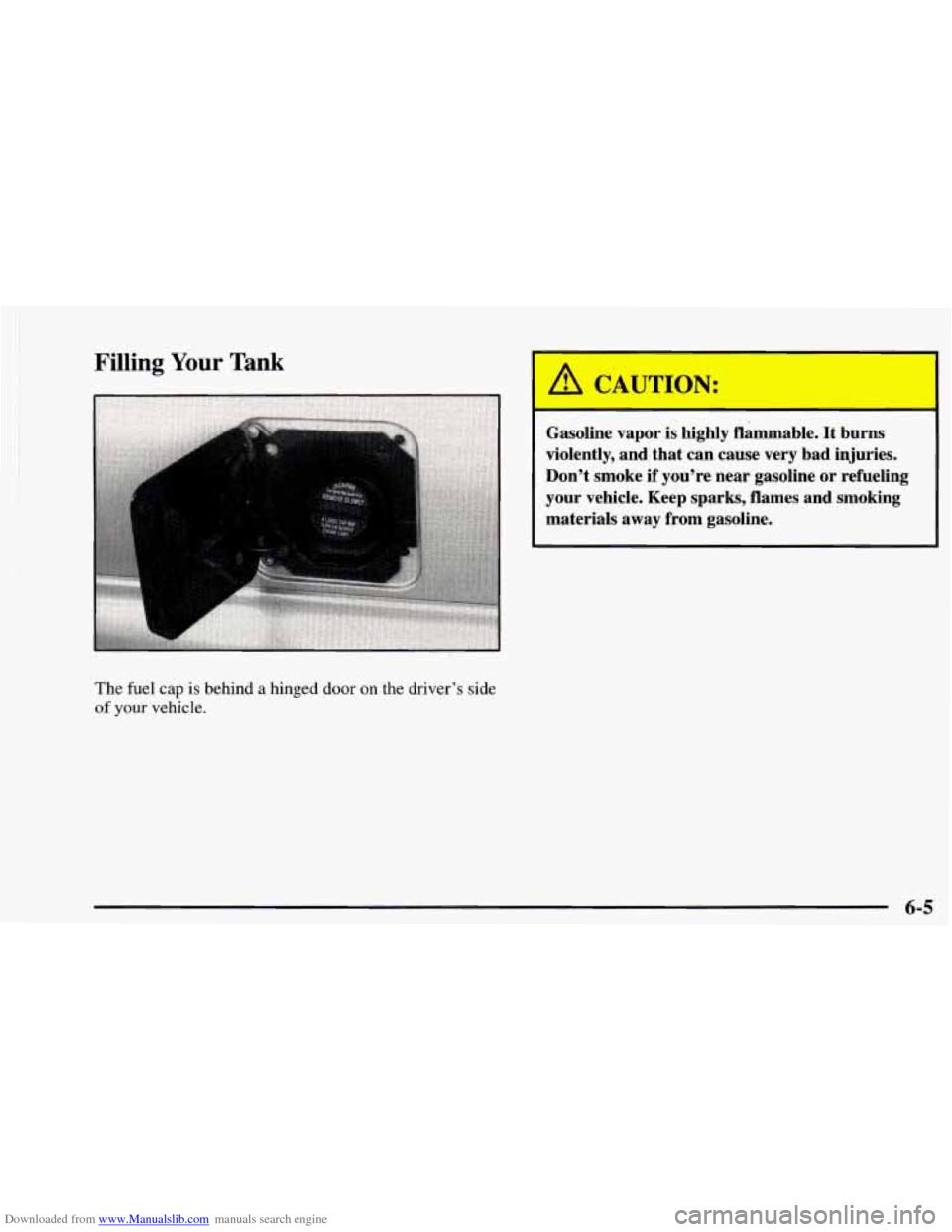
The fuel cap is behind a hinged door on the driver’s side
of your vehicle.
A CAUTION:
Gasoline vapor is highly flammable. It burns
violently, and that can cause very bad injuries.
Don’t smoke if you’re near gasoline or refueling
your vehicle. Keep sparks, flames and smoking
materials away from gasoline.
6-5
Page 262 of 404
Downloaded from www.Manualslib.com manuals search engine A CAUTION:
If you get gasoline on yourself and then
something ignites it, you could be badly burned.
Gasoline can spray out on you
if you open the
fuel filler cap too quickly.
This spray can happen
if your tank is nearly full, and is more likely in
hot weather. Open the fuel filler cap slowly and
wait for any
“hiss” noise to stop. Then unscrew
the cap all the way.
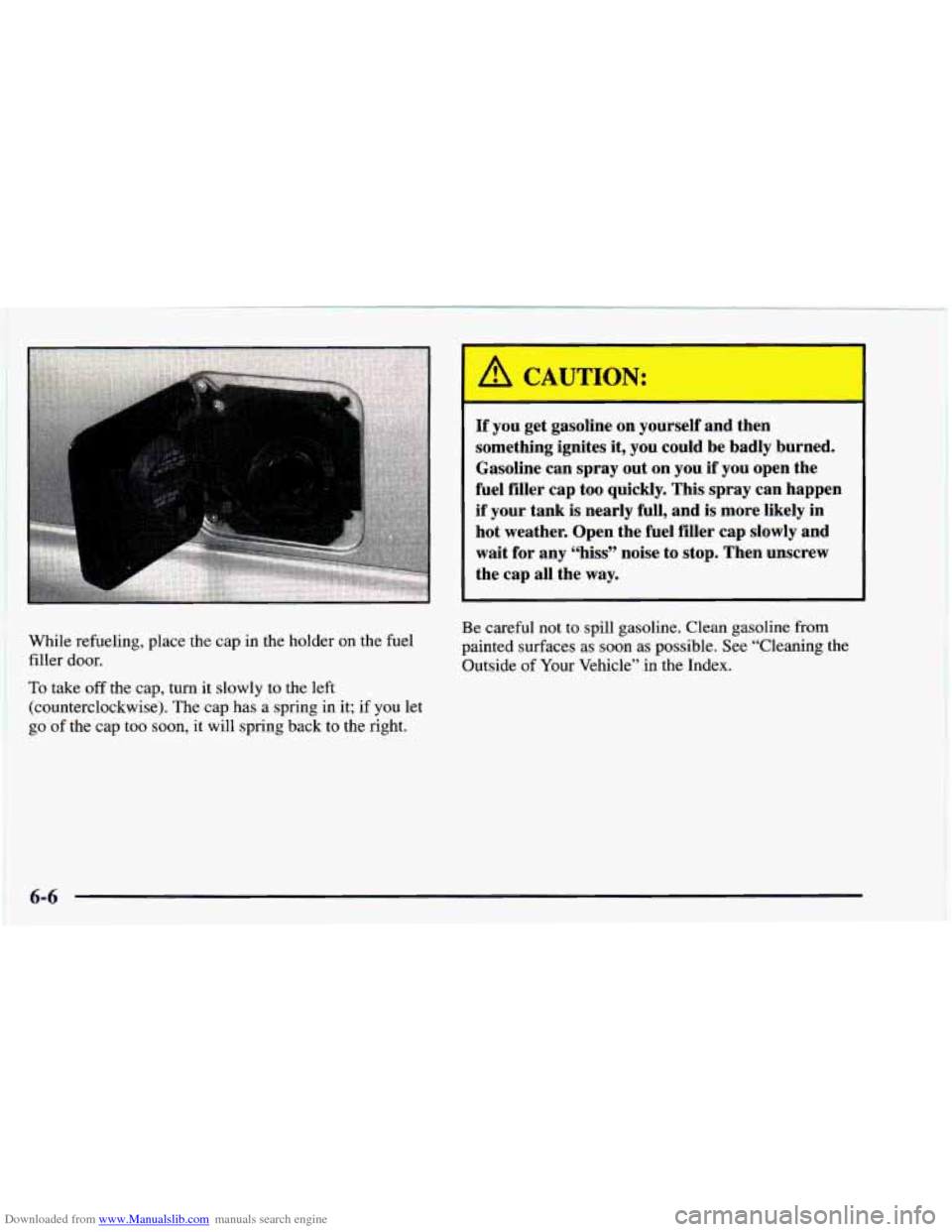
While refueling, place the cap in the holder on the fuel
filler door.
Be careful not to spill gasoline. Clean gasoline from
painted surfaces as soon as possible. See “Cleaning the
Outside
of Your Vehicle” in the Index.
To take off the cap, turn it slowly to the left
(counterclockwise). The cap has a spring in it;
if you let
go of the cap too soon, it will spring back to the right.
6-6
Page 263 of 404
Downloaded from www.Manualslib.com manuals search engine When you put the cap back on, turn it to the right
(clockwise) until
you hear a clicking sound. Make sure
you fully install the cap. The diagnostic system can
determine if the fuel cap has been left off or improperly
installed. This would allow fuel to evaporate into the
atmosphere. See “Malfunction Indicator Lamp” in
the Index.
NOTICE:
If you need a new cap, be sure to get the right
type. Your dealer can get one for you.
If you get
the wrong type,
it may not fit properly. This may
cause your malfunction indicator lamp to light
and your fuel tank and emissions system may be
damaged. See “Malfunction Indicator Lamp” in
the Index.
Checking Things Under the Hoc4
m-
Things that burn can get on hot engine parts and
start a fire. These include liquids like gasoline,
oil, coolant, brake fluid, windshield washer and
other fluids, and plastic or rubber. You
or others
could be burned. Be careful not to drop or spill
things that will burn onto a hot engine.
6-7