belt CHEVROLET ASTRO 1997 2.G Owner's Guide
[x] Cancel search | Manufacturer: CHEVROLET, Model Year: 1997, Model line: ASTRO, Model: CHEVROLET ASTRO 1997 2.GPages: 404, PDF Size: 20.63 MB
Page 51 of 404
Downloaded from www.Manualslib.com manuals search engine Smaller Children and Babies (Cargo Vans)
I 4 CAUTION:
A very young child’s hip bones are so small that a
regular belt might not stay low on the hips, as it
should. Instead, the belt will likely be over the
child’s abdomen.
In a crash, the belt would apply
force right
on the child’s abdomen, which could
cause serious or fatal injuries. Smaller children
and babies should always be restrained in
a child
restraint. However, infants, who should be
restrained in a rearfacing child restraint, cannot
ride safely in this vehicle. The instructions for the
restraint will
say whether it is the right type and
size for your child.
If a forward-facing child
restraint is suitable for your child, be sure the
child is always properly restrained while riding in
this vehicle.
lA
A CAUTION:
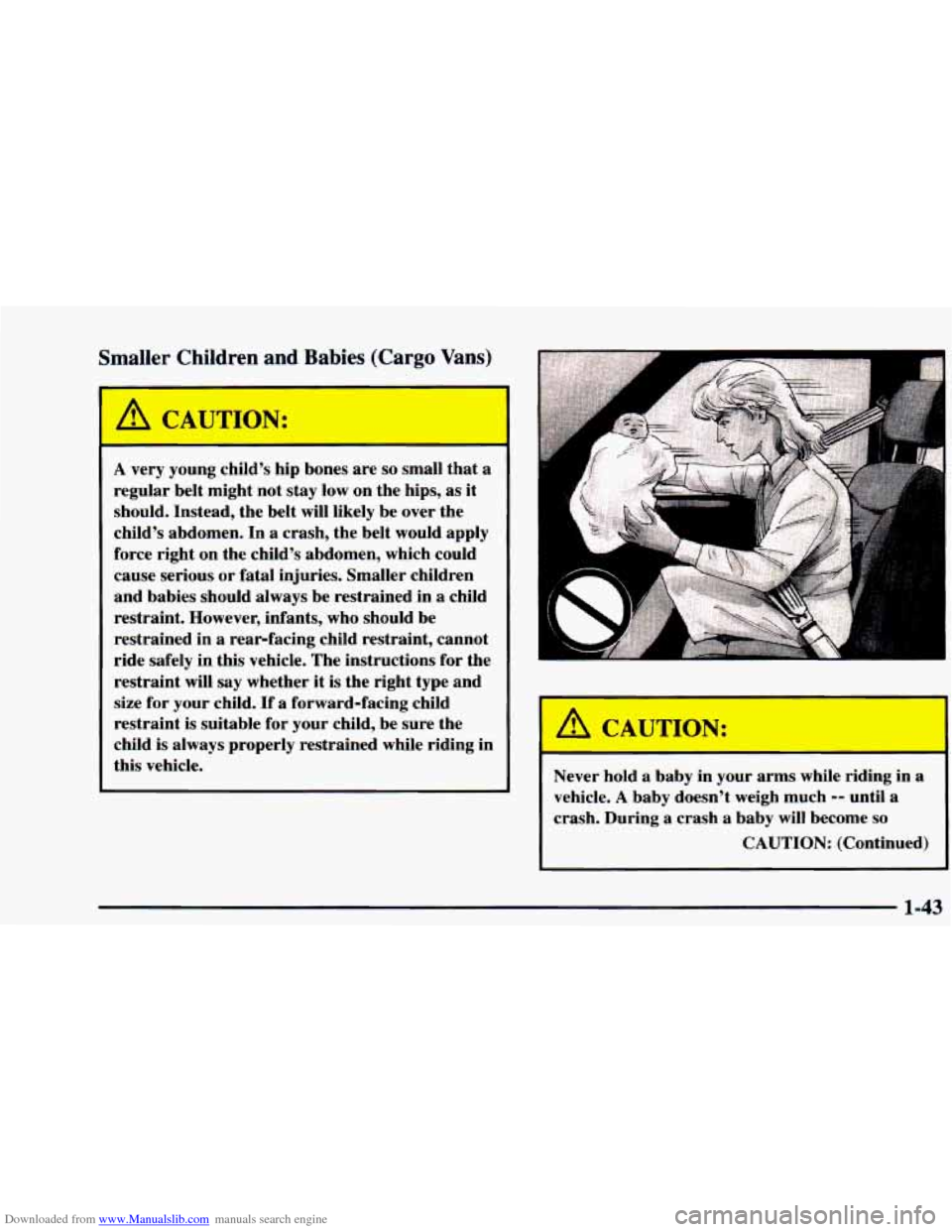
Never hold a baby in your arms while riding in a
vehicle. A baby doesn’t weigh much -- until a
crash. During
a crash a baby will become so
CAUTION: (Continued)
1-43
Page 53 of 404
Downloaded from www.Manualslib.com manuals search engine This child restraint system conforms to all applicable
Federal Motor Vehicle Safety Standards.
Each child restraint is designed for
use only by children
who weigh between
22 and 60 pounds (10 and 27 kg)
and whose height is between
33.5 and 5 1 inches (850 and
1 295 mm) and who are capable of sitting upright alone.
The child should also be at least one year old. It is
important to use a rear-facing infant restraint until the
child is about a year old.
A rear-facing restraint gives
the infant’s head,
neck and body the support they would
need in a crash. See “Child Restraints” later in this
section for more information.
@ What if the top of my child’s shoulders is above
the shoulder belt slots for the five-point child
restraint harness system?
A: A child whose shoulders are above the shoulder
belt slots for the five-point child restraint harness
system shouldn’t
use the harness. Instead, the child
should sit on the vehicle’s regular seat cushion and
use the vehicle’s adult safety belts.
BEFORE YOU USE THIS CHILD RESTRAINT,
BE SURE THE TOP
OF THE CHILD’S
SHOULDERS IS BELOW THE SLOTS THAT
THE HARNESS
GOES THROUGH. IF A
CHILD WHOSE SHOULDERS ARE ABOVE
THOSE SLOTS USES THIS CHILD
RESTRAINT, THE CHILD COULD BE
IN JURED DURING A SUDDEN STOP OR
CRASH.
IF THE TOP OF THE CHILD’S
SHOULDERS
IS ABOVE THE SLOTS, DON’T
USE THIS CHILD RESTRAINT WHILE THE
VEHICLE IS
IN MOTION.
1-45
Page 54 of 404
Downloaded from www.Manualslib.com manuals search engine Securing a Child in the Built-in
Child Restraint
I---
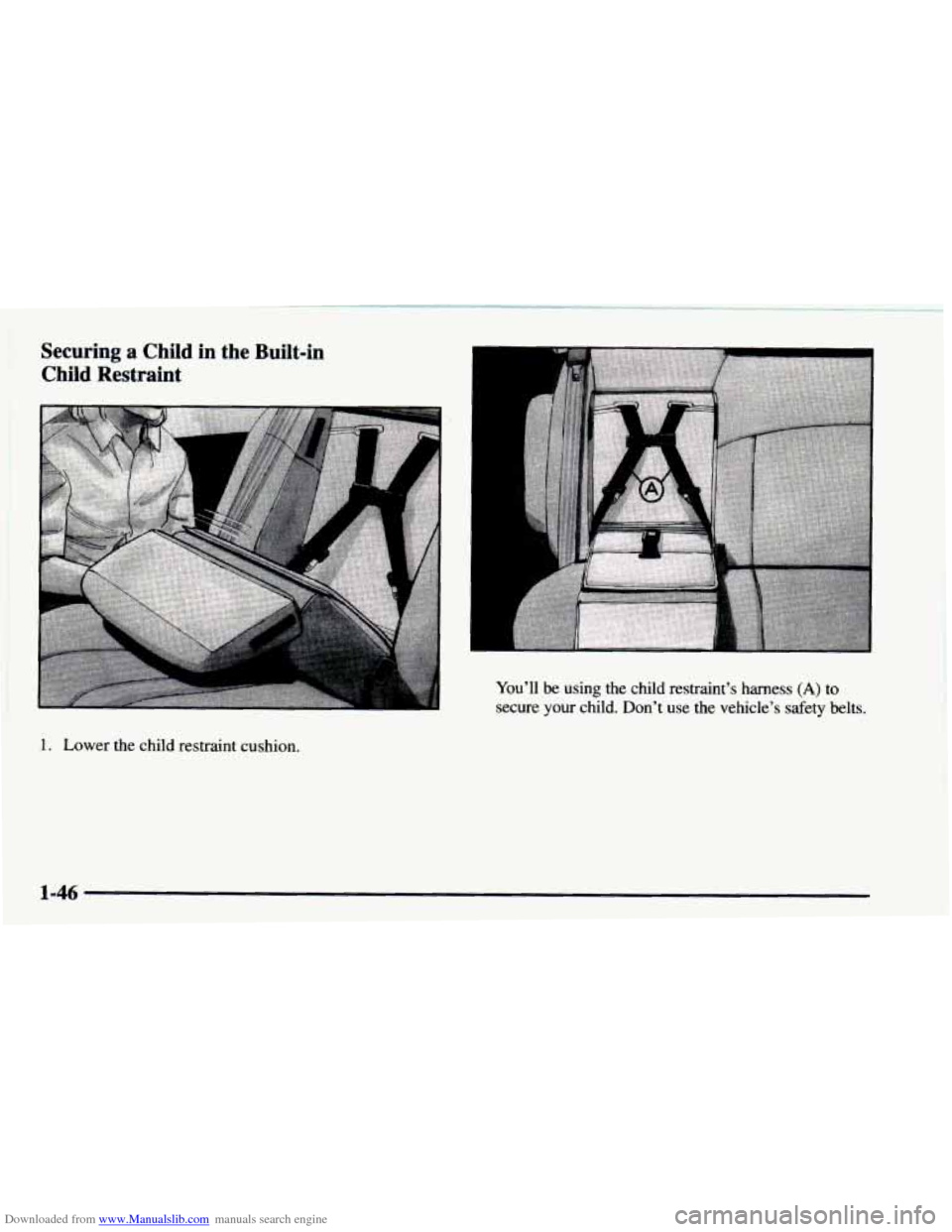
1. Lower the child restraint cushion. You’ll
be using the child restraint’s harness (A) to
secure your child. Don’t use the vehicle’s safety belts.
1-46
Page 55 of 404
Downloaded from www.Manualslib.com manuals search engine i’ I
Using the vehicle’s regular safety belts on a child
seated on the child restraint cushion can cause
serious injury to the child in
a sudden stop or
crash.
If a child is the proper size for the built-in
child restraint, secure the child using the child
restraint’s harness. But children
who are too
large for the built-in child restraint should sit on
the vehicle’s regular seat and use the regular
safety belts.
WARNING! FAILURE TO FOLLOW THE
MANUFACTURER’S INSTRUCTIONS
ON THE
USE
OF THIS CHILD RESTRAINT SYSTEM
CAN RESULT IN YOUR CHILD STRIKING THE
VEHICLE’S INTERIOR DURING A SUDDEN
STOP OR CRASH. SNUGLY ADJUST THE
BELTS PROVIDED WITH THIS CHILD
RESTRAINT AROUND YOUR CHILD.
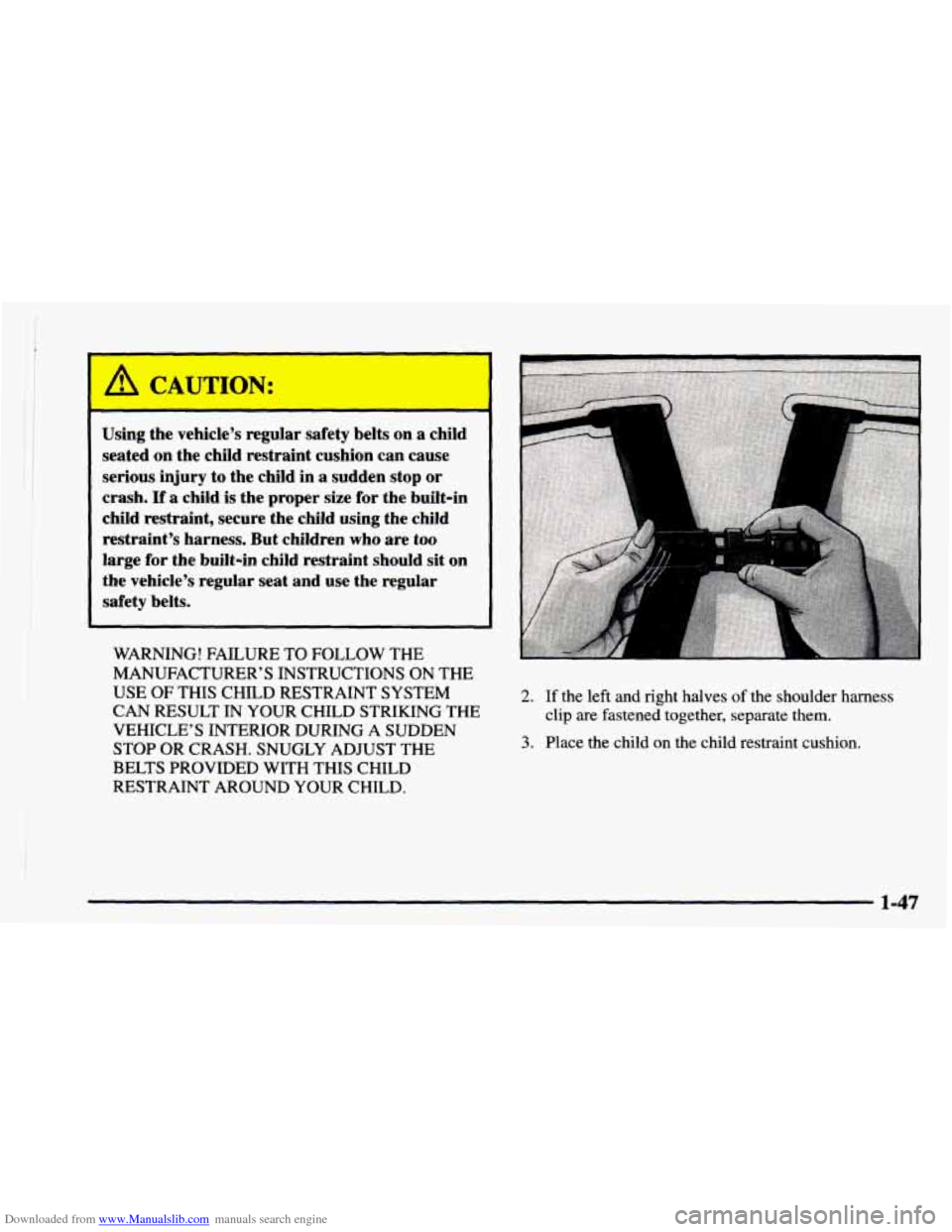
2. If the left and right halves of the shoulder harness
clip are fastened together, separate them.
3. Place the child on the child restraint cushion.
1-47
Page 56 of 404
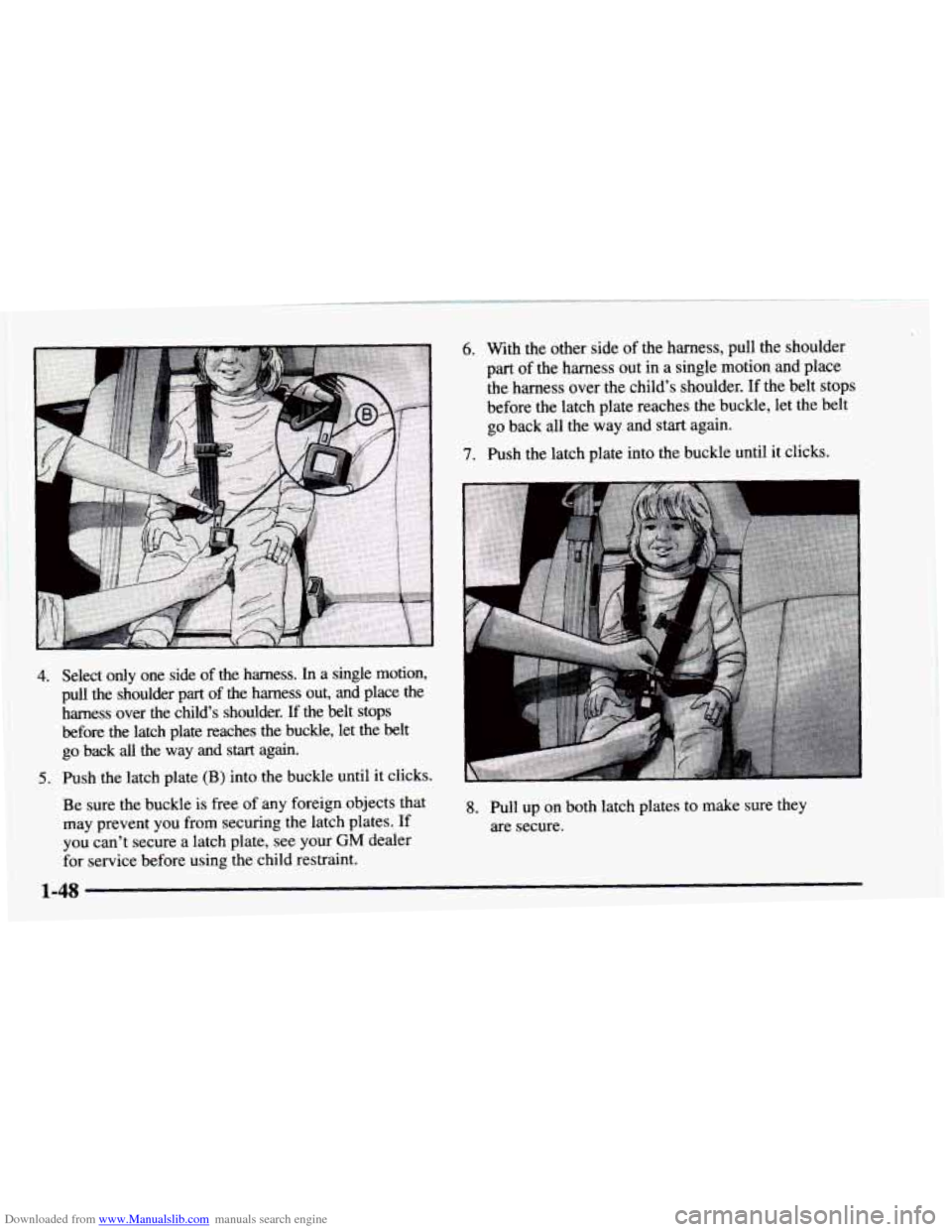
Downloaded from www.Manualslib.com manuals search engine 6. With the other side of the harness, pull the shoulder
part
of the harness out in a single motion and place
the harness over the child’s shoulder. If
the belt stops
before the latch plate reaches the buckle, let the belt
go back all the way and start again.
7. Push the latch plate into the buckle until it clicks.
4. Select only one side of the harness. In a single motion,
pull the shoulder part of the harness out, and place
the
harness over the child’s shoulder. If the belt stops
before the latch plate reaches the buckle, let the belt
go back all the way and start again.
5. Push the latch plate (B) into the buckle until it clicks.
Be sure the buckle is free of any foreign objects that
may prevent you from securing the latch plates. If
you can’t secure
a latch plate, see your GM dealer
for service before using the child restraint.
1-48
8. Pull up on both latch plates to make sure they
are secure.
Page 60 of 404
Downloaded from www.Manualslib.com manuals search engine Storing the Built-in Child Restraint
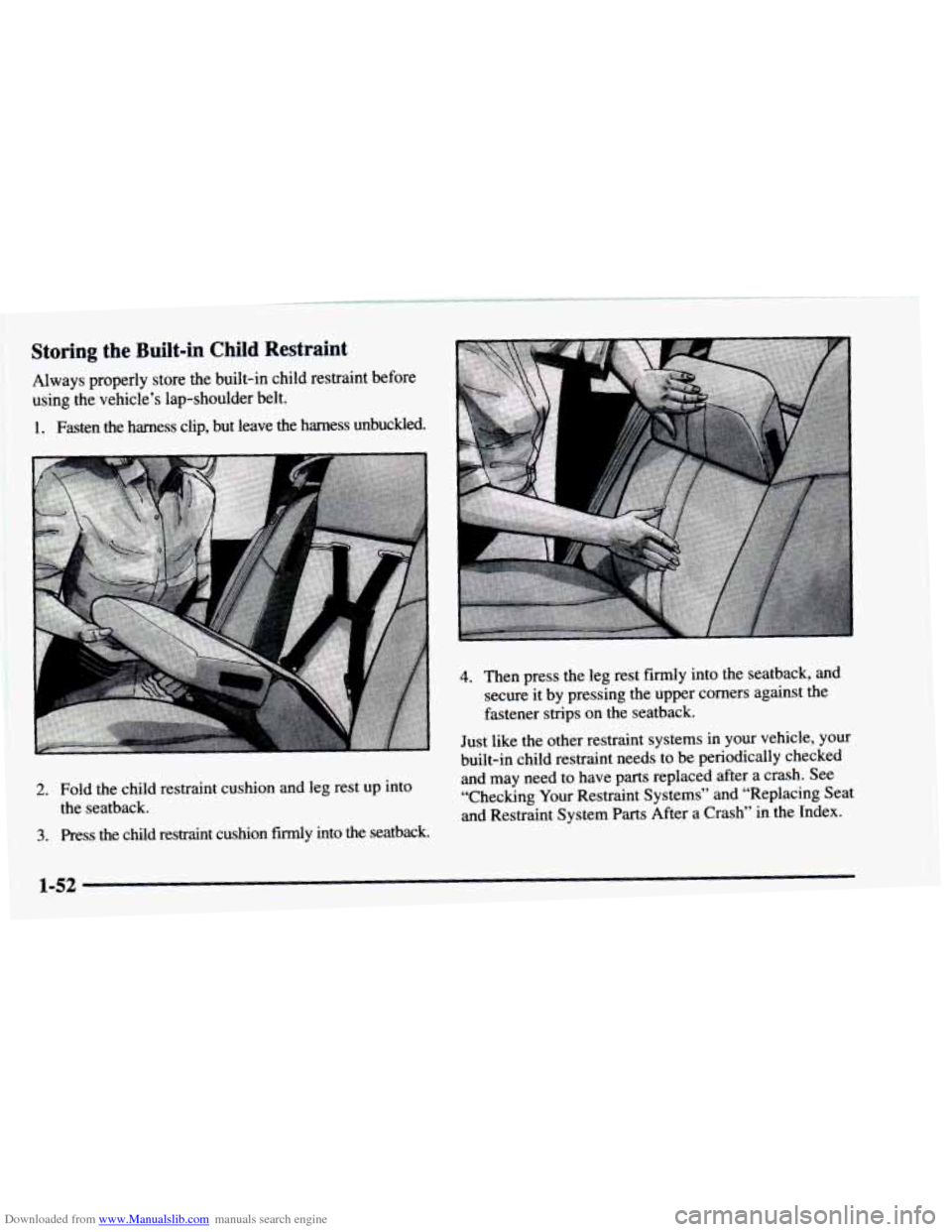
Always properly store the built-in child restraint before
using the vehicle’s lap-shoulder belt.
1. Fasten the harness clip, but leave the harness unbuckled.
..
2. Fold the child restraint cushion and leg rest up into
the seatback.
3. Press the child restraint cushion firmly into the seatback.
4. Then press the leg rest firmly into the seatback, and
secure it by pressing the upper corners against the
fastener strips on the seatback.
Just like the other restraint systems in your vehicle, your
built-in child restraint needs to be periodically checked
and may need to have parts replaced after
a crash. See
“Checking Your Restraint Systems” and “Replacing Seat
and Restraint System
Parts After a Crash” in the Index.
1-52
Page 61 of 404
Downloaded from www.Manualslib.com manuals search engine Child Restraints
Be sure the child restraint is designed to be used in a
vehicle. If it is, it will have a label saying that it meets
Federal Motor Vehicle Safety Standards.
Then follow the instructions for the restraint.
You may
find these instructions on
the restraint itself or in a
booklet, or both. These restraints use the belt system in
your vehicle, but the child also has to be secured within
the restraint to help reduce the chance of personal injury.
The instructions that come with the infant or child
restraint will show you how to do
that.
Where to Put the Restraint
(Except Cargo Vans)
Accident statistics show that children are safer if they
are restrained in the rear rather
than the front seat. We at
General Motors therefore recommend that
you put your
child restraint in a rear seat.
Never put a rear-facing
child restraint
in the front passenger seat. Here’s why:
A child in a rearfacing child restraint can be
seriously injured if
the right front passenger’s air
bag inflates. This is because the back
of a
rear-facing child restraint would be very close to
the inflating air bag. Always secure a rearfacing
child restraint in a rear seat.
You may, however, secure a forward-facing child
restraint in the right front seat. Before
you secure
a forward-facing child restraint, always move the
front passenger seat as far back as it will go. Or,
secure the child restraint in a rear seat.
Wherever you install it, be sure to secure the child
-estraint properly.
Keep in mind that an unsecured child restraint can move
around
in a collision or sudden stop and injure people in
the vehicle. Be sure to properly secure any child
restraint
in your vehicle -- even when no child is in it.
1-53
Page 63 of 404
Downloaded from www.Manualslib.com manuals search engine Securing a Child Restraint in a Rear
Outside Seat Position
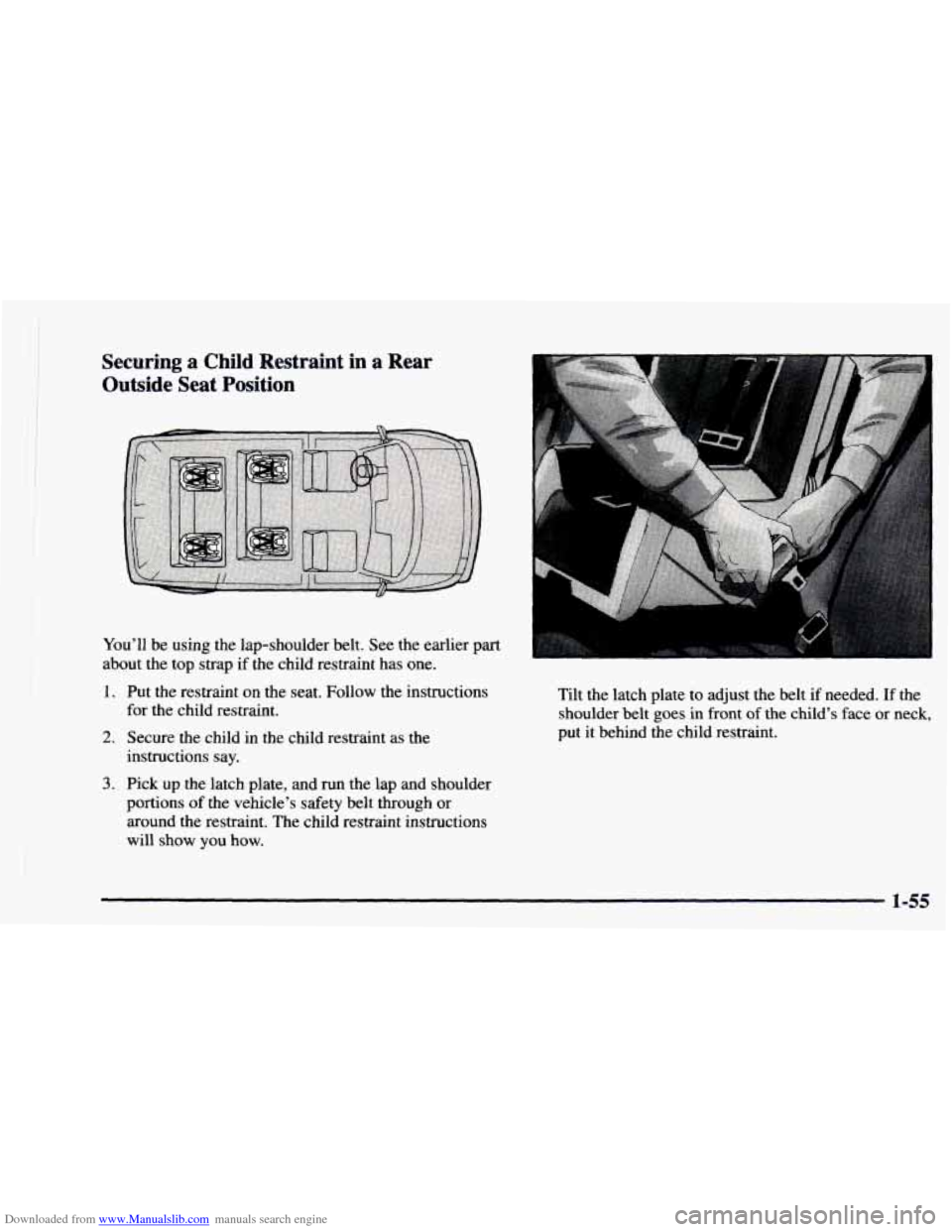
You’ll be using the lap-shoulder belt. See the earlier part
about the
top strap if the child restraint has one.
1. Put the restraint on the seat. Follow the instructions
for the child restraint.
2. Secure the child in the child restraint as the
instructions say.
3. Pick up the latch plate, and run the lap and shoulder
portions
of the vehicle’s safety belt through or
around the restraint. The child restraint instructions
will show you how. Tilt the latch
plate to adjust the belt if needed. If the
shoulder belt goes
in front of the child’s face or neck,
put it behind the child restraint.
1-55
Page 64 of 404
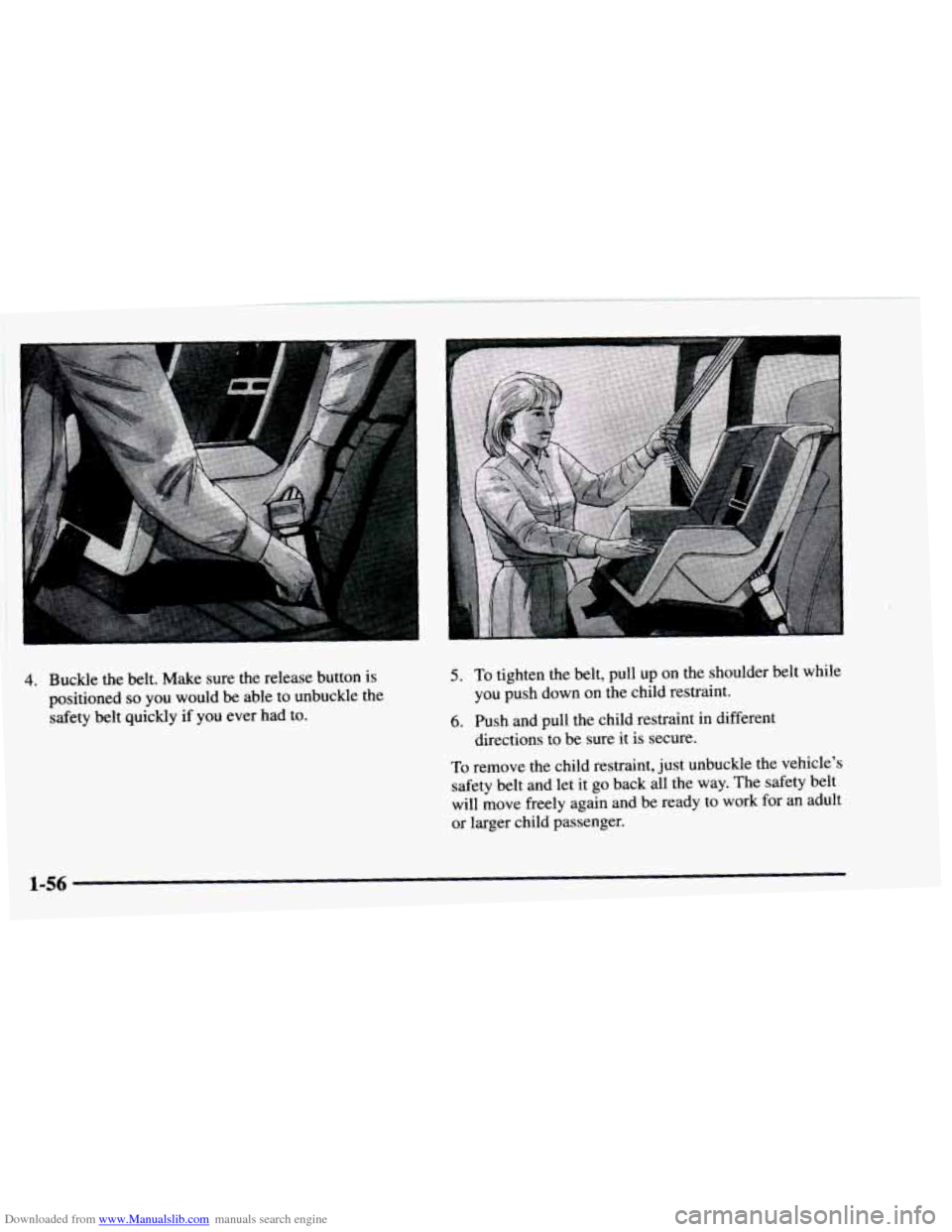
Downloaded from www.Manualslib.com manuals search engine 4. Buckle the belt. Make sure the release button is
positioned
so you would be able to unbuckle the
safety belt quickly if you ever had to.
I
5. To tighten the belt, pull up on the shoulder belt while
6. Push and pull the child restraint in different
you push down on the
child restraint.
directions to be sure it is secure.
To remove the child restraint, just unbuckle the vehicle’s
safety belt and let it go back all the
way. The safety belt
will move freely again and be ready to work for an adult
or larger child passenger.
1-56
Page 65 of 404
Downloaded from www.Manualslib.com manuals search engine Securing a Child Restraint in a Center Seat
Position (Bench Seat)
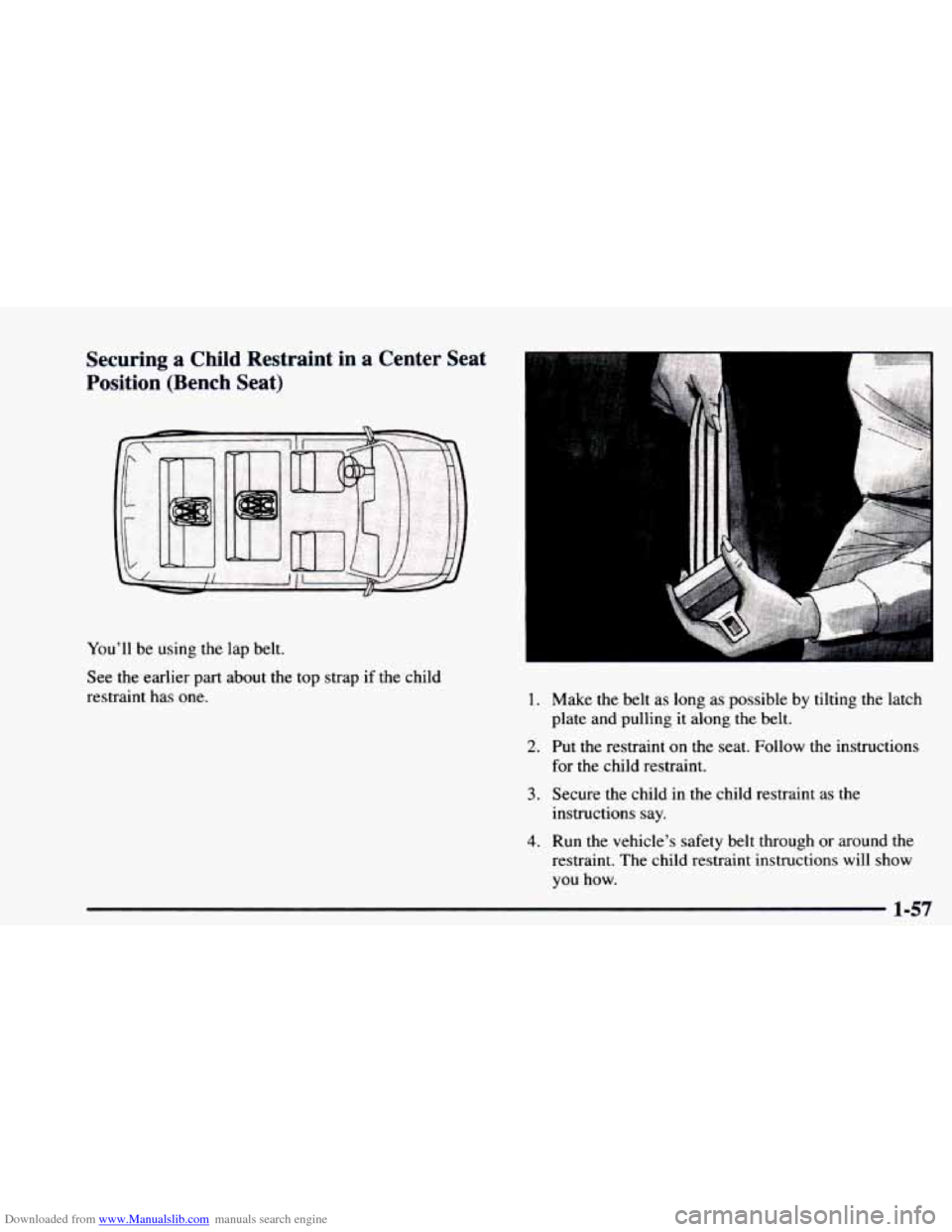
You'll be using the lap belt.
See the earlier part about the top strap if the child
restraint has one.
1.
2.
3.
4.
Make the belt as long as possible by tilting the latch
plate and pulling
it along the belt.
Put the restraint on the seat. Follow the instructions
for the child restraint.
Secure the child in the child restraint as the
instructions
say.
Run the vehicle's safety belt through or around the
restraint. The child restraint instructions will show
you how.
1-57