trailer CHEVROLET ASTRO 1998 2.G Owner's Manual
[x] Cancel search | Manufacturer: CHEVROLET, Model Year: 1998, Model line: ASTRO, Model: CHEVROLET ASTRO 1998 2.GPages: 414, PDF Size: 21.46 MB
Page 276 of 414
Downloaded from www.Manualslib.com manuals search engine Engine Oil Additives
Don't add anything to your oil, Your dealer is ready to
advise if you think something should be added.
When to Change Engine Oil
If any one of these is true for you, use the short trip/city
maintenance schedule:
0
0
0
e
0
Most trips are less than 5 to 10 miles (8 to 16 km).
This
is particularly important when outside
temperatures are below freezing.
Most trips include extensive idling (such as frequent
driving in stop-and-go traffic).
Most trips are through dusty areas.
You frequently tow a trailer or use a carrier on top of
your vehicle.
The vehicle is used for delivery service, police, taxi
or other commercial apl :ation.
Driving under these conc'"ions c
Ses engine oil to
break down sooner. If any one oi rnese is true for your
vehicle, then you need to change your oil and filter
every
3,000 miles (5 000 km) or 3 months -- whichever
occurs first. If
none
of them is true, use the long trip/highway
maintenance schedule. Change the oil and filter every
7,500 miles (12 500 km) or 12 months -- whichever
occurs first. Driving a vehicle with a fully warmed
engine under highway conditions causes engine oil
to
break down slower.
What to Do with Used Oil
Did you know that used engine oil contains certain
elements that may be unhealthy for your skin and could
even cause cancer? Don't
let used oil stay on your skin
for very long. Clean your skin and nails with soap and
water, or a good hand cleaner. Wash or properly throw
away clothing or rags containing used engine oil. (See
the manufacturer's warnings about the use and disposal
of oil products.)
Used oil can be a real threat to the environment. If you
change your own oil, be sure
to drain all free-flowing oil
from the filter before disposal. Don't ever dispose
of oil
by putting it
in the trash, pouring it on the ground, into
sewers,
or into streams or bodies of water. Instead,
recycle
it by taking it to a place that collects used oil. If
you have a problem properly disposing of your used
oil,
ask your dealer, a service station or a local recycling
center for help.
6-14
Page 282 of 414
Downloaded from www.Manualslib.com manuals search engine Automatic Transmission Fluid
When to Check and Change
How to Check
Because this operation can be a little difficult, you may
choose
to have this done at your GM dealership ~
A good time to check your automatic transmission fluid Service Department.
level is when the engine oil
is changed.
Change both the fluid and filter every
15,000 miles here, or you could get a false reading on the dipstick.\
(25 000 km) if the vehicle is mainly driven under one or If
you do
it yourself, be sure to follow all the instructions
more of these conditions:
0 In heavy city traffic where the outside temperature
0 In hilly or mountainous terrain.
0 When doing frequent trailer towing.
regularly reaches
90°F (32 “C) or
higher.
NOTICE:
Too much or too little fluid can damage your
transmission.
Too much can mean that some of
the fluid could come out and fall on hot engine
Uses such as found in taxi, police or delivery service.
If you do not
use your vehicle under any of
these conditions, change the fluid and filter every
50,000 miles (83 000 km).
parts or exhaust system parts, starting a fire. Be
sure to get an accurate reading if you check your
transmission fluid.
See “Scheduled Maintenance Services’’ in the Index.
6-20
Page 283 of 414
Downloaded from www.Manualslib.com manuals search engine I
’Wait at least 30 minutes before checking the
transmission fluid level if you have been driving:
When outside temperatures are above 90°F (32°C).
At high speed for quite a while.
0 In heavy traffic -- especially in hot weather.
0 While pulling a trailer.
To get the right reading, the fluid should be at normal
operating temperature, which
is 180°F to 200°F
182°C to 93 ” C). See “Checking Transmission Fluid
’Hot” in the Index.
Checking Transmission Fluid Hot
Get the vehicle warmed up by driving about 15 miles
(24 km) when outside temperatures are above 50°F
(10°C). If it’s colder than 50°F (lO”C), drive the
vehicle in DRIVE
(D) until the engine temperature gage
moves and then remains steady for
10 minutes. Then
follow the hot check procedures.
Checking Transmission Fluid Cold
A cold check is made after the vehicle has been sitting
for eight hours or more with the engine off and is used
only as a reference. Let the engine run at idle for five
minutes
if outside temperatures are 50°F (10°C) or
more. If it’s colder than
50°F ( 10°C), you may have to
idle the engine longer. Should the fluid level be low
during
a cold check, you must perform a hot check
before adding fluid. This will give you a more accurate
reading
of the fluid level.
Checking the Fluid Hot or Cold
Park your vehicle on a level place. Keep the
engine running.
With the parking brake applied, place the shift lever
in PARK (P)
.
With your foot on the brake pedal, move the shift
lever through each gear range, pausing for about
three seconds in each range. Then, position the shift
lever in
PARK (P).
0 Let the engine run at idle for three minutes or more.
6-21
Page 324 of 414
Downloaded from www.Manualslib.com manuals search engine / 18 24
5 11 17 23 c7 c7 c7 17
4 ~ 10 16
3 9 15 21 c7 E7 c7 E7
2 8 14 20 c7 c7 11 17
7 13 19 E7 c7 c7 E3
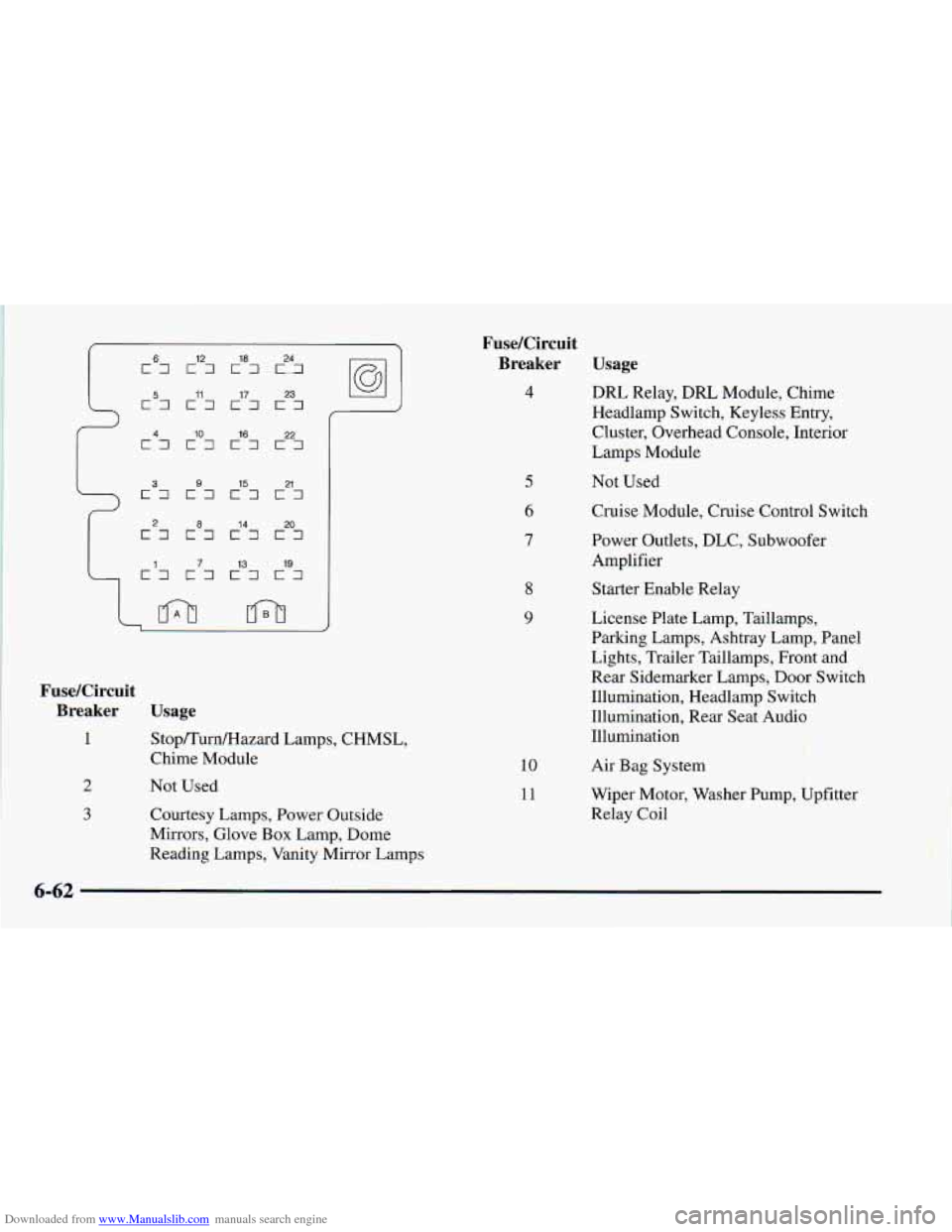
FuseKircuit
Breaker Usage
4
8
9
2
3
FuseKircuit Breaker
Usage I
1 Stop/Turn/Hazard Lamps, CHMSL,
! Chime Module
Not Used
Courtesy Lamps, Power Outside
Mirrors, Glove
Box Lamp, Dome
Reading Lamps, Vanity Mirror Lamps
10
11
DRL Relay, DRL Module, Chime
Headlamp Switch, Keyless Entry,
Cluster, Overhead Console, Interior
Lamps Module
Not Used
Cruise Module, Cruise Control Switch
Power Outlets, DLC, Subwoofer
Amplifier Starter Enable Relay
I
License Plate Lamp, Taillamps, I
Parking Lamps, Ashtray Lamp, Panel
Lights, Trailer Taillamps, Front and
Rear Sidemarker Lamps, Door Switch
Illumination, Headlamp Switch
Illumination, Rear Seat Audio
Illumination
Air
Bag System
Wiper Motor, Washer Pump, Upfitter
Relay Coil
Page 325 of 414
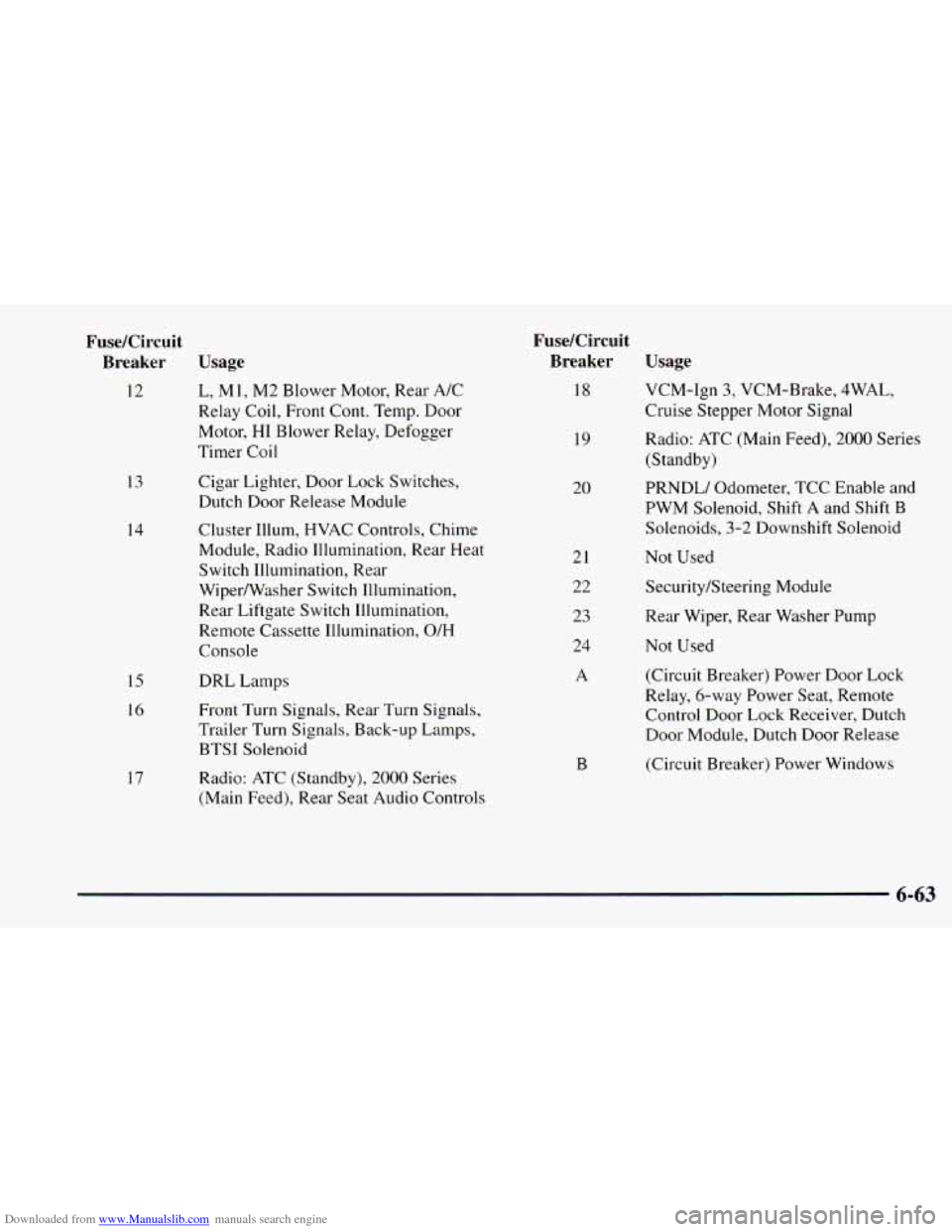
Downloaded from www.Manualslib.com manuals search engine FuseKircuit Breaker Usage
12
13
14
15
16
17
L, M 1, M2 Blower Motor, Rear A/C
Relay Coil, Front Cont. Temp. Door
Motor,
HI Blower Relay, Defogger
Timer Coil
Cigar Lighter, Door Lock Switches,
Dutch Door Release Module
Cluster Illum, HVAC Controls, Chime
Module, Radio Illumination, Rear Heat
Switch Illumination, Rear
Wiper/Washer Switch Illumination,
Rear Liftgate Switch Illumination,
Remote Cassette Illumination, O/H
Console
DRL Lamps
Front Turn Signals, Rear Turn Signals,
Trailer Turn Signals, Back-up Lamps,
BTSI Solenoid
Radio: ATC (Standby), 2000 Series
(Main Feed), Rear Seat Audio Controls 19
20
FuseKircuit
Breaker Usage
18 VCM-Ign 3, VCM-Brake, LCWAL,
Cruise Stepper Motor Signal
Radio: ATC (Main Feed),
2000 Series
(Standby)
PRNDL/ Odometer, TCC Enable and
PWM Solenoid, Shift A and Shift B
Solenoids, 3-2 Downshift Solenoid
21
22
23
24
A
B Not Used
Security/Steering Module
Rear Wiper, Rear Washer Pump
Not Used (Circuit Breaker) Power Door
Lock
Relay, 6-way Power Seat, Remote
Control Door Lock Receiver, Dutch
Door Module, Dutch Door Release
(Circuit Breaker) Power Windows
6-63
Page 327 of 414
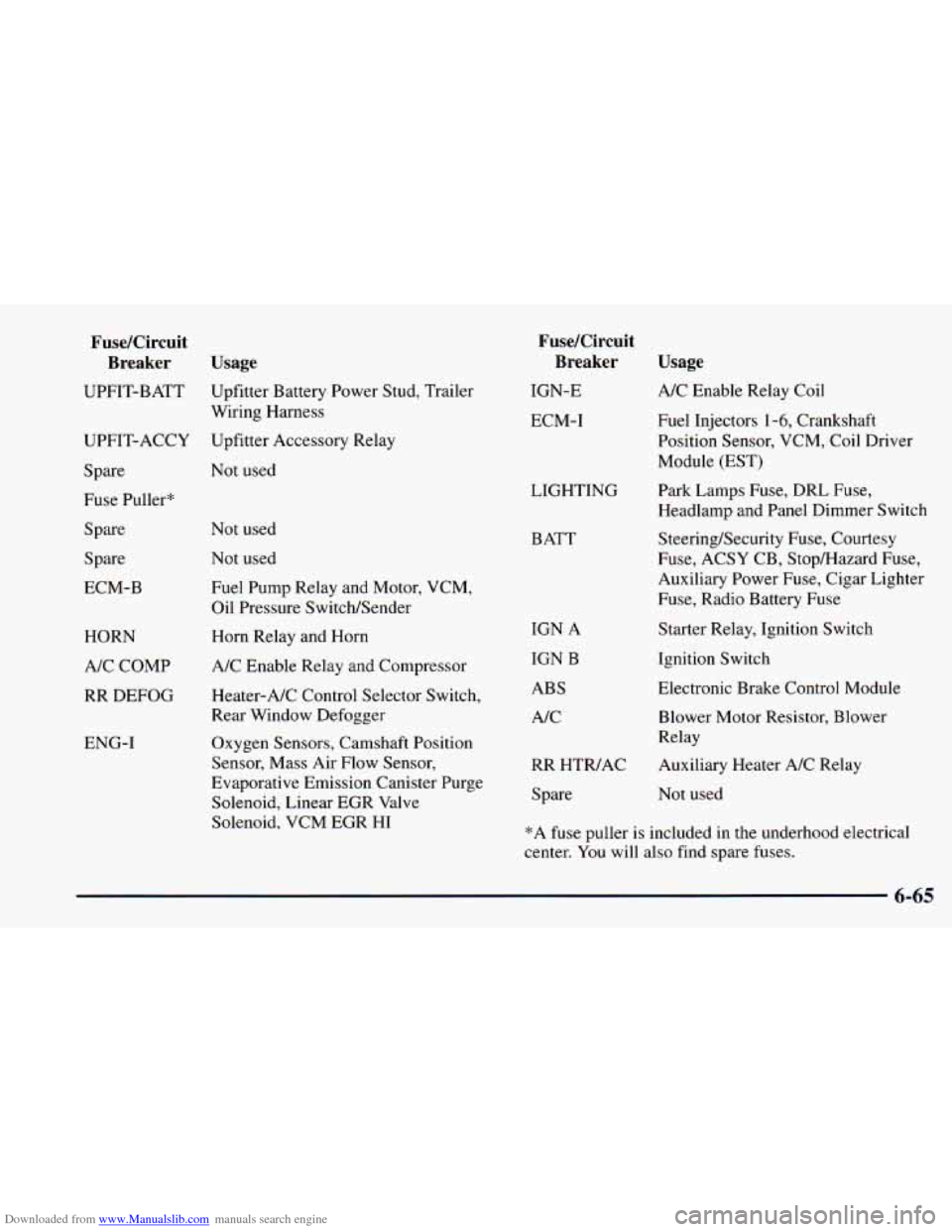
Downloaded from www.Manualslib.com manuals search engine Fuse/Circuit Breaker Usage
UPFIT-BATT Upfitter Battery Power Stud, Trailer
UPFIT-ACCY Upfitter Accessory Relay
Wiring
Harness
Spare
Fuse Puller*
Spare
Spare
ECM-B
HORN
A/C COMP
RR DEFOG
ENG-I
Fuse/Circuit Breaker Usage
IGN-E
ECM-I
Not used
LIGHTING
Not used
Not used Fuel Pump Relay and Motor, VCM,
Oil Pressure Switch/Sender
Horn Relay and Horn
A/C Enable Relay and Compressor
Heater-A/C Control Selector Switch,
Rear Window Defogger
Oxygen Sensors, Camshaft Position
Sensor, Mass Air Flow Sensor,
Evaporative Emission Canister Purge
Solenoid, Linear EGR Valve
Solenoid, VCM EGR HI BATT
IGN A
IGN B
ABS
NC
RR HTRIAC
Spare A/C
Enable Relay Coil
Fuel Injectors
1-6, Crankshaft
Position Sensor, VCM, Coil Driver
Module (EST)
Park Lamps Fuse, DRL Fuse,
Headlamp and Panel Dimmer Switch
SteeringBecurity Fuse, Courtesy
Fuse, ACSY CB, Stop/Hazard Fuse,
Auxiliary Power Fuse, Cigar Lighter
Fuse, Radio Battery Fuse
Starter Relay, Ignition Switch
Ignition Switch
Electronic Brake Control Module Blower Motor Resistor, Blower
Relay
Auxiliary Heater NC Relay
Not used
*A fuse puller is included
in the underhood electrical
center. You will also find spare fuses.
6-65
Page 339 of 414
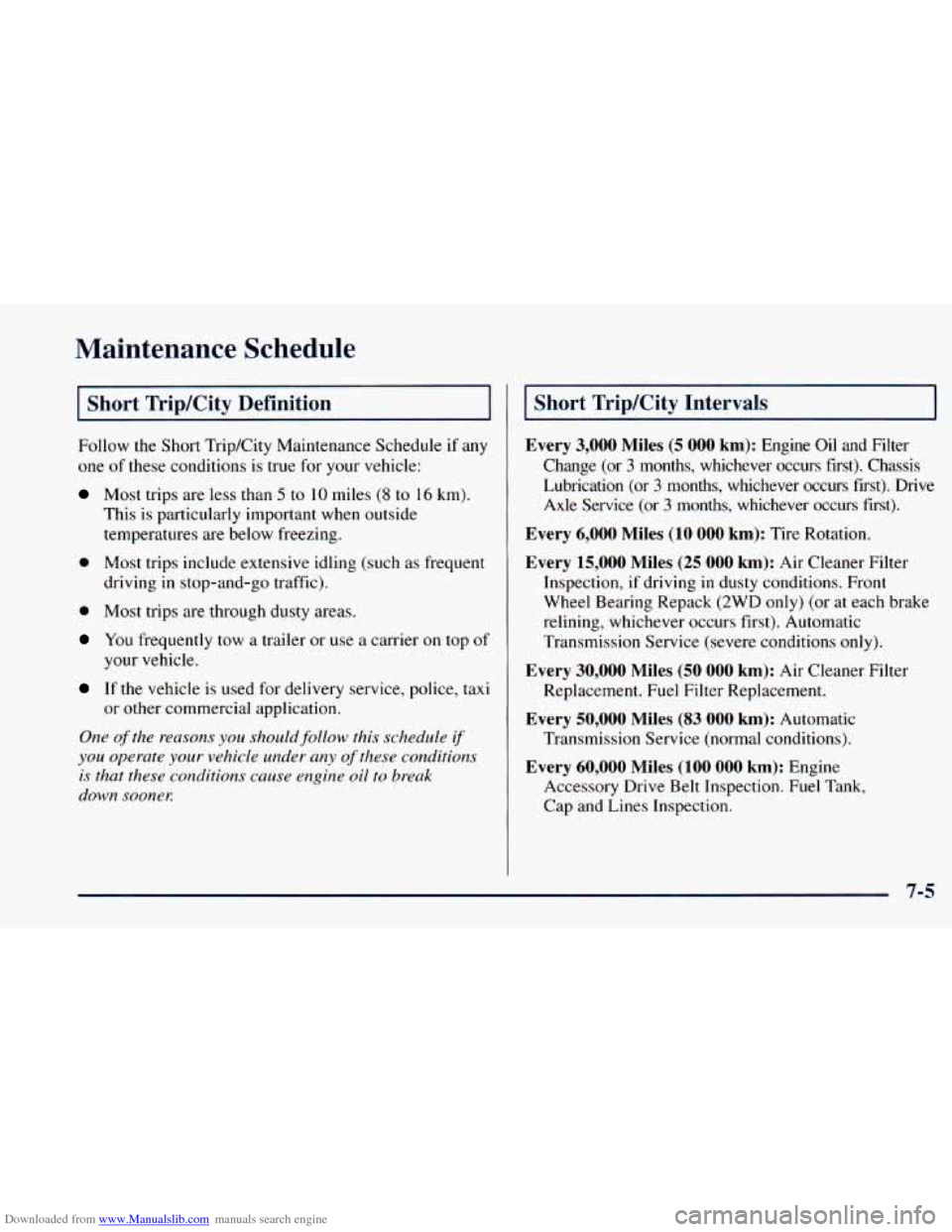
Downloaded from www.Manualslib.com manuals search engine Maintenance Schedule
I Short Trip/City Definition
Follow the Short Trip/City Maintenance Schedule if any
one of these conditions
is true for your vehicle:
Most trips are less than 5 to 10 miles (8 to 16 km).
This is particularly important when outside
temperatures are below freezing.
driving
in stop-and-go traffic).
0 Most trips are through dusty areas.
You frequently tow a trailer or use a carrier on top of
If the vehicle is used for delivery service, police, taxi
One of the reasons you should follow this schedule if
you operate your vehicle under any of these conditions
is that these conditions cause engine oil to
break
down sooneE
0 Most trips include extensive idling (such as frequent
your vehicle.
or other commercial application.
I Short Trip/City Intervals
Every 3,000 Miles (5 000 km): Engine Oil and Filter
Change (or
3 months, whichever occurs first). Chassis
Lubrication (or
3 months, whichever occurs first). Drive
Axle Service (or
3 months, whichever occurs first).
Every 6,000 Miles (10 000 km): Tire Rotation.
Every 15,000 Miles (25 000 km): Air Cleaner Filter
Inspection, if driving
in dusty conditions. Front
Wheel Bearing Repack
(2WD only) (or at each brake
relining, whichever occurs first). Automatic
Transmission Service (severe conditions only).
Every 30,000 Miles (50 000 km): Air Cleaner Filter
Replacement. Fuel Filter Replacement.
Every 50,000 Miles (83 000 km): Automatic
Transmission Service (normal conditions).
Every 60,000 Miles (100 000 km): Engine
Accessory Drive Belt Inspection. Fuel Tank,
Cap and Lines Inspection.
7-5
Page 340 of 414
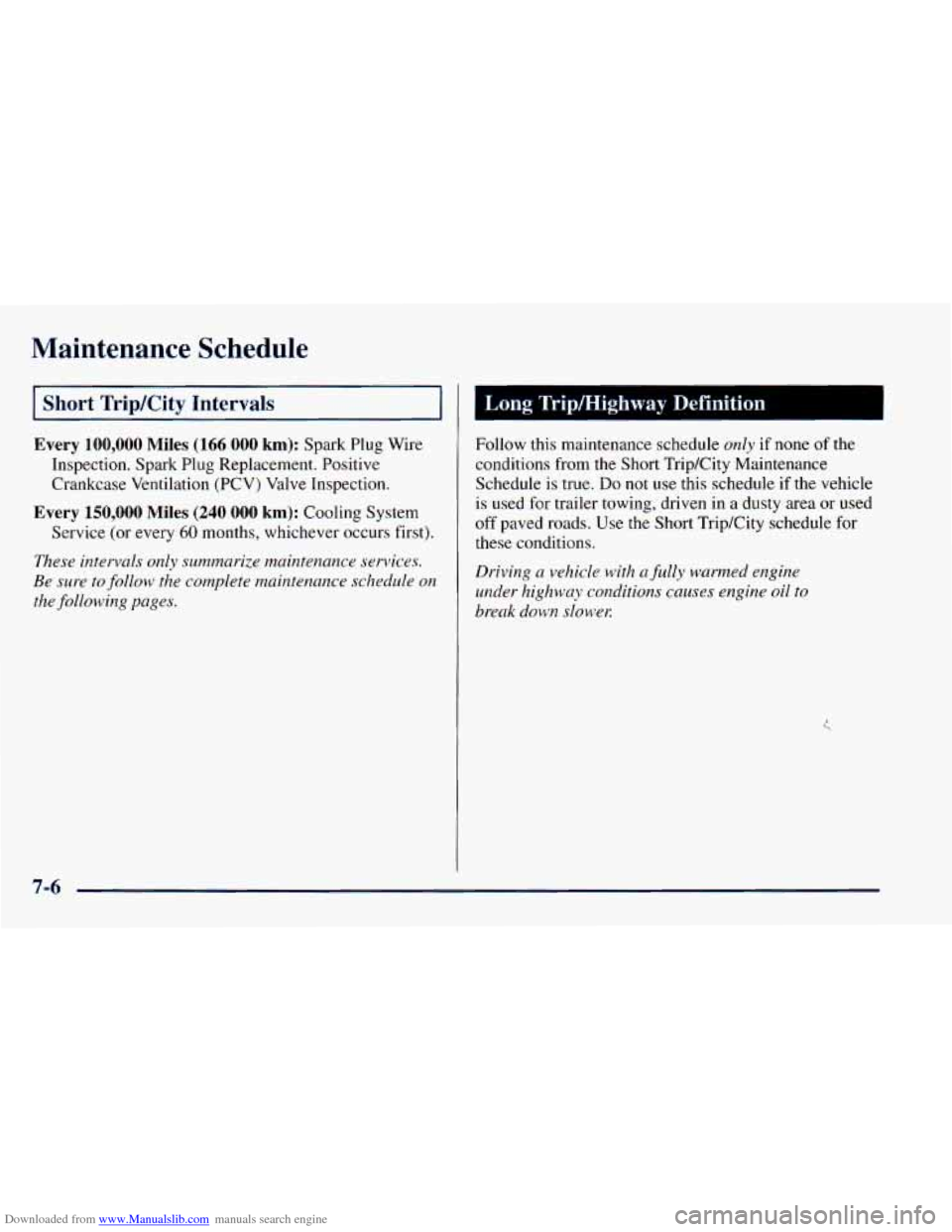
Downloaded from www.Manualslib.com manuals search engine Maintenance Schedule
I Short Trip/City Intervals
Every 100,000 Miles (166 000 km): Spark Plug Wire
Inspection. Spark Plug Replacement. Positive
Crankcase Ventilation (PCV) Valve Inspection.
Every 150,000 Miles (240 000 km): Cooling System
Service (or every
60 months, whichever occurs first).
These intervals only summarize maintenance services.
Be sure to follow the complete maintenance schedule
on
the following pages.
Long Trip/Highway Definition ,-
Follow this maintenance schedule only if none of the
conditions from the Short TripKity Maintenance
Schedule
is true. Do not use this schedule if the vehicle
is used for trailer towing, driven in a dusty area or used
off paved roads. Use the Short Trip/City schedule for
these conditions.
Driving a vehicle with a fully warmed engine
under higlzway conditions causes engine oil to
break down slowec
c
7-6
Page 342 of 414
Downloaded from www.Manualslib.com manuals search engine Short TripKity Maintenance Schedule
The services shown in this schedule up to 100,000 miles
(166 000 km) should be performed after 100,000 miles
(166 000 km) at the same intervals. The services shown
at 150,000 miles
(240 000 km) should be performed at
the same interval after 150,000 miles (240 000 km).
See “Owner Checks and Services’’ and “Periodic
Maintenance Inspections” following.
Footnotes
The U.S. Envlronmental Protection Agency or the
California Air Resources Board has determined that the
failure to perform this maintenance item will
not nullify
the emission warranty or limit recall liability prior to the
completion
of the vehicle’s useful life. We, however,
urge that all recommended maintenance services be
performed at the indicated intervals and the maintenance
be recorded.
# Lubricate the front suspension, ball joints and kingpin
bushings, steering linkage and transfer case shift linkage,
parking brake cable guides, and brake pedal springs.
+ A good time to check your brakes is during tire
rotation. See “Brake System Inspection” under “Periodic
Maintenance Inspections” in Part
C of this schedule.
** Drive axle service (see “Recommended Fluids and
Lubricants”
in the Index for proper lubricant to use):
0
0
0
Locking Differential -- Drain fluid and refill at first
engine oil change. At subsequent oil changes, check
fluid level and add fluid as needed. If driving
in
dusty areas or towing a trailer, drain fluid and refill
every 15,000 miles
(25 000 km).
Standard Differential
-- Check fluid level and add
fluid as needed at every oil change. If driving in
dusty areas or towing a trailer, drain fluid and refill
every 15,000 miles
(25 000 km).
More frequent lubrication may be required for
heavy-duty use.
7-8
Page 345 of 414
Downloaded from www.Manualslib.com manuals search engine 1 Short TripKity Maintenance Schedule I
0 Inspect air cleaner filter if you are driving in dusty conditions. Replace filter
if necessary.
An Emission Control Service. (See footnote?.)
velocity joints and axle seals for leaking. (See footnote
**.)
bearings (or at each brake relining, whichever occurs first).
under
one or more of these conditions:
0 Check readfront axle fluid level and add fluid as needed. Check constant
0 For Two-Wheel-Drive vehicles only: Clean and repack the front wheel
0 Change automatic transmission fluid and filter if the vehicle is mainly driven
- In heavy city traffic where the outside temperature regularly reaches
- In hilly or mountainous terrain.
- When doing frequent trailer towing.
90 OF (32 O C) or higher.
- Uses such as found in taxi, police or delivery service.
If you do not use yaw- vehicle under any of these conditions, change thejiruid
andfilter every
50,000 miles (83 000 km).
18,000 Miles (30 000 km)
0 Change engine oil and filter (or every 3 months, whichever occurs first).
An Emission Control Service.
7-11