light CHEVROLET ASTRO 1998 2.G Workshop Manual
[x] Cancel search | Manufacturer: CHEVROLET, Model Year: 1998, Model line: ASTRO, Model: CHEVROLET ASTRO 1998 2.GPages: 414, PDF Size: 21.46 MB
Page 209 of 414
Downloaded from www.Manualslib.com manuals search engine Tie a red cloth to your vehicle to alert police that
you’ve been stopped by the snow.
Put on extra clothing or wrap a blanket around you.
If you have no blankets or extra clothing, make body
insulators from newspapers, burlap bags, rags, floor
mats
-- anything you can wrap around yourself or
tuck under your clothing
to keep warm.
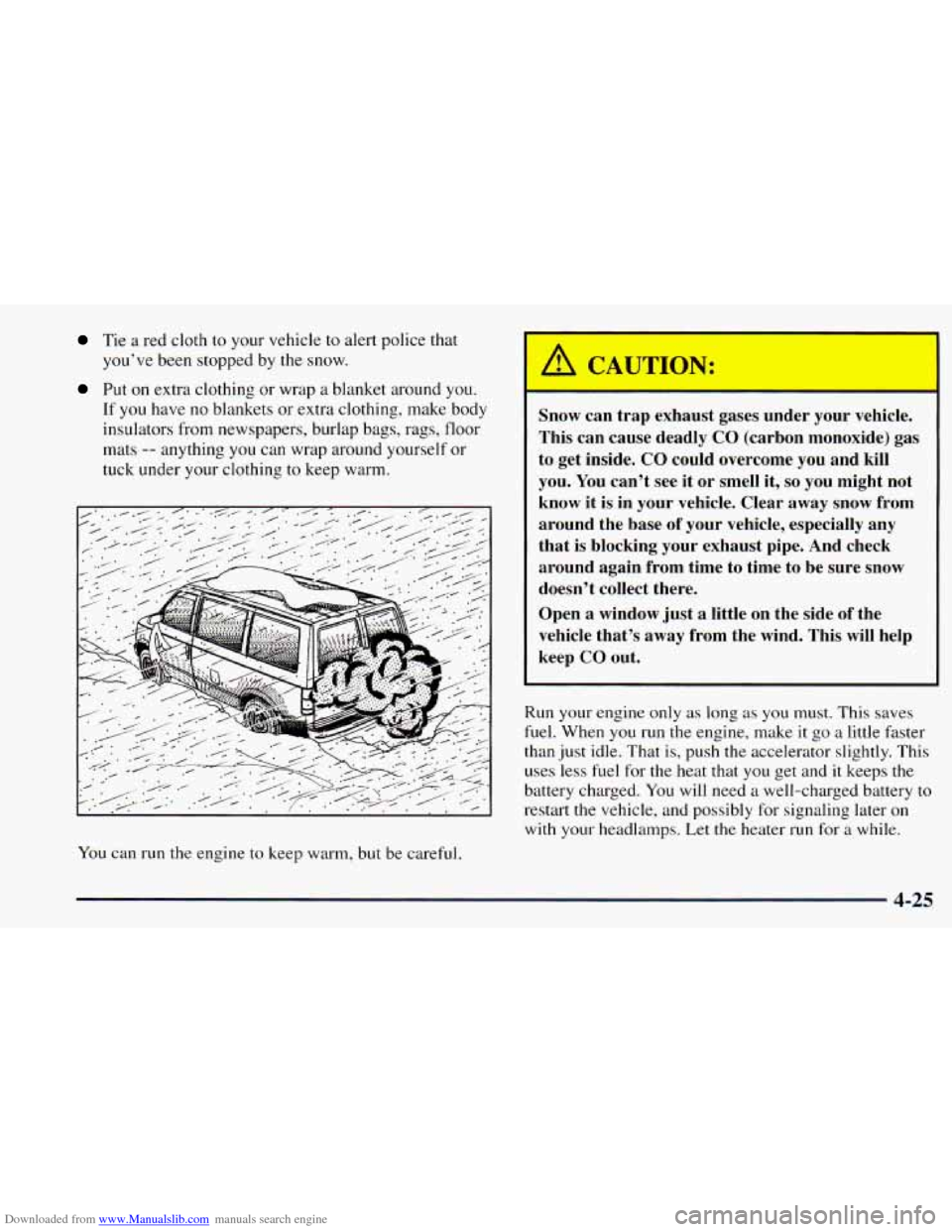
Sr Y can trap exha. ler your vehicle.
~ This can cause deadly 60 (carbon monoxide) gas
to get inside. CO could overcome you and kill
you.
You can’t see it or smell it, so you might not
know
it is in your vehicle. Clear away snow from
around the base of your vehicle, especially any
~ that is blocking your exhaust pipe. And check
around again from time to time to be sure snow
doesn’t collect there.
Open a window just
a little on the side of the
vehicle that’s
away from the wind. This will help
~ keep CO out.
Run your engine only as long as you must. This saves
fuel. When you run
the engine, make it go a little faster
than just idle. That is, push the accelerator slightly. This
uses less fuel for the heat that you get and it keeps the
battery charged. You will need a well-charged battery
to
restart the vehicle, and possibly for signaling later on
with your headlamps. Let
the heater run for a while.
You can run the engine to keep warm, but be careful.
4-25
Page 221 of 414
Downloaded from www.Manualslib.com manuals search engine Trailer Wiring Harness
If you have the optional trailering package, your vehicle
will have an eight-wire
harness, including the center
high-mounted stoplamp battery feed wire. The harness
is stored
on the passenger’s side of the vehicle near the
rear wheel well. This harness has
a 30 amp battery feed
wire and
no connector, and should be wired by a
qualified electrical technician. After choosing an
aftermarket trailer mating connector pair, have the
technician attach one connector to
the eight-wire trailer
harness and the other connector to the wiring harness on
the trailer. Be sure the wiring harness on the trailer is
taped or strapped to the trailer’s frame rail and leave
it
loose enough so the wiring doesn’t bend or break, but
not
so loose that it drags on the ground. The eight-wire
harness must be routed out of your vehicle between the
rear door and the floor, with enough of the harness left
on both sides so that the trailer or the body won’t pull it. If
you do
not have the optional trailering package, your
vehicle will
still have a trailering harness. The harness is
located near the passenger’s side rear wheel well. It
consists
of six wires that may be used by after-market
trailer hitch installers.
The technician can use the
following color code chart when connecting
the wiring
harness
to your trailer.
Brown: Rear lamps.
0 Yellow: Left stoplamp and turn signal.
Dark Green: Right stoplamp and turn signal.
White (Heavy Gage): Ground.
0 Light Green: Back-up lamps.
0 White (Light Gage): Center High-Mounted
Stoplamp.
Blue: Auxiliary circuit (eight-wire harness only).
0 Orange: Fused auxiliary (eight-wire harness only).
Store the harness
in its original place. Wrap the harness
together and tie
it neatly so it won’t be damaged.
4-37
Page 226 of 414
Downloaded from www.Manualslib.com manuals search engine To avoid the possibility of the vehicles rolling, set
the parking brake firmly on both vehicles involved
in the jump start procedure. Put an automatic
transmission in PARK
(P).
3. Turn off the ignition on both vehicles. Unplug
unnecessary accessories plugged into the cigarette
lighter or accessory power outlets. Turn
off all lamps
that aren’t needed as well as radios. This will avoid
sparks and help save both batteries.
In addition, it
could save your radio!
NOTICE:
If you leave your radio on, it could be badly
damaged. The repairs wouldn’t be covered by
your warranty.
4. Open the hoods and locate the batteries. Find
the positive
(+) and negative (-) terminals on
each battery.
A CAUTION:
1 ng a match near a battery can cause battery
gas to explode. People have been hurt doing this,
and some have been blinded. Use a flashlight if
you need more light.
Be sure the battery has enough water. You
don’t need to add water to the Delco Freedom@
battery installed in every new
GM vehicle. But
if a battery has filler caps, be sure the right
amount of fluid is there.
If it is low, add water to
take care of that first.
If you don’t, explosive gas
could be present.
Battery fluid contains acid that can burn you.
Don’t get it on you.
If you accidentally get it in
your eyes or on your skin, flush the place with
water and get medical help immediately.
Page 259 of 414
Downloaded from www.Manualslib.com manuals search engine If You’re Stuck: In Sand, Mud,
Ice
or Snow
What you don’t want to do when your vehicle is stuck is
to spin your wheels too fast. The method known
as
“rocking” can help you get out when you’re stuck, but
you must use caution.
L
A CAUTION: I I
If you let your tires spin at high speed, they can
explode, and you or others could be injured. And,
the transmission or other parts
of the vehicle can
overheat. That could cause an engine
compartment fire or other damage. When you’re
stuck, spin the wheels as little
as possible. Don’t
spin the wheels above
35 mph (55 km/h) as shown
on the speedometer.
NOTICE:
Spinning your wheels can destroy parts of your
vehicle as well as the tires.
If you spin the wheels
too fast while shifting your transmission back
and forth, you can destroy your transmission.
For information about using tire chains on your vehicle,
see “Tire Chains” in the Index.
Rocking Your Vehicle To Get It Out
First, turn your steering wheel left and right. That will
clear the area around your front wheels. Then shift back
and forth between
REVERSE (R) and a forward gear,
spinning the wheels as little as possible. Release the
accelerator pedal while you shift, and press lightly on
the accelerator pedal when the transmission is in gear. If
that doesn’t get you out after a few tries, you may need
to be towed out. If you do need to be towed out, see
“Towing Your Vehicle” in the Index.
5-37
Page 269 of 414
Downloaded from www.Manualslib.com manuals search engine I
NOTICE:
If you need a new cap, be sure to get the right
type. Your dealer can get one for you.
If you get
the wrong type, it may not fit properly. This may cause your malfunction indicator lamp to light and your fuel tank and emissions system may be
damaged. See “Malfunction Indicator Lamp” in
the Index.
Filling a Portable Fuel Container
A CAUTION:
Never fill a portable fuel container while it is in
your vehicle. Static electricity discharge from the
container can ignite the gasoline vapor.
You can
be badly burned and your vehicle damaged if this
occurs.
To help avoid injury to you and others:
Dispense gasoline only into
approved containers.
CAUTION: (Continued)
I
Do not fill a container whilc : is inside a
vehicle, in a vehicle’s trunk, pickup bed or
on any surface other than the ground.
inside of the fill opening before operating
the nozzle. Contact should be maintained
until the filling
is complete.
0 Bring the fill nozzle in contact with the
Don’t smoke while pumping gasoline.
Checking Things Under the Hood
A CAUTION: I
Things that burn can get on hot engine parts and
start a fire. These include liquids like gasoline,
oil, coolant, brake fluid, windshield washer and
other fluids, and plastic
or rubber. You or others
could be burned. Be careful not to drop or spill
things that will burn onto a hot engine.
6-7
Page 287 of 414
Downloaded from www.Manualslib.com manuals search engine Rear Axle
When to Check and Change Lubricant
Refer to the Maintenance Schedule to determine how
often
to check the lubricant and when to change it. See
“Scheduled Maintenance Services” in the Index.
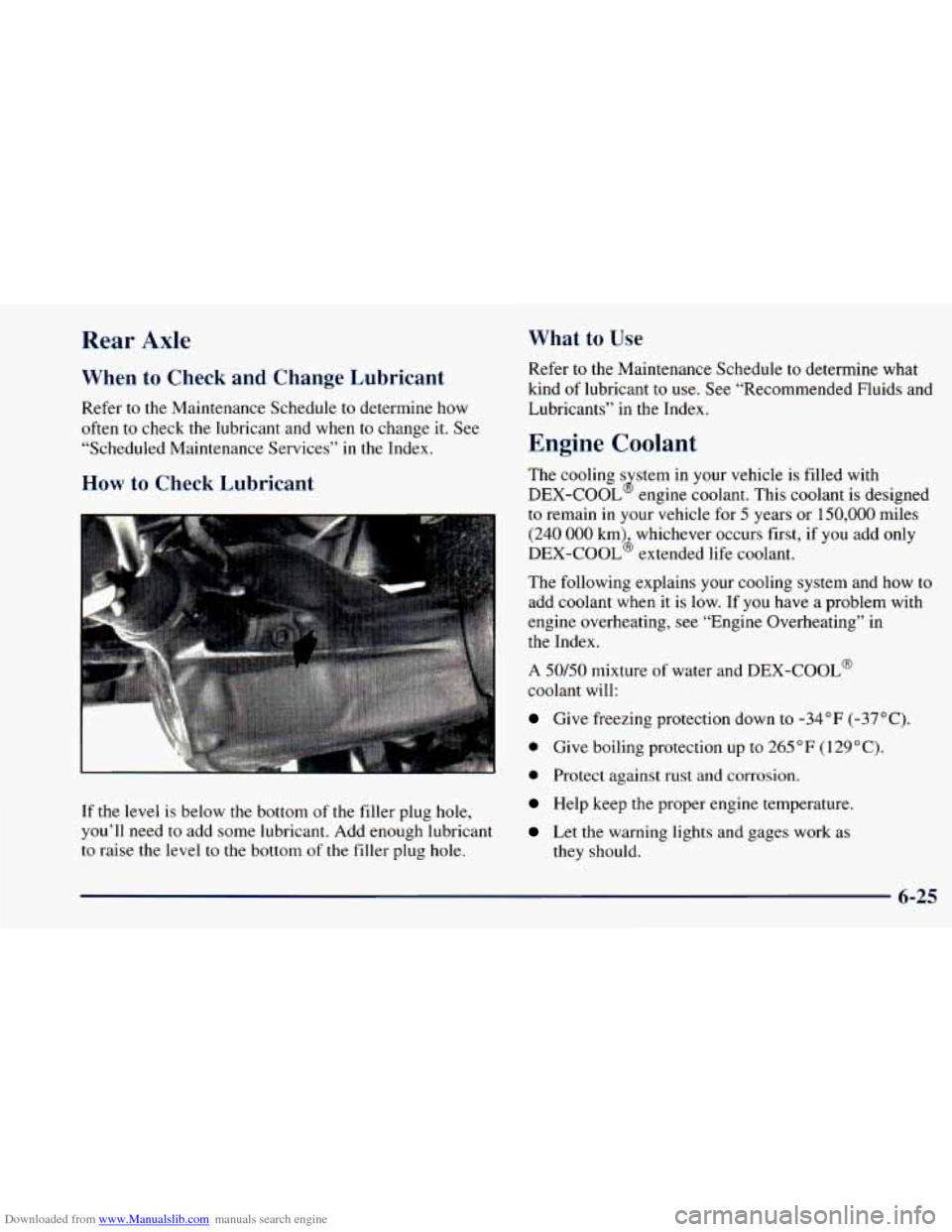
How to Check Lubricant
If the level is below the bottom of the filler plug hole,
you’ll need to add some lubricant. Add enough lubricant
to raise the level to the bottom
of the filler plug hole.
What to Use
Refer to the Maintenance Schedule to determine what
kind of lubricant
to use. See “Recommended Fluids and
Lubricants” in the Index.
Engine Coolant
The cooling s stem in your vehicle is filled with
DEX-COOL engine coolant. This coolant
is designed
to remain in your vehicle for
5 years or 150,000 miles
(240
000 km) whichever occurs first, if you add only
DEX-COOL’ extended life coolant.
The following explains your cooling system and how to
add coolant when it is low. If you have a problem with
engine overheating,
see “Engine Overheating” in
the Index.
A 50/50 mixture of water and DEX-COOL@
coolant will:
Give freezing protection down to -34°F (-37°C).
0 Give boiling protection up to 265 “F ( 129°C).
0 Protect against rust and corrosion.
Help keep the proper engine temperature.
Let the warning lights and gages work as
B
they should.
6-25
Page 309 of 414
Downloaded from www.Manualslib.com manuals search engine Uniform Tire Quality Grading Treadwe:
The following information relates to the system
developed by the United States National Highway
Traffic Safety Administration, which grades tires by
treadwear, traction and temperature performance. (This
applies only to vehicles sold in the United States.) The
grades are molded
on the sidewalls of most passenger
car tires. The Uniform Tire Quality Grading system does
not apply to deep tread, winter-type snow tires,
space-saver or temporary use spare tires, tires with
nominal rim diameters of 10 to
12 inches (25 to 30 cm),
or
to some limited-production tires.
While the tires available on General Motors passenger
cars and light trucks may vary with respect
to these
grades, they must also conform to Federal safety
requirements and additional General Motors Tire
Performance Criteria (TPC) standards.
The treadwear grade is a comparative rating based on
the wear rate of the tire when tested under controlled
conditions
on a specified government test course. For
example, a tire graded 150 would wear one and
a half
(1 1/2) times as well on the government course as a tire
graded
100. The relative performance of tires depends
upon the actual conditions
of their use, however, and
may depart significantly from the norm due to variations
in driving habits, service practices and differences in
road characteristics and climate.
Traction -- A, B, C
The traction grades, from highest to lowest, are A, B,
and C, and they represent the tire’s ability to stop on wet
pavement as measured under controlled conditions
on
specified government test surfaces of asphalt and concrete.
A
tire marked C may have poor traction performance.
Warning: The traction grade assigned
to this tire is based
on braking (straight ahead) traction tests and does not
include cornering (turning) traction.
- 6-47
Page 320 of 414
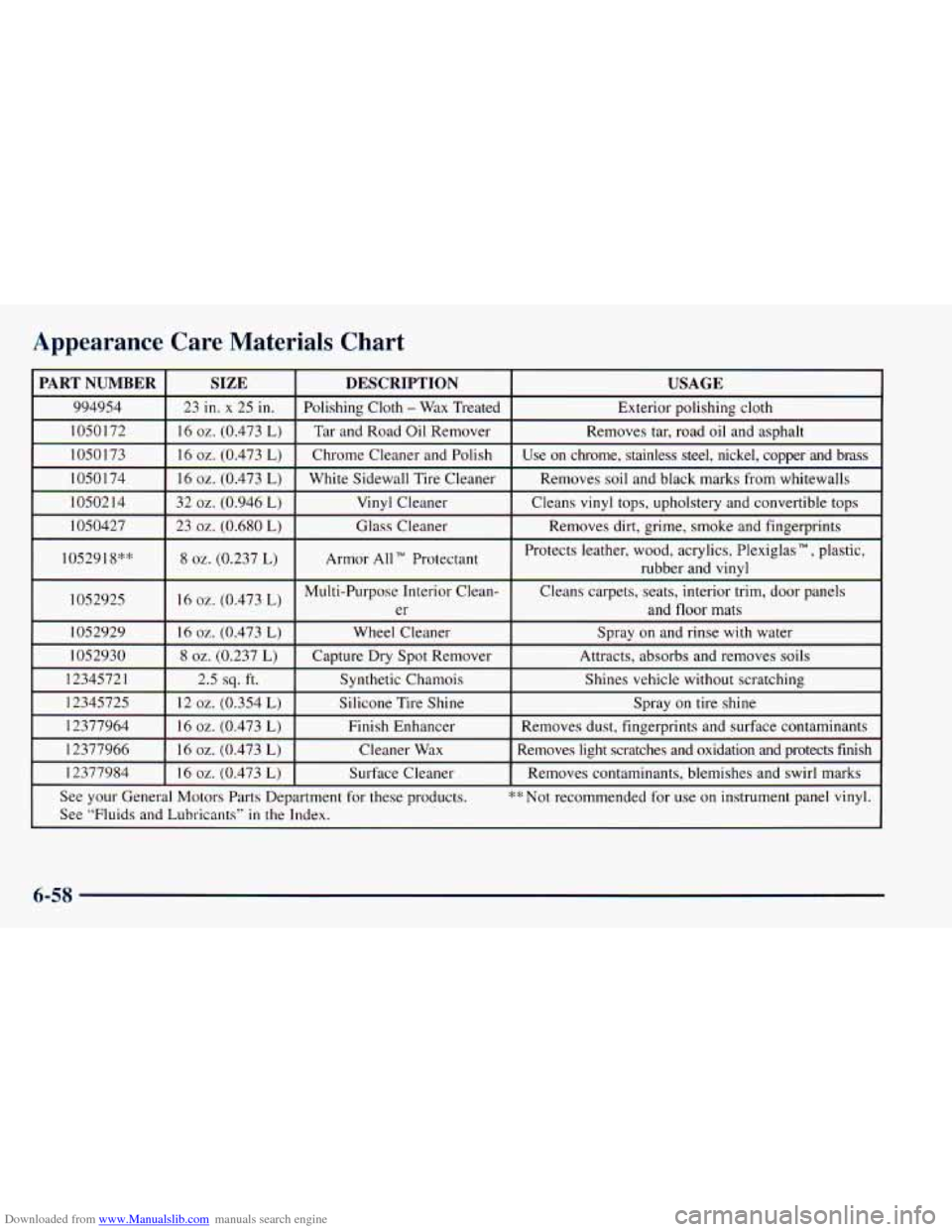
Downloaded from www.Manualslib.com manuals search engine Appearance Care Materials Chart
PART NUMBER
994954
1050 172
1050 173
1050 174
1050214
1050427
10529 18**
1052925
1052929
1052930
1234572
1
12345725
I2377964
12377966
12377984
SIZE DESCRIPTION USAGE
23 in. x 25 in. Polishing Cloth - Wax Treated Exterior polishing cloth
16
oz. (0.473 L) Tar and Road Oil Remover Removes tar, road oil and asphalt
16 oz. (0.473 L) I Chrome Cleaner and Polish I Use on chrome, stainless steel, nickel, copper and brass I
16 oz. (0.473 L) I White Sidewall Tire Cleaner I Removes soil and black marks from whitewalls I
32 oz. (0.946 L) Vinyl Cleaner Cleans vinyl tops, upholstery and convertible tops
23
oz. (0.680 L) Glass Cleaner Removes dirt, grime, smoke and fingerprints
8 oz. (0.237 L) I Armor All Protectant Protects leather, wood,
acrylics, Plexiglas , plastic,
rubber and vinyl
16 oz. (0.473 L) Multi-Purpose Interior Clean- Cleans carpets, seats, interior trim, door panels
I er and floor mats I I
16 02. (0.473 L) I Wheel Cleaner I Spray on and rinse with water
8 oz. (0.237 L) I Capture Dry Spot Remover I Attracts, absorbs and removes soils -*
2.5 sq. ft. Synthetic Chamois
12
oz. (0.354 L) Silicone Tire Shine
16 02, (0.473 L) Finish Enhancer
16 oz. (0.473 L) Cleaner Wax
16
oz. (0.473 L) Surface Cleaner Shines vehicle without scratching
Spray on tire shine
Removes dust, fingerprints and surface contaminants
Removes light scratches and oxidation and protects finish
Removes contaminants, blemishes and swirl marks
6-58
Page 323 of 414
Downloaded from www.Manualslib.com manuals search engine 11
Fuses and Circuit Breakers
The wiring circuits in your vehicle are protected from
short circuits by a combination of fuses, circuit breakers
and fusible thermal links. This greatly reduces the
chance of fires caused by electrical problems.
Look at the silver-colored band inside the fuse. If the
band is broken or melted, replace the fuse. Be sure you
replace a bad fuse with a new one of the identical size
and rating.
Spare fuses and a fuse puller are located in the
underhood electrical center.
You can remove fuses with
the fuse puller. Remember to replace any of the spare
fuses you use,
so you will have some if you ever need
them again.
If you ever have a problem on the road and don’t have a
spare fuse, you can borrow one that has the same
amperage. Just pick some feature of your vehicle that
you can get along without
-- like the radio or cigarette
lighter
-- and use its fuse, if it is the correct amperage.
Replace
it as soon as you can.
There are two fuse blocks in your vehicle: one is inside
the vehicle and one is in the engine compartment.
Instrument Panel Fuse Block
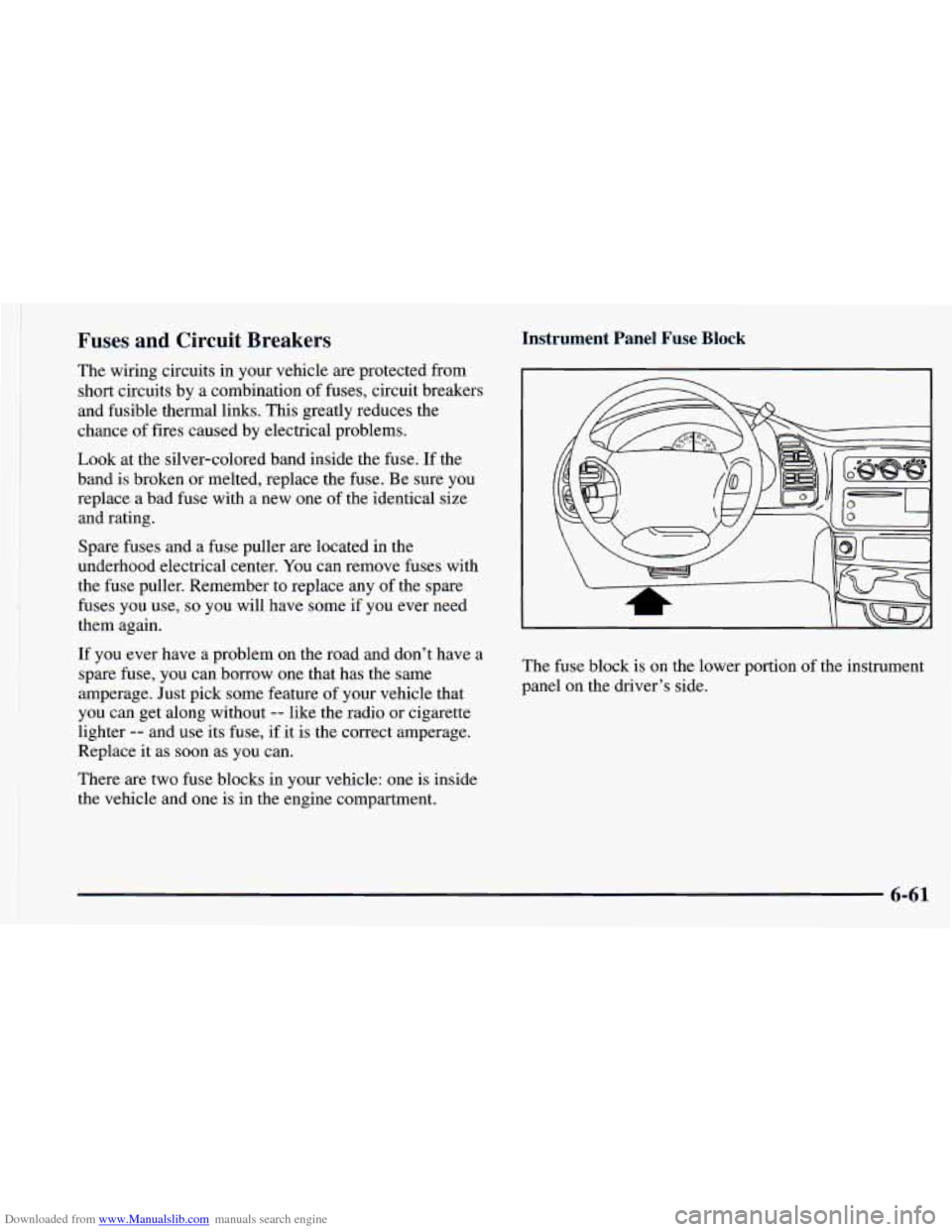
The fuse block is on the lower portion of the instrument
panel on the driver’s side.
6-61
Page 324 of 414
Downloaded from www.Manualslib.com manuals search engine / 18 24
5 11 17 23 c7 c7 c7 17
4 ~ 10 16
3 9 15 21 c7 E7 c7 E7
2 8 14 20 c7 c7 11 17
7 13 19 E7 c7 c7 E3
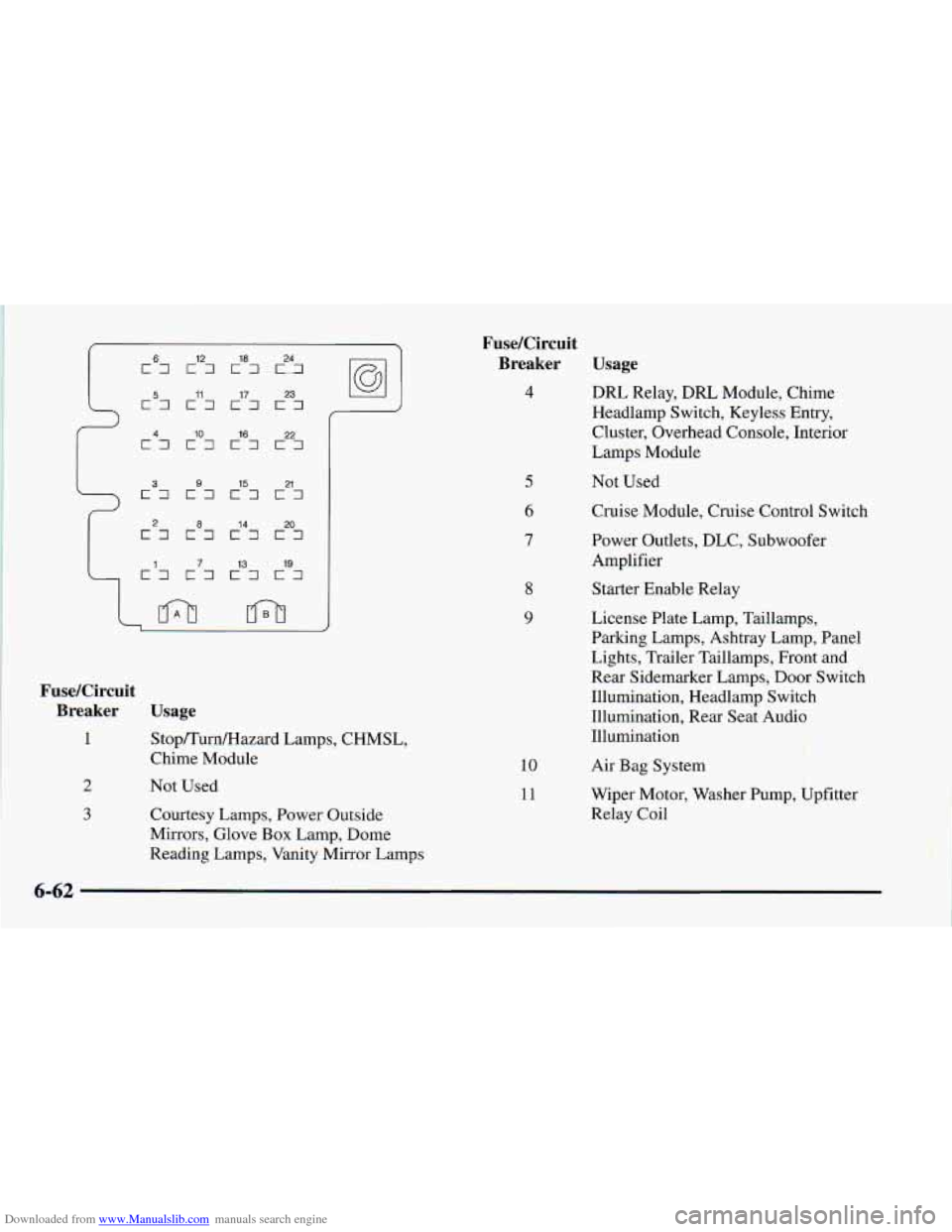
FuseKircuit
Breaker Usage
4
8
9
2
3
FuseKircuit Breaker
Usage I
1 Stop/Turn/Hazard Lamps, CHMSL,
! Chime Module
Not Used
Courtesy Lamps, Power Outside
Mirrors, Glove
Box Lamp, Dome
Reading Lamps, Vanity Mirror Lamps
10
11
DRL Relay, DRL Module, Chime
Headlamp Switch, Keyless Entry,
Cluster, Overhead Console, Interior
Lamps Module
Not Used
Cruise Module, Cruise Control Switch
Power Outlets, DLC, Subwoofer
Amplifier Starter Enable Relay
I
License Plate Lamp, Taillamps, I
Parking Lamps, Ashtray Lamp, Panel
Lights, Trailer Taillamps, Front and
Rear Sidemarker Lamps, Door Switch
Illumination, Headlamp Switch
Illumination, Rear Seat Audio
Illumination
Air
Bag System
Wiper Motor, Washer Pump, Upfitter
Relay Coil