seats CHEVROLET ASTRO 2003 User Guide
[x] Cancel search | Manufacturer: CHEVROLET, Model Year: 2003, Model line: ASTRO, Model: CHEVROLET ASTRO 2003Pages: 386, PDF Size: 17.31 MB
Page 25 of 386
Q: If I’m a good driver, and I never drive far from
home, why should
I wear safety belts?
A: You may be an excellent driver, but if you’re in an
accident
- even one that isn’t your fault - you and
your passengers can be hurt. Being a good
driver doesn’t protect you from things beyond your
control, such as bad drivers.
Most accidents occur within
25 miles (40 km)
of home. And the greatest number of serious
injuries and deaths occur at speeds of less than
40 mph (65 km/h).
Safety belts are for everyone.
How to Wear Safety Belts Properly
This part is only for people of adult size.
Be aware that there are special things to know about
safety belts and children. And there are different
rules for smaller children and babies.
If a child will be
riding in your vehicle, see
Older Children on page 1-35
or lnfants and Young Children on page 1-38. Follow
those rules for everyone’s protection.
First, you’ll want to know which restraint systems your
vehicle has.
We’ll start with the driver position.
Driver Position
This part describes the driver’s restraint system.
Lap-Shoulder Belt
The driver has a lap-shoulder belt. Here’s how to
wear it properly.
1. Close and lock the door.
2. Adjust the seat so you can sit up straight.
To see how, see “Seats” in the Index.
1-18
Page 34 of 386
The best way to protect the fetus is to protect the
mother. When a safety belt
is worn properly, it’s more
likely that the fetus won’t be hurt in a crash. For
pregnant women,
as for anyone, the key to making
safety belts effective is wearing them properly.
Right Front Passenger Position
To learn how to wear the right front passenger’s safety
belt properly, see
Driver Position on page 1-18.
The right front passenger’s safety belt works the same
way as the driver’s safety belt
- except for one thing.
If you ever pull the lap portion of the belt out all the
way, you
will engage the child restraint locking feature.
If this happens, just let the belt go back all the way and
start again.
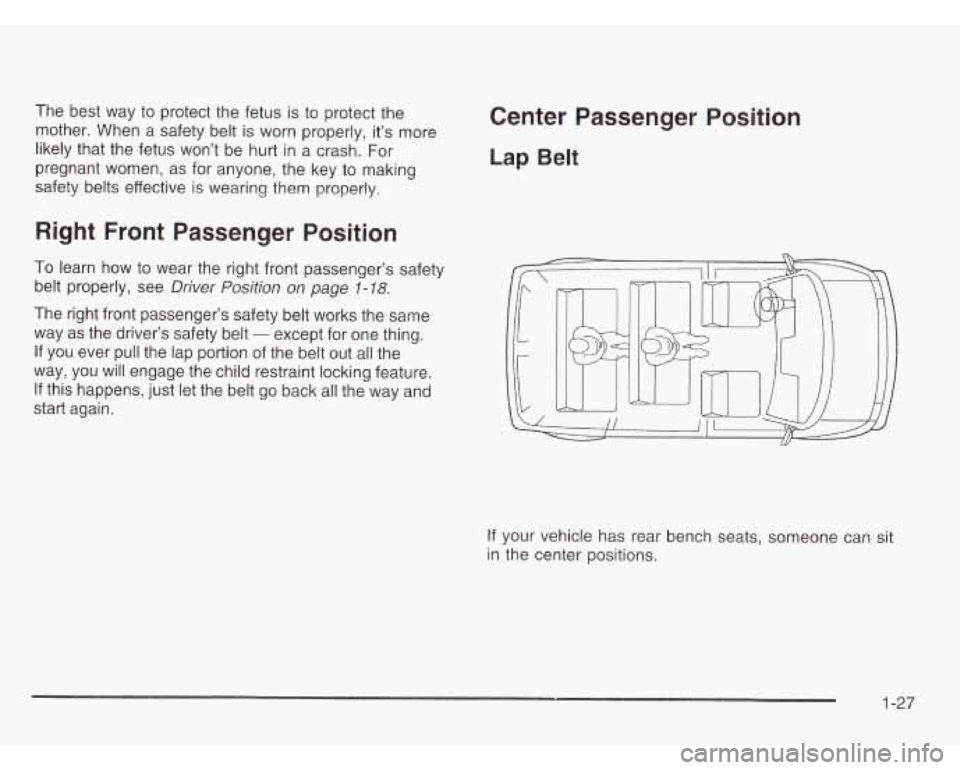
Center Passenger Position
Lap Belt
If your vehicle has rear bench seats, someone can sit
in the center positions.
1-27
Page 39 of 386
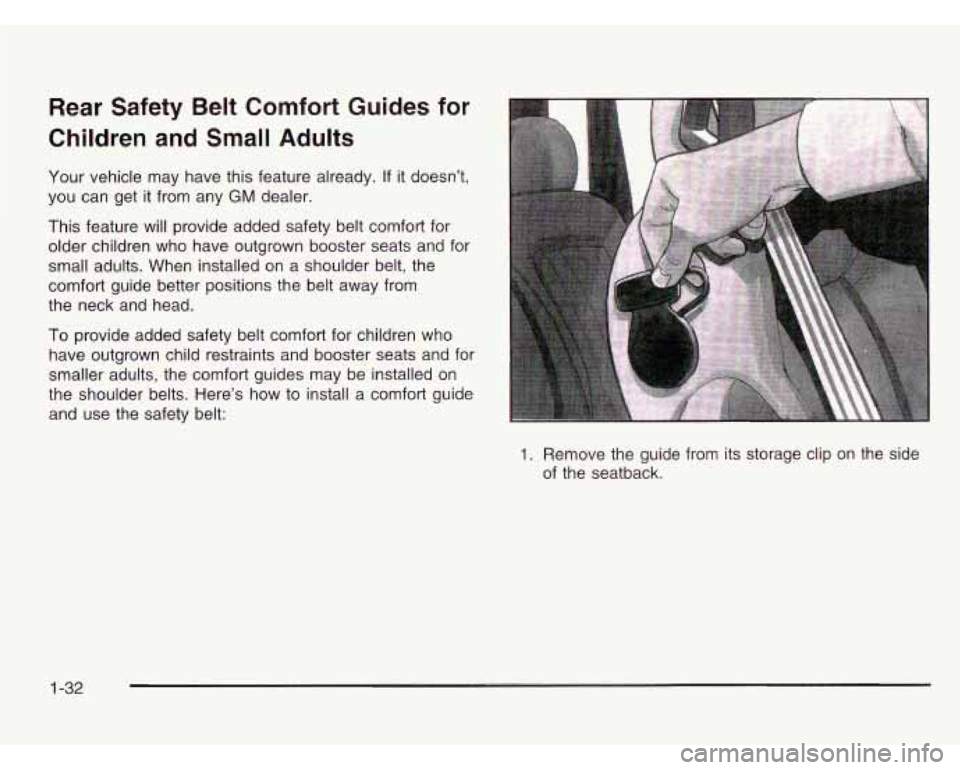
Rear Safety Belt Comfort Guides for
Children and Small Adults
Your vehicle may have this feature already. If it doesn’t,
you can get it from any
GM dealer.
This feature will provide added safety belt comfort for
older children who have outgrown booster seats and for
small adults. When installed on a shoulder belt, the
comfort guide better positions the belt away from
the neck and head.
To provide added safety belt comfort for children who
have outgrown child restraints and booster seats and for
smaller adults, the comfort guides may be installed on
the shoulder belts. Here’s how to install a comfort guide
and use the safety belt:
1. Remove the guide from its storage clip on the side
of the seatback.
1-32
Page 42 of 386
Child Restraints
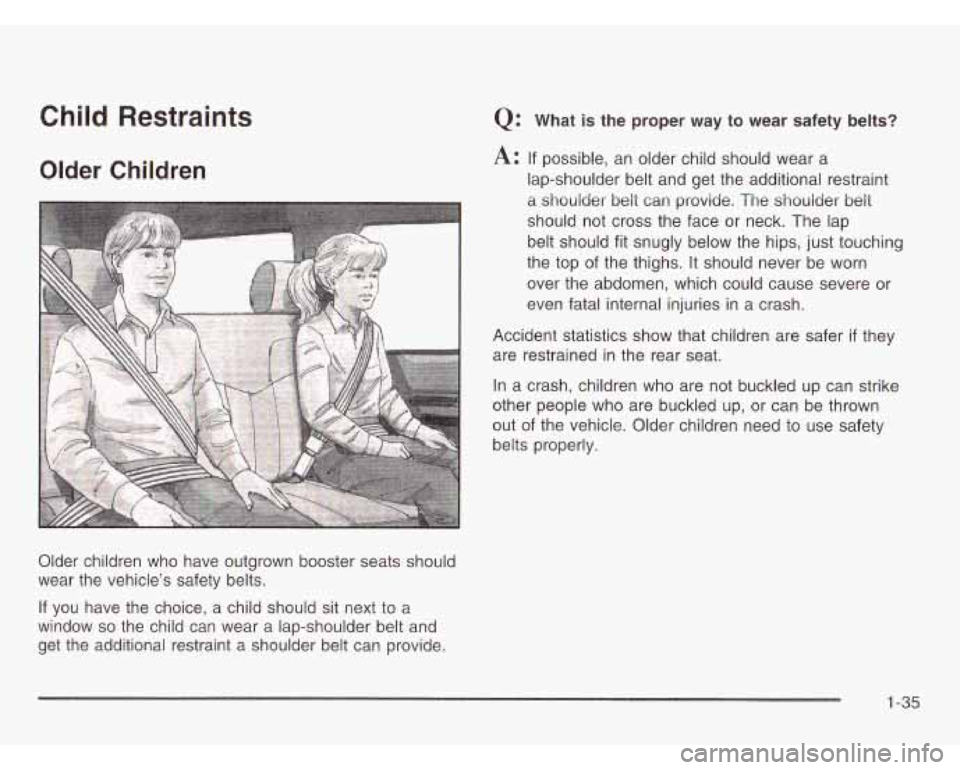
Older Children
Older children who have outgrown booster seats should
wear the vehicle’s safety belts.
Q: What is the proper way to wear safety belts?
A: If possible, an older child should wear a
lap-shoulder belt and get the additional restraint
a shouider beit can provide. The shouider belt
should not cross the face or neck. The lap
belt should fit snugly below the hips, just touching
the top of the thighs.
It should never be worn
over the abdomen, which could cause severe or
even fatal internal injuries in a crash.
Accident statistics show that children are safer
if they
are restrained in the rear seat.
In a crash, children who are not buckled up can strike
other people who are buckled up, or can be thrown
out of the vehicle. Older children need to use safety
belts properly.
If you have the choice, a child should sit next to a
window
so the child can wear a lap-shoulder belt and
get the additional restraint a shoulder belt can provide.
1-35
Page 52 of 386
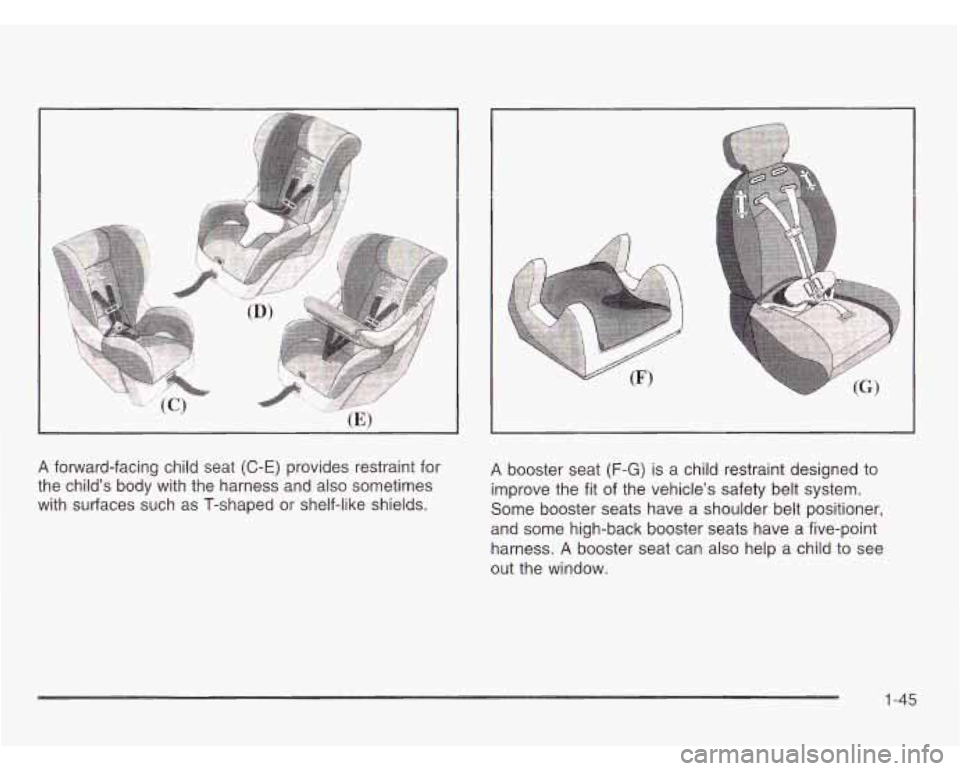
A forward-facing child seat (C-E) provides restraint for
the child's body with the harness and also sometimes
with surfaces such as T-shaped
or shelf-like shields.
A booster seat (F-G) is a child restraint designed to
improve the fit of the vehicle's safety belt system.
Some booster seats have a shoulder belt positioner,
and some high-back booster seats have a five-point
harness.
A booster seat can also help a child to see
out the window.
1-45
Page 57 of 386
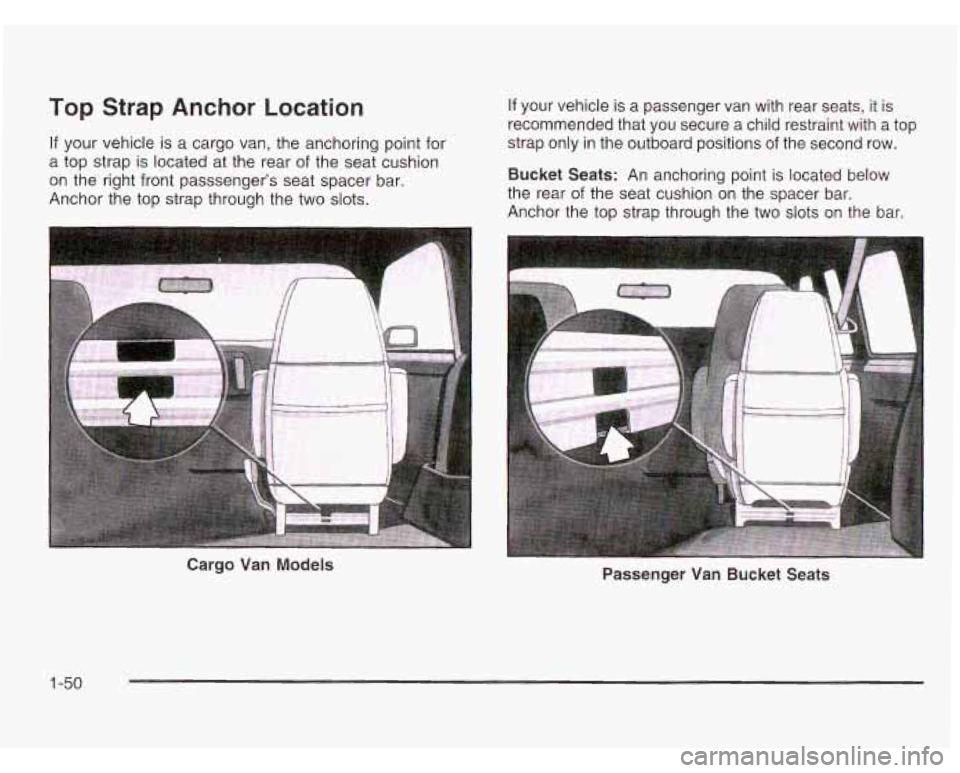
Top Strap Anchor Location
If your vehicle is a cargo van, the anchoring point for
a top strap is located at the rear
of the seat cushion
on the right front passsenger's seat spacer bar.
Anchor the top strap through the two slots.
If your vehicle is a passenger van with rear seats, it is
recommended that you secure a child restraint with a top
strap only in the outboard positions of the second row.
Bucket Seats: An anchoring point is located below
the rear of the seat cushion on the spacer bar.
Anchor the top strap through the two slots on the bar.
Cargo Van Models
Passenger Van Bucket Seats
1 -50
Page 58 of 386
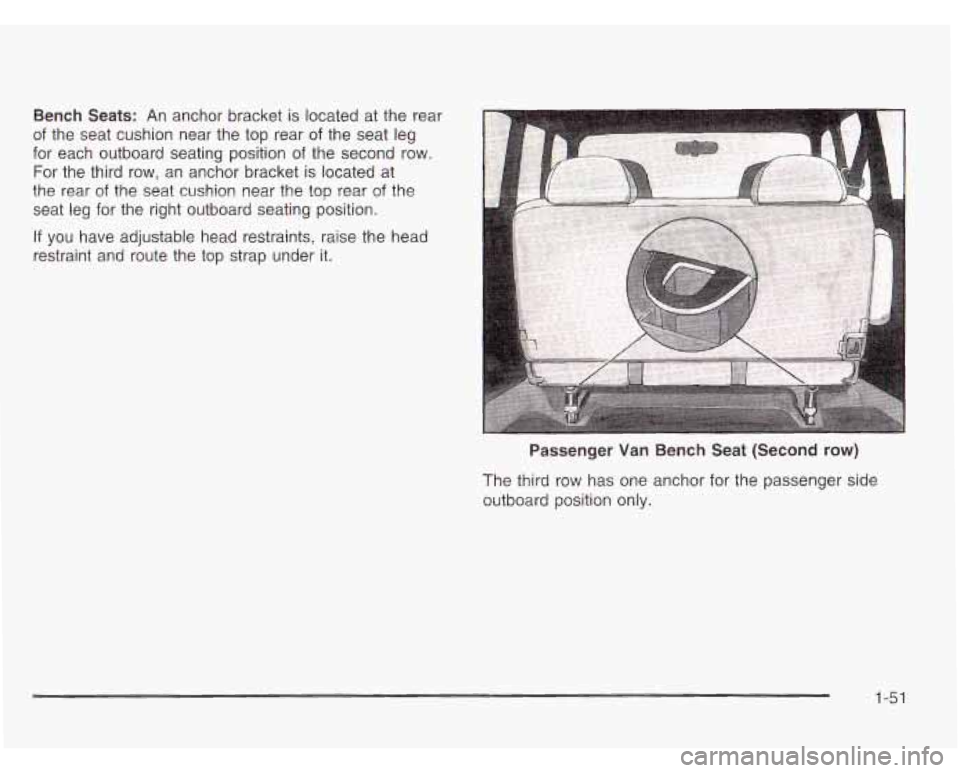
Bench Seats: An anchor bracket is located at the rear
of the seat cushion near the top rear of the seat leg
for each outboard seating position
of the second row.
For the third row, an anchor bracket
is located at
the rear of the seat cushion near the top rear of the
seat leg for the right outboard seating position.
If you have adjustable head restraints, raise the head
restraint and route the top strap under it.
Passenger Van Bench Seat (Second row)
The third row has one anchor for the passenger side
outboard position only.
1-51
Page 59 of 386
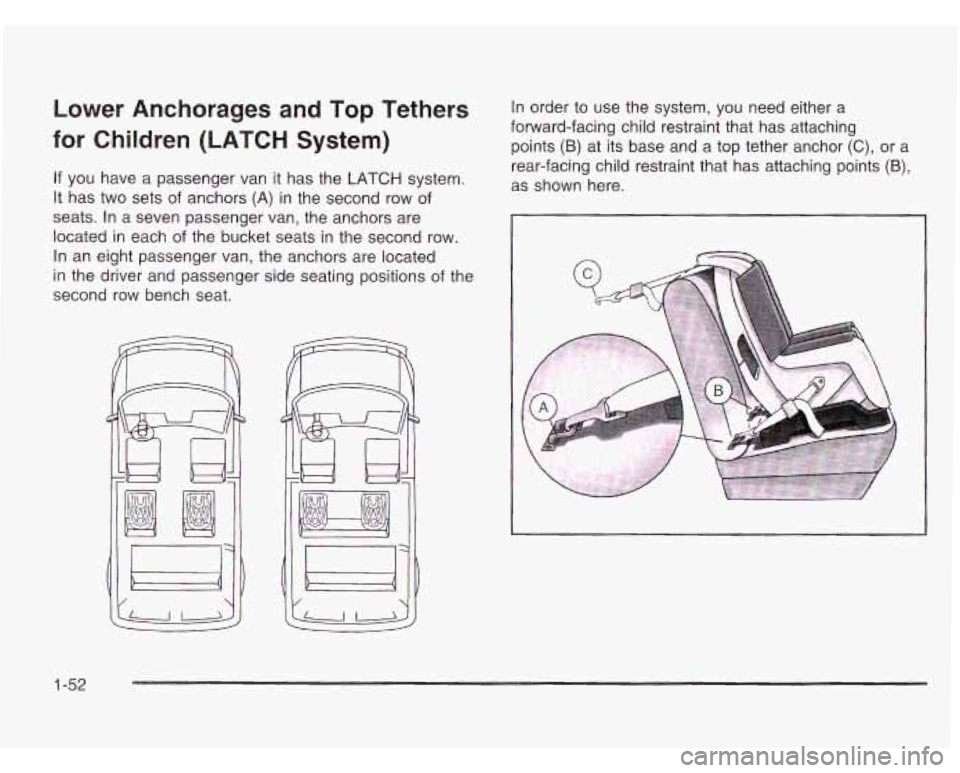
Lower Anchorages and Top Tethers
for Children
(LATCH System)
If you have a passenger van it has the LATCH system.
It has two sets of anchors (A) in the second row of
seats. In a seven passenger van, the anchors are
located in each
of the bucket seats in the second row.
In an eight passenger van, the anchors are located
in the driver and passenger side seating positions
of the
second row bench seat. In
order to use the system, you need either a
forward-facing child restraint that has attaching
points
(B) at its base and a top tether anchor (C), or a
rear-facing child restraint that has attaching points
(B),
as shown here.
n
1-52
Page 67 of 386
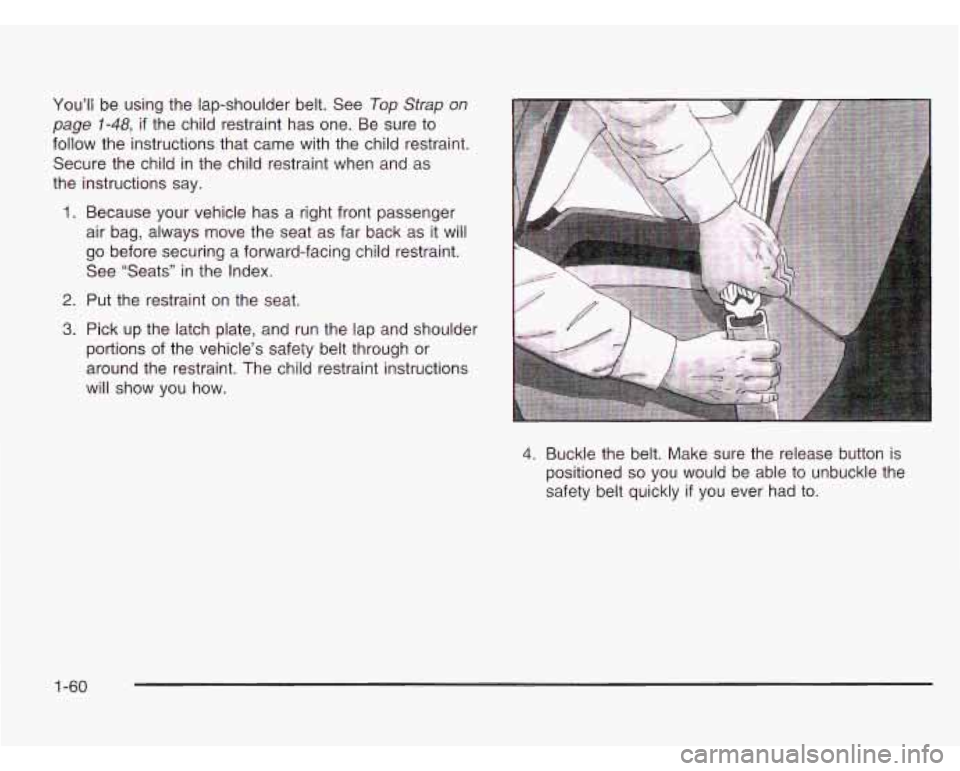
You’ll be using the lap-shoulder belt. See Top Strap on
page 1-48, if the child restraint has one. Be sure to
follow the instructions that came with the child restraint.
Secure the child in the child restraint when and as
the instructions say.
1. Because your vehicle has a right front passenger
air bag, always move the seat as far back as it will
go before securing a forward-facing child restraint.
See “Seats” in the Index.
2. Put the restraint on the seat.
3. Pick up the latch plate, and run the lap and shoulder
portions of the vehicle’s safely belt through or
around the restraint. The child restraint instructions
will show you how.
..
4. Buckle the belt. Make sure the release button is
positioned
so you would be able to unbuckle the
safety belt quickly
if you ever had to.
1-60
Page 146 of 386
Be sure to keep the area under the front seats clear of
any objects
so that the air inside of your vehicle can
circulate effectively.
For information on how to use the main climate-control
system. For information
on ventilation, see “Outlet
Adjustment” listed later in this section.
Rear Climate Control System
Rear Window Defogger
Your vehicle may have a rear window defogger that
uses a warming grid
to remove fog or frost from the
rear window.
The rear window defogger will only work when the
ignition is in
RUN.
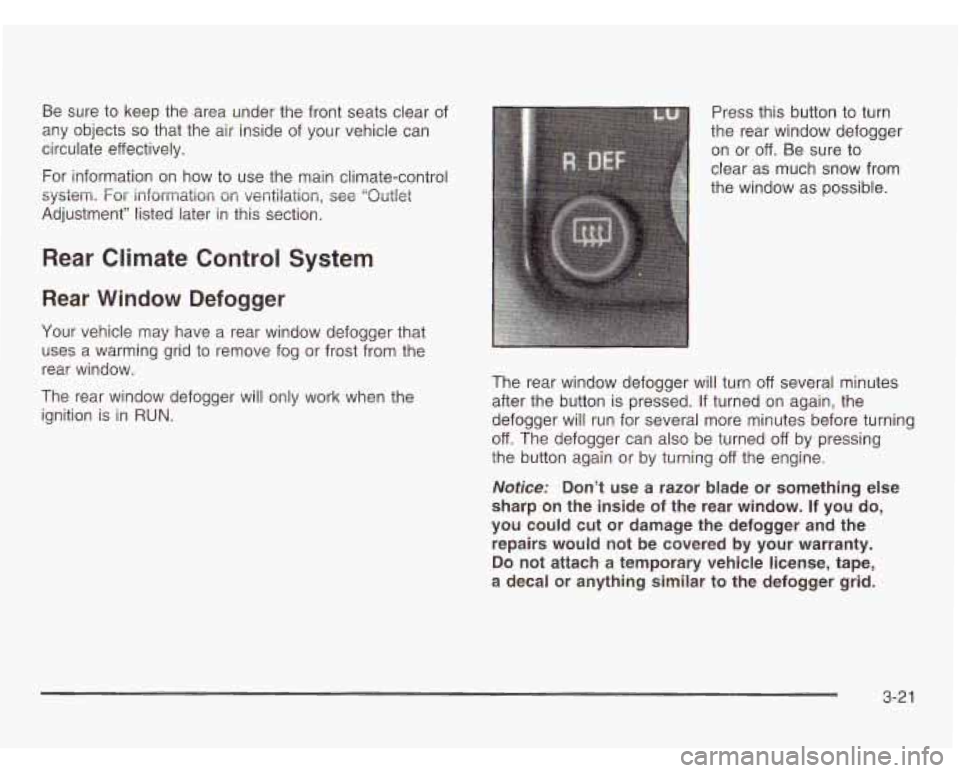
Press this button to turn
the rear window defogger
on or off. Be sure to
clear as much snow from
the window as possible.
The rear window defogger will turn
off several minutes
after the button is pressed. If turned on again, the
defogger will run for several more minutes before turning
off. The defogger can also be turned off by pressing
the button again or by turning off the engine.
Notice: Don’t use a razor blade or something else
sharp on the inside of the rear window. If you do,
you could cut or damage the defogger and the repairs would not be covered by your warranty.
Do not attach a temporary vehicle license, tape,
a decal or anything similar to the defogger grid.
3-2 1