seats CHEVROLET ASTRO 2003 Owners Manual
[x] Cancel search | Manufacturer: CHEVROLET, Model Year: 2003, Model line: ASTRO, Model: CHEVROLET ASTRO 2003Pages: 386, PDF Size: 17.31 MB
Page 2 of 386
The 2003 Chevrolet Astro Owner Manual
Seats and Restraint Systems ........................... I-!
Front Seats ............................................... 1-2
Rear Seats
............................................... 1-7
Safety Belts
............................................. 1-13
Child Restraints
....................................... 1-35
Air Bag System
....................................... 1-62
Restraint System Check
............................ 1-71
Keys
........................................................ 2-2
Doors and Locks
....................................... 2-7
Windows
................................................. 2-1 6
Theft-Deterrent Systems
............................ 2-1 8
Mirrors
.................................................... 2-32
HomeLink@ Transmitter
............................. 2-34
Features and Controls ..................................... 2-1
Starting and Operating Your Vehicle
........... 2-19
Storage Areas
Instrument Panel .
Instrument Panel
Climate Controls
......................................... 2-38
........................................... 3-1
Overview .......................... 3-2
...................................... 3-18
Warning Lights. Gages and Indicators
......... 3-23
Audio System(s)
....................................... 3-38
Driving Your Vehicle ....................................... 4-1
Your Driving, the Road, and Your Vehicle
........ 4-2
Towing
................................................... 4-29
Service and Appearance Care .......................... 5-1
Service ..................................................... 5-3
Fuel
......................................................... 5-5
All-Wheel Drive
........................................ 5-52
Rear Axle ............................................... 5-53
Front Axle
............................................... 5-54
Bulb Replacement
.................................... 5-55
Windshield Wiper Blade Replacement ......... 5-62
Tires
...................................................... 5-63
Appearance Care
..................................... 5-83
Vehicle Identification
................................. 5-91
Electrical System
...................................... 5-92
Capacities and Specifications
..................... 5-99
Normal Maintenance Replacement Parts
...... 5-1 01
Maintenance Schedule ..................................... 6-1
Maintenance Schedule
................................ 6-2
Customer Assistance Information .................... 7-1
Customer Assistance Information
.................. 7-2
Reporting Safety Defects ........................... 7-10
Checking Things Under
the Hood
............... 5-11
Index ................................................................ 1
Page 5 of 386
Vehicle Damage Warnings
Also, in this book you will find these notices:
Notice: These mean there is something that could
damage your vehicle.
A notice will tell you about something that can damage
your vehicle. Many times, this damage would not be
covered by your warranty, and it could be costly. But the
notice will tell you what to do to help avoid the damage.
When you read other manuals, you might see CAUTION
and NOTICE warnings in different colors or in different
words.
You’ll also see warning labels on your vehicle. They use
the same words, CAUTION or NOTICE.
Vehicle Symbols
Your vehicle has components and labels that use
symbols instead of text. Symbols, used on your vehicle,
are shown along with the text describing the operation
or information relating to a specific component, control,
message, gage or indicator.
If you need help figuring out a specific name of a
component, gage or indicator reference the following
topics:
Seats and Restraint Systems in Section 1
Features and Controls in Section 2
Instrument Panel Overview in Section 3
Climate Controls in Section 3
Warning Lights, Gages and Indicators in Section 3
Audio System(s) in Section 3
Engine Compartment Overview in Section 5
iv
Page 8 of 386
Section 1 Seats and Restraint Systems
Front Seats ...................................................... 1-2
Manual Seats
................................................ 1-2
Power Seat
................................................... 1-3
Manual Lumbar
.............................................. 1-3
Reclining Seatbacks
........................................ 1.4
Head Restraints
............................................. 1.5
Seatback Latches
........................................... 1.6
Rear Seats ....................................................... 1-7
Rear Seat Operation
....................................... 1-7
Bench Seat
.................................................. 1-1 1
Bucket Seats ............................................... 1-1 2
Safety Belts ................................................... 1-1 3
Safety Belts: They Are for Everyone
................ 1-13
Questions and Answers About Safety Belts
...... 1-17
How to Wear Safety Belts Properly
................. 1-18
Driver Position
.............................................. 1.18
Safety Belt Use During Pregnancy
.................. 1-26
Right Front Passenger Position
....................... 1.27
Center Passenger Position
............................. 1.27
Rear Seat Passengers
................................. -1-29
Rear Safety Belt Comfort Guides for
Children and Small Adults
...................... 1.32
Safety Belt Extender
..................................... 1-34
Child Restraints ............................................. 1-35
Older Children
.............................................. 1-35
Child Restraint Systems
................................. 1.44
Infants and Young
Children
.......... ....... 1.38 Where
to Put the Restraint
............................. 1-47
Top Strap
.................................................... 1-48
Top Strap Anchor Location ............................. 1-50
Lower Anchorages and Top Tethers for
Children (LATCH System)
........................... 1-52
Securing a Child Restraint Designed for
the LATCH System
.................................... 1-54
Securing a Child Restraint in a Rear
Outside Seat Position
............................ 1-54
Securing a Child Restraint in a Center
Seat Position
............................................ 1-57
Securing a Child Restraint in the Right
Front Seat Position
................................... -1 -59
Air Bag System .............................................. 1-62
Where Are the Air Bags?
............... ..... 1-64
When Should an Air Bag Inflate?
.................... 1-66
What Makes an Air Bag Inflate?
..................... 1-67
How Does an Air Bag Restrain?
..................... 1-67
What Will You See After an
Air Bag Inflates?
....................................... 1.68
Servicing Your Air Bag-Equipped Vehicle
......... 1.69
Adding Equipment to Your
Air Bag-Equipped Vehicle
........................... 1.70
Restraint System Check ................................. -1-71
Checking Your Restraint Systems ... ..... 1-71
Replacing Restraint System Parts
After a Crash
............................................ 1-71
1-1
Page 9 of 386
Front Seats
Manual Seats
1 I
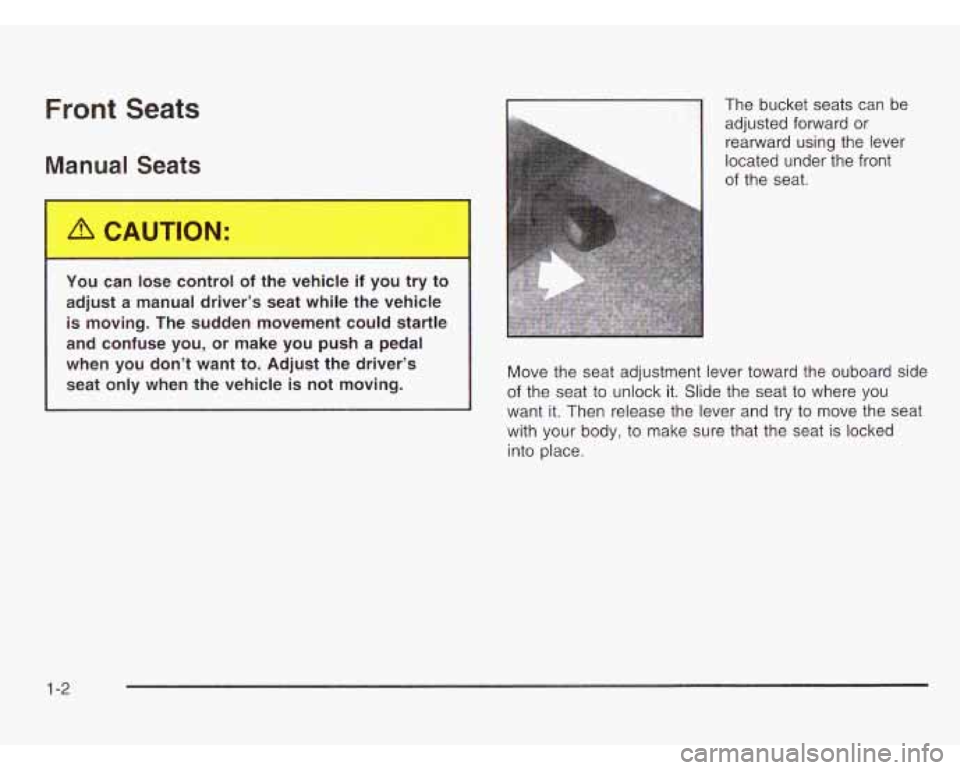
The bucket seats can be
adjusted forward or
rearward using the lever
located under the front
You can lose control of the vehicle if you try to
adjust a manual driver’s seat while the vehicle
is moving. The sudden movement could startle
and confuse you, or make you push a pedal
when you don’t want to. Adjust the driver’s
seat only when the vehicle
is not moving. Move the seat adjustment lever toward the ouboard side
of the seat to unlock it. Slide the seat to where you
want it. Then release the lever and try
to move the seat
with your body, to make sure that the seat is locked
into place.
1 -2
Page 10 of 386
Power Seat
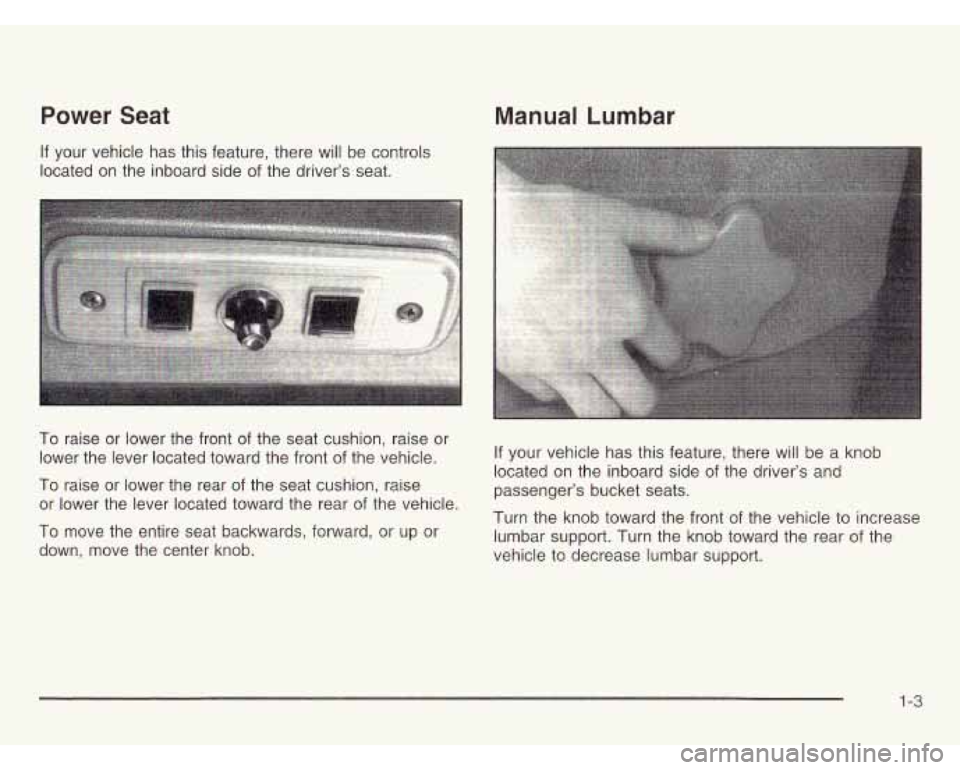
If your vehicle has this feature, there will be controls
located on the inboard side of the driver’s seat.
Manual Lumbar
To raise or lower the front of the seat cushion, raise or
lower the lever located toward the front of the vehicle.
To raise or lower the rear of the seat cushion, raise
or lower the lever located toward the rear of the vehicle.
To move the entire seat backwards, forward, or up or
down, move the center knob.
If your vehicle has this feature, there will be a knob
located on the inboard side of the driver’s and
passenger’s bucket seats.
Turn the knob toward the front of the vehicle
to increase
lumbar support. Turn the knob toward the rear of the
vehicle to decrease lumbar support.
1 -3
Page 14 of 386
Rear Seats
Rear Seat Operation
Removing the Rear Seats
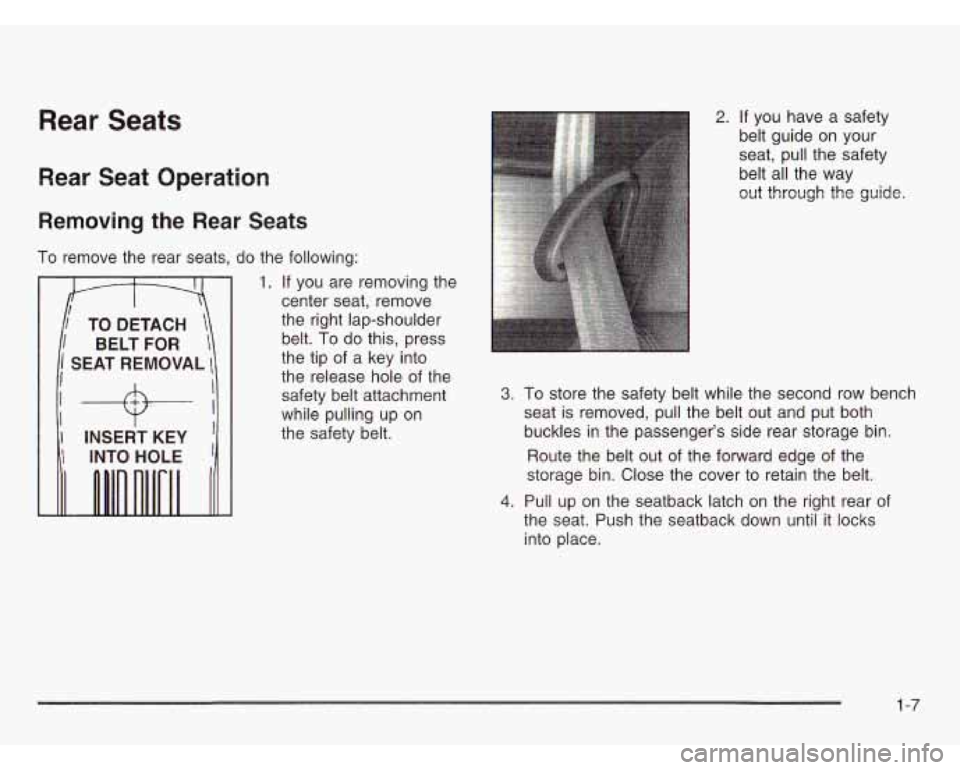
To remove the rear seats, do the following:
1. If you are removing the
center seat, remove
the right lap-shoulder
belt.
To do this, press
the release hole of the
safety belt attachment
while pulling up on
SEAT REMOVAL the tip of a key into
I INSERT KEY the safety belt. 2.
If you have a safety
belt guide on your
seat, pull the safety
belt all the way
out through the guide.
3. To store the safety belt while the second row bench
seat is removed, pull the belt out and put both
buckles in the passenger’s side rear storage bin.
Route the belt out of the forward edge of the
storage bin. Close the cover to retain the belt.
4. Pull up on the seatback latch on the right rear of
the seat. Push the seatback down until it locks
into place.
1 -7
Page 16 of 386
Replacing the Rear Seats
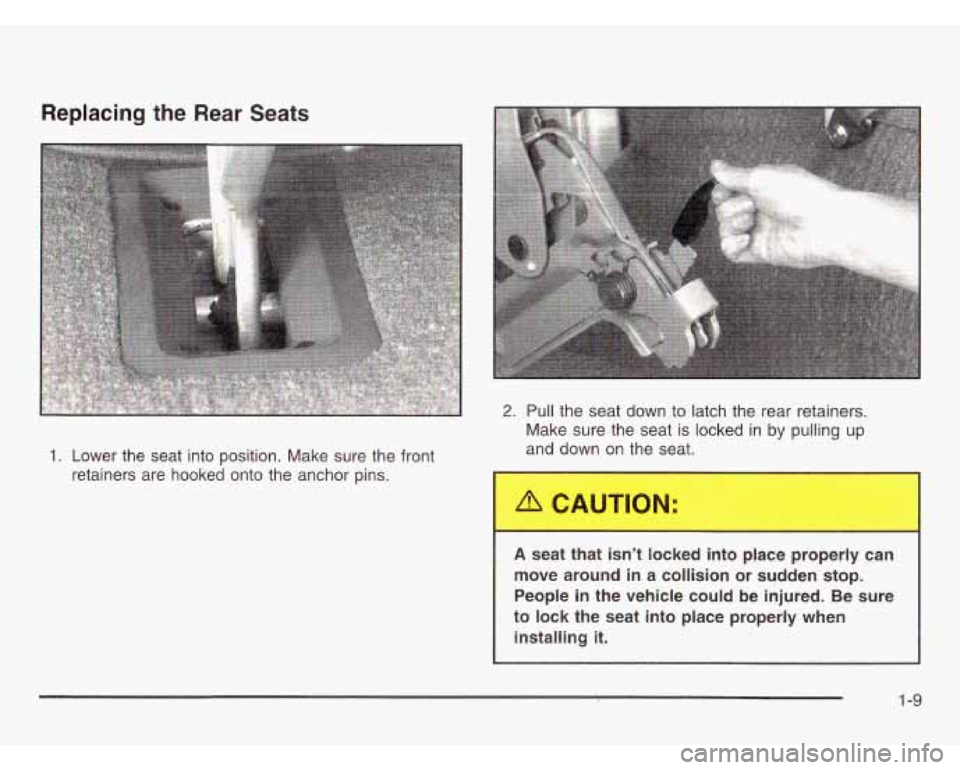
1. Lower the seat into position. Make sure the front
retainers are hooked onto the anchor pins.
2. Pull the seat down to latch the rear retainers.
Make sure the seat
is locked in by pulling up
and down on the seat.
A seat that isn’t locked into place properly can
move around in a collision or sudden stop.
People in the vehicle could be injured. Be sure
to lock the seat into place properly when
installing it.
1-9
Page 18 of 386
Bench Seat
Each bench seat can carry up to three passengers.
They can also be removed to increase storage space.
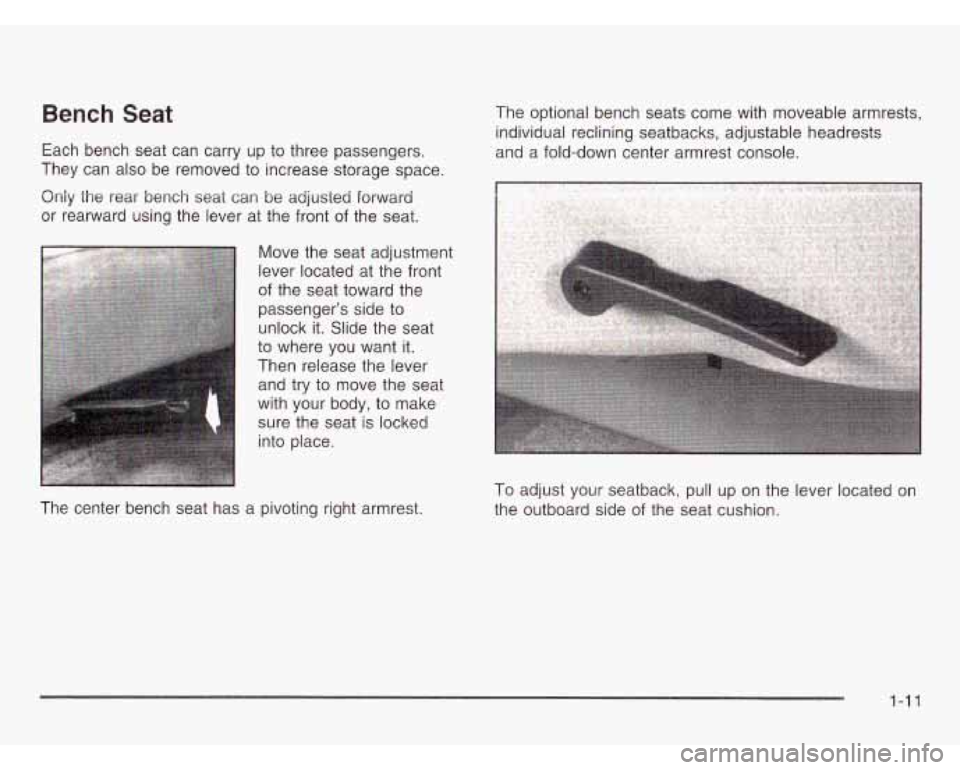
Only the rear bench seat can be adjusted forward
or rearward using the lever at the front of the seat.
Move the seat adjustment
lever located at the front
of the seat toward the
passenger’s side to
unlock it. Slide the seat
to where you want it.
Then release the lever
and try to move the seat
with your body, to make
sure the seat is locked
into place. The optional
bench seats come with moveable armrests,
individual reclining seatbacks, adjustable headrests
and a fold-down center armrest console.
The center bench seat has a pivoting right armrest. To
adjust your seatback, pull up on the lever located on
the outboard side of the seat cushion.
1-1 1
Page 19 of 386
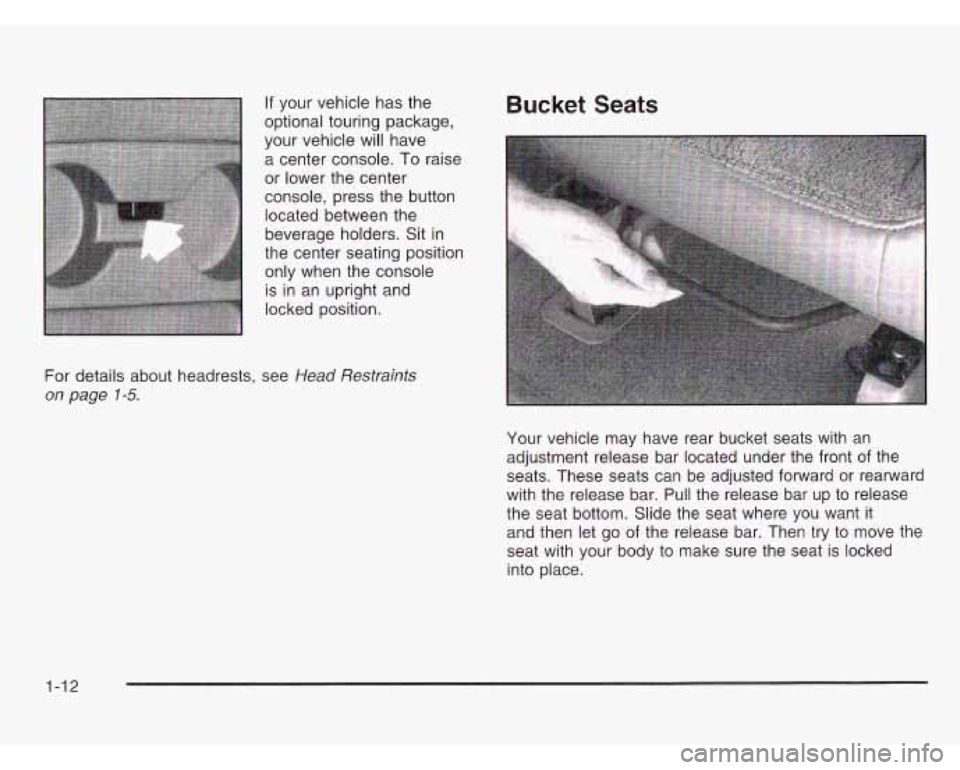
If your vehicle has the
optional touring package,
your vehicle will have
a center console.
To raise
or lower the center
console, press the button
located between the
beverage holders. Sit in
the center seating position only when the console
is in an upright and
locked position.
For details about headrests, see
Head Restraints
on page 1-5.
Bucket Seats
Your vehicle may have rear bucket seats with an
adjustment release bar located under the front
of the
seats. These seats can be adjusted forward or rearward
with the release bar. Pull the release bar up to release
the seat bottom. Slide the seat where you want it
and then let go of the release bar. Then try to move the
seat with your body to make sure the seat is locked
into place.
1-12
Page 20 of 386
Safety Belts
Safety Belts: They Are for Everyone
This part of the manual tells you how to use safety
belts properly. It also tells you some things you should
r-+ do with safety belts.
Don’t let anyone ride where he or she can’t
wear a safety
belt properly. If you are in a
crash and you’re not wearing a safety belt,
your injuries can be much worse. You can
hit
things inside the vehicle or be ejected from it.
You can be seriously injured or killed. In the
same crash, you might not be, if you are
buckled up. Always fasten your safety belt,
and check that your passengers’ belts are
fastened properly too.
it is extremely dangerous to ride in a CN~G
area, inside or outside of a vehicle. In a
collision, people riding in these areas are more likely to be seriously injured or killed.
Do not
allow people to ride
in any area of your vehicle
that
is not equipped with seats and safety
belts. Be sure everyone
in your vehicle is in
a seat and using a safety belt properly.
Your vehicle has a light
that comes
on as a
reminder to buckle up.
See
Safety Belt Reminder
Light on page 3-26.
1-13