battery CHEVROLET ASTRO 2003 Owner's Manual
[x] Cancel search | Manufacturer: CHEVROLET, Model Year: 2003, Model line: ASTRO, Model: CHEVROLET ASTRO 2003Pages: 386, PDF Size: 17.31 MB
Page 265 of 386
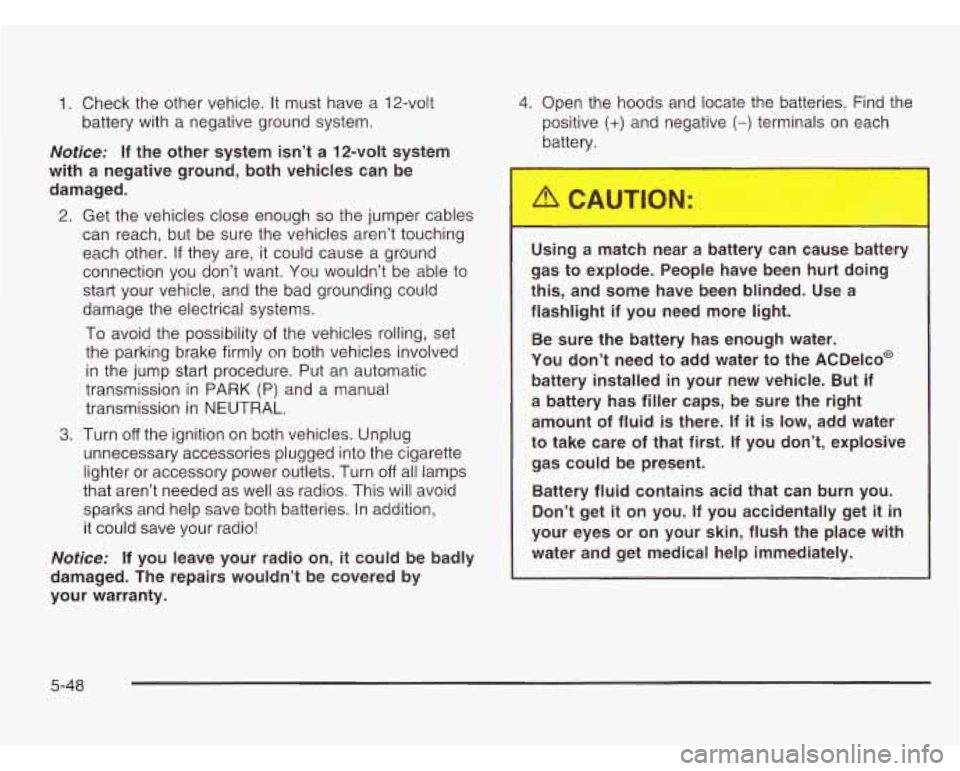
1. Check the other vehicle. It must have a 12-volt
battery with a negative ground system.
Notice: If the other system isn’t a 12-volt system
with a negative ground, both vehicles can be
damaged.
2. Get the vehicles close enough so the jumper cables
can reach, but be sure the vehicles aren’t touching
each other. If they are, it could cause a ground
connection you don’t want. You wouldn’t be able
to
start your vehicle, and the bad grounding could
damage the electrical systems.
To avoid the possibility
of the vehicles rolling, set
the parking brake firmly on both vehicles involved
in the jump start procedure. Put an automatic
transmission in PARK (P) and a manual
transmission in NEUTRAL.
3. Turn off the ignition on both vehicles. Unplug
unnecessary accessories plugged into the cigarette
lighter
or accessory power outlets. Turn off all lamps
that aren’t needed as well as radios. This will avoid
sparks and help save both batteries. In addition,
it could save your radio!
Nofice: If you leave your radio on, it could be badly
damaged. The repairs wouldn’t be covered by
your warranty.
4. Open the hoods and locate the batteries. Find the
positive
(+) and negative (-) terminals on each
battery.
Using a match near a battery can cause battery
gas to explode. People have been hurt doing
this, and some have been blinded. Use a
flashlight if you need more light.
Be sure the battery has enough water.
You don’t need to add water to the ACDelco@
battery installed in your new vehicle. But if
a battery has filler caps, be sure the right amount
of fluid is there. If it is low, add water
to take care
of that first. If you don’t, explosive
gas could be present.
Battery fluid contains acid that can burn you.
Don’t get
it on you. If you accidentally get it in
your eyes or on your skin, flush the place with
water and get medical help immediately.
5-48
Page 266 of 386
Fans or other moving engine p-. ts can injure
you badly. Keep your hands away from moving
parts once the engine
is running.
5. Check that the jumper cables don’t have loose or
missing insulation.
If they do, you could get a
shock. The vehicles could be damaged too.
Before you connect the cables, here are some
basic things you should know. Positive
(+) will go
to positive
(+) or to a remote positive (+) terminal
if the vehicle has one. Negative (-) will go to a
heavy, unpainted metal engine part, or to a
negative
(-) terminal if the vehicle has one.
Don’t connect positive
(+) to negative (-) or you’ll
get a short that would damage the battery and
maybe other parts, too. And don’t connect the
negative
(-) cable to the negative (-) terminal on
the dead battery because this can cause sparks.
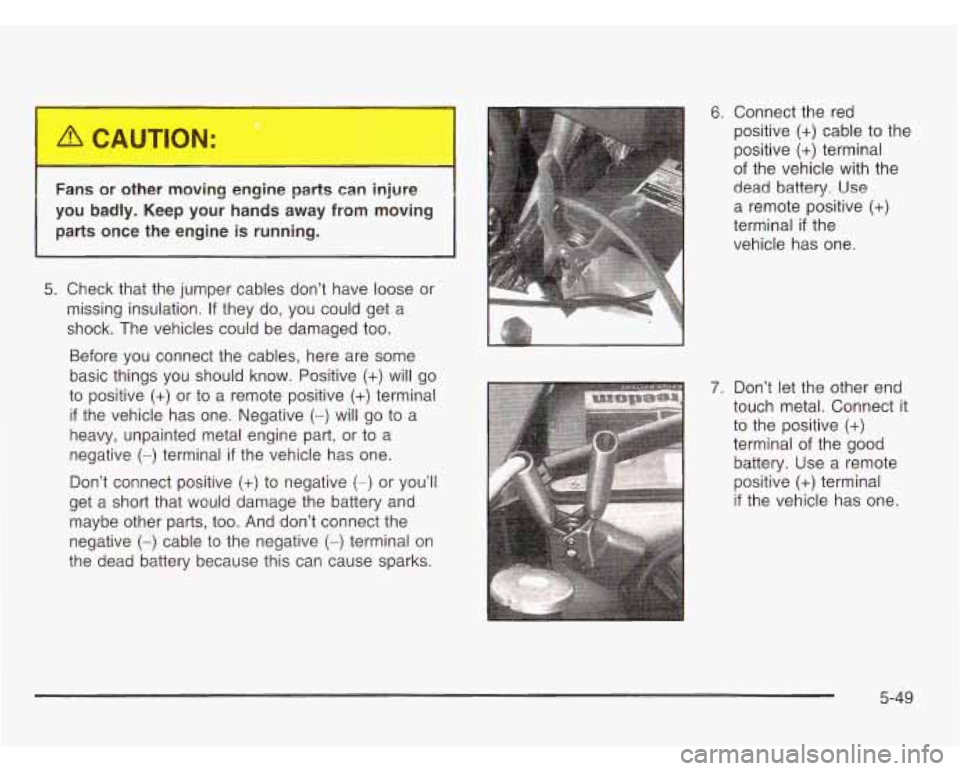
6. Connect the red
positive
(+) cable to the
positive
(+) terminal
of the vehicle with the
dead battery.
Use
a remote positive (+)
terminal if the
vehicle has one.
7. Don’t let the other end
touch metal. Connect it
to the positive
(+)
terminal of the good
battery. Use a remote
positive
(+) terminal
if the vehicle has one.
5-49
Page 267 of 386
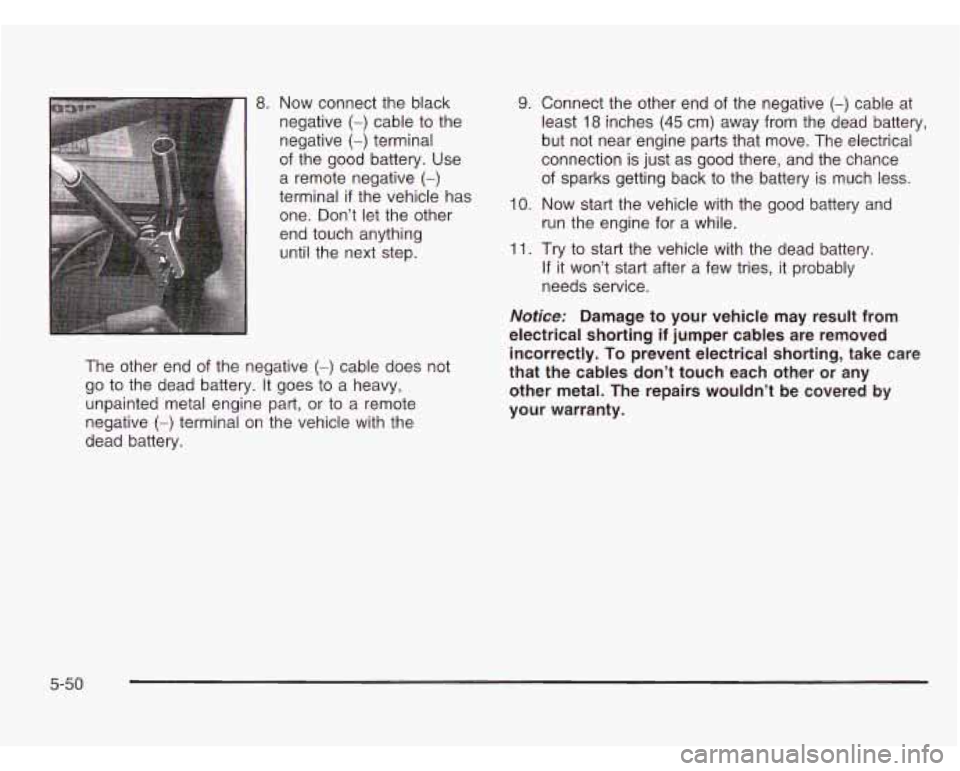
The other end of the negative (-) cable does not
go to the dead battery. It goes to a heavy,
unpainted metal engine part, or to a remote
negative
(-) terminal on the vehicle with the
dead battery.
Notice: Damage to your vehicle may result from
electrical shorting
if jumper cables are removed
incorrectly. To prevent electrical shorting, take care
that the cables don’t touch each other
or any
other metal. The repairs wouldn’t be covered by
your warranty.
5-50
Page 268 of 386
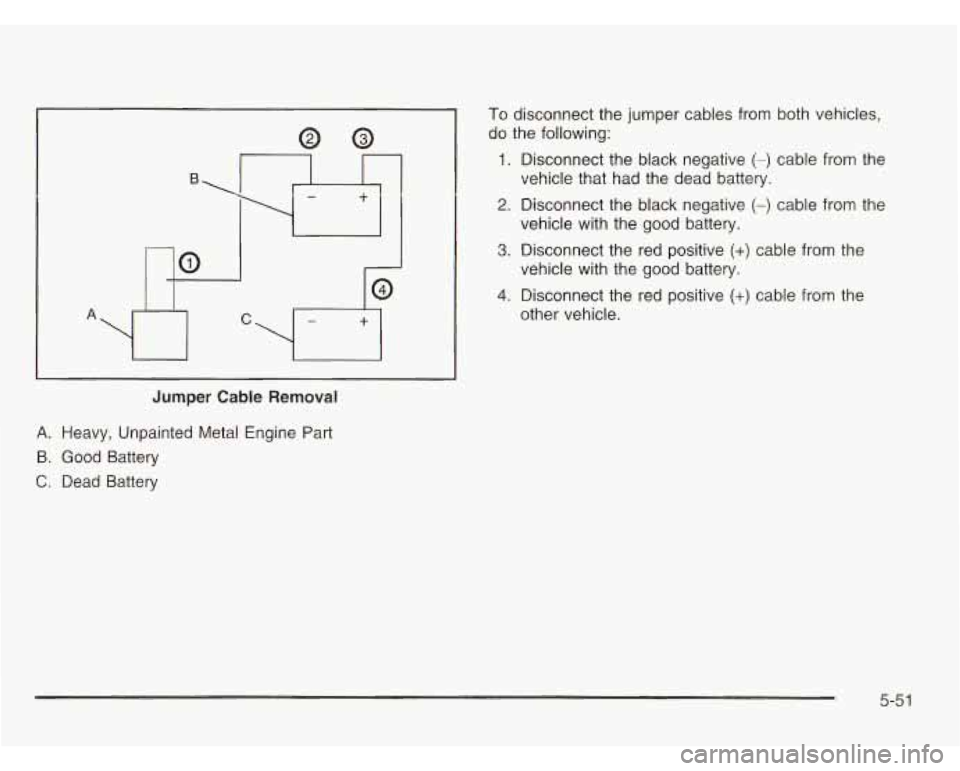
Jumper Cable Removal
A. Heavy, Unpainted Metal Engine Part
B. Good Battery
C. Dead Battery
To disconnect the jumper cables from both vehicles,
do the following:
1. Disconnect the black negative (-) cable from the
2. Disconnect the black negative (-) cable from the
3. Disconnect the red positive (+) cable from the
4. Disconnect the red positive (+) cable from the
vehicle that
had the dead battery.
vehicle with the good battery.
vehicle with the good battery.
other vehicle.
5-5 1
Page 313 of 386
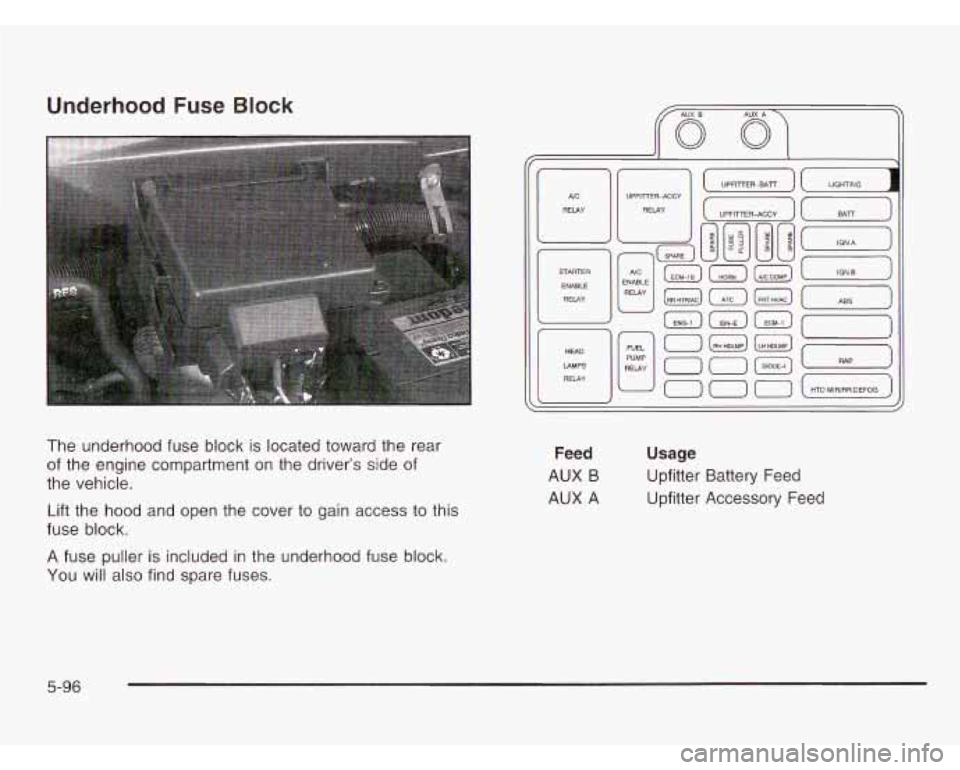
Underhood Fuse Block
The underhood fuse block is located toward the rear
of the engine compartment on the driver’s side of
the vehicle.
Lift the hood and open the cover to gain access to this
fuse block.
A fuse puller is included in the underhood fuse block.
You will also find spare fuses.
Feed
AUX B
AUX A
Usage
Upfitter Battery Feed
Upfitter Accessory Feed
5-96
Page 314 of 386
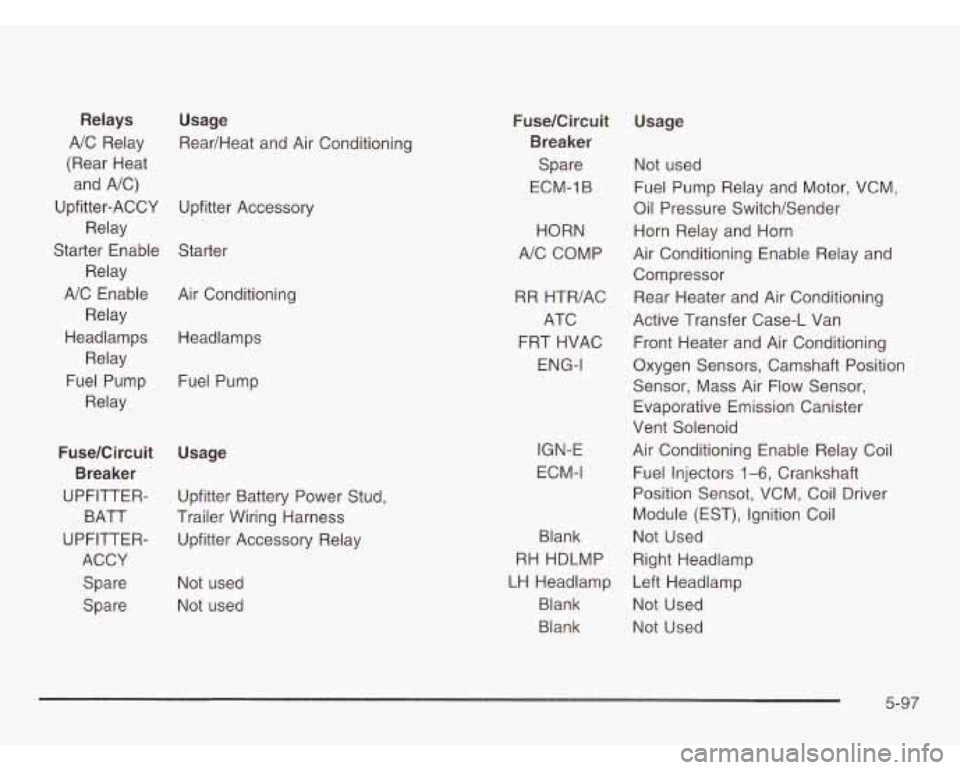
Usage
Rear/Heat and Air Conditioning
Relays
AIC Relay
(Rear Heat
and AIC)
Relay
Relay
A/C Enable
Relay
Upfitter-ACCY
Upfitter Accessory
Starter Enable Starter
Headlamps Relay
Fuel Pump
Relay Air
Conditioning
Headlamps
Fuel Pump
FuselCircuit
Usage
UPFITTER- Upfitter Battery Power Stud,
BATT Trailer Wiring Harness
UPFITTER- Upfitter Accessory Relay
ACCY
Spare Not used
Spare Not used
Breaker FuselCircuit
Breaker
Spare
ECM-1 B
HORN
AIC COMP
RR HTR/AC ATC
FRT HVAC
ENG-I
IGN-E
ECM-I
Blank
RH HDLMP
LH Headlamp
Blank
Blank
Usage
Not used
Fuel Pump Relay and Motor, VCM,
Oil Pressure Switch/Sender
Horn Relay and Horn
Air Conditioning Enable Relay and
Compressor
Rear Heater and Air Conditioning
Active Transfer Case-L Van
Front Heater and Air Conditioning
Oxygen Sensors, Camshaft Position
Sensor, Mass Air Flow Sensor,
Evaporative Emission Canister
Vent Solenoid
Air Conditioning Enable Relay Coil
Fuel Injectors
1-6, Crankshaft
Position Sensot, VCM, Coil Driver
Module (EST), Ignition Coil
Not Used
Right Headlamp
Left Headlamp
Not Used
Not Used
5-97
Page 315 of 386
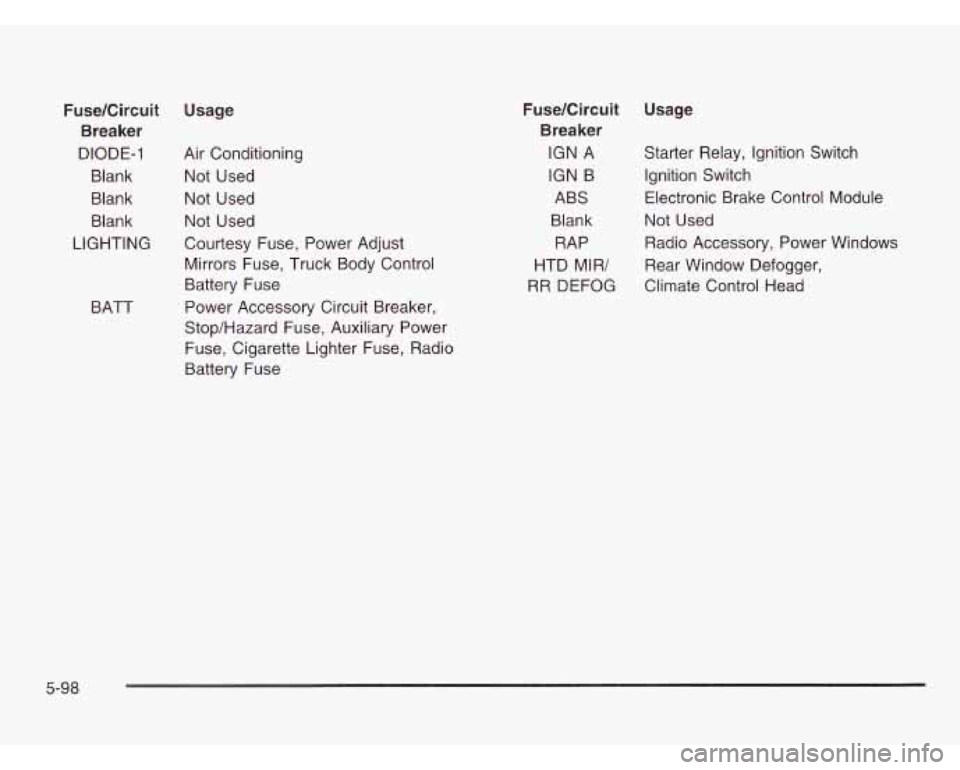
Fuse/Circuit Usage
Breaker
DIODE-I Air Conditioning
Blank Not Used
Blank
Not Used
Blank Not Used
LIGHTING Courtesy Fuse, Power Adjust
Mirrors Fuse, Truck Body Control
Battery Fuse
Power Accessory Circuit Breaker,
Stop/Hazard Fuse, Auxiliary Power
Fuse, Cigarette Lighter Fuse, Radio
Battery Fuse
BATT
Fuse/Circuit
Breaker
IGN A
IGN
B
ABS
Blank RAP
HTD MIRI
RR DEFOG
Usage
Starter Relay, Ignition Switch
Ignition Switch
Electronic Brake Control Module
Not Used Radio Accessory, Power Windows
Rear Window Defogger,
Climate Control Head
5-98
Page 369 of 386
Automatic Headlamp System ..................
Automatic Transmission
Fluid
................................................
Automatic Transmission Check ................
Automatic Transmission Shift Lock Control
System Check
...................................
Operation .........................................
......... 3-13
......... 5-25
......... 2-23
......... 6-27
......... 6-28
Backing Up
.................................................... 4-38
Battery
.......................................................... 5-46
Battery Replacement
......................................... 2-6
Battery Run-Down Protection
............................ 3-1 6
Before Leaving on a Long Trip
......................... 4-21
Bench Seat
............................................ 1-1 1, 1-57
Body Lubrication Service
.................................. 6-27
Brake Parking
...................................................... 2-26
System Inspection
....................................... 6-31
System Warning Light
.................................. 3-28
Brake Adjustment
............................................ 5-45
Brake Fluid
.................................................... 5-42
Brake Pedal Travel
......................................... 5-45
Brake Wear
................................................... 5-45
Brakes
.......................................................... 5-42
Braking in Emergencies
..................................... 4-9
Break-In, New Vehicle
..................................... 2-19
Braking
........................................................... 4-6
Bucket Seats, Rear
......................................... 1-12 Bulb
Replacement
........................................... 5-55
Halogen Bulbs ............................................ 5-55
Headlamps
............................ ......... 5-55
Replacement Bulbs
.............................. 5-61
Taillamps
.................................................... 5-60
Front
Turn Signal Lamps
.............................. 5-59
Buying New Tires
................................... 5-66
C
California Fuel .................................................. 5-6
Canada
........................................................... 7-5
Canadian Owners
................................................ ii
Canadian Roadside Assistance ............ ....... 7-7
Cancelling the Sliding Door
Security Lock
.......................................... 2-12
Capacities and Specifications
........................ 5-99
Carbon Monoxide
............... ..... 4-24, 4-31, 2-30
Care of
Safety Belts
.... ~ ~ ~ ~ ..................... 5-86
Care of Your
CD Player
.......... ...., ............ ..... 3-50
CDS
.......................................................... 3-50
Cargo Vans
........................................... 1-41, 1-48
Center Passenger Position, Safety Belts
............. 1-27
Chains, Tires
..................................... ..... 5-70
Charging System Light
....................... ..... 3-27
Engine Light
.............................. , ..... 3-30
Check
Gages Warning Light
................................... 3-36
2
Page 371 of 386
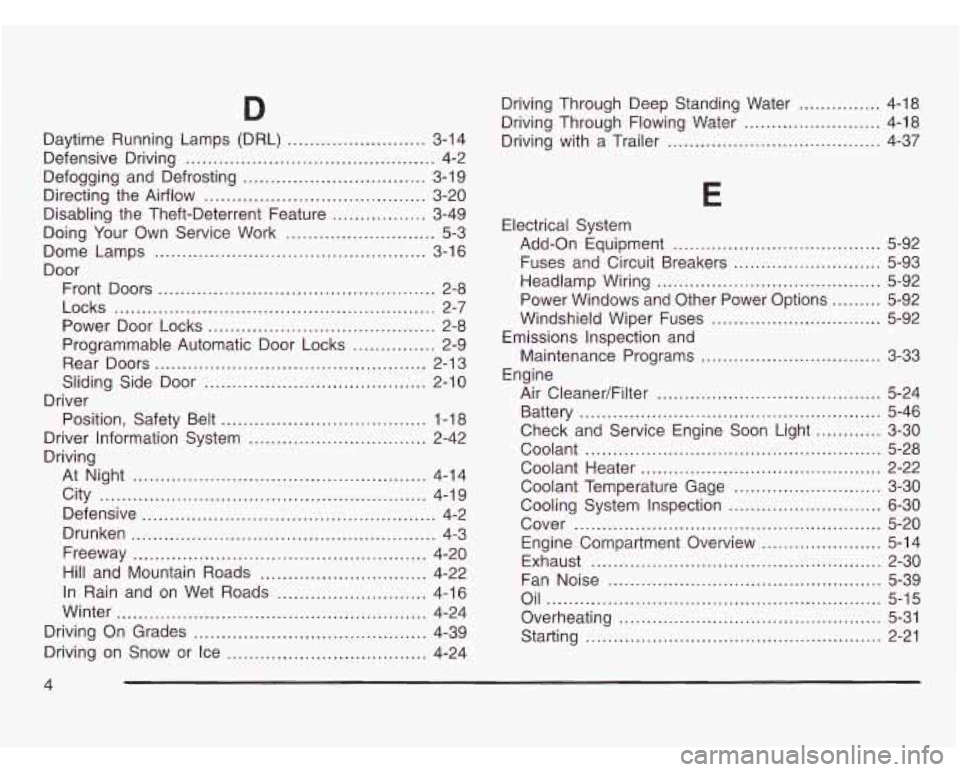
Daytime Running Lamps (DRL) ...................... 3-14
Defensive Driving
............................................. 4-2
Defogging and Defrosting
................................. 3-1 9
Directing the Airflow
........................................ 3-20
Disabling the Theft-Deterrent Feature
................. 3-49
Doing Your Own Service Work
........................... 5-3
Dome Lamps
.......................................... ~ ~~~ 3-16
Door Front Doors
............................................... 2-8
Locks
.......................................................... 2-7
Power Door Locks
......................................... 2-8
Programmable Automatic Door Locks
............... 2-9
Rear Doors
................................................. 2-13
Sliding Side Door
........................................ 2-10
Position, Safety Belt
..................................... 1-1 8
Driver Information System
................................ 2-42
At Night
..................................................... 4-14
City
........................................................... 4-19
Defensive
..................................................... 4-2
Drunken
....................................................... 4-3
Freeway
..................................................... 4-20
Hill and Mountain Roads
.............................. 4-22
In Rain and on Wet Roads ........................... 4-16
Winter
........................................................ 4-24
Driving On Grades
.......................................... 4-39
Driving on Snow or Ice
.................................... 4-24
Driver
Driving Driving
Through Deep Standing Water
............... 4-18
Driving Through Flowing Water
......................... 4-18
Driving with a Trailer
....................................... 4-37
E
Electrical System
Add-on Equipment
...................................... 5-92
Headlamp Wiring
......................................... 5-92
Fuses and
Circuit Breakers
........................... 5-93
Power Windows and Other Power Options
......... 5-92
Windshield Wiper Fuses
............................... 5-92
Emissions Inspection and
Engine Maintenance Programs
................................. 3-33
Air Cleaner/Filter
......................................... 5-24
Battery
....................................................... 5-46
Check and Service Engine Soon Light
............ 3-30
Coolant
...................................................... 5-28
Coolant Heater
............................................ 2-22
Coolant Temperature Gage
........................... 3-30
Cooling System Inspection
............................ 6-30
Cover
........................................................ 5-20
Engine Compartment Overview
...................... 5-14
Exhaust
..................................................... 2-30
Fan Noise
.................................................. 5-39
Oil
............................................................. 5-15
Starting
...................................................... 2-21
Overheating
................................................ 5-31
4