battery CHEVROLET ASTRO 2003 User Guide
[x] Cancel search | Manufacturer: CHEVROLET, Model Year: 2003, Model line: ASTRO, Model: CHEVROLET ASTRO 2003Pages: 386, PDF Size: 17.31 MB
Page 153 of 386
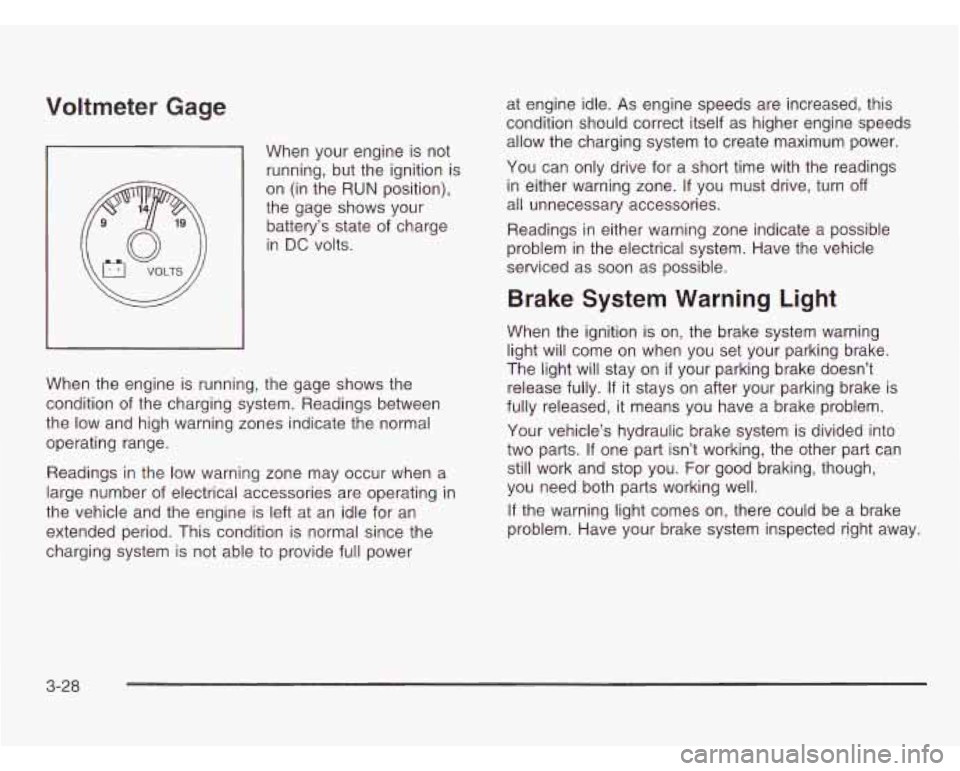
Voltmeter Gage
When your engine is not
running, but the ignition is
on (in the RUN position),
the gage shows your
battery’s state of charge
in
DC volts.
When the engine is running, the gage shows the
condition of the charging system. Readings between
the low and high warning zones indicate the normal
operating range.
Readings in the low warning zone may occur when a
large number of electrical accessories are operating in
the vehicle and the engine is left at an idle for an
extended period. This condition
is normal since the
charging system
is not able to provide full power at engine
idle.
As engine speeds are increased, this
condition should correct itself as higher engine speeds
allow the charging system to create maximum power.
You can only drive for a short time with the readings
in either warning zone.
If you must drive, turn off
all unnecessary accessories.
Readings in either warning zone indicate a possible
problem in the electrical system. Have the vehicle
serviced as soon as possible.
Brake System Warning Light
When the ignition is on, the brake system warning
light will come on when you set your parking brake.
The light will stay on
if your parking brake doesn’t
release fully.
If it stays on after your parking brake is
fully released, it means you have a brake problem.
Your vehicle’s hydraulic brake system is divided into
two parts.
If one part isn’t working, the other part can
still work and stop you. For good braking, though,
you need both parts working well.
If the warning light comes on, there could be a brake
problem. Have your brake system inspected right away.
3-28
Page 158 of 386
If you experience one or more of these conditions,
change the fuel brand you use.
it will require at least
one full tank of the proper fuel to turn the light
off.
If none of the above steps have made the light turn off,
have your dealer or qualified service center check
the vehicle. Your dealer has the proper test equipment
and diagnostic tools to fix any mechanical or electrical
problems that may have developed.
Emissions Inspection and
Maintenance Programs
Some state/provincial and local governments have or
may begin programs to inspect the emission control
equipment on your vehicle. Failure to pass this
inspection could prevent you from getting a vehicle
registration. Here are
some things you need to know to help your
vehicle pass an inspection:
Your vehicle will not pass this inspection
if the SERVICE
ENGINE SOON or CHECK ENGINE light is on or not
working properly.
Your vehicle will not pass this inspection
if the OBD
(on-board diagnostic) system determines that critical
emission control systems have not been completely
diagnosed by the system. The vehicle would be
considered not ready for inspection. This can happen
if you have recently replaced your battery or if your
battery has run down. The diagnostic system is
designed to evaluate critical emission control systems
during normal driving. This may take several days
of routine driving.
If you have done this and your
vehicle still does not pass the inspection for lack of
OBD system readiness, see your dealer or qualified
service center to prepare the vehicle for inspection.
3-33
Page 172 of 386
While listening to a CD, press the up arrow to hear the
next track on the CD. Press the down arrow to go
back to the start of the current track
if more than eight
seconds have played. The SEEK button is inactive
if the
CD mode on the front radio is in use.
To scan preset stations, press and hold SEEK until the
radio goes into scan mode. The radio will go to a station,
play for a few seconds, then go on to the next station.
Press either SEEK arrow again to stop scanning. The
scan function is inactive
if the front radio is in use.
P.SET PROG (Preset Program): The front passengers
must be listening to something different for each of
these functions to work:
Press this button to scan through the preset radio
stations set on the pushbuttons on the main radio.
The radio will go to
a preset station, play for a
few seconds, then go on to the next preset station.
Press this button again to stop scanning.
TAPE CD: Press this button to switch between playing
a tape or CD
if loaded. The inactive tape or CD will
remain safely inside the radio for future listening.
Theft-Deterrent Feature
THEFTLOCK@ is designed to discourage theft of your
radio. It works by using a secret code to disable all radio
functions whenever battery power is interrupted.
The THEFTLOCK@ feature for the radio may be used or
ignored.
If ignored, the system plays normally and the
radio is not protected by the feature.
If THEFTLOCK@ is
activated, your radio will not operate
if stolen.
When THEFTLOCK@ is activated, the radio will display
LOC to indicate a locked condition anytime battery
power has been interrupted.
If your battery loses power
for any reason, you must unlock the radio with the
secret code before
it will operate.
3-47
Page 174 of 386
Unlocking the Theft-Deterrent Feature
After
a Power Loss
Enter your secret code as follows; pause no more than
15 seconds between steps:
1. Turn the ignition on. LOC will appear on the display.
2, Press MN and 000 will appear on the display.
3. Press MN again to make the last two digits agree
with your code.
4. Press HR to make the first one or two digits agree
with your code.
5. Press AM FM after you have confirmed that the
code matches the secret code you have written
down. The display will show SEC, indicating
the radio is now operable and secure.
If you enter the wrong code eight times, INOP will
appear on the display. You will have to wait an hour
with the ignition on before you can try again. When you
try again, you will only have three chances to enter
the correct code before INOP appears.
If you lose or forget your code, contact your dealership.
Disabling the Theft-Deterrent Feature
Enter your secret code as follows; pause no more than
15 seconds between steps:
1. Turn the ignition on.
2. Turn the radio off.
3. Press the 1 and 4 pushbuttons at the same time.
Hold them down until SEC shows on the display.
4. Press MN and
000 will appear on the display.
5. Press MN again to make the last two digits agree
with your code.
6. Press HR to make the first one or two digits agree
with your code.
7. Press AM FM after you have confirmed that the
code matches the secret code you have written
down. The display will show
- - -, indicating that the
radio is no longer secured.
If the code entered is incorrect, SEC will appear on the
display. The radio will remain secured until the correct
code is entered.
When battery power is removed and later applied to a
secured radio, the radio won’t turn on and LOC will
appear on the display.
To unlock a secured radio, see Unlocking the
Theft-Deterrent Feature After
a Power Loss earlier
in this section.
3-49
Page 202 of 386
Snow can trap exhaust gases under your
vehicle. This can cause deadly
CO (carbon
monoxide) gas to get inside.
CO could
overcome you and kill you. You can’t see
it or
smell
it, so you might not know it is in your
vehicle. Clear away snow from around the
base of your vehicle, especially any that is
blocking your exhaust pipe. And check around
again from time to time to be sure snow doesn’t collect there.
Open a window just a little on the side
of the
vehicle that’s away from the wind. This will
help keep
CO out. Run your
engine only as long as you must. This saves
fuel. When you run the engine, make it go a little
faster than just idle. That is, push the accelerator
slightly. This uses less fuel for the heat that you get
and
it keeps the battery charged. You will need a
well-charged battery to restart the vehicle, and possibly
for signaling later on with your headlamps. Let the
heater run for a while.
Then, shut the engine
off and close the window almost
all the way to preserve the heat. Start the engine
again and repeat this only when you feel really
uncomfortable from the cold. But do it as little as
possible. Preserve the fuel as long as you can.
To help keep warm, you can get out of the vehicle and
do some fairly vigorous exercises every half hour or
so until help comes.
4-27
Page 216 of 386
Trailer Wiring Harness
If you have the optional trailering package, your vehicle
will have an eight-wire harness, including the center
high-mounted stoplamp battery feed wire. The harness
is stored on the passenger’s side of the vehicle near
the rear wheel well. This harness has a
30 amp battery
feed wire and no connector, and should be wired by
a qualified electrical technician. After choosing an
aftermarket trailer mating connector pair, have the
technician attach one connector to the eight-wire trailer
harness and the other connector to the wiring harness
on the trailer. Be sure the wiring harness on the trailer
is
taped or strapped to the trailer’s frame rail and leave
it loose enough
so the wiring doesn’t bend or break, but
not
so loose that it drags on the ground. The eight-wire
harness must be routed out of your vehicle between
the rear door and the floor, with enough of the harness
left on both sides
so that the trailer or the body won’t
pull it. If you do not have the optional trailering
package, your vehicle will still have a trailering harness.
The harness is located near the passenger’s side
rear wheel well. It consists
of six wires that may be
used by after-market trailer hitch installers. The
technician can use the following color code chart
when connecting the wiring harness to your trailer.
e
e
Brown: Rear lamps.
Yellow: Left stoplamp and turn signal.
Dark Green: Right stoplamp and turn signal.
White (Heavy Gage): Ground.
Light Green: Back-up lamps.
White (Light Gage): Center High-Mounted Stoplamp.
Blue: Auxiliary circuit (eight-wire harness only).
Orange: Fused auxiliary (eight-wire harness only).
Store the harness in its original place. Wrap the
harness together and tie it neatly
so it won’t
be damaged.
4-4 1
Page 218 of 386
Section 5 Service and Appearance Care
Service .......................................................... -5-3
Doing Your Own Service Work
......................... 5-3
Adding Equipment to the Outside of
Your Vehicle
.............................................. 5-4
Fuel ................................................................ 5.5
Gasoline Octane ........................................... -5-5
Gasoline Specifications .................................... 5.5
California Fuel ............................................. -56
Additives
....................................................... 5.6
Fuels in Foreign Countries
............................... 5.7
Filling Your Tank
............................................ 5-8
Filling a Portable Fuel Container
..................... 5-10
Checking Things Under the Hood .................... 5-1 1
Hood Release .............................................. 5.11
Engine Compartment Overview
...................... 5.14
Engine Oil
................................................... 5.15
Engine Cover ................. .... ........ 5.20
Engine Air Cleaner/Filter
................. ........ 5.24
Automatic Transmission Fluid
...................... 5.25
Engine Coolant ............................................. 5.28
Radiator Pressure Cap
.................................. 5.30
Engine Overheating
....................................... 5.31
Cooling System
............................................ 5.33
Engine Fan Noise
......................................... 5.39
Power Steering Fluid
..................................... 5.40
Windshield Washer Fluid
................................ 5.41 Brakes
........................................................ 5.42
Battery
........................................................ 5-46
Jump Starting
............................................... 5-47
All-Wheel Drive .............................................. 5-52
Rear Axle ....................................................... 5-53
Front Axle ...................................................... 5-54
Bulb Replacement .......................................... 5-55
Halogen Bulbs .............................. ..... 5-55
Headlamps .................................. ..... 5-55
Front Turn Signal Lamps ............................... 5-59
Replacement Bulbs
....................................... 5-61
Windshield Wiper Blade Replacement .............. 5-62
Tires .............................................................. 5.63
Inflation
- Tire Pressure ................................ 5-64
Tire Inspection and Rotation
........................... 5-64
When It
Is Time for New Tires ....................... 5-66
Buying New Tires
......................................... 5-66
Uniform Tire Quality Grading
.......................... 5-67
Wheel Alignment and Tire Balance
.................. 5-69
Wheel Replacement
...................................... 5-69
Tire Chains
.................................................. 5-70
If a Tire Goes Flat ........................................ 5.70
Changing a Flat Tire ..................................... 5.71
Compact Spare Tire ...................................... 5-82
Taillamps
.................................................... 5-60
5- 1
Page 232 of 386
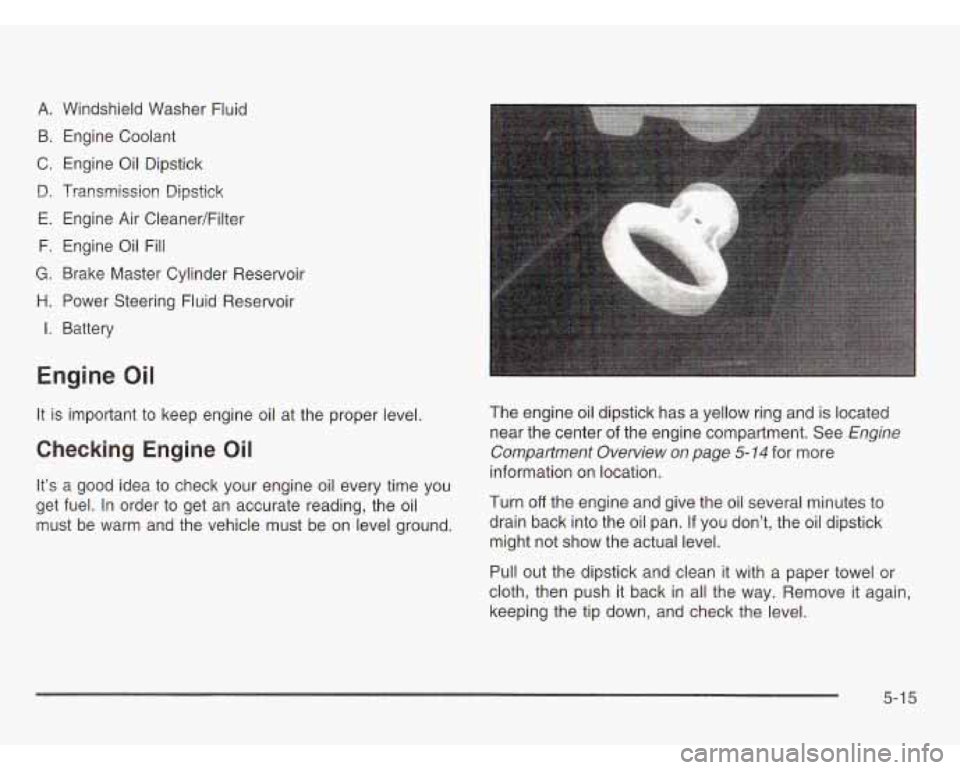
A. Windshield Washer Fluid
B. Engine Coolant
C. Engine
Oil Dipstick
D. Transmission Dipstick
E. Engine Air Cleaner/Filter
F. Engine Oil Fill
G. Brake Master Cylinder Reservoir
H. Power Steering Fluid Reservoir
I. Battery
Engine Oil
It is important to keep engine oil at the proper level. The engine oil dipstick has a yellow ring and is located
near the center of the engine compartment. See
Engine
information on location.
Checking Engine Oil Compartment Overview on page 5- 14 for more
It’s a good idea to check your engine oil every time
you
get fuel. In order to get an accurate reading, the oil Turn off the engine and give the oil several minutes to
must be warm and the vehicle must be on level ground. drain back into the
Oil pan. If YOU don’t, the oil dipstick
might not show the actual level.
Pull out the dipstick and clean it with a paper towel or
cloth, then push it back in all the way. Remove it again,
keeping the tip down, and check the level.
5-1 5
Page 263 of 386
Replacing Brake System Parts
Te braking system on a vehicle is complex. Its many parts
have to be of top quality and work well together
if the
vehicle is to have really good braking. Your vehicle was
designed and tested with top-quality
GM brake parts.
When you replace parts of your braking system -for
example, when your brake linings wear down and you
need new ones put
in - be sure you get new approved
GM replacement parts. If you don’t, your brakes may no
longer work properly.
For example,
if someone puts in brake linings that are
wrong for your vehicle, the balance between your front
and rear brakes can change -for the worse. The braking
performance you’ve come to expect can change
in many
other ways
if someone puts in the wrong replacement
brake parts.
Battery
Your new vehicle comes with a maintenance free
ACDelco@ battery. When it’s time for a new battery,
get one that has the replacement number shown on the
original battery’s label. We recommend an ACDelco@
battery. See
Engine Compartment Overview on
page 5-74 for battery location.
Warnings Battery posts, terminals and related
accessories contain lead and lead compounds,
chemicals known to the State
of California to cause
cancer and reproductive harm. Wash hands after
handling.
5-46
Page 264 of 386
Vehicle Storage
If you’re not going to drive your vehicle for 25 days or
more, remove the black, negative
(-) cable from
the battery. This will help keep your battery from
running down.
Jump Starting
If your battery has run down, you may want to use
another vehicle and some jumper cables to start your
vehicle. But
please follow the numbered steps to
do it safely.
Batteries have acid that can burn you and gas
that can explode. You can be badly hurt if you
aren’t careful. See “Jump Starting” next for
Contact your dealer to learn how
to prepare your
vehicle for longer storage periods.
Also, for your audio system, see Theft-Deterrent
Feature
on page 3-47.
Batteries can hurt you. They can be dangerous
They contain acid that can burn you.
They contain gas that can explode
0 They contain enough electricity to
Nofice: Ignoring these steps could result in costly
damage to your vehicle that wouldn’t be covered
by your warranty.
Trying to start your vehicle by pushing or pulling
it
won’t work, and it could damage your vehicle.
5-47