light CHEVROLET ASTRO 2003 Owner's Guide
[x] Cancel search | Manufacturer: CHEVROLET, Model Year: 2003, Model line: ASTRO, Model: CHEVROLET ASTRO 2003Pages: 386, PDF Size: 17.31 MB
Page 155 of 386
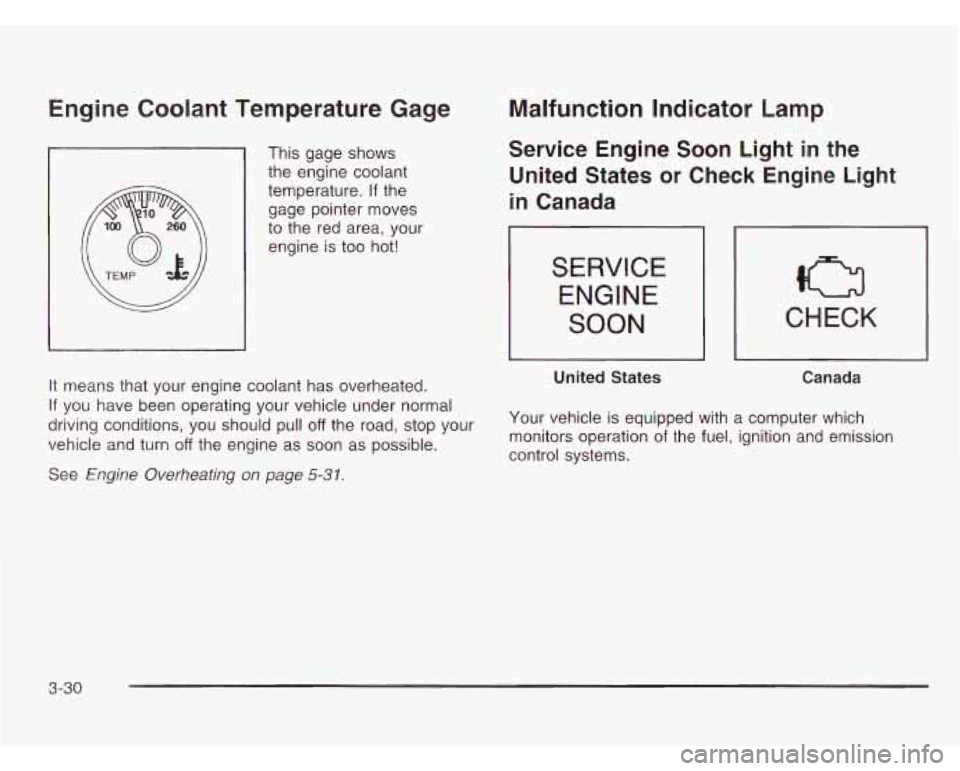
Engine Coolant Temperature Gage
This gage shows
the engine coolant
temperature.
If the
gage pointer moves
to the red area, your
engine is too hot!
It means that your engine coolant has overheated.
If you have been operating your vehicle under normal
driving conditions, you should pull
off the road, stop your
vehicle and turn
off the engine as soon as possible.
See
Engine Overheating on page 5-31.
Malfunction Indicator Lamp
Service Engine Soon Light in the
United States
or Check Engine Light
in Canada
SERVICE
ENGINE
SOON
ds
CHECK
United States Canada
Your vehicle is equipped with a computer which
monitors operation of the fuel, ignition and emission
control systems.
3-30
Page 156 of 386
This system is called OBD II (On-Board Diagnostics-
Second Generation) and is intended to assure that
emissions are at acceptable levels for the life of
the vehicle, helping to produce a cleaner environment.
The SERVICE ENGINE SOON or CHECK ENGINE
light comes on and a chime will sound to indicate that
there is a problem and service is required. Malfunctions
often will be indicated by the system before any
problem is apparent. This may prevent more serious
damage to your vehicle. This system is also designed to
assist your service technician in correctly diagnosing
any malfunction.
Notice: If you keep driving your vehicle with this
light on, after a while, your emission controls
may not work as well, your fuel economy may not
be as good and your engine may not run as
smoothly. This could lead to costly repairs that
may not be covered by your warranty.
Notice: Modifications made to the engine,
transmission, exhaust, intake or fuel system of
your vehicle
or the replacement of the original tires
with other than those of the same Tire Performance
Criteria (TPC) can affect your vehicle’s emission
controls and may cause
this light to come on. Modifications to these systems could lead to costly
repairs not covered by your warranty. This may
also result
in a failure to pass a required Emission
Inspection/Maintenance test.
This light should come on, as a check to show you
it
is working, when the ignition is on and the engine is not
running.
If the light doesn’t come on, have it repaired.
This light will also come on during a malfunction in one
of two ways:
e
e Light Flashing - A misfire condition has been
detected.
A misfire increases vehicle emissions
and may damage the emission control system on
your vehicle. Dealer or qualified service center
diagnosis and service may be required.
Light On Steady
- An emission control system
malfunction has been detected on your vehicle.
Dealer or qualified service center diagnosis
and service may be required.
3-31
Page 157 of 386
If the Light Is Flashing
The following may prevent more serious damage to
your vehicle:
Reducing vehicle speed.
Avoiding hard accelerations.
Avoiding steep uphill grades.
If you are towing a trailer, reduce the amount of
cargo being hauled as soon as it is possible.
If the light stops flashing and remains on steady,
see
“If the Light Is On Steady” following.
If the light continues to flash, when it is safe to do so,
stop the vehicle. Find a safe place to park your vehicle.
Turn the key off, wait at least
10 seconds and restart
the engine.
If the light remains on steady, see “If the
Light
Is On Steady” following. If the light is still flashing,
follow the previous steps, and drive the vehicle to
your dealer or qualified service center for service.
If the Light Is On Steady
You may be able to correct the emission system
malfunction by considering the following:
Did you recently put fuel into your vehicle?
If so, reinstall the fuel cap, making sure to fully
install the cap. See
Filling Your Tank on page 5-8.
The diagnostic system can determine if the fuel cap has
been left off or improperly installed. A loose or missing
fuel cap will allow fuel to evaporate into the atmosphere.
A few driving trips with the cap properly installed
should turn the light off.
Did you just drive through a deep puddle of water?
If
so, your electrical system may be wet. The condition
will usually be corrected when the electrical system
dries out.
A few driving trips should turn the light off.
Have you recently changed brands of fuel?
If
so, be sure to fuel your vehicle with quality fuel.
See
Gasoline Octane on page 5-5. Poor fuel quality
will cause your engine not to run as efficiently as
designed. You may notice this as stalling after start-up,
stalling when you put the vehicle into gear, misfiring,
hesitation on acceleration or stumbling on acceleration.
(These conditions may go away once the engine is
warmed up.) This will be detected by the system and
cause the light to turn on.
3-32
Page 158 of 386
If you experience one or more of these conditions,
change the fuel brand you use.
it will require at least
one full tank of the proper fuel to turn the light
off.
If none of the above steps have made the light turn off,
have your dealer or qualified service center check
the vehicle. Your dealer has the proper test equipment
and diagnostic tools to fix any mechanical or electrical
problems that may have developed.
Emissions Inspection and
Maintenance Programs
Some state/provincial and local governments have or
may begin programs to inspect the emission control
equipment on your vehicle. Failure to pass this
inspection could prevent you from getting a vehicle
registration. Here are
some things you need to know to help your
vehicle pass an inspection:
Your vehicle will not pass this inspection
if the SERVICE
ENGINE SOON or CHECK ENGINE light is on or not
working properly.
Your vehicle will not pass this inspection
if the OBD
(on-board diagnostic) system determines that critical
emission control systems have not been completely
diagnosed by the system. The vehicle would be
considered not ready for inspection. This can happen
if you have recently replaced your battery or if your
battery has run down. The diagnostic system is
designed to evaluate critical emission control systems
during normal driving. This may take several days
of routine driving.
If you have done this and your
vehicle still does not pass the inspection for lack of
OBD system readiness, see your dealer or qualified
service center to prepare the vehicle for inspection.
3-33
Page 160 of 386
Security Light Service All-Wheel
This light will come on
briefly when you turn the
ignition key to
START.
SERVICE
AWD
Drive Light
This light should come on
briefly when you turn on
the ignition, as a check to
show you it is working.
The light will stay on until the engine starts.
If the light The SERVICE AWD light
comes on to indicate that
flashes, the Passlock@ System has entered a tamper there
may be a problem with the drive system and
mode. If the vehicle fails to start, see
Passlock@ service is required. Malfunctions can be indicated by the
on page 2- 18. system before any problem is apparent, which may
If the light comes on continuously while driving and also designed to assist your service technician in
stays on, there may be a problem with the Passlock@ correctly diagnosing a malfunction.
System. Your vehicle will not be protected by Passlock@,
and you should see your
GM dealer. prevent serious
damage to the vehicle. This system is
3-35
Page 161 of 386
Tow/HauI Mode Liaht
TOW / HAUL
J
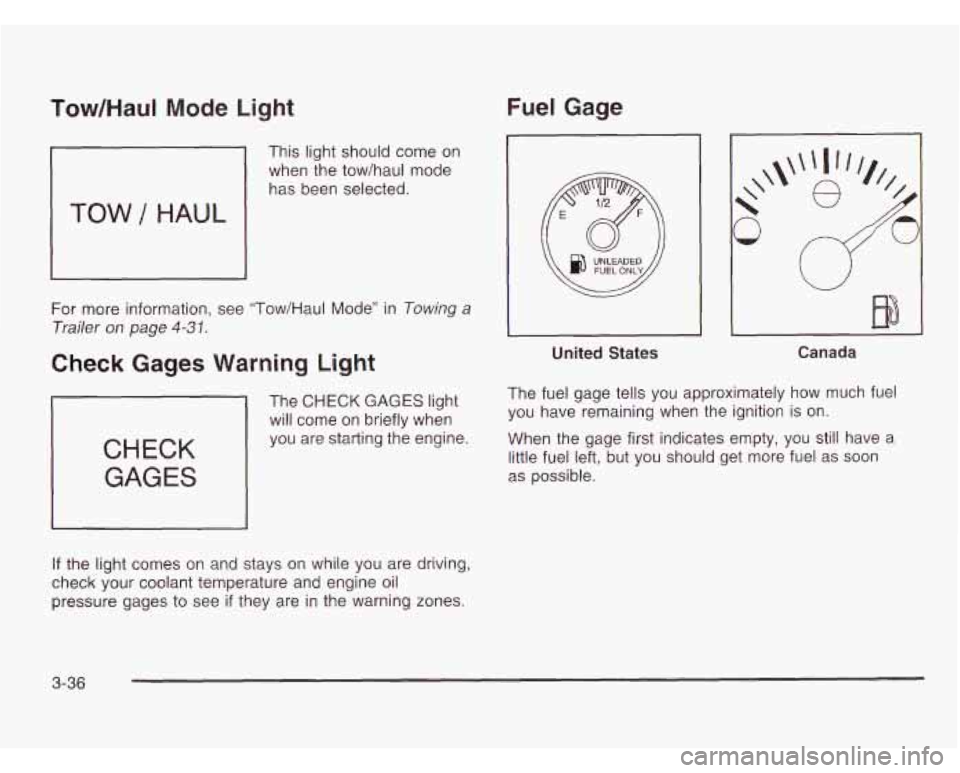
This light should come on
when the tow/haul mode
has been selected.
For more information, see “Tow/Haul Mode” in
Towing a
Trailer on page 4-31.
Check Gages Warning Light
CHECK
GAGES
The CHECK GAGES light
will come on briefly when
you are starting the engine.
Fuel Gage
I
UNLEADED
United States Canada
The
fuel gage tells you approximately how much fuel
you have remaining when the ignition is on.
When the gage first indicates empty, you still have a
little fuel left, but you should get more fuel as soon
as possible.
If the light comes on and stays on while you are driving,
check your coolant temperature and engine oil
pressure gages to see
if they are in the warning zones.
3-36
Page 162 of 386
Here are things some owners ask about. None of these
indicate a problem with your fuel gage:
0 At the gas station, the gas pump shuts off before
the gage reads full.
The fuel tank will take either a little more or a little
less fuel
to fill up than the gage shows.
0 The gage moves a little when you turn a corner or
The gage doesn’t go back to empty when you turn
speed up.
off the ignition.
Low Fuel Warning Light
The LOW FUEL light will
come on briefly when you
are starting the engine.
This light comes on when the fuel tank
is low on fuel.
To turn it off, add fuel to the fuel tank. See Fuel on
page 5-5.
3-37
Page 166 of 386
Radio with CD
Playing the Radio
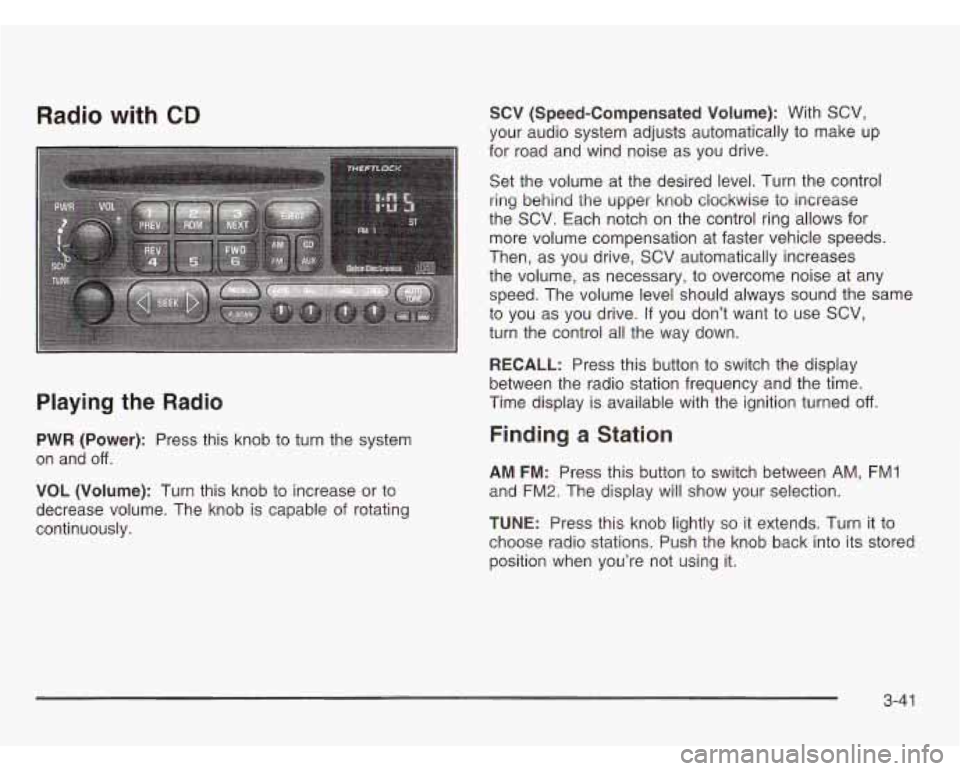
PWR (Power): Press this knob to turn the system
on and
off.
VOL (Volume): Turn this knob to increase or to
decrease volume. The knob is capable of rotating
continuously.
SCV (Speed-Compensated Volume): With SCV,
your audio system adjusts automatically to make up
for road and wind noise as you drive.
Set the volume at the desired level. Turn the control
ring behind the upper knob clockwise to increase
the SCV. Each notch on the control ring allows for
more volume compensation at faster vehicle speeds.
Then, as you drive, SCV automatically increases
the volume, as necessary, to overcome noise at any
speed. The volume level should always sound the same
to you as you drive.
If you don’t want to use SCV,
turn the control all the way down.
RECALL: Press this button to switch the display
between the radio station frequency and the time.
Time display is available with the ignition turned
off.
Finding a Station
AM FM: Press this button to switch between AM, FM1
and FM2. The display will show your selection.
TUNE: Press this knob lightly so it extends. Turn it to
choose radio stations. Push the knob back into its stored
position when you’re not using it.
3-41
Page 168 of 386
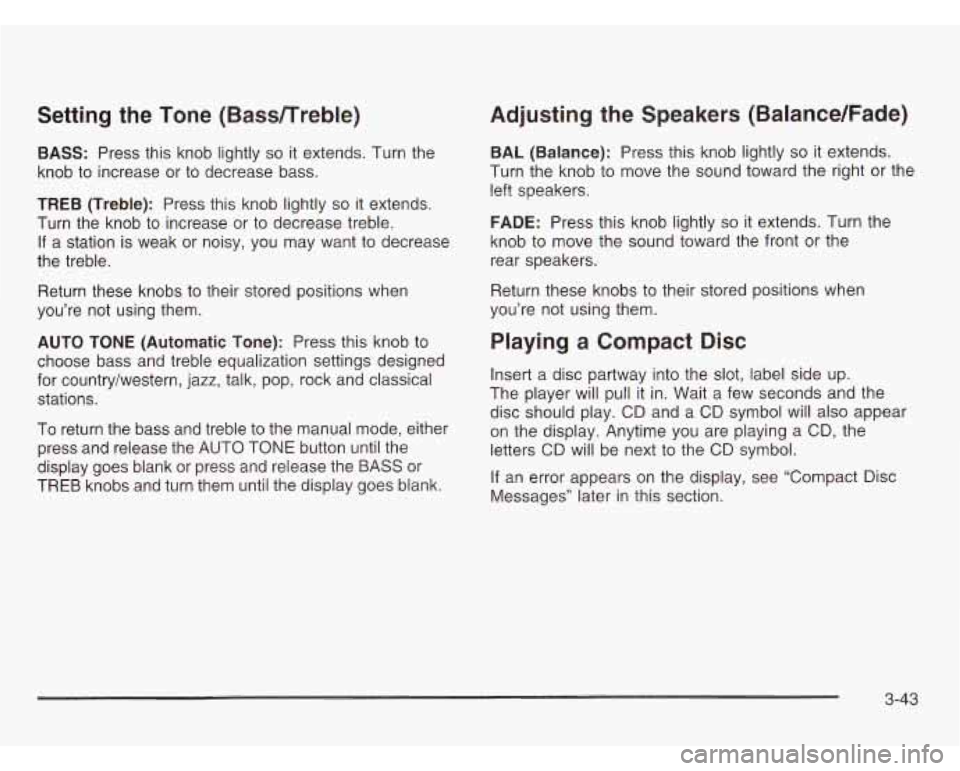
Setting the Tone (Bassnreble)
BASS: Press this knob lightly so it extends. Turn the
knob to increase or to decrease bass.
TREB (Treble): Press this knob lightly so it extends.
Turn the knob to increase or to decrease treble.
If a station is weak or noisy, you may want to decrease
the treble.
Return these knobs to their stored positions when
you’re not using them.
AUTO TONE (Automatic Tone): Press this knob to
choose bass and treble equalization settings designed
for country/western, jazz, talk, pop, rock and classical
stations.
To return the bass and treble to the manual mode, either
press and release the AUTO
TONE button until the
display goes blank or press and release the BASS or
TREB knobs and turn them until the display goes blank.
Adjusting the Speakers (Balance/Fade)
BAL (Balance): Press this knob lightly so it extends.
Turn the knob to move the sound toward the right or the
left speakers.
FADE: Press this knob lightly so it extends. Turn the
knob to move the sound toward the front or the
rear speakers.
Return these knobs to their stored positions when
you’re not using them.
Playing a Compact Disc
Insert a disc partway into the slot, label side up.
The player will pull it in. Wait a few seconds and the
disc should play. CD and a CD symbol will also appear
on the display. Anytime you are playing a CD, the
letters CD will be next to the CD symbol.
If an error appears on the display, see “Compact Disc
Messages’’ later in this section.
3-43
Page 171 of 386
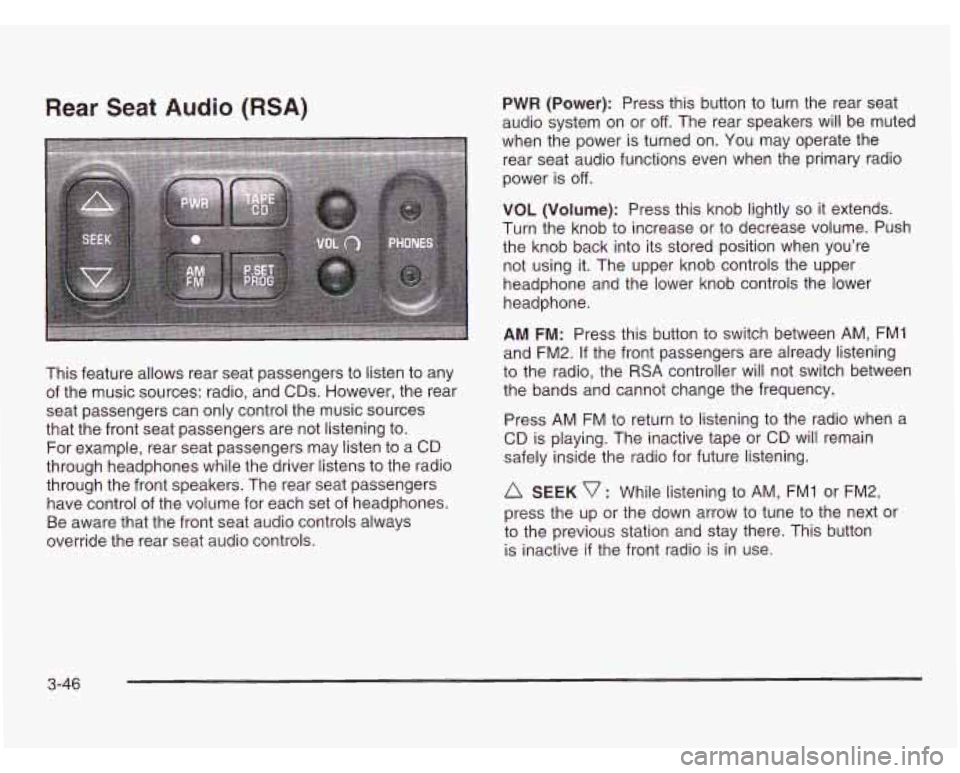
Rear Seat Audio (RSA) PWR (Power): Press this button to turn the rear seat
audio system on or
off. The rear speakers will be muted
when the power is turned on. You may operate the
rear seat audio functions even when the primary radio
power is
off.
VOL (Volume): Press this knob lightly so it extends.
Turn the knob
to increase or to decrease volume. Push
the knob back into its stored position when you’re
not using it. The upper knob controls the upper
headphone and the lower knob controls the lower
headphone.
This feature allows rear seat passengers to listen
to any
of the music sources: radio, and CDs. However, the rear
seat passengers can only control the music sources
that the front seat passengers are not listening to.
For example, rear seat passengers may listen to a CD
through headphones while the driver listens to the radio
through the front speakers. The rear seat passengers
have control of the volume for each set of headphones.
Be aware that the front seat audio controls always
override the rear seat audio controls.
AM FM: Press this button to switch between AM, FMI
and FM2.
If the front passengers are already listening
to the radio, the RSA controller will not switch between
the bands and cannot change the frequency.
Press AM FM to return to listening
to the radio when a
CD is playing. The inactive tape or CD will remain
safely inside the radio for future listening.
A SEEK v : While listening to AM, FMI or FM2,
press the up or the down arrow to tune
to the next or
to the previous station and stay there. This button
is inactive
if the front radio is in use.
3-46