oil level CHEVROLET ASTRO 2003 Owners Manual
[x] Cancel search | Manufacturer: CHEVROLET, Model Year: 2003, Model line: ASTRO, Model: CHEVROLET ASTRO 2003Pages: 386, PDF Size: 17.31 MB
Page 159 of 386
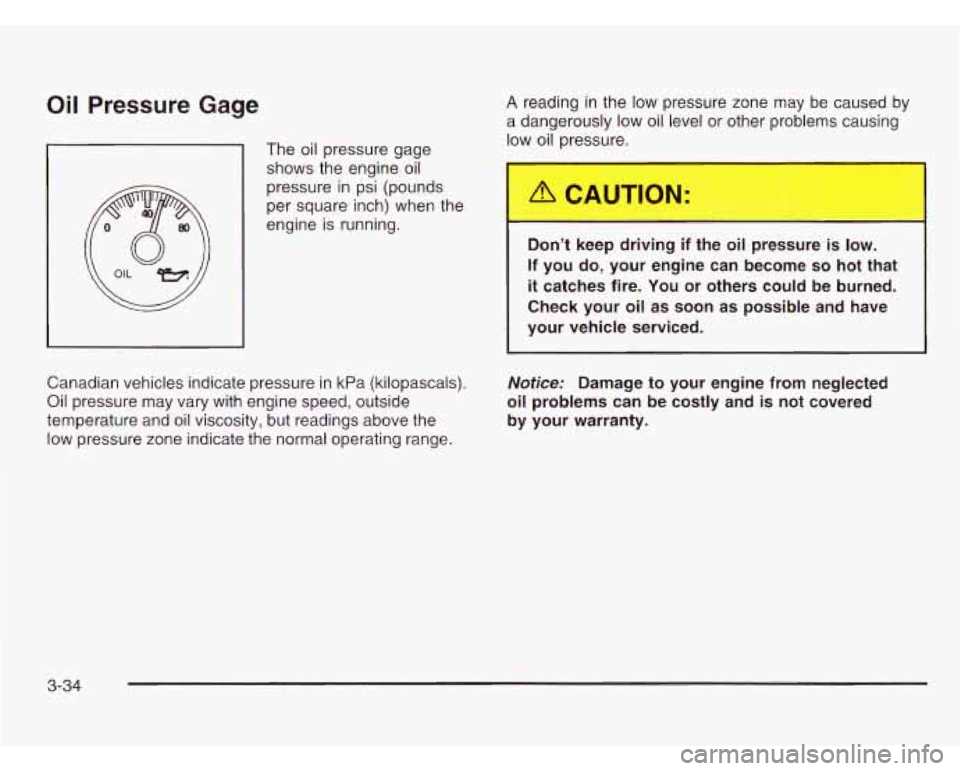
Oil Pressure Gage
The oil pressure gage
shows the engine oil
pressure
in psi (pounds
per square inch) when the
engine is running.
Canadian vehicles indicate pressure in kPa (kilopascals).
Oil pressure may vary with engine speed, outside
temperature and oil viscosity, but readings above the
low pressure zone indicate the normal operating range.
A reading in the low pressure zone may be caused by
a dangerously low oil level or other problems causing
low oil pressure.
Don’t keep driving if
the oil pressure is low.
If you do, your engine can become so hot that
it catches fire. You or others could be burned.
Check your oil as soon as possible and have
your vehicle serviced.
Notice: Damage to your engine from neglected
oil problems can be costly and
is not covered
by your warranty.
3-34
Page 196 of 386
The exit ramp can be curved, sometimes quite sharply.
The exit speed is usually posted.
Reduce your speed according to your speedometer, not
to your sense of motion. After driving for any distance
at higher speeds, you
may tend to think you are
going slower than you actually are.
Before Leaving on a Long Trip
Make sure you’re ready. Try to be well rested. If you
must start when you’re not fresh
- such as after a day’s
work
- don’t plan to make too many miles that first
part of the journey. Wear comfortable clothing and shoes
you can easily drive in.
Is your vehicle ready for a long trip? If you keep it
serviced and maintained, it’s ready to go.
If it needs
service, have it done before starting out. Of course,
you’ll find experienced and able service experts
in dealerships all across North America. They’ll be
ready and willing to help
if you need it. Here
are some things you can check before a trip:
e
e
e
Windshield Washer Fluid: Is the reservior full?
Are
all windows clean inside and outside?
Wiper Blades: Are they in good shape?
Fuel, Engine Oil, Other Fluids: Have you checked
all levels?
Lamps: Are they all working? Are the lenses clean?
Tires: They are vitally important to a safe,
trouble-free trip.
Is the tread good enough for
long-distance driving? Are the tires all inflated
to the recommended pressure?
Weather Forecasts: What’s the weather outlook
along your route? Should you delay your trip a
short time to avoid a major storm system?
Maps: Do you have up-to-date maps?
4-2 1
Page 214 of 386
Driving On Grades Parking on Hills
Reduce speed and shift to a lower gear before you start
down a long or steep downgrade.
If you don’t shift
down, you might have to use your brakes
so much that
they would get hot and no longer work well.
You can tow in DRIVE (D). You may want to shift the
transmission to THIRD
(3) or, if necessary, a lower gear
selection
if the transmission shifts too often (e.g., under
heavy loads and/or hilly conditions).
When towing at high altitude on steep uphill grades,
consider the following: Engine coolant will boil at a lower
temperature than at normal altitudes.
If you turn your
engine
off immediately after towing at high altitude
on steep uphill grades, your vehicle may show signs
similar to engine overheating.
To avoid this, let the
engine run while parked (preferably on level ground)
with the automatic transmission in PARK
(P) for a
few minutes before turning the engine
off. If you do get
the overheat warning, see
Engine Overheating on
page
5-3 1.
You really shoul tot park your vehicle, ith a
trailer attached, on a hill.
If something goes
wrong, your rig could start to move. People
can be injured, and both your vehicle and the
trailer can be damaged.
But if you ever have to park your rig on a hill, here’s
how to do it:
1. Apply your regular brakes, but don’t shift into
2. Have someone place chocks under the trailer
3. When the wheel chocks are in place, release the
4. Reapply the regular brakes. Then apply your PARK (P) yet.
wheels. regular brakes until the chocks absorb the load.
parking brake, and shift to PARK (P).
5. Release the regular brakes.
4-39
Page 232 of 386
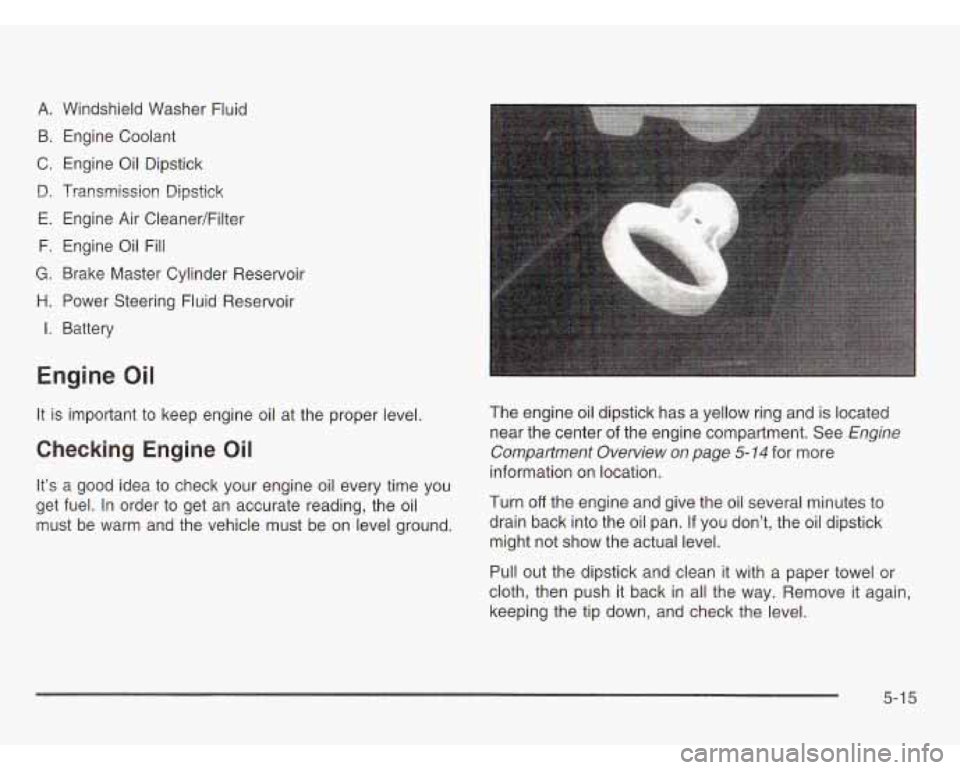
A. Windshield Washer Fluid
B. Engine Coolant
C. Engine
Oil Dipstick
D. Transmission Dipstick
E. Engine Air Cleaner/Filter
F. Engine Oil Fill
G. Brake Master Cylinder Reservoir
H. Power Steering Fluid Reservoir
I. Battery
Engine Oil
It is important to keep engine oil at the proper level. The engine oil dipstick has a yellow ring and is located
near the center of the engine compartment. See
Engine
information on location.
Checking Engine Oil Compartment Overview on page 5- 14 for more
It’s a good idea to check your engine oil every time
you
get fuel. In order to get an accurate reading, the oil Turn off the engine and give the oil several minutes to
must be warm and the vehicle must be on level ground. drain back into the
Oil pan. If YOU don’t, the oil dipstick
might not show the actual level.
Pull out the dipstick and clean it with a paper towel or
cloth, then push it back in all the way. Remove it again,
keeping the tip down, and check the level.
5-1 5
Page 233 of 386
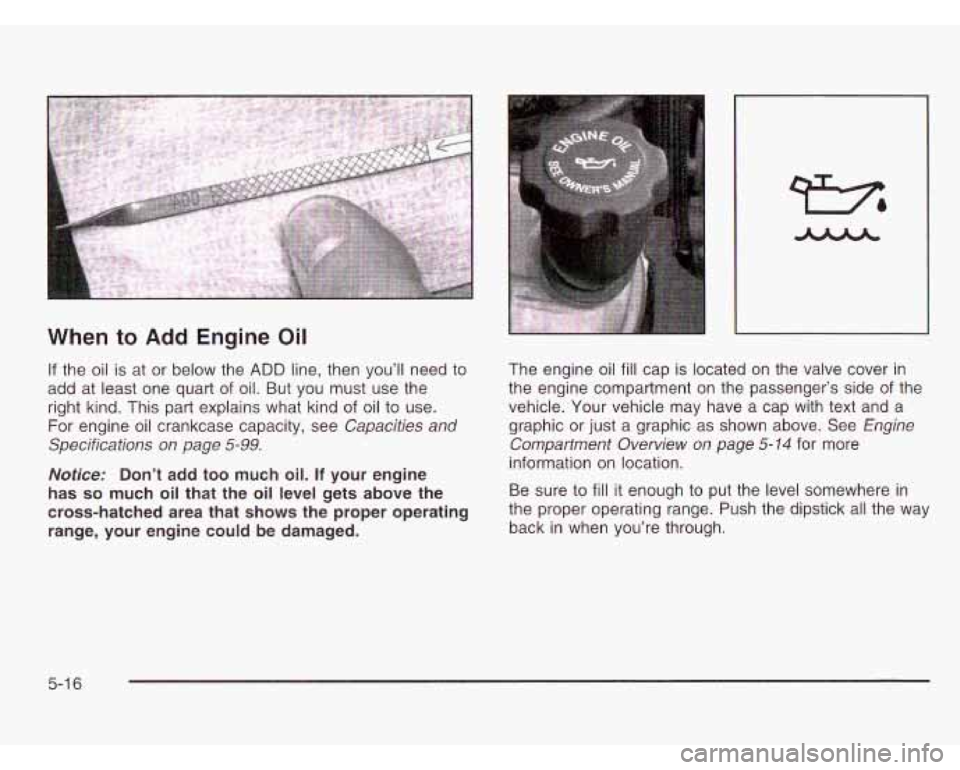
When to Add Engine Oil
If the oil is at or below the ADD line, then you’ll need to
add at least one quart of oil. But you must use the
right kind. This part explains what kind of oil to use.
For engine oil crankcase capacity, see
Capacities and
Specifications on page
5-99.
Notice: Don’t add too much oil. If your engine
has
so much oil that the oil level gets above the
cross-hatched area that shows the proper operating
range, your engine could be damaged.
The engine oil fill cap is located on the valve cover in
the engine compartment on the passenger’s side of the
vehicle. Your vehicle may have a cap with text and a
graphic or just a graphic as shown above. See
Engine
Compartment Overview on page
5-14 for more
information on location.
Be sure to
fill it enough to put the level somewhere in
the proper operating range. Push the dipstick all the way
back in when you’re through.
5-1 6
Page 242 of 386
Automatic Transmission Fluid
When to Check and Change
A good time to check your automatic transmission fluid
level is when the engine oil is changed.
Change both the fluid and filter every
15,000 miles
(25
000 km) if the vehicle is mainly driven under one or
more of these conditions:
In heavy city traffic where the outside temperature
In hilly or mountainous terrain.
When doing frequent trailer towing.
Uses such as found in taxi, police or delivery
If you do not use your vehicle under any of these
conditions, change the fluid and filter every
50,000 miles (83 000 km).
See
Part A: Scheduled Maintenance Services on
page
6-4.
regularly reaches 90°F (32°C) or higher.
service.
How to Check
Because this operation can be a little difficult, you may
choose to have this done at the dealership service
department.
If you do it yourself, be sure to follow all the instructions
here, or you could get a false reading on the dipstick.
Notices Too much or too little fluid can damage
your transmission.
Too much can mean that some
of the fluid could come out and fall on hot engine
part or exhaust system parts, starting a fire.
Too little fluid could cause the transmission to
overheat. Be sure to get an accurate reading if you
check your transmission fluid.
Wait at least 30 minutes before checking the
transmission fluid level
if you have been driving:
When outside temperatures are above 90°F (32°C).
0 At high speed for quite a while.
In heavy traffic
- especially in hot weather.
While pulling a trailer.
To get the right reading, the fluid should be at normal
operating temperature, which is 180°F to 200°F
(82°C to 93°C).
5-25
Page 250 of 386
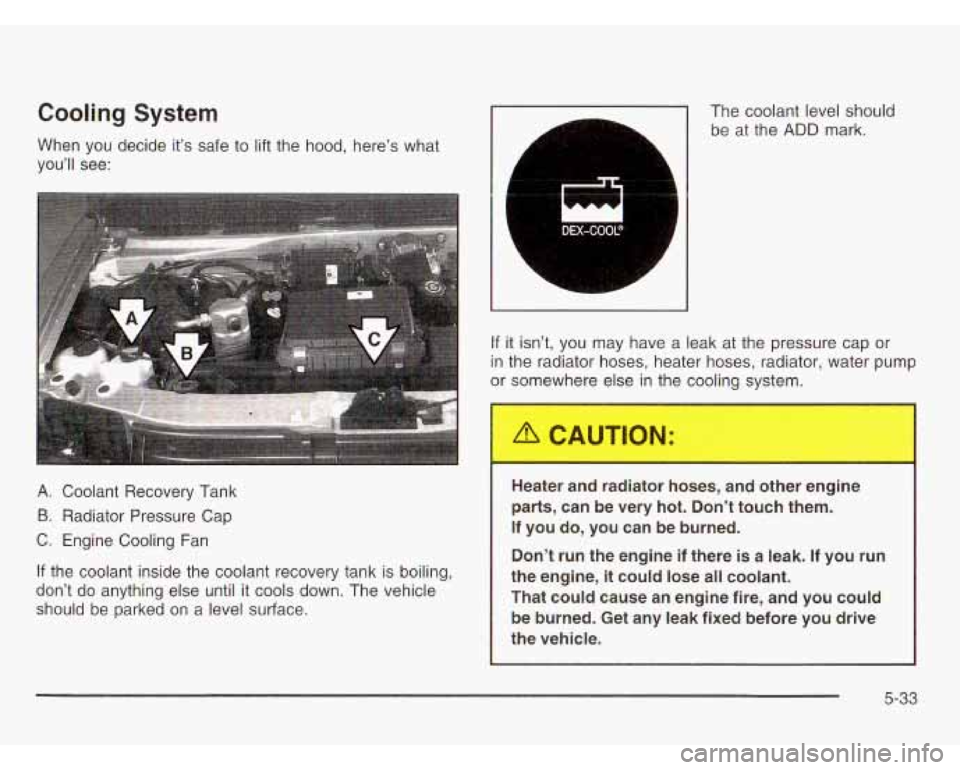
Cooling System
When you decide it’s safe to lift the hood, here’s what
you’ll see: The
coolant level should
be at the
ADD mark.
A. Coolant Recovery Tank
B. Radiator Pressure Cap
C. Engine Cooling Fan
If the coolant inside the coolant recovery tank is boiling,
don’t do anything else until it cools down. The vehicle
should be parked
on a level surface.
A
If it isn’t, you may have a leak at the pressure cap or
in the radiator hoses, heater hoses, radiator, water pump
or somewhere else
in the cooling system.
Heater and radiator hoses, and other engine
parts, can be very hot. Don’t touch them.
If you do, you can be burned.
Don’t run the engine if there
is a leak. If you run
the engine,
it could lose all coolant.
That could cause an engine fire, and you could be burned. Get any leak fixed before you drive
the vehicle.
5-33
Page 251 of 386
If there seems to be no leak, start the engine again. How to Add Coolant to the Coolant
The engine cooling fan speed should increase when idle
speed is doubled by pushing the accelerator pedal
Recovery Tank
down. If it doesn’t, your vehicle needs service. Turn off If you haven’t found a problem yet, but the coolant level
the engine. isn’t at the
ADD mark, add a 50/50 mixture of clean
Nofice: Engine damage from running your engine
without coolant isn’t covered by your warranty.
Notice: When adding coolant, it is important that
you use only
DEX-COOL@ (silicate-free) coolant.
If coolant other than DEX-COOL@’ is added to the
system, premature engine, heater core or radiator
corrosion may result.
In addition, the engine coolant
will require change sooner
- at 30,000 miles
(50 000 km) or 24 months, whichever occurs first.
Damage caused by the use of coolant other than
DEX-COOL@ is not covered by your new vehicle
warranty.
drinkable wafer, and DEX-COOL@ engine coolant at
the coolant recovery tank. See
Engine Coolant on
page 5-28 for more information.
Adding only p.,,n water to your coG...rg
system can be dangerous. Plain water, or
some other
liquid such as alcohol, can boil
before the proper coolant mixture will. Your
vehicle’s coolant warning system
is set for the
proper coolant mixture. With plain water or the
wrong mixture, your engine could get too hot but you wouldn’t get the overheat warning.
Your engine could catch fire and you or others
could be burned. Use a
50/50 mixture of clean,
drinkable water and DEX COOL@ coolant.
5-34
Page 326 of 386
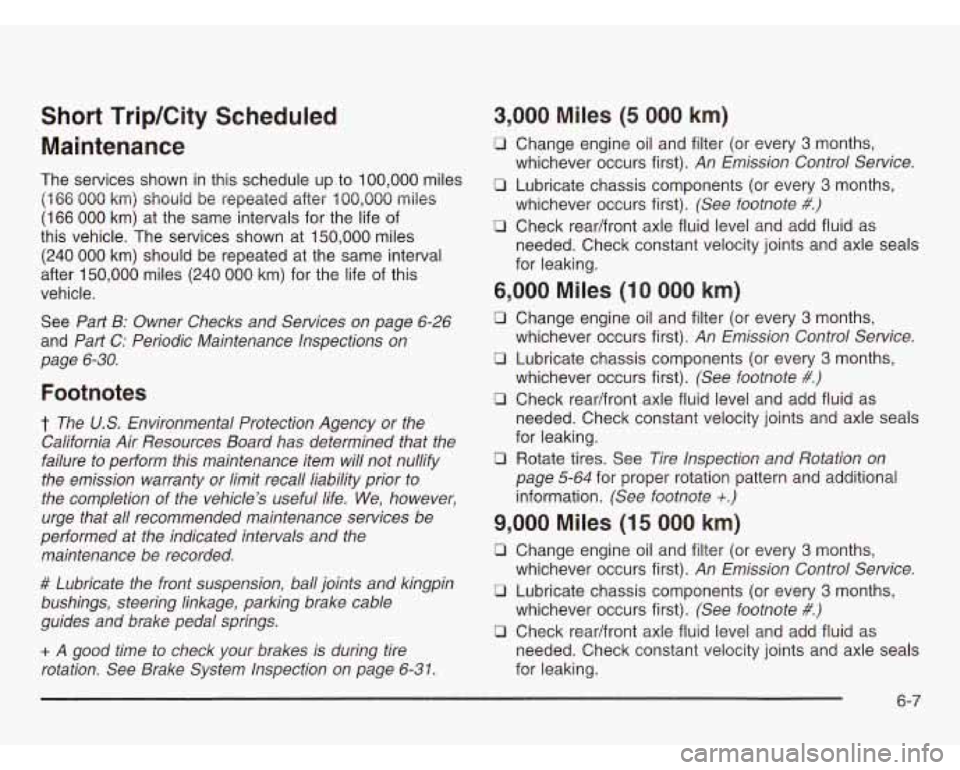
Short Trip/City Scheduled Maintenance
The services shown in this schedule up to 100,000 miles
(166 000 km) should be repeated after IQ0,OOQ miles
(166 000 km) at the same intervals for the life of
this vehicle. The services shown at
150,000 miles
(240
000 km) should be repeated at the same interval
after
150,000 miles (240 000 km) for the life of this
vehicle.
See
Part B: Owner Checks and Services on page 6-26
and Part C: Periodic Maintenance Inspections on
page 6-30.
Footnotes
t The U.S. Environmental Protection Agency or the
California Air Resources Board has determined that the
failure to perform this maintenance item will not nullify
the emission warranty or limit recall liability prior to
the completion of the vehicle’s useful life. We, however,
urge that all recommended maintenance services be
performed at the indicated intervals and the
maintenance be recorded.
# Lubricate the front suspension, ball joints and kingpin
bushings, steering linkage, parking brake cable
guides and brake pedal springs.
+ A good time to check your brakes is during tire
rotation. See Brake System Inspection
on page 6-3 1.
3,000 Miles (5 000 km)
0 Change engine oil and filter (or every 3 months,
0 Lubricate chassis components (or every 3 months,
0 Check readfront axle fluid level and add fluid as
whichever
occurs first).
An Emission Control Service.
whichever occurs first). (See footnote #.)
needed. Check constant velocity joints and axle seals
for leaking.
6,000 Miles (IO 000 km)
0
0
0
0
Change engine oil and filter (or every 3 months,
whichever occurs first).
An Emission Control Service.
Lubricate chassis components (or every 3 months,
whichever occurs first).
(See footnote #.)
Check readfront axle fluid level and add fluid as
needed. Check constant velocity joints and axle seals
for leaking.
Rotate tires. See
Tire Inspection and Rotation on
page 5-64
for proper rotation pattern and additional
information.
(See footnote +.)
9,000 Miles (15 000 km)
0 Change engine oil and filter (or every 3 months,
0 Lubricate chassis components (or every 3 months,
0 Check readfront axle fluid level and add fluid as
whichever
occurs first).
An Emission Control Service.
whichever occurs first). (See footnote #.)
needed. Check constant velocity joints and axle seals
for leaking.
6-7
Page 327 of 386
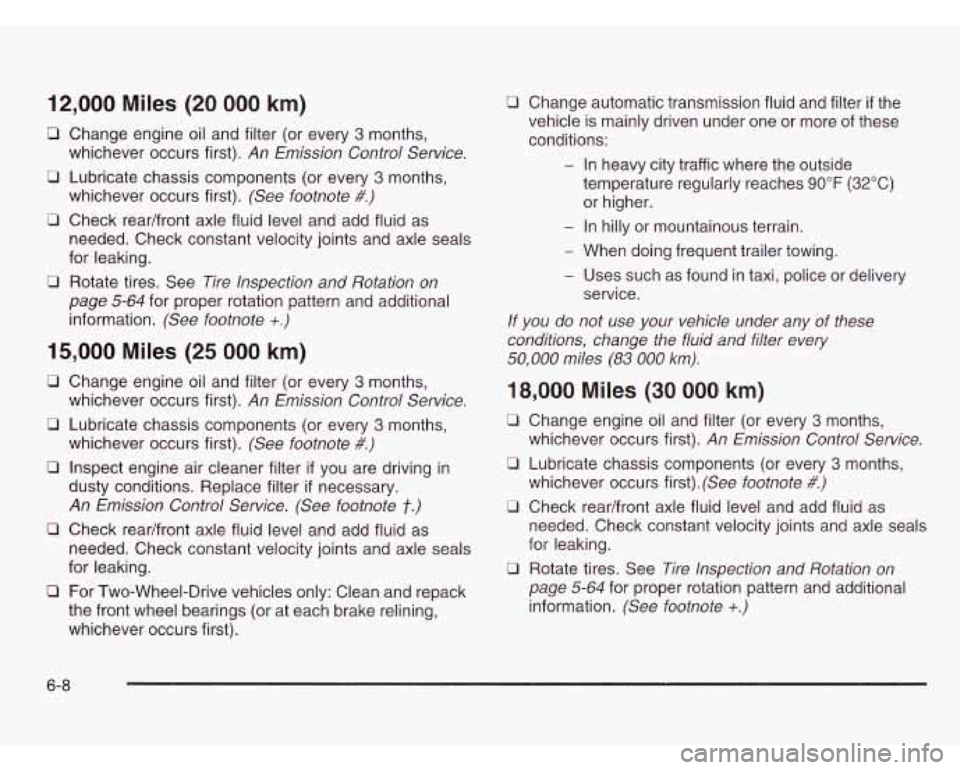
12,000 Miles (20 000 km)
0 Change engine oil and filter (or every 3 months,
0 Lubricate chassis components (or every 3 months,
0 Check readfront axle fluid level and add fluid as
whichever
occurs first).
An Emission Control Service.
whichever occurs first). (See footnote #.)
needed. Check constant velocity joints and axle seals
for leaking.
page 5-64 for proper rotation pattern and additional
information.
(See footnote +.)
0 Rotate tires. See Tire lnspection and Rotation on
15,000 Miles (25 000 km)
0 Change engine oil and filter (or every 3 months,
whichever occurs first).
An Emission Control Service.
0 Lubricate chassis components (or every 3 months,
whichever occurs first).
(See footnote #.)
CI Inspect engine air cleaner filter if you are driving in
dusty conditions. Replace filter
if necessary.
An Emission Control Service. (See footnote t.)
0 Check readfront axle fluid level and add fluid as
needed. Check constant velocity joints and axle seals
for leaking.
0 For Two-Wheel-Drive vehicles only: Clean and repack
the front wheel bearings (or at each brake relining,
whichever occurs first).
0 Change automatic transmission fluid and filter if the
vehicle
is mainly driven under one or more of these
conditions:
- In heavy city traffic where the outside
temperature regularly reaches
90°F (32°C)
or higher.
- In hilly or mountainous terrain.
- When doing frequent trailer towing.
- Uses such as found in taxi, police or delivery
service.
If you do not use your vehicle under any of these
conditions, change the fluid and filter every
50,000 miles (83 000 km).
18,000 Miles (30 000 km)
0 Change engine oil and filter (or every 3 months,
whichever occurs first).
An Emission Control Service.
0 Lubricate chassis components (or every 3 months,
0 Check readfront axle fluid level and add fluid as
whichever
occurs first).(See
footnote #.)
needed. Check constant velocity joints and axle seals
for leaking.
0 Rotate tires. See Tire lnspection and Rotation on
page
5-64 for proper rotation pattern and additional
information.
(See footnote +.)
6-8