oil pressure CHEVROLET ASTRO 2003 Owners Manual
[x] Cancel search | Manufacturer: CHEVROLET, Model Year: 2003, Model line: ASTRO, Model: CHEVROLET ASTRO 2003Pages: 386, PDF Size: 17.31 MB
Page 6 of 386
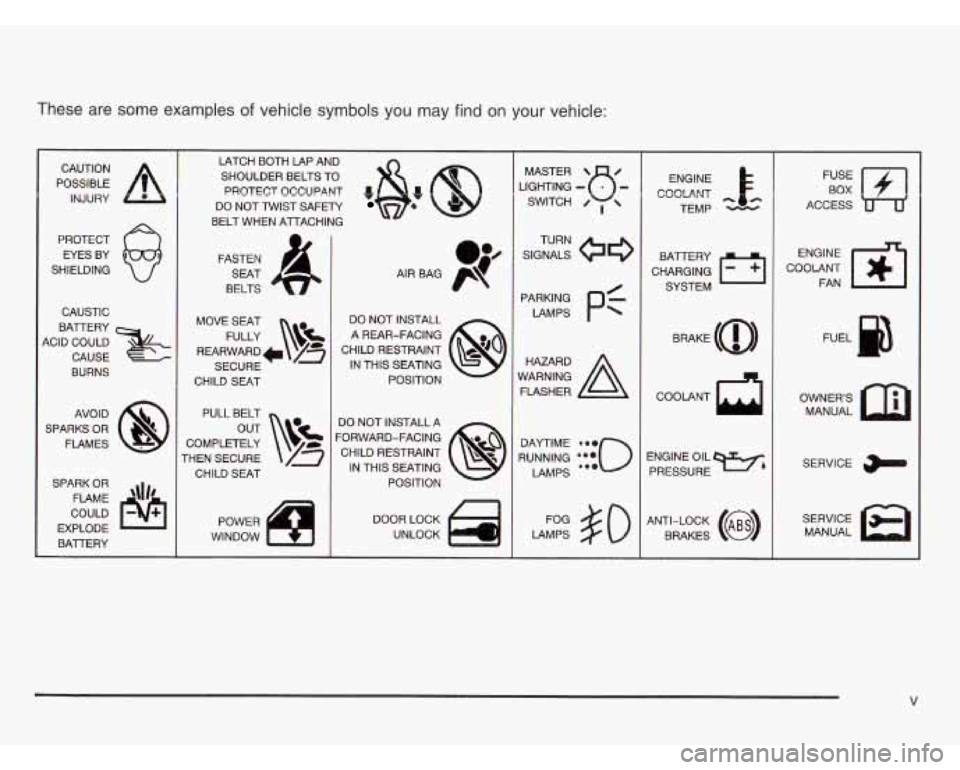
These are some examples of vehicle symbols you may find on your vehicle:
POSSIBLE A
CAUTION INJURY
PROTECT EYES BY
SHIELDING
CAUSTIC
BATTERY
KID COULD
CAUSE
BURNS
AVOID
SPARKS OR FLAMES
SPARK OR COULD
EXPLODE FLAME
\\I/'
BAlTERY I
LATCH BOTH LAP AND
SHOULDER BELTS TO
PROTECT OCCUPANT
*&: @
DO NOT TWIST SAFETY
BELT WHEN AlTACHING
FASTEN SEAT
BELTS
MOVE SEAT FULLY
\!$!
REARWARD /a
SECURE
CHILD
SEAT
PULL BELT
COMPLETELY
rHEN SECURE CHILD SEAT
POWER
WINDOW DO NOT INSTALL
A REAR-FACING
CHILD RESTRAINT IN THIS SEATING POSITION
DO NOT INSTALL A
'ORWARD-FACING CHILD RESTRAINT IN THIS SEATING POSITION
DOOR LOCK UNLOCK LIGHTING
- MASTER SWITCH u- 0 ,
SIGNALS
TURN
LAMPS
Pf
RUNNING ***o
DAYTIME 0.0
LAMPS ea.
LAMPS $0
ENGINE
COOLANT
cc
TEMP
CHARGING
I-1
BATTERY SYSTEM
BRAKE
(a)
ENGINE OIL PRESSURE
Wb
ANTI-LOCK (@)
BRAKES COOLANT
FAN
OWNERS MANUAL
SERVICE
MANUAL
V
Page 126 of 386
Section 3 Instrument Panel
Instrument Panel Overview ............................... 3.2
Hazard Warning Flashers
................................ 3-4
Other Warning Devices
................................... 3-5
Horn
............................................................. 3-5
Tilt Wheel
..................................................... 3-5
Turn SignaVMultifunction Lever
......................... 3.6
Exterior Lamps
.......................................... 3.12
Interior Lamps
................................ ....... 3.15
Accessory Power Outlets
............................... 3.16
Ashtrays and Cigarette Lighter
........................ 3.17
Climate Controls ............................................ 3.18
Climate Control System
................................. 3.18
Rear Heating System
................................... -3-1 9
Rear Air Conditioning System ......................... 3.20
Rear Climate Control System
......................... 3.21
Warning Lights, Gages and Indicators ............. 3.23
Instrument Panel Cluster
................................ 3.24
Speedometer and Odometer
........................... 3.25
Safety Belt Reminder Light
............................. 3.26
Air Bag Readiness Light
................................ 3-26
Charging System Light
.................................. 3.27
Voltmeter Gage
........................................... -3-28
Brake System Warning Light
.......................... 3.28 Anti-Lock
Brake System Warning Light
............. 3.29
Engine Coolant Temperature Gage
= = =. ~ = = ~ ~ ~ = i. 3-39
Malfunction Indicator Lamp
............................. 3.30
Oil Pressure Gage
........................................ 3.34
Security Light
.............................................. -3-35
Service All-Wheel Drive Light
......................... 3.35
Tow/Haul Mode Light
......... ................... 3.36
Fuel Gage
................................................... 3.36
Low Fuel Warning Light
................................. 3.37
Audio System@) ............................................. 3.38
Setting the Time for Radios with
the Set Button
.......................................... 3-38
Setting the Time for Radios with
HR and MN Buttons .................................. 3-38
AM-FM Radio
............................................... 3.39
Radio with CD
.............................................. 3-41
Theft-Deterrent Feature
........... ................ 3.47
Understanding Radio Reception
................... 3.50
Care of Your CDs
......................................... 3-50
Care of Your CD Player
................................ 3-50
Fixed Mast Antenna
...................................... 3.50
Check Gages Warning
Light
........................... 3-36
Rear Seat Audio (RSA)
. . .... ............ 3.46
3-
1
Page 159 of 386
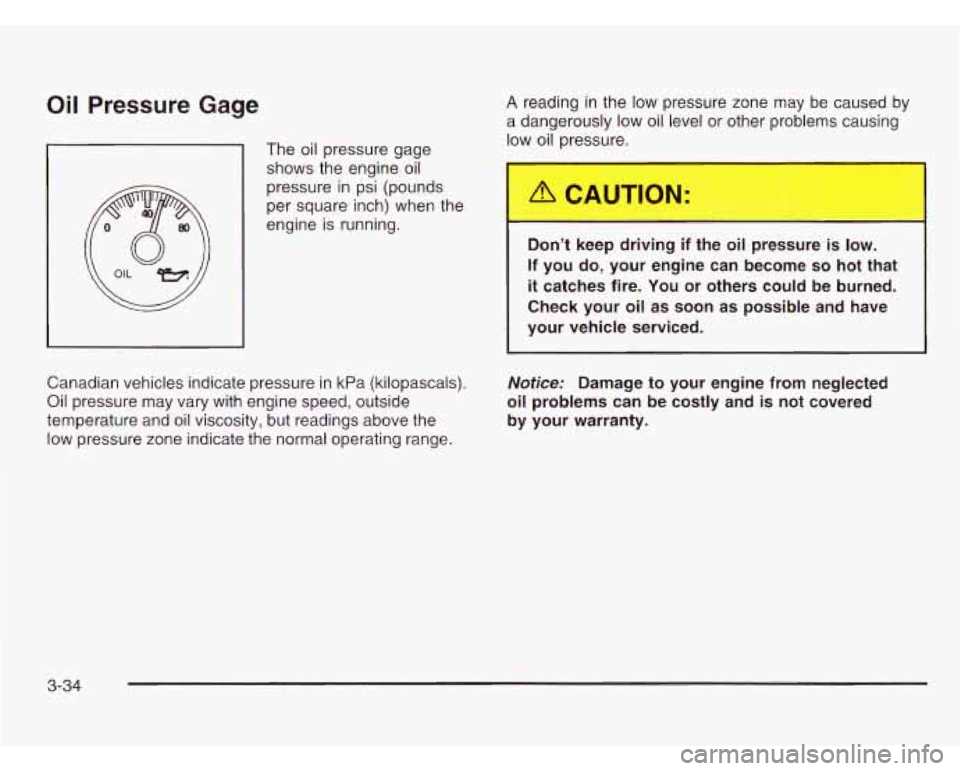
Oil Pressure Gage
The oil pressure gage
shows the engine oil
pressure
in psi (pounds
per square inch) when the
engine is running.
Canadian vehicles indicate pressure in kPa (kilopascals).
Oil pressure may vary with engine speed, outside
temperature and oil viscosity, but readings above the
low pressure zone indicate the normal operating range.
A reading in the low pressure zone may be caused by
a dangerously low oil level or other problems causing
low oil pressure.
Don’t keep driving if
the oil pressure is low.
If you do, your engine can become so hot that
it catches fire. You or others could be burned.
Check your oil as soon as possible and have
your vehicle serviced.
Notice: Damage to your engine from neglected
oil problems can be costly and
is not covered
by your warranty.
3-34
Page 161 of 386
Tow/HauI Mode Liaht
TOW / HAUL
J
This light should come on
when the tow/haul mode
has been selected.
For more information, see “Tow/Haul Mode” in
Towing a
Trailer on page 4-31.
Check Gages Warning Light
CHECK
GAGES
The CHECK GAGES light
will come on briefly when
you are starting the engine.
Fuel Gage
I
UNLEADED
United States Canada
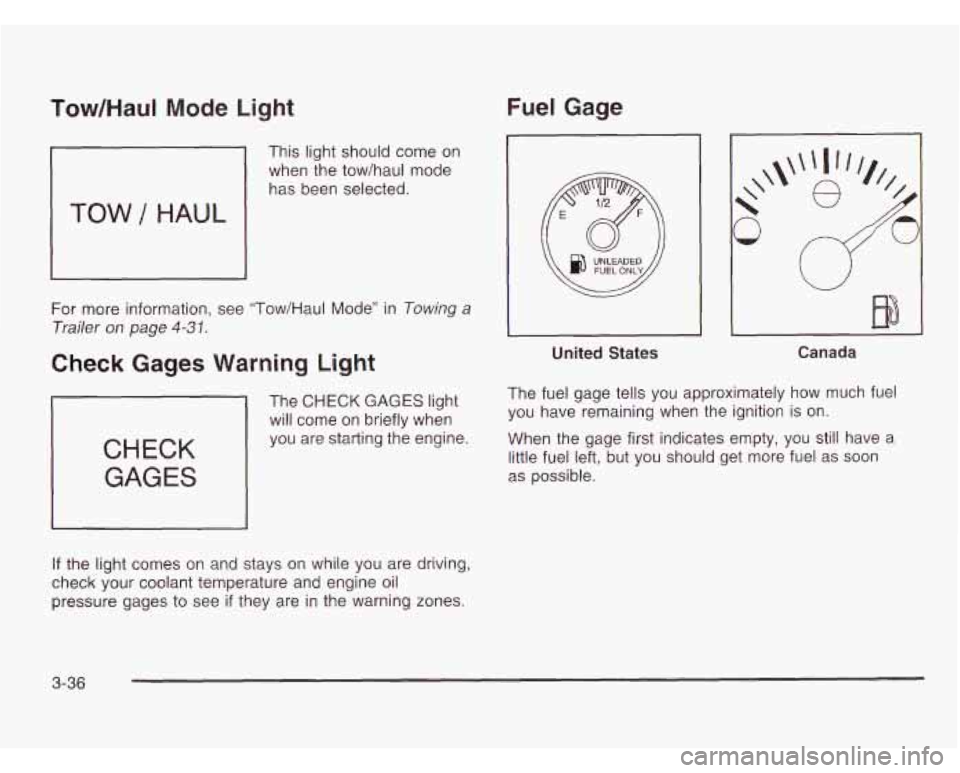
The
fuel gage tells you approximately how much fuel
you have remaining when the ignition is on.
When the gage first indicates empty, you still have a
little fuel left, but you should get more fuel as soon
as possible.
If the light comes on and stays on while you are driving,
check your coolant temperature and engine oil
pressure gages to see
if they are in the warning zones.
3-36
Page 196 of 386
The exit ramp can be curved, sometimes quite sharply.
The exit speed is usually posted.
Reduce your speed according to your speedometer, not
to your sense of motion. After driving for any distance
at higher speeds, you
may tend to think you are
going slower than you actually are.
Before Leaving on a Long Trip
Make sure you’re ready. Try to be well rested. If you
must start when you’re not fresh
- such as after a day’s
work
- don’t plan to make too many miles that first
part of the journey. Wear comfortable clothing and shoes
you can easily drive in.
Is your vehicle ready for a long trip? If you keep it
serviced and maintained, it’s ready to go.
If it needs
service, have it done before starting out. Of course,
you’ll find experienced and able service experts
in dealerships all across North America. They’ll be
ready and willing to help
if you need it. Here
are some things you can check before a trip:
e
e
e
Windshield Washer Fluid: Is the reservior full?
Are
all windows clean inside and outside?
Wiper Blades: Are they in good shape?
Fuel, Engine Oil, Other Fluids: Have you checked
all levels?
Lamps: Are they all working? Are the lenses clean?
Tires: They are vitally important to a safe,
trouble-free trip.
Is the tread good enough for
long-distance driving? Are the tires all inflated
to the recommended pressure?
Weather Forecasts: What’s the weather outlook
along your route? Should you delay your trip a
short time to avoid a major storm system?
Maps: Do you have up-to-date maps?
4-2 1
Page 218 of 386
Section 5 Service and Appearance Care
Service .......................................................... -5-3
Doing Your Own Service Work
......................... 5-3
Adding Equipment to the Outside of
Your Vehicle
.............................................. 5-4
Fuel ................................................................ 5.5
Gasoline Octane ........................................... -5-5
Gasoline Specifications .................................... 5.5
California Fuel ............................................. -56
Additives
....................................................... 5.6
Fuels in Foreign Countries
............................... 5.7
Filling Your Tank
............................................ 5-8
Filling a Portable Fuel Container
..................... 5-10
Checking Things Under the Hood .................... 5-1 1
Hood Release .............................................. 5.11
Engine Compartment Overview
...................... 5.14
Engine Oil
................................................... 5.15
Engine Cover ................. .... ........ 5.20
Engine Air Cleaner/Filter
................. ........ 5.24
Automatic Transmission Fluid
...................... 5.25
Engine Coolant ............................................. 5.28
Radiator Pressure Cap
.................................. 5.30
Engine Overheating
....................................... 5.31
Cooling System
............................................ 5.33
Engine Fan Noise
......................................... 5.39
Power Steering Fluid
..................................... 5.40
Windshield Washer Fluid
................................ 5.41 Brakes
........................................................ 5.42
Battery
........................................................ 5-46
Jump Starting
............................................... 5-47
All-Wheel Drive .............................................. 5-52
Rear Axle ....................................................... 5-53
Front Axle ...................................................... 5-54
Bulb Replacement .......................................... 5-55
Halogen Bulbs .............................. ..... 5-55
Headlamps .................................. ..... 5-55
Front Turn Signal Lamps ............................... 5-59
Replacement Bulbs
....................................... 5-61
Windshield Wiper Blade Replacement .............. 5-62
Tires .............................................................. 5.63
Inflation
- Tire Pressure ................................ 5-64
Tire Inspection and Rotation
........................... 5-64
When It
Is Time for New Tires ....................... 5-66
Buying New Tires
......................................... 5-66
Uniform Tire Quality Grading
.......................... 5-67
Wheel Alignment and Tire Balance
.................. 5-69
Wheel Replacement
...................................... 5-69
Tire Chains
.................................................. 5-70
If a Tire Goes Flat ........................................ 5.70
Changing a Flat Tire ..................................... 5.71
Compact Spare Tire ...................................... 5-82
Taillamps
.................................................... 5-60
5- 1
Page 250 of 386
Cooling System
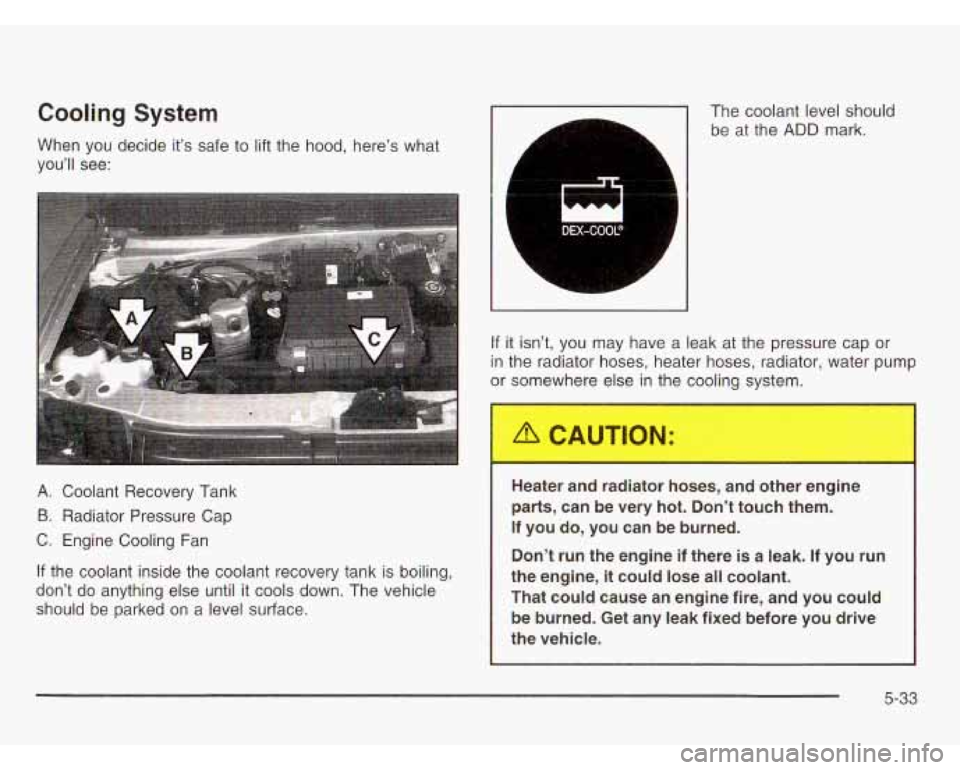
When you decide it’s safe to lift the hood, here’s what
you’ll see: The
coolant level should
be at the
ADD mark.
A. Coolant Recovery Tank
B. Radiator Pressure Cap
C. Engine Cooling Fan
If the coolant inside the coolant recovery tank is boiling,
don’t do anything else until it cools down. The vehicle
should be parked
on a level surface.
A
If it isn’t, you may have a leak at the pressure cap or
in the radiator hoses, heater hoses, radiator, water pump
or somewhere else
in the cooling system.
Heater and radiator hoses, and other engine
parts, can be very hot. Don’t touch them.
If you do, you can be burned.
Don’t run the engine if there
is a leak. If you run
the engine,
it could lose all coolant.
That could cause an engine fire, and you could be burned. Get any leak fixed before you drive
the vehicle.
5-33
Page 314 of 386
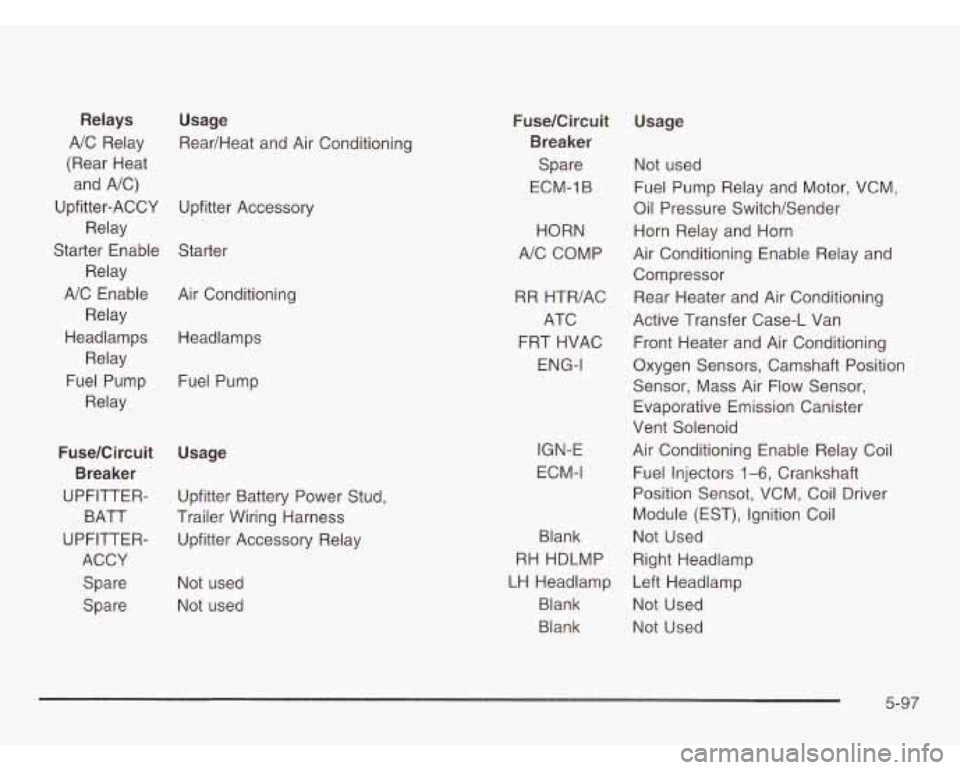
Usage
Rear/Heat and Air Conditioning
Relays
AIC Relay
(Rear Heat
and AIC)
Relay
Relay
A/C Enable
Relay
Upfitter-ACCY
Upfitter Accessory
Starter Enable Starter
Headlamps Relay
Fuel Pump
Relay Air
Conditioning
Headlamps
Fuel Pump
FuselCircuit
Usage
UPFITTER- Upfitter Battery Power Stud,
BATT Trailer Wiring Harness
UPFITTER- Upfitter Accessory Relay
ACCY
Spare Not used
Spare Not used
Breaker FuselCircuit
Breaker
Spare
ECM-1 B
HORN
AIC COMP
RR HTR/AC ATC
FRT HVAC
ENG-I
IGN-E
ECM-I
Blank
RH HDLMP
LH Headlamp
Blank
Blank
Usage
Not used
Fuel Pump Relay and Motor, VCM,
Oil Pressure Switch/Sender
Horn Relay and Horn
Air Conditioning Enable Relay and
Compressor
Rear Heater and Air Conditioning
Active Transfer Case-L Van
Front Heater and Air Conditioning
Oxygen Sensors, Camshaft Position
Sensor, Mass Air Flow Sensor,
Evaporative Emission Canister
Vent Solenoid
Air Conditioning Enable Relay Coil
Fuel Injectors
1-6, Crankshaft
Position Sensot, VCM, Coil Driver
Module (EST), Ignition Coil
Not Used
Right Headlamp
Left Headlamp
Not Used
Not Used
5-97
Page 344 of 386
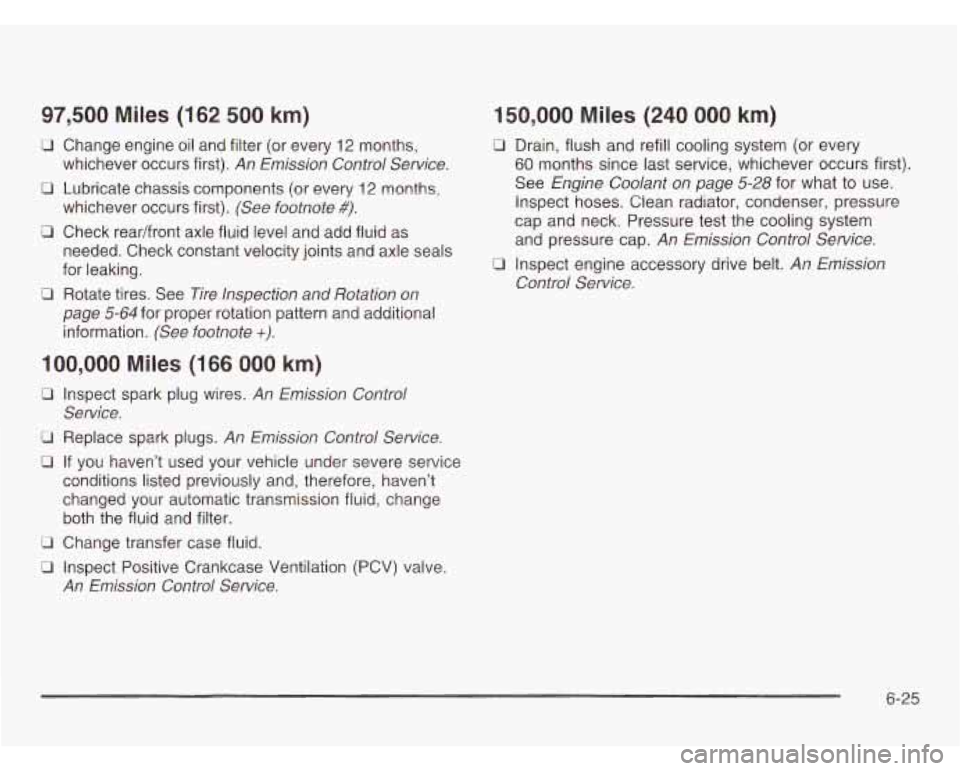
97,500 Miles (162 500 km)
U Change engine oil and filter (or every 12 months,
0 Lubricate chassis components (or every 12 months,
0 Check readfront axle fluid level and add fluid as
whichever occurs first).
An Emission Control Service.
whichever
occurs first). (See footnote #).
needed. Check constant velocity joints and axle seals
for leaking.
page 5-64 for proper rotation pattern and additional
information.
(See footnote +).
0 Rotate tires. See Tire Inspection and Rotation on
100,000 Miles (166 000 km)
0 Inspect spark plug wires. An Emission Control
U Replace spark plugs. An Emission Control Service.
Service.
0 If you haven’t used your
vehicle under severe service
conditions listed previously and, therefore, haven’t
changed your automatic transmission fluid, change
both the fluid and filter.
150,000 Miles (240 000 km)
U Drain, flush and refill cooling system (or every
60 months since last service, whichever occurs first).
See
Engine Coolant on page 5-28 for what to use.
inspect hoses. Clean radiator, condenser, pressure
cap and neck. Pressure test the cooling system
and pressure cap.
An Emission Control Service.
U Inspect engine accessory drive belt. An Emission
Control Service.
0 Change transfer case fluid.
0 Inspect Positive Crankcase Ventilation (PCV) valve.
An Emission Control Service.
6-25
Page 345 of 386
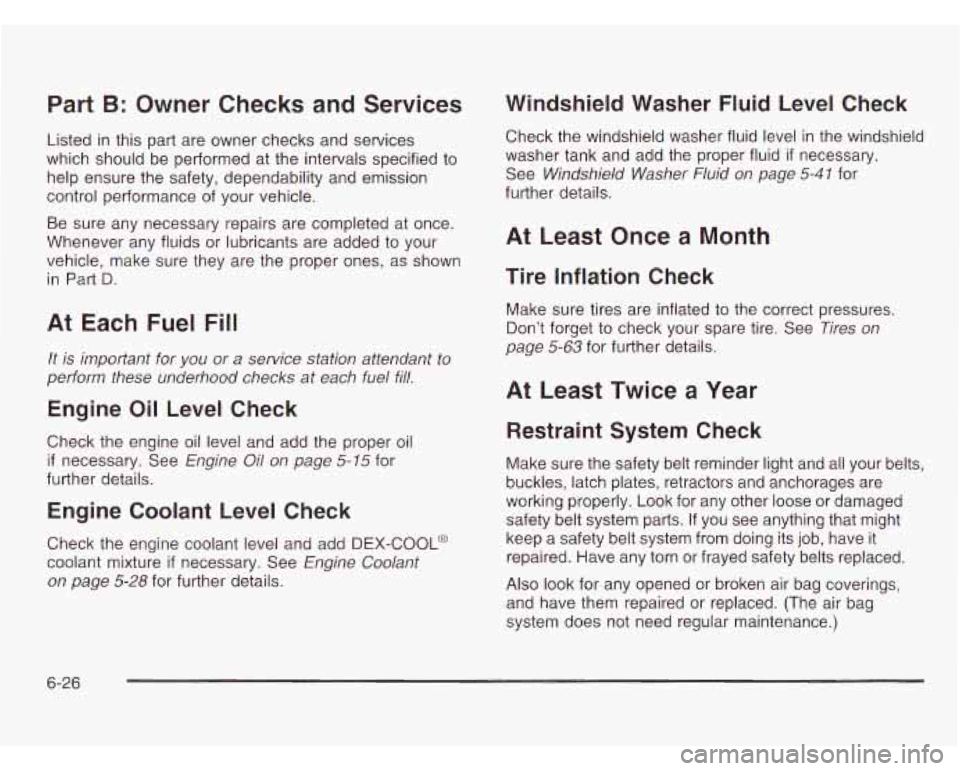
Part B: Owner Checks and Services
Listed in this part are owner checks and services
which should be performed at the intervals specified to
help ensure the safety, dependability and emission
control performance of your vehicle.
Be sure any necessary repairs are completed at once.
Whenever any fluids or lubricants are added to your
vehicle, make sure they are the proper ones, as shown
in Part D.
At Each Fuel Fill
It is important for you or a service station attendant to
perform these underhood checks at each fuel fill.
Engine Oil Level Check
Check the engine oil level and add the proper oil
if necessary. See Engine Oil on page 5-15 for
further details.
Engine Coolant Level Check
Check the engine coolant level and add DEX-COOL@
coolant mixture
if necessary. See Engine Coolant
on page
5-28 for further details.
Windshield Washer Fluid Level Check
Check the windshield washer fluid level in the windshield
washer tank and add the proper fluid
if necessary.
See
Windshield Washer Fluid on page 5-41 for
further details.
At Least Once a Month
Tire Inflation Check
Make sure tires are inflated to the correct pressures.
Don’t forget to check your spare tire. See
Tires on
page
5-63 for further details.
At Least Twice a Year
Restraint System Check
Make sure the safety belt reminder light and all your belts,
buckles, latch plates, retractors and anchorages are
working properly. Look for any other loose or damaged
safety belt system parts. If you see anything that might
keep a safety belt system from doing its job, have it
repaired. Have any torn or frayed safety belts replaced.
Also look for any opened or broken air bag coverings,
and have them repaired or replaced. (The air bag
system does not need regular maintenance.)
6-26