door lock CHEVROLET ASTRO 2004 User Guide
[x] Cancel search | Manufacturer: CHEVROLET, Model Year: 2004, Model line: ASTRO, Model: CHEVROLET ASTRO 2004Pages: 382, PDF Size: 2.73 MB
Page 91 of 382
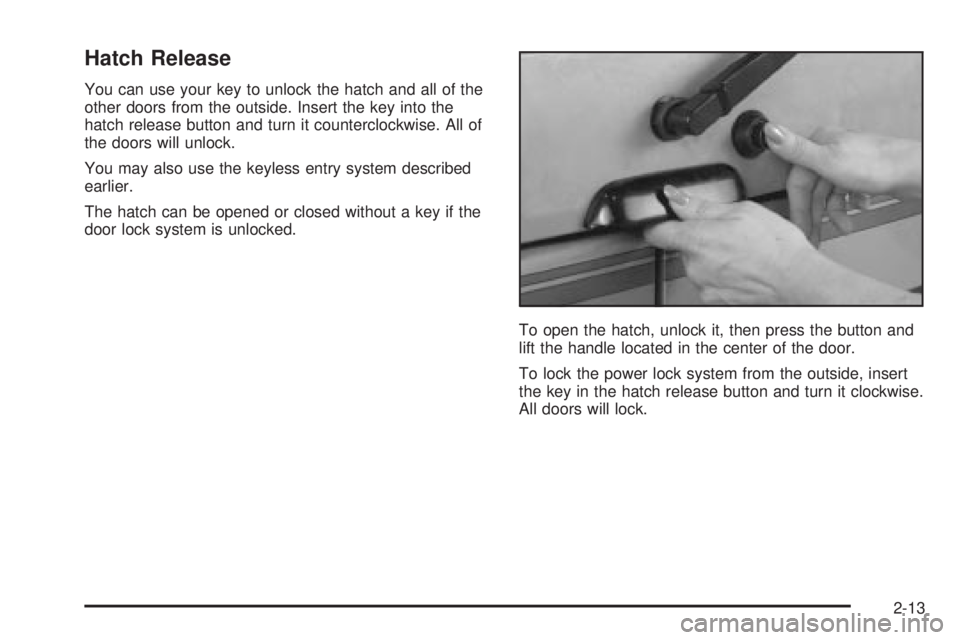
Hatch Release
You can use your key to unlock the hatch and all of the
other doors from the outside. Insert the key into the
hatch release button and turn it counterclockwise. All of
the doors will unlock.
You may also use the keyless entry system described
earlier.
The hatch can be opened or closed without a key if the
door lock system is unlocked.
To open the hatch, unlock it, then press the button and
lift the handle located in the center of the door.
To lock the power lock system from the outside, insert
the key in the hatch release button and turn it clockwise.
All doors will lock.
2-13
Page 93 of 382
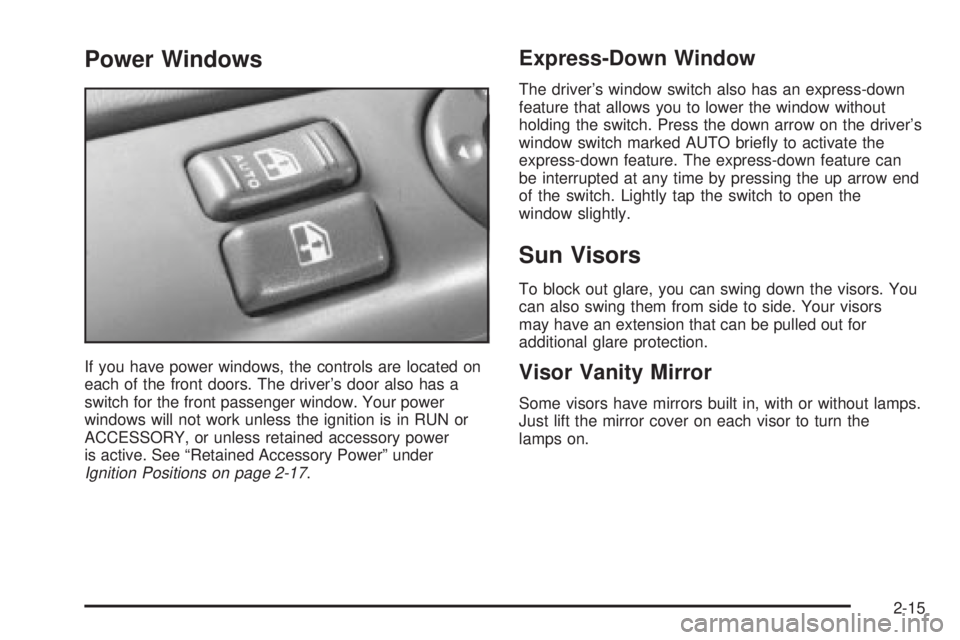
Power Windows
If you have power windows, the controls are located on
each of the front doors. The driver's door also has a
switch for the front passenger window. Your power
windows will not work unless the ignition is in RUN or
ACCESSORY, or unless retained accessory power
is active. See ªRetained Accessory Powerº under
Ignition Positions on page 2-17.
Express-Down Window
The driver's window switch also has an express-down
feature that allows you to lower the window without
holding the switch. Press the down arrow on the driver's
window switch marked AUTO brie¯y to activate the
express-down feature. The express-down feature can
be interrupted at any time by pressing the up arrow end
of the switch. Lightly tap the switch to open the
window slightly.
Sun Visors
To block out glare, you can swing down the visors. You
can also swing them from side to side. Your visors
may have an extension that can be pulled out for
additional glare protection.
Visor Vanity Mirror
Some visors have mirrors built in, with or without lamps.
Just lift the mirror cover on each visor to turn the
lamps on.
2-15
Page 96 of 382
Notice:Lengthy operation of features such as the
radio in the accessory ignition position may
drain the battery and prevent your vehicle from
starting. Do not operate your vehicle in the
accessory ignition position for a long period
of time.
B (LOCK):This position locks your ignition and
transmission. It's a theft-deterrent feature. You will only
be able to remove your key when the ignition is
turned to LOCK.
Notice:Using a tool to force the key from the
ignition switch could cause damage or break the
key. Use the correct key and turn the key only with
your hand. Make sure the key is all the way in. If
none of this works, then your vehicle needs service.C (OFF):This position lets you turn off the engine. Use
OFF if you must have your vehicle in motion while
the engine is off (for example, if your vehicle is being
towed).
D (RUN):This is the position for driving.
E (START):This position starts your engine.
Retained Accessory Power (RAP)
Your vehicle is equipped with a Retained Accessory
Power (RAP) feature which will allow certain features on
your vehicle to continue to work up to 20 minutes
after the ignition key is turned to OFF.
Your radio, power windows and overhead console will
work when the ignition key is in RUN or ACCESSORY.
Once the key is turned from RUN to OFF, these
features will continue to work for up to 20 minutes or
until a door is opened.
2-18
Page 109 of 382
Outside Convex Mirror
Your passenger's side mirror is convex. A convex
mirror's surface is curved so you can see more from the
driver's seat.
{CAUTION:
A convex mirror can make things (like other
vehicles) look farther away than they really are.
If you cut too sharply into the right lane, you
could hit a vehicle on your right. Check your
inside mirror or glance over your shoulder
before changing lanes.
HomeLinkžTransmitter
HomeLink, a combined universal transmitter and
receiver, provides a way to replace up to three
hand-held transmitters used to activate devices such as
gate operators, garage door openers, entry door
locks, security systems and home lighting. Additional
HomeLink information can be found on the internet
at www.homelink.com or by calling 1-800-355-3515.
If your vehicle is equipped with the Homelink
ž
transmitter, it complies with Part 15 of the FCC Rules.Operation is subject to the following two conditions:
(1) this device may not cause harmful interference, and
(2) this device must accept any interference received,
including interference that may cause undesired
operation.
This device complies with RSS-210 of Industry Canada.
Operation is subject to the following two conditions: (1)
this device may not cause interference, and (2) this
device must accept any interference, including
interference that may cause undesired operation of the
device.
Changes and modi®cations to this system by other than
an authorized service facility could void authorization
to use this equipment.
Programming the HomeLinkž
Transmitter
Do not use the HomeLinkžTransmitter with any garage
door opener that does not have the ªstop and reverseº
feature. This includes any garage door opener model
manufactured before April 1, 1982. If you have a newer
garage door opener with rolling codes, please be
sure to follow steps 6 through 8 to complete the
programming of your HomeLink
žTransmitter.
Read the instructions completely before attempting to
program the HomeLink
žTransmitter. Because of the
steps involved, it may be helpful to have another person
available to assist you in programming the transmitter.
2-31
Page 290 of 382
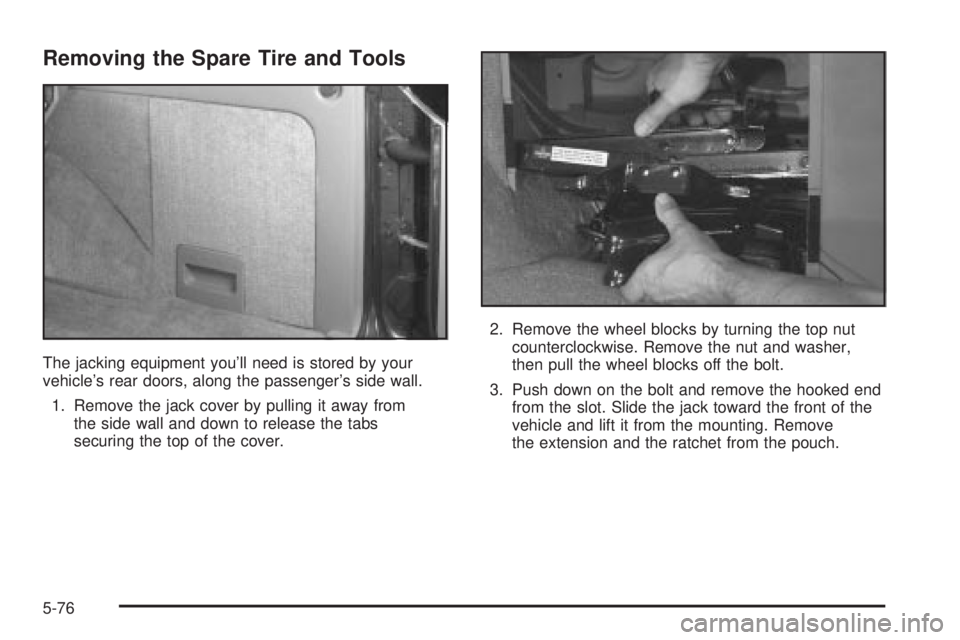
Removing the Spare Tire and Tools
The jacking equipment you'll need is stored by your
vehicle's rear doors, along the passenger's side wall.
1. Remove the jack cover by pulling it away from
the side wall and down to release the tabs
securing the top of the cover.2. Remove the wheel blocks by turning the top nut
counterclockwise. Remove the nut and washer,
then pull the wheel blocks off the bolt.
3. Push down on the bolt and remove the hooked end
from the slot. Slide the jack toward the front of the
vehicle and lift it from the mounting. Remove
the extension and the ratchet from the pouch.
5-76
Page 292 of 382
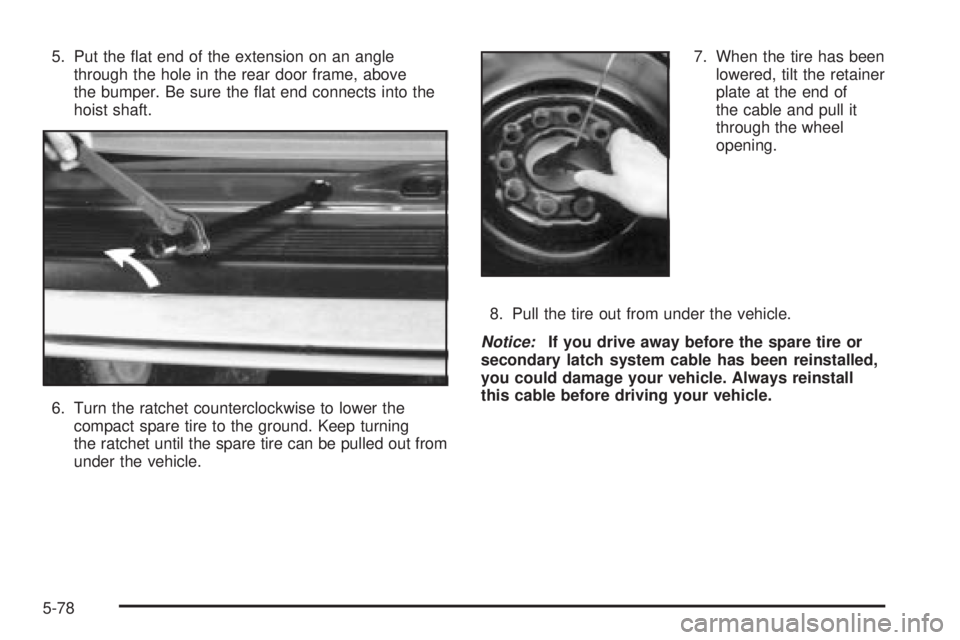
5. Put the ¯at end of the extension on an angle
through the hole in the rear door frame, above
the bumper. Be sure the ¯at end connects into the
hoist shaft.
6. Turn the ratchet counterclockwise to lower the
compact spare tire to the ground. Keep turning
the ratchet until the spare tire can be pulled out from
under the vehicle.7. When the tire has been
lowered, tilt the retainer
plate at the end of
the cable and pull it
through the wheel
opening.
8. Pull the tire out from under the vehicle.
Notice:If you drive away before the spare tire or
secondary latch system cable has been reinstalled,
you could damage your vehicle. Always reinstall
this cable before driving your vehicle.
5-78
Page 312 of 382

Fuse/Circuit
Breaker Usage
3 Courtesy Lamps, Glove Box Lamp,
Dome Reading Lamps, Vanity Mirror
Lamps, Courtesy Lamps
4 Daytime Running Lamps Relay,
Instrument Panel Cluster
5 Rear Defogger
6 Cruise Module, Truck Body Control
Module, Instrument Panel Cluster,
Cruise Control Switch,
Electrochromic Mirror
7 Power Outlets, Subwoofer Ampli®er
8 Crank Circuit Fuse, Park/Neutral
Switch, Starter Enabler Relay
9 License Plate Lamp, Tailamps,
Parking Lamps, Ashtray Lamp,
Panel Lights, Trailer Taillamps, Front
and Rear Sidemarker Lamps, Door
Switch Illumination, Headlamp
Switch Illumination, Rear Seat Audio
Illumination, Truck Body Control
Module
10 Air Bag System
11 Not UsedFuse/Circuit
Breaker Usage
12 Blower Motor, Rear Air Conditioning
Relay Coil, Front Cont. Temp. Door
Motor, HI Blower Relay, Defogger
Timer Coil
13 Cigarette Lighter, Door Lock
Switches, Dutch Door Release
Module
14 Cluster Illumination, Climate
Controls, Chime Module, Radio
Illumination, Rear Heat Switch
Illumination, Rear Wiper/Washer
Switch Illumination, Rear Liftgate
Switch Illumination, Remote
Cassette Illumination, Overhead
Console, Truck Body Control
Illumination
15 Truck Body Module, Headlamp
Relay
16 Front Turn Signals, Rear Turn
Signals, Trailer Turn Signals,
Back-Up Lamps, Brake
Transmission Shift Interlock Solenoid
17 Front Wipers, Front Washer Pump
5-98
Page 313 of 382
Fuse/Circuit
Breaker Usage
18 VCM-Ign 3, VCM-Brake, Cruise
Stepper Motor Signal, ATC Module
19 Instrument Panel Radio: ATC (Main
Feed), 2000 Series (Standby)
20 PRNDL/Odometer, Shift A and Shift
B Solenoids, 3±2 Downshift
Solenoid, Instrument Panel Cluster,
VCM Module
21 Powr Adjust Mirrors
22 Not Used
23 Rear Wiper, Rear Washer Pump
24 Not Used
A (Circuit Breaker) Power Door Lock
Relay, 6±Way Power Seats
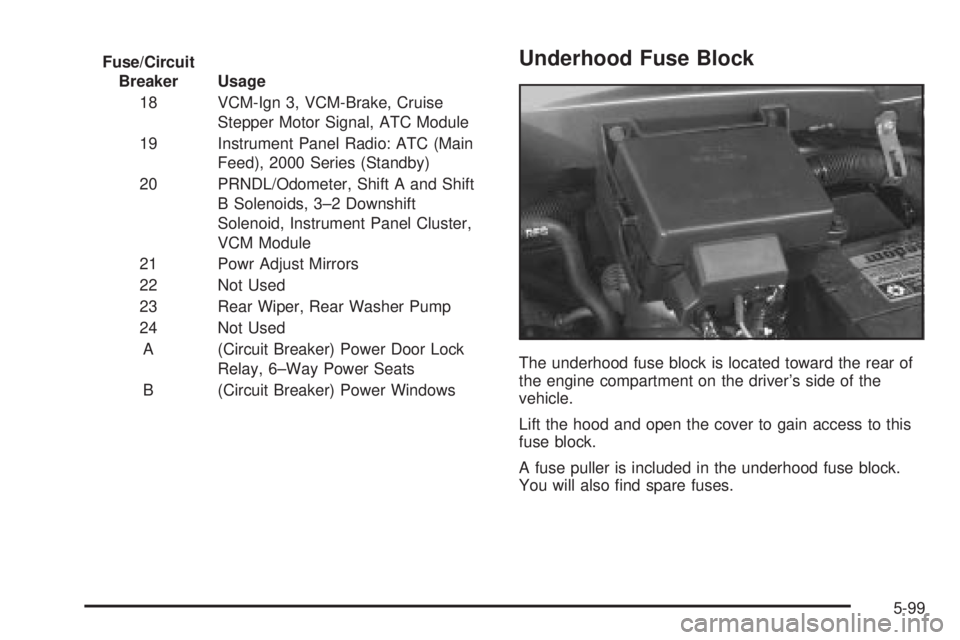
B (Circuit Breaker) Power WindowsUnderhood Fuse Block
The underhood fuse block is located toward the rear of
the engine compartment on the driver's side of the
vehicle.
Lift the hood and open the cover to gain access to this
fuse block.
A fuse puller is included in the underhood fuse block.
You will also ®nd spare fuses.
5-99
Page 345 of 382
Wiper Blade Check
Inspect wiper blades for wear or cracking. Replace
blade inserts that appear worn or damaged or that
streak or miss areas of the windshield. Also see
Cleaning the Outside of Your Vehicle on page 5-83.
Spare Tire Check
At least twice a year, after the monthly in¯ation check of
the spare tire determines that the spare is in¯ated to
the correct tire in¯ation pressure, make sure that
the spare tire is stored securely. Push, pull, and then try
to rotate or turn the tire. If it moves, use the wheel
wrench to tighten the cable. See
Changing a Flat Tire
on page 5-68.
Weatherstrip Lubrication
Silicone grease on weatherstrips will make them last
longer, seal better, and not stick or squeak. Apply
silicone grease with a clean cloth. During very cold,
damp weather more frequent application may be
required. See
Part D: Recommended Fluids and
Lubricants on page 6-30.
Automatic Transmission Check
Check the transmission ¯uid level; add if needed. SeeAutomatic Transmission Fluid on page 5-21. A ¯uid loss
may indicate a problem. Check the system and repair
if needed.
At Least Once a Year
Key Lock Cylinders Service
Lubricate the key lock cylinders with the lubricant
speci®ed in Part D.
Body Lubrication Service
Lubricate all body door hinges, the body hood, fuel door
and rear compartment hinges, latches and locks
including interior glove box and console doors, hood
latch assembly, secondary latch, pivots, spring anchor,
release pawl and any moving seat hardware. Lubricate
the hood safety lever pivot and prop rod pivot. Part D
tells you what to use. More frequent lubrication may be
required when exposed to a corrosive environment.
6-25
Page 369 of 382
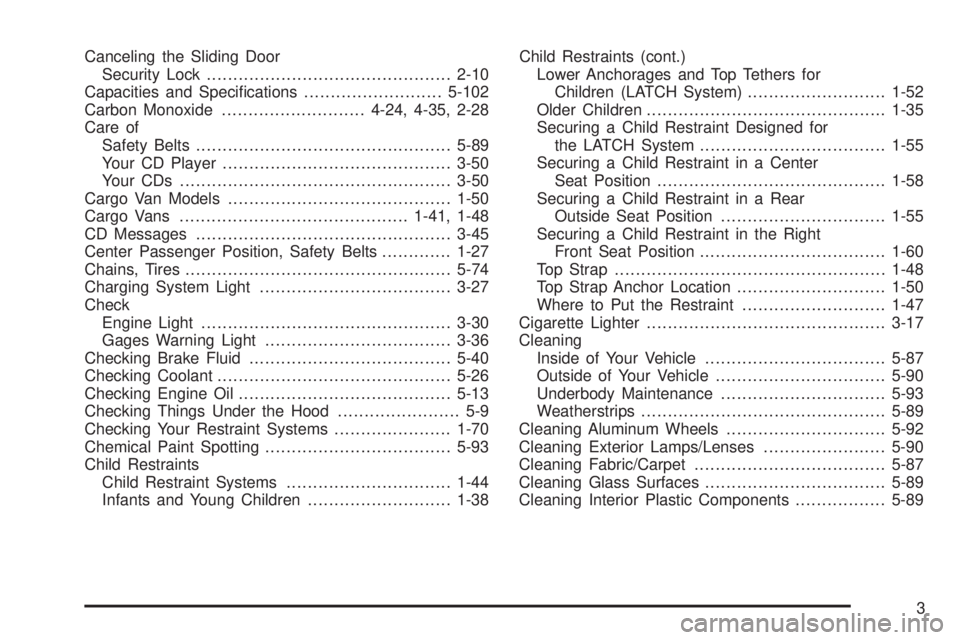
Canceling the Sliding Door
Security Lock..............................................2-10
Capacities and Speci®cations..........................5-102
Carbon Monoxide...........................4-24, 4-35, 2-28
Care of
Safety Belts................................................5-89
Your CD Player...........................................3-50
Your CDs ...................................................3-50
Cargo Van Models..........................................1-50
Cargo Vans...........................................1-41, 1-48
CD Messages................................................3-45
Center Passenger Position, Safety Belts.............1-27
Chains, Tires..................................................5-74
Charging System Light....................................3-27
Check
Engine Light...............................................3-30
Gages Warning Light...................................3-36
Checking Brake Fluid......................................5-40
Checking Coolant............................................5-26
Checking Engine Oil........................................5-13
Checking Things Under the Hood....................... 5-9
Checking Your Restraint Systems......................1-70
Chemical Paint Spotting...................................5-93
Child Restraints
Child Restraint Systems...............................1-44
Infants and Young Children...........................1-38Child Restraints (cont.)
Lower Anchorages and Top Tethers for
Children (LATCH System)..........................1-52
Older Children.............................................1-35
Securing a Child Restraint Designed for
the LATCH System...................................1-55
Securing a Child Restraint in a Center
Seat Position...........................................1-58
Securing a Child Restraint in a Rear
Outside Seat Position...............................1-55
Securing a Child Restraint in the Right
Front Seat Position...................................1-60
Top Strap...................................................1-48
Top Strap Anchor Location............................1-50
Where to Put the Restraint...........................1-47
Cigarette Lighter.............................................3-17
Cleaning
Inside of Your Vehicle..................................5-87
Outside of Your Vehicle................................5-90
Underbody Maintenance...............................5-93
Weatherstrips..............................................5-89
Cleaning Aluminum Wheels..............................5-92
Cleaning Exterior Lamps/Lenses.......................5-90
Cleaning Fabric/Carpet....................................5-87
Cleaning Glass Surfaces..................................5-89
Cleaning Interior Plastic Components.................5-89
3