tow CHEVROLET ASTRO 2004 Owner's Guide
[x] Cancel search | Manufacturer: CHEVROLET, Model Year: 2004, Model line: ASTRO, Model: CHEVROLET ASTRO 2004Pages: 382, PDF Size: 2.73 MB
Page 171 of 382
Your Driving, the Road, and Your Vehicle..........4-2
Defensive Driving...........................................4-2
Drunken Driving.............................................4-3
Control of a Vehicle........................................4-6
Braking.........................................................4-6
Locking Rear Axle..........................................4-9
Steering........................................................4-9
Off-Road Recovery.......................................4-11
Passing.......................................................4-12
Loss of Control.............................................4-13
Driving at Night............................................4-14
Driving in Rain and on Wet Roads..................4-16
City Driving..................................................4-19Freeway Driving...........................................4-20
Before Leaving on a Long Trip.......................4-21
Highway Hypnosis........................................4-22
Hill and Mountain Roads................................4-22
Winter Driving..............................................4-24
If You Are Stuck: In Sand, Mud,
Ice or Snow..............................................4-28
Towing..........................................................4-29
Towing Your Vehicle.....................................4-29
Recreational Vehicle Towing...........................4-29
Loading Your Vehicle....................................4-30
Towing a Trailer...........................................4-35
Section 4 Driving Your Vehicle
4-1
Page 198 of 382
If You Are Stuck: In Sand, Mud,
Ice or Snow
In order to free your vehicle when it is stuck, you will
need to spin the wheels, but you do not want to
spin your wheels too fast. The method known as
ªrockingº can help you get out when you are stuck, but
you must use caution.
{CAUTION:
If you let your tires spin at high speed, they
can explode, and you or others could be
injured. And, the transmission or other parts of
the vehicle can overheat. That could cause an
engine compartment ®re or other damage.
When you are stuck, spin the wheels as little
as possible. Do not spin the wheels above
35 mph (55 km/h) as shown on the
speedometer.
Notice:Spinning your wheels can destroy parts of
your vehicle as well as the tires. If you spin the
wheels too fast while shifting your transmission
back and forth, you can destroy your transmission.
For information about using tire chains on your
vehicle, see
Tire Chains on page 5-67.
Rocking Your Vehicle To Get It Out
First, turn your steering wheel left and right. That will
clear the area around your front wheels. Then shift back
and forth between REVERSE (R) and a forward gear,
spinning the wheels as little as possible. Release
the accelerator pedal while you shift, and press lightly
on the accelerator pedal when the transmission is
in gear. By slowly spinning your wheels in the forward
and reverse directions, you will cause a rocking
motion that may free your vehicle. If that does not get
you out after a few tries, you may need to be towed out.
If you do need to be towed out, see
Towing Your
Vehicle on page 4-29.
4-28
Page 199 of 382
Towing
Towing Your Vehicle
Consult your dealer or a professional towing service if
you need to have your disabled vehicle towed. See
Roadside Assistance Program on page 7-6.
If you want to tow your vehicle behind another vehicle
for recreational purposes (such as behind a motorhome),
see ªRecreational Vehicle Towingº following.
Recreational Vehicle Towing
Recreational vehicle towing means towing your vehicle
behind another vehicle Ð such as behind a motorhome.
The two most common types of recreational vehicle
towing are known as ªdinghy towingº (towing your
vehicle with all four wheels on the ground) and ªdolly
towingº (towing your vehicle with two wheels on
the ground and two wheels up on a device known
as a ªdollyº).
Notice:Towing an all-wheel-drive vehicle with all
four wheels on the ground, or even with only two of
its wheels on the ground, will damage drivetrain
components. Do not tow an all-wheel-drive vehicle if
any of its wheels will be on the ground.
Your vehicle was not designed to be towed with any of
its wheels on the ground. If your vehicle must be
towed, it should be placed on a platform trailer.
4-29
Page 201 of 382
The Tire and Loading Information label also tells you
the size and recommended in¯ation pressure for
the original equipment tires on your vehicle. For more
information on tires and in¯ation see
Tires on page 5-52andIn¯ation - Tire Pressure on page 5-61.
If your vehicle does not have the Tire and Loading
Information label, the Certi®cation/Tire label shows the
tire size and recommended in¯ation pressures
needed to obtain the Gross Vehicle Weight Rating
(GVWR) and the Gross Axle Weight Rating (GAWR) for
the front and rear axles. See ªCerti®cation/Tire Labelº
later in this section.
Steps for Determining Correct Load Limit
1. Locate the statement ªThe combined weight of
occupants and cargo should never exceed XXX
poundsº on your vehicle placard.
2. Determine the combined weight of the driver and
passengers that will be riding in your vehicle.
3. Subtract the combined weight of the driver and
passengers from XXX kilograms or XXX pounds.4. The resulting ®gure equals the available amount of
cargo and luggage load capacity. For example, if
the ªXXXº amount equals 1400 lbs. and there will be
®ve 150 lb. passengers in your vehicle, the
amount of available cargo and luggage load
capacity is 650 lbs. (1400-750 (5 x 150) =
650 lbs.).
5. Determine the combined weight of luggage and
cargo being loaded on the vehicle. That weight
may not safely exceed the available cargo
and luggage load capacity calculated in Step 4.
6. If your vehicle will be towing a trailer, the load from
your trailer will be transferred to your vehicle.
Consult this manual to determine how this reduces
the available cargo and luggage load capacity of
your vehicle. See
Towing a Trailer on page 4-35for
important information on towing a trailer, towing
safety rules and trailering tips.
4-31
Page 205 of 382
Payload
The Payload Capacity is shown on the Certi®cation/Tire
label. This is the maximum load capacity that your
vehicle can carry. Be sure to include the weight of the
people inside as part of your load. If you added any
accessories or equipment after your vehicle left
the factory, remember to subtract the weight of these
things from the payload. Your dealer can help you
with this.
Trailering Package
There is a load rating which includes the weight of the
vehicle and the trailer it tows. This rating is called
the Gross Combination Weight Rating (GCWR).
When you weigh your trailer, be sure to include the
weight of everything you put in it. And, remember
to ®gure the weight of the people inside the vehicle as
part of your load.
Add-On Equipment
When you carry removable items, you may need to put
a limit on how many people you carry inside your
vehicle. Be sure to weigh your vehicle before you buy
and install the new equipment.
Towing a Trailer
{CAUTION:
If you do not use the correct equipment and
drive properly, you can lose control when you
pull a trailer. For example, if the trailer is too
heavy, the brakes may not work well Ð or even
at all. You and your passengers could be
seriously injured. Pull a trailer only if you have
followed all the steps in this section. Ask your
dealer for advice and information about towing
a trailer with your vehicle.
Notice:Pulling a trailer improperly can damage
your vehicle and result in costly repairs that would
not be covered by your warranty. Always follow
the instructions in this section and check with your
dealer for more information about towing a trailer
with your vehicle.
To identify the trailering capacity of your vehicle, you
should read the information in ªWeight of the Trailerº that
appears later in this section.
4-35
Page 206 of 382
If yours was built with trailering options, as many are,
it's ready for heavier trailers. But trailering is different
than just driving your vehicle by itself. Trailering means
changes in handling, acceleration, braking, durability
and fuel economy. Successful, safe trailering takes
correct equipment, and it has to be used properly.
That's the reason for this part. In it are many time-tested,
important trailering tips and safety rules. Many of
these are important for your safety and that of your
passengers. So please read this section carefully before
you pull a trailer.
If You Do Decide To Pull A Trailer
If you do, here are some important points:
·There are many different laws, including speed limit
restrictions, having to do with trailering. Make sure
your rig will be legal, not only where you live
but also where you'll be driving. A good source for
this information can be state or provincial police.
·Consider using a sway control. See ªHitchesº later
in this section.
·Don't tow a trailer at all during the ®rst 500 miles
(800 km) your new vehicle is driven. Your engine,
axle or other parts could be damaged.
·Then, during the ®rst 500 miles (800 km) that you
tow a trailer, don't drive over 50 mph (80 km/h)
and don't make starts at full throttle. This helps your
engine and other parts of your vehicle wear in at
the heavier loads.
·See also ªDriving on Gradesº later in this section.
Three important considerations have to do with weight:
·the weight of the trailer,
·the weight of the trailer tongue
·and the weight on your vehicle's tires.
Tow/Haul Mode
Tow/haul is designed to assist while your vehicle is
pulling a large or heavy load or trailer. Tow/haul is most
useful while pulling such a load in rolling terrain, in
stop-and-go traffic, or when you need improved
low-speed control, such as when parking. The purpose
of the tow/haul mode is to:
·Reduce the frequency and improve the predictability
of transmission shifts,
·provide the same solid shift feel when pulling a
heavy load as when the vehicle is unloaded, and
·improve control of vehicle speed while requiring less
throttle pedal activity.
4-36
Page 207 of 382
Press the button on the end of the shift lever to turn
tow/haul mode on and off. While activated, the indicator
light on the instrument panel will be on. Tow/haul
mode will turn off automatically when the ignition is
turned off. See
Tow/Haul Mode Light on page 3-36.
Tow/haul is most effective when the vehicle and trailer
combined weight is at least 75% of the vehicle's
Gross Combined Weight Rating (GCWR). See ªWeight
of the Trailerº later in this section.
Driving with tow/haul activated without a heavy load will
cause reduced fuel economy and unpleasant engine
and transmission driving characteristics, but will
not cause damage.
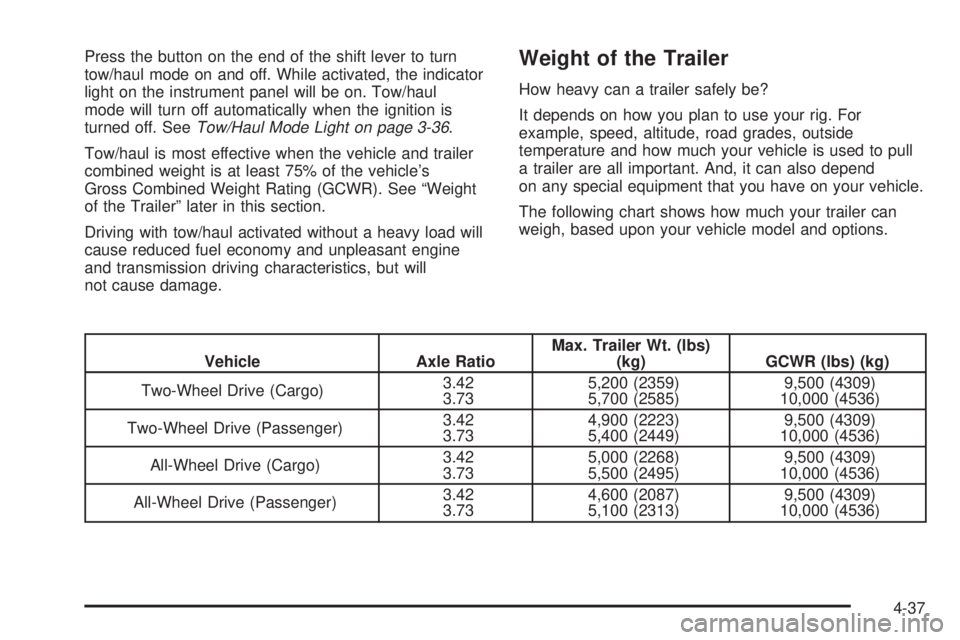
Weight of the Trailer
How heavy can a trailer safely be?
It depends on how you plan to use your rig. For
example, speed, altitude, road grades, outside
temperature and how much your vehicle is used to pull
a trailer are all important. And, it can also depend
on any special equipment that you have on your vehicle.
The following chart shows how much your trailer can
weigh, based upon your vehicle model and options.
Vehicle Axle RatioMax. Trailer Wt. (lbs)
(kg) GCWR (lbs) (kg)
Two-Wheel Drive (Cargo)3.42
3.735,200 (2359)
5,700 (2585)9,500 (4309)
10,000 (4536)
Two-Wheel Drive (Passenger)3.42
3.734,900 (2223)
5,400 (2449)9,500 (4309)
10,000 (4536)
All-Wheel Drive (Cargo)3.42
3.735,000 (2268)
5,500 (2495)9,500 (4309)
10,000 (4536)
All-Wheel Drive (Passenger)3.42
3.734,600 (2087)
5,100 (2313)9,500 (4309)
10,000 (4536)
4-37
Page 208 of 382
The Gross Combined Weight Rating (GCWR) is the
total allowable weight of the completely loaded vehicle
and trailer including any passengers, cargo equipment
and conversion. The GCWR for your vehicle should not
be exceeded.
You can ask your dealer for our trailering information or
advice, or you can write us at the address listed in
your Warranty and Owner Assistance Information
Booklet.
In Canada, write to:
General Motors of Canada Limited
Customer Communication Centre, 163-005
1908 Colonel Sam Drive
Oshawa, Ontario L1H 8P7
Weight of the Trailer Tongue
The tongue load (A) of any trailer is an important weight
to measure because it affects the total or gross weight
of your vehicle. The Gross Vehicle Weight (GVW)
includes the curb weight of the vehicle, any cargo you
may carry in it, and the people who will be riding in
the vehicle. If you have a lot of options, equipment,
passengers or cargo in your vehicle, it will reduce the
tongue weight your vehicle can carry, which will
also reduce the trailer weight your vehicle can tow. And
if you will tow a trailer, you must add the tongue load
to the GVW because your vehicle will be carryingthat weight, too. See
Loading Your Vehicle on page 4-30for more information about your vehicle's maximum
load capacity.
The trailer tongue weight (A) should be 10 percent to
15 percent of the total loaded trailer weight, up to
a maximum of 200 lbs (92 kg) with a weight carrying
hitch. The trailer tongue weight (A) should be 10 percent
to 15 percent of the total loaded trailer weight, up to
a maximum of 750 lbs (341 kg) with a weight
distributing hitch.
4-38
Page 209 of 382
After you've loaded your trailer, weigh the trailer and then
the tongue, separately, to see if the weights are proper. If
they aren't, you may be able to get them right simply by
moving some items around in the trailer.
Total Weight on Your Vehicle's Tires
Be sure your vehicle's tires are in¯ated to the upper limit
for cold tires. You'll ®nd these numbers on the
Certi®cation/Tire label at the rear edge of the driver's
door or see
Loading Your Vehicle on page 4-30.
Then be sure you don't go over the GVW limit for your
vehicle, including the weight of the trailer tongue. If
you use a weight distributing hitch, make sure you don't
go over the rear axle limit before you apply the weight
distribution spring bars.
Hitches
It's important to have the correct hitch equipment.
Crosswinds, large trucks going by and rough roads are
a few reasons why you'll need the right hitch.
Weight-Distributing Hitches and Weight
Carrying Hitches
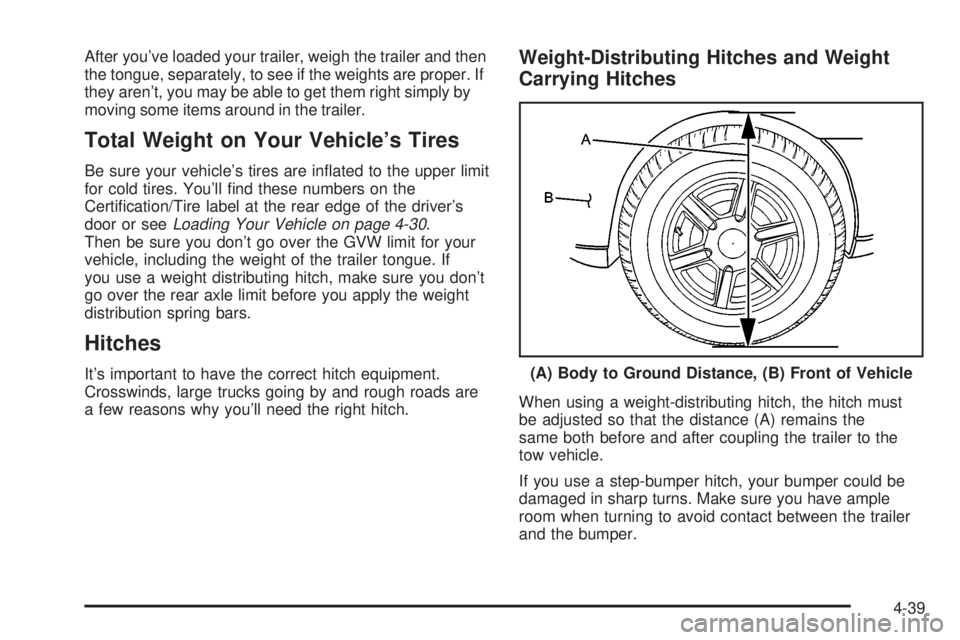
When using a weight-distributing hitch, the hitch must
be adjusted so that the distance (A) remains the
same both before and after coupling the trailer to the
tow vehicle.
If you use a step-bumper hitch, your bumper could be
damaged in sharp turns. Make sure you have ample
room when turning to avoid contact between the trailer
and the bumper.(A) Body to Ground Distance, (B) Front of Vehicle
4-39
Page 211 of 382
Driving with a Trailer
{CAUTION:
If you have a rear-most window open and you
pull a trailer with your vehicle, carbon
monoxide (CO) could come into your vehicle.
You can not see or smell CO. It can cause
unconsciousness or death. See
Engine
Exhaust on page 2-26
. To maximize your safety
when towing a trailer:
·Have your exhaust system inspected for
leaks, and make necessary repairs before
starting on your trip.
·Keep the rear-most windows closed.
·If exhaust does come into your vehicle
through a window in the rear or another
opening, drive with your front, main
heating or cooling system on and with the
fan on any speed. This will bring fresh,
outside air into your vehicle. Do not use
the climate control setting for maximum air
because it only recirculates the air inside
your vehicle. See Climate Control System
in the Index.Towing a trailer requires a certain amount of experience.
Before setting out for the open road, you'll want to get
to know your rig. Acquaint yourself with the feel of
handling and braking with the added weight of the trailer.
And always keep in mind that the vehicle you are
driving is now a good deal longer and not nearly as
responsive as your vehicle is by itself.
Before you start, check the trailer hitch and platform
(and attachments), safety chains, electrical connector,
lamps, tires and mirror adjustment. If the trailer has
electric brakes, start your vehicle and trailer moving and
then apply the trailer brake controller by hand to be
sure the brakes are working. This lets you check your
electrical connection at the same time.
During your trip, check occasionally to be sure that the
load is secure, and that the lamps and any trailer
brakes are still working.Following Distance
Stay at least twice as far behind the vehicle ahead as
you would when driving your vehicle without a trailer.
This can help you avoid situations that require
heavy braking and sudden turns.
4-41