tow CHEVROLET ASTRO 2004 Workshop Manual
[x] Cancel search | Manufacturer: CHEVROLET, Model Year: 2004, Model line: ASTRO, Model: CHEVROLET ASTRO 2004Pages: 382, PDF Size: 2.73 MB
Page 288 of 382
Tire Chains
Notice:Use tire chains only where legal and only
when you must. Use only SAE Class²S²type chains
that are the proper size for your tires. Install them
on the rear axle tires and tighten them as tightly as
possible with the ends securely fastened. Drive
slowly and follow the chain manufacturer's
instructions. If you can hear the chains contacting
your vehicle, stop and retighten them. If the contact
continues, slow down until it stops. Driving too
fast or spinning the wheels with chains on will
damage your vehicle.
If a Tire Goes Flat
It's unusual for a tire to ªblowoutº while you're driving,
especially if you maintain your tires properly. If air goes
out of a tire, it's much more likely to leak out slowly.
But if you should ever have a ªblowout,º here are a few
tips about what to expect and what to do:
If a front tire fails, the ¯at tire will create a drag that
pulls the vehicle toward that side. Take your foot off the
accelerator pedal and grip the steering wheel ®rmly.
Steer to maintain lane position, and then gently brake to
a stop well out of the traffic lane.A rear blowout, particularly on a curve, acts much like a
skid and may require the same correction you'd use
in a skid. In any rear blowout, remove your foot from the
accelerator pedal. Get the vehicle under control by
steering the way you want the vehicle to go. It may be
very bumpy and noisy, but you can still steer. Gently
brake to a stop, well off the road if possible.
{CAUTION:
Lifting a vehicle and getting under it to do
maintenance or repairs is dangerous without
the appropriate safety equipment and training.
The jack provided with your vehicle is
designed only for changing a ¯at tire. If it is
used for anything else, you or others could be
badly injured or killed if the vehicle slips off
the jack. Use the jack provided with your
vehicle only for changing a ¯at tire.
If a tire goes ¯at, the next part shows how to use your
jacking equipment to change a ¯at tire safely.
5-74
Page 289 of 382
Changing a Flat Tire
If a tire goes ¯at, avoid further tire and wheel damage
by driving slowly to a level place. Turn on your
hazard warning ¯ashers.
{CAUTION:
Changing a tire can be dangerous. The vehicle
can slip off the jack and roll over or fall on you
or other people. You and they could be badly
injured or even killed. Find a level place to
change your tire. To help prevent the vehicle
from moving:
1. Set the parking brake ®rmly.
2. Put the shift lever in PARK (P).
3. Turn off the engine and do not restart
while the vehicle is raised.
4. Do not allow passengers to remain in the
vehicle.
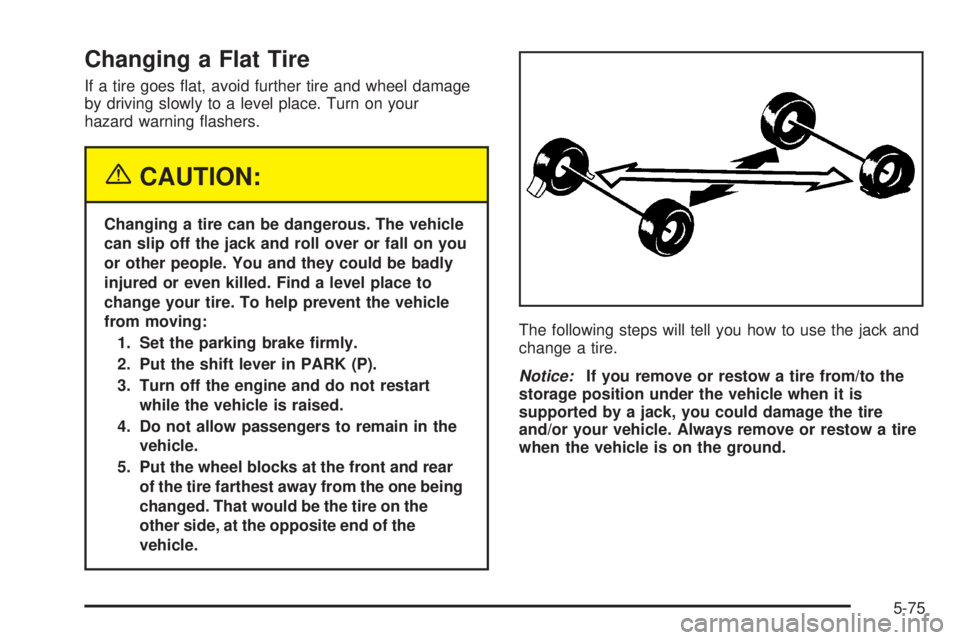
5. Put the wheel blocks at the front and rear
of the tire farthest away from the one being
changed. That would be the tire on the
other side, at the opposite end of the
vehicle.The following steps will tell you how to use the jack and
change a tire.
Notice:If you remove or restow a tire from/to the
storage position under the vehicle when it is
supported by a jack, you could damage the tire
and/or your vehicle. Always remove or restow a tire
when the vehicle is on the ground.
5-75
Page 290 of 382
Removing the Spare Tire and Tools
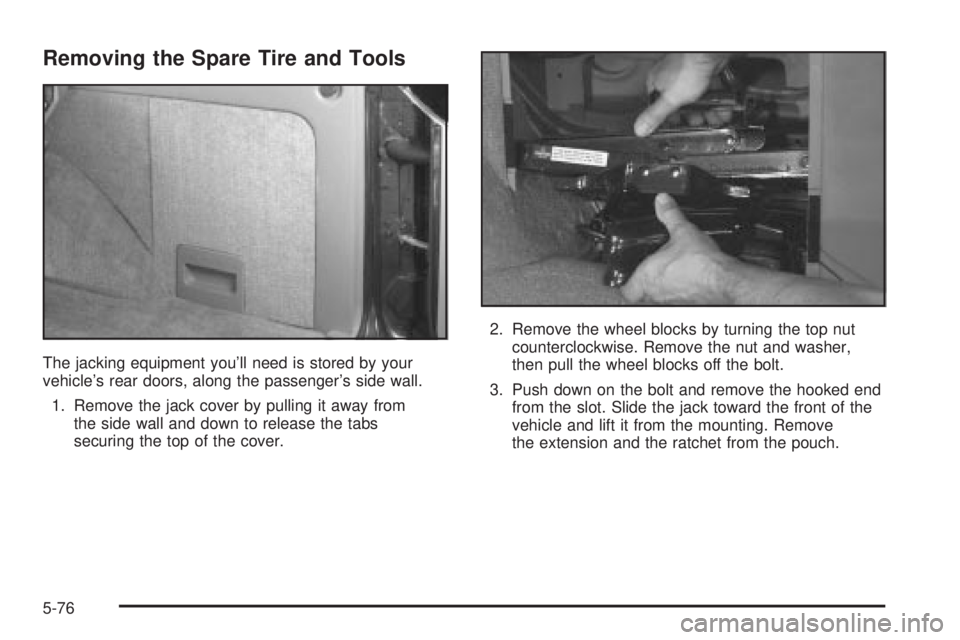
The jacking equipment you'll need is stored by your
vehicle's rear doors, along the passenger's side wall.
1. Remove the jack cover by pulling it away from
the side wall and down to release the tabs
securing the top of the cover.2. Remove the wheel blocks by turning the top nut
counterclockwise. Remove the nut and washer,
then pull the wheel blocks off the bolt.
3. Push down on the bolt and remove the hooked end
from the slot. Slide the jack toward the front of the
vehicle and lift it from the mounting. Remove
the extension and the ratchet from the pouch.
5-76
Page 297 of 382
{CAUTION:
Rust or dirt on the wheel, or on the parts to
which it is fastened, can make the wheel nuts
become loose after a time. The wheel could
come off and cause an accident. When you
change a wheel, remove any rust or dirt from
the places where the wheel attaches to the
vehicle. In an emergency, you can use a cloth
or a paper towel to do this; but be sure to use
a scraper or wire brush later, if you need to, to
get all the rust or dirt off.
{CAUTION:
Never use oil or grease on studs or nuts. If
you do, the nuts might come loose. Your wheel
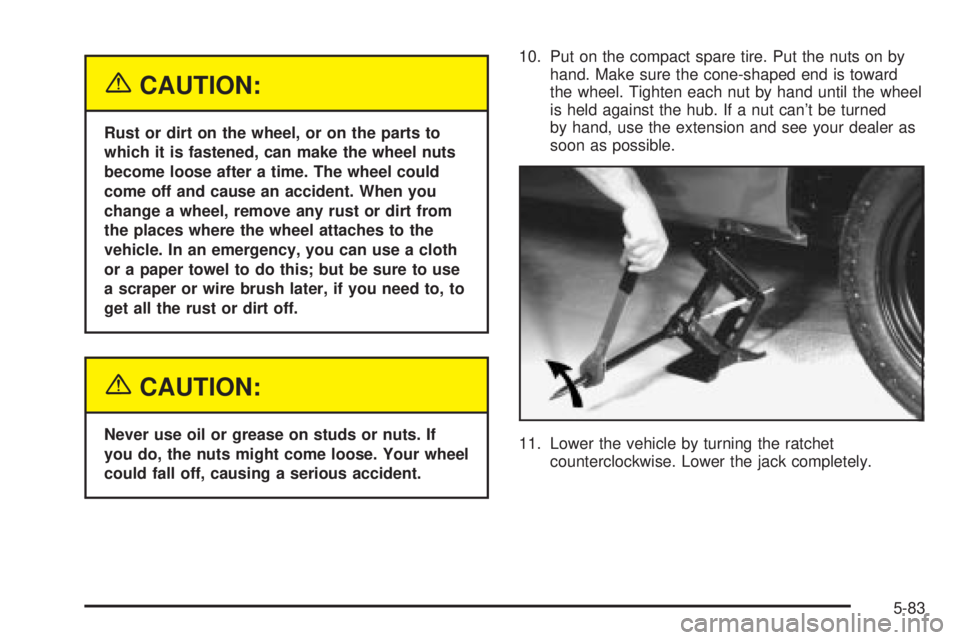
could fall off, causing a serious accident.10. Put on the compact spare tire. Put the nuts on by
hand. Make sure the cone-shaped end is toward
the wheel. Tighten each nut by hand until the wheel
is held against the hub. If a nut can't be turned
by hand, use the extension and see your dealer as
soon as possible.
11. Lower the vehicle by turning the ratchet
counterclockwise. Lower the jack completely.
5-83
Page 301 of 382
Do not use any of these unless this manual says you
can. In many uses, these will damage your vehicle:
·Alcohol
·Laundry Soap
·Bleach
·Reducing Agents
Cleaning the Inside of Your Vehicle
Use a vacuum cleaner often to get rid of dust and
loose dirt. Wipe vinyl, leather, plastic and painted
surfaces with a clean, damp cloth.
Cleaning Fabric/Carpet
Your dealer has cleaners for the cleaning of fabric
and carpet. They will clean normal spots and stains
very well.
You can get GM-approved cleaning products from your
dealer. See
Vehicle Care/Appearance Materials on
page 5-94.
Here are some cleaning tips:
·Always read the instructions on the cleaner label.
·Clean up stains as soon as you can Ð before
they set.
·Carefully scrape off any excess stain.
·Use a clean cloth or sponge, and change to a clean
area often. A soft brush may be used if stains are
stubborn.
·If a ring forms on fabric after spot cleaning, clean
the entire area immediately or it will set.
Using Cleaner on Fabric
1. Vacuum and brush the area to remove any
loose dirt.
2. Always clean a whole trim panel or section. Mask
surrounding trim along stitch or welt lines.
3. Follow the directions on the container label.
4. Apply cleaner with a clean sponge. Do not saturate
the material and do not rub it roughly.
5. As soon as you have cleaned the section, use a
sponge to remove any excess cleaner.
6. Wipe cleaned area with a clean, water-dampened
towel or cloth.
7. Wipe with a clean cloth and let dry.
5-87
Page 304 of 382
Cleaning the Outside of Your
Vehicle
The paint ®nish on your vehicle provides beauty, depth
of color, gloss retention and durability.
Washing Your Vehicle
The best way to preserve your vehicle's ®nish is to
keep it clean by washing it often with lukewarm or
cold water.
Do not wash your vehicle in the direct rays of the sun.
Use a car washing soap. Do not use strong soaps
or chemical detergents. Be sure to rinse the vehicle well,
removing all soap residue completely. You can get
GM-approved cleaning products from your dealer. See
Vehicle Care/Appearance Materials on page 5-94.
Do not use cleaning agents that are petroleum based,
or that contain acid or abrasives. All cleaning agents
should be ¯ushed promptly and not allowed to dry on the
surface, or they could stain. Dry the ®nish with a soft,
clean chamois or an all-cotton towel to avoid surface
scratches and water spotting.
High pressure car washes may cause water to enter
your vehicle.
Cleaning Exterior Lamps/Lenses
Use only lukewarm or cold water, a soft cloth and a car
washing soap to clean exterior lamps and lenses.
Follow instructions under ªWashing Your Vehicle.º
Finish Care
Occasional waxing or mild polishing of your vehicle by
hand may be necessary to remove residue from the
paint ®nish. You can get GM-approved cleaning products
from your dealer. See
Vehicle Care/Appearance
Materials on page 5-94.
Your vehicle has a ªbasecoat/clearcoatº paint ®nish. The
clearcoat gives more depth and gloss to the colored
basecoat. Always use waxes and polishes that are
non-abrasive and made for a basecoat/clearcoat paint
®nish.
Notice:Machine compounding or aggressive
polishing on a basecoat/clearcoat paint ®nish may
damage it. Use only non-abrasive waxes and
polishes that are made for a basecoat/clearcoat
paint ®nish on your vehicle.
5-90
Page 306 of 382
Cleaning Aluminum Wheels
Keep your wheels clean using a soft clean cloth with
mild soap and water. Rinse with clean water. After
rinsing thoroughly, dry with a soft clean towel. A wax
may then be applied.
The surface of these wheels is similar to the painted
surface of your vehicle. Do not use strong soaps,
chemicals, abrasive polishes, abrasive cleaners,
cleaners with acid, or abrasive cleaning brushes on
them because you could damage the surface. Do not
use chrome polish on aluminum wheels.
Do not take your vehicle through an automatic car wash
that has silicone carbide tire cleaning brushes. These
brushes can also damage the surface of these wheels.
Cleaning Tires
To clean your tires, use a stiff brush with tire cleaner.
Notice:Using petroleum-based tire dressing
products on your vehicle may damage the paint
®nish and/or tires. When applying a tire dressing,
always wipe off any overspray from all painted
surfaces on your vehicle.
Sheet Metal Damage
If your vehicle is damaged and requires sheet metal
repair or replacement, make sure the body repair shop
applies anti-corrosion material to parts repaired or
replaced to restore corrosion protection.
Original manufacturer replacement parts will provide the
corrosion protection while maintaining the warranty.
5-92
Page 313 of 382
Fuse/Circuit
Breaker Usage
18 VCM-Ign 3, VCM-Brake, Cruise
Stepper Motor Signal, ATC Module
19 Instrument Panel Radio: ATC (Main
Feed), 2000 Series (Standby)
20 PRNDL/Odometer, Shift A and Shift
B Solenoids, 3±2 Downshift
Solenoid, Instrument Panel Cluster,
VCM Module
21 Powr Adjust Mirrors
22 Not Used
23 Rear Wiper, Rear Washer Pump
24 Not Used
A (Circuit Breaker) Power Door Lock
Relay, 6±Way Power Seats
B (Circuit Breaker) Power WindowsUnderhood Fuse Block
The underhood fuse block is located toward the rear of
the engine compartment on the driver's side of the
vehicle.
Lift the hood and open the cover to gain access to this
fuse block.
A fuse puller is included in the underhood fuse block.
You will also ®nd spare fuses.
5-99
Page 325 of 382
Selecting the Right Schedule
First you will need to decide which of the two schedules
is right for your vehicle. Here is how to decide which
schedule to follow:
Short Trip/City De®nition
Follow the Short Trip/City Scheduled Maintenance if any
one of these conditions is true for your vehicle:
·Most trips are less than 5 miles (8 km). This is
particularly important when outside temperatures
are below freezing.
·Most trips include extensive idling (such as frequent
driving in stop-and-go traffic).
·You frequently tow a trailer or use a carrier on top
of your vehicle.
·If the vehicle is used for delivery service, police,
taxi or other commercial application.
One of the reasons you should follow this schedule if
you operate your vehicle under any of these conditions
is that these conditions cause engine oil to break
down sooner.
Short Trip/City Intervals
Every 3,000 Miles (5 000 km):Engine Oil and Filter
Change (or 3 months, whichever occurs ®rst). Chassis
Lubrication (or 3 months, whichever occurs ®rst).
Drive Axle Fluid Check.
Every 6,000 Miles (10 000 km):Tire Rotation.
Every 15,000 Miles (25 000 km):Engine Air Cleaner
Filter Inspection. Front Wheel Bearing Repack
(two±wheel drive only) (or at each brake relining,
whichever occurs ®rst). Automatic Transmission Service
(severe conditions only).
Every 30,000 Miles (50 000 km):Engine Air Cleaner
Filter Replacement. Fuel Filter Replacement.
Every 50,000 Miles (83 000 km):Automatic
Transmission Service (normal conditions). Transfer
Case Fluid Change.
Every 100,000 Miles (166 000 km):Spark Plug Wire
Inspection. Spark Plug Replacement. Positive
Crankcase Ventilation (PCV) Valve Inspection.
Every 150 000 Miles (240 000 km):Cooling System
Service (or every 60 months, whichever occurs
®rst). Engine Accessory Drive Belt Inspection.
These intervals only summarize maintenance services.
Be sure to follow the complete scheduled maintenance
on the following pages.
6-5
Page 326 of 382
Long Trip/Highway De®nition
Follow this scheduled maintenanceonlyif none of the
conditions from the Short Trip/City Scheduled
Maintenance are true. Do not use this schedule if the
vehicle is used for trailer towing, driven in a dusty area
or used off paved roads. Use the Short Trip/City
schedule for these conditions
Driving a vehicle with a fully warmed engine under
highway conditions will cause engine oil to break down
slower.
Long Trip/Highway Intervals
Every 7,500 Miles (12 500 km):Engine Oil and Filter
Change (or every 12 months, whichever occurs
®rst). Chassis Lubrication (or 12 months, whichever
occurs ®rst). Drive Axle Fluid Check. Tire Rotation.
Every 15,000 Miles (25 000 km):Engine Air Cleaner
Filter Inspection. Automatic Transmission Service
(severe conditions only).
Every 30,000 Miles (50 000 km):Fuel Filter
Replacement. Engine Air Cleaner Filter Replacement.
Front Wheel Bearing Repack (two±wheel drive only) (or
at each brake relining, whichever occurs ®rst).
Every 50,000 Miles (83 000 km):Automatic
Transmission Service (normal conditions). Transfer
Case Fluid Change.Every 100,000 Miles (166 000 km):Spark Plug Wire
Inspection. Spark Plug Replacement. Positive
Crankcase Ventilation (PCV) Valve Inspection.
Every 150,000 Miles (240 000 km):Cooling System
Service (or every 60 months, whichever occurs
®rst). Engine Accessory Drive Belt Inspection.
These intervals only summarize maintenance services.
Be sure to follow the complete scheduled maintenance
on the following pages.
Short Trip/City Scheduled
Maintenance
The services shown in this schedule up to 100,000 miles
(166 000 km) should be repeated after 100,000 miles
(166 000 km) at the same intervals for the life of
this vehicle. The services shown at 150,000 miles
(240 000 km) should be repeated at the same interval
after 150,000 miles (240 000 km) for the life of this
vehicle.
See
Part B: Owner Checks and Services on page 6-24andPart C: Periodic Maintenance Inspections on
page 6-28.
6-6