key CHEVROLET ASTRO CARGO VAN 1995 2.G Owner's Manual
[x] Cancel search | Manufacturer: CHEVROLET, Model Year: 1995, Model line: ASTRO CARGO VAN, Model: CHEVROLET ASTRO CARGO VAN 1995 2.GPages: 342, PDF Size: 17.57 MB
Page 140 of 342
Downloaded from www.Manualslib.com manuals search engine Rear-end collisions are about the most preventable of accidents. Yet they
are common. Allow enough following distance. It’s the best defensive
driving maneuver, in both city and rural driving. You never know when the
vehicle in front of you is going to brake or turn suddenly.
Drunken Driving
Death and injury associated with drinking and driving is a national tragedy.
It’s the number one contributor to the highway death toll, claiming
thousands
of victims every year.
Alcohol affects four things that anyone needs to drive a vehicle:
Judgment
Muscular Coordination
Vision
Attentiveness
Police records show that almost half of all motor vehicle-related deaths
involve alcohol. In most cases, these deaths are the result
of someone who
was drinking and driving. In recent years, some 18,000 annual motor
vehicle-related deaths have been associated with the use of alcohol, with
more than
300,000 people injured.
Many adults
- by some estimates, nearly half the adult population -
choose never to drink alcohol, so they never drive after drinking. For
persons under
21, it’s against the law in every U.S. state to drink alcohol.
There are good medical, psychological and developmental reasons for these
laws.
The obvious way to solve this highway safety problem is for people never to
drink alcohol and then drive. But what if people do? How much is “too
much” if the driver plans to drive? It’s a lot less than many might think.
Although it depends on each person and situation, here is some general
information
on the problem.
The Blood Alcohol Concentration (BAC) of someone who
is drinking
depends upon four things:
How much alcohol consumed
The drinker’s body weight
The amount of food that is consumed before and during drinking
The length of time it’s taken the drinker to consume the alcohol
According
to the American Medical Association, a 180-pound (82 kg)
person who drinks three 12-ounce
(355 ml) bottles of beer in an hour will
end up with a BAC of about
0.06 percent. The person would reach the same
BAC by drinking three 4-ounce
(1 20 ml) glasses of wine or three mixed
drinks if each had
1-1/2 ounces (45 ml) of a liquor like whiskey, gin or
vodka.
4-2
Page 174 of 342
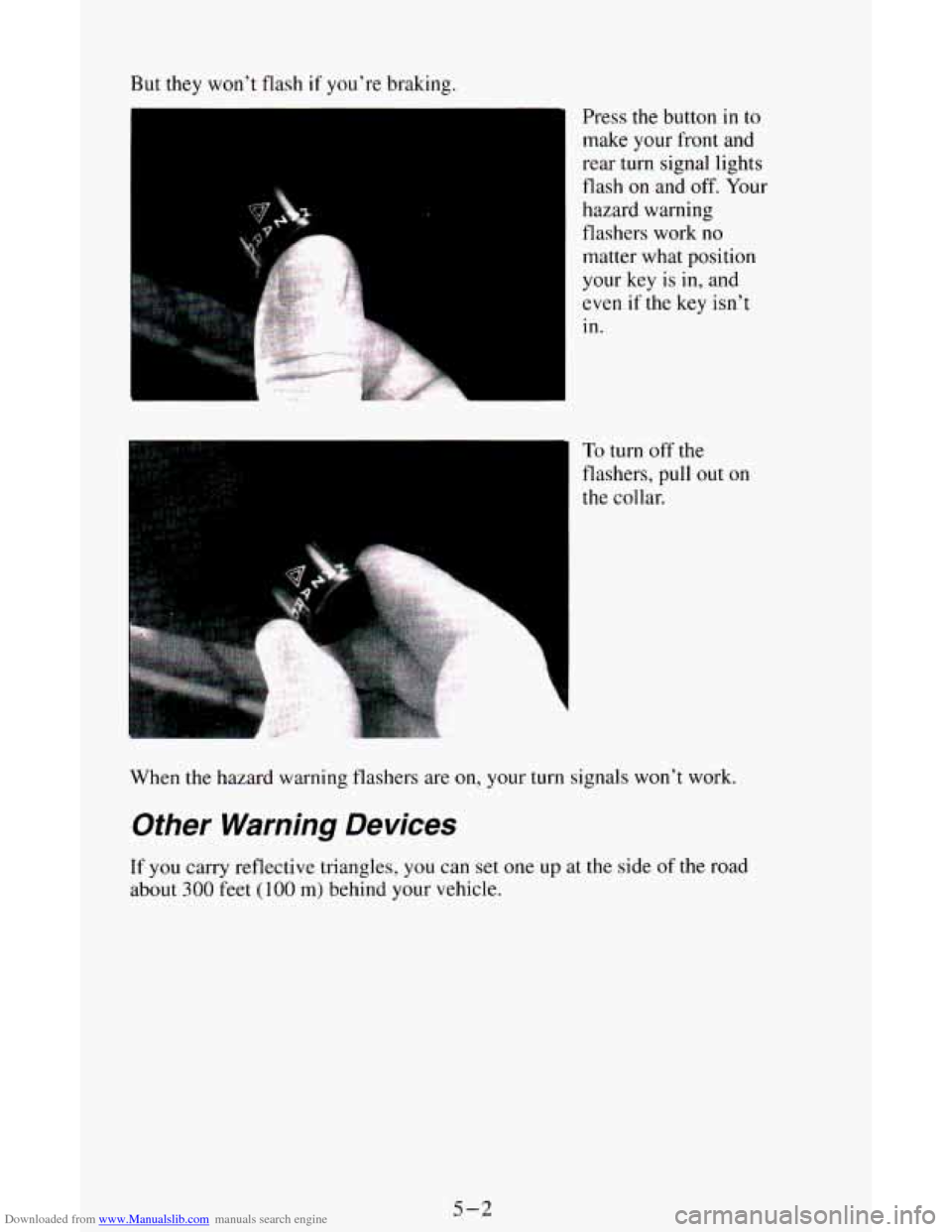
Downloaded from www.Manualslib.com manuals search engine But they won’t flash if you’re braking. Press the button
in to
make your front and
rear turn signal lights
flash
on and off. Your
hazard warning
flashers work no
matter what position
your key
is in, and
even
if the key isn’t
in.
To turn off the
flashers, pull out on
the collar.
When the hazard warning flashers are on, your turn signals
won’t work.
Other Warning Devices
If you carry reflective triangles, you can set one up at the side of the road
about
300 feet (100 m) behind your vehicle.
5-2
Page 179 of 342
Downloaded from www.Manualslib.com manuals search engine Towing Your Vehicle
Try to have a GM dealer or a professional towing service tow your vehicle.
They can provide the right equipment and know how to tow
it without
damage.
If your vehicle has been changed
or modified since it was factory-new by
adding aftermarket items like fog lamps, aero skirting, or special tires and
wheels, these things can be damaged during towing.
Before
you do anything, turn on the hazard warning flashers.
When
you call, tell the towing service:
0 Whether your vehicle has rear-wheel drive or the all-wheel-drive
option. If your vehicle has fog lamps, it cannot be towed from the front
with sling-type equipment.
The make, model, and year of your vehicle.
0 Whether you can still move the shift lever.
0 If there was an accident, what was damaged.
When your vehicle
is being towed, have the ignition key off. The steering
wheel should be clamped in a straight-ahead position, with
a clamping
device designed for towing service.
Do not use the vehicle’s steering
column lock for this.
The transmission should be in NEUTRAL (N) and the
parking brake released.
5-7
Page 312 of 342
Downloaded from www.Manualslib.com manuals search engine Engine Coolant Level
Check the engine coolant level and add the proper coolant mix if necessary.
See “Coolant” in the Index for further details.
Windshield Washer Fluid Level
Check the windshield washer fluid level in the windshield washer tank and
add the proper fluid if necessary. See “Windshield Washer Fluid” in the
Index for further details.
At Least Once a Month
Tire lnflation
Check tire inflation. Make sure tires are inflated to the pressures specified
on the CertificatiodTire label located on the rear edge of the driver’s door.
See “Tires” in the Index for further details.
Cassette Deck
Clean cassette deck. Cleaning should be done every 50 hours of tape play.
See “Audio Systems” in the Index for further details.
At Least Once a Year
Key Lock Cylinders
Lubricate the key lock cylinders with the lubricant specified in Part D.
Body Lubrication
Lubricate all body door hinges, the body hood, fuel door and rear
compartment hinges, latches and locks including interior glove box and
console doors, and any moving seat hardware. Lubricate the hood safety
lever pivot and prop rod pivot. Part
D tells you what to use. More frequent
lubrication may be required when exposed to a corrosive environment.
7-36
Page 313 of 342
Downloaded from www.Manualslib.com manuals search engine Starter Switch
1. Before you start, be sure you have enough room around the vehicle.
2. Firmly apply both the parking brake (see “Parking Brake” in the Index
if necessary) and the regular brake.
NOTE: Do not use the accelerator pedal, and be ready to turn off the
engine immediately if it starts.
3. Try to start the engine in each gear. The starter should work only in
PARK (P) or NEUTRAL (N). If the starter works in any other position,
your vehicle needs service.
Brake-Transmission Shift Interlock - BTSI
1. Before you start, be sure you have enough room around the vehicle. It
should be parked on a level surface.
2. Firmly apply the parking brake (see “Parking Brake” in the Index if
necessary).
NOTE: Be ready
to apply the regular brake immediately if the vehicle
begins to move.
3. With the engine off, turn the key to the RUN position, but don’t start
the engine. Without applying the regular brake, try to move the shift
lever out
of PARK (P) with normal effort. If the shift lever moves out
of PARK (P), your vehicle’s BTSI needs service.
7-37
Page 314 of 342
Downloaded from www.Manualslib.com manuals search engine Steering Column Lock
While parked, and with the parking brake set, try to turn the key to LOCK
in each shift lever position.
The key should turn to LOCK only when the shift lever is in PARK (P).
The key should come out only in LOCK.
Parking Brake and Automatic Transmission PARK (P)
Mechanism Check
I
When you are doing this check, your vehicle could begin to I
CAUTION:
move. You or others could be injured and property could be
damaged.
Make sure there is room in front of your vehicle in
case it begins to roll. Be ready to apply the regular brake at once
should the vehicle begin
to move.
Park on a fairly steep hill, with the vehicle facing downhill. Keeping your
foot on the regular brake, set the parking brake.
0 To check the parking brake: With the engine running and transmission
in NEUTRAL (N), slowly remove foot pressure from the regular brake
pedal.
Do this until the vehicle is held by the parking brake only.
To check the PARK (P) mechanism's holding ability: Shift to PARK
(P). Then release all brakes.
Lap and Shoulder Belts Condition and Operation
Inspect belt system, including: webbing, buckles, latch plates, retractors,
guide loops and anchors. Have
a belt assembly replaced if the webbing has
been cut
or otherwise damaged.
7-38
Page 316 of 342
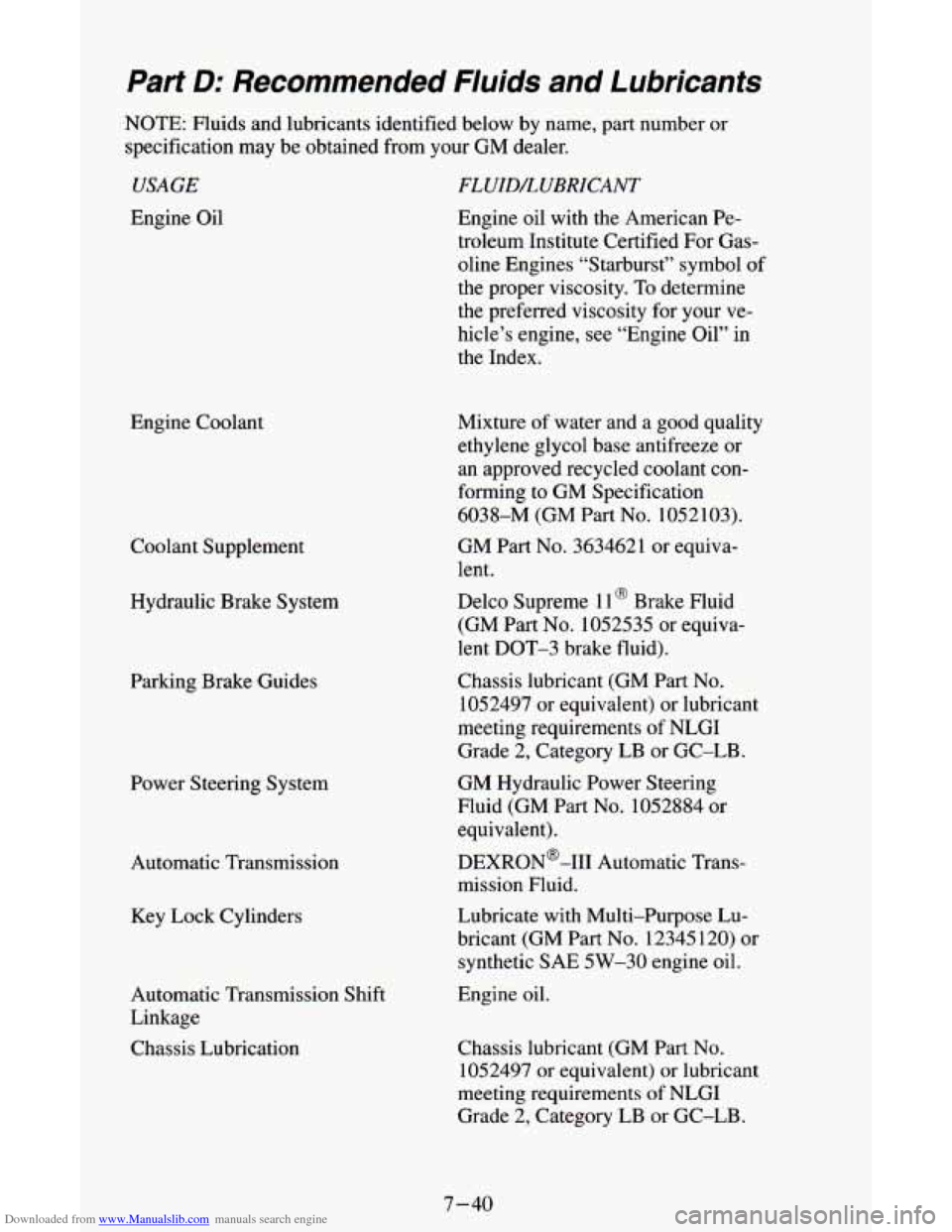
Downloaded from www.Manualslib.com manuals search engine NOTE: Fluids and lubricants identified below by name, part number or
specification may be obtained from your GM dealer.
USAGE
Engine Oil
Engine Coolant Coolant Supplement
Hydraulic Brake System
Parking Brake Guides
Power Steering System
Automatic Transmission Key Lock Cylinders
Automatic Transmission Shift
Linkage
Chassis Lubrication
FLUID/LUBRICANT
Engine oil with the American Pe-
troleum Institute Certified For Gas-
oline Engines “Starburst” symbol
of
the proper viscosity. To determine
the preferred viscosity for your ve-
hicle’s engine, see “Engine Oil” in
the Index.
Mixture of water and a good quality
ethylene glycol base antifreeze or
an approved recycled coolant con-
forming to GM Specification
GM Part No. 3634621 or equiva-
lent. 6038-M (GM Part
NO. 1052103).
Delco Supreme
11 @ Brake Fluid
(GM Part
No. 1052535 or equiva-
lent DOT-3 brake fluid).
Chassis lubricant (GM Part No.
1052497 or equivalent) or lubricant
meeting requirements
of NLGI
Grade
2, Category LB or GC-LB.
GM Hydraulic Power Steering
Fluid (GM Part
No. 1052884 or
equivalent).
DEXRON@-I11 Automatic Trans-
mission Fluid.
Lubricate
with Multi-Purpose Lu-
bricant (GM Part
No. 12345 120) or
synthetic SAE
5W-30 engine oil.
Engine oil.
Chassis lubricant
(GM Part No.
1052497 or equivalent) or lubricant
meeting requirements of NLGI
Grade 2, Category LB
or GC-LB.
7-40
Page 326 of 342
Downloaded from www.Manualslib.com manuals search engine Roadside offers two levels of service to the customer, Basic Care and
Courtesy TM Care:
ROADSIDE Basic Care PROVIDES
Toll-free number, 1-800-CHEV-USA
Free towing for warranty repairs
Basic over-the-phone technical advice
Available dealer services at reasonable costs
(i.e., wrecker services, locksmith/key service, glass repair, etc.)
Note: Roadside
Basic Care applies to all ChevroletIGeo vehicles regardless
of age or miles.
ROADSIDE
Courtesy Care PROVIDES:
Roadside Basic Care services (as outlined above)
Plus:
FREE Non-Warranty Towing (to the closest dealer from a legal roadway)
FREE LocksmithKey Service (when keys are lost on the road or
a FREE Flat Tire Service (spare installed on the road)
FREE Jump Start (at home or on the road)
FREE Fuel Delivery ($5 of fuel delivered on the road)
locked inside)
Note:
Courtesy Care is available to Retail and Retail Lease Customers
operating
1994 and newer ChevroletIGeo vehicles for a period of
36 months/36,000 miles.
All Courtesy Care services must be pre-arranged by Chevrolet
Roadside
or Dealer Service Management.
Basic Care and Courtesy Caw are not part of or included in the coverage provided by
the
New Vehicle Limited Warranty. Chevrolet reserves the right to modify or
discontinue
Basic Cure and Corrrtesy Care at any time.
The Roadside Assistance Center uses companies that will provide you with
quality and priority service. When roadside services are required, our
advisors will explain any payment obligations that may be incurred for
utilizing outside services.
For prompt assistance when calling, please have the following available to
give
to the representative:
a Vehicle Identification Number
License plate number
Vehicle color
Vehicle location
8-6
Page 337 of 342
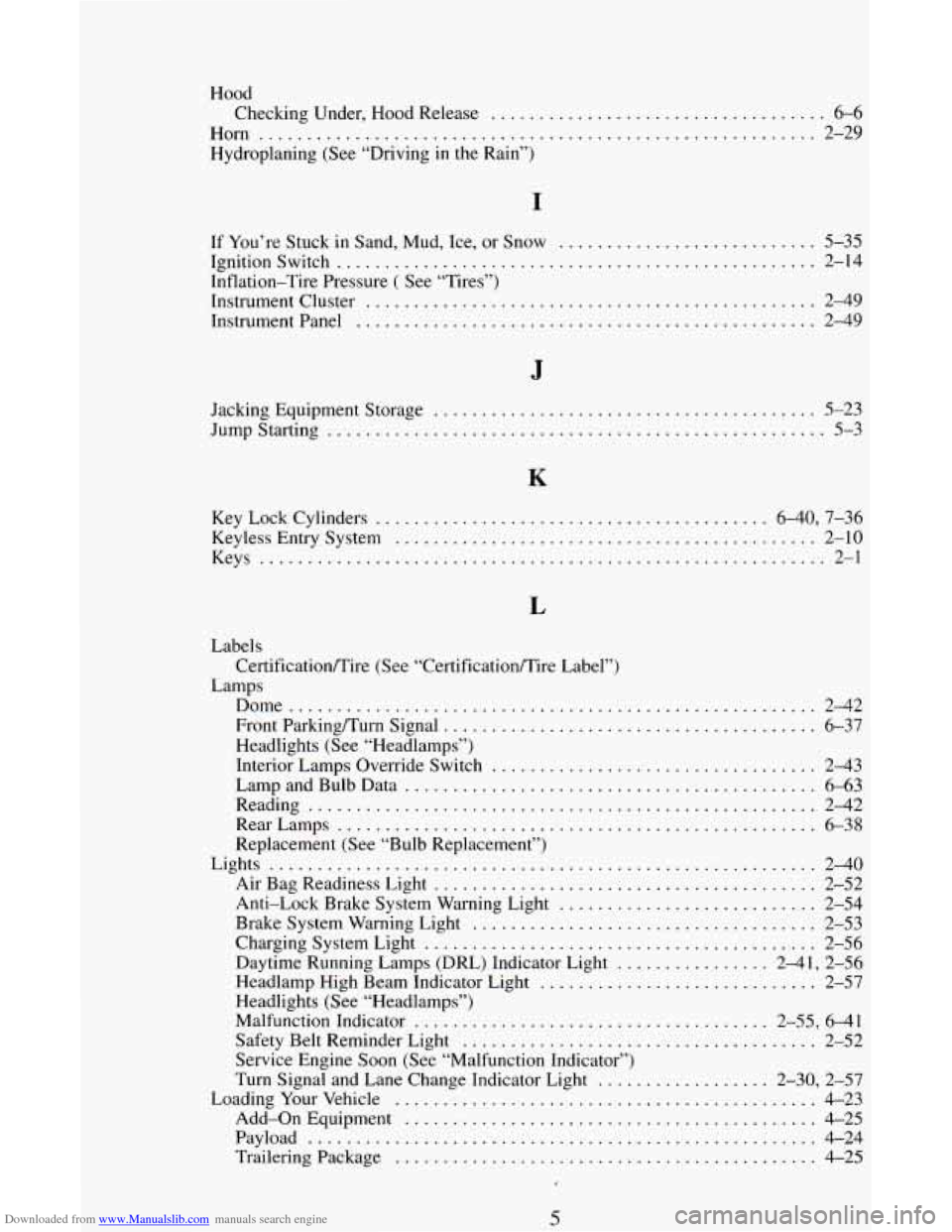
Downloaded from www.Manualslib.com manuals search engine Hood Checking Under. Hood Release
................................... 6-6
Horn
.......................................................... 2-29
Hydroplaning (See “Driving
in the Rain”)
I
If You’re Stuck in Sand. Mud. Ice. or Snow ........................... 5-35
Ignitionswitch
.................................................. 2-14
Inflation-Tire Pressure
( See “Tires”)
Instrument Cluster
............................................... 2-49
Instrumentpanel
................................................ 2-49
J
Jacking Equipment Storage ........................................ 5-23
Jumpstarting
.................................................... 5-3
K
Key Lock Cylinders ......................................... 6-40. 7-36
Keyless Entry System
............................................ 2-10
Keys ........................................................... 2-1
L
Labels
Lamps Certificationmire (See
“CertificatiodTire Label”)
Dome
....................................................... 2-42
Front Parkingnurn Signal
................................... 6-37
Headlights (See “Headlamps”)
Interior Lamps Override Switch
.................................. 2-43
Lamp and Bulb Data
........................................... 6-63
RearLamps .................................................. 6-38
Replacement (See “Bulb Replacement”)
Air Bag Readiness Light
........................................ 2-52
Anti-Lock Brake System Warning Light
........................... 2-54
Brake System Warning Light
.................................... 2-53
Charging System Light ......................................... 2-56
Daytime Running Lamps
(DRL) Indicator Light ................ 2-41. 2.56
Headlamp High Beam Indicator Light
............................. 2-57
Headlights (See “Headlamps”)
Malfunction Indicator
..................................... 2.55. 6-41
Safety Belt Reminder Light ..................................... 2-52
Service Engine Soon (See “Malfunction Indicator”)
Turn Signal and Lane Change Indicator Light
.................. 2.30. 2.57
LoadingYourVehicle
............................................ 4-23
Add-on Equipment
........................................... 4-25
Reading
..................................................... 2-42
Lights
......................................................... 2-40
Payload
..................................................... 4-24
TraileringPackage
............................................ 4-25
.
Page 338 of 342
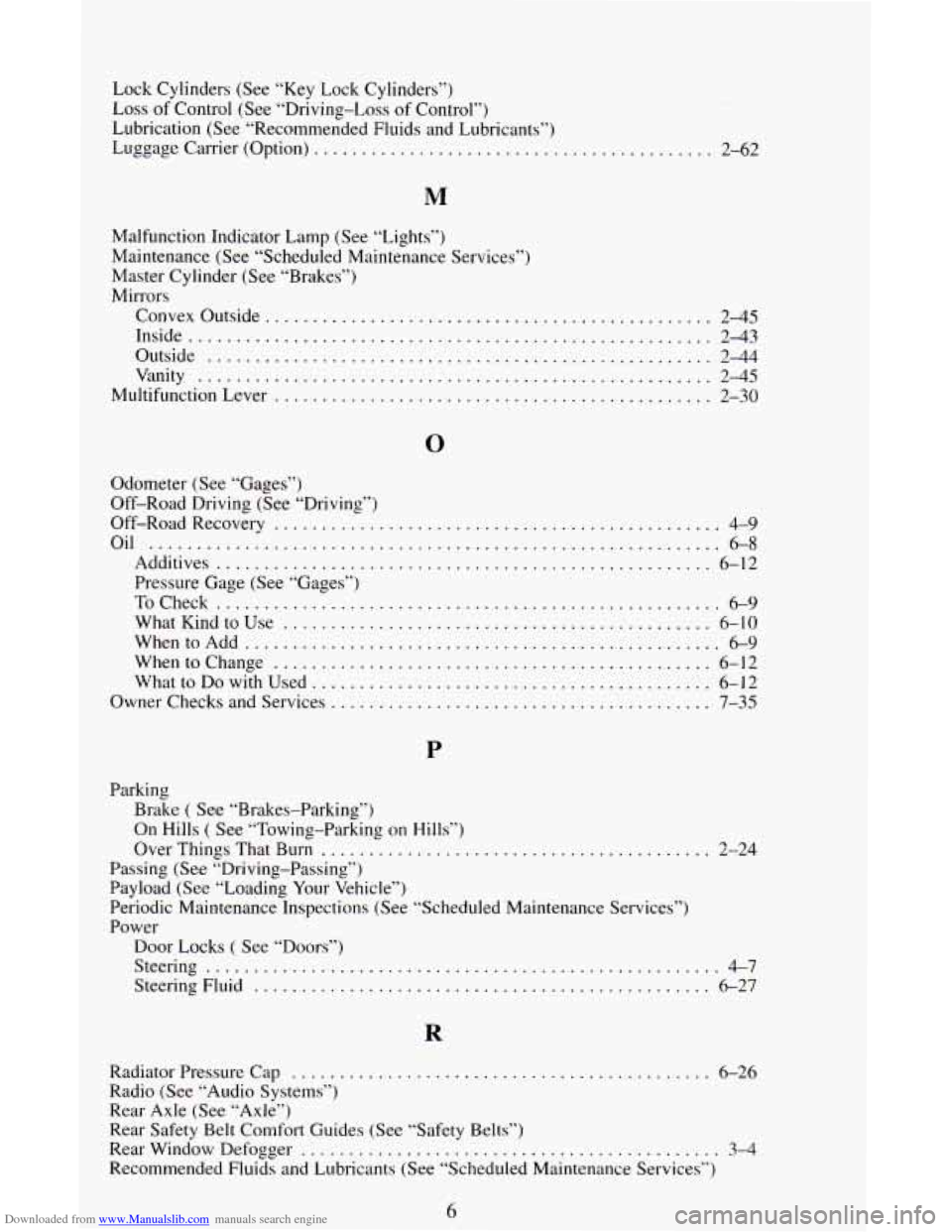
Downloaded from www.Manualslib.com manuals search engine Lock Cylinders (See “Key Lock Cylinders”)
Loss of Control (See “Driving-Loss of Control”)
Lubrication (See “Recommended Fluids and Lubricants”)
Luggage Carrier (Option)
.......................................... 2-62
M
Malfunction Indicator Lamp (See “Lights”)
Maintenance (See “Scheduled Maintenance Services”)
Master Cylinder (See “Brakes”)
Mirrors ConvexOutside
............................................... 2-45
Inside
....................................................... 2-43
Outside
..................................................... 244
Vanity
...................................................... 245
Multifunction Lever
.............................................. 2-30
Odometer (See “Gages”)
Off-Road Driving (See “Driving”)
Oil
............................................................ 6-8
Additives
.................................................. 6-12
Pressure Gage (See “Gages”)
ToCheck
..................................................... 6-9
WhatKindtoUse
............................................. 6-10
WhentoAdd .................................................. 6-9
WhentoChange
.............................................. 6-12
What to
Do with Used .......................................... 6-12
OwnerChecksandServices
........................................ 7-35
Off-Road Recovery
............................................... 4-9
P
Parking
Brake
( See “Brakes-Parking”)
On Hills
( See “Towing-Parking on Hills”)
Over Things That Burn
......................................... 2-24
Passing (See “Driving-Passing”)
Payload (See “Loading Your Vehicle”)
Periodic Maintenance Inspections (See “Scheduled Maintenance Services”)
Power Door Locks
( See “Doors”)
Steering
...................................................... 4-7
Steering Fluid
................................................ 6-27
R
Radiator Pressure Cap ............................................ 6-26
Radio (See “Audio Systems”)
Rear Axle (See “Axle”)
Rear Safety Belt Comfort Guides (See “Safety Belts”)
Recommended Fluids and Lubricants (See “Scheduled Maintenance Services”)
Rear Window
Defogger
............................................ 3-4
6