lock CHEVROLET ASTRO CARGO VAN 1995 2.G Repair Manual
[x] Cancel search | Manufacturer: CHEVROLET, Model Year: 1995, Model line: ASTRO CARGO VAN, Model: CHEVROLET ASTRO CARGO VAN 1995 2.GPages: 342, PDF Size: 17.57 MB
Page 206 of 342
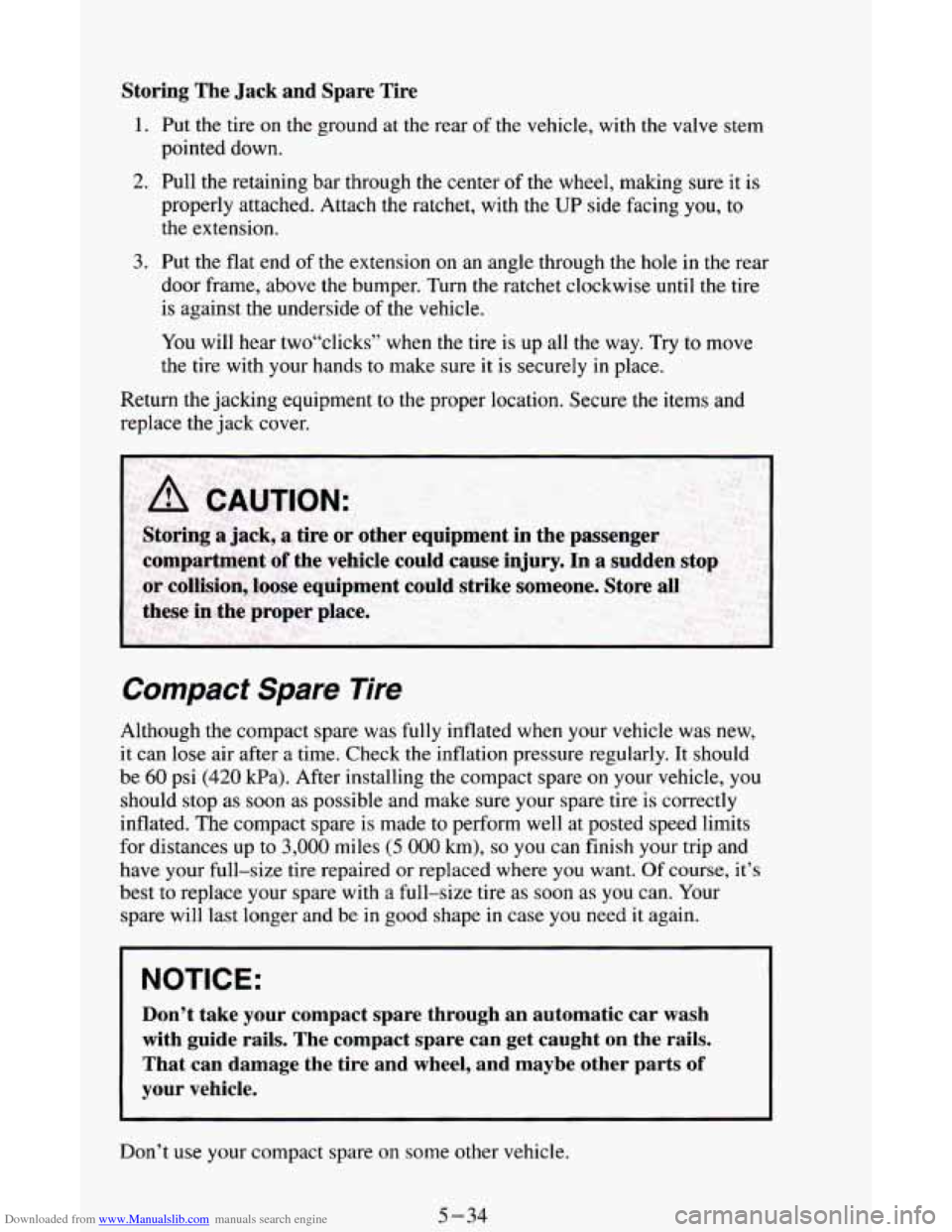
Downloaded from www.Manualslib.com manuals search engine Storing The Jack and Spare Tire
1. Put the tire on the ground at the rear of the vehicle, with the valve stem
pointed down.
2. Pull the retaining bar through the center of the wheel, making sure it is
properly attached. Attach the ratchet, with the UP side facing you, to
the extension.
3. Put the flat end of the extension on an angle through the hole in the rear
door frame, above the bumper. Turn the ratchet clockwise until the tire
is against the underside
of the vehicle.
You will hear two“c1icks” when the tire is up all the way. Try to move
the tire with your hands to make sure it is securely in place.
Return the jacking equipment to the proper location. Secure the items and
replace the jack cover.
Compact Spare Tire
Although the compact spare was fully inflated when your vehicle was new,
it can lose air after
a time. Check the inflation pressure regularly. It should
be
60 psi (420 kPa). After installing the compact spare on your vehicle, you
should stop as soon as possible and make sure your spare tire is correctly
inflated. The compact spare is made to perform well at posted speed limits
for distances up to
3,000 miles (5 000 km), so you can finish your trip and
have your full-size tire repaired or replaced where you want. Of course, it’s
best to replace your spare with a full-size tire as soon as you can. Your
spare will last longer and be in good shape in case you need
it again.
I NOTICE:
Don’t take your compact spare through an automatic car wash \
with guide rails. The compact spare can get caught
on the rails.
That can damage the tire and wheel, and maybe other parts
of
your vehicle.
Don’t use your compact spare on some other vehicle.
5-34
Page 213 of 342
Downloaded from www.Manualslib.com manuals search engine While refueling, hang
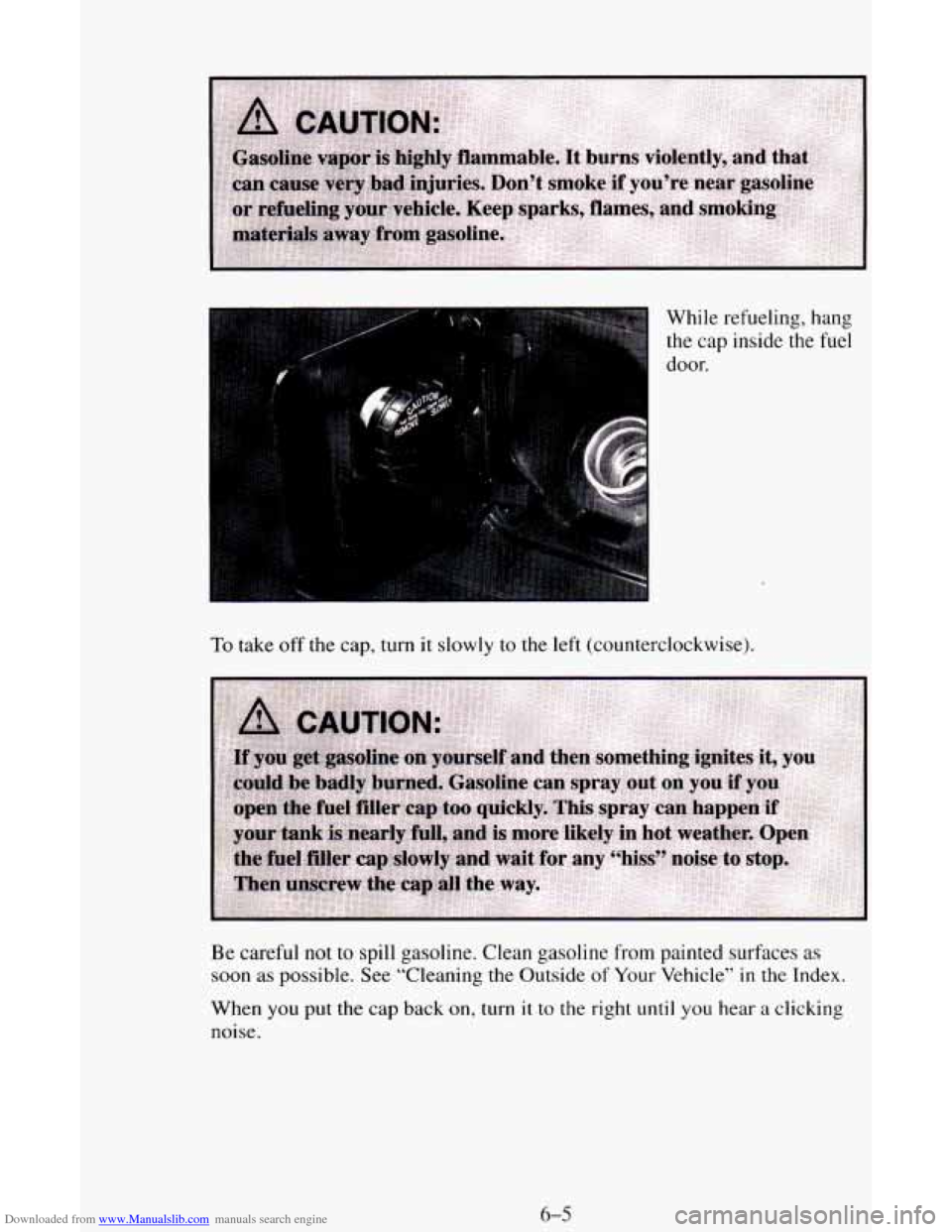
the cap inside the fuel
door.
To take off the cap, turn it slowly to the left (counterclockwise).
Be careful not to spill gasoline. Clean gasoline from painted surfaces as
soon
as possible. See “Cleaning the Outside of Your Vehicle” in the Index.
When you put the cap back
on, turn it to the right until you hear a clicking
noise.
6-5
Page 228 of 342
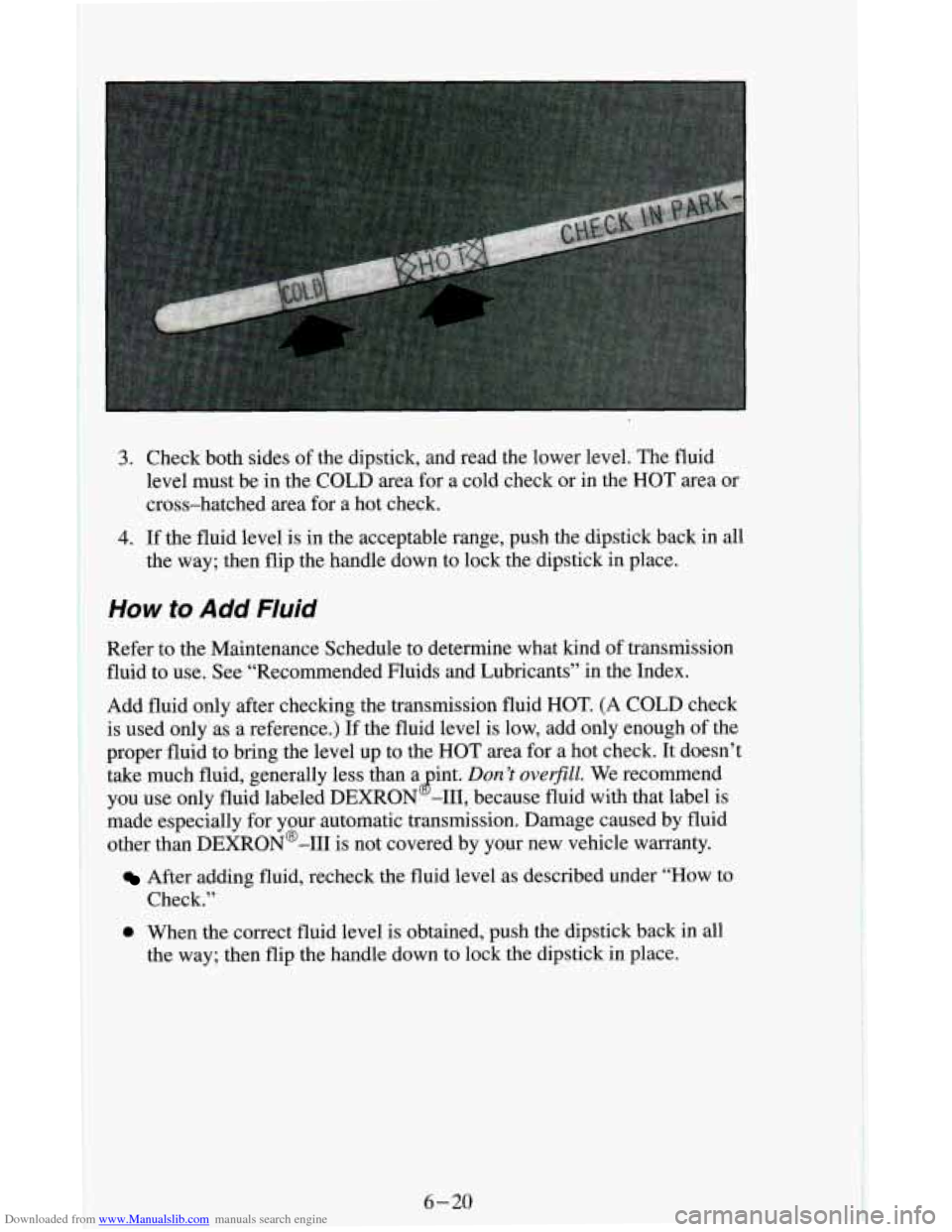
Downloaded from www.Manualslib.com manuals search engine 3. Check both sides of the dipstick, and read the lower level. The fluid
level must be in the COLD area for a cold check or in the
HOT area or
cross-hatched area for a hot check.
4. If the fluid level is in the acceptable range, push the dipstick back in all
the way; then flip the handle down to lock the dipstick in place.
How to Add Fluid
Refer to the Maintenance Schedule to determine what kind of transmission
fluid to use., See “Recommended Fluids and Lubricants” in the Index.
Add fluid only after checking the transmission fluid
HOT. (A COLD check
is used only’ as a reference.) If the fluid level is low, add only enough of the
proper fluid to bring the level up to the
HOT area for a hot check. It doesn’t
take much fluid, generally less than a int.
Don ’t overjill. We recommend
you use only fluid labeled DEXRON
8 -111, because fluid with that label is
made especially for your automatic transmission. Damage caused by fluid
other than DEXRON@-I11 is not covered by your new vehicle warranty.
After adding fluid, recheck the fluid level as described under “How to
Check.”
0 When the correct fluid level is obtained, push the dipstick back in all
the way; then flip the handle down to lock the dipstick in place.
6-20
Page 241 of 342
Downloaded from www.Manualslib.com manuals search engine For more information on vehicle storage, contact your dealer’s service
department, or write to:
Adistra Corporation
17 1 Hamilton Street
Plymouth, MI
48 170
In Canada, write to:
General Motors of Canada, Limited
Customer Services Department
Oshawa, Ontario
Ll J 5Z6
Fluid Leak Check
After the vehicle has been parked for awhile, inspect the surface beneath the
vehicle for water, oil,
fuel or other fluids. Water dripping from the air
conditioning system is normal. If you notice fuel leaks or fumes, the causes
should be found and corrected at once.
Bulb Replacement
Before replacing any bulbs, make sure all lights are off and the vehicle is
not running.
Sealed Beam Headlamps
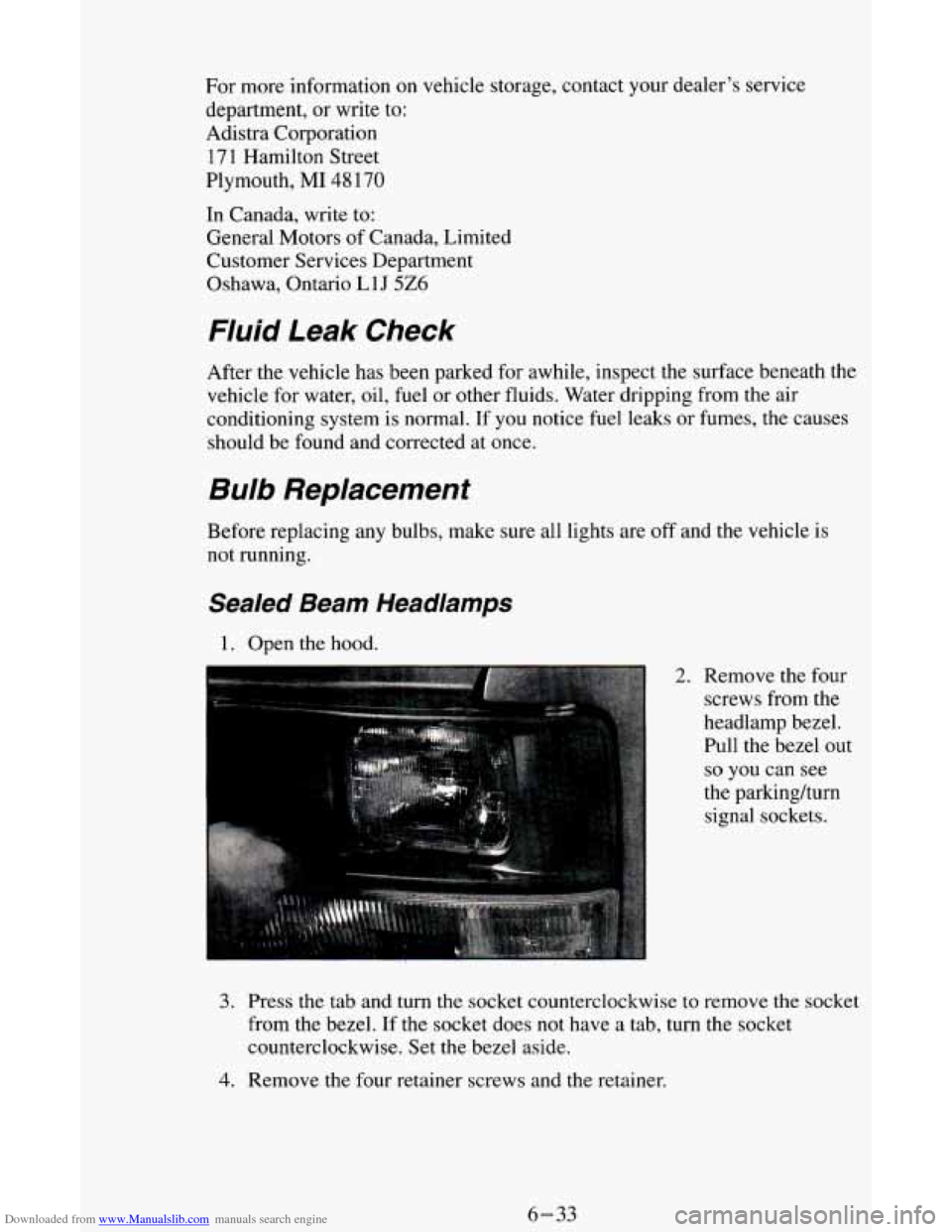
1. Open the hood.
2. Remove the four
screws from the
headlamp bezel.
Pull the bezel out
so you can see
the parkingkurn
signal sockets.
3. Press the tab and turn the socket counterclockwise to remove the socket
from the bezel. If the socket does
not have a tab, turn the socket
counterclockwise. Set the bezel aside.
4. Remove the four retainer screws and the retainer.
6-33
Page 244 of 342
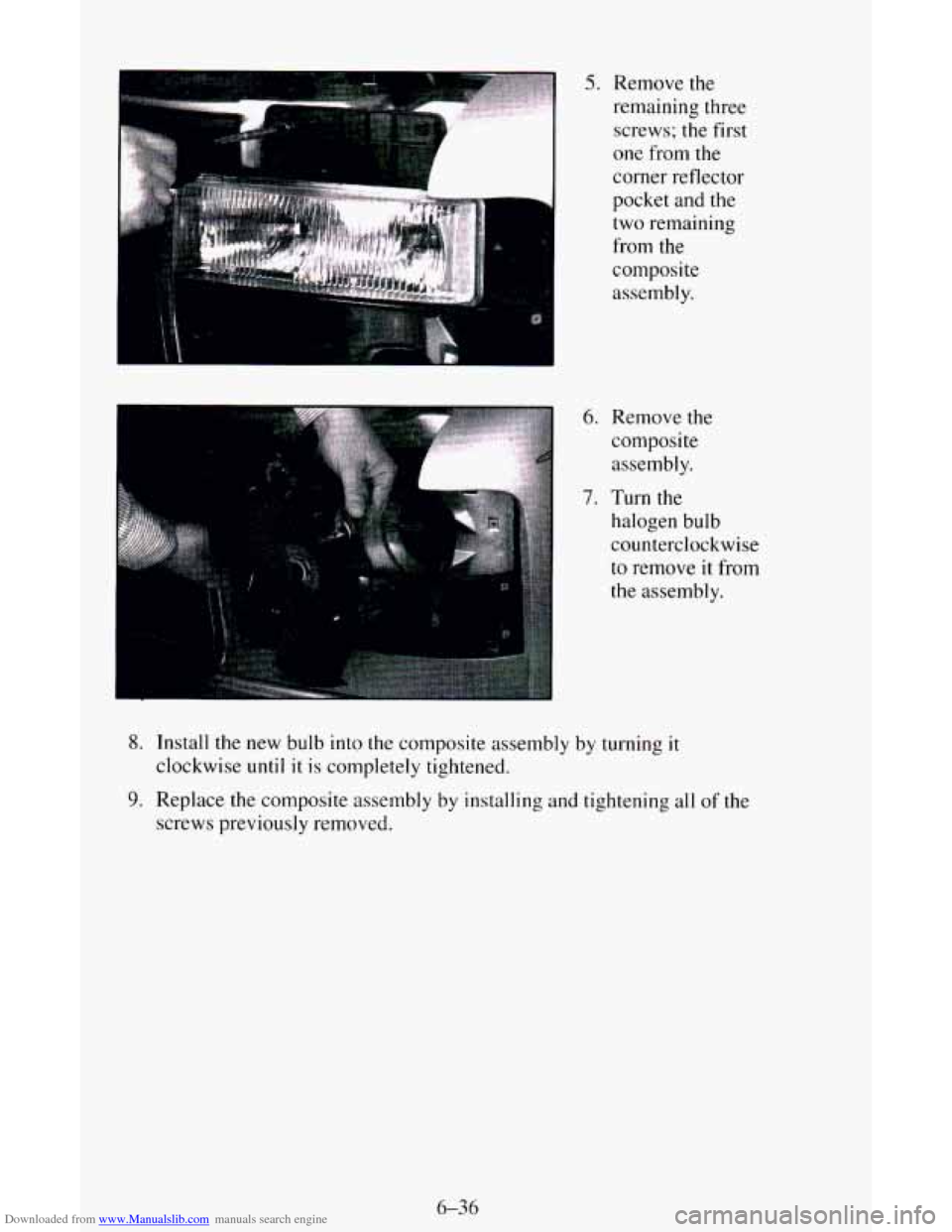
Downloaded from www.Manualslib.com manuals search engine 5. Remove the
remaining three
screws; the first
one from the
corner reflector
pocket and the
two remaining
from the
composite
assembly.
6. Remove the
composite
assembly.
halogen bulb
counterclockwise
to remove it from
the assembly.
7. Turn the
8. Install the new bulb into the composite assembly by turning it
9. Replace the composite assembly by installing and tightening all of the
clockwise
until it is
completely tightened.
screws previously removed.
6-36
Page 245 of 342
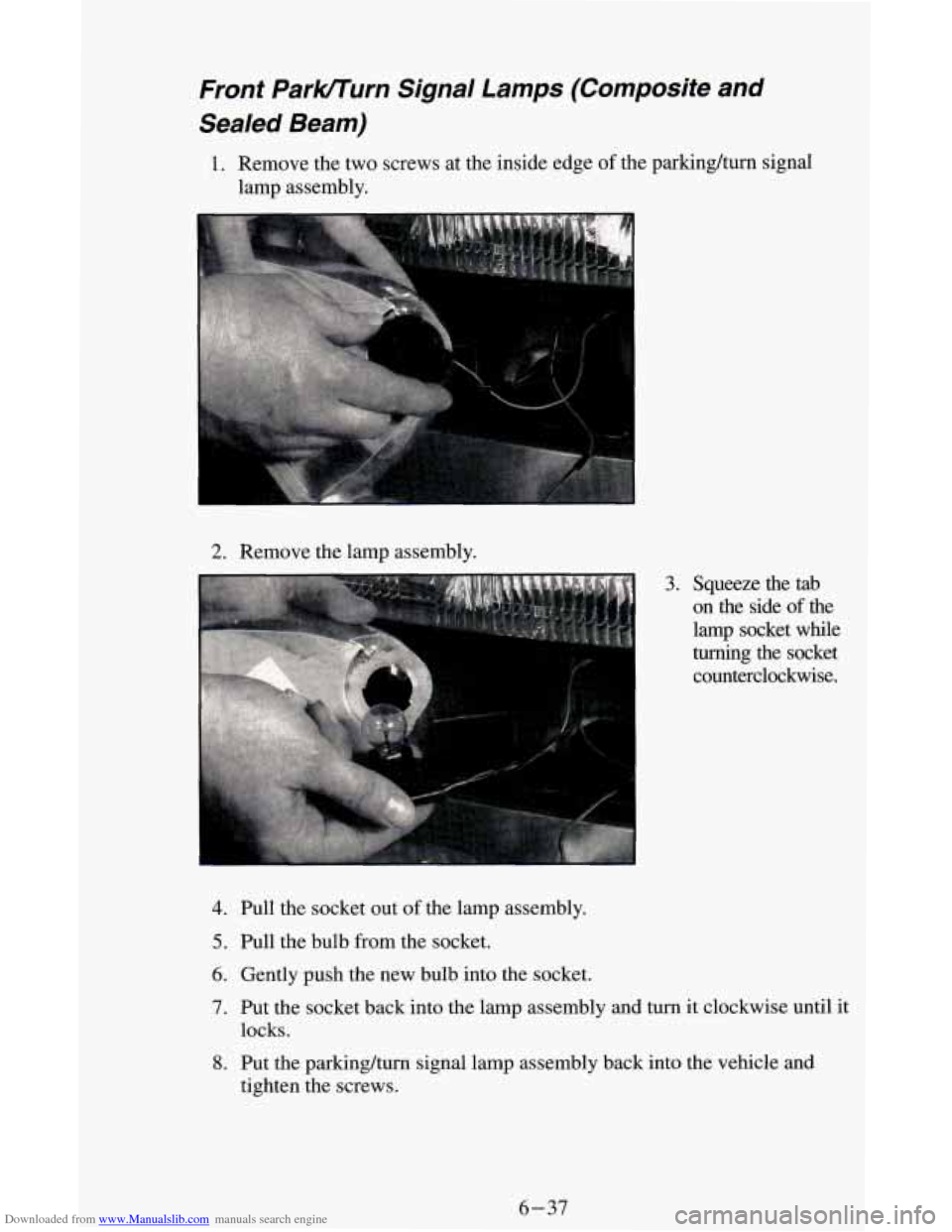
Downloaded from www.Manualslib.com manuals search engine Front Parlcrrurn Signal Lamps (Composite and Sealed Beam)
1. Remove the two screws at the inside edge of the parking/turn signal
lamp assembly.
2. Remove +he lamp awmbly.
3. Squeeze the tab
on the side
of the
lamp socket while
turning the socket
counterclockwise.
4. Pull the socket out of the lamp assembly.
5. Pull the bulb from the socket.
6. Gently push the new bulb into the socket.
7. ht the socket back into the lamp assembly and turn it clockwise until it
locks.
8. Put the parking/turn signal lamp assembly back into the vehicle and
tighten the screws.
6-37
Page 246 of 342
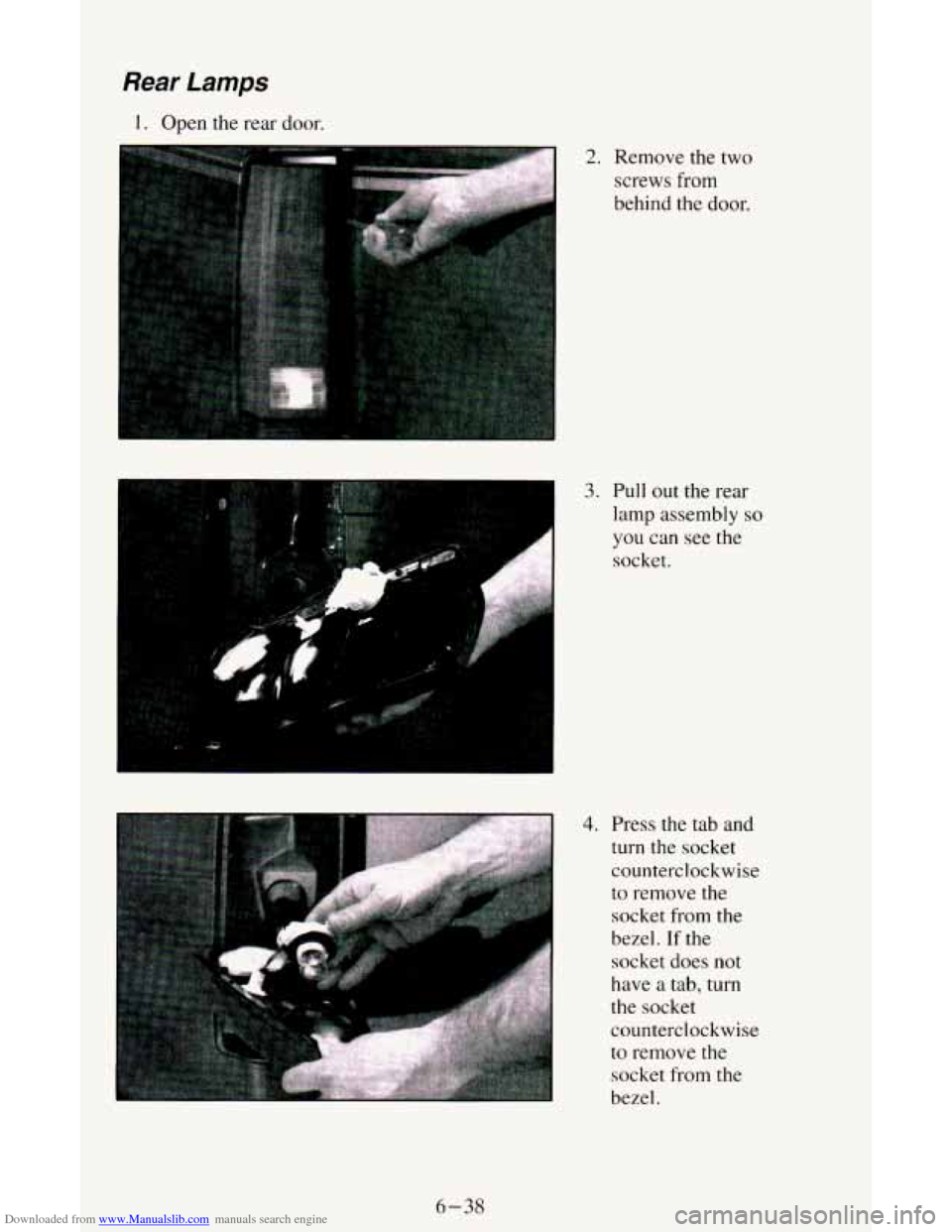
Downloaded from www.Manualslib.com manuals search engine Rear Lamps
I. Open the rear door.
n
i
2.
3.
Remove the two
screws from
behind the door.
Pull out the rear
lamp assembly s
you can see the
socket.
4. Press the tab and
turn the socket
counterclockwise
to remove the
socket from
the
bezel. If the
socket does not
have a tab, turn
the socket
counterclockwise
to remove
the
socket from the
bezel.
6-38
Page 247 of 342
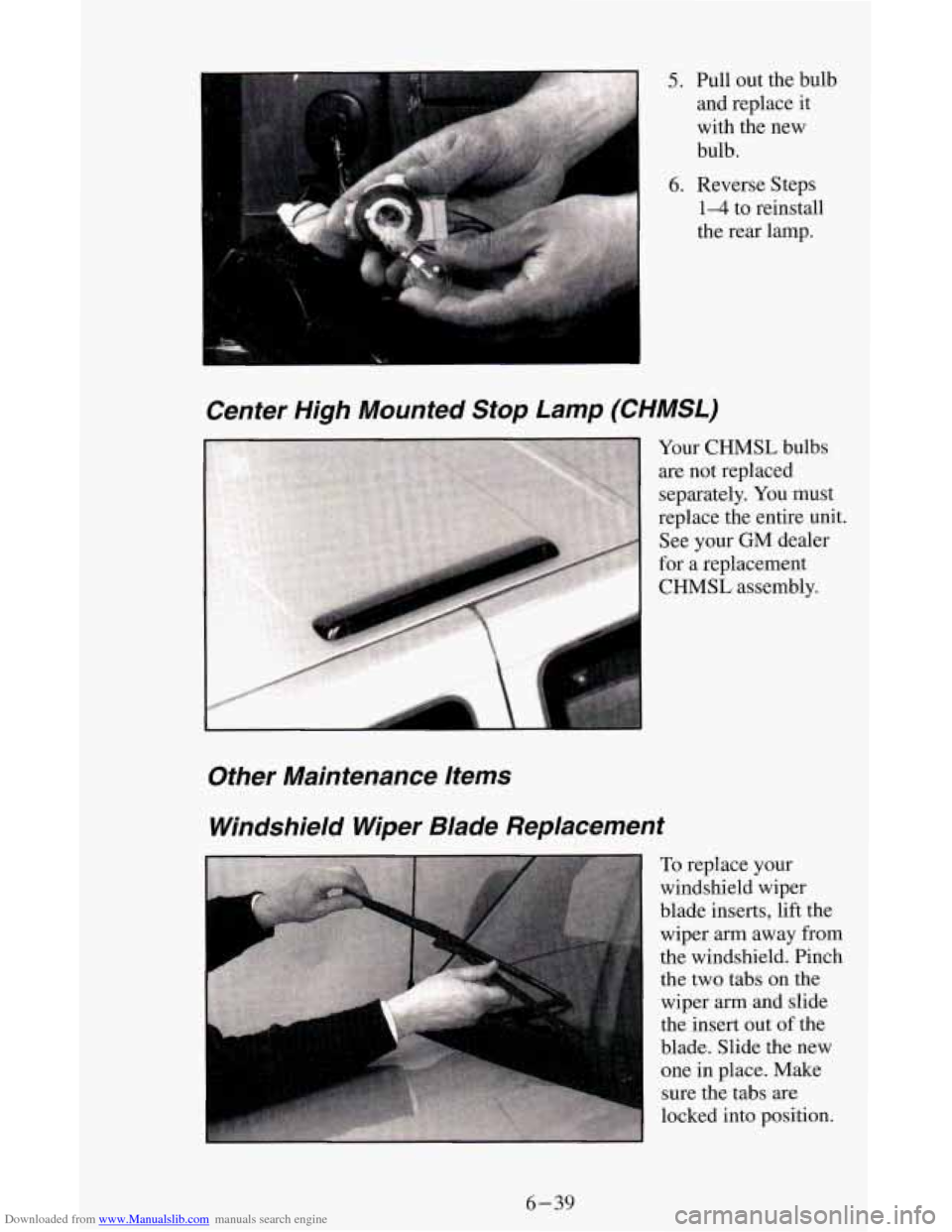
Downloaded from www.Manualslib.com manuals search engine 5. Pull out the bulb
and replace it
with the new
bulb.
6. Reverse Steps
1-4 to reinstall
the rear lamp.
Center High Mounted Stop Lamp (CHMSL)
I
Other Maintenance Items
Windshield Wiper Blade Replacement
To replace your
windshield wiper
blade inserts, lift the
wiper arm away from
the windshield. Pinch the two tabs on the
wiper
arm and slide
the insert out of the
blade. Slide the new
one in place. Make
sure the tabs are
locked into position.
6-39
Page 248 of 342
Downloaded from www.Manualslib.com manuals search engine Air Conditioning
Every now and then have your dealership check your air conditioning
system
to be sure it has not lost any cooling ability. If you think the system
is not working properly, have your dealership check it out as soon as
possible.
The air conditioning will not work when the temperature
is below 40°F
(4°C).
Lock Cylinders
To be sure your locks operate properly, they must be lubricated.
Refer
to the Maintenance Schedule to determine how often to lubricate them
and what type
of lubricant to use.
You should not use penetrating oils because they could wash out the factory
installed lubricant and cause the lock to bind. De-icers which contain
alcohol could also wash away the lubricant,
so be sure to lubricate the lock
after using a de-icer of this type.
Exhaust System
To help prevent damage to your exhaust system, do not continue to drive
your vehicle if you notice:
0 Engine misfiring
Loss of performance
Exhaust system components hanging lower than normal.
Loud exhaust system noises.
Other unusual operating conditions
Have your engine and exhaust system serviced regularly.
Three-way Catalytic Converter
Your vehicle’s three-way catalytic converter is designed to reduce the
pollutants in your vehicle’s exhaust. Use only unleaded fuel in your vehicle.
If you use leaded fuel, you could damage your three-way catalytic converter
and other engine components.
Engine Control Module System
This system has an oxygen (02) sensor that helps keep your engine’s
air-fuel mixture at a proper level. Use only unleaded fuel in your vehicle. If
you
use leaded fuel, you could damage your oxygen (02) sensor and affect
your vehicle’s emissions.
6-40
Page 268 of 342
Downloaded from www.Manualslib.com manuals search engine Fuses and Circuit Breakers
The wiring circuits in your vehicle are protected from short circuits by a
combination of fuses, circuit breakers, and fusible thermal links in
the
wiring itself. This greatly reduces the chance of fires caused by electrical
problems.
See “Fuses and Circuit Breakers” in the Index for more
information.
Headlamps
The headlamp wiring is protected by a circuit breaker in the lamp switch.
An electrical overload will cause the lamps
to go on and off, or in some
cases to remain off. If this happens, have your headlamp wiring checked
right away.
Windshield Wipers
The windshield wiper motor is protected by a circuit breaker and a fuse. If
the motor overheats due
to heavy snow, etc., the wiper will stop until the
motor cools. If the overload is caused by some electrical problem and not
snow, etc., be sure to get it fixed.
Power Windows and Other Power Options
Circuit breakers in the fuse panel protect the power windows and other
power accessories. When the current load is too heavy, the circuit breaker
opens and closes, protecting the circuit until the problem is fixed or goes
away.
Trailer Wiring Harness
The optional eight-wire trailer wiring harness is protected by an in-line fuse
in the battery feed wire. This fuse is near the junction block, See “Trailer
Wiring Harness” in the Index.
6-60