change time CHEVROLET ASTRO CARGO VAN 2003 2.G User Guide
[x] Cancel search | Manufacturer: CHEVROLET, Model Year: 2003, Model line: ASTRO CARGO VAN, Model: CHEVROLET ASTRO CARGO VAN 2003 2.GPages: 382, PDF Size: 2.63 MB
Page 241 of 382

Notice:If the air cleaner/®lter is off, a back®re can
cause a damaging engine ®re. And, dirt can
easily get into your engine, which will damage it.
Always have the air cleaner/®lter in place when
you're driving.
Automatic Transmission Fluid
When to Check and Change
A good time to check your automatic transmission ¯uid
level is when the engine oil is changed.
Change both the ¯uid and ®lter every 15,000 miles
(25 000 km) if the vehicle is mainly driven under one or
more of these conditions:
·In heavy city traffic where the outside temperature
regularly reaches 90ÉF (32ÉC) or higher.
·In hilly or mountainous terrain.
·When doing frequent trailer towing.
·Uses such as found in taxi, police or delivery
service.
If you do not use your vehicle under any of these
conditions, change the ¯uid and ®lter every 50,000 miles
(83 000 km).
See
Part A: Scheduled Maintenance Services on
page 6-4.
How to Check
Because this operation can be a little difficult, you may
choose to have this done at the dealership service
department.
If you do it yourself, be sure to follow all the instructions
here, or you could get a false reading on the dipstick.
Notice:Too much or too little ¯uid can damage
your transmission. Too much can mean that some
of the ¯uid could come out and fall on hot engine
part or exhaust system parts, starting a ®re.
Too little ¯uid could cause the transmission to
overheat. Be sure to get an accurate reading if you
check your transmission ¯uid.
Wait at least 30 minutes before checking the
transmission ¯uid level if you have been driving:
·When outside temperatures are above 90ÉF (32ÉC).
·At high speed for quite a while.
·In heavy traffic Ð especially in hot weather.
·While pulling a trailer.
To get the right reading, the ¯uid should be at normal
operating temperature, which is 180ÉF to 200ÉF
(82ÉC to 93ÉC).
5-25
Page 262 of 382

Replacing Brake System Parts
The braking system on a vehicle is complex. Its many
parts have to be of top quality and work well together if
the vehicle is to have really good braking. Your vehicle
was designed and tested with top-quality GM brake parts.
When you replace parts of your braking system Ð for
example, when your brake linings wear down and you
need new ones put in Ð be sure you get new approved
GM replacement parts. If you don't, your brakes may no
longer work properly. For example, if someone puts in
brake linings that are wrong for your vehicle, the balance
between your front and rear brakes can change Ð for the
worse. The braking performance you've come to expect
can change in many other ways if someone puts in the
wrong replacement brake parts.
Battery
Your new vehicle comes with a maintenance free
ACDelcožbattery. When it's time for a new battery, get
one that has the replacement number shown on the
original battery's label. We recommend an ACDelco
ž
battery. SeeEngine Compartment Overview on
page 5-14for battery location.
Warning:Battery posts, terminals and related
accessories contain lead and lead compounds,
chemicals known to the State of California to cause
cancer and reproductive harm. Wash hands after
handling.
5-46
Page 281 of 382
Make sure the spare tire is stored securely. Push, pull,
and then try to rotate or turn the tire. If it moves,
use the ratchet/wheel wrench to tighten the cable. See
Changing a Flat Tire on page 5-71.
The purpose of regular rotation is to achieve more
uniform wear for all tires on the vehicle. The ®rst rotation
is the most important. See ªPart A: Scheduled
Maintenance Services,º in Section 6, for scheduled
rotation intervals.
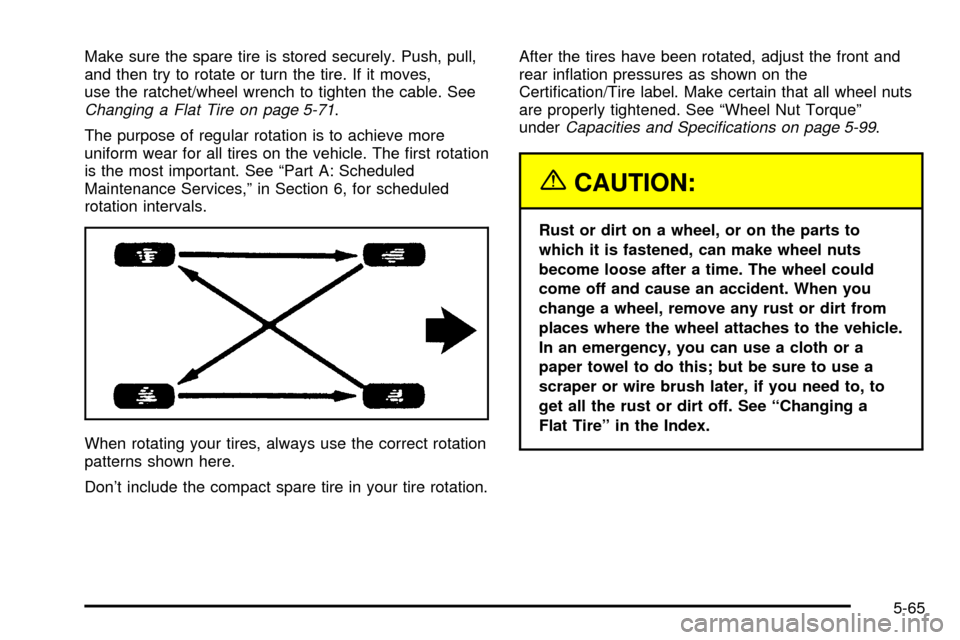
When rotating your tires, always use the correct rotation
patterns shown here.
Don't include the compact spare tire in your tire rotation.After the tires have been rotated, adjust the front and
rear in¯ation pressures as shown on the
Certi®cation/Tire label. Make certain that all wheel nuts
are properly tightened. See ªWheel Nut Torqueº
underCapacities and Speci®cations on page 5-99.
{CAUTION:
Rust or dirt on a wheel, or on the parts to
which it is fastened, can make wheel nuts
become loose after a time. The wheel could
come off and cause an accident. When you
change a wheel, remove any rust or dirt from
places where the wheel attaches to the vehicle.
In an emergency, you can use a cloth or a
paper towel to do this; but be sure to use a
scraper or wire brush later, if you need to, to
get all the rust or dirt off. See ªChanging a
Flat Tireº in the Index.
5-65
Page 295 of 382
9. Remove any rust or dirt from the wheel bolts,
mounting surfaces and spare wheel.
{CAUTION:
Rust or dirt on the wheel, or on the parts to
which it is fastened, can make the wheel nuts
become loose after a time. The wheel could
come off and cause an accident. When you
change a wheel, remove any rust or dirt from
the places where the wheel attaches to the
vehicle. In an emergency, you can use a cloth
or a paper towel to do this; but be sure to use
a scraper or wire brush later, if you need to, to
get all the rust or dirt off.
{CAUTION:
Never use oil or grease on studs or nuts. If you
do, the nuts might come loose. Your wheel
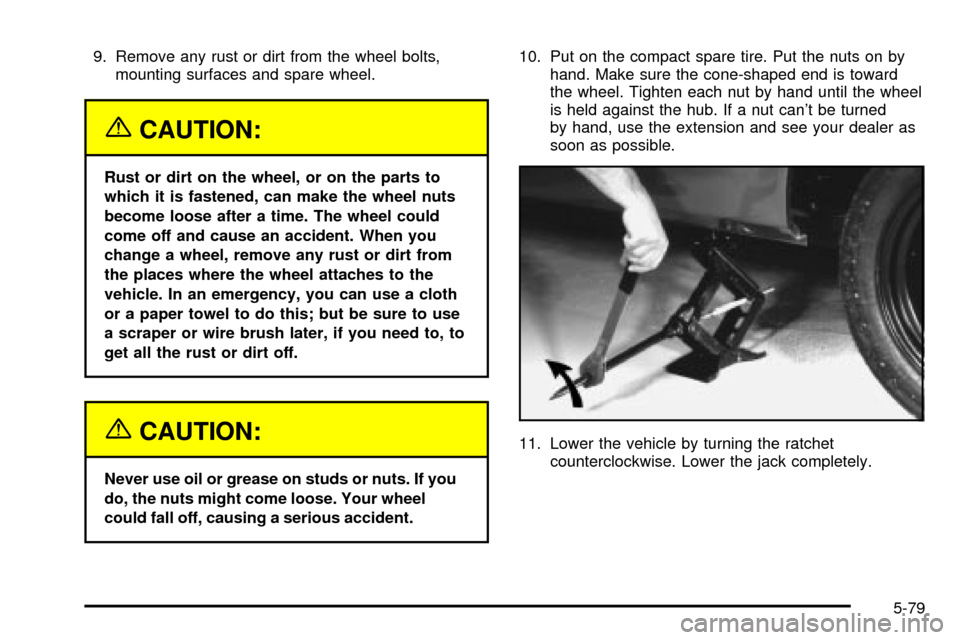
could fall off, causing a serious accident.10. Put on the compact spare tire. Put the nuts on by
hand. Make sure the cone-shaped end is toward
the wheel. Tighten each nut by hand until the wheel
is held against the hub. If a nut can't be turned
by hand, use the extension and see your dealer as
soon as possible.
11. Lower the vehicle by turning the ratchet
counterclockwise. Lower the jack completely.
5-79
Page 317 of 382
Normal Maintenance Replacement Parts
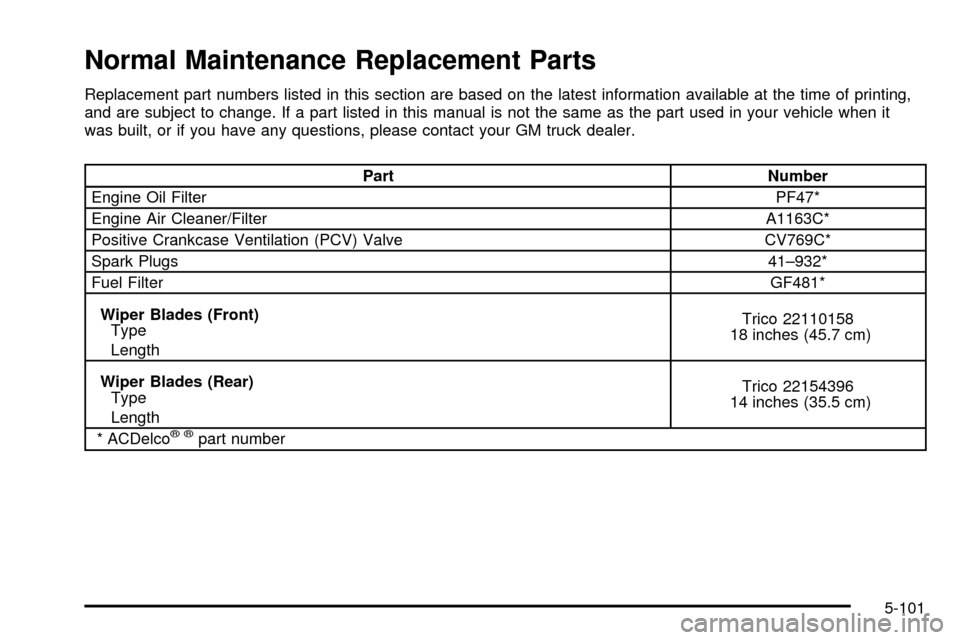
Replacement part numbers listed in this section are based on the latest information available at the time of printing,
and are subject to change. If a part listed in this manual is not the same as the part used in your vehicle when it
was built, or if you have any questions, please contact your GM truck dealer.
Part Number
Engine Oil FilterPF47*
Engine Air Cleaner/Filter A1163C*
Positive Crankcase Ventilation (PCV) Valve CV769C*
Spark Plugs41±932*
Fuel FilterGF481*
Wiper Blades (Front)
Type
LengthTrico 22110158
18 inches (45.7 cm)
Wiper Blades (Rear)
Type
LengthTrico 22154396
14 inches (35.5 cm)
* ACDelco
žžpart number
5-101
Page 325 of 382

Short Trip/City Scheduled
Maintenance
The services shown in this schedule up to 100,000 miles
(166 000 km) should be repeated after 100,000 miles
(166 000 km) at the same intervals for the life of this
vehicle. The services shown at 150,000 miles
(240 000 km) should be repeated at the same interval
after 150,000 miles (240 000 km) for the life of this
vehicle.
See
Part B: Owner Checks and Services on page 6-26andPart C: Periodic MaintenanceInspections on
page 6-30.
Footnotes
²The U.S. Environmental Protection Agency or the
California Air Resources Board has determined that the
failure to perform this maintenance item will not nullify
the emission warranty or limit recall liability prior to
the completion of the vehicle's useful life. We, however,
urge that all recommended maintenance services be
performed at the indicated intervals and the
maintenance be recorded.
#Lubricate the front suspension, ball joints and kingpin
bushings, steering linkage, parking brake cable
guides and brake pedal springs.
+A good time to check your brakes is during tire
rotation. See Brake System Inspection on page 6-31.
3,000 Miles (5 000 km)
qChange engine oil and ®lter (or every 3 months,
whichever occurs ®rst).An Emission Control Service.
qLubricate chassis components (or every 3 months,
whichever occurs ®rst).(See footnote #.)
qCheck rear/front axle ¯uid level and add ¯uid as
needed. Check constant velocity joints and axle seals
for leaking.
6,000 Miles (10 000 km)
qChange engine oil and ®lter (or every 3 months,
whichever occurs ®rst).An Emission Control Service.
qLubricate chassis components (or every 3 months,
whichever occurs ®rst).(See footnote #.)
qCheck rear/front axle ¯uid level and add ¯uid as
needed. Check constant velocity joints and axle seals
for leaking.
qRotate tires. See
Tire Inspection and Rotation on
page 5-64for proper rotation pattern and additional
information.(See footnote +.)
9,000 Miles (15 000 km)
qChange engine oil and ®lter (or every 3 months,
whichever occurs ®rst).An Emission Control Service.
qLubricate chassis components (or every 3 months,
whichever occurs ®rst).(See footnote #.)
qCheck rear/front axle ¯uid level and add ¯uid as
needed. Check constant velocity joints and axle seals
for leaking.
6-7
Page 336 of 382

Long Trip/Highway Scheduled
Maintenance
The services shown in this schedule up to 100,000 miles
(166 000 km) should be repeated after 100,000 miles
(166 000 km) at the same intervals for the life of
this vehicle. The services shown at 150,000 miles
(240 000 km) should be repeated at the same interval
after 150,000 miles (240 000 km) for the life of this
vehicle.
See
Part B: Owner Checks and Services on page 6-26andPart C: Periodic MaintenanceInspections on
page 6-30.
Footnotes
²The U.S. Environmental Protection Agency or the
California Air Resources Board has determined that the
failure to perform this maintenance item will not nullify the
emission warranty or limit recall liability prior to the
completion of the vehicle's useful life. We, however, urge
that all recommended maintenance services be
performed at the indicated intervals and the maintenance
be recorded.
#Lubricate the front suspension, ball joints and kingpin
bushings, steering linkage and transfer case shift linkage,
parking brake cable guides and brake pedal springs.
+A good time to check your brakes is during tire
rotation. See Brake System Inspection on page 6-31.
7,500 Miles (12 500 km)
qChange engine oil and ®lter (or every 12 months,
whichever occurs ®rst).An Emission Control
Service.
qLubricate chassis components (or every 12 months,
whichever occurs ®rst).(See footnote #).
qCheck rear/front axle ¯uid level and add ¯uid as
needed. Check constant velocity joints and axle seals
for leaking.
qRotate tires. See
Tire Inspection and Rotation on
page 5-64for proper rotation pattern and additional
information.(See footnote +).
6-18
Page 364 of 382

Additional Program Information
Courtesy Transportation is available during the
Bumper-to-Bumper warranty coverage period, but itis
notpart of the New Vehicle Limited Warranty. A
separate booklet entitled ªWarranty and Owner
Assistance Informationº furnished with each new vehicle
provides detailed warranty coverage information.
Courtesy Transportation is available only at participating
dealers and all program options, such as shuttle
service, may not be available at every dealer. Please
contact you dealer for speci®c information about
availability. All Courtesy Transportation arrangements
will be administered by appropriate dealer personnel.
Canadian Vehicles:For warranty repairs during
the Complete Vehicle Coverage period of the General
Motors of Canada New Vehicle Limited Warranty,
alternative transportation may be available under the
Courtesy Transportation Program. Please consult
your dealer for details.
General Motors reserves the right to unilaterally modify,
change or discontinue Courtesy Transportation at
any time and to resolve all questions of claim eligibility
pursuant to the terms and conditions described
herein at its sole discretion.
Reporting Safety Defects
Reporting Safety Defects to the
United States Government
If you believe that your vehicle has a defect which could
cause a crash or could cause injury or death, you
should immediately inform the National Highway Traffic
Safety Administration (NHTSA), in addition to notifying
General Motors.
If NHTSA receives similar complaints, it may open an
investigation, and if it ®nds that a safety defect exists in
a group of vehicles, it may order a recall and remedy
campaign. However, NHTSA cannot become involved in
individual problems between you, your dealer or
General Motors.
To contact NHTSA, you may either call the Auto Safety
Hotline toll-free at 1-800-424-9393 (or 366-0123 in
the Washington, D.C. area) or write to:
NHTSA, U.S. Department of Transportation
Washington, D.C. 20590
You can also obtain other information about motor
vehicle safety from the hotline.
7-10
Page 366 of 382

Service Bulletins
Service Bulletins give technical service information
needed to knowledgeably service General Motors cars
and trucks. Each bulletin contains instructions to
assist in the diagnosis and service of your vehicle.
In Canada, information pertaining to Product Service
Bulletins can be obtained by contacting your General
Motors dealer or by calling 1-800-GM-DRIVE
(1-800-463-7483).
Owner's Information
Owner publications are written speci®cally for owners
and intended to provide basic operational information
about the vehicle. The owner's manual will include
the Maintenance Schedule for all models.
In-Portfolio: Includes a Portfolio, Owner's Manual, and
Warranty Booklet.
RETAIL SELL PRICE: $35.00
Without Portfolio: Owner's Manual only.
RETAIL SELL PRICE: $25.00
Current and Past Model Order Forms
Service Publications are available for current and
past model GM vehicles. To request an order form,
please specify year and model name of the vehicle.
ORDER TOLL FREE: 1-800-551-4123
Monday-Friday 8:00 AM - 6:00 PM
Eastern Time
For Credit Card Orders Only
(VISA-MasterCard-Discover), visit Helm, Inc. on the
World Wide Web at: www.helminc.com
Or you can write to:
Helm, Incorporated
P. O. Box 07130
Detroit, MI 48207
Prices are subject to change without notice and without
incurring obligation. Allow ample time for delivery.
Note to Canadian Customers: All listed prices are
quoted in U.S. funds. Canadian residents are to make
checks payable in U.S. funds.
7-12
Page 380 of 382

Tires.............................................................5-63
Buying New Tires........................................5-66
Chains.......................................................5-70
Changing a Flat Tire....................................5-71
Compact Spare Tire.....................................5-82
If a Tire Goes Flat.......................................5-70
In¯ation Ð Tire Pressure..............................5-64
Inspection and Rotation................................5-64
Uniform Tire Quality Grading.........................5-67
Wheel Alignment and Tire Balance.................5-69
Wheel Replacement.....................................5-69
When It Is Time for New Tires......................5-66
To Use the Engine Coolant Heater....................2-22
Top Strap Anchor Location...............................1-50
Top Strap......................................................1-48
Torque Lock...................................................2-29
Total Weight on Your Vehicle's Tires..................4-35
Tow/Haul Mode Button.....................................2-25
Tow/Haul Mode Light.......................................3-36
Towing..........................................................4-29
Recreational Vehicle.....................................4-29
Towing a Trailer..........................................4-31
Your Vehicle...............................................4-29
Trailer Brakes.................................................4-36
Trailer Wiring Harness.....................................4-41
Trailering Package..........................................4-31
Transfer Case................................................5-52Transmission Operation, Automatic....................2-23
Transmission, Transaxle, Transfer Case Unit
Repair Manual............................................7-11
Transmission..................................................5-25
Fluid, Automatic...........................................5-25
Transportation Options...................................... 7-9
Trip Odometer................................................3-25
Turn and Lane Change Signals.......................... 3-6
Turn Signal/Multifunction Lever........................... 3-6
Turn Signals When Towing a Trailer..................4-38
U
Underbody Flushing Service.............................6-29
Underhood Fuse Block....................................5-96
Understanding Radio Reception........................3-50
Uniform Tire Quality Grading............................5-67
United States ± Customer Assistance.................. 7-4
Unlocking the Theft-Deterrent Feature After a
Power Loss................................................3-49
Used Replacement Wheels..............................5-70
Using Cleaner on Fabric..................................5-84
Using HomeLink
ž...........................................2-37
14