window CHEVROLET ASTRO CARGO VAN 2003 2.G Owners Manual
[x] Cancel search | Manufacturer: CHEVROLET, Model Year: 2003, Model line: ASTRO CARGO VAN, Model: CHEVROLET ASTRO CARGO VAN 2003 2.GPages: 382, PDF Size: 2.63 MB
Page 1 of 382

Seats and Restraint Systems........................... 1-1
Front Seats
............................................... 1-2
Rear Seats
............................................... 1-7
Safety Belts
.............................................1-13
Child Restraints
.......................................1-35
Air Bag System
.......................................1-62
Restraint System Check
............................1-71
Features and Controls..................................... 2-1
Keys
........................................................ 2-2
Doors and Locks
....................................... 2-7
Windows
.................................................2-16
Theft-Deterrent Systems
............................2-18
Starting and Operating Your Vehicle
...........2-19
Mirrors
....................................................2-32
HomeLink
žTransmitter
.............................2-34
Storage Areas
.........................................2-38
Instrument Panel............................................. 3-1
Instrument Panel Overview
.......................... 3-2
Climate Controls
......................................3-18
Warning Lights, Gages and Indicators
.........3-23
Audio System(s)
.......................................3-38
Driving Your Vehicle....................................... 4-1
Your Driving, the Road, and Your Vehicle
..... 4-2Towing
....................................................4-29
Service and Appearance Care.......................... 5-1
Service
..................................................... 5-3
Fuel
......................................................... 5-5
Checking Things Under the Hood
...............5-11
All-Wheel Drive
........................................5-52
Rear Axle
...............................................5-53
Front Axle
...............................................5-54
Bulb Replacement
....................................5-55
Windshield Wiper Blade Replacement
.........5-62
Tires
......................................................5-63
Appearance Care
.....................................5-83
Vehicle Identi®cation
.................................5-91
Electrical System
......................................5-92
Capacities and Speci®cations
.....................5-99
Normal Maintenance Replacement Parts
....5-101
Maintenance Schedule..................................... 6-1
Maintenance Schedule
................................ 6-2
Customer Assistance Information.................... 7-1
Customer Assistance Information
.................. 7-2
Reporting Safety Defects
...........................7-10
Index.................................................................1
2003 Chevrolet Astro Owner ManualM
Page 41 of 382
Child Restraints
Older Children
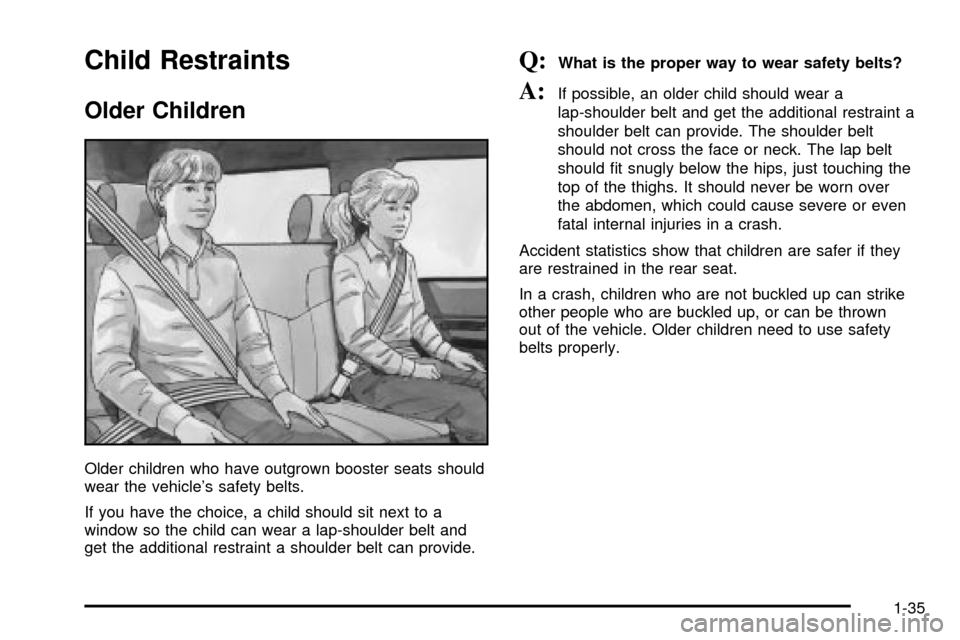
Older children who have outgrown booster seats should
wear the vehicle's safety belts.
If you have the choice, a child should sit next to a
window so the child can wear a lap-shoulder belt and
get the additional restraint a shoulder belt can provide.
Q:What is the proper way to wear safety belts?
A:If possible, an older child should wear a
lap-shoulder belt and get the additional restraint a
shoulder belt can provide. The shoulder belt
should not cross the face or neck. The lap belt
should ®t snugly below the hips, just touching the
top of the thighs. It should never be worn over
the abdomen, which could cause severe or even
fatal internal injuries in a crash.
Accident statistics show that children are safer if they
are restrained in the rear seat.
In a crash, children who are not buckled up can strike
other people who are buckled up, or can be thrown
out of the vehicle. Older children need to use safety
belts properly.
1-35
Page 51 of 382
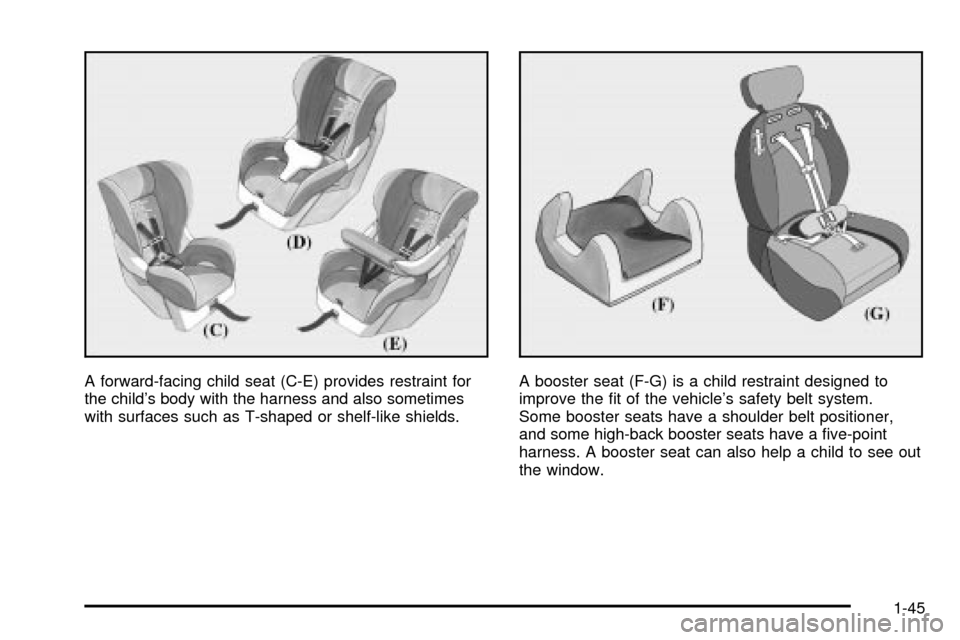
A forward-facing child seat (C-E) provides restraint for
the child's body with the harness and also sometimes
with surfaces such as T-shaped or shelf-like shields.A booster seat (F-G) is a child restraint designed to
improve the ®t of the vehicle's safety belt system.
Some booster seats have a shoulder belt positioner,
and some high-back booster seats have a ®ve-point
harness. A booster seat can also help a child to see out
the window.
1-45
Page 74 of 382

What Will You See After an Air Bag
In¯ates?
After an air bag in¯ates, it quickly de¯ates, so quickly
that some people may not even realize the air
bag in¯ated. Some components of the air bag
module ± the steering wheel hub for the driver's air bag,
or the instrument panel for the right front passenger's bag
± will be hot for a short time. The parts of the bag that
come into contact with you may be warm, but not too hot
to touch. There will be some smoke and dust coming from
the vents in the de¯ated air bags. Air bag in¯ation doesn't
prevent the driver from seeing or being able to steer the
vehicle, nor does it stop people from leaving the vehicle.
{CAUTION:
When an air bag in¯ates, there is dust in the
air. This dust could cause breathing problems
for people with a history of asthma or other
breathing trouble. To avoid this, everyone in
the vehicle should get out as soon as it is safe
to do so. If you have breathing problems but
can't get out of the vehicle after an air bag
in¯ates, then get fresh air by opening a
window or a door. If you experience breathing
problems following an air bag deployment, you
should seek medical attention.
1-68
Page 79 of 382

Keys...............................................................2-2
Remote Keyless Entry System.........................2-4
Remote Keyless Entry System Operation...........2-5
Doors and Locks.............................................2-7
Door Locks....................................................2-7
Front Doors...................................................2-8
Power Door Locks..........................................2-8
Programmable Automatic Door Locks................2-9
Leaving Your Vehicle....................................2-10
Sliding Side Door..........................................2-10
Rear Doors..................................................2-13
Windows........................................................2-16
Manual Windows..........................................2-16
Power Windows............................................2-17
Sun Visors...................................................2-17
Theft-Deterrent Systems..................................2-18
Passlock
ž....................................................2-18
Starting and Operating Your Vehicle................2-19
New Vehicle Break-In....................................2-19
Ignition Positions..........................................2-19
Starting Your Engine.....................................2-21Engine Coolant Heater..................................2-22
Automatic Transmission Operation...................2-23
All-Wheel Drive............................................2-26
Parking Brake..............................................2-26
Shifting Into Park (P).....................................2-27
Shifting Out of Park (P).................................2-29
Parking Over Things That Burn.......................2-30
Engine Exhaust............................................2-30
Running Your Engine While You Are Parked. . . .2-31
Mirrors...........................................................2-32
Manual Rearview Mirror.................................2-32
Outside Manual Mirror...................................2-32
Outside Power Mirrors...................................2-32
Outside Convex Mirror...................................2-33
HomeLink
žTransmitter...................................2-34
Programming the HomeLinkžTransmitter.........2-35
Storage Areas................................................2-38
Overhead Console........................................2-39
Luggage Carrier...........................................2-44
Convenience Net..........................................2-45
Section 2 Features and Controls
2-1
Page 80 of 382
Keys
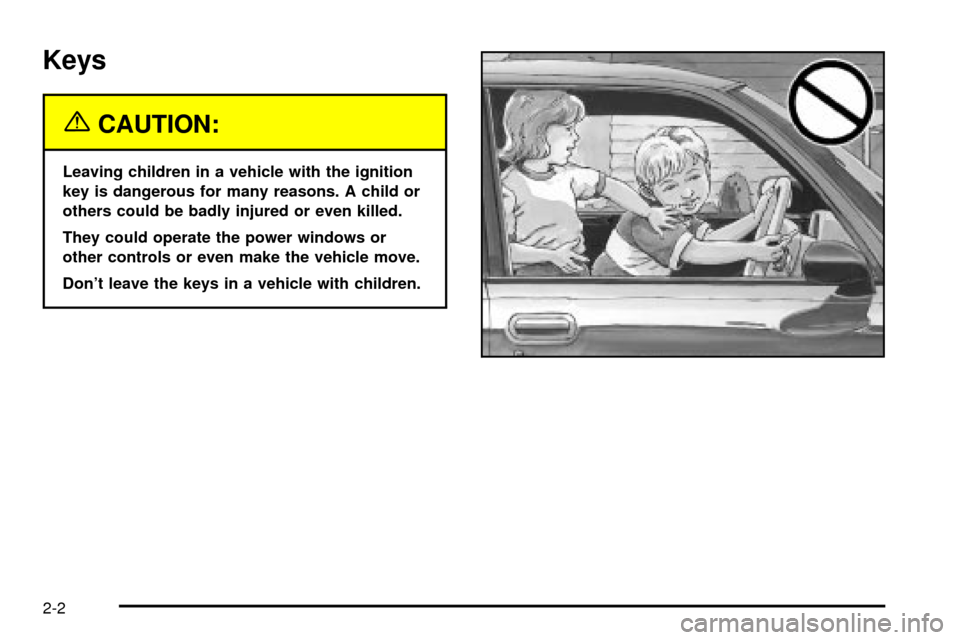
{CAUTION:
Leaving children in a vehicle with the ignition
key is dangerous for many reasons. A child or
others could be badly injured or even killed.
They could operate the power windows or
other controls or even make the vehicle move.
Don't leave the keys in a vehicle with children.
2-2
Page 92 of 382
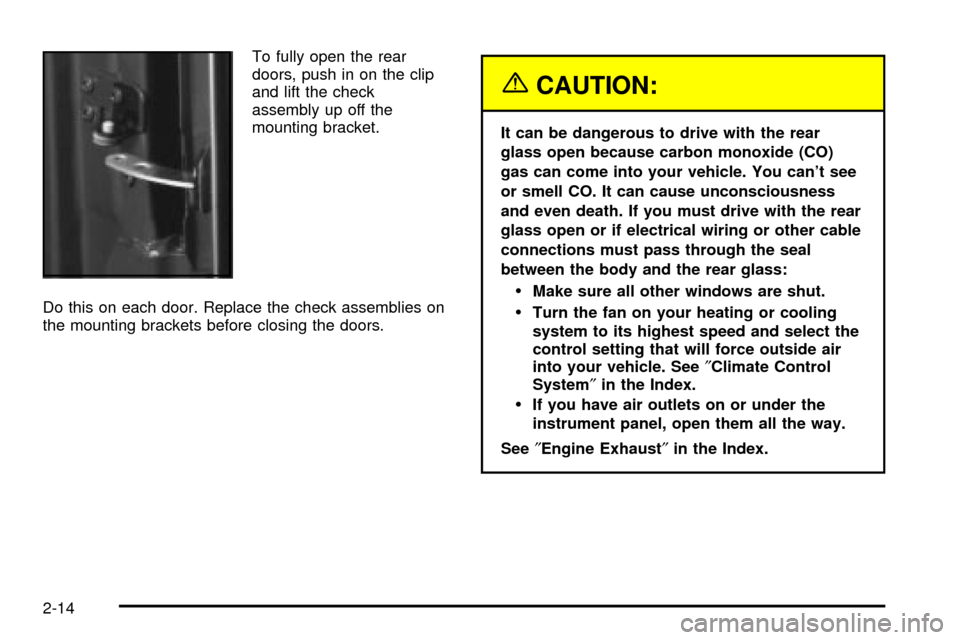
To fully open the rear
doors, push in on the clip
and lift the check
assembly up off the
mounting bracket.
Do this on each door. Replace the check assemblies on
the mounting brackets before closing the doors.
{CAUTION:
It can be dangerous to drive with the rear
glass open because carbon monoxide (CO)
gas can come into your vehicle. You can't see
or smell CO. It can cause unconsciousness
and even death. If you must drive with the rear
glass open or if electrical wiring or other cable
connections must pass through the seal
between the body and the rear glass:
·Make sure all other windows are shut.
·Turn the fan on your heating or cooling
system to its highest speed and select the
control setting that will force outside air
into your vehicle. See²Climate Control
System²in the Index.
·If you have air outlets on or under the
instrument panel, open them all the way.
See²Engine Exhaust²in the Index.
2-14
Page 94 of 382
Windows
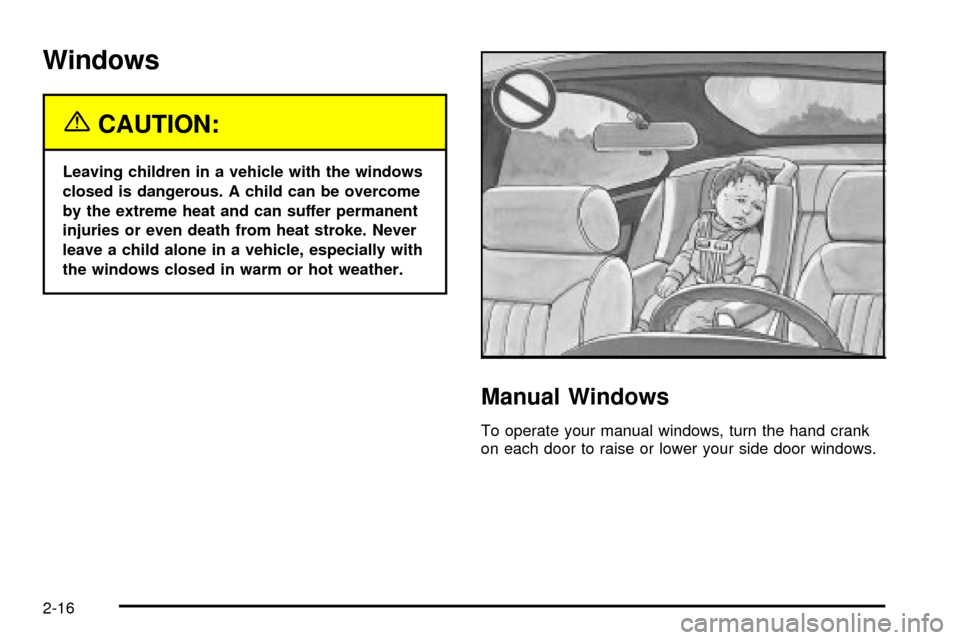
{CAUTION:
Leaving children in a vehicle with the windows
closed is dangerous. A child can be overcome
by the extreme heat and can suffer permanent
injuries or even death from heat stroke. Never
leave a child alone in a vehicle, especially with
the windows closed in warm or hot weather.
Manual Windows
To operate your manual windows, turn the hand crank
on each door to raise or lower your side door windows.
2-16
Page 95 of 382
Power Windows
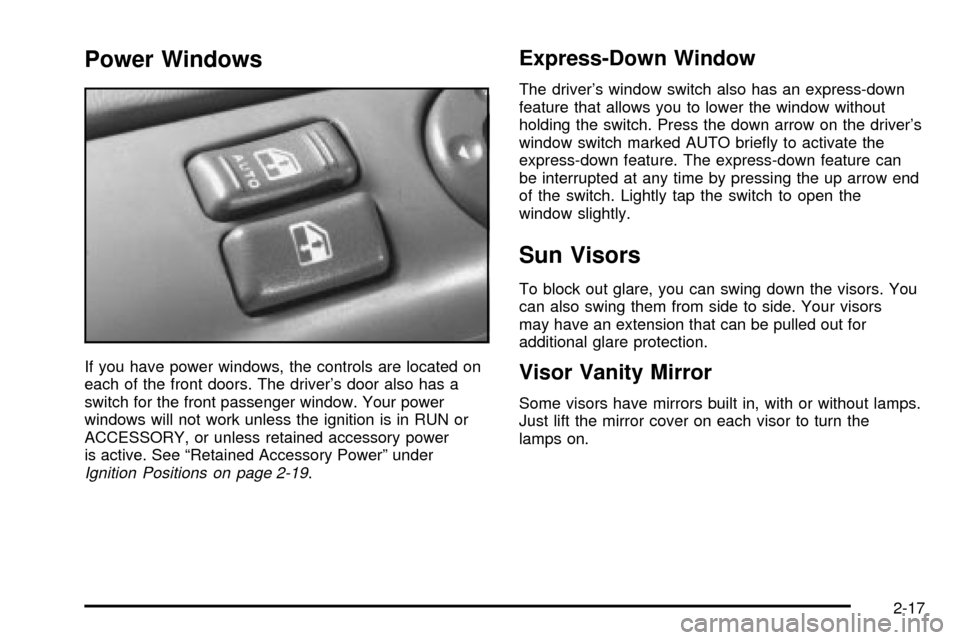
If you have power windows, the controls are located on
each of the front doors. The driver's door also has a
switch for the front passenger window. Your power
windows will not work unless the ignition is in RUN or
ACCESSORY, or unless retained accessory power
is active. See ªRetained Accessory Powerº under
Ignition Positions on page 2-19.
Express-Down Window
The driver's window switch also has an express-down
feature that allows you to lower the window without
holding the switch. Press the down arrow on the driver's
window switch marked AUTO brie¯y to activate the
express-down feature. The express-down feature can
be interrupted at any time by pressing the up arrow end
of the switch. Lightly tap the switch to open the
window slightly.
Sun Visors
To block out glare, you can swing down the visors. You
can also swing them from side to side. Your visors
may have an extension that can be pulled out for
additional glare protection.
Visor Vanity Mirror
Some visors have mirrors built in, with or without lamps.
Just lift the mirror cover on each visor to turn the
lamps on.
2-17
Page 97 of 382

Starting and Operating Your
Vehicle
New Vehicle Break-In
Notice:Your vehicle doesn't need an elaborate
ªbreak-in.º But it will perform better in the long run
if you follow these guidelines:
·Keep your speed at 55 mph (88 km/h) or less for
the ®rst 500 miles (805 km).
·Don't drive at any one speed Ð fast or
slow Ð for the ®rst 500 miles (805 km). Don't
make full-throttle starts.
·Avoid making hard stops for the ®rst 200 miles
(322 km) or so. During this time your new
brake linings aren't yet broken in. Hard stops
with new linings can mean premature wear and
earlier replacement. Follow this breaking-in
guideline every time you get new brake linings.
·Don't tow a trailer during break-in. See ªTowing
a Trailerº in the Index for more information.
Ignition Positions
With the key in the ignition, you can turn it to ®ve
different positions.
A (ACCESSORY):This position lets you use things like
the radio, power windows and windshield wipers when
the engine is off. To get into ACCESSORY, push in the
key and turn it toward you. Your steering wheel will
remain locked, just as it was before you inserted the key.
2-19