check engine CHEVROLET ASTRO PASSENGER 1993 1.G Repair Manual
[x] Cancel search | Manufacturer: CHEVROLET, Model Year: 1993, Model line: ASTRO PASSENGER, Model: CHEVROLET ASTRO PASSENGER 1993 1.GPages: 345, PDF Size: 19 MB
Page 300 of 345
Downloaded from www.Manualslib.com manuals search engine Service & Appearance Cam
Be sure to use the correct fuse. If you ever have a problem on the road and
don’t have a spare fuse, you can “borrow” one of the correct value. Just pick
some feature of your
cigarette lighter-and
as soon
as you can.
information.
Capacities
vehicle that you can get along without-like the radio or
use its fuse,
if it is of the value you need.. Replace it
See “Fuses and Circuit Breakers” in the Index for more
and Specification Charts
Replacement Parfs
Replacement part numbers listed in this section are based on the latest
information available at the time of printing, and are subject to change.
If a
part listed in this manual is not the same as the part used in your vehicle
when
it was built, or if you have any questions, please contact your GM
dealer.
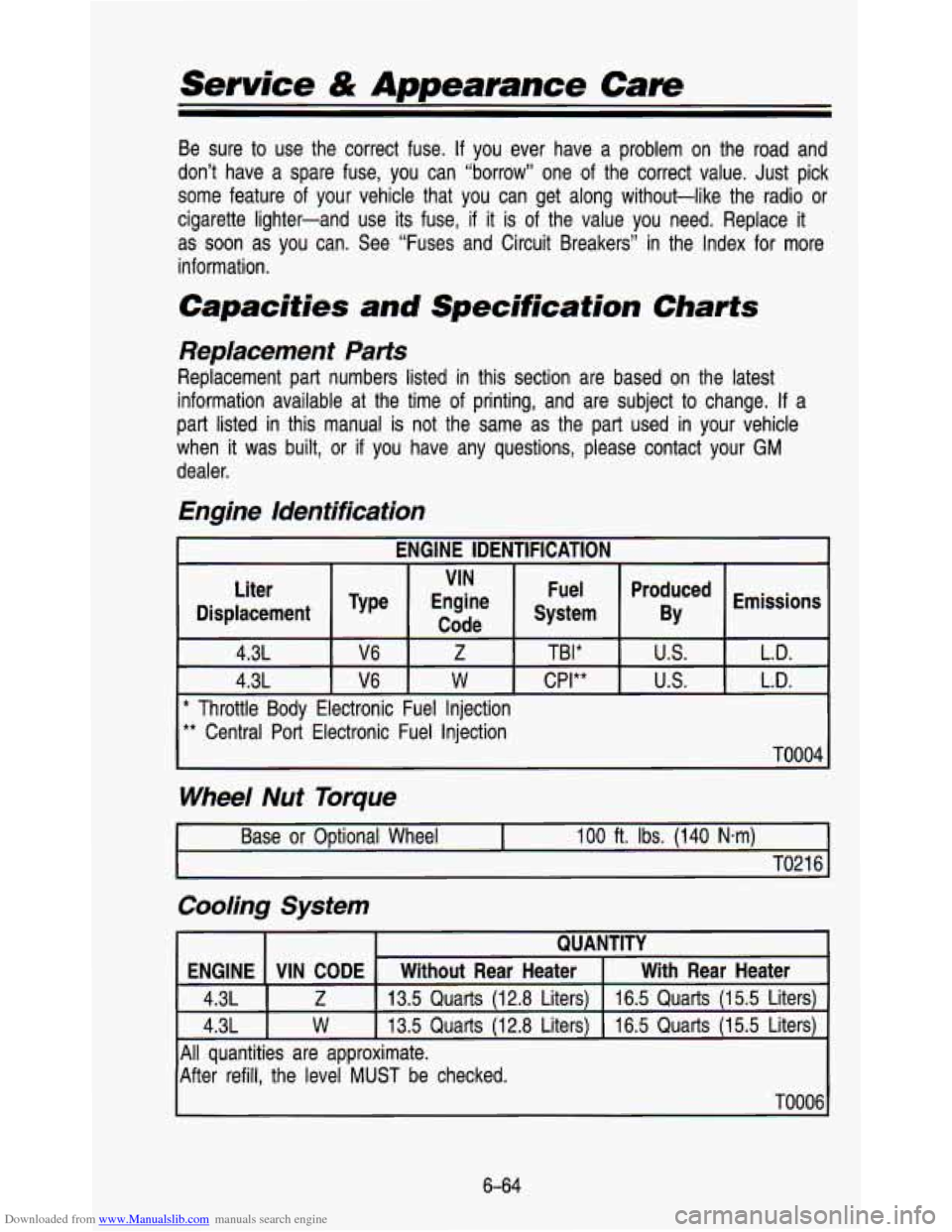
Engine Identification
IGINE IDENTIFICATION
Liter VIN
Fuel
Code
BY Displacement System
Engine
Type
Produced Emissions
4.3L
L.D. U.S. CPI** W V6 4.3L L.D.
us. TBI* Z V6
* Throttle Body Electronic Fuel Injection
** Central Port Electronic Fuel Injection
~0004
Wheel Nut Torque
I Base or Optional Wheel I 100 ft. Ibs. (140
N-m) I
I TO21 6 I
Cooling System
ENGINE With Rear Heater
Without Rear Heater
VIN CODE
QUANTITY
4.3L I Z
16.5 Quarts (1 5.5 Liters)
13.5 Quarts (1 2.8 Liters)
4.3L I w
16.5 Quarts (I 5.5 Liters) 13.5 Quarts (1 2.8 Liters)
All quantities are approximate.
After refill, the level
MUST be checked.
TO006
6-64
Page 301 of 345
Downloaded from www.Manualslib.com manuals search engine Air Conditioning Refrigerants
Not all air conditioning refrigerants are the same. If the air conditioning
system in your vehicle needs refrigerant, be sure the proper refrigerant
is
used. If you’re not sure, ask your GM dealer.
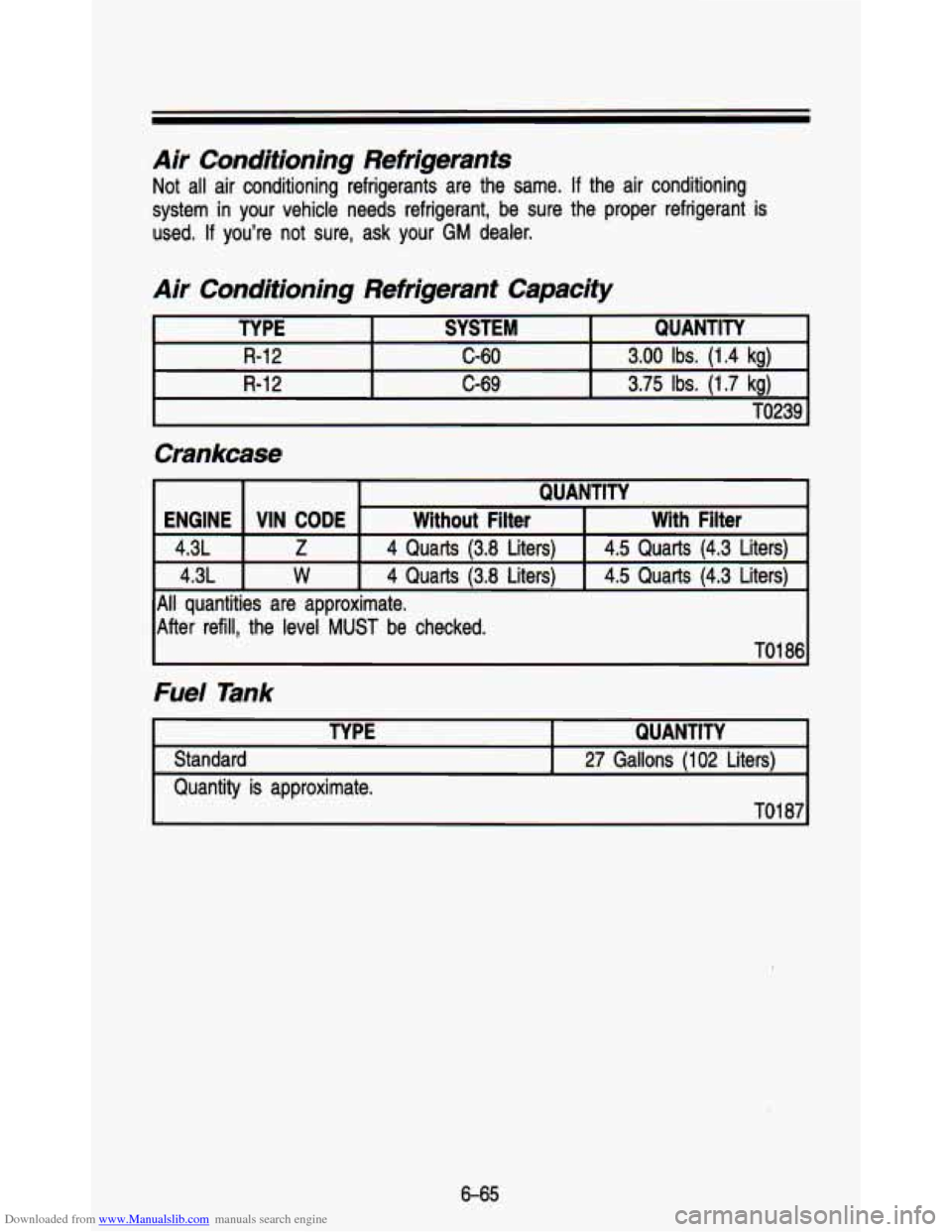
Air Conditioning Refrigerant Capacity
TYPE SYSTEM QUANTITY
R-12 C-60 3.00
Ibs. (1.4 kg)
R-12 C-69 3.75 Ibs. (1.7 kg)
Crankcase
QUANTITY
ENGINE Without Filter
I With Filter
VIN CODE
4.3L
4.5 Quarts
(4.3 Liters) 4 Quarts (3.8 Liters) W 4.3L
4.5 Quarts (4.3 Liters) 4 Quarts (3.8 Liters) Z
All quantities are approximate.
After refill, the level
MUST be checked.
TO1 8E
Fuel Tank
TYPE QUANTITY
Standard 27 Gallons (102 Liters)
I
Quantity is approximate.
TO1 87 I
6-65
Page 307 of 345
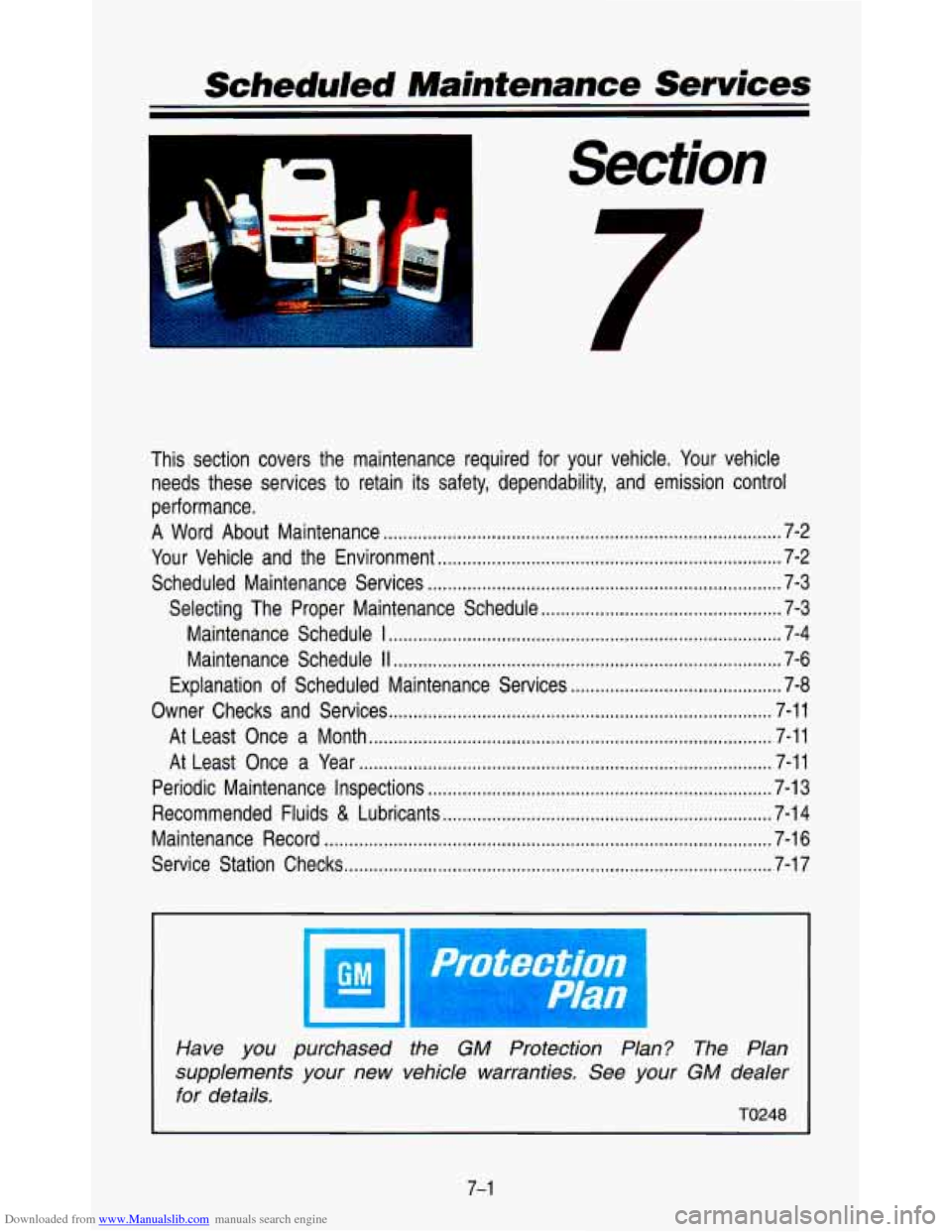
Downloaded from www.Manualslib.com manuals search engine This section covers the maintenance required for your vehicle . Your vehicle
needs these services to retain its safety. dependability. and emission control
performance
.
A Word About Maintenance ........................................................................\
......... 7-2
Your Vehicle and the Environment
...................................................................... 7-2
Scheduled Maintenance Services
........................................................................\
7-3
Selecting The Proper Maintenance Schedule
................................................. 7-3
Maintenance Schedule
I ........................................................................\
........ 7-4
Maintenance Schedule
II ........................................................................\
....... 7-6
Explanation
of Scheduled Maintenance Services ........................................... 7-8
Owner Checks and Services
........................................................................\
...... 7-11
At Least Once a Month
........................................................................\
.......... 7-11
At Least Once a Year ........................................................................\
............ 7-11
Periodic Maintenance Inspections
...................................................................... 7-13
Recommended Fluids
& Lubricants ................................................................... 7-14
Maintenance Record
........................................................................\
................... 7-16
Service Station Checks
........................................................................\
............... 7-17
Have you purchased the GM Protection Plan? The Plan
supplements
your new vehicle warranties . See your GM dealer
for details .
TO248
7-1
Page 308 of 345
Downloaded from www.Manualslib.com manuals search engine Scheduled Maintenance Services
A Word About Maintenance
We at General Motors want to help you keep your vehicle in good working
condition. But we don’t know exactly how you’ll drive it. You may drive very
short distances only a few times a week. Or you may drive lo\
ng distances all
the time
in very hot, dusty weather. You may use your vehicle in making
deliveries. Or you may drive
it to work, to do errands, or in many other ways.
Because
of all the different ways people use their GM vehicles, maintenance
needs vary. You may even need more frequent checks and replacements than
you will find in the schedules in this section.
So please read this section and
note how you drive. If you have any questions on how
to keep your vehicle
in good condition, see your GM dealer, the place many
GM owners choose
to have their maintenance work done. Your dealer can be relied upon to use
proper parts and practices.
Your Vehicle And The Environment
Proper vehicle maintenance not only helps keep your vehicle in good working
condition, but it also helps the environment.
All recommended maintenance
procedures are important. Improper vehicle maintenance or the re\
moval of
important components can significantly affect the quality of the air we breathe.
Improper fluid levels or even the wrong tire inflation can inc\
rease the level of
emissions from your vehicle. To help protect our environment, and to help
keep your vehicle in good condition, please maintain your vehic\
le properly.
CAUTION
. Performing maintenance work on a vehicle can be dangerous. ...
trying to do some jobs, you can be seriously injured. Do your own
maintenance work only
if you have the reauired know-how and the
proper
tools and equipment for the iob. IOU have ar doubt. have
a qualified technician do the
WOrK. I
If you are skilled enough to do some work on your vehicle, you will probably
want
to get the service information GM publishes. You will find a list of
publications and how to get them in Section
8, “Customer Assistance
Information”. See “Service Publications’’ in the Index.
The Maintenance Record provides a place for you to record the maintenance
performed on your vehicle. Whenever any maintenance is performed, be sure
to write
it down in this section. This will help you determine when your next
maintenance should be done. In addition,
it is a good idea to keep your
maintenance receipts. They may be needed to qualify your vehicle for
warranty repairs.
7-2
Page 312 of 345
Downloaded from www.Manualslib.com manuals search engine Scheduled Maintenance Services
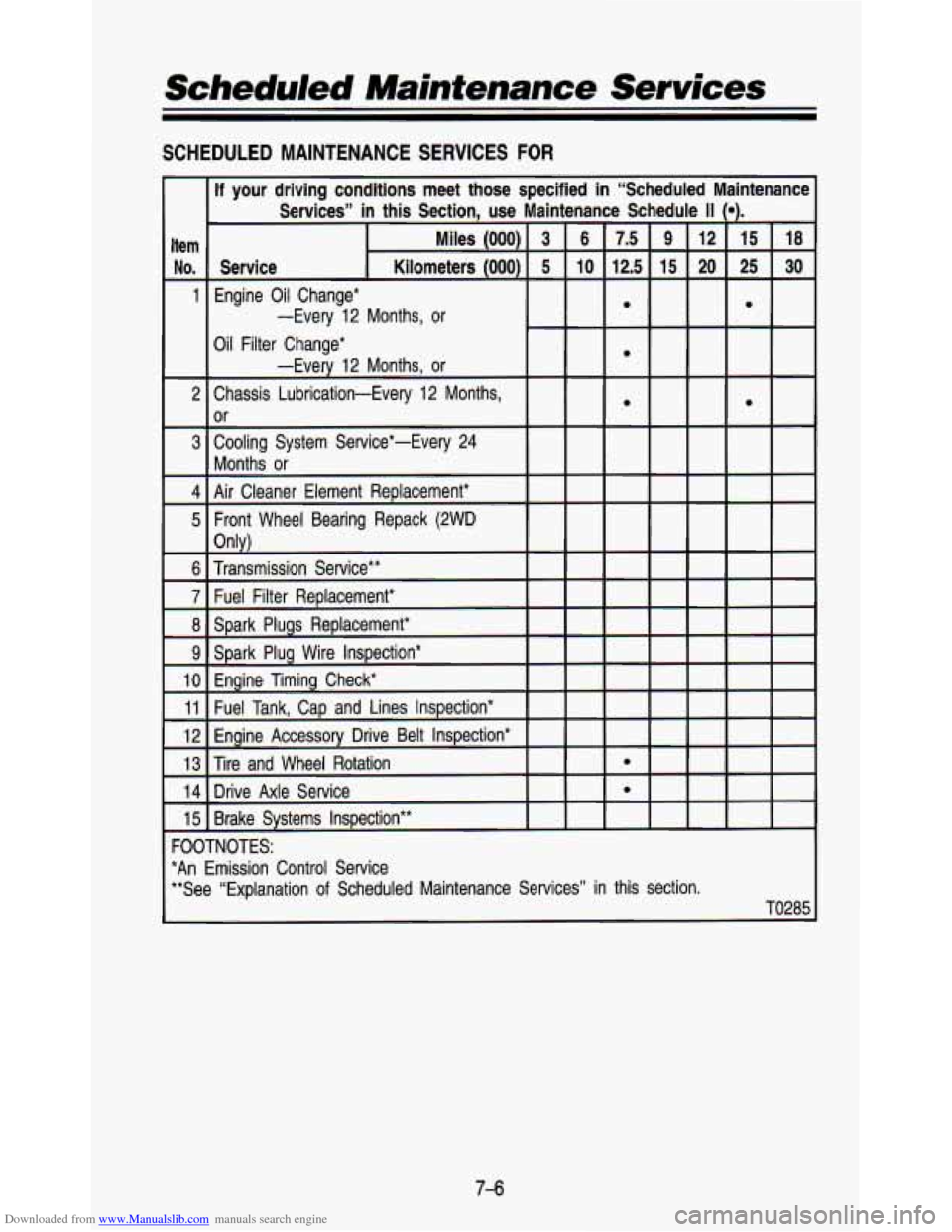
SCHEDULED MAINTENANCE SERVICES FOR
13
14
15
-
-
-
If your driving conditions meet those specified in “Scheduled Ma\
intenance I
Services” in this Section, use Maintenance Sc
Spark Plug Wire Inspection*
Engine Timing Check*
Fuel Tank, Cap and Lines Inspection*
Engine Accessory Drive Belt Inspection*
Tire and Wheel Rotation
e
Drive Axle Service e
Brake Systems Inspection**
FOOTNOTES:
*An Emission Control Service
**See “Explanation
of Scheduled Maintenance Services” in this section.
TO285
7-6
Page 314 of 345
Downloaded from www.Manualslib.com manuals search engine Scheduled Maintenance Services
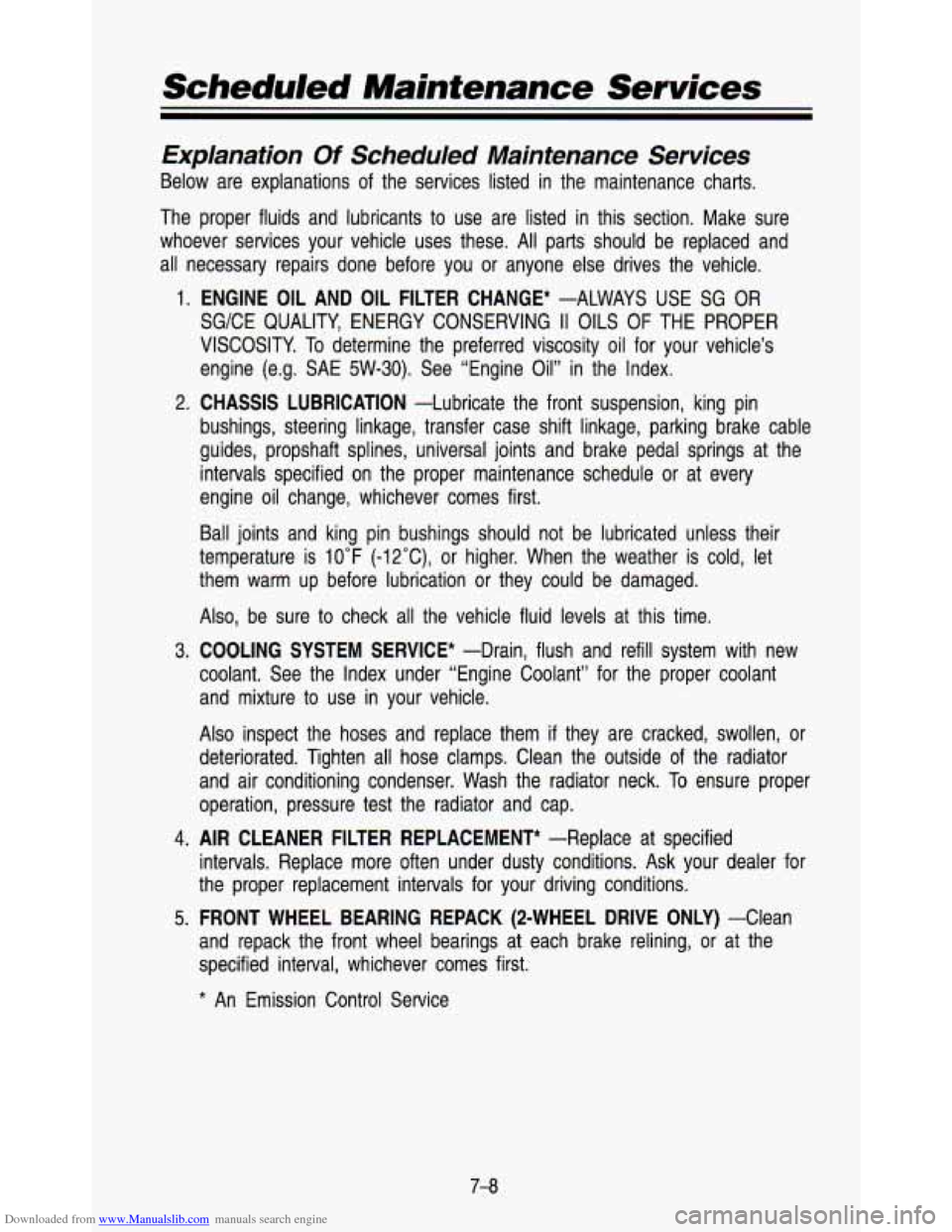
Explanation Of Scheduled Maintenance Services
Below are explanations of the services listed in the maintenance charts.
The proper fluids and lubricants to use are listed in this section. Make sure
whoever services your vehicle uses these. All parts should be \
replaced and
all necessary repairs done before you or anyone else drives th\
e vehicle.
1. ENGINE OIL AND OIL FILTER CHANGE* -ALWAYS USE SG OR
SG/CE QUALITY, ENERGY CONSERVING II OILS OF THE PROPER
VISCOSITY.
To determine the preferred viscosity oil for your vehicle’s
engine (e.g. SAE 5W-30). See “Engine Oil” in the Index.
bushings, steering linkage, transfer case shift linkage, parking \
brake cable
guides, propshaft splines, universal joints and brake pedal spri\
ngs at the
intervals specified on the proper maintenance schedule or at ev\
ery
engine oil change, whichever comes first.
2.
CHASSIS LUBRICATION -Lubricate the front suspension, king pin
Ball joints and king pin bushings should not be lubricated unl\
ess their
temperature is
10°F (-12”C), or higher. When the weather is cold, let
them warm up before lubrication or they could be damaged.
Also, be sure to check all the vehicle fluid levels at this time.
3.
COOLING SYSTEM SERVICE* -Drain, flush and refill system with new
coolant. See the Index under “Engine Coolant” for the pro\
per coolant and mixture to use in your vehicle.
Also inspect the hoses and replace them
if they are cracked, swollen, or
deteriorated. Tighten all hose clamps. Clean the outside of the radiator
and air conditioning condenser. Wash the radiator neck.
To ensure proper
operation, pressure test the radiator and cap.
4. AIR CLEANER FILTER REPLACEMENT* -Replace at specified
intervals. Replace more often under dusty conditions. Ask your \
dealer for
the proper replacement intervals for your driving conditions.
5. FRONT WHEEL BEARING REPACK (2-WHEEL DRIVE ONLY) -Clean
and repack the front wheel bearings at each brake relining, or at the
specified interval, whichever comes first.
* An Emission Control Service
Page 315 of 345
.
If the vehicle is mainly drive")
Downloaded from www.Manualslib.com manuals search engine 6. TRANSMISSION SERVICE
Change the transmission fluid and filter every 15,000 miles (2\
5 000 km).
If the vehicle is mainly driven under one or more of these conditions:
In heavy city traffic.
Where the outside temperature regularly reaches 90°F (32°C\
) or
In hilly or mountainous terrain.
Frequent trailer pulling.
Uses such as taxi, police, delivery or other commercial service\
.
higher.
If the vehicle is not used mainly under any
of these conditions, change
the fluid and filter every 30,000 miles
(50 000 km). See “Automatic
Transmission Fluid’’ in the Index for more information.
7. FUEL FILTER REPLACEMENT* -Replace the fuel filter at the specified
interval or sooner
if clogged.
8. SPARK PLUGS REPLACEMENT* -Replace spark plugs with the type
listed in Section
6. See “Specification Charts’’ in the Index.
9. SPARK PLUG WIRE INSPECTION* -Clean wires and inspect for burns,
cracks or other damage. Check the wire boot
fit at the distributor and at
the spark plugs. Replace wires as needed.
10.
ENGINE TIMING CHECK AND DISTRIBUTOR CHECK -Adjust timing to
underhood label specifications. Inspect the inside and outside of the
distributor cap and rotor for cracks, carbon tracking and corro\
sion. Clean
or replace as needed.
cap and lines for damage or leaks. Remove fuel cap, inspect g\
asket for
an even filler neck imprint, and any damage. Replace parts as \
needed.
12.
ENGINE ACCESSORY DRIVE BELT INSPECTION* -Inspect belt. Look
for cracks, fraying, wear, and proper tension. Adjust or replac\
e as needed.
11.
FUEL TANK, CAP AND LINES INSPECTION* -Inspect the fuel tank,
* An Emission Control Service
7-9
Page 316 of 345
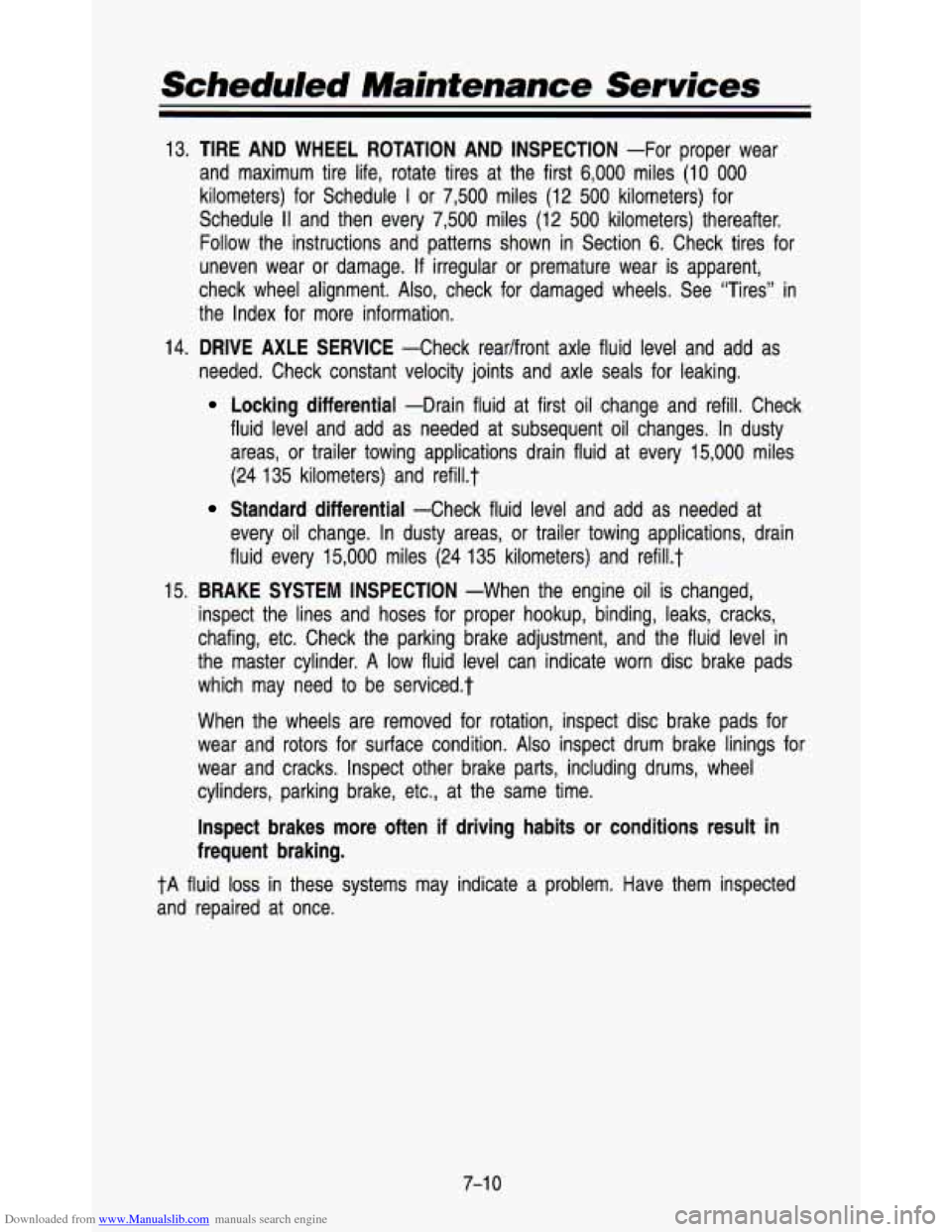
Downloaded from www.Manualslib.com manuals search engine 13. TIRE AND WHEEL ROTATION AN- INSPECTION -For proper wear
and maximum tire life, rotate tires at the first
6,000 miles (1 0 000
kilometers) for Schedule I or 7,500 miles (12 500 kilometers) for
Schedule
II and then every 7,500 miles (12 500 kilometers) thereafter.
Follow the instructions and patterns shown in Section
6. Check tires for
uneven wear or damage.
If irregular or premature wear is apparent,
check wheel alignment.
Also, check for damaged wheels. See “Tires” in
the Index for more information.
14.
DRIVE AXLE SERVICE -Check readfront axle fluid level and add as
needed. Check constant velocity joints and axle seals for leaki\
ng.
Locking differential -Drain fluid at first oil change and refill. Check
fluid level and add as needed at subsequent oil changes. In d\
usty areas, or trailer towing applications drain fluid at every 15,000 miles
(24 135 kilometers) and refi1l.t
Standard differential -Check fluid level and add as needed at
every oil change. In dusty areas, or trailer towing application\
s, drain
fluid every
15,000 miles (24 135 kilometers) and refi1l.t
15.
BRAKE SYSTEM INSPECTION -When the engine oil is changed,
inspect the lines and hoses for proper hookup, binding, leaks, \
cracks,
chafing, etc. Check the parking brake adjustment, and the fluid\
level in
the master cylinder.
A low fluid level can indicate worn disc brake pads
which may need
to be serviced$
When the wheels are removed for rotation, inspect disc brake p\
ads for
wear and rotors for surface condition.
Also inspect drum brake linings for
wear and cracks. Inspect other brake parts, including drums, wh\
eel
cylinders, parking brake, etc., at the same time.
Inspect brakes more often if driving habits or conditions result in
frequent braking.
tA fluid loss in these systems may indicate a problem. Have them inspected
and repaired at once.
7-1 0
Page 317 of 345
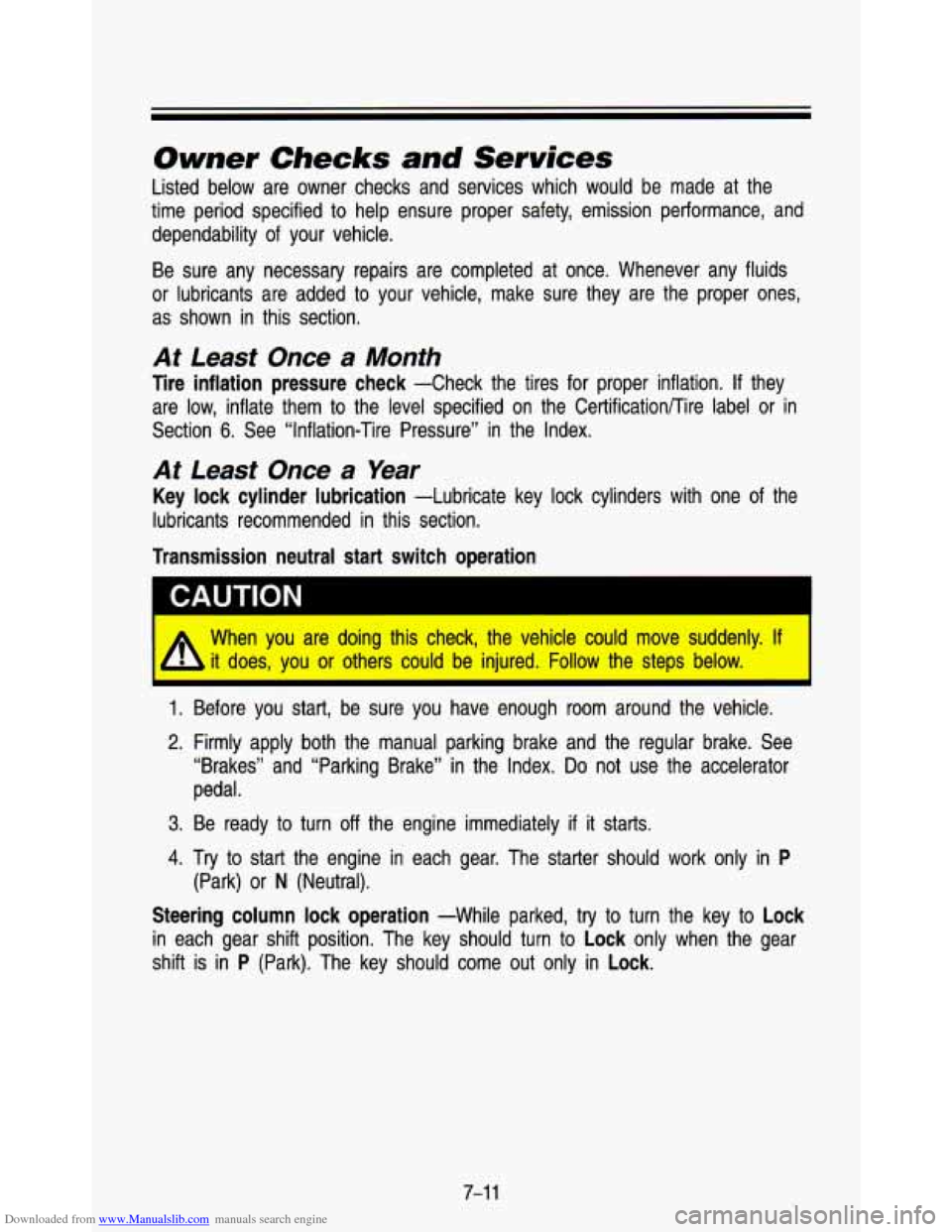
Downloaded from www.Manualslib.com manuals search engine Owner Checks and Services
Listed below are owner checks and services which would be made at the
time period specified to help ensure proper safety, emission performance, and
dependability of your vehicle.
Be sure any necessary repairs are completed at once. Whenever \
any fluids
or lubricants are added to your vehicle, make sure they are the \
proper ones,
as shown in this section.
At Least Once a Month
Tire inflation pressure check -Check the tires for proper inflation. If they
are low, inflate them
to the level specified on the CertificationRire label or in
Section
6. See “Inflation-Tire Pressure” in the Index.
At Least Once a Year
Key lock cylinder lubrication -Lubricate key lock cylinders with one of the
lubricants recommended in this section.
Transmission neutral start switch operation
I A When you are doing this check, the vehicle could move suddenly\
. If I
it does, you or others could be injured. Follow the steps below. I L
1. Before you start, be sure you have enough room around the vehicle.
2. Firmly apply both the manual parking brake and the regular brake. See
“Brakes” and “Parking Brake” in the Index.
Do not use the accelerator
pedal.
3. Be ready to turn off the engine immediately if it starts.
4. Try to start the engine in each gear. The starter should work only in P
Steering column lock operation -While parked, try to turn the key to Lock
in each gear shift position. The key should turn to Lock only when the gear
shift is in
P (Park). The key should come out only in Lock.
(Park) or N (Neutral).
7-1 1
Page 318 of 345
Downloaded from www.Manualslib.com manuals search engine Scheduled Maintenance Services
Parking brake and transmission P (Park) mechanism operation -
I CAUTION
When you are doing this check, your vehicle could begin to mo\
ve. I
/i You or others could be injured and property could be damaged.
Make sure there is room in front of your vehicle in case you\
begin
to roll. Be ready to apply the regular brake at once should the \
vehicle begin to move.
Park on a fairly steep hill, with the vehicle facing downhill.\
Keeping your foot
on the regular brake, set the manual parking brake.
To check the parking brake: With the engine running and the
transmission in
N (Neutral), slowly remove foot pressure from the regular
brake pedal.
Do this until the vehicle is held by the parking brake only.
To check the P (Park) mechanism’s holding ability: Apply the regular
brake and shift to
P (Park). Release the manual parking brake, then
slowly release the regular brake.
Lap and shoulder belts condition and operation -Inspect belt system,
including: webbing, buckles, latch plates, retractors, guide loop\
s and anchors.
Have a belt assembly replaced
if the webbing has been cut or otherwise
damaged.
Body Lubrication Service -Lubricate all body door hinges including the
tailgate, tailgate handle pivot points, and tailgate mounted spa\
re tire carrier
(if
equipped), lubricate the body hood, fuel door and rear compart\
ment hinges, latches, any locks and any moving seat- hardware. Lubricate the\
hood safety
lever pivot and prop rod pivot. More frequent lubrication may \
be required
when exposed to a corrosive environment.
7-1 2